Hundreds of Epidemiologists Expected Mask-Wearing in Public for at Least a Year

The C.D.C. said Thursday that vaccinated Americans no longer needed masks in most places. Other disease experts recently had a different message: that masks were necessary in public.At a cafe in Hudson Yards in New York City early this month. Such indoor gatherings may become more common in response to new federal health guidelines.Timothy A. Clary/Agence France-Presse — Getty ImagesWhen federal health officials said on Thursday that fully vaccinated Americans no longer needed to wear masks in most places, it came as a surprise to many people in public health. It also was a stark contrast with the views of a large majority of epidemiologists surveyed in the last two weeks by The New York Times.In the informal survey, 80 percent said they thought Americans would need to wear masks in public indoor places for at least another year. Just 5 percent said people would no longer need to wear masks indoors by this summer.In large crowds outdoors, like at a concert or protest, 88 percent of the epidemiologists said it was necessary even for fully vaccinated people to wear masks.“Unless the vaccination rates increase to 80 or 90 percent over the next few months, we should wear masks in large public indoor settings,” said Vivian Towe, a program officer at the Patient-Centered Outcomes Research Institute.The responses came from 723 epidemiologists, submitted between April 28 and May 10, before the new guidance from the Centers for Disease Control and Prevention. The survey asked epidemiologists about being outdoors in groups of various sizes, and about being indoors with people whose vaccination status was unknown. The situations were consistent with the new guidance, which governs behavior in public places, regardless of size, where it is impossible to know the vaccine status of others.Federal health officials have already said that vaccinated people can be indoors with other vaccinated people, and epidemiologists mostly agreed. But the C.D.C.’s new guidance said masks were no longer necessary for fully vaccinated people regardless of the size of the gathering and whether it was indoors or outside, except in certain situations, like in a doctor’s office or on public transit.Epidemiologists are, on the whole, very cautious when it comes to Covid-19, by nature of their training in understanding risk and preventing the spread of infectious disease. Nearly three-quarters described themselves as risk-averse, and they are likely to have been able to work from home over the past year, unlike many Americans. But they also have the same training as many of the scientists at the C.D.C. who devised the new policy, and about one-third of the survey respondents work in government, mostly at the state level.They acknowledged that many Americans would not want to continue to wear masks — and that many have already stopped.Wearing masks “will be a need, which is a very different question than how long will it continue to occur,” said Sophia K., an epidemiologist at the Great Lakes Inter-Tribal Council. “I expect that most people will refuse to wear masks, even in public, by the end of 2021, whether there is still a pandemic or not.”Many epidemiologists echoed the C.D.C. in saying that as long as people were fully vaccinated, they could gather without precautions. But the C.D.C. went further than the epidemiologists by giving the OK for vaccinated people to stop masking in groups with an unknown number of unvaccinated people.“It is either you trust the vaccine, or you do not,” said Kristin Harrington, an epidemiology Ph.D. student at Emory. “And if we trust the vaccine, that means an unlimited number of vaccinated individuals should be allowed to gather together.”Others acknowledged that policy decisions are based on many goals, such as invigorating the economy and incentivizing people to get vaccinated.Yet most said mask-wearing continued to be necessary for now, because the number of vaccinated Americans had not yet reached a level that scientists consider necessary to significantly slow the spread of the virus. Until then, there are too many chances for vaccines, which are not 100 percent effective, to fail, they said.“Crowded circumstances, indoors or outdoors, necessitate a mask until community levels of Covid are much lower,” said Luther-King Fasehun, a doctor and an epidemiology Ph.D. student at Temple University.Sally Picciotto, an epidemiologist at the University of California, Berkeley, said the decision to stop wearing masks indoors “depends on more people rolling up their sleeves to get the shot.”Respondents also said that as long as the virus was still spreading, masks were important to protect high-risk people and those who cannot be vaccinated, like children or people who have underlying health conditions.“Until community transmission is lower, it protects the whole community and the other people in the room to wear masks,” including children, immuno-suppressed people and Black and Latino communities who have been hit harder by Covid-19, said Julia Raifman, an assistant professor of public health at Boston University.One-quarter of the epidemiologists in the survey said they thought people would need to continue wearing masks in certain settings indefinitely, and some said they planned to continue to wear them in places like airplanes or concert halls, or during the winter virus season.“Heck, I may wear a mask for every flu season now,” said Allison Stewart, the lead epidemiologist at the Williamson County and Cities Health District in Texas. “Sure has been nice not to be sick for over a year.”Alana Cilwick, an epidemiologist at the Colorado Department of Public Health, said, “I plan to wear a mask indoors for the foreseeable future given the amount of vaccine hesitancy we are seeing, especially in higher-risk settings like the gym or on an airplane.”Just one-fifth of epidemiologists said it was safe for fully vaccinated people to socialize indoors without masks in a group of unlimited size. A majority said indoor gatherings should be limited to five or fewer households.Even outside, where the coronavirus is much less likely to spread, nearly all the epidemiologists said it was necessary to keep wearing masks in crowds, when people are near others whose vaccination status they don’t know.“Masks are the second-most helpful prevention strategy we have to vaccines,” Professor Raifman said.

Read more →

In Survey, Epidemiologists Saw Continued Need for Masks

The C.D.C. said Thursday that vaccinated Americans no longer needed masks in most places. Other disease experts recently a different message: that masks were necessary in public for at least another year.At a cafe in Hudson Yards in New York City early this month. Such indoor gatherings are about to become more common in response to new federal health guidelines.Timothy A. Clary/Agence France-Presse — Getty ImagesWhen federal health officials said on Thursday that fully vaccinated Americans no longer needed to wear masks in most places, it came as a surprise to many people in public health. It also was a stark contrast with the views of a large majority of epidemiologists surveyed in the last two weeks by The New York Times.In the informal survey, 80 percent said they thought Americans would need to wear masks in public indoor places for at least another year. Just 5 percent said people would be able to stop wearing masks indoors by this summer.In large crowds outdoors, like at a concert or protest, 88 percent of the epidemiologists said it was necessary even for fully vaccinated people to wear masks.“Unless the vaccination rates increase to 80 or 90 percent over the next few months, we should wear masks in large public indoor settings,” said Vivian Towe, a program officer at the Patient-Centered Outcomes Research Institute.The responses came from of 723 epidemiologists, submitted between April 28 and May 10, before the new guidance from the Centers for Disease Control and Prevention. The survey asked epidemiologists about being outdoors in groups of various sizes, and about being indoors with people whose vaccination status was unknown. The situations were consistent with the new guidance, which governs behavior in public places, regardless of size, where it is impossible to know the vaccine status of others.Federal health officials have already said that vaccinated people can be indoors with other vaccinated people, and epidemiologists mostly agreed. But the C.D.C.’s new guidance said masks were no longer necessary for fully vaccinated people regardless of the size of the gathering and whether it was indoors or outside, except in certain situations, like in a doctor’s office or on public transit.Epidemiologists are, on the whole, very cautious when it comes to Covid-19, by nature of their training in understanding risk and preventing the spread of infectious disease. Nearly three-quarters described themselves as risk-averse, and they are likely to have been able to work from home over the past year, unlike many Americans. But they also have the same training as many of the scientists at C.D.C. who devised the new policy, and about one-third of the survey respondents work in government, mostly at the state level.They acknowledged that many Americans would not want to continue to wear masks — and that many have already stopped.Wearing masks “will be a need, which is a very different question than how long will it continue to occur,” said Sophia K., an epidemiologist at the Great Lakes Inter-Tribal Council. “I expect that most people will refuse to wear masks, even in public, by the end of 2021, whether there is still a pandemic or not.”Many epidemiologists echoed the C.D.C. in saying that as long as people were fully vaccinated, they could gather without precautions. But the C.D.C. went further than the epidemiologists by giving the OK for vaccinated people to stop masking in groups with an unknown number of unvaccinated people.“It is either you trust the vaccine, or you do not,” said Kristin Harrington, an epidemiology Ph.D. student at Emory. “And if we trust the vaccine, that means an unlimited number of vaccinated individuals should be allowed to gather together.”Others acknowledged that policy decisions are based on many goals, such as invigorating the economy and incentivizing people to get vaccinated.Yet most said mask-wearing continued to be necessary for now, because the number of vaccinated Americans had not yet reached a level that scientists consider necessary to significantly slow the spread of the virus. Until then, there are too many chances for vaccines, which are not 100 percent effective, to fail, they said.“Crowded circumstances, indoors or outdoors, necessitate a mask until community levels of Covid are much lower,” said Luther-King Fasehun, a doctor and an epidemiology Ph.D student at Temple University.Sally Picciotto, an epidemiologist at the University of California, Berkeley, said the decision to stop wearing masks indoors “depends on more people rolling up their sleeves to get the shot.”Respondents also said that as long as the virus was still spreading, masks were important to protect high-risk people and those who cannot be vaccinated, like children or people who have underlying health conditions.“Until community transmission is lower, it protects the whole community and the other people in the room to wear masks,” including children, immuno-suppressed people and Black and Latino communities who have been hit harder by Covid-19, said Julia Raifman, an assistant professor of public health at Boston University.One-quarter of the epidemiologists in the survey said they thought people would need to continue wearing masks in certain settings indefinitely, and some said they planned to continue to wear them in places like airplanes or concert halls, or during the winter virus season.“Heck, I may wear a mask for every flu season now,” said Allison Stewart, the lead epidemiologist at the Williamson County and Cities Health District in Texas. “Sure has been nice not to be sick for over a year.”Alana Cilwick, an epidemiologist at the Colorado Department of Public Health, said, “I plan to wear a mask indoors for the foreseeable future given the amount of vaccine hesitancy we are seeing, especially in higher-risk settings like the gym or on an airplane.”Just one-fifth of epidemiologists said it was safe for fully vaccinated people to socialize indoors without masks in a group of unlimited size. A majority said indoor gatherings should be limited to five or fewer households.Even outside, where the coronavirus is much less likely to spread, nearly all the epidemiologists said it was necessary to keep wearing masks in crowds, when people are near others whose vaccination status they don’t know.“Masks are the second-most helpful prevention strategy we have to vaccines,” Professor Raifman said.

Read more →
Screening for ovarian cancer did not reduce early deaths

A large-scale randomised trial of annual screening for ovarian cancer, led by UCL researchers, did not succeed in reducing deaths from the disease, despite one of the screening methods tested detecting cancers earlier.
Results from the UK Collaborative Trial of Ovarian Cancer Screening (UKCTOCS) have been published in a report in the medical journal The Lancet.
In the UK, 4,000 women die from ovarian cancer each year. It is not usually diagnosed until it is at a late stage and hard to treat. UKCTOCS was designed to test the hypothesis that a reliable screening method that picks up ovarian cancer earlier, when treatments are more likely to be effective, could save lives.
The latest analysis looked at data from more than 200,000 women aged 50-74 at recruitment who were followed up for an average of 16 years. The women were randomly allocated to one of three groups: no screening, annual screening using an ultrasound scan, and annual multimodal screening involving a blood test followed by an ultrasound scan as a second line test.
The researchers found that, while the approach using multimodal testing succeeded in picking up cancers at an early stage, neither screening method led to a reduction in deaths.
Earlier detection in UKCTOCS did not translate into saving lives. Researchers said this highlighted the importance of requiring evidence that any potential screening test for ovarian cancer actually reduced deaths, as well as detecting cancers earlier.

Read more →

Epigenetic changes drive the fate of a B cell

B cells are the immune cells responsible for creating antibodies, and most B cells, known as B2 cells, produce antibodies in response to a pathogen or a vaccine, providing defense and immunity against infections. But a small subset of long-lived B cells, known as B1 cells, are quite different from their short-lived cousins, the B2 cells. Instead of producing antibodies in response to invaders, they spontaneously make antibodies that perform vital housekeeping functions, such as removing waste like oxidized LDL cholesterol from the blood.
Like all the cells in the body, B1 and B2 cells have the same DNA, and therefore the same starting set of instructions. It is through epigenetic modifications, which open and close different areas of the genome to the machinery that reads the genetic instructions, that the same genome can be used to create unique instructions for each cell type. Understanding how the different epigenetic landscapes — the changes in instructions — allows for these differences in such similar cells is both an important fundamental question in immunology and can help scientists better understand diseases linked to B cells’ dysregulation.
Shiv Pillai, MD, PhD, a core member of the Ragon Institute of MGH, MIT and Harvard, studied the DNA modifications present in both cell types during different stages of development to identify an epigenetic signature that may determine whether a cell becomes a B1 or a B2 cell. This work was published recently in the journal Nature Communications.
“Through our analysis, we found the fate of a B cell is determined by epigenetic modifications driven by a protein called DNMT3A,” says Vinay Mahajan, MD, PhD, an instructor in Pathology at the Ragon Institute and the paper’s first author. “Genetic studies in humans link the genomic regions with these markers to a variety of immune-mediated disorders.”
The team studied CpG methylation, a type of epigenetic modification that opens up specific areas of DNA and marks regulatory elements that can turn genes on or off. They discovered a set of regulatory elements with unique features in these B1 and B2 cells. In most cases, CpG methylation is permanent and, once added, is even passed on when the cell replicates. But in B cells, the protein DNMT3A had to continually work to maintain these epigenetic modifications. If DNMT3A was removed from B1 cells, the epigenetic modifications were lost, and chronic lymphomic leukemia (CLL), a cancer caused by the uncontrolled replication of B1 cells, would arise.
“These unique B1 cells are vitally important to our ability to stay healthy,” says Pillai. “The antibodies they create help prevent clots and heart attacks. At the same time, understanding what genetic factors regulate them can help us better understand what happens when their regulation goes awry and leads to CLL and other diseases.”
Story Source:
Materials provided by Massachusetts General Hospital. Note: Content may be edited for style and length.

Read more →

Study of 70,000 individuals links dementia to smoking and cardiovascular disease

In the largest study of the associations between smoking and cardiovascular disease on cognitive function, researchers at the Translational Genomics Research Institute (TGen), an affiliate of City of Hope, found both impair the ability to learn and memorize; and that the effects of smoking are more pronounced among females, while males are more impaired by cardiovascular disease.
The results appear today in the journal Scientific Reports.
Previous attempts to quantify cognitive function among smokers and assess sex differences produced mixed results. The TGen researchers attribute this to the limited size of previous data sets. By analyzing data representing more than 70,000 individuals worldwide — generated through TGen’s online cognitive test called MindCrowd — the current study produced results that indicate definitive trends.
“These results suggest that smoking and cardiovascular disease impact verbal learning and memory throughout adulthood, starting as early as age 18,” said Matt Huentelman, Ph.D., TGen Professor of Neurogenomics, a MindCrowd founder, and the study’s senior author. “Smoking is associated with decreased learning and memory function in women, while cardiovascular is associated with decreased learning and memory function in men.”
Besides Alzheimer’s disease, the most significant cause of cognitive decline is known as “vascular contributions to cognitive impairment and dementia” or VCID, which arises from stroke and other vascular brain injuries that cause significant changes to memory, thinking and behavior: smoking and cardiovascular disease exacerbate VCID.
“The reasons for these sex-modification effects are not entirely understood,” said Candace Lewis, Ph.D., a Postdoctoral Fellow in Dr. Huentelman’s Lab, and the study’s lead author. “Our findings highlight the importance of considering biological sex in studying vascular contributions to cognitive impairment and dementia.”
This study’s findings are important, Dr. Lewis said, since cigarette smoking is the nation’s leading cause of preventable disease and death, accounting for nearly 1 in 5 deaths, and cardiovascular disease is the leading cause of disease and death worldwide, and is an important predictor of cognitive decline and VCID. Vascular diseases also are associated with increased risk of Alzheimer’s, which is the nation’s 6th leading cause of death.

Read more →

More Scientists Urge Broad Inquiry Into Coronavirus Origins

Researchers urge an open mind, saying lack of evidence leaves theories of natural spillover and laboratory leak both viable.A group of 18 scientists stated Thursday in a letter published in the journal Science that there is not enough evidence to decide whether a natural origin or an accidental laboratory leak caused the Covid-19 pandemic.They argued, as the U.S. government and other countries have, for a new investigation to explore where the virus came from.The organizers of the letter, Jesse Bloom, who studies the evolution of viruses at the Fred Hutchinson Cancer Research Center in Seattle, and David Relman, a microbiologist at Stanford University, said they strove to articulate a wait-and-see viewpoint that they believe is shared by many scientists. Many of the signers have not spoken out before.“Most of the discussion you hear about SARS-CoV-2 origins at this point is coming from, I think, the relatively small number of people who feel very certain about their views,” Dr. Bloom said.He added: “Anybody who’s making statements with a high level of certainty about this is just outstripping what’s possible to do with the available evidence.”The new letter stated: “Theories of accidental release from a lab and zoonotic spillover both remain viable.”Proponents of the idea that the virus may have leaked from a lab, especially the Wuhan Institute of Virology in China where SARS viruses were studied, have been active this year since a World Health Organization team issued a report claiming that such a leak was extremely unlikely, even though the mission never investigated any Chinese labs. The team did visit the Wuhan lab, but did not investigate it. A lab investigation was never part of their mandate. The report, produced in a mission with Chinese scientists, drew extensive criticism from the U.S. government and others that the Chinese government had not cooperated fully and had limited the international scientists’ access to information.The new letter argued for a new and more rigorous investigation of virus origins that would involve a broader range of experts and safeguard against conflicts of interest.The call for further investigation echoed statements urging further inquiry by the Biden administration and other nations, as well as by the director of the W.H.O., Dr. Tedros Adhanom Ghebreyesus.World Health Organization investigators arriving at the Wuhan Institute of Virology in February. The letter challenged the team’s conclusion that a natural origin of the leap from animals to humans was most likely.Hector Retamal/Agence France-Presse — Getty ImagesUnlike other recent statements, the new letter did not come down in favor of one scenario or another. Recent letters by another group of scientists and international affairs experts argued at length for the relative likelihood of a laboratory leak. Previous statements from other scientists and the W.H.O. report both asserted that a natural origin was by far the most plausible.Michael Worobey, an evolutionary biologist at the University of Arizona, said he signed the new letter because “the recent W.H.O. report on the origins of the virus, and its discussion, spurred several of us to get in touch with each other and talk about our shared desire for dispassionate investigation of the origins of the virus.”“I certainly respect the opinion of others who may disagree with what we’ve said in the letter, but I felt I had no choice but to put my concerns out there,” he said.Another signer, Sarah E. Cobey, an epidemiologist and evolutionary biologist at the University of Chicago, said, “I think it is more likely than not that SARS-CoV-2 emerged from an animal reservoir rather than a lab.”But “lab accidents do happen and can have disastrous consequences,” she added. “I am concerned about the short- and long-term consequences of failing to evaluate the possibility of laboratory escape in a rigorous way. It would be a troublesome precedent.”The list of signers includes researchers with deep knowledge of the SARS family of viruses, such as Ralph Baric at the University of North Carolina, who had collaborated with the Chinese virologist Shi Zhengli in research done at the university on the original SARS virus. Dr. Baric did not respond to attempts to reach him by email and telephone.While this group of scientists does not single out any researchers by name, the letter finds fault with those who have also been vocal in supporting the theory of a natural origin, citing a lack of evidence.Kristian Andersen, a virologist at the Scripps Research Institute in La Jolla, Calif., has been a strong proponent of the overwhelming likelihood of a natural origin. He was one of the authors of an often cited paper in March 2020 that dismissed the likelihood of a laboratory origin based largely on the genome of the SARS-CoV-2 virus that causes Covid-19. “We do not believe any type of laboratory-based scenario is plausible,” that paper stated.Speaking for himself only, Dr. Relman said in an interview that “the piece that Kristian Anderson and four others wrote last March in my view simply fails to provide evidence to support their conclusions.”Dr. Andersen, who reviewed the letter in Science, said that both explanations were theoretically possible. But, “the letter suggests a false equivalence between the lab escape and natural origin scenarios,” he said. “To this day, no credible evidence has been presented to support the lab leak hypothesis, which remains grounded in speculation.”Instead, he said, available data “are consistent with a natural emergence of a novel virus from a zoonotic reservoir, as has been observed so many times in the past.” He said he supported further inquiry into the origin of the virus.Angela Rasmussen, a virologist at University of Saskatchewan’s Vaccine and Infectious Disease Organization, has criticized the politicization of the laboratory leak theory.She supports further investigation, but said that “there is more evidence (both genomic and historical precedent) that this was the result of zoonotic emergence rather than a laboratory accident.”

Read more →

Covid Pandemic Demands Air Quality Changes in the Workplace, Researchers Say

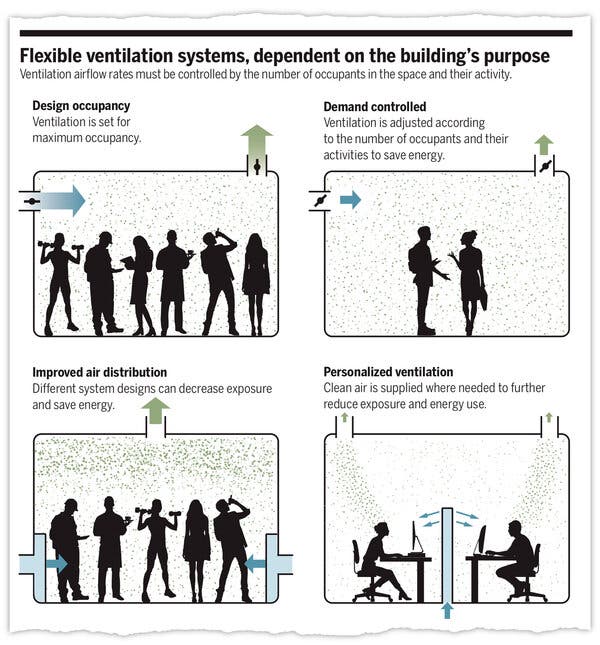
The researchers issued a call to action to improve indoor air quality as a safeguard against the spread of contagions like the coronavirus.Clean water in 1842, food safety in 1906, a ban on lead-based paint in 1971. These sweeping public health reforms transformed not just our environment but expectations for what governments can do.Now it’s time to do the same for indoor air quality, according to a group of 39 scientists. In a manifesto of sorts published on Thursday in the journal Science, the researchers called for a “paradigm shift” in how citizens and government officials think about the quality of the air we breathe indoors.The timing of the scientists’ call to action coincides with the nation’s large-scale reopening as coronavirus cases steeply decline: Americans are anxiously facing a return to offices, schools, restaurants and theaters — exactly the type of crowded indoor spaces in which the coronavirus is thought to thrive.There is little doubt now that the coronavirus can linger in the air indoors, floating far beyond the recommended six feet of distance, the experts declared. The accumulating research puts the onus on policymakers and building engineers to provide clean air in public buildings and to minimize the risk of respiratory infections, they said.“We expect to have clean water from the taps,” said Lidia Morawska, the group’s leader and an aerosol physicist at Queensland University of Technology in Australia. “We expect to have clean, safe food when we buy it in the supermarket. In the same way, we should expect clean air in our buildings and any shared spaces.”Meeting the group’s recommendations would require new workplace standards for air quality, but the scientists maintained that the remedies do not have to be onerous. Air quality in buildings can be improved with a few simple fixes, they said: adding filters to existing ventilation systems, using portable air cleaners and ultraviolet lights — or even just opening the windows where possible.Dr. Morawska led a group of 239 scientists who last year called on the World Health Organization to acknowledge that the coronavirus can spread in tiny droplets, or aerosols, that drift through the air. The W.H.O. had insisted that the virus spreads only in larger, heavier droplets and by touching contaminated surfaces, contradicting its own 2014 rule to assume all new viruses are airborne.The W.H.O. conceded on July 9 that transmission of the virus by aerosols could be responsible for “outbreaks of Covid-19 reported in some closed settings, such as restaurants, nightclubs, places of worship or places of work where people may be shouting, talking or singing,” but only at short range.“For the source room, clearly more ventilation is a good thing,” said one of the study’s authors. But that air goes somewhere. Maybe more ventilation is not always the solution.”L. Morawska et al., Science 2021, with permission of AAASThe pressure to act on preventing airborne spread has recently been escalating. In February, more than a dozen experts petitioned the Biden administration to update workplace standards for high-risk settings like meatpacking plants and prisons, where Covid outbreaks have been rampant.Last month, a separate group of scientists detailed 10 lines of evidence that support the importance of airborne transmission indoors.On April 30, the W.H.O. inched forward and allowed that in poorly ventilated spaces, aerosols “may remain suspended in the air or travel farther than 1 meter (long-range).” The Centers for Disease Control and Prevention, which had also been slow to update its guidelines, recognized last week that the virus can be inhaled indoors, even when a person is more than six feet away from an infected individual.“They have ended up in a much better, more scientifically defensible place,” said Linsey Marr, an expert in airborne viruses at Virginia Tech, and a signatory to the letter.“It would be helpful if they were to undertake a public service messaging campaign to publicize this change more broadly,” especially in parts of the world where the virus is surging, she said. For example, in some East Asian countries, stacked toilet systems could transport the virus between floors of a multistory building, she noted.More research is also needed on how the virus moves indoors. Researchers at the Department of Energy’s Pacific Northwest National Laboratory modeled the flow of aerosol-size particles after a person has had a five-minute coughing bout in one room of a three-room office with a central ventilation system. Clean outdoor air and air filters both cut down the flow of particles in that room, the scientists reported in April.But rapid air exchanges — more than 12 in an hour — can propel particles into connected rooms, much as secondhand smoke can waft into lower levels or nearby rooms.“For the source room, clearly more ventilation is a good thing,” said Leonard Pease, a chemical engineer and lead author of the study. “But that air goes somewhere. Maybe more ventilation is not always the solution.”In the United States, the C.D.C.’s concession may prompt the Occupational Safety and Health Association to change its regulations on air quality. Air is harder to contain and clean than food or water. But OSHA already mandates air-quality standards for certain chemicals. Its guidance for Covid does not require improvements to ventilation, except for health care settings.“Ventilation is really built into the approach that OSHA takes to all airborne hazards,” said Peg Seminario, who served as director of occupational safety and health for the A.F.L.-C.I.O. from 1990 until her retirement in 2019. “With Covid being recognized as an airborne hazard, those approaches should apply.”In January, President Biden directed OSHA to issue emergency temporary guidelines for Covid by March 15. But OSHA missed the deadline: Its draft is reportedly being reviewed by the White House’s regulatory office.Workers installed ventilation equipment at University Hospital in Augusta, Ga., last year. As a group of scientists called for new workplace air quality improvements, they contended the measures would not be onerous. Michael Holahan/The Augusta Chronicle, via Associated PressIn the meantime, businesses can do as much or as little as they wish to protect their workers. Citing concerns of continued shortages of protective gear, the American Hospital Association, an industry trade group, endorsed N95 respirators for health care workers only during medical procedures known to produce aerosols, or if they have close contact with an infected patient. Those are the same guidelines the W.H.O. and the C.D.C. offered early in the pandemic. Face masks and plexiglass barriers would protect the rest, the association said in March in a statement to the House Committee on Education and Labor.“They’re still stuck in the old paradigm, they have not accepted the fact that talking and coughing often generate more aerosols than do these so-called aerosol-generating procedures,” Dr. Marr said of the hospital group.“We know that Plexiglas barriers do not work,” she said, and may in fact increase the risk, perhaps because they inhibit proper airflow in a room.The improvements do not have to be expensive: In-room air filters are reasonably priced at less than 50 cents per square foot, although a shortage of supply has raised prices, said William Bahnfleth, professor of architectural engineering at Penn State University, and head of the Epidemic Task Force at Ashrae (the American Society of Heating, Refrigerating and Air-Conditioning Engineers), which sets standards for such devices. UV lights that are incorporated into a building’s ventilation system can cost up to roughly $1 per square foot; those installed room by room perform better but could be 10 times as expensive, he said.If OSHA rules do change, demand could inspire innovation and slash prices. There is precedent to believe that may happen, according to David Michaels, a professor at George Washington University who served as OSHA director under President Barack Obama.When OSHA moved to control exposure to a carcinogen called vinyl chloride, the building block of vinyl, the plastics industry warned it would threaten 2.1 million jobs. In fact, within months, companies “actually saved money and not a single job was lost,” Dr. Michaels recalled.In any case, absent employees and health care costs can prove to be more costly than updates to ventilation systems, the experts said. Better ventilation will help thwart not just the coronavirus, but other respiratory viruses that cause influenza and common colds, as well as pollutants.Before people realized the importance of clean water, cholera and other waterborne pathogens claimed millions of lives worldwide every year.“We live with colds and flus and just accept them as a way of life,” Dr. Marr said. “Maybe we don’t really have to.”

Read more →

Jab-free dengue immunity could be just a click away

A dengue virus vaccine candidate has passed an important milestone, with promising results in animal model testing providing hope to the 390 million people infected every year.
The University of Queensland-developed vaccine candidate, applied to the skin via the high-density microarray patch (HD-MAP), has produced a protective immune response in dengue-infected mice.
UQ PhD candidate Jovin Choo said the result could lead to a readily administered vaccine that could help halt the devastation of dengue fever globally.
“Dengue is the most significant mosquito-borne viral disease in the world’s tropical zone, infecting 390 million and killing 25,000 annually, resulting in annual estimated economic cost of $8.9 billion,” Ms Choo said.
“While a dengue vaccine technically already exists, it’s only licensed to be used in certain countries where Dengue virus is endemic — and with restricted use.
“So to properly fight this terrible disease, we’ve engineered a vaccine candidate based on a platform technology that uses an Australian insect virus called Binjari virus.”
UQ researchers merged the Binjari and dengue viruses making what’s known as a chimeric virus — an artificial virus — to build the basis of the vaccine which has resulted in some great benefits.

Read more →

A sibling-guided strategy to capture the 3D shape of the human face

A new strategy for capturing the 3D shape of the human face draws on data from sibling pairs and leads to identification of novel links between facial shape traits and specific locations within the human genome. Hanne Hoskens of the Department of Human Genetics at Katholieke Universiteit in Leuven, Belgium, and colleagues present these findings in the open-access journal PLOS Genetics.
The ability to capture the 3D shape of the human face — and how it varies between individuals with different genetics — can inform a variety of applications, including understanding human evolution, planning for surgery, and forensic sciences. However, existing tools for linking genetics to physical traits require input of simple measurements, such as distance between the eyes, that do not adequately capture the complexities of facial shape.
Now, Hoskens and colleagues have developed a new strategy for capturing these complexities in a format that can then be studied with existing analytical tools. To do so, they drew on the facial similarities often seen between genetically related siblings. The strategy was initially developed by learning from 3D facial data from a group of 273 pairs of siblings of European ancestry, which revealed 1,048 facial traits that are shared between siblings — and therefore presumably have a genetic basis.
The researchers then applied their new strategy for capturing face shape to 8,246 individuals of European ancestry, for whom they also had genetic information. This produced data on face-shape similarities between siblings that could then be combined with their genetic data and analyzed with existing tools for linking genetics to physical traits. Doing so revealed 218 locations within the human genome, or loci, that were associated with facial traits shared by siblings.
Further examination of the 218 loci showed that some are the sites of genes that have previously been linked to embryonic facial development and abnormal development of head and facial bones.
The authors note that this study could serve as the basis for several different directions of future research, including replication of the findings in larger populations, and investigation of the identified genetic loci in order to better understand the biological processes involved in facial development.
Hoskens adds, “Since siblings are likely to share facial features due to close kinship, traits that are biologically relevant can be extracted from phenotypically similar sibling pairs.”
Story Source:
Materials provided by PLOS. Note: Content may be edited for style and length.

Read more →

Call for 'paradigm shift' to fight airborne spread of COVID-19 indoors

QUT air-quality expert Distinguished Professor Lidia Morawska is leading an international call for a “paradigm shift” in combating airborne pathogens such as COVID-19, demanding universal recognition that infections can be prevented by improving indoor ventilation systems.
Professor Morawska led a group of almost 40 researchers from 14 countries in a call published in Science for a shift in standards in ventilation requirements equal in scale to the transformation in the 1800s when cities started organising clean water supplies and centralised sewage systems.
The international group of air quality researchers called on the World Health Organisation to extend the indoor air quality guidelines to include airborne pathogens and to recognise the need to control hazards of airborne transmission of respiratory infections.
Professor Morawska, director of QUT’s International Laboratory for Air Quality and Health, said there needed to be a shift in the perception that we could not afford the cost of control, given the globally monthly harm from COVID-19 had been conservatively estimated as $1 trillion and the cost of influenza in the US alone exceeded $11.2 billion annually.
“We need to establish the foundations to ensure that the air in our buildings is clean with a significantly reduced pathogen count, contributing to the building occupants’ health, just as we expect for the water coming out of our taps,” Professor Morawska said.
“Mandated building ventilation standards need to include higher airflow, filtration and disinfection rates, and monitors that allowed the public to observe the quality of air around them.

Read more →