People at high genetic risk for colorectal cancer benefit more from lifestyle changes

People with a high polygenic risk score for colorectal cancer could benefit more at preventing the disease by leading healthy lifestyles than those at lower genetic risk, according to a study by Vanderbilt researchers published in the April issue of The American Journal of Clinical Nutrition.
Analyzing data from participants in the UK Biobank, the researchers estimated that maintaining a healthy lifestyle was associated with a nearly 40% reduction in colorectal cancer risk among those with a high genetic risk of developing the disease. The percentage dropped to only about 25% among people at a low genetic risk for this cancer. People with a high genetic risk and an unhealthy lifestyle were more than three times as likely to be diagnosed with colorectal cancer than those with a low genetic risk and a healthy lifestyle.
“Results from this study could be useful to design personalized prevention strategies for colorectal cancer prevention,” said Wei Zheng, MD, PhD, MPH, Anne Potter Wilson Professor of Medicine and associate director for Population Sciences Research at Vanderbilt-Ingram Cancer Center (VICC).
In the analysis, lifestyle scores of unhealthy, intermediate and healthy were determined according to waist-to-hip ratio, physical activity, sedentary time, processed and red meat intake, vegetable and fruit intake, alcohol consumption and tobacco use. Polygenic risk scores are used to measure genetic susceptibility to colorectal cancer. Vanderbilt researchers constructed polygenic risk scores using genetic variants associated with colorectal cancer risk identified in recent large genetic studies including more than 120,000 study participants. They also constructed polygenetic risk scores for several other common cancers in research that was published last year in JNCI Cancer Spectrum.
The recently published study in The American Journal of Clinical Nutrition is one of the few that quantifies potential interactions of overall lifestyle with genetic susceptibility to colorectal cancer.
Story Source:
Materials provided by Vanderbilt University Medical Center. Original written by Tom Wilemon. Note: Content may be edited for style and length.

Read more →

Simple surgery prevents strokes in heart patients

A simple surgery saves patients with heart arrhythmia from often-lethal strokes, says a large international study led by McMaster University.
Researchers found that removing the left atrial appendage — an unused, finger-like tissue that can trap blood in the heart chamber and increase the risk of clots — cuts the risk of strokes by more than one-third in patients with atrial fibrillation.
Even better, the reduced clotting risk comes on top of any other benefits conferred by blood-thinner medications patients with this condition are usually prescribed.
“If you have atrial fibrillation and are undergoing heart surgery, the surgeon should be removing your left atrial appendage, because it is a set-up for forming clots. Our trial has shown this to be both safe and effective for stroke prevention,” said Richard Whitlock, first author of the study.
“This is going to have a positive impact on tens of thousands of patients globally.”
Whitlock is a scientist at the Population Health Research Institute (PHRI), a joint institute of McMaster University and Hamilton Health Sciences (HHS); a professor of surgery at McMaster, the Canada Research Chair in cardiovascular surgical trials, a cardiac surgeon for HHS, and is supported by a Heart and Stroke Foundation career award.

Read more →

Saving my teeth damaged by years of domestic abuse

Maisie, not her real name, was in an abusive marriage for seven years. She says she was throttled and had bottles thrown at her during violent attacks by her partner. As well as mental trauma, it’s had a physical impact – her teeth are so damaged that she’s close to losing some of them.A domestic abuse charity says urgent help is needed for people like Maisie, after the pandemic made waiting lists for NHS dentists longer.It’s set up a new scheme to match survivors with dentists who want to offer free treatment.

Read more →

Una revolución psicodélica llega a la psiquiatría

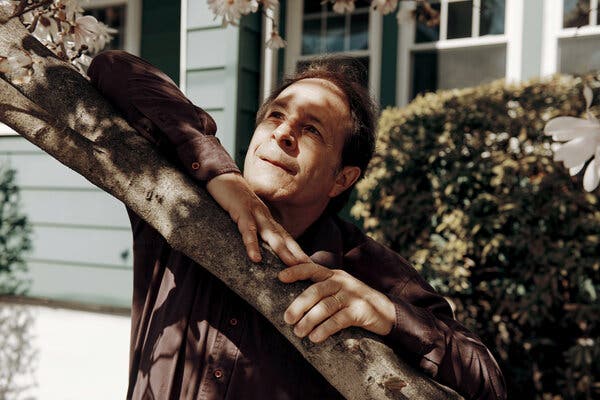
Ha sido un viaje largo y extraño en las cuatro décadas que han transcurrido desde que Rick Doblin, un investigador pionero de las drogas psicodélicas, probó su primera dosis de ácido en la universidad y decidió dedicar su vida a los poderes curativos de los compuestos que alteran la mente. Aunque las campañas antidrogas provocaron la criminalización del éxtasis, el LSD y los hongos alucinógenos, y ahuyentaron a la mayoría de los investigadores del campo, Doblin continuó su cruzada quijotesca con la ayuda económica de sus padres.La misión de Doblin de lograr que los alucinógenos sean aceptados por el público en general dará un salto significativo este mismo mes, cuando se espera que la revista Nature Medicine publique los resultados de su estudio de laboratorio sobre el MDMA, la droga de clubes nocturnos conocida popularmente como éxtasis y Molly. En el estudio clínico, el primero en Fase 3 con terapia asistida por drogas psicodélicas, reveló que el MDMA ligado a una terapia produce un alivio notable en los pacientes con trastorno por estrés postraumático grave (TEPT).Los resultados fueron divulgados semanas después de un estudio publicado en New England Journal of Medicine que enfatizaba los beneficios de la psilocibina, el ingrediente psicoactivo de los hongos alucinógenos, en el tratamiento de la depresión y han emocionado a científicos, psicoterapeutas y empresarios de la medicina psicodélica, un campo que se ha expandido con rapidez. Estas personas aseguran que es solo cuestión de tiempo para que la Administración de Alimentos y Medicamentos de Estados Unidos (FDA, por su sigla en inglés) apruebe el uso terapéutico de los compuestos psicoactivos: en 2023, el MDMA ya podría recibir la aprobación, y la psilocibina uno o dos años más tarde.Tras décadas de satanización y criminalización, las drogas psicodélicas están a punto de entrar a la psiquiatría tradicional, con profundas consecuencias para un campo que en décadas recientes ha visto pocos avances farmacológicos para el tratamiento de los trastornos mentales y las adicciones. La necesidad de una nueva terapéutica se ha vuelto más urgente en medio de una epidemia de abuso de opioides y suicidios en Estados Unidos.“Algunos días despierto y no puedo creer cuán lejos hemos llegado”, comentó Doblin, de 67 años, quien ahora supervisa la Asociación Multidisciplinaria de Estudios Psicodélicos (MAPS, por su sigla en inglés), un imperio multimillonario de investigación y defensoría que tiene una plantilla de 130 neurocientíficos, farmacólogos y especialistas regulatorios que están preparando el terreno para la próxima revolución psicodélica.Las universidades más importantes del país aceleran el paso para crear centros de investigación psicodélica y los inversionistas destinan millones de dólares a un grupo de empresas emergentes. Hay estados y ciudades de todo Estados Unidos que han comenzado a relajar las restricciones hacia las drogas, y algunas personas esperan que estos sean los primeros pasos hacia la despenalización federal de las drogas psicodélicas para uso terapéutico e incluso recreativo.“Ha habido un cambio en las actitudes hacia algo que, hasta hace no mucho tiempo, era considerado una ciencia marginal”, dijo Michael Pollan, cuyo éxito de ventas sobre la psicodelia, Cómo cambiar tu mente, es un libro que ha ayudado a eliminar el estigma en contra de las drogas en los tres años que han pasado desde su publicación. “Debido a la crisis de salud mental en el país, hay una gran curiosidad y esperanza en torno a las drogas psicodélicas y un reconocimiento de que necesitamos nuevas herramientas terapéuticas”.La pregunta que se hacen muchas personas es qué tan lejos —y qué tan rápido— debería balancearse el péndulo. Incluso los investigadores que defienden la terapia asistida por alucinógenos aseguran que el deseo de comercializar las drogas combinado con un creciente movimiento para liberalizar las prohibiciones existentes podrían ser un riesgo, en especial para quienes padecen trastornos psiquiátricos graves, que malograría el regreso metódico y lento de este campo a la aceptación pública.El investigador psicodélico Rick Doblin tomó su primera dosis de ácido en la universidad y decidió dedicar su vida a los poderes curativos de los compuestos que alteran la mente. Su centro de investigación, MAPS, ha recaudado 44 millones de dólares en los últimos dos años.Tony Luong para The New York TimesDoblin sostiene un número de septiembre de 1985 de la revista The Miami Herald en la que aparece un retrato suyo.Gretchen Ertl para The New York TimesLa organización de Doblin, MAPS, se enfoca principalmente en obtener la aprobación para las terapias asistidas por drogas y promoverlas en todo el mundo, pero también está abogando por la legalización de las drogas psicodélicas a nivel federal, aunque con estrictos requisitos de concesión de licencias para el uso recreativo en adultos.Varios estudios han mostrado que los alucinógenos clásicos como el LSD y la psilocibina no son adictivos y no causan ningún daño a los órganos incluso en dosis altas. Además, contrario al conocimiento popular, el éxtasis no deja hoyos en los cerebros de los usuarios, según los estudios, ni tampoco hay daño a nivel cromosómico tras un mal viaje de ácido.Sin embargo, la mayoría de los científicos concuerda en que es necesaria una mayor investigación relacionada con otros posibles efectos secundarios, como la manera en que las drogas podrían afectar a las personas con problemas cardiacos. Además, aunque la acumulación constante de datos alentadores ha suavizado el escepticismo de científicos prominentes, algunos investigadores desaconsejan la aceptación precipitada de las drogas psicodélicas sin una supervisión rigurosa. A pesar de que un “mal viaje” es poco común, un puñado de testimonios anecdóticos sugiere que las drogas psicodélicas pueden inducir psicosis en quienes padecen trastornos mentales subyacentes.Michael P. Bogenschutz, un profesor de psiquiatría que dirige el Centro para la Medicina Psicodélica del Centro Médico Langone de la Universidad de Nueva York desde su inauguración hace cuatro meses, comentó que la mayoría de los estudios clínicos hasta la fecha se habían realizado con cantidades pequeñas de personas que eran examinadas a detalle para descartar a las que tuvieran esquizofrenia y otros problemas mentales graves.Esto dificulta saber si habrá posibles reacciones adversas si millones de personas consumen esas sustancias sin orientación ni supervisión. “Sé que puede sonar como una tontería pero, chicos, no las prueben en casa”, mencionó Bogenschutz. “Simplemente les sugeriría a todos que no se adelanten a los datos”.La prisa por invertirDe pronto, las drogas psicodélicas nadan en dinero.Doblin puede recordar cuando el financiamiento para la investigación era casi imposible de conseguir. No obstante, ahora la MAPS está forrada de dinero, tras haber recaudado 44 millones de dólares durante los últimos dos años.“Ahora paso una gran parte de mi tiempo diciéndoles que no a los inversionistas”, comentó Doblin, cuyo trabajo ha recibido el financiamiento de una colección atípica de filántropos, entre ellos Rebekah Mercer, una donante política del Partido Republicano, y David Bronner, un liberal heredero de la empresa de jabón líquido Dr. Bronners.La Universidad Johns Hopkins, la Universidad de Yale, la Universidad de California, campus Berkeley, y el Hospital Monte Sinaí en Nueva York son algunas de las instituciones que hace poco crearon divisiones para la investigación de las drogas psicodélicas, o están en planes de hacerlo, con financiamiento de donantes privados.Además, hay científicos realizando estudios para determinar si los alucinógenos pueden ser eficaces en el tratamiento de todo tipo de trastornos, desde la depresión, el autismo y la adicción a los opioides hasta la anorexia y las ansiedades que experimentan los enfermos terminales.Una clínica Field Trip Health en ManhattanCalla Kessler para The New York TimesEn la clínica Field Trip de Manhattan se anima a los clientes para que sean creativos.Calla Kessler para The New York TimesSe han involucrado más de una decena de empresas emergentes y en conjunto el puñado de compañías que cotizan en los mercados públicos están valuadas en más de 2000 millones de dólares. Field Trip Health, una empresa canadiense con dos años de existencia que cotiza en la Canadian Securities Exchange y en el OTC Markets Group, ha recaudado 150 millones de dólares para financiar decenas de clínicas de gama alta que ofrecen tratamientos a base de ketamina en Los Ángeles, Chicago, Houston y otras ciudades de Norteamérica. Compass Pathways, una empresa de atención médica que ha recaudado 240 millones de dólares y cotiza en la Nasdaq, está llevando a cabo 22 estudios clínicos de la terapia con psilocibina para la depresión resistente al tratamiento en diez países.El cambio en las políticas ha incentivado a los inversionistas, un giro inspirado en parte en la rapidez con la que la nación aceptó la marihuana recreativa y en el hartazgo del público por la eterna guerra de Estados Unidos contra las drogas. El año pasado, Oregón se convirtió en el primer estado en legalizar el uso terapéutico de la psilocibina. Denver, Oakland, California, y Washington D. C. han despenalizado esa sustancia y varios estados, entre ellos California, están considerando una legislación similar. Aunque las drogas siguen siendo ilegales conforme a la ley federal, hasta la fecha el Departamento de Justicia ha tenido un enfoque no intervencionista en la aplicación de la ley, con una estrategia similar a la que se ha implementado con la marihuana recreativa.Incluso algunos republicanos, un grupo que tradicionalmente se ha opuesto a la liberación de las leyes relacionadas con las drogas, están empezando a convencerse. El mes pasado, tras citar las altas tasas de suicidios entre los veteranos de guerra, el exgobernador de Texas Rick Perry les pidió a los legisladores de su estado que apoyaran un proyecto de ley respaldado por los demócratas para realizar un estudio de la psilocibina en pacientes con TEPT.“Hemos tenido 50 años de propaganda política en torno a estas sustancias y, gracias a la investigación y a un movimiento comunitario, esa narrativa está cambiando”, opinó Kevin Matthews, un defensor de la psilocibina que lideró una exitosa propuesta de votación en Denver.Décadas en el desiertoMucho antes de que Nancy Reagan le advirtiera a la nación que le dijera no a las drogas y que el presidente Richard Nixon supuestamente declarara a Timothy Leary como “el hombre más peligroso de Estados Unidos”, investigadores como William A. Richards estaban usando las drogas psicodélicas para ayudar a los alcohólicos a dejar la bebida y a pacientes con cáncer a hacerle frente a la ansiedad relacionada con la muerte.Las drogas eran legales y Richards, quien en ese entonces era un psicólogo del Centro de Investigación Psiquiátrica de Maryland, era uno de los varios científicos que estudiaban la capacidad terapéutica de los enteógenos, el tipo de sustancias psicoactivas que los humanos han usado durante milenios. Incluso años después, según Richards y otros investigadores, muchos de los primeros voluntarios consideraron las sesiones psicodélicas como las experiencias más importantes y significativas de sus vidas.Sin embargo, en la década de 1960, cuando las drogas salieron de los laboratorios y el movimiento de contracultura las recibió con los brazos abiertos, la élite política tradicional del país reaccionó con alarma. Para cuando la Administración de Control de Drogas emitió su prohibición de emergencia en contra del MDMA en 1985, el financiamiento para la investigación de las drogas psicodélicas en esencia había desaparecido.“Estábamos aprendiendo mucho y luego todo se acabó”, comentó Richards, de 80 años, quien ahora trabaja como investigador de la Escuela de Medicina de la Universidad Johns Hopkins.En estos días, el Centro para la Investigación de Alucinógenos y la Conciencia de la Universidad Johns Hopkins, creado hace dos años con 17 millones de dólares de financiamiento privado, está estudiando, entre otras cosas, la psilocibina para dejar de fumar y el tratamiento de depresión asociada con el alzhéimer, así como exploraciones más espirituales que involucran al clero religioso.“Debemos ser cuidadosos y no prometer de más, pero estos compuestos son fantásticamente interesantes y tienen numerosos usos posibles”, opinó Roland R. Griffiths, el director fundador del centro y psicofarmacólogo, en cuyo estudio de 2006, del cual es coautor Richards, administró psilocibina a voluntarios sanos, el primer estudio con alucinógenos en obtener la aprobación de la FDA después de una generación.Los pioneros: William Richards, a la izquierda, y Roland R. Griffiths.Matt Roth para The New York TimesViaje artístico: una talla de madera y un cuadro de hongos que contienen psilocibina decoran el despacho de Griffiths.Matt Roth para The New York TimesAunque los investigadores todavía tratan de comprender los mecanismos cognitivos y terapéuticos de los psicodélicos, han llegado a la conclusión de que la psilocibina, la DMT y otras sustancias químicas psicoactivas pueden ayudar a las personas a sentir más tolerancia, comprensión y empatía. También inducen la neuroplasticidad, la capacidad del cerebro para cambiar y reorganizar los patrones de pensamiento, lo que permite a las personas con trastornos psicológicos encontrar nuevas formas de procesar la ansiedad, la depresión o los traumas profundamente arraigados.“Pueden ayudar a las personas que han perdido la línea argumental de sus vidas”, afirma Doblin.El negocio del viajeYa se le puede echar un vistazo al futuro de la medicina psicodélica en una serie de lujosas “habitaciones para viajar” decoradas de una forma relajante que ocupan el piso más alto de un edificio de oficinas en Midtown Manhattan. La clínica, dirigida por Field Trip Health, es un emprendimiento que inició hace un año en el que los pacientes usan antifaces para dormir y escuchan música electrónica y cantos tibetanos, mientras les administran seis inyecciones de ketamina a lo largo de varias semanas.Los viajes de 90 minutos se intercalan con “sesiones de integración” guiadas por un terapeuta para ayudar a los participantes a procesar sus experiencias y trabajar a fin de lograr sus objetivos de salud mental. Un curso típico de cuatro sesiones está disponible a partir de 4100 dólares, aunque algunas aseguradoras reembolsan parte del costo a los pacientes.La ketamina no es una droga psicodélica clásica; es un anestésico que tal vez es mejor conocido como una droga de clubes nocturnos y un tranquilizador de caballos. No obstante, en dosis altas, puede producir alucinaciones y ha sido prometedora en el tratamiento de depresión grave y TEPT grave, aunque los efectos suelen durar menos que las terapias con psilocibina o MDMA. Sin embargo, la ketamina tiene una ventaja distintiva en comparación con esas drogas: es la única disponible de manera legal en Estados Unidos para pacientes que no participen en estudios clínicos.Emily Hackenburg, la directora clínica de Field Trip, comentó que la droga solo era un componente de un proceso terapéutico demandante. “El fármaco no es una varita mágica”, comentó.Joe, un ejecutivo de mercadeo de unos 40 años que lleva décadas luchando contra la depresión y la ansiedad, dijo que decidió visitar la sede de la empresa en Atlanta tras ver uno de sus anuncios en Facebook. Los antidepresivos, dijo, lo dejaron emocionalmente frágil, y sus años de psicoterapia sirvieron de poco. (Pidió que no se dijera su nombre completo, citando los estigmas que rodean tanto a las enfermedades mentales como a las drogas que alteran la mente).En una entrevista realizada una semana después de su última sesión, describió una nueva conciencia de los factores que podían llevarle a la desesperación: su obsesión de “macho alfa” por el éxito, las frustraciones avivadas por el mal comportamiento de su hija de 9 años y los malos hábitos alimenticios y de consumo de alcohol que, a menudo, hacen que se sienta mal.Dos semanas después, Joe dijo que los efectos de la terapia estaban empezando a desaparecer. Dijo que estaba ansioso por probar la terapia asistida con psilocibina. “Estoy deseando que llegue el día en que sea legal”, dijo.Una silla de meditación en Field Trip, que ofrece terapia asistida con ketamina.Calla Kessler para The New York TimesEmily Hackenburg, directora clínica de Field Trip, dijo que la ketamina era sólo un componente de un exigente proceso terapéutico. “El fármaco no es una varita mágica”, dijo.Calla Kessler para The New York TimesLo mismo ocurre con Field Trip. La empresa, que empezó abriendo dispensarios de cannabis en Canadá, tiene previsto probar la terapia con psilocibina el mes que viene en Ámsterdam, donde las trufas de hongos mágicos son legales. Además, sus científicos están desarrollando un nuevo psicodélico que tiene el mismo efecto terapéutico que la psilocibina, pero que funciona en la mitad de tiempo, entre dos y tres horas. La creación de un psicodélico patentado de corta duración reduciría los costes de personal de las sesiones supervisadas, pero lo más importante es que daría a la empresa una lucrativa exclusividad sobre su nuevo fármaco. Otras empresas de biotecnología también están desarrollando nuevos compuestos psicodélicos.Ronan Levy, el presidente ejecutivo de Field Trip, mencionó que la empresa esperaba tomar una tajada de los 240.000 millones de dólares que los estadounidenses gastan cada año en servicios de salud mental. “Estamos al frente de lo que creo que será una ola cultural y comercial significativa”, opinó.Para los científicos veteranos que vivieron la primera y desafortunada historia de amor de la nación con los alucinógenos, ese tipo de impulso corporativo es tan emocionante como preocupante. Están conscientes de los posibles tropiezos que podrían deshacer el progreso de años recientes y se preguntan si la próxima comercialización podría restringir el acceso de quienes tienen recursos económicos limitados.A Charles S. Grob, profesor de psiquiatría de la escuela de medicina de la Universidad de California en Los Ángeles, quien ha dedicado décadas a la investigación de los alucinógenos, le preocupa que la comercialización y una premura por conseguir el uso recreativo puedan provocar una reacción negativa del público, en especial si una mayor disponibilidad de las drogas produce una ola de reacciones psicóticas problemáticas.Según Grob, es necesario que haya protocolos rigurosos y un sistema para capacitar y acreditar a los profesionales de la medicina psicodélica. “Debemos seguir muy de cerca los parámetros de seguridad porque, si no se mantienen las condiciones de manera adecuada, corremos el riesgo de que algunas personas se descarrilen psicológicamente”, opinó. “Y si la principal motivación es extraer ganancias, creo que el campo será más vulnerable a sufrir percances”.Doblin comparte algunas de esas preocupaciones, aunque su instituto obtenga grandes beneficios. Si bien MAPS es una organización sin fines de lucro, recientemente ha creado una entidad corporativa y contrató a consultores de gestión para ayudar a trazar el futuro de la terapia legalizada con MDMA.Obtener la aprobación de la FDA daría a MAPS al menos seis años de exclusividad para comercializar sus tratamientos con MDMA para el TEPT, con una ganancia potencial de 750 millones de dólares. La mayor parte de ese dinero, dijo, ayudaría a formar a una generación de profesionales de la psicodelia, a financiar los esfuerzos de los grupos de presión para exigir la cobertura de los seguros para esos tratamientos y a promover las nuevas terapias en todo el mundo. “Nuestro objetivo es la salud mental masiva”, dijo, explicando el rechazo de la organización a la inversión privada. “No es amasar un montón de dinero”.A pesar de su optimismo, Doblin no ignora la posibilidad de que la fascinación de la sociedad por los psicodélicos pueda agriarse. “Hemos avanzado mucho y muy rápido, pero hay muchos retos por delante”, dijo. “Soy consciente de que podríamos estropear las cosas en el último momento, así que no pienso celebrarlo pronto”.Andrew Jacobs es reportero de Ciencia y Salud en Nueva York. Anteriormente reportó desde Pekín y Brasil y ha escrito para Metro, Estilos de vida y ha sido corresponsal de Nacional, donde cubría el sur de Estados Unidos. @AndrewJacobsNYT

Read more →

723 Epidemiologists on When and How the U.S. Can Fully Return to Normal

Government mandates are lifting, but these experts say the pandemic won’t really end nationally until more people, including children, are vaccinated. In a survey, epidemiologists said the pandemic would not be over in the United States until children were vaccinated. A child looked out the window of a restaurant in Santa Monica, Calif., on Thursday.Marcio Jose Sanchez/Associated PressCovid-19 cases are decreasing in the United States, and masks are no longer required everywhere, but the pandemic is not over — and won’t be until younger children can also be vaccinated, epidemiologists said in a new survey by The New York Times.The true end of the pandemic — when it becomes safer to return to most activities without precautions — will arrive once at least 70 percent of Americans of all ages are vaccinated, they said. Adolescents just began receiving vaccines this week, and those for children younger than 12 are not yet approved.“Children are key to ending the pandemic,” said David Celentano, the chair of epidemiology at Johns Hopkins University and one of the 723 epidemiologists who participated in the survey this month.They are optimistic this will happen, even if not as quickly as many Americans hope. In five years, they expect Covid-19 will be more like the flu, circulating at a lower rate and with some deaths every year — but no longer a public health crisis necessitating lockdowns.“It feels like there is a light at the end of the tunnel,” said Gretchen Bandoli, an assistant professor of pediatrics at the University of California, San Diego. “We have the tools we need to get there, and it feels within reach.”Yet it’s still unclear if the United States can reach that level of vaccination. And even as cases decline domestically, the global toll of Covid-19 is rising in parts of the world that have not had the same access to vaccines.Already, Americans are beginning to be able to do things they had been advised to avoid for the last 14 months. The Biden administration said Thursday that fully vaccinated people no longer needed to wear masks in most places. (The survey was conducted over the last two weeks, before the mask announcement.)In the survey, about 85 percent of respondents said it was likely that Americans would be able to safely gather for Fourth of July barbecues this summer, as President Biden has called for. A slightly higher share said it was likely that schools would be able to be fully open in the fall, and that families would be able to safely gather indoors for the winter holidays.Still, the campaign to vaccinate more Americans cannot let up until children are protected, they said. Half of respondents said at least 80 percent of Americans, including children, would need to be vaccinated before it would be safe to do most activities without precautions. Though children are less likely than adults to develop severe cases of Covid-19, the scientists said their immunity was important because they could be hosts for the virus and a way for it to continue to circulate or develop new variants.“Children cannot be left out of the equation as we reopen,” said Corinne McDaniels-Davidson, the director of the San Diego State University Institute for Public Health. “The ideas that they cannot transmit Covid or are immune from disease are pervasive among the lay public. We need education here.”In assessing when the acute phase of the Covid pandemic could be considered over, they said vaccinations were more relevant than other metrics like new cases, hospitalizations or deaths (because an effective vaccination campaign would lower those rates, they said).The country is not there yet. Nationwide, 36 percent of Americans are fully vaccinated, and the pace of vaccinations has slowed.Of the 723 epidemiologists who participated in the survey, 35 percent work for governments. The rest are mostly academics. The questionnaire was distributed to two major professional groups, the Society for Epidemiologic Research and the Council of State and Territorial Epidemiologists, as well as some individual scientists.Andrew Lai, 12, received his  vaccine in Los Angeles on Thursday, the first day that Covid vaccines were available for adolescents. Children under 12 are still not eligible.Frederic J. Brown/Agence France-Presse — Getty ImagesThe decision to reopen states is based on many factors, including the decisions of governors and the considerations of business owners, and may not align with the recommendations of the survey respondents. Even before the C.D.C. announcement, about half of states had already dropped mask requirements or lifted capacity limits for large group settings, and more may follow suit in the coming days. Also, many public health professionals fear that such a high threshold of vaccinations — enough to reach so-called herd immunity — may not be achieved.But the survey responses from the group of scientists suggested that full reopening without high vaccination rates may be associated with continuing outbreaks of the virus, in the United States and worldwide.“Lack of ability to effectively vaccinate globally may continue to haunt us,” said Cynthia Morris, an epidemiologist at the Oregon Health & Science University.Americans’ reluctance to accept vaccines is the biggest threat to ending the pandemic, the scientists said. They were also concerned about the rise of new virus variants or a too-quick return of people’s prepandemic routines. A substantial share — 22 percent — worried that the politicization of public health could hamper the fight against the virus.“The more people refuse vaccinations, the longer Covid will hang around,” said Ethan S. Walker, an epidemiologist at the University of Montana.Scott Bartell, an epidemiologist at the University of California, Irvine, said, “I’m hopeful that someday Covid-19 will be more like measles, mostly eliminated but not eradicated, with sporadic outbreaks and clusters primarily among those not immunized.”Even if the spread of Covid-19 decreases enough to allow a return of most activities, there are some aspects of pandemic life that epidemiologists say will persist much longer.In particular, they say that masks are a norm that should continue, even if that view puts them at odds with the new C.D.C. guidance. More than 80 percent of them say people should continue to wear masks when indoors with strangers for at least another year, and outdoors in crowds.They would like to see the continuation of what they consider the rare silver linings that came from the last year. They hoped that people would have to travel for work less often. They wanted expanded grocery delivery and takeout restaurant options to continue, as well as tele-health visits for routine medical appointments. Many buildings have improved their ventilation, upgrades that will pay off when it comes to other respiratory diseases.They also hoped people would keep habits that make them healthier in general: avoiding things like going to work when sick, shaking hands and even blowing out birthday candles.“I cannot believe that we used to celebrate birthdays by eating a cake that someone has blown all over,” said Brian Labus, an epidemiologist at the University of Nevada, Las Vegas.In the past year, epidemiologists have found themselves suddenly in the spotlight. One of their challenges, they said, has been communicating to the public a complicated truth of their profession — that there are rarely clear right or wrong answers when it comes to risks and benefits.“We as epidemiologists are constantly dealing with uncertainty, and it’s pretty familiar to us,” said Kevin Martinez-Folgar, an epidemiology Ph.D. student at Drexel University. “We need to create better ways to communicate this uncertainty to the public to avoid all the misinformation problems that we currently have.”Most important, they said, they wished they had done a better job of communicating the fact that science evolves, and that by definition, health advice will change as scientists learn new things.Asked what public health practitioners should have done differently during the pandemic, David Abramson of N.Y.U.’s School of Global Public Health said he wished they had “reinforced how much science changes daily, and with it the recommendations for protective actions.”

Read more →

Why the C.D.C. Changed Its Advice on Masks

Two scientific findings altered the calculus: Vaccinated people don’t transmit the virus, and the shots are effective against variants.Advice from federal health officials that fully vaccinated people could drop their masks in most settings came as a surprise to Americans, from state officials to scientific experts. Even the White House got less than a day’s notice from the Centers for Disease Control and Prevention, the press secretary, Jen Psaki, said at a news briefing on Friday.“The C.D.C., the doctors and medical experts there, are the ones who determined what this guidance would be based on their own data, and what the timeline would be,” Ms. Psaki said. “That was not a decision directed by or made by the White House.”For months, federal officials have vigorously warned that wearing masks and social distancing were necessary to contain the pandemic. So what changed?Introducing the new recommendations on Thursday, Dr. Rochelle P. Walensky, the C.D.C. director, cited two recent scientific findings as significant factors: Few vaccinated people become infected with the virus, and transmission seems rarer still; and the vaccines appear to be effective against all known variants of the coronavirus.There is no doubt at this point that the vaccines are powerful. On Friday, the C.D.C. released results from another large study showing that the vaccines made by Pfizer-BioNTech and Moderna are 94 percent effective in preventing symptomatic illness in those who were fully vaccinated, and 82 percent effective even in those only partly vaccinated.“The science is quite clear on this,” said Zoë McLaren, a health policy expert at the University of Maryland, Baltimore County. Mounting evidence indicates that people who are vaccinated are highly unlikely to catch or transmit the virus, she noted.The risk “is definitely not zero, but it’s clear that it’s very low,” she said.One of the lingering concerns among scientists had been that even a vaccinated person might carry the virus — perhaps briefly, without symptoms — and spread it to others. But C.D.C. research, including the new study, has consistently found few infections among those who received the Pfizer-BioNTech and Moderna vaccines.“This study, added to the many studies that preceded it, was pivotal to C.D.C. changing its recommendations for those who are fully vaccinated against Covid-19,” Dr. Walensky said in a statement on Friday.Other recent studies confirm that people who are infected after vaccination carry too little virus to infect others, said Florian Krammer, a virologist at the Icahn School of Medicine at Mount Sinai.“It’s really hard to even sequence the virus sometimes because there’s very little virus, and it’s there for a short period of time,” he said.Still, most of the data has been gathered on the Pfizer-BioNTech and Moderna vaccines, Dr. Krammer cautioned. Because Johnson & Johnson’s vaccine was authorized later, there are fewer studies assessing its effectiveness.In clinical trials, the Johnson & Johnson vaccine had 72 percent efficacy — lower than the figure for the Pfizer and Moderna vaccines. And effectiveness was measured in terms of moderate and severe disease, rather than mild disease.“It’s a very good vaccine, and I’m sure it will save many, many, many lives,” Dr. Krammer said. “But we need more data on how well the J.&J. vaccine prevents infection, and how well it prevents transmission.”Variants of the virus have been a particular worry for scientists. While Dr. Walensky cited evidence showing that the mRNA vaccines like those from Pfizer and Moderna are effective against the variants circulating in the United States, there is little data about variants and the Johnson & Johnson vaccine. And new variants are emerging constantly.“I’m not at all saying that this is now a big problem,” Dr. Krammer said. But before lifting the masking requirements, “I might have waited a little bit longer to look at the numbers.”In a statement on Friday, a C.D.C. spokesman said, “All of the authorized vaccines provide strong protection against serious illness, hospitalization, and death, and we are accumulating data that our authorized vaccines are effective against the variants that are circulating in this country.”Fully immunized people are unlikely to get seriously ill, even if they are infected with the coronavirus. The risk of infection is greater for the people around them — unvaccinated children and adults, or vaccinated people who remain unprotected because of a medical condition or treatment.C.D.C. officials said they weighed those factors and were confident in their assessment of the science. And the new advice has other salutary effects, rewarding fully immunized people by giving them permission to end their social isolation — and perhaps incentivizing others to opt for vaccination.The new advice “signals that we really are on the final stretch here, and I think that’s a very good thing for people,” said Dr. Joshua Sharfstein, the vice dean for public health practice and community engagement at Johns Hopkins University Bloomberg School of Health.“It’s unlikely that we’re going to have another huge surge in cases,” he added. “But will the final stretch last for weeks or months is still a question.”The difficulty with the new recommendations, he and other experts said, is not so much the science underpinning them as their implementation.Leaders at the state, city and county levels still have the authority to require masks even for vaccinated people, as the C.D.C. was quick to acknowledge on Thursday. After the agency’s announcement, some states instantly lifted mask mandates, while others said they would need more time to weigh the evidence.But in states without mask mandates, the onus of checking vaccination status will fall on shopkeepers, restaurant workers, school officials and workplace managers.“Without a means to verify vaccination, we will have to rely on an honor system,” said Caitlin Rivers, an epidemiologist at Johns Hopkins University.The number of cases in the country is the lowest it has been since September, and many experts support lifting mask mandates in much of the country. But doing so will be riskier in places like Michigan, where there are more cases, and for people who are unprotected, including children under 12 and people with a weak immune systems, Dr. Rivers said.“People who are unvaccinated should continue to wear masks in public indoors and avoid crowds,” she said.In Nacogdoches, Texas, Dr. Ahammed Hashim fretted that only 36 percent of the population was immunized and the pace seemed to have stalled. And yet only one or two people in 10 in the local shops wore masks.“I think the C.D.C. might send a wrong message saying that everything’s OK,” said Dr. Hashim, a pulmonologist. “It would feel much better if we had a 60 or 70 percent vaccination.”The C.D.C.’s guidance is intended for fully vaccinated individuals, and should only be interpreted as such, Dr. Sharfstein cautioned. Nationwide, only 36 percent of the population is fully vaccinated.“What we’re just seeing is a little bit of the distance between advice that is entirely appropriate for people who are vaccinated, and the reality that there are places that still are seeing viral transmission and a lot of people who aren’t vaccinated,” he said.Individuals may make choices based on their perception of their own risks, but state and local leaders must decide what’s best for the community based on the rate of infections. “Those are two different things,” Dr. Sharfstein said. “And when they get conflated, that’s when people may make bad judgments about policy.”The new guidelines should serve as a reminder to health officials to step up their outreach and investment to ensure that everyone has access to vaccines, Dr. McLaren said. Parents of children under 12 should continue to urge them to wear masks indoors.The C.D.C.’s new policy shifts the onus onto the immunocompromised as well, to protect themselves from unmasked and unvaccinated people.“When we make policy, we need to balance the needs and desires of everyone,” Dr. McLaren said. “We could keep masking forever, but there are benefits to getting back to a life that looks more normal.”Health officials should emphasize that the situation may yet change, and official recommendations with it, she added: “We really need to practice being good at responding to changing situations.”

Read more →

Pfizer and Moderna Shots Are Powerfully Effective against Virus, Analysis Says

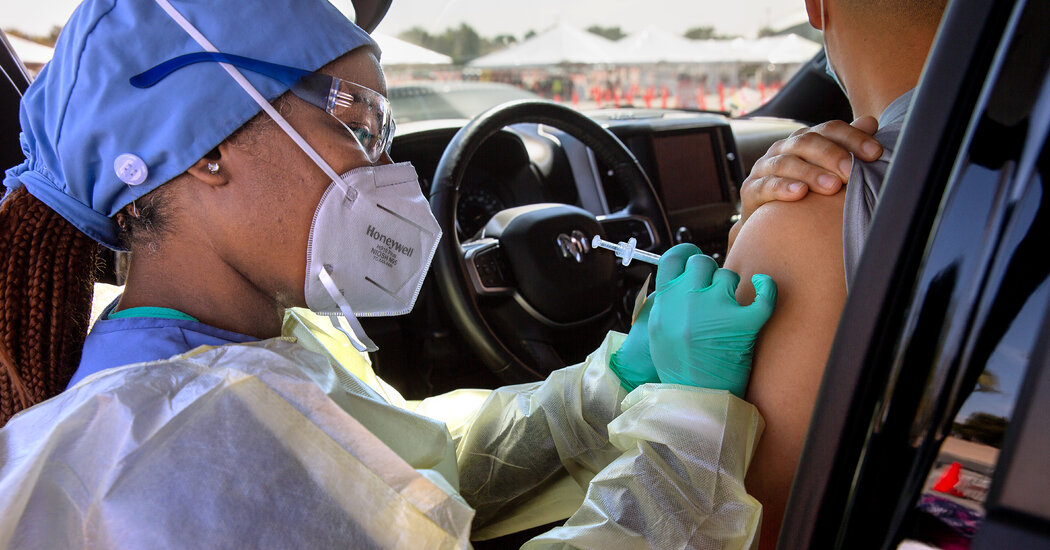
The Pfizer-BioNTech and Moderna coronavirus vaccines are 94 percent effective at preventing symptomatic Covid-19 illness, according to a new study of more than 1,800 health care workers in the United States.The research, which the Centers for Disease Control and Prevention released on Friday, provides yet more evidence that the vaccines are working well even outside controlled clinical trials.“This report provided the most compelling information to date that Covid-19 vaccines were performing as expected in the real world,” Dr. Rochelle Walensky, the C.D.C. director, said in a statement on Friday.“This study, added to the many studies that preceded it, was pivotal to C.D.C. changing its recommendations for those who are fully vaccinated against Covid-19.”The findings are based on an ongoing study of health care workers in 25 states. This interim analysis included data on 1,843 health care workers who were routinely tested for infection with the coronavirus. More than 80 percent of participants were female.Some 623 workers tested positive between January and mid-March. Those who were fully vaccinated were 94 percent less likely to develop symptomatic coronavirus infections than their unvaccinated peers, the researchers found. The figures are consistent with the efficacy estimates from the clinical trials.The scientists also found that a single dose of the two-shot regimen was 82 percent effective at preventing symptomatic infection. That figure is higher than has been reported in other studies and may be a result of the relative youth of the study participants, who had a median age of 37 to 38. Fewer than 2 percent were 65 or older.C.D.C. scientists had previously found that fully vaccinated health care, frontline and essential workers were 90 percent less likely to contract the coronavirus. Those findings helped allay fears that vaccinated people might still be likely to carry the virus, even asymptomatically, and spread it to others.The concern was one of the main rationales for asking vaccinated Americans to continue to wear masks, a recommendation that the C.D.C. lifted on Thursday.

Read more →

How the United States Beat the Variants — for Now

The country has managed to avoid a variant-fueled spike in coronavirus cases. Scientists say we were lucky.On Dec. 29, a National Guardsman in Colorado became the first known case in the United States of a contagious new variant of the coronavirus.The news was unsettling. The variant, called B.1.1.7, had roiled Britain, was beginning to surge in Europe and threatened to do the same in the United States. And although scientists didn’t know it yet, other mutants were also cropping up around the country. They included variants that had devastated South Africa and Brazil and that seemed to be able to sidestep the immune system, as well as others homegrown in California, Oregon and New York.This mélange of variants could not have come at a worse time. The nation was at the start of a post-holiday surge of cases that would dwarf all previous waves. And the distribution of powerful vaccines made by Moderna and Pfizer-BioNTech was botched by chaos and miscommunication. Scientists warned that the variants — and B.1.1.7 in particular — might lead to a fourth wave, and that the already strained health care system might buckle.That didn’t happen. B.1.1.7 did become the predominant version of the virus in the United States, now accounting for nearly three-quarters of all cases. But the surge experts had feared ended up a mere blip in most of the country. The nationwide total of daily new cases began falling in April and has now dropped more than 85 percent from the horrific highs of January.“It’s pretty humbling,” said Kristian Andersen, a virologist at Scripps Research in La Jolla, Calif. “We could actually do a lot better than I had expected.”Dr. Andersen and other virus watchers still see variants as a potential source of trouble in the months to come — particularly one that has battered Brazil and is growing rapidly in 17 U.S. states. But they are also taking stock of the past few months to better understand how the nation dodged the variant threat.Experts point to a combination of factors — masks, social distancing and other restrictions, and perhaps a seasonal wane of infections — that bought crucial time for tens of millions of Americans to get vaccinated. They also credit a good dose of serendipity, as B.1.1.7, unlike some of its competitors, is powerless against the vaccines.“I think we got lucky, to be honest,” said Nathan Grubaugh, an epidemiologist at Yale University. “We’re being rescued by the vaccine.”After B.1.1.7 emerged at the end of December, new variants with combinations of troubling mutations came to light. Scientists fretted about how the competition between the variants might play out.Dr. Charles Chiu of the University of California, San Francisco, who discovered the California variant.James Tensuan for The New York TimesIn January, researchers in California discovered a variant with 10 mutations that was growing more common there and had drifted into other states. Laboratory experiments suggested that the variant could dodge an antibody treatment that had worked well against previous forms of the virus, and that it was perhaps also more contagious.In the months that have followed, the United States has drastically improved its surveillance of how the variants mutate. Last week more than 28,800 virus genomes, almost 10 percent of all positive test cases, were uploaded to an international online database called GISAID. That clearer picture has enabled scientists to watch how the mutants compete.The California variant turned out to be a weak competitor, and its numbers dropped sharply in February and March. It is still prevalent in parts of Northern California, but it has virtually disappeared from southern parts of the state and never found a foothold elsewhere in the country. By April 24, it accounted for just 3.2 percent of all virus samples tested in the country, as B.1.1.7 soared to 66 percent.“B.1.1.7 went in for the knockout, and it’s like, ‘Bye bye, California variant,’” Dr. Andersen said.On the other side of the country, researchers reported in February that a variant called B.1.526 was spreading quickly in New York and appeared to be a formidable adversary for B.1.1.7. By February, each of those variants had grown to about 35 percent of the samples collected by Dr. Grubaugh’s lab in Connecticut. But B.1.1.7 came out on top.In fact, B.1.1.7 seems to have the edge over nearly every variant identified so far. At a congressional hearing on Tuesday, Dr. Rochelle P. Walensky, the director of the Centers for Disease Control and Prevention, said B.1.1.7 made up 72 percent of cases in the country.“We’re really seeing B.1.1.7 pushing out other variants decisively,” said Emma Hodcroft, an epidemiologist at the University of Bern.The variants identified in California and New York turned out to be only moderately more contagious than older versions of the virus, and much of their initial success may have been luck. The overall boom in cases last fall amplified what might otherwise have gone undetected.Coronavirus test samples being readied for processing and eventual genomic sequencing at Duke University.Pete Kiehart for The New York TimesIt’s unclear what gives B.1.1.7 an edge over the others. “Is it the greatest of all the variants? It’s just really hard to say right now,” said Angela Rasmussen, a virologist at the University of Saskatchewan’s Vaccine and Infectious Disease Organization. “We need more research to figure out more about what all of these combinations of mutations are doing.” Some answers may come from California, where researchers are staging a head-to-head competition in a lab, injecting mice with a cocktail of B.1.1.7 and six other variants.“The idea is to see which one will win out,” said Dr. Charles Chiu, a virologist at the University of California, San Francisco, who was the first scientist to discover the California variant.In Michigan, one of the few states that saw the predicted surge in cases this spring, B.1.1.7 found a hook in younger people who were returning to schools and playing contact sports.“Because it’s more transmissible, the virus finds cracks in behavior that normally wouldn’t have been as much of a problem,” said Emily Martin, an epidemiologist at the University of Michigan.But in the rest of the country, people naturally became more cautious when confronted with the horrifying toll of the virus after the holidays. B.1.1.7 is thought to be about 60 percent more contagious than previous forms of the virus, but its mode of spread is no different. Most states had at least partial restrictions on indoor dining and instituted mask mandates.“B.1.1.7 is more transmissible, but it can’t jump through a mask,” Dr. Hodcroft said. “So we can still stop its spread.”But other experts are still discomfited by how much the virus seems to have defied predictions.“I can’t necessarily ascribe it just to behavior,” said Sarah Cobey, an evolutionary biologist at the University of Chicago. Respiratory viruses sometimes go through seasonal cycles, but it’s not clear why the coronavirus’s cycle would have caused it to decline in the middle of winter. “That makes me feel maybe even more ignorant,” she said.Also puzzling is why variants that pummeled other countries have not yet spread widely in the United States. B.1.351 rapidly dominated South Africa and some other African countries late last year. It was first reported in the United States on Jan. 28, but still accounts for only 1 percent of cases. That may be because it can’t get ahead of the fast-spreading B.1.1.7.“I think that is because it doesn’t really have much transmission advantage,” said William Hanage, an epidemiologist at the Harvard T.H. Chan School of Public Health.Loved ones who lost a relative to Covid visited his grave in a cemetery in Manaus, Brazil, last week. Researchers expect the P.1 variant will become the most prevalent variant in the United States before long.Bruno Kelly/ReutersP.1, a variant that is ravaging Brazil, got off to a slow start in the United States but is now estimated to make up more than 10 percent of the country’s cases.“I believe it is a matter of time before the P.1 variant becomes one of the most prevalent in the U.S.A.,” warned Dr. André Ricardo Ribas Freitas, a medical epidemiologist at Faculdade São Leopoldo Mandic in Brazil.Still, Nels Elde, an evolutionary biologist at the University of Utah, said the events of the past four months raised questions about whether it was worth fretting over different variants, rather than focusing on the behaviors that can rein in all of them.“We’re splitting hairs between a handful of mutations here and there, we’ve lost some perspective,” he said. “It’s catnip for a curious mind.”The United States also has an ample supply of powerful vaccines that make variants more an academic concern than a cause of worry for the average person. The vaccines may be slightly less effective against the variants identified in South Africa and Brazil, but they prevent severe disease from all known variants.It’s not impossible the situation could worsen. Only about 35 percent of people in the United States have been fully immunized, and the protection from the vaccines may wane by the winter. No one knows how variants emerging in other parts of the world, like one that has come to prominence in India and is circulating at low levels in the United States, will behave here. And yet more variants will inevitably arise in places where the virus is rampant, Dr. Cobey warned: “There’s a lot of evolution to happen yet.”

Read more →

New pre-clinical model could hold the key to better HIV treatments

A team led by researchers at Weill Cornell Medicine and Children’s National Hospital has developed a unique pre-clinical model that enables the study of long-term HIV infection, and the testing of new therapies aimed at curing the disease.
Ordinary mice cannot be infected with HIV, so previous HIV mouse models have used mice that carry human stem cells or CD4 T cells, a type of immune cell that can be infected with HIV. But these models tend to have limited utility because the human cells soon perceive the tissues of their mouse hosts as “foreign,” and attack — making the mice gravely ill.
By contrast, the new mouse model, described in a paper in the Journal of Experimental Medicine on May 14, avoids this problem by using a subset of human CD4 cells that mostly excludes the cells that would attack mouse tissue. The researchers showed that the mice can usefully model the dynamics of long-term HIV infection, including the virus’s response to experimental therapies.
“We expect this to be a valuable and widely used tool for studying the basic science of HIV infection, and for speeding the development of better therapies,” said co-first author Dr. Chase McCann. During the study, Dr. McCann was a Weill Cornell Graduate School student in the laboratory of senior author Dr. Brad Jones, associate professor of immunology in medicine in the Division of Infectious Diseases at Weill Cornell Medicine. Dr. McCann, who was supported at Weill Cornell by a Clinical and Translational Science Center (CTSC) TL1 training award, is now the Cell Therapy Lab Lead in the Center for Cancer and Immunology Research at Children’s National Hospital in Washington, DC. The other co-first authors of the study are Dr. Christiaan van Dorp of Los Alamos National Laboratory and Dr. Ali Danesh, a senior research associate in medicine at Weill Cornell Medicine.
The invention of the new mouse model is part of a wider effort to develop and test cell therapies against HIV infection. Cell therapies, such as those using the patient’s own engineered T cells, are increasingly common in cancer treatment and have achieved some remarkable results. Many researchers hope that a similar strategy can work against HIV and can potentially be curative. But the lack of good mouse models has hampered the development of such therapies.
Drs. Jones and McCann and their colleagues showed in the study that the cell-attacks-host problem found in prior mouse models is chiefly due to so-called “naïve” CD4 cells. These are CD4 cells that have not yet been exposed to targets, and apparently include a population of cells that can attack various mouse proteins. When the researchers excluded naïve CD4 cells and instead used only “memory” CD4 cells, which circulate in the blood as sentinels against infection following exposure to a specific pathogen, the cells survived indefinitely in the mice without causing major damage to their hosts.
The researchers observed that the human CD4 cells also could be infected and killed by HIV, or protected by standard anti-HIV drugs, essentially in the same way that they are in humans. Thus, they showed that the mice, which they termed “participant-derived xenograft” or PDX mice, served as a workable model for long-term HIV infection. This term is akin to the “patient-derived xenograft” PDX models used to study cancer therapies, while recognizing the contributions of people with HIV as active participants in research.
Lastly, the researchers used the new model to study a prospective new T-cell based therapy, very similar to one that is now being tested against cancers. They put memory CD4 T cells from a human donor into the mice to permit HIV infection, and then, after infection was established, treated the mice with another infusion of human T cells, these being CD8-type T cells, also called “killer T cells.”
The killer T cells were from the same human donor and could recognize a vulnerable structure on HIV — so that they attacked the virus wherever they found it within the mice. To boost the killer T cells’ effectiveness, the researchers supercharged them with a T cell-stimulating protein called IL-15.
The treatment powerfully suppressed HIV in the mice. And although, as often seen in human cases, the virus ultimately evolved to escape recognition by the killer T cells, the ease of use of the mouse model allowed the researchers to monitor and study these long-term infection and viral escape dynamics in detail.
“I think that the major impact of this model will be its acceleration of the development of T cell-based therapies that can overcome this problem of viral escape,” Dr. Jones said.
He and his laboratory are continuing to study such therapies using the new mouse model, with engineered T cells from Dr. McCann’s laboratory and others.

Read more →