Covid: EU approves Pfizer-BioNTech jab for 12-15 year olds
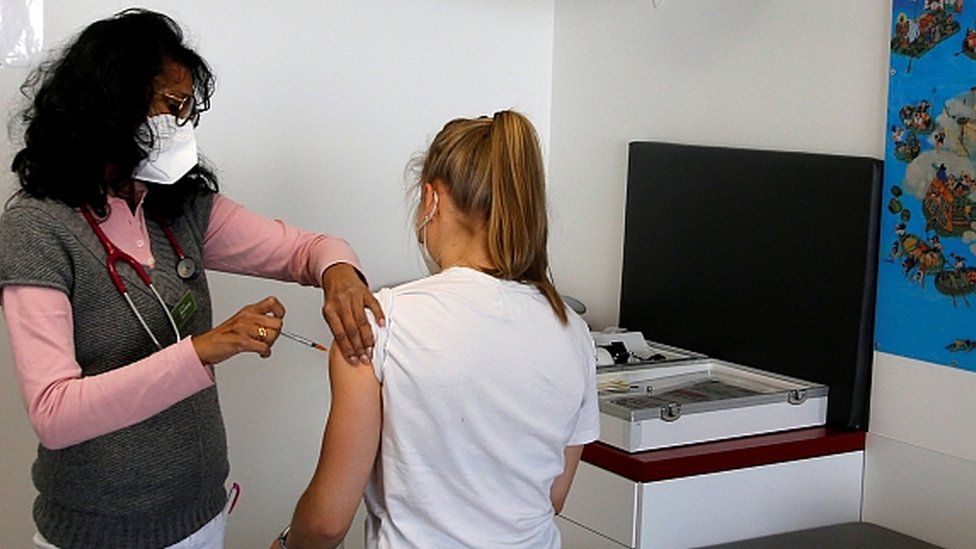
SharecloseShare pageCopy linkAbout sharingimage copyrightReutersThe EU’s medicines agency (EMA) has approved the Pfizer-BioNTech vaccine for 12-15 year olds – the first jab allowed for this age group in the bloc.Friday’s announcement came after the World Health Organization’s Europe director warned that the pandemic would not be over until at least 70% of the population had been vaccinated.The EU has already approved the Pfizer vaccine for those aged 16 and older.Individual states must now decide if they will offer the jab to children.Marco Cavaleri, the EMA’s head of vaccine strategy, announced the move for the 12 to 15s at a news conference on Friday, saying the age group would require two doses with an interval of at least three weeks. German leaders announced on Thursday that vaccinations of children over 12 would start on 7 June.Where is the Indian variant and how is it spreading?What are the holiday rules for Spain and Portugal?France and Austria open bars as lockdowns easeChancellor Angela Merkel has said that the vaccine will not be compulsory for children and one survey suggested that only 51% of parents wanted their children to be vaccinated. Florian Hoffmann, the head of Germany’s Association for Intensive and Emergency Medicine, has said that adults should be prioritised “because they have a much higher risk of getting a serious course of the virus which could see them end up in intensive care”.Earlier on Friday, WHO Europe director Hans Kluge warned that the vaccine rollout across the region was still “too slow”.”The pandemic will be over once we reach 70% minimum coverage in vaccination,” he told AFP news agency.Mr Kluge said he remained concerned about the increased contagiousness of new variants, adding that speed was of the essence.”We know for example that the B.1617 (Indian variant) is more transmissible than the B.117 (UK or Kent variant), which already was more transmissible than the previous strain,” he said.”Our best friend is speed, the time is working against us. We need to accelerate, we need to enlarge the number of vaccines.” France is to open up vaccinations to everyone aged over 18 from 31 May, the government has said. Until now only adults aged 50 and over have been eligible.

Read more →

Tiniest of moments proves key for baby's healthy brain

University of Virginia School of Medicine researchers have shed new light on how our brains develop, revealing that the very last step in cell division is crucial for the brain to reach its proper size and function.
The new findings identify a potential contributor to microcephaly, a birth defect in which the head is underdeveloped and abnormally small. That’s because the head grows as the brain grows. The federal Centers for Disease Control estimates that microcephaly affects from 1 in 800 children to 1 in 5,000 children in the United States each year. The condition is associated with learning disabilities, developmental delays, vision and hearing loss, movement impairment and other problems.
“By understanding the genetic causes of microcephaly, even though they are rare, we can also help to understand how some viral infections can cause of microcephaly, such as Zika virus or cytomegalovirus,” said researcher Noelle D. Dwyer, PhD, of UVA’s Department of Cell Biology.
Understanding Brain Development
Dwyer and her team aim to understand how small changes in individual cells can lead to dramatic changes in the brain. In this case, they have identified an important role for abscission, the final step in cell division. During abscission, a new, or “daughter,” cell severs its connection to its “mother” cell. Think of it like cutting the cord when a new baby arrives in the world.
Scientists have suspected that a particular cellular protein, Cep55, is essential for proper abscission. Dwyer wanted to investigate that, to determine what would happen if the protein were absent. She and her colleagues were surprised to find that abscission could still occur in their lab mice. However, the process took longer than usual, and the failure rate went up substantially.

Read more →

Waking just one hour earlier cuts depression risk by double digits, study finds

Waking up just one hour earlier could reduce a person’s risk of major depression by 23%, suggests a sweeping new genetic study published May 26 in the journal JAMA Psychiatry.
The study of 840,000 people, by researchers at University of Colorado Boulder and the Broad Institute of MIT and Harvard, represents some of the strongest evidence yet that chronotype — a person’s propensity to sleep at a certain time — influences depression risk.
It’s also among the first studies to quantify just how much, or little, change is required to influence mental health.
As people emerge, post-pandemic, from working and attending school remotely — a trend that has led many to shift to a later sleep schedule — the findings could have important implications.
“We have known for some time that there is a relationship between sleep timing and mood, but a question we often hear from clinicians is: How much earlier do we need to shift people to see a benefit?” said senior author Celine Vetter, assistant professor of integrative physiology at CU Boulder. “We found that even one-hour earlier sleep timing is associated with significantly lower risk of depression.”
Previous observational studies have shown that night owls are as much as twice as likely to suffer from depression as early risers, regardless of how long they sleep. But because mood disorders themselves can disrupt sleep patterns, researchers have had a hard time deciphering what causes what.

Read more →

Japan's hands-off formula in disciplining schoolchildren works. Is it worth a try elsewhere?

A study examining Japanese schools’ hands-off approach when children fight showed it could create opportunities for autonomy and encourage ownership of solutions, suggesting a new strategy in handling kids squabbles in other countries.
Called mimamoru, the pedagogical strategy is a portmanteau of the Japanese words mi, meaning watch, and mamoru, meaning guard or protect. It is generally understood as “teaching by watching” — where adults, including early childhood educators, intentionally let kids handle disagreements on their own to promote their learning through voluntary exploration and actions. While not an official part of Japan’s early childhood education and care (ECEC) curriculum, it is treated as an implicit guideline. The approach reflects Japanese socialization practices at home and school, where it is a norm for grownups to wait for children to respond to problems and guide them to take ownership of their learning.
“This study aims to understand the reason why Japanese early childhood educators tend not to intervene, and how and in what contexts they do,” said study author Fuminori Nakatsubo, ECEC specialist and associate professor at Hiroshima University’s Graduate School of Humanities and Social Sciences.
The researchers said insights gleaned from exploring the mimamoru approach could provide educators with fresh perspectives on disciplinary practices, particularly in countries where direct and immediate intervention is prioritized.
Maximizing learning through minimal intervention
A total of 34 Japanese and 12 US early childhood educators participated in focus groups that used modified video-cued multi-vocal ethnography methods to scrutinize the non-intervention strategy. After watching a three-minute clip showing it in action at a private preschool in western Japan, the international mix of educators discussed non-verbal cues exhibited by the students and teachers and the timing of intervention. Their findings are published in the Early Childhood Education Journal.

Read more →

Alzheimer's: Blood oxygen levels could explain why memory loss is an early symptom

In a world first, scientists from the University of Sussex have recorded blood oxygen levels in the hippocampus and provided experimental proof for why the area, commonly referred to as ‘the brain’s memory centre’, is vulnerable to damage and degeneration, a precursor to Alzheimer’s disease.
To understand why this region is so sensitive, the University of Sussex researchers, headed up by Dr Catherine Hall from the School of Psychology and Sussex Neuroscience, studied brain activity and blood flow in the hippocampus of mice. The researchers then used simulations to predict that the amount of oxygen supplied to hippocampal neurons furthest from blood vessels is only just enough for the cells to keep working normally.
Dr Catherine Hall, Senior Lecturer in Psychology at the University of Sussex says:
“These findings are an important step in the search for preventative measures and treatments for Alzheimer’s, because they suggest that increasing blood flow in the hippocampus might be really effective at preventing damage from happening.
“If it’s right that increasing blood flow in the hippocampus is important in protecting the brain from diseases like Alzheimer’s, then it will throw further weight behind the importance of regular exercise and a low-cholesterol diet to long-term brain health.
“We think that the hippocampus exists at a watershed. It’s just about OK normally, but when anything else happens to decrease brain blood flow, oxygen levels in the hippocampus reduce to levels that stop neurons working. We think that’s probably why Alzheimer’s disease first causes memory problems — because the early decrease in blood flow stops the hippocampus from working properly.
“The same factors that put you at risk of having a heart attack make you more likely to develop dementia. That’s because our brains need enough blood flow to provide energy — in the form of oxygen and glucose — so brain cells can work properly, and because blood flow can clear away waste products such as the beta amyloid proteins that build up in Alzheimer’s disease.
“Now we want to discover whether the lower blood flow and oxygen levels in the hippocampus are what causes beta amyloid to start to build up in Alzheimer’s disease. Understanding what causes early damage will be really important to help us learn how to treat or prevent disease.”
Dr Kira Shaw, a psychology researcher at the University of Sussex who undertook the main experiments, reported:
“We found that blood flow and oxygen levels in the hippocampus were lower than those in the visual cortex. Also, when neurons are active, there is a large increase in blood flow and oxygen levels in the visual cortex. This provides energy to hungry neurons. But in the hippocampus, these responses were much smaller.”
The scientists also found that blood vessels in the hippocampus contained fewer mRNA transcripts (codes for making proteins) for proteins that shape blood vessel dilation. Additionally, the cells that dilate small blood vessels, called pericytes, were a different shape in the hippocampus than in the visual cortex.
Dr Shaw concluded: “We think blood vessels in the hippocampus are less able to dilate than in the visual cortex.”
Story Source:
Materials provided by University of Sussex. Original written by Anna Ford. Note: Content may be edited for style and length.

Read more →

Stem cell drugs surprise researchers: Could lead to better drugs in the future

Your immune system is always busy fighting incoming threats. It consists of a system of cells, and when there is a shortage of cells, it affects the performance of the immune system.
This is seen in e.g. cancer patients following chemotherapy. This is because chemotherapy targets all the cells in your body, including the stem cells in your bone marrow, which were meant to develop into new immune cells. This means that the immune system then lacks cells to fight new infections.
There are drugs that can harvest stem cells from the bone marrow, so that they can be returned to the patients after treatment. They then develop into new immune cells, enabling the body to once again fight incoming threats. But previously, we lacked detailed knowledge of how these drugs worked.
Now, a study conducted in mice by researchers at the University of Copenhagen demonstrates how the medicine works at the cell level — and, surprisingly, how one of the two applied and tested drugs is more effective than the other, despite the fact that the other drug, on paper, appears to be the most effective of the two. This discovery may not just help improve stem cell transplantation; it may also lead to improved drugs in the future.
“We have tested two drugs for stem cell transplantation which appear to have the same effect. What they do is block a receptor, causing the bone marrow to release stem cells into the blood. What the new study shows, though, is that they do not just block the receptor; one of the two drugs also affects other signalling pathways in the cell. And in short, that makes it more effective than the other of the two drugs,” says PhD Student Astrid Sissel Jørgensen from the Department of Biomedical Sciences at the University of Copenhagen.
“We used to believe that all we had to do was block the receptor, and that the two drugs had the same effect. It now appears that there is more to it,” she says.
The drugs tested by the researchers mobilize stem cells by acting as CXCR4 receptor antagonists. This means that they inhibit or reduce activity of the receptor. Several drugs target this receptor, including drugs inhibiting HIV replication.
“The drugs not only block the receptor’s normal signalling. One of the two drugs we have tested also affect some of the other cell pathways and even make the receptor withdraw into the cell and disappear from the surface,” explains Professor Mette Rosenkilde, who is the corresponding author of the study. The study results reveal that one of the two drugs makes the bone marrow release more stem cells into the blood.
This knowledge about how drugs affect cell pathways differently is also known as biased signalling. And it is things like these that make one of the drugs more effective in practice than on paper.
According to the researchers, the new knowledge on biased signalling challenges our current view of these drugs.
“The results of our study directly influence our view of drugs used for stem cell transplantation. In the long term, though, it may also affect our view of future drugs, and how new drugs should be designed to have the best possible effect, both in connection with stem cell mobilisation, but also for treating HIV infections, where this particular receptor also plays a main role,” says Mette Rosenkilde.

Read more →

Revenge of the seabed burrowers

The ancient burrowers of the seafloor have been getting a bum rap for years.
These prehistoric dirt churners — a wide assortment of worms, trilobites, and other animals that lived in Earth’s oceans hundreds of millions of years ago — are thought to have played a key role in creating the conditions needed for marine life to flourish. Their activities altered the chemical makeup of the sea itself and the amount of oxygen in the oceans, in a process called bioturbation.
But did that bioturbation help or hinder the expansion of complex animal life? A new Yale study, published in the journal Earth and Planetary Science Letters, found that seabed burrowers were very helpful indeed.
“Bioturbating animals are one of our foremost examples of ‘ecosystem engineers,'” said lead author Lidya Tarhan, an assistant professor of Earth and planetary sciences at Yale. “They play a major role in shaping the chemical composition of the oceans, and even, on geologic time scales, the atmosphere.”
Bioturbating animals that live and burrow in the sediments of the seabed first became widespread and active during the early Cambrian Period, about 541 million years ago. They were part of the so-called “Cambrian Explosion,” when most animal groups with sophisticated body plans and behaviors began to appear in rapid succession, according to the fossil record.
But there is much debate among Earth scientists about what impact these burrowers had on their surroundings.

Read more →

Detecting skin disorders based on tissue stiffness with a soft sensing device

By putting a piece of soft, strain-sensing sheet on the skin may be able to detect skin disorders non-invasively and in real-time very soon. A research team co-led by a scientist from City University of Hong Kong (CityU) has designed a simple electromechanical device that can be used for deep tissue pathology diagnosis, such as psoriasis, in an automated and non-invasive fashion. The findings will lay a foundation for future applications in the clinical evaluation of skin cancers and or dermatology diseases.
The research is co-led by Dr Yu Xinge, Assistant Professor from CityU’s Department of Biomedical Engineering, and scientists from and Northwestern University in the US. Their findings have been published in the science journal Nature Biomedical Engineering, titled “Miniaturized electromechanical devices for the characterization of the biomechanics of deep tissue.”
Electromechanical systems that enable precise, rapid measurements of the stiffness of soft tissues of the human body can provide useful clinical information for monitoring, diagnosing and treating various pathologies, particularly those of the skin. However, existing diagnostic evaluations, for example, magnetic resonance elastography, usually involve huge instruments at hospitals and trained practitioners. And the latest tissue stiffness-measuring technology based on sensing can only measure to superficial depths of upper skin, up to micrometre scale.
New device for real-time evaluations of deep tissue stiffness
To address the issue, the research team designed a simple, miniature electromechanical device for high-precision, real-time evaluations of deep tissue stiffness. The team used a miniature electromagnetic system that integrates a vibratory actuator and a soft strain-sensing sheet to monitor in real-time the Young’s modulus, ie the tensile stiffness, of skin and other soft biological tissues at depths of approximately 1 to 8 mm, depending on the sensor designs.
The team evaluated the device’s performance with a range of synthetic and biological materials, such as hydrogels, pigskin and on various parts of human skin. “The lesions exhibited higher stiffness than those of the nearby skin, primarily due to differences in skin elasticity and hydration. These simple measurements have potential clinical significance in rapidly identifying and targeting skin lesions, with capabilities that complement those of recently reported methods for sensing mechanical properties at tissue surface (typically micrometre-scale),” explained Dr Yu. He pointed out that cancer tissue is typically stiffer or softer than normal tissue, and such difference can be used as diagnostic biomarker for a range of skin conditions, like skin cancer or tumours under the skin.
Story Source:
Materials provided by City University of Hong Kong. Note: Content may be edited for style and length.

Read more →

'Good' bacteria show promise for clinical treatment of Crohn's disease, ulcerative colitis

A new study published in Nature Communications demonstrates that a consortium of bacteria designed to complement missing or underrepresented functions in the imbalanced microbiome of inflammatory bowel disease (IBD) patients, prevented and treated chronic immune-mediated colitis in humanized mouse models. The study’s senior author, Balfour Sartor, MD, Midget Distinguished Professor of Medicine, Microbiology and Immunology, Co-Director of the UNC Multidisciplinary IBD Center, said the results are encouraging for future use treating Crohn’s disease and ulcerative colitis patients.
“The idea with this treatment is to restore the normal function of the protective bacteria in the gut, targeting the source of IBD, instead of treating its symptoms with traditional immunosuppressants that can cause side effects like infections or tumors,” Sartor said.
The live bacteria consortia, called GUT-103 and GUT-108, were developed by biotech firm Gusto Global. GUT-103 is comprised of 17 strains of bacteria that work together to protect and feed each other. GUT-108 is a refined version of GUT-103, using 11 human isolates related to the 17 strains. These combinations permit the bacteria to stay in the colon for an extended amount of time, as opposed to other probiotics that are not capable of living in the gut and pass through the system quickly.
GUT-103 and GUT-108 were given orally three times a week to “germ-free” mice (no bacteria present) that had been specially developed and treated with specific human bacteria, creating a humanized mouse model. The therapeutic bacteria consortia worked by addressing upstream targets, rather than targeting a single cytokine to block downstream inflammation responses, and reversed established inflammation.
“It also decreased pathobionts — bacteria that can cause harm — while expanding resident protective bacteria, and produced metabolites promoting mucosal healing and immunoregulatory responses,” Sartor said. “Simply put — the treatment increased the good guys and decreased the bad guys.”
Because of the robust results seen in this study, and the need for more alternative therapies for Crohn’s disease, Sartor would like to see GUT-103 and GUT-108 studied in Phase 1 and 2 clinical trials in the future. He plans to continue his work with Gusto Global to further explore uses of the bacterial consortia.
This work was funded by Gusto Global, LLC. Daniel Van der Lelie, PhD, Chief Executive Officer of Gusto Global, is the first author of this study. Germ-free mice were provided by grants from the National Institutes of Health (NIH) and the Crohn’s and Colitis Foundation.
Story Source:
Materials provided by University of North Carolina Health Care. Note: Content may be edited for style and length.

Read more →

U.K. Approves Johnson & Johnson Vaccine

Britain’s drug regulator on Friday approved the use of the single-dose shots manufactured by Johnson & Johnson, the fourth coronavirus vaccine to be authorized in the country.The authorization comes amid growing concerns about the spread in Britain of a coronavirus variant first detected in India. The number of cases of the variant, known as B.1.617.2, has doubled in a week, according to public data, and as of Thursday, nearly 7,000 cases had been detected.“This fourth approved vaccine adds to our armory,” the British health secretary, Matt Hancock, said on Twitter. “When you’re eligible, get your jab.” Britain has also authorized the use of the vaccines manufactured by Moderna, Oxford-AstraZeneca and Pfizer-BioNTech.More than 58 percent of Britain’s population has received at least one dose of a coronavirus vaccine, and 36 percent has been fully vaccinated. Britain opened vaccination to adults 30 and older this week, but most of the vaccination campaign’s efforts have in recent weeks focused on second injections.Johnson & Johnson’s vaccine is 85 percent effective against severe illness from Covid-19, according to the British regulator.The approval in Britain comes a day after Mexico gave emergency authorization to the same vaccine.The Mexican government has previously authorized the vaccines from AstraZeneca and Pfizer, as well as Russia’s Sputnik V and China’s Sinovac and CanSino.In other news around the world:Hong Kong on Thursday recorded no new coronavirus cases for the first time in seven months, a promising sign in the Chinese territory’s efforts to quash a wave of infections that began in November. The city has gone more than a month without recording more than 15 daily cases, increasing calls for the authorities to relax social-distancing measures.Vietnam ordered religious establishments to suspend large gatherings after a cluster of infections was linked to a Protestant congregation in Ho Chi Minh City, part of a nationwide surge in cases. Of more than 6,300 total cases recorded in the Southeast Asian nation since the start of the pandemic, half have come in the past month, the state-run Vietnam News Agency reported.South America’s largest soccer tournament is scheduled to start in just over two weeks, but with one of the planned host countries, Colombia, removed because of political protests, and the remaining host, Argentina, mired in its worst coronavirus surge to date, it is unclear where the competition will take place.

Read more →