How Covid-19 Has Upended Life in Undervaccinated Arkansas
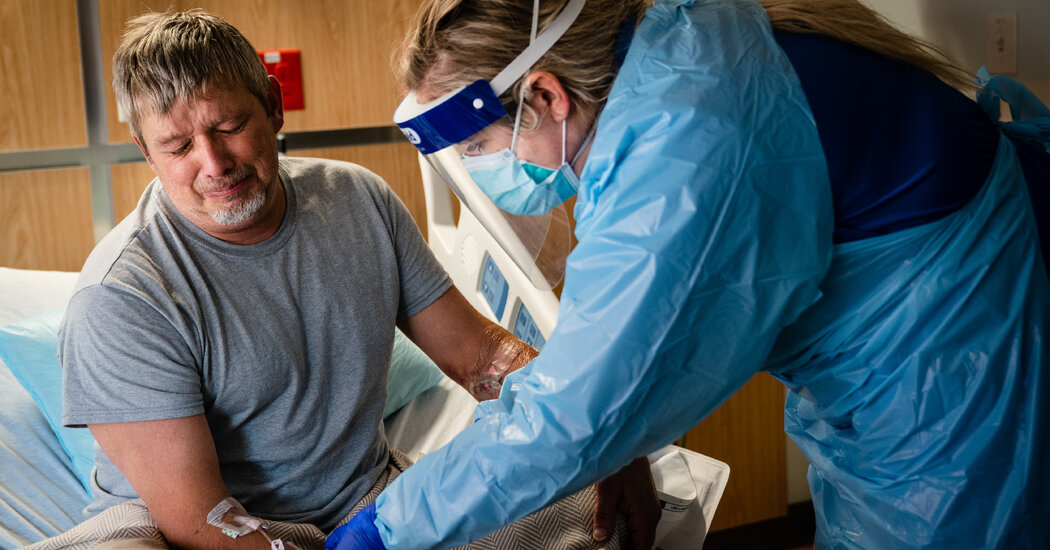
While much of the nation tiptoes toward normalcy, the coronavirus is again swamping hospitals in places like Mountain Home, in a rural county where fewer than one-third of residents are vaccinated.MOUNTAIN HOME, Ark. — When the boat factory in this leafy Ozark Mountains city offered free coronavirus vaccinations this spring, Susan Johnson, 62, a receptionist there, declined the offer, figuring she was protected as long as she never left her house without a mask.Linda Marion, 68, a widow with chronic pulmonary disease, worried that a vaccination might actually trigger Covid-19 and kill her. Barbara Billigmeier, 74, an avid golfer who retired here from California, believed she did not need it because “I never get sick.”Last week, all three were patients on 2 West, an overflow ward that is now largely devoted to treating Covid-19 at Baxter Regional Medical Center, the largest hospital in north-central Arkansas. Mrs. Billigmeier said the scariest part was that “you can’t breathe.” For 10 days, Ms. Johnson had relied on supplemental oxygen being fed to her lungs through nasal tubes.Ms. Marion said that at one point, she felt so sick and frightened that she wanted to give up. “It was just terrible,” she said. “I felt like I couldn’t take it.”Yet despite their ordeals, none of them changed their minds about getting vaccinated. “It’s just too new,” Mrs. Billigmeier said. “It is like an experiment.”Linda Marion, 68, a widow with chronic pulmonary disease, said that at one point, she felt so sick and frightened that she wanted to give up.Erin Schaff/The New York TimesWhile much of the nation tiptoes toward normalcy, the coronavirus is again swamping hospitals in places like Mountain Home, a city of fewer than 13,000 people not far from the Missouri border. A principal reason, health officials say, is the emergence of the new, far more contagious variant called Delta, which now accounts for more than half of new infections in the United States.The variant has highlighted a new divide in America, between communities with high vaccination rates, where it causes hardly a ripple, and those like Mountain Home that are undervaccinated, where it threatens to upend life all over again. Part of the country is breathing a sigh of relief; part is holding its breath.While infections rose in more than half the nation’s counties last week, those with low vaccination rates were far more likely to see bigger jumps. Among the 25 counties with the sharpest increases in cases, all but one had vaccinated under 40 percent of residents, and 16 had vaccinated under 30 percent, a New York Times analysis found.In Baxter County, where the hospital is, fewer than a third of residents are fully vaccinated — below both the state and the national averages. Even fewer people are protected in surrounding counties that the hospital serves.“It’s absolutely flooded,” said Dr. Rebecca Martin, a pulmonologist, as she made the rounds of 2 West one morning last week.In the first half of June, the hospital averaged only one or two Covid-19 patients a day. On Thursday, 22 of the unit’s 32 beds were filled with coronavirus patients. Five more were in intensive care. In a single week, the number of Covid patients had jumped by one-third.Overall, Arkansas ranks near the bottom of states in the share of population that is vaccinated. Only 44 percent of residents have received at least one shot.“Boy, we’ve tried just about everything we can think of,” a retired National Guard colonel, Robert Ator, who runs the state’s vaccination effort, said in an interview. For about one in three residents, he said, “I don’t think there’s a thing in the world we could do to get them to get vaccinated.”For that, the state is paying a price. Hospitalizations have quadrupled since mid-May. More than a third of patients are in intensive care. Deaths, a lagging indicator, are also expected to rise, health officials said.Undervaccinated places like Mountain Home are bearing the brunt of rising coronavirus infections and hospitalizations from the Delta variant.Erin Schaff/The New York TimesDr. José R. Romero, the state health director, said he still believed enough Arkansans were vaccinated, or immune from having contracted Covid-19, that the “darkest days” of December and January were behind them. “What I’m concerned about now is we’ll have a rise or surge,” he said, “then winter is going to add another surge, so we’re going to have a surge on top of a surge.”Dr. Mark Williams, the dean of the College of Public Health at the University of Arkansas for Medical Sciences, said the Delta variant was upending his projections for the pandemic. It is spreading through the state’s unvaccinated population “at a very fast rate,” he said, and threatens to strain the ability of hospitals to cope. “I would say we have definitely hit the alarming stage,” he said.At Baxter Regional, many doctors and nurses are girding for another wave while still exhausted from battling the pandemic they thought had abated.“I started having flashbacks, like PTSD,” said Dr. Martin, the pulmonologist, who obsesses over her patients’ care. “This is going to sound very selfish but unfortunately it’s true: The fact that people won’t get vaccinated means I can’t go home and see my kids for dinner.”Dr. Rebecca Martin, a pulmonologist, said Baxter Regional was “flooded.”Erin Schaff/The New York TimesThe Biden administration has pledged to help stem outbreaks by supplying Covid-19 tests and treatments, promoting vaccines with advertising campaigns and sending community health workers door to door to try to persuade the hesitant.But not all those tactics are welcome. Dr. Romero said Arkansas would happily accept more monoclonal antibody therapies, a Covid-19 treatment often used in outpatient settings. But Mr. Ator, the vaccine coordinator, said door-knocking “would probably do more harm than good,” given residents’ suspicions of federal intentions.Both said the Arkansas public had been saturated with vaccine promotions and incentives, including free lottery tickets, hunting and fishing licenses and stands offering shots at state parks and high school graduation ceremonies.The last mass vaccination event was May 4, when the Arkansas Travelers, a minor-league baseball team, had its first game since the pandemic hit. Thousands gathered at the stadium in Little Rock to watch. Fourteen accepted shots.Even health care workers have balked. Statewide, only about 40 percent are vaccinated, Dr. Romero said.In April, the state legislature added yet another roadblock, making it essentially illegal for any state or local entity, including public hospitals, to require coronavirus vaccination as a condition of education or employment until two years after the Food and Drug Administration fully licenses a shot. That almost certainly means no such requirements can be issued until late in 2023.Fewer than one-third of Baxter County residents are fully vaccinated.Erin Schaff/The New York TimesOnly fear of the Delta variant appears to be pushing some off the fence.When the pandemic hit, Baxter Regional became a vaccine distribution center and inoculated 5,500 people. But only half of its 1,800 staff members accepted shots, according to Jonny Harvey, its occupational health coordinator. By early June, demand had tapered off so much that the hospital was administering an average of one a day.Now, Mr. Harvey said, he is ordering enough vaccine to deliver 30 shots a day because people are increasingly anxious of the Delta variant. “I hate that we are having the surge,” he said. “But I do like that we are vaccinating people.”At the state’s only academic medical center in Little Rock, run by the University of Arkansas for Medical Sciences, vaccines are also suddenly more popular. Over a recent two-week period, the share of the hospital’s staff who are vaccinated jumped to 86 percent from 75 percent.

Read more →

Where Does Weed Come From? A New Study Suggests East Asia.

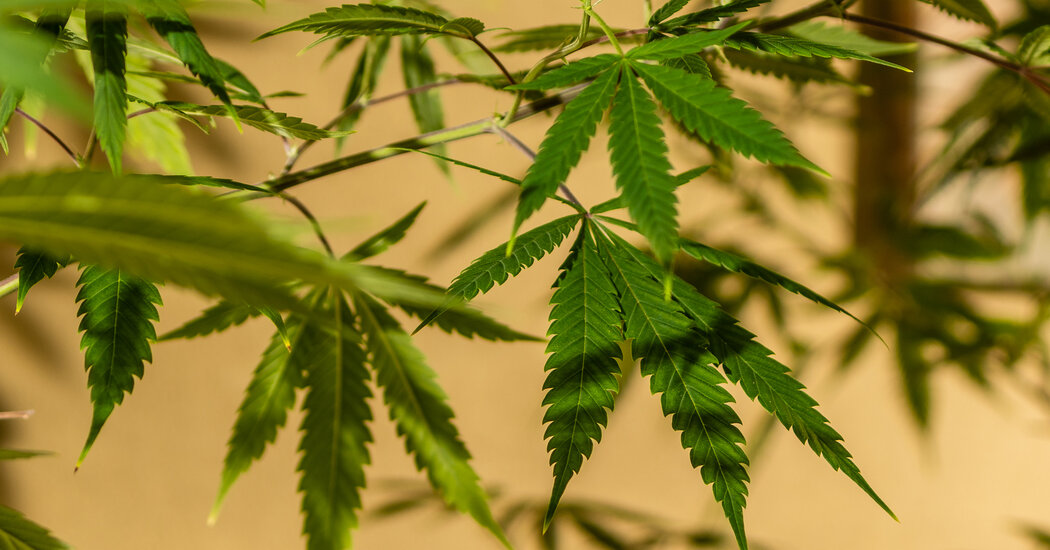
A group of biologists and other scientists said humans began growing cannabis about 12,000 years ago not just for food, but also for hemp and, yes, probably to get high.People feeling the effects of marijuana are prone to what scientists call “divergent thinking,” the process of searching for solutions to a loosely defined question.Here’s one to ponder: Where did the weed come from? No, not where it was bought, but where and when was the plant first domesticated?Many botanists believe that the cannabis sativa plant was first domesticated in Central Asia. But a new study published on Friday in the journal Science Advances suggests that East Asia is the more likely source, and that all existing strains of the plant come from an “ancestral gene pool” represented by wild and cultivated varieties growing in China today.The study’s authors found that the plant was a “primarily multipurpose crop” grown about 12,000 years ago during the early Neolithic period, probably for fiber and medicinal uses.Farmers began breeding the plant specifically for its mind-altering properties about 4,000 years ago, as cannabis began to spread into Europe and the Middle East, the authors of the study said.Michael Purugganan, a professor of biology at New York University who read the study, said the usual assumption about early humans was that they domesticated plants for food.“That seems to be the most pressing problem for humans then: How to get food,” said Professor Purugganan, who was not involved in the research. “The suggestion that even early on they were also very concerned with fiber and even intoxicants is interesting. It would bring to question what were the priorities of these Neolithic societies.”A 2016 study by other scientists said that the earliest records for cannabis were mostly from China and Japan, but most botanists believe that it was probably first domesticated in the eastern part of Central Asia, where wild varieties of the plant are widespread.Genetic sequencing for the latest study suggests that the species has a “single domestication origin” in East Asia, the researchers wrote.By sequencing genetic samples of the plant, they found that the species had most likely been domesticated by the early Neolithic period. They said their conclusion was supported by pottery and other archaeological evidence from the same period that was discovered in present-day China, Japan and Taiwan.But Professor Purugganan said he was skeptical about conclusions that the plant was developed for drug or fiber use 12,000 years ago since archaeological evidence show the consistent use or presence of cannabis for those purposes began about 7,500 years ago.“I would like to see a much larger study with a larger sampling,” he said.Luca Fumagalli, an author of the study and a biologist in Switzerland who specializes in conservation genetics, said the theory of a Central Asian origin was largely based on observational data of wild samples in that region.“It’s easy to find feral samples, but these are not wild types,” Dr. Fumagalli said. “These are plants that escaped captivity and readapted to the wild environment.”“By the way, that’s the reason you call it weed, because it grows anywhere,” he added.The study was led by Ren Guangpeng, a botanist at Lanzhou University in the western Chinese province of Gansu. Dr. Ren said in an interview that the original site of cannabis domestication was most likely northwestern China, and that the finding could help with current efforts in the country to breed new types of hemp.To conduct the study, Dr. Ren and his colleagues collected 82 samples, either seeds or leaves, from around the world. The samples included strains that had been selected for fiber production, and others from Europe and North America that were bred to produce high amounts of tetrahydrocannabinol (THC), the plant’s most mood-altering compound.Dr. Fumagalli and his colleagues then extracted genomic DNA from the samples and sequenced them in a lab in Switzerland. They also downloaded and reanalyzed sequencing data from 28 other samples. The results showed that the wild varieties they analyzed were in fact “historical escapes from domesticated forms,” and that existing strains in China — cultivated and wild — were their closest descendants of the ancestral gene pool.“Although additional sampling of feral plants in these key geographical areas is still needed, our results, which are based on very broad sampling already, would suggest that pure wild progenitors of C. sativa have gone extinct,” they wrote.As hemp’s function as a global source for textiles, food and oilseed dried up in the 20th century, the use of cannabis as a recreational drug increased, the new study noted. But there are still “large gaps” in knowledge about its domestication history, it said, in large part because the plant is illegal in many countries.It can also be hard to understand precisely how plant species are domesticated in the first place, said Catherine Rushworth, a postdoctoral researcher at the University of Minnesota who studies plant evolution.Although scientists can make some basic predictions about how a given plant species will diverge in nature, she added, such predictions “go out the window” when a natural selection process is driven by humans.“So, for example, we might think that species would diverge when they’re adapting to different habitats, or to different pollinators,” she said. “But people are often the pollinators and people have created those habitats.”Joy Dong

Read more →

Cannabis Was Domesticated in East Asia, New Study Suggests

A group of biologists and other scientists said humans began growing cannabis about 12,000 years ago not just for food, but also for hemp and, yes, probably to get high.People feeling the effects of marijuana are prone to what scientists call “divergent thinking,” the process of searching for solutions to a loosely defined question.Here’s one to ponder: Where did the weed come from? No, not where it was bought, but where and when was the plant first domesticated?Many botanists believe that the cannabis sativa plant was first domesticated in Central Asia. But a new study published on Friday in the journal Science Advances suggests that East Asia is the more likely source, and that all existing strains of the plant come from an “ancestral gene pool” represented by wild and cultivated varieties growing in China today.The study’s authors found that the plant was a “primarily multipurpose crop” grown about 12,000 years ago during the early Neolithic period, probably for fiber and medicinal uses.Farmers began breeding the plant specifically for its mind-altering properties about 4,000 years ago, as cannabis began to spread into Europe and the Middle East, the authors of the study said.Michael Purugganan, a professor of biology at New York University who read the study, said the usual assumption about early humans was that they domesticated plants for food.“That seems to be the most pressing problem for humans then: How to get food,” said Professor Purugganan, who was not involved in the research. “The suggestion that even early on they were also very concerned with fiber and even intoxicants is interesting. It would bring to question what were the priorities of these Neolithic societies.”A 2016 study by other scientists said that the earliest records for cannabis were mostly from China and Japan, but most botanists believe that it was probably first domesticated in the eastern part of Central Asia, where wild varieties of the plant are widespread.Genetic sequencing for the latest study suggests that the species has a “single domestication origin” in East Asia, the researchers wrote.By sequencing genetic samples of the plant, they found that the species had most likely been domesticated by the early Neolithic period. They said their conclusion was supported by pottery and other archaeological evidence from the same period that was discovered in present-day China, Japan and Taiwan.But Professor Purugganan said he was skeptical about conclusions that the plant was developed for drug or fiber use 12,000 years ago since archaeological evidence show the consistent use or presence of cannabis for those purposes began about 7,500 years ago.“I would like to see a much larger study with a larger sampling,” he said.Luca Fumagalli, an author of the study and a biologist in Switzerland who specializes in conservation genetics, said the theory of a Central Asian origin was largely based on observational data of wild samples in that region.“It’s easy to find feral samples, but these are not wild types,” Dr. Fumagalli said. “These are plants that escaped captivity and readapted to the wild environment.”“By the way, that’s the reason you call it weed, because it grows anywhere,” he added.The study was led by Ren Guangpeng, a botanist at Lanzhou University in the western Chinese province of Gansu. Dr. Ren said in an interview that the original site of cannabis domestication was mostly likely northwestern China, and that the finding could help with current efforts in the country to breed new types of hemp.To conduct the study, Dr. Ren and his colleagues collected 82 samples, either seeds or leaves, from around the world. The samples included strains that had been selected for fiber production, and others from Europe and North America that were bred to produce high amounts of tetrahydrocannabinol (THC), the plant’s most mood-altering compound.Dr. Fumagalli and his colleagues then extracted genomic DNA from the samples and sequenced them in a lab in Switzerland. They also downloaded and reanalyzed sequencing data from 28 other samples. The results showed that the wild varieties they analyzed were in fact “historical escapes from domesticated forms,” and that existing strains in China — cultivated and wild — were their closest descendants of the ancestral gene pool.“Although additional sampling of feral plants in these key geographical areas is still needed, our results, which are based on very broad sampling already, would suggest that pure wild progenitors of C. sativa have gone extinct,” they wrote.As hemp’s function as a global source for textiles, food and oilseed dried up in the 20th century, the use of cannabis as a recreational drug increased, the new study noted. But there are still “large gaps” in knowledge about its domestication history, it said, in large part because the plant is illegal in many countries.It can also be hard to understand precisely how plant species are domesticated in the first place, said Catherine Rushworth, a postdoctoral researcher at the University of Minnesota who studies plant evolution.Although scientists can make some basic predictions about how a given plant species will diverge in nature, she added, such predictions “go out the window” when a natural selection process is driven by humans.“So, for example, we might think that species would diverge when they’re adapting to different habitats, or to different pollinators,” she said. “But people are often the pollinators and people have created those habitats.”Joy Dong

Read more →

Erin Gilmer, Disability Rights Activist, Dies at 38

She fought for a more compassionate health care system, bringing an extensive knowledge of policy and even more extensive firsthand experience as a patient.Erin Gilmer, a lawyer and disability rights activist who fought for medical privacy, lower drug prices and a more compassionate health care system as she confronted a cascade of illnesses that left her unable to work or even get out of bed for long stretches, died on July 7 in Centennial, Colo. She was 38.Anne Marie Mercurio, a friend whom Ms. Gilmer had given power of attorney, said the cause was suicide.First in Texas and later in Colorado, where she had her own law practice, Ms. Gilmer pushed for legislation that would make health care more responsive to patients’ needs, including a state law, passed in 2019, that allows pharmacists in Colorado to provide certain medications without a current prescription if a patient’s doctor cannot be reached.She was a frequent consultant to hospitals, universities and pharmaceutical companies, bringing an extensive knowledge of health care policy and even more extensive firsthand experience as a patient.At conferences and on social media, she used her own life to illustrate the degradations and difficulties that she said were inherent in the modern medical system, in which she believed patients and doctors alike were treated as cogs in a machine.Her conditions included rheumatoid arthritis, Type 1 diabetes, borderline personality disorder and occipital neuralgia, which produces intensely painful headaches. Her lengthy medical file presented a challenge to doctors used to addressing patients in 15-minute visits, and she said she often found herself dismissed as “difficult” simply because she tried to advocate for herself.“Too often patients have to wonder: ‘Will they believe me?’” she wrote on Twitter in May. “‘Will they help me? Will they cause more trauma? Will they listen and understand?’”She spoke often about her financial difficulties; despite her law degree, she said, she had to rely on food stamps. But she acknowledged that her race gave her the privilege to cut corners.“In the months when I couldn’t figure out how to make ends meet, I would disguise myself in my nice white-girl clothes and go to the salad bar and ask for a new plate as if I had already paid,” she said in a 2014 speech to a medical conference at Stanford University.“I’m not proud of it, but I’m desperate,” she added. “It’s survival of the fittest. Some patients die trying to get food, medicine, housing and medical care. If you don’t die along the way, you honestly wish you could, because it’s all so exhausting and frustrating and degrading.”She could be fierce, especially when people presumed to explain her problems to her or offer a quick-fix solution. But she also developed a following among people with similarly complicated health conditions, who saw her as both an ally and an inspiration, showing them how to make the system work for them.“Before, I thought I didn’t have a choice,” Tinu Abayomi-Paul, who became a disability rights activist after meeting Ms. Gilmer in 2018, said by phone. “She was the first to show me how to address the institution of medicine and not be written off as a difficult patient.”Ms. Gilmer highlighted the need for trauma-informed care, calling on the medical system to recognize not only that many patients enter the intimate space of a doctor’s office already traumatized but also that the health care experience can itself be traumatizing. Last year she wrote a handbook, “A Preface to Advocacy: What You Should Know as an Advocate,” which she shared online, for free.“She expected the system to fail her,” said Dr. Victor Montori, an endocrinologist at the Mayo Clinic and a founder of the Patient Revolution, an organization that supports patient-centered care. “But she tried to make it so the system didn’t fail other people.”Ms. Gilmer in 2016. She used her own life in her advocacy work to illustrate the degradations and difficulties that she said were inherent in the modern medical system.Erin Michelle Gilmer was born on Sept. 27, 1982, in Wheat Ridge, Colo., a Denver suburb, and grew up in nearby Aurora. Her father, Thomas S. Gilmer, a physician, and her mother, Carol Yvonne Troyer, a pharmacist, divorced when she was 19, and she became estranged from them.In addition to her parents, Ms. Gilmer is survived by her brother, Christopher.Ms. Gilmer, a competitive swimmer as a child, began to develop health problems in high school. She had surgery on her jaw and a rotator cuff, her father said in an interview, and she also developed signs of depression.A star student, she graduated with enough advanced placement credits to skip a year of college at the University of Colorado, Boulder. She studied psychology and economics, and she graduated summa cum laude in 2005.She decided to continue her education, at the University of Colorado’s law school, to keep her student health insurance — “a cruel joke,” she said in a 2020 interview with Dr. Montori. She focused on health law and human rights, training herself to be both a policy expert and an activist; she later called her blog Health as a Human Right.She received her degree in 2008 and moved to Texas, where she worked for the state government and a number of health care nonprofits. She returned to Denver in 2012 to open her own practice.By then her health was beginning to decline. Her existing conditions worsened and new ones appeared, exacerbated by a 2010 accident in which she was hit by a car. She found it hard to work a full day, and eventually most of her advocacy was virtual, including via social media.For all her mastery of the intricacies of health care policy, Ms. Gilmer said what the system needed most was more compassion.“We can do that at the big grand levels of instituting trauma-informed care as the way to practice,” she said in the interview with Dr. Montori. “And we can do that at the small micro levels of just saying: ‘How are you today? I’m here to listen. I’m glad you’re here.’”If you are having thoughts of suicide, call the National Suicide Prevention Lifeline at 1-800-273-8255 (TALK). You can find a list of additional resources at SpeakingOfSuicide.com/resources.

Read more →

Canada's vaccination rate overtakes US

SharecloseShare pageCopy linkAbout sharingimage copyrightToronto Star via Getty ImagesCanada has overtaken the US in second dose vaccination rates, after months of lagging behind its southern neighbour.As of 16 July, 48.45% of Canadians are fully vaccinated against Covid-19, compared with 48.05% of Americans. If Canada’s vaccine progress continues it may open its border to US travellers after a 16-month closure, Prime Minister Justin Trudeau said this week.In the US, a levelling-off of vaccine rates comes amid a concerning increase in Covid-19 cases.President Joe Biden failed to meet a self-set target of 70% of adults vaccinated by the 4 July holiday weekend. About 68% of Americans aged 18 and older have received at least one shot. The White House and local governments have turned to both creative solutions and celebrity guest stars in an effort to counter vaccine hesitancy. Michigan, Ohio and California are among the states offering cash lotteries for residents who get the jab. Pop superstar Olivia Rodrigo made an appearance at the White House this week to promote vaccinations among young people, and Nascar will host a vaccine drive this weekend. The push for vaccines is now taking on added urgency, as infections increase in every state, driven by a surge in variants. Still, case numbers remain dramatically lower than in winter when they were at the peak. In Canada, too, vaccine rates have slowed in recent weeks, after a steep upswing beginning in late March.Two of Canada’s northern territories – Yukon and the Northwest Territories – lead the country with roughly 75% and 72% of residents vaccinated, respectively. The uptick in vaccines has been met with a steady drop in Covid-19 cases. After a steep third wave this spring, Canada reported around 3,000 infections this week – a low not seen since last summer.With roughly 80% of eligible Canadians protected by at least one dose, Mr Trudeau said on Thursday that the country expects to begin allowing fully vaccinated US citizens and permanent residents into Canada as of mid-August for non-essential travel, and international travellers in September. Canada has curbed almost all non-essential travel by foreigners since March 2020. Mr Trudeau has faced growing pressure to show his plans for reopening the US-Canada border. Of G20 countries, Canada is now at the head of the pack in vaccination rates. Worldwide, it is hovering around the 15th spot for percentage of the population fully vaccinated, with the US just behind, according to the New York Times global tracker.

Read more →

How Republican Vaccine Opposition Got to This Point

In recent months, Republican skepticism of Covid vaccines and their rollout has grown louder: One recent poll found that 47 percent said they weren’t likely to get vaccinated.After Sherri Tenpenny, a Cleveland-area doctor, falsely suggested during a hearing last month in the Ohio House of Representatives that Covid vaccines left people “magnetized” and could “interface” with 5G cellular towers, Republican lawmakers thanked her for her “enlightening” testimony.In Congress, Republicans who once praised the Trump administration for its work facilitating the swift development of the vaccines now wage campaigns of vaccine misinformation, sowing doubts about safety and effectiveness from the Capitol.And this week, Republican state lawmakers in Tennessee successfully pressured health officials to stop outreach to children for all vaccines. The guidance prohibits sending reminders about the second dose of a Covid vaccine to adolescents who had received one shot and communicating about routine inoculations, like the flu shot.A wave of opposition to Covid vaccines has risen within the Republican Party, as conservative news outlets produce a steady diet of misinformation about vaccines and some G.O.P. lawmakers invite anti-vaccination conspiracy theorists to testify in statehouses and Congress. With very little resistance from party leaders, these Republican efforts have elevated falsehoods and doubts about vaccinations from the fringes of American life to the center of our political conversation.It’s a pattern that was seen throughout the Trump administration: Rather than rebuke conspiratorial thinking and inaccuracies when they begin spreading among their party’s base, many Republicans tolerate extremist misinformation.Some conservatives promulgate the falsehoods as a way to rally their political base, embracing ideas like a stolen election, rampant voter fraud and revisionist history about the deadly siege at the Capitol. Many others say very little at all, preferring to dodge questions from the news media.Those who do speak up remain reluctant to specifically name colleagues who have given voice to misinformation, or to call out media personalities who have done so, like Tucker Carlson of Fox News.“We don’t control conservative media figures so far as I know — at least I don’t,” Senator Mitt Romney, Republican of Utah, told The New York Times recently. “That being said, I think it’s an enormous error for anyone to suggest that we shouldn’t be taking vaccines.”Anti-vaccination sentiment isn’t new to Republican voters. During the 2016 Republican presidential primary race, a number of candidates, including Donald J. Trump, repeated debunked theories that vaccines caused autism in children. Around that time, Republican state legislators began opposing laws that would tighten vaccine requirements for children.But over the past few months, the shift within the party has accelerated, as some supporters of Mr. Trump embrace the belief that the national effort to promote Covid vaccinations is harmful, unconstitutional or perhaps even a sign of a nefarious government plot.“Think about what those mechanisms could be used for,” Representative Madison Cawthorn of North Carolina said of the Biden administration’s plan to go door-to-door to reach millions of unvaccinated Americans, going on to claim without evidence: “They could then go door-to-door to take your guns. They could go door-to-door to take your Bibles.”In a report this month, the Kaiser Family Foundation found a growing vaccination divide between Republican and Democratic areas, with nearly 47 percent of people in counties won by President Biden fully vaccinated, compared with 35 percent of people in Trump counties. In a recent Washington Post-ABC News poll, 47 percent of Republicans said they weren’t likely to get vaccinated, compared with just 6 percent of Democrats.As Covid cases across the country rise, nearly all recent hospitalizations and deaths have occurred among unvaccinated people, White House officials have said. While the national outlook remains much better than during previous upticks, Vivek Murthy, the surgeon general, this week issued his first advisory of the Biden administration, warning of the “urgent threat” of health misinformation.There’s a tendency among Republican leaders to quietly — and sometimes not-so-quietly — attribute the support for fringe beliefs and figures to Mr. Trump. But when it comes to vaccinations, it’s difficult to pin the blame on the former president.Mr. Trump has eagerly taken credit for the accelerated development process of the vaccines, and has urged Americans to get vaccinated. (He did, however, quietly receive a vaccine in private before he left office, rather than hold a public event for the shot that might have encouraged his supporters to follow his lead.) In an interview with Fox News last month, the former president expressed some concern about vaccinating “very young people” but said he remained a “big believer in what we did with the vaccine.”“it’s incredible what we did,” he said. “You see the results.”Other Republicans have not remained quite as steadfast in their echoing of Mr. Trump’s message on vaccines. Last year, Senator Ron Johnson of Wisconsin praised Trump’s “brilliant” Operation Warp Speed. This year, he has made a number of dubious claims about adverse reactions and deaths linked to the vaccines.In March, Representative Marjorie Taylor Greene of Georgia praised Mr. Trump for saving lives with the vaccines. This month, she urged Americans to “just say no” to the vaccine, using Nazi-era imagery to criticize the Biden administration’s effort to reach unvaccinated people.“People have a choice, they don’t need your medical brown shirts showing up at their door ordering vaccinations,” she tweeted. “You can’t force people to be part of the human experiment.”Less than a week later, Senator Mitch McConnell of Kentucky, the Republican minority leader, encouraged Americans to get vaccinated, citing his experience as a childhood survivor of polio.“We have not one, not two, but three highly effective vaccines, so I’m perplexed by the difficulty we have finishing the job,” he said.Yet when asked by a reporter whether some of the challenge could stem from the words of members of his own party, Mr. McConnell demurred.“I’ve already answered the question about how I feel about this,” he said. “I can only speak for myself, and I just did a few minutes ago.”Drop us a line!We want to hear from our readers. Have a question? We’ll try to answer it. Have a comment? We’re all ears. Email us at onpolitics@nytimes.com or message me on Twitter at @llerer.By the numbers: $15 billion… That’s roughly the amount of money deposited in American bank accounts this week for the nearly 60 million children eligible for the expanded monthly child tax credit.… Seriously“I am kind of a sentimental man, don’t get me wrong,” Roland Mesnier, a former White House pastry chef, said in a recent interview. “They were my babies.”The Great Junk Purge sweeps America.Were you forwarded this newsletter? Sign up here to get it delivered to your inbox.Thanks for reading. On Politics is your guide to the political news cycle, delivering clarity from the chaos.Is there anything you think we’re missing? Anything you want to see more of? We’d love to hear from you. Email us at onpolitics@nytimes.com.

Read more →

How Republican Coronavirus Vaccine Opposition Got to This Point

In recent months, Republican skepticism of Covid vaccines and their rollout has grown louder: One recent poll found that 47 percent said they weren’t likely to get vaccinated.After Sherri Tenpenny, a Cleveland-area doctor, falsely suggested during a hearing last month in the Ohio House of Representatives that Covid vaccines left people “magnetized” and could “interface” with 5G cellular towers, Republican lawmakers thanked her for her “enlightening” testimony.In Congress, Republicans who once praised the Trump administration for its work facilitating the swift development of the vaccines now wage campaigns of vaccine misinformation, sowing doubts about safety and effectiveness from the Capitol.And this week, Republican state lawmakers in Tennessee successfully pressured health officials to stop outreach to children for all vaccines. The guidance prohibits sending reminders about the second dose of a Covid vaccine to adolescents who had received one shot and communicating about routine inoculations, like the flu shot.A wave of opposition to Covid vaccines has risen within the Republican Party, as conservative news outlets produce a steady diet of misinformation about vaccines and some G.O.P. lawmakers invite anti-vaccination conspiracy theorists to testify in statehouses and Congress. With very little resistance from party leaders, these Republican efforts have elevated falsehoods and doubts about vaccinations from the fringes of American life to the center of our political conversation.It’s a pattern that was seen throughout the Trump administration: Rather than rebuke conspiratorial thinking and inaccuracies when they begin spreading among their party’s base, many Republicans tolerate extremist misinformation.Some conservatives promulgate the falsehoods as a way to rally their political base, embracing ideas like a stolen election, rampant voter fraud and revisionist history about the deadly siege at the Capitol. Many others say very little at all, preferring to dodge questions from the news media.Those who do speak up remain reluctant to specifically name colleagues who have given voice to misinformation, or to call out media personalities who have done so, like Tucker Carlson of Fox News.“We don’t control conservative media figures so far as I know — at least I don’t,” Senator Mitt Romney, Republican of Utah, told The New York Times recently. “That being said, I think it’s an enormous error for anyone to suggest that we shouldn’t be taking vaccines.”Anti-vaccination sentiment isn’t new to Republican voters. During the 2016 Republican presidential primary race, a number of candidates, including Donald J. Trump, repeated debunked theories that vaccines caused autism in children. Around that time, Republican state legislators began opposing laws that would tighten vaccine requirements for children.But over the past few months, the shift within the party has accelerated, as some supporters of Mr. Trump embrace the belief that the national effort to promote Covid vaccinations is harmful, unconstitutional or perhaps even a sign of a nefarious government plot.“Think about what those mechanisms could be used for,” Representative Madison Cawthorn of North Carolina said of the Biden administration’s plan to go door-to-door to reach millions of unvaccinated Americans, going on to claim without evidence: “They could then go door-to-door to take your guns. They could go door-to-door to take your Bibles.”In a report this month, the Kaiser Family Foundation found a growing vaccination divide between Republican and Democratic areas, with nearly 47 percent of people in counties won by President Biden fully vaccinated, compared with 35 percent of people in Trump counties. In a recent Washington Post-ABC News poll, 47 percent of Republicans said they weren’t likely to get vaccinated, compared with just 6 percent of Democrats.As Covid cases across the country rise, nearly all recent hospitalizations and deaths have occurred among unvaccinated people, White House officials have said. While the national outlook remains much better than during previous upticks, Vivek Murthy, the surgeon general, this week issued his first advisory of the Biden administration, warning of the “urgent threat” of health misinformation.There’s a tendency among Republican leaders to quietly — and sometimes not-so-quietly — attribute the support for fringe beliefs and figures to Mr. Trump. But when it comes to vaccinations, it’s difficult to pin the blame on the former president.Mr. Trump has eagerly taken credit for the accelerated development process of the vaccines, and has urged Americans to get vaccinated. (He did, however, quietly receive a vaccine in private before he left office, rather than hold a public event for the shot that might have encouraged his supporters to follow his lead.) In an interview with Fox News last month, the former president expressed some concern about vaccinating “very young people” but said he remained a “big believer in what we did with the vaccine.”“it’s incredible what we did,” he said. “You see the results.”Other Republicans have not remained quite as steadfast in their echoing of Mr. Trump’s message on vaccines. Last year, Senator Ron Johnson of Wisconsin praised Trump’s “brilliant” Operation Warp Speed. This year, he has made a number of dubious claims about adverse reactions and deaths linked to the vaccines.In March, Representative Marjorie Taylor Greene of Georgia praised Mr. Trump for saving lives with the vaccines. This month, she urged Americans to “just say no” to the vaccine, using Nazi-era imagery to criticize the Biden administration’s effort to reach unvaccinated people.“People have a choice, they don’t need your medical brown shirts showing up at their door ordering vaccinations,” she tweeted. “You can’t force people to be part of the human experiment.”Less than a week later, Senator Mitch McConnell of Kentucky, the Republican minority leader, encouraged Americans to get vaccinated, citing his experience as a childhood survivor of polio.“We have not one, not two, but three highly effective vaccines, so I’m perplexed by the difficulty we have finishing the job,” he said.Yet when asked by a reporter whether some of the challenge could stem from the words of members of his own party, Mr. McConnell demurred.“I’ve already answered the question about how I feel about this,” he said. “I can only speak for myself, and I just did a few minutes ago.”Drop us a line!We want to hear from our readers. Have a question? We’ll try to answer it. Have a comment? We’re all ears. Email us at onpolitics@nytimes.com or message me on Twitter at @llerer.By the numbers: $15 billion… That’s roughly the amount of money deposited in American bank accounts this week for the nearly 60 million children eligible for the expanded monthly child tax credit.… Seriously“I am kind of a sentimental man, don’t get me wrong,” Roland Mesnier, a former White House pastry chef, said in a recent interview. “They were my babies.”The Great Junk Purge sweeps America.Were you forwarded this newsletter? Sign up here to get it delivered to your inbox.Thanks for reading. On Politics is your guide to the political news cycle, delivering clarity from the chaos.Is there anything you think we’re missing? Anything you want to see more of? We’d love to hear from you. Email us at onpolitics@nytimes.com.

Read more →

3D 'assembloid' shows how SARS-CoV-2 infects brain cells

Researchers at University of California San Diego School of Medicine and Rady Children’s Institute for Genomic Medicine have produced a stem cell model that demonstrates a potential route of entry of SARS-CoV-2, the virus that causes COVID-19, into the human brain.
The findings are published in the July 9, 2021 online issue of Nature Medicine.
“Clinical and epidemiological observations suggest that the brain can become involved in SARS-CoV-2 infection,” said senior author Joseph Gleeson, MD, Rady Professor of Neuroscience at UC San Diego School of Medicine and director of neuroscience research at the Rady Children’s Institute for Genomic Medicine.
“The prospect of COVID19-induced brain damage has become a primary concern in cases of ‘long COVID,’ but human neurons in culture are not susceptible to infection. Prior publications suggest that the cells that make the spinal fluid could become infected with SARS-CoV-2, but other routes of entry seemed likely.”
Gleeson and colleagues, who included both neuroscientists and infectious disease specialists, confirmed that human neural cells are resistant to SARS-CoV-2 infection. However, recent studies hinted that other types of brain cells might serve as a ‘Trojan horse.’
Pericytes are specialized cells that wrap around blood vessels — and carry the SARS-CoV2 receptor. The researchers introduced pericytes into three-dimensional neural cell cultures — brain organoids — to create “assembloids,” a more sophisticated stem cell model of the human body. These assembloids contained many types of brain cells in addition to pericytes, and showed robust infection by SARS-CoV-2.
The coronavirus was able to infect the pericytes, which served as localized factories for production of SARS-CoV-2. These locally produced SARS-CoV-2 could then spread to other cell types, leading to widespread damage. With this improved model system, they found that the supporting cells known as astrocytes were the main target of this secondary infection.
The results, said Gleeson, indicate that one potential route of SARS-CoV-2 into the brain is through the blood vessels, where SARS-CoV-2 can infect pericytes, and then SARS-CoV-2 can spread to other types of brain cells.
“Alternatively, the infected pericytes could lead to inflammation of the blood vessels, followed by clotting, stroke or hemorrhages, complications that are observed in many patients with SARS-CoV-2 who are hospitalized in intensive care units.”
Researchers now plan to focus on developing improved assembloids that contain not just pericytes, but also blood vessels capable of pumping blood to better model the intact human brain. Through these models, Gleeson said, greater insight into infectious disease and other human brain disease could emerge.
Co-authors include: Lu Wang, David Sievert and Sangmoon Lee, UC San Diego and Rady Children’s Institute for Genomic Medicine; Alex E. Clark and Aaron F. Carlin, UC San Diego; Hannah Federman, UC San Diego, Rady Children’s Institute for Genomic Medicine and Rutgers University; and Benjamin D. Gastfriend, Eric V. Shusta and Sean P. Palecek, University of Wisconsin-Madison.
Story Source:
Materials provided by University of California – San Diego. Original written by Scott LaFee. Note: Content may be edited for style and length.

Read more →

Covid: Coping with opening-up anxiety

As England prepares to lift the remaining pandemic restrictions, there are calls for greater mental health support to continue for people with anxiety as we emerge from lockdown. The mental health charity Mind says the mental health consequences of coronavirus calls for an immediate and long-term commitment from government. Lauren and Angelica-Jane explain how they have coped during lockdown – and why they fear the end of restrictions will be challenging for their mental health.

Read more →