Republic of Ireland's plan for alcohol minimum pricing comes into effect

SharecloseShare pageCopy linkAbout sharingImage source, Getty ImagesA decision by the Republic of Ireland’s government to introduce minimum unit pricing on alcohol has come into effect.The new law will affect alcohol sold in off licences, shops and supermarkets.Some retailers fear unless similar measures are introduced in Northern Ireland there will be a surge in cross-border shoppers seeking “cheaper booze”.The government believes minimum pricing is a vital public health measure.The measure aims to change dangerous patterns of alcohol behaviour with the intention of deterring binge drinking, RTE reported.Alcohol off-sales drop credited to minimum pricingIreland agrees plans for alcohol minimum pricingUnder the new measures, a standard bottle of wine cannot be sold for less than €7.40 (£6.40) and a can of beer for less than €1.70 (£1.40)Spirits with 40% alcohol content cannot be sold for less than €20.70 (£17.30) and a 700 ml bottle of whiskey for less than €22. (£18.40)Image source, Getty ImagesStatistics from the country’s Revenue Commissioners indicated that alcohol consumption levels in 2020 were 10.07 litres of pure alcohol per person, only slightly down – 6.6% – on the previous year despite the closure of many pubs and restaurants for large parts of 2020.Alcohol consumption has remained at about 11 litres per person since 2015.That is the equivalent of 116 bottles of wine or 445 pints of beer per adult every year.Scotland introduced minimum unit pricing in 2018 and the following year alcohol consumption fell to its lowest level in more than two decades.

Read more →

Covid: Australians desperate for tests amid Omicron surge

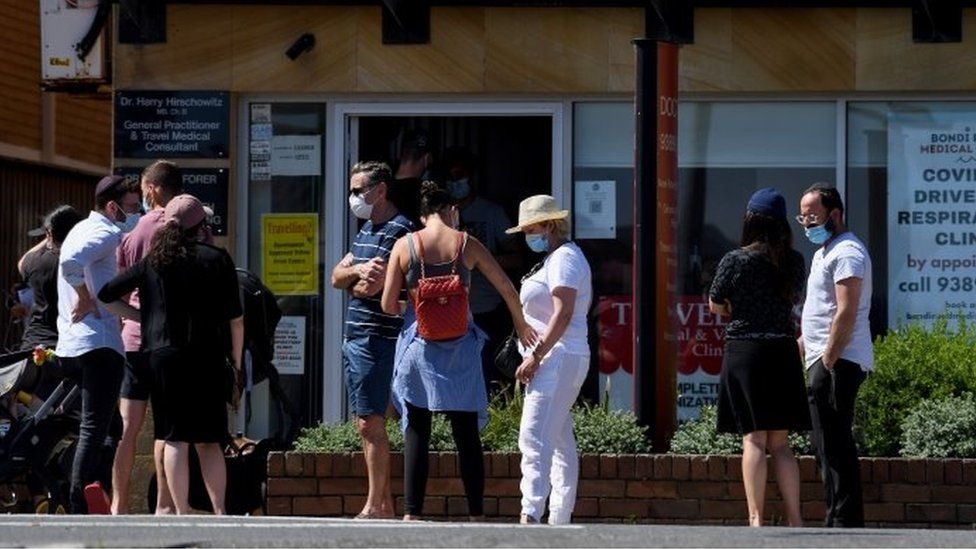
SharecloseShare pageCopy linkAbout sharingImage source, EPAAustralians have expressed anger at facing Covid test shortages and price-gouging as the nation battles its most widespread infections yet.Last month Australia lifted most of its strict domestic restrictions after reaching a 90% vaccination target.But the Omicron variant has fuelled a surge in cases – now totalling over 25,000 a day. That’s put intense pressure on testing and hospital systems, causing anxiety around the country.PCR tests have always been widely available in Australia, but last week the government began limiting who is eligible to receive them for free.It followed tens of thousands of people spending hours queuing outside testing clinics around Christmas. Isolation times blew out and test results were delayed.Prime Minister Scott Morrison said the new rules aimed to alleviate pressure on the system.But it has increased reliance on lateral flow tests – known locally as rapid antigen tests (RATs) – which people have to pay for.Mr Morrison’s government has been heavily criticised for a supply shortage, and many instances of price-gouging have been reported.Dear PM,You told us to lockdown. We did.Told us to vaccinate. We did.Told us to get out there. We did.Now, businesses everywhere are closing, your “free market” on RAT tests sees obscene price gouging, the vulnerable exposed & kids can’t get vax appt’s.What now?— Lisa Wilkinson (@Lisa_Wilkinson) January 3, 2022
The BBC is not responsible for the content of external sites.View original tweet on TwitterRAT test rip-off, @bp_Australia. This #Edgecliff BP selling single rapid antigen tests for an outrageous $30 a pop. They’re as little as $1 – $2 in Europe, but for a family of four in Oz, you’ll pay $120. #auspol @9NewsSyd pic.twitter.com/SwVWzl8mAG— Airlie Walsh (@AirlieWalsh) January 3, 2022
The BBC is not responsible for the content of external sites.View original tweet on TwitterThe government has rejected calls from medical bodies and political opponents to make the tests freely available, as they are in many nations.Mr Morrison has argued that pharmacies require certainty that there will be a private market for the tests.Critics say the new guidelines further disadvantage those on lower incomes, leaving them more exposed as the virus spreads.About one in five people presenting at public testing clinics in Victoria and New South Wales (NSW) – the two most populous states – are now testing positive.Many hospitals are struggling to cope as admissions rise, according to local media. Intensive care unit admissions and death rates remain relatively low. Australia has reported about 2,200 deaths in the pandemic.Due to the nation’s delayed vaccination rollout, many people remain ineligible to get a booster shot.A big shift for AustraliaOmicron has changed the game yet again for Australia. The country had sealed itself off from the world for most of the pandemic – sometimes a single infection was enough to cause a lockdown. Now it’s trying to live with the virus. While Omicron has not pushed to country back into lockdown, it has raised the case numbers into never-before-seen highs. Videos of what seem like endless queues outside testing clinics and reports of severe staff shortages – especially where whole teams have had to isolate – are discussed on a daily basis now. PCR vs RAT is the debate du jour. Omicron has also changed the way Australians view the virus. Many people seem unfazed by the numbers and resigned to the fact that they’ll get it. The anxiety now is around rapid tests and why they’re not currently free; and the rules around so-called “close contacts” and what parents should expect when their children return to school. On New Year’s Eve, I saw my first ever fireworks. It was a spectacular way to start the new year. The park near the Sydney Harbour was crowded but not packed. Many were sensible with distancing and masks. On our way home, one of my friends asked: “How many of us do you think will get it tonight?” Thankfully none of us has so far. But 2022 is looking like the year Australians are finding out what it means to live with Omicron and part of that is the strong likelihood of infection. You may also be interested in:This video can not be playedTo play this video you need to enable JavaScript in your browser.

Read more →

The Epic Rise and Fall of Elizabeth Holmes

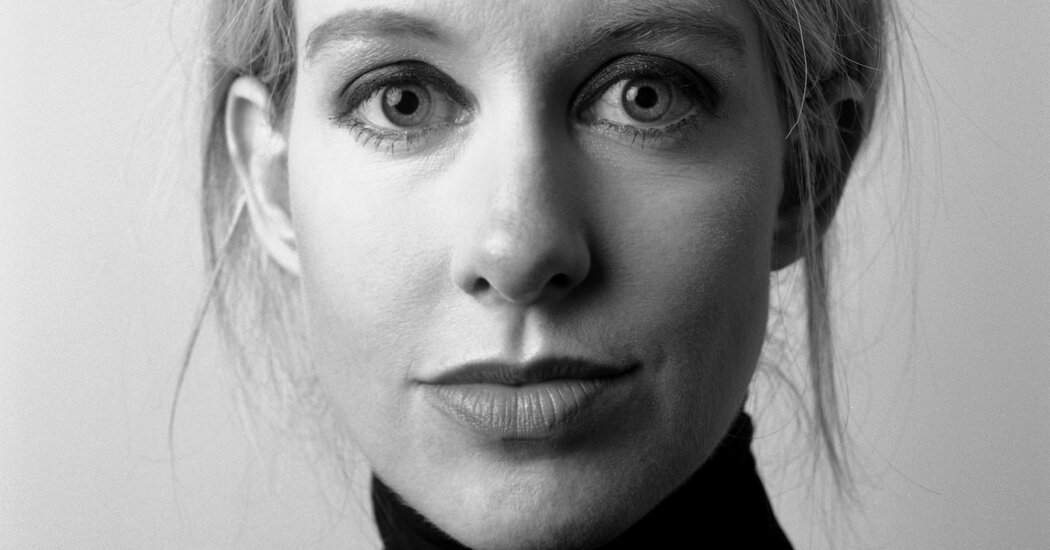
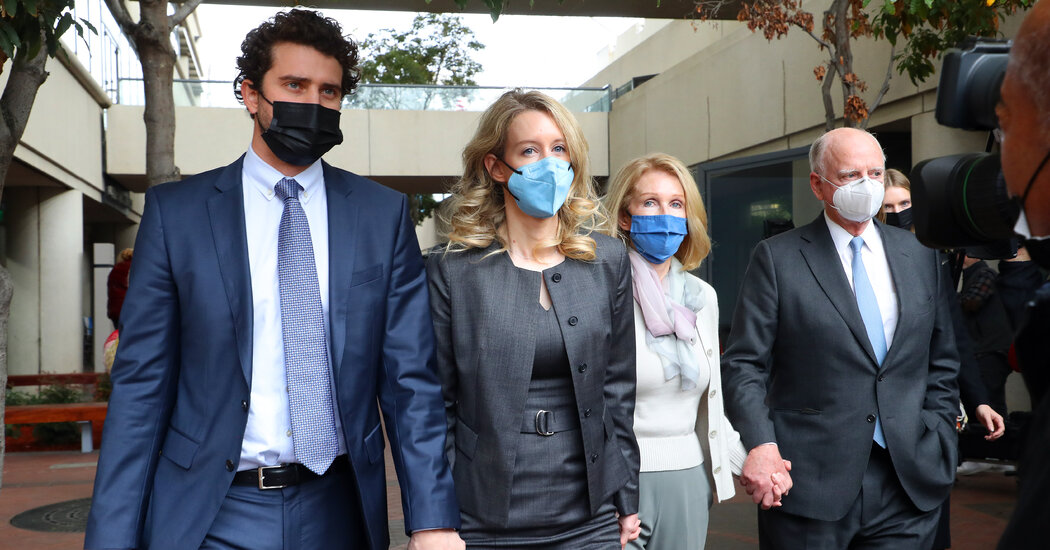
In Silicon Valley’s world of make-believe, the philosophy of “fake it until you make it” finally gets its comeuppance.SAN FRANCISCO — Near the end of Elizabeth Holmes’s criminal trial, her lawyers submitted into evidence her punishing self-improvement plan.“4 a.m. Rise and thank God,” the handwritten memo began. Exercise, meditation, prayer, breakfast (whey and, as she spelled it, “bannanna”) followed. By 6:45 a.m., a time when slackers were still fumbling for the alarm clock, she was at the office of Theranos, the blood-testing company she founded in 2003.Ms. Holmes had many rules at Theranos: “I am never a minute late. I show no excitement. ALL ABOUT BUSINESS. I am not impulsive. I know the outcome of every encounter. I do not hesitate. I constantly make decisions and change them as needed. I speak rarely. I call bullshit immediately.”It worked. Ms. Holmes’s resolve was so forceful, and fit so neatly into the Silicon Valley cliché of achieving the impossible by refusing to admit it was impossible, that it inspired belief right up to the moment on Monday when a jury officially convicted her of four counts of fraud.The verdict signaled the end of an era. In Silicon Valley, where the line between talk and achievement is often vague, there is finally a limit to faking it.From Stanford University dropout to Theranos’s $9 billion valuation to conviction, it is an epic rise and fall that will be chewed over in the coffee shops and juice bars of Palo Alto, Calif., until the tech industry departs for a new life in Elon Musk and Jeff Bezos’ off-world colonies. For a decade, Ms. Holmes fooled savvy investors, hundreds of smart employees, an all-star board and a media eager to anoint a new star even, or especially, if she had no qualifications.Just as Silicon Valley is a cartoonish version of American notions about the virtues of hard work and getting rich quick, so Ms. Holmes was a heightened version of Silicon Valley.Elizabeth Holmes and her partner, Billy Evans, leaving the federal courthouse in San Jose, Calif.Jim Wilson/The New York TimesAs her self-improvement scheme made clear, she was trying to turn herself into a machine that had no time for anything but work. This was not for her own benefit, of course, but humanity’s. She perfectly encapsulated the Silicon Valley credo that tech was here to serve us, and never mind exactly how it did it, the billions it was making or whether it even worked.Whenever anyone — a regulator, an investor, a reporter — wanted to know a little more about exactly how the Theranos machines functioned, the company cried “trade secrets.” The real secret, of course, was that Theranos didn’t have any trade secrets because its machines didn’t work. But her answer worked for a long time.Hiding fraud behind the imperatives of secrecy wasn’t the only way Ms. Holmes’s actions were rooted in tradition. Her self-improvement plan dated back to Ben Franklin but found its most indelible expression in F. Scott Fitzgerald’s creation of Jay Gatsby, the mysterious, alluring, handsome millionaire who also ran a few swindles.Ms. Holmes in 2015 at Theranos’s lab.Carlos Chavarria for The New York TimesGatsby was practically Ms. Holmes’s brother. He, too, got where he was with a schedule and rules, in his case written inside a book when he was a striving youth:5 p.m.-6 p.m.: Practice elocution, poise and how to obtain it7 p.m.-9 p.m.: Study needed inventionsThe parallels with Ms. Holmes extended even to Gatsby’s equally loose grasp of spelling. “No more smokeing or chewing,” he admonished himself.Gatsby was a bootlegger but also used Wall Street to cheat. He sold fake bonds. Ms. Holmes chose Silicon Valley, the last and greatest of all human dreams. In the first decade of the century, it promised to reinvent transportation, friendship, commerce, politics, money.Blood-testing must have seemed like a breeze by comparison, especially since Ms. Holmes was a natural salesperson, as good at bending reality as Steve Jobs himself. Here she was in an interview with the radio show Tech Nation in 2005, explaining what Theranos was all about:“We focused on creating a customized medicine tool that could be used in the home by every patient, so that every day, a patient can get real-time analysis of their blood samples.”Who could not applaud such an invention? Theranos was making a messy, uncertain and time-consuming medical process into something effortless and painless. “A little teeny needle that pulls a little teeny drop of blood,” she said. Software would do the rest.Tech Nation’s host, Moira Gunn, has a master’s degree in computer science and a doctor of philosophy in mechanical engineering, but she was dazzled. “How old are you, Elizabeth?” she asked.“I’m 21,” Ms. Holmes said.Her age was brought up not to knock down her claims but to underline how impressive they were. “I’m gonna go tell my two children, they better get off their duffs,” Ms. Gunn exclaimed.Ms. Holmes said Theranos’s device was in “the production phase.” She added, “We hope to release it, actually, to a pharmaceutical partner around mid-to-late this year.” Thirteen years later, when the company dissolved, it had never successfully released a device.In 2005, however, even reinventing blood-testing at 21 was not enough, so deep was our expectations of genius. Ms. Holmes was asked about her future, and gave the stock Silicon Valley response: You ain’t seen nothing yet.Theranos already had the “next generations” of its device in prototype, she said. It was miniaturized to make it even faster, to make it “more high-throughput.” It would be automated: “You don’t even have to touch your finger on the device.”So in one of the first media interviews Ms. Holmes ever did, she said Theranos had a working device that would be able to analyze your health without actually touching you. No one called her on it. No wonder she and her deputy and boyfriend, Ramesh Balwani, the company’s chief operating officer who was known as “Sunny,” thought they could brazen it out in the Silicon Valley tradition until they had something that actually worked.This is a credulous age. William Perry, a Theranos board member, was secretary of defense under President Bill Clinton, a mathematician, engineer and Stanford professor. Not, in other words, a fool with regard to Silicon Valley. Yet he told The New Yorker in 2014 that Ms. Holmes “has sometimes been called another Steve Jobs, but I think that’s an inadequate comparison. She has a social consciousness that Steve never had. He was a genius; she’s one with a big heart.”Mr. Jobs, who died in 2011, might as well have been a recruiter for Theranos. Adam Rosendorff, a lab director at Theranos, testified during Ms. Holmes’s trial that he thought the company was going to be “the next Apple.” He applied for the job after reading a biography of the Apple co-founder.William J. Perry, center, a former defense secretary, was a Theranos board member until December 2016.Win McNamee/Getty Images“The whole excitement around Steve Jobs was very compelling to me,” he said. “I wanted to make a more global impact on health care and I thought that joining a diagnostics company would help me do that.”Mr. Rosendorff grew disillusioned before Theranos’s misleading claims were exposed, but Mr. Perry stuck it out until December 2016, when the start-up was forced to change its board in a futile attempt to survive.With believers like these, Ms. Holmes’s dream must have seemed so close that she could hardly fail to grasp it. A couple more late nights from the engineering team, a few more magazine covers declaring her a genius, and it would be as good as done.So where does this conviction leave the rest of us — her marks, her enablers, her investors and former fans?Ripe for the next huckster that comes along, probably. Some Silicon Valley promises are so sweet we just can’t get enough of them. Immortality. Crypto. Flying cars. Mars. Digital harmony. Wealth beyond compare.As Fitzgerald wrote, we will always be a sucker for the orgastic future that year by year recedes before us.

Read more →

Elizabeth Holmes Found Guilty of Four Counts of Fraud

SAN JOSE, Calif. — Elizabeth Holmes, the founder of the failed blood testing start-up Theranos, was found guilty of four of 11 charges of fraud on Monday, in a case that came to symbolize the pitfalls of Silicon Valley’s culture of hustle, hype and greed.Ms. Holmes was the most prominent tech executive to field fraud accusations in a generation of high-flying, money-losing start-ups. A jury of eight men and four women took 50 hours to reach a verdict, convicting her of three counts of wire fraud and one count of conspiracy to commit wire fraud. She was found not guilty on four other counts. The jury was unable to reach a verdict on three counts, which were set aside for later.Each count carries a maximum sentence of 20 years in prison, terms that are likely to be served concurrently. Ms. Holmes is expected to appeal. The verdict stands out for its rarity. Few technology executives are charged with fraud and even fewer are convicted. If sentenced to prison, Ms. Holmes would be the most notable female executive to serve time since Martha Stewart did in 2004 after lying to investigators about a stock sale. And Theranos, which dissolved in 2018, is likely to stand as a warning to other Silicon Valley start-ups that stretch the truth to score funding and business deals.The mixed verdict suggested that jurors believed the evidence presented by prosecutors that showed Ms. Holmes lied to investors about Theranos’s technology in the pursuit of money and fame. They were not swayed by her defense of blaming others for Theranos’s problems and accusing her co-conspirator, Ramesh Balwani, the company’s chief operating officer and her former boyfriend, of abusing her.They were also not swayed by the prosecutor’s case that she had defrauded patients. Ms. Holmes was acquitted on four counts related to patients who took Theranos’s blood tests and one related to advertisements that the patients saw.The guilty verdict arrived in a frenzied period for the tech industry, with investors fighting to get into hot deals and often ignoring potential red flags about the companies they were putting money into. Some have warned that more Theranos-like disasters loom.In recent years, tales of start-up chicanery, from the bungled initial public offering of WeWork to the aggressive boundary-pushing tactics of Uber, have not slowed the flow of capital toward charismatic founders spinning tales of business success. Those downfalls captured the public’s attention, but did not result in criminal charges.Yet the Justice Department under President Biden has renewed its focus on white-collar crimes. “We will urge prosecutors to be bold,” Lisa O. Monaco, the deputy attorney general, recently said in a speech. “The fear of losing should not deter them.”Ms. Holmes’s conviction sends a message to other founders and executives to be careful about their statements to investors and the public, said Jessica Roth, a law professor at Cardozo School of Law and former federal prosecutor in the Southern District of New York.It “shines a light on the importance of drawing a distinction between truth and optimistic projections — and keeping that clear in ones mind,” she said.Ms. Holmes rose to prominence by mimicking the disruptive change-the-world chutzpah of Silicon Valley heroes like Steve Jobs — a playbook that has turned companies like Apple, Tesla, Google and Facebook into some of the most valuable in the world.In the process, she captured the attention of heads of state, top business leaders and wealthy families with idealistic plans to revolutionize the health care industry. She traveled the world on private jets, was feted with awards and glowing magazine cover stories and lauded as the world’s youngest self-made female billionaire.But she crossed into fraud when she lied about the accuracy, types and number of tests Theranos’s machines could do to raise funding and secure business deals.“That’s a crime on Main Street and it’s a crime in Silicon Valley,” said Robert Leach, an assistant U.S. attorney, said in opening statements at the trial’s start.The verdict concludes nearly four months of proceedings that alternated between exhilarating and plodding. There were delays because of a coronavirus scare, a burst water pipeline, technology problems in the courtroom and juror travel. One juror was dismissed for playing Sudoku and another for her Buddhist faith. Crowds of spectators, many of whom followed the Theranos saga via podcasts, documentaries, books and news articles, waited for hours for a spot in the courtroom’s limited seats.Inside, jurors heard from dozens of witnesses and viewed hundreds of pieces of evidence used to support prosecutors’s argument that Ms. Holmes knowingly misled investors and patients on her rise to fame and fortune.Witnesses included James Mattis, the former defense secretary who sat on Theranos’s board, as well as Lisa Peterson, who managed money for the wealthy family of a former education secretary, Betsy DeVos, and invested $100 million into Theranos. Prominent investors including Rupert Murdoch and Larry Ellison, as well as two former secretaries of state, George Shultz and Henry Kissinger, who sat on its board, were discussed but never called to the stand.The case’s evidence outlined Ms. Holmes’s role in faked demonstrations, falsified validation reports, misleading claims about contracts, and overstated financials at Theranos. Jurors heard recordings and watched videos of Ms. Holmes making inflated or misleading claims about Theranos.Before it shut down in 2018, Theranos voided two years’ worth of its blood tests. It paid to settle several investor lawsuits, as well as fraud charges by the Securities and Exchange Commission.But prosecutors argued that Ms. Holmes’s actions went beyond those punishments — they were criminal. She led investors to lose hundreds of millions of dollars and patients to get unreliable test results, they said.“At so many of the forks in the road, she chose the dishonest path,” John Bostic, an assistant U.S. attorney, said in closing arguments.In her defense, Ms. Holmes’s lawyers tried to discredit testimony from whistle-blowers, attacked investors for not doing more research into Theranos and said Ms. Holmes’s failures were not a crime.Ms. Holmes capped the proceedings by taking the stand. Over seven days of testimony, she alternated between accepting responsibility for certain missteps and deflecting blame for other problems to colleagues.She said she believed that Theranos’s tests worked and had relied on the expertise of more qualified people running the company’s lab. And she used her charisma to sell jurors on the same vision of the future that, years earlier, had helped her win over investors, world leaders and the press.“I wanted to talk about what this company could do a year from now, five years from now, 10 years from now,” Ms. Holmes said. “I wanted to talk about what was possible.”Ms. Holmes’s argument that her optimistic projections were no different than that of other Silicon Valley companies contradicted the government’s evidence, which was consistent with traditional fraud cases, Ms. Roth said.“If other founders and executives are engaged in the kinds of deceit that was alleged and proven by considerable evidence in this case, then they should be concerned,” she said.Most strikingly, Ms. Holmes accused Mr. Balwani of emotional and sexual abuse. The pair dated in secret for more than decade, even owning an estate in Atherton, Calif., together. Ms. Holmes said Mr. Balwani, who is around 20 years older than her, controlled every aspect of her life, including her schedule, self-presentation and time spent with her family. She also accused him of forcing her to have sex with him. Mr. Balwani has denied the allegations.That testimony, delivered through tears, threatened to turn the tide against the prosecutor’s case by appealing to the jury’s emotions and painting Ms. Holmes as a victim. But it was a risky strategy, experts have said, particularly since Ms. Holmes did not provide an expert witness to put her accusations in context of the wire fraud charges.Mr. Balwani, known as Sunny, will stand trial next year. He has also pleaded not guilty.

Read more →

Lymphoma cell metabolism may provide new cancer target

Aggressive and relatively common lymphomas called diffuse large B cell lymphomas (DLBCLs) have a critical metabolic vulnerability that can be exploited to trick these cancers into starving themselves, according to a study from researchers at Weill Cornell Medicine and Cornell’s Ithaca campus.
The researchers, whose study was published Dec. 13 in Blood Cancer Discovery, showed that a protein called ATF4, a genetic master-switch that controls the activities of hundreds of genes, has a key role in supporting the fast growth of DLBCLs. The scientists found that silencing ATF4 in DLBCL cells essentially fools the cells into starving themselves and slowing their growth — and that targeting ATF4 along with a closely related metabolic protein, SIRT3, even further enhances this cancer-killing effect.
“ATF4 represents a crucial and exploitable vulnerability in DLBCLs — and one that they appear to share regardless of the specific genetic mutations that trigger them,” said study co-senior author Dr. Ari Melnick, the Gebroe Family Professor of Hematology / Oncology in the Division of Hematology and Clinical Oncology and a member of the Sandra and Edward Meyer Cancer Center at Weill Cornell Medicine.
Dr. Hening Lin, a professor in the Department of Chemistry and Chemical Biology at Cornell University in Ithaca and a Howard Hughes Medical Institute investigator, is the other co-senior author of the study.
Lymphomas are blood cancers that usually originate from immune cells such as B cells, the producers of antibodies. The vast majority of lymphomas are so-called non-Hodgkin lymphomas, and DLBCLs account for about a third of these, or roughly 25,000 cases per year in the United States. DLBCLs are relatively fast-growing and aggressive, and despite many advances in lymphoma treatment in recent decades, about 40 percent of cases are not cured — a statistic that underscores the need for new treatment strategies.
Dr. Melnick, Dr. Lin and their colleagues set out in the study to investigate SIRT3, which resides in mitochondria, the tiny, oxygen-burning fuel reactors in our cells that are essential for powering cellular activities. The research team had discovered in a 2019 study that SIRT3 strongly supports the growth and survival of DLBCLs by speeding up the biochemical reactions that produce the molecular building blocks cells need to proliferate.

Read more →

Choline during pregnancy impacts children’s sustained attention

Seven-year-old children performed better on a challenging task requiring sustained attention if their mothers consumed twice the recommended amount of choline during their pregnancy, a new Cornell study has found.
The study, which compared these children with those whose mothers had consumed the recommended amount of choline, suggests that the recommended choline intake for expectant mothers does not fully meet the needs of the fetal brain.
“Our findings suggest population-wide benefits of adding choline to a standard prenatal vitamin regimen,” said Barbara Strupp, professor in the Division of Nutritional Sciences (DNS) and Department of Psychology, and co-senior author of the study, “Prenatal Choline Supplementation Improves Child Sustained Attention: A Seven-Year Follow-Up of a Randomized Controlled Feeding Trial,” published Dec. 28 in the Journal of the Federation of American Societies for Experimental Biology.
First author of the study is Charlotte Bahnfleth, Ph.D. ’19, a former graduate student in the Strupp Laboratory. Co-senior author is Richard Canfield, senior research associate in DNS. Marie Caudill, professor in DNS, was also a co-author.
Choline – found in egg yolks, lean red meat, fish, poultry, legumes, nuts and cruciferous vegetables – is absent from most prenatal vitamins, and more than 90% of expectant mothers consume less than the recommended amount.
Several decades of research using rodent models has shown that adding extra choline to the maternal diet produces long term cognitive benefits for the offspring. In addition to improving offspring attention and memory throughout life, maternal choline supplementation in rodents has proven to be neuroprotective for the offspring by mitigating the cognitive adversities caused by prenatal stress, fetal alcohol exposure, autism, epilepsy, Down syndrome and Alzheimer’s disease.

Read more →

When mom talks, are infants with ASD listening?

Motherese is a form of simplified, exaggerated melodic speech that parents use to communicate with newborns and young toddlers. A horse becomes horsie; a dog becomes doggie; parents become mama and dada. The tendency to speak in such short sing-song phrases is universal across cultures.
Previous research has shown that infants prefer to listen to motherese, more formally known as infant-directed speech, over adult-like speech; that it more effectively holds their attention and is an important component of emotional bonding and fosters learning experiences between child and parents.
An early sign of autism spectrum disorder (ASD) in children is a reduced response to motherese speech and challenges in sustained attention to social information in general. In a new study, published January 3, 2022 in the journal Nature Human Behavior, researchers at University of California San Diego School of Medicine employed a number of techniques to pinpoint the regions of the brain responsible for a child’s response to baby talk.
“This new study, which combined state-of-the-art brain imaging, eye-tracking and clinical testing, opens the door toward precision medicine in autism,” said senior author Eric Courchesne, PhD, professor of neuroscience at UC San Diego School of Medicine.
Courchesne said the approach generates new insights into how the brain is developing in children with autism related to objective information about social preference and social attention.
“For the first time, we are seeing what the possible brain impact is for children with autism who fail to pay attention to social information,” he said.

Read more →

Anthropologists study the energetics of uniquely human subsistence strategies

Among our closest living relatives — the great apes — we humans are unique: We have larger brains, reproduce more quickly and have longer life spans. These traits are obviously valuable, but the extra energy required to sustain them is quite significant. So how did we manage to afford them?
A group of anthropologists from UC Santa Barbara, the University of Utah and Duke University have teamed up on a research study to understand the strategies humans developed for obtaining that extra energy. Their findings are published in the current issue of Science.
Evolutionary success is largely determined by the extent to which an organism is effective at extracting energy (i.e. calories) from the environment and converting that energy into offspring. But energy acquisition is constrained by a number of factors, the primary being how much time and energy one can spend in the pursuit of food. Energy budgets represent the balance between energy intake and expenditure that all organisms must navigate in order to survive and reproduce.
“Because energy is such a fundamental currency, evolution has produced many astonishing energy-saving adaptations across the Tree of Life,” said Thomas Kraft, the paper’s lead author. Currently an assistant professor at the University of Utah, Kraft conducted the research while a postdoctoral student with Michael Gurven, senior author and professor of anthropology at UC Santa Barbara. “But that doesn’t mean natural selection always favors reduced energy expenditure. In fact, tremendous variation exists in the ‘tempo’ of energetic strategies. A dramatic example is the difference between endothermic (warm-blooded) and ectothermic (cold-blooded) animals. Warm-blooded animals tend to use a lot more energy each day but are able to successfully channel that energy into activities that ultimately lead to successful reproduction.”
The researchers began by comparing the amount of energy and time humans and other great apes expend in order to obtain all the foods they typically include in their diets. “We studied contemporary subsistence societies of hunter-gatherers and farmers in order to examine the kinds of energetic strategies that have existed for millennia, including those after the advent of plant domestication,” said Kraft.
The team of scientists drew especially upon their long-term collective experience working with the Hadza, an indigenous group of foragers in northwest Tanzania, and the Tsimane, an indigenous group of horticulturalists in the Bolivian Amazon.

Read more →

Gene involved in sense of smell could play a role in the spread of breast cancer to the brain

An olfactory receptor gene that aids in the sense of smell may also play a role in the metastasis of breast cancer to the brain, bones and lung, researchers from Massachusetts General Hospital (MGH) have found. The team further discovered that inhibiting the gene, OR5B21, significantly decreased the metastasis of breast cancer cells to these organs and could thus be an important target for future therapy to prevent its spread, according to a paper published in iScience.
“The common perception is that the only role of olfactory receptors, which line the nasal cavity and relay sensory data to the brain, is to recognize odor and smell,” says Bakhos Tannous, PhD, director of the Experimental Therapeutics Unit in the Department of Neurology at MGH and senior author of the study. “Our work suggests that the olfactory receptor 5B21 is also a novel oncogene that may figure prominently in cancer progression by driving breast cancer cells to the brain and other sites in the body.”
Breast cancer is the second most frequently diagnosed malignancy behind lung cancer, and the leading cause of cancer in women, with more than two million new cases reported each year. Moreover, migration of breast cancer to the brain is the leading cause of mortality from the disease, underscoring the urgent need for new therapeutic targets to delay or halt its metastasis.
“The olfactory receptor family of genes is known to be overexpressed in a variety of cancers, including prostate, melanoma, lung and liver, though its role in breast cancer has been understudied in the past,” says Litia Carvalho, PhD, co-corresponding author of the study and an instructor in Neurology at MGH. The team learned through its research with animal models that OR5B21 enhances or primes breast cancer cells to metastasize through a signaling pathway that activates a process known as the epithelial to mesenchymal transition (EMT). EMT prompts multiple biochemical or phenotypical changes in the olfactory cells which include enhanced migratory capacity to distant organs, especially the brain.
“This activation converts a wide range of extracellular signals into intracellular messages through the signaling pathway NF-κB/STAT, resulting in cell proliferation, invasion and metastasis,” explains lead author Mao Li, a graduate student researcher in the Experimental Therapeutics Unit. “Our findings are novel for the field, though further research is needed to determine exactly how OR5B21 induces metastasis.”
Future research might also lead to a molecular inhibitor of OR5B21 in response to the team’s discovery that downregulating the olfactory receptor resulted in a significant decrease in cancer cell metastasis. “Our hope,” says Tannous, “is that using OR5B21 as a target for adjuvant therapy could help fill a huge unmet medical need by preventing breast cancer metastasis to the brain and other organs, and thus prolong survival of patients.”
Tannous is an associate professor of Neurology at Harvard Medical School and an associate neuroscientist at MGH.
Story Source:
Materials provided by Massachusetts General Hospital. Note: Content may be edited for style and length.

Read more →

U.S. Doctors Struggle to Identify Variants in Patients, Complicating Treatment

Most U.S. doctors have no way to determine which variant of the coronavirus a patient is carrying, a distinction that could mean the difference between life and death.High-risk patients carrying the Delta variant could benefit greatly from two particular monoclonal antibody treatments shown to reduce hospitalization and death. But those medications would most likely do nothing for patients with Omicron, who would only respond to a third antibody treatment that is in very short supply.While U.S. officials have endorsed using a workaround test that can identify Omicron’s genetic signature, experts say it’s not feasible for large health systems facing a crush of patients to employ in each case.That makes treating patients challenging in places like Maryland, where cases are spiking and Omicron accounts for roughly 58 percent of them. The Delta variant is also holding strong in the Great Plains and swaths of the West, including California.While there is no approved test to determine each individual’s variant, a national network of state and other labs use genome-sequencing tests to track variants broadly in communities. Health systems then use those regional estimates or their own data to decide which antibody treatments to use in their clinics and hospitals.Many of them concluded that a community of largely Delta patients would benefit most from the antibody drugs made by Regeneron and Eli Lilly, while communities where Omicron patients are predominant would benefit from antibodies from GlaxoSmithKline and Vir Biotechnology.Preparing Covid-positive samples for genomic sequencing at the Washington State Department of Health in Shoreline, Wash.Ted S. Warren/Associated PressFederal officials have dabbled with making the decision for the nation. On Dec. 23, they stopped shipments of antibody treatments by Eli Lilly and Regeneron after the Centers for Disease Control and Prevention said 73 percent of U.S. Covid cases were Omicron.An outcry followed from Republican political leaders, who argued that some people in their states were still infected with Delta. And on Tuesday, the C.D.C. slashed its estimate of national Omicron cases to 59 percent. On Dec. 31, federal officials resumed national shipping all of the antibody treatments.For the next few weeks, as the country grapples with this uneven mix of both variants, tailoring treatments to each patient will be “extraordinarily difficult,” said Dr. Alex Greninger, assistant director of the clinical virology laboratories at the University of Washington Medical Center.Dr. Greninger is credited with developing one of the first tests to detect the coronavirus in the United States. But he is pessimistic that health systems can pivot quickly to sort out which patients have Delta or Omicron. And although a shortcut test can detect Omicron, there’s no simple way to report the results in bulk, he said.What’s more, the genome sequencing used by public health officials takes nearly a week — too long to target the early antibody treatments that have been found to reduce the need for hospitalizations. That makes patient care particularly difficult right now, said Dr. Mark Siedner, an infectious disease clinician and researcher at Massachusetts General Hospital.In Massachusetts and nearby states, an estimated 44.5 percent of cases are Omicron. Dr. Siedner said his health system has stopped using the Regeneron and Eli Lilly antibodies that are not effective against Omicron and are “anxiously awaiting” more doses of the effective treatment by GlaxoSmithKline and Vir Biotechnology.“We’re in a holding pattern and it’s a terrible time to be in that place,” he said.

Read more →