HIV testing: Free DIY home kit offered in England
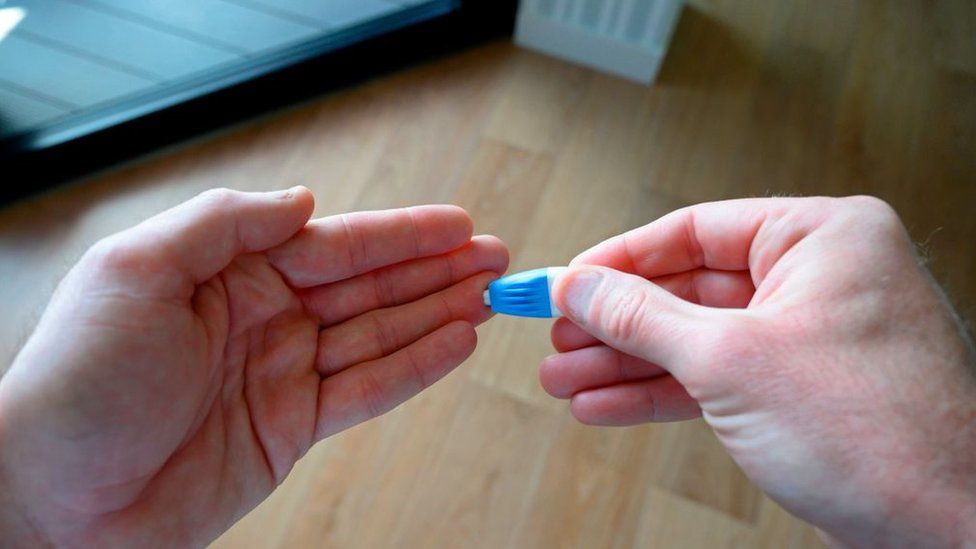
Published8 hours agoShareclose panelShare pageCopy linkAbout sharingImage source, Getty ImagesBy Michelle RobertsDigital health editorFree HIV tests that can be done at home are being offered this week to people in England. It is part of a government drive to improve diagnosis, which dropped off during the Covid pandemic.The kit is small enough to fit through the letterbox and arrives in plain packaging through the post. It gives a result within 15 minutes by testing a drop of blood from a finger prick. A “reactive” result means HIV is possible and a clinic check is needed.Support and help is available to arrange this. If the result is negative it means the test did not detect HIV. If you think you are at risk of HIV, however, you should test every three months because it can take a while for the virus to show in the blood.About 4,400 people in England are living with undiagnosed HIV, which comes with serious health risks. HIV medication can keep the virus at undetectable levels, meaning you cannot pass HIV on and your health is protected.Most people get the virus from someone who is unaware they have it, according to the Terrence Higgins Trust (THT) charity which campaigns about and provides services relating to HIV and sexual health.HIV testing rates remain a fifth lower than before the Covid-19 pandemic – with heterosexual men in particular now testing far less than in 2019. Testing among gay and bisexual men has increased but rates of testing among women have fallen by 22% compared to 2019, while there has been a 41% drop for heterosexual men. Straight men and women are also far more likely to be diagnosed at a late stage.Prince Harry: Know your status and get an HIV test Get tested more, urges sexual health charityTHT has been working with the BBC drama EastEnders to raise awareness of HIV among heterosexuals through a storyline where a lead character called Zack Hudson is diagnosed with the virus.Taku Mukiwa, head of health programmes at THT, said: “Gay and bisexual men and black African people continue to be the most impacted by HIV in the UK, but anyone who’s sexually active can be affected and should think about testing. “As the EastEnders HIV storyline we’ve been advising on shows, the truth is it’s always better to know your HIV status, whether positive or negative. “If it’s negative, you can make sure it stays that way. “While, as Zack in EastEnders is learning, huge advances in HIV treatment mean you can live a long healthy life with the virus, have children who are HIV-negative and that HIV can’t be passed on to anyone else.”People can live with HIV for a long time without any symptoms. Testing is the only way to know your HIV status.Using a condom during sex can prevent infections.Dr Alison Brown, interim head of HIV surveillance at the UK Health Security Agency, said: “HIV does not discriminate, no matter your gender or sexual orientation.”Taking up a free and confidential HIV test regularly when having condom-less sex will ensure you’re diagnosed early and started on effective treatment, helping to reduce transmission of HIV and the number of people with undiagnosed HIV.” It is recommended that anyone who is sexually active tests for HIV annually, and more regularly if you have a new or multiple partners.The free testing initiative coincides with National HIV Testing Week and making progress towards the government’s goal of ending new HIV cases by 2030. More on this storyPrince Harry: Know your status and get an HIV test10 February 2022Stigma around HIV still causing harm, says charity28 November 2022Related Internet LinksTerrence Higgins TrustFree Testing HIVThe BBC is not responsible for the content of external sites.

Read more →

A Patient Declared Dead Is Found in a Body Bag Gasping for Air

A 66-year-old woman was taken to a funeral home, where workers discovered her chest moving, a report said. An Alzheimer’s care center in Iowa that declared her dead was fined $10,000.An Alzheimer’s care center in Iowa was fined $10,000 after mistakenly declaring a patient dead, according to a report from the state’s Health Department.The patient, a 66-year-old woman who was not named in the report, was declared dead by staff members of the Glen Oaks Alzheimer’s Special Care Center in Urbandale, Iowa, on Jan. 3, and transported to a funeral home, according to the report.But when staff members at the funeral home unzipped the body bag, she was alive and gasping for air, according to a citation from the Iowa Department of Inspections and Appeals.The woman was admitted to the special care center in December 2021 with early onset dementia, anxiety and depression. She entered hospice care in late December 2022 with senile degeneration of the brain and was treated with the anxiety drug lorazepam and morphine, a painkiller, according to the report.Starting around last month, her vital signs and responsiveness worsened. She refused meals and had seizures. A doctor ordered an increase in morphine and lorazepam “due to active decline,” the report said.Early on Jan. 3, a care center employee at the end of a 12-hour shift found the woman unresponsive and conferred with a nurse, who declared the woman dead. The nurse informed the woman’s daughter and secured orders from a doctor to release her to a funeral home.Funeral home workers unzipped the body bag and noticed that the woman’s chest was moving and watched as “she gasped for air,” the report said. They called 911 and the hospice.An ambulance transported the woman to an emergency room with a low temperature and shallow breathing. The woman had a do-not-resuscitate directive, so she was brought back to the hospice at the Alzheimer’s care center, where she died two days later.Iowa’s Health Department fined the center $10,000 for two violations, which included a rule that says care homes must preserve the dignity of residents. The report did not address what, if any, actions were taken regarding the nurse.On Sunday, an employee at Glen Oaks Alzheimer’s Special Care Center said she was not able to comment. The center’s executive director, Lisa Eastman, did not immediately respond to an email seeking comment.Ms. Eastman sent a statement to the local television station KCCI, which reported on the case.“We care deeply for our residents and remain fully committed to supporting their end-of-life care,” Ms. Eastman said in the statement. “All employees undergo regular training so they can best support end-of-life care and the death of our residents.”The center did not dispute the Health Department’s findings, according to the report. It has 30 days from Feb. 1, the date of the citation, to request a formal hearing or pay the penalty.The center is a 66-bed residential facility run by Dallas-based Frontier Management, one of the largest senior housing managers in the United States.The center or its administrator has been fined more than a dozen times since opening in 2001, according to Iowa Health Department records, for violations that include a lack of specialized staff training in memory care and a lack of infection control during the pandemic, when patients who tested positive for Covid-19 were roomed with other residents.It is not unheard-of for people to be declared dead only to be found alive hours later.In 2020, a woman in Michigan with cerebral palsy was declared dead by paramedics but was discovered to be breathing hours later by a funeral home worker who was preparing to embalm her body.In 2018, a South African woman was pronounced dead at the scene of a car wreck but hours later was found alive in a mortuary.

Read more →

Accepting anxiety for peace of mind

Sadly, many family members, friends, and celebrities have suffered from anorexia nervosa, or AN, a severe psychiatric illness associated with intense anxieties concerning weight, shape, and self-esteem. AN is characterized by an eating disorder, food restriction, voluntary vomiting, and extreme emaciation.
Mindfulness meditation has already become a globally recognized method for addressing AN. Its effectiveness in clinically treating neurogenic emaciation, however, was not previously studied.
A team of researchers at Kyoto University’s Graduate School of Medicine has now found that mindfulness meditation does reduce such anxieties. Results from the study show changes in the activity of brain regions involved in anxiety.
The team’s mindfulness meditation program has seen a significant decrease in obsessive thoughts about test subject’s self-image and brain activity associated with related emotions.
“Our results suggest that the participants in the study became better at accepting their anxiety as it is,” says lead author Tomomi Noda.
Mindfulness and meditation work hand-in-hand. The former teaches practitioners to hone their awareness of their present experience and their ability to not judge and rather accept their circumstances. The latter is the medium by which mindfulness can be approached.
“We focused on the possibility that patients with AN try to avoid their crippling anxiety about weight gain and self-image by restricting food or vomiting,” adds co-author Masanori Isobe.
A 4-week mindfulness intervention program examined neural changes using tasks designed to induce weight-related anxiety. The researchers then regulated this anxiety by helping patients accept their current situations and experiences at face value, instead of avoiding them.
The researchers used functional magnetic resonance imaging — or fMRI — to analyze attention regulation in relation to eating disorders. The study’s results support the subjective experiences of the researchers, although it was unexpected to them that several global events, such as the Covid-19 pandemic and the Russo-Ukrainian war, were significant factors in patients’ anxieties.
“We anticipate practical implications of our results in clinical psychiatry and psychology and broader research into mitigating suffering through mindfulness, using the strategy of self-acceptance to regulate attention,” concludes group leader Toshiya Murai.

Read more →

How age and sex influence our body clocks

The human body runs on a finely tuned clock synchronized to the 24-hour cycle of Earth’s rotation, known as the circadian clock, which controls various physiological processes such as the sleep-wake cycle, hormone production, and metabolism.
In a new study, researchers led by Felix Naef at EPFL were able to uncover the organization of tissue-specific gene expression rhythms in humans, and shed light on how our body clocks depend on sex and age.
In model organisms, analyzing molecular rhythms is usually done using time-stamped measurements — but such data are not readily available in humans. To work around this, the researchers used existing measurements from a large cohort of post-mortem donors, combined with a novel computer algorithm that was designed to assign internal clock times to nearly one thousand donors.
“Interestingly, the data-science algorithm we developed turned out to resemble models from magnetic systems, which are well studied in statistical physics,” says Felix Naef. Using this innovative approach, the researchers obtained the first comprehensive and accurate whole-organism view of 24-hour gene expression rhythms in 46 human tissues.
The study found that the core clock machinery properties are conserved across the body and do not change significantly with sex and age. On the other hand, the analysis revealed extensive programs of gene expression rhythms across major compartments of metabolism, stress response pathways and immune function, and these programs peaked twice a day.
In fact, the emerging whole-body organization of circadian timing shows that rhythmic gene expression occurs as morning and evening waves, with the timing in the adrenal gland peaking first, while brain regions displayed much lower rhythmicity compared to metabolic tissues.
Dividing the donors by sex and age revealed a previously unknown richness of sex- and age- specific gene expression rhythms spread across biological functions. Strikingly, gene expression rhythms were sex-dimorphic (different in males and females) and more sustained in females, while rhythmic programs were generally reduced with age across the body.
Sex-dimorphic rhythms — referring to the differences between males and females — were particularly noticeable in the liver’s “xenobiotic detoxification,” the process by which liver breaks down harmful substances. Additionally, the study found that as people grow older, the rhythm of gene expression decreases in the heart’s arteries, which may explain why older people are more susceptible to heart disease. This information could be useful in the field of “chronopharmacology,” which is the study of how a person’s internal clock affects the effectiveness and side effects of medication.
This study provides new insights into the complex interplay between our body clock, sex, and age. By understanding these rhythms, we might find new ways of diagnosing and treating pathologies such as sleep disorders and metabolic diseases.

Read more →