Zapping nerves with ultrasound lowers drug-resistant blood pressure

Brief pulses of ultrasound delivered to nerves near the kidney produced a clinically meaningful drop in blood pressure in people whose hypertension did not respond to a triple cocktail of medications, reports a new study led by researchers at Columbia University Vagelos College of Physicians and Surgeons and NewYork-Presbyterian.
In a clinical trial of the procedure, called renal denervation, daytime blood pressure after two months had dropped 8 points compared to a 3-point drop in patients who were treated with a sham procedure. Nighttime blood pressure decreased by an average of 8.3 points in the treatment group versus 1.8 points in the sham group.
“For patients with drug-resistant hypertension, a drop in blood pressure of 8 points — if maintained over longer-term follow-up — is almost certainly going to help reduce the risk of heart attack, stroke, and other adverse cardiac events,” says Ajay Kirtane, MD, professor of medicine at Columbia University Vagelos College of Physicians and Surgeons, an interventional cardiologist at NewYork-Presbyterian/Columbia University Irving Medical Center, and co-principal investigator of the trial.
“These results suggest that renal denervation has potential to become an important add-on to medication therapy — including for those who have difficulty managing several medications to control their hypertension.”
Data from the trial, called RADIANCE-HTN TRIO, were presented May 16 at the American College of Cardiology conference and simultaneously published in The Lancet.
The treatment is still experimental, has not been approved for use by the FDA, and is only available through clinical trials. The trial will follow patients for five years to determine if the drop in blood pressure is maintained over time.

Read more →

Preemie boys age faster as men, study shows

Boys born weighing less than a kilogram are miracles, but they do not age as well as the girls, according to new research from McMaster University.
Researchers following a group of extremely low birth weight (ELBW) babies as well as their normal weight counterparts have found that, at least biologically, the premature or preemie boys age more quickly and are 4.6 years older than boys with normal birth weight born at the same time. The difference was not found between birth weight groups in girls.
In the study published in the journal Pediatrics today, the researchers point out that the rate of aging may be influenced by boys’ handling of physiological stress before birth, and in the hospital neonatal intensive care unit after they are born.
The information comes from the world’s oldest longitudinal study of ELBW babies who have been followed since the study began at McMaster and Hamilton Health Sciences in 1977.
Using an epigenetic clock, the researchers looked at the genes of 45 of those who were ELBW babies along with 47 who were normal birth weight when they were age 30 to 35 to compare their biological age, controlling for chronic health problems and sensory impairments.
“Although it is unclear why accelerated biological aging is seen in the ELBW men, this suggests that prenatal exposures play an important role in aging,” said Ryan Van Lieshout, first author of the study, physician and associate professor of psychiatry and behavioural neurosciences at McMaster’s Michael G. DeGroote School of Medicine.
He added that previous research has shown that the ELBW boys are more susceptible to prenatal stresses than ELBW girls.
“This certainly highlights the need to monitor the health of preterm survivors across their lifespan, and more research needs to be done,” he said. “This also emphasizes the need to forewarn the ELBW men and promote healthy aging so they may proactively mitigate these risks.”
He said optimizing health during adulthood includes a balanced diet, avoiding smoking, proper sleep and exercise, stress management, cognitive stimulation and development of strong social networks.
The study was supported by the Canadian Institutes of Health Research.
Story Source:
Materials provided by McMaster University. Note: Content may be edited for style and length.

Read more →

How plankton hold secrets to preventing pandemics

Whether it’s plankton exposed to parasites or people exposed to pathogens, a host’s initial immune response plays an integral role in determining whether infection occurs and to what degree it spreads within a population, new University of Colorado Boulder research suggests.
The findings, published May 13 in The American Naturalist, provide valuable insight for understanding and preventing the transmission of disease within and between animal species. From parasitic flatworms transmitted by snails into humans in developing nations, to zoonotic spillover events from mammals and insects to humans — which have caused global pandemics like COVID-19 and West Nile virus — an infected creature’s immune response is a vital variable to consider in calculating what happens next.
“One of the biggest patterns that we’re seeing in disease ecology and epidemiology is the fact that not all hosts are equal,” said Tara Stewart Merrill, lead author of the paper and a postdoctoral fellow in ecology. “In infectious disease research, we want to build host immunity into our understanding of how disease spreads.”
Invertebrates are common vectors for disease, which means they can transmit infectious pathogens between humans or from animals to humans. Vector-borne diseases, like malaria, account for almost 20% of all infectious diseases worldwide and are responsible for more than 700,000 deaths each year.
Yet epidemiological studies have rarely considered invertebrate immunity and recovery in creatures that are vectors for human disease. They assume that once exposed to a pathogen, the invertebrate host will become infected.
But what if it was possible for invertebrates to fight off these diseases, and break the link in the chain that passes them on to humans?

Read more →

Shortcut for dendritic cells

In its response to pathogens and vaccines, our immune system relies on dendritic cells. These white blood cells patrol the body’s tissues, collect components of pathogens and vaccines and transport them via lymphatic vessels to the nearest lymph node. There, they present the collected material to other immune cells in order to trigger an immune response.
How exactly dendritic cells get from the tissue into lymphatic vessels and from there to the lymph node is the focus of research conducted by Cornelia Halin, Professor of Pharmaceutical Immunology at ETH Zurich. For a long time, scientists assumed that dendritic cells choose the path of least resistance and migrate from the tissue into the smallest branches of the lymphatic vessels, the lymphatic capillaries. This is because, unlike other lymphatic vessels, capillaries are surrounded only by a thin, barely closed layer of cells, allowing dendritic cells to slip through the spaces between neighbouring cells relatively easily.
However, this route is slow. While cells in blood vessels and in most other lymphatic vessels are carried along by a flow of fluid, virtually no flow is present in lymphatic capillaries. Consequently, cells in these capillary vessels need to actively move themselves forward, which only happens at an extremely low speed.
Faster despite obstacles
With her team, ETH Professor Halin has now discovered that dendritic cells can take a shortcut. In studies performed on mouse tissues and employing microscopy, the scientists were able to show that dendritic cells can also migrate directly into those lymphatic vessels into which the capillaries merge: the collecting lymphatics. These vessels are surrounded by a well-sealed layer of cells and a thicker membrane of connective tissue. Consequently, migration across these barriers is more difficult for dendritic cells, and entry takes longer than into capillaries. All in all, however, dendritic cells taking this path arrive in the lymph nodes much faster, since immediately after entry they are carried along by the lymph flow present in the collecting vessels and can bypass the slow active migration step in the capillaries.
Thinner barrier in case of inflammation
At present, it is not yet completely understood under which circumstances dendritic cells choose the known path via the capillaries and under which they take the newly discovered shortcut. As ETH Professor Halin and her colleagues have shown, the shortcut becomes available when there is an ongoing inflammatory response in the tissue. Specifically, the researchers were able to show that the connective tissue membrane surrounding the collecting lymphatics becomes degraded during inflammation, making it easier for dendritic cells to penetrate into the collectors.
It thus appears that an inflammatory response is the key factor that allows dendritic cells to take this shortcut and arrive more quickly in the lymph nodes. The scientists will now investigate whether all dendritic cells or only specific subtypes can travel via this route. In particular, they plan to explore the importance of the newly discovered pathway for the activation of the immune system and for installing immune responses. They suspect that the ability to sound the alarm in the lymph node more quickly may provide an advantage in fighting certain infections.
Story Source:
Materials provided by ETH Zurich. Original written by Fabio Bergamin. Note: Content may be edited for style and length.

Read more →

Save our oceans to protect our health: Scientists call for global action plan

Scientists have proposed the first steps towards a united global plan to save our oceans, for the sake of human health.
An interdisciplinary European collaboration called the Seas Oceans and Public Health In Europe (SOPHIE) Project, led by the University of Exeter and funded by Horizons 2020, has outlined the initial steps that a wide range of organisations could take to work together to protect the largest connected ecosystem on Earth. In a commentary paper published in the American Journal of Public Health the researchers call for the current UN Ocean Decade to act as a meaningful catalyst for global change, reminding us that ocean health is intricately linked to human health.
The paper highlights 35 first steps for action by different groups and individuals, including individual citizens, healthcare workers, private organisations, researchers and policy-makers.
First author Professor Lora Fleming, of the University of Exeter, said: “The devastating COVID-19 pandemic, climate and other environmental change and the perilous state of our seas have made clear that we share a single planet with a single global ocean. Our moral compass points to addressing the myriad threats and potential opportunities we encounter by protecting and providing for everyone, both rich and poor, while learning to sustain all ecosystems.”
The researchers point to our huge reliance on our global ocean as a source of food and economic income internationally, as well as a precious resource that research shows benefits our mental and physical health. However, the consequences of the impact of human activity are severe. Extreme weather events induced by climate and other environmental change result in coastal flooding, exposure to harmful algal blooms, and chemical and microbial pollution. These threats are compounded by sea-level rise, ocean warming, acidification, and deoxygenation associated with global environmental change.
At the same time, the coasts, seas and ocean provide us with food, trade, culture, renewable energy, and many other benefits. In fact, there is now strong evidence that access to healthy coasts can improve and preserve our physical health and mental wellbeing. And a healthy ocean is a major source of potential natural products including medicines and green substitutes for plastics.
The paper suggests a list of possible first steps to a wide range of groups who can influence ocean health, emphasising that holistic collaboration is essential to make an impact. For example: Large businesses can review their impact on ocean health, share best practice and support community initiatives. Healthcare professionals could consider “blue prescriptions,” integrated with individual and community promotion activities Tourism operators can share research on the benefits of spending time by the coast on wellbeing, and collect and share their customers’ experiences of these benefits. Individual citizens can take part in ocean-based citizen science or beach cleans and encourage school projects on sustainability.The paper calls on planners, policy-makers and organisations to understand and share research into the links between ocean and human health, and to integrate this knowledge into policy.
Co-author Professor Sheila JJ Heymans, of the European Marine Board, said: “The UN Ocean Decade is a chance to truly transform the way we interact with the global ocean. Given how critical the link is between the health of people and the health of the ocean and how important the ocean is for humans, achieving the aims of the Ocean Decade should not be left to just the ocean community. By working together with communities, policy makers, business and other stakeholders, we add impetus to finding powerful, effective, new ways to foster a step change in public health.”
Story Source:
Materials provided by University of Exeter. Note: Content may be edited for style and length.

Read more →

How a Colorado Campus Became a Pandemic Laboratory

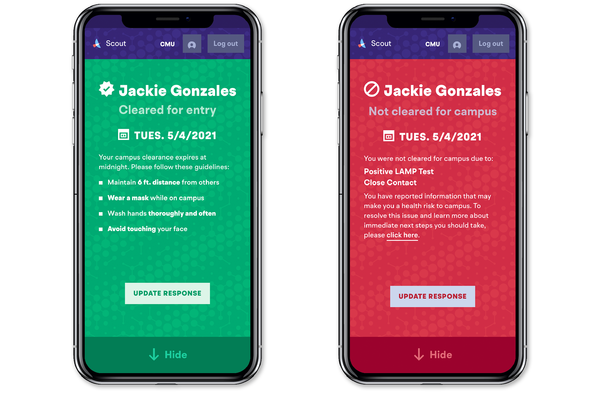
One weekend last August, Shynell Moore woke up with a headache and a sore throat. Ms. Moore, then just a few weeks into her junior year at Colorado Mesa University, pulled out her phone and fired up a symptom-tracking app called Scout.Within seconds of reporting her symptoms, the screen turned red: She might have Covid-19, the app said. She promptly got a call from a school administrator, and before the day was out, she had packed some clothes and her elephant ear fish, Dumbo, and moved into quarantine housing. Her Covid-19 test soon came back positive.Several days into her quarantine period, Ms. Moore took a whiff of Dumbo’s typically malodorous food. “I couldn’t smell it,” she said. “And then I drank some cough syrup, and I couldn’t taste it.” She opened Scout and clicked an option: “Lost taste or smell.”Students at Colorado Mesa University use the Scout app to report symptoms.Fathom/C.M.U.Each time she reported a symptom, the information was transmitted to Lookout, the university’s digital Covid-19 dashboard. Over the months that followed, Lookout evolved into a sophisticated system for tracking Covid-19 symptoms and cases across campus, recording students’ contacts, mapping case clusters, untangling chains of viral transmission and monitoring the spread of new variants.“Colorado Mesa has the most sophisticated system in the country to track outbreaks,” said Dr. Pardis Sabeti, a geneticist at the Broad Institute of M.I.T. and Harvard who has helped health officials around the world respond to Ebola, Lassa fever and other infectious diseases. “It’s definitely the kind of analytics that people talk about having but nobody actually has access to in this way.”Lookout is the product of a partnership between C.M.U. — a medium-sized school that sits in the high desert of Western Colorado and prides itself on serving disadvantaged students — and the Broad Institute, a cutting-edge genomic research center in Cambridge, Mass.Together, they have turned C.M.U.’s campus of 10,000-plus students into a real-world, real-time epidemiological laboratory, experimenting with creative approaches to pandemic management. Not everything has gone perfectly — college students will be college students, after all, and a university cannot be entirely cordoned off from the wider world. But the lessons they have learned and the tools they have developed could help institutions around the world better manage future outbreaks, Dr. Sabeti said: “We’re trying to build technologies that can be used globally. But a school is a great place to start.”Shynell “Nelly” Moore, a junior at Colorado Mesa University, contracted Covid-19 last fall and had to quarantine in the covid dorm. She brought her fish, Dumbo, with her.Eliza Earle for The New York TimesFacebook for outbreaksIn 2016 and 2017, mumps outbreaks blossomed across Massachusetts, hopping from one college campus to another. Dr. Sabeti worked closely with state epidemiologists, watching them map case clusters by hand and log data in increasingly unwieldy Excel spreadsheets. It was painstaking, time-consuming work, and the insights were “really hard-earned,” she said.In the years that followed, Dr. Sabeti and her postdoctoral fellow Andrés Colubri worked with a local firm, Fathom Information Design, to develop a symptom-tracking and contact-tracing app that could be used in future outbreaks. They imagined a scenario in which a college student could report a fever and then be informed that two students down the hall had recently developed the same symptom. “We called it the Facebook app for outbreaks,” Dr. Sabeti said.They were still developing the app, which became Scout, when Covid-19 hit. “Five-year plans turned into six-month plans,” Dr. Sabeti said. Fathom raced to finish the app, while Dr. Sabeti looked for a place to pilot it.Dr. Pardis Sabeti, a geneticist at the Broad Institute of M.I.T. and Harvard, has helped health officials around the world respond to Covid-19, Ebola, Lassa fever and other infectious diseases.Damon Winter/The New York TimesShe had begun advising colleges across the country on their coronavirus responses, but C.M.U., based in Grand Junction, Colo., immediately stood out to her. “We were looking for somebody who was scrappy, hungry, ready to go,” Dr. Sabeti said. “And we felt there was a need there.”Like many schools, C.M.U. had suddenly suspended its in-person classes in mid-March 2020. College students everywhere were facing the same educational disruption. But C.M.U. administrators worried that their students — two-thirds of whom were students of color, low-income or the first in their families to go to college — might be permanently derailed by a semester, or longer, spent entirely online.And so the administration made a decision: In the fall, it would bring students back to campus. All of them. “It became really obvious very quickly, this was a moral imperative,” said John Marshall, the school’s vice president. “We had to find a way to get back.” (Mr. Marshall, himself a C.M.U. alumnus, was recently named the university’s new president, starting on July 1.)Mr. Marshall and Amy Bronson, who directs C.M.U.’s physician assistant program, became co-chairs of the campus coronavirus response. When they first connected with Dr. Sabeti in the summer of 2020, they told her about C.M.U.’s can-do, community spirit and their determination not to make it a “less than” year for students. They also sent her a music video that students had made about returning to campus safely. John Marshall, vice-president of C.M.U., and Amy Bronson, director of the university’s physician assistant program.Eliza Earle for The New York TimesAs the teams began to talk, it soon became clear that their work together would go far beyond piloting an app. They strategized about testing, planned for worst-case scenarios and devised new learning experiences, including a for-credit seminar, “Leaning In: Leadership in the Time of a Pandemic.” (Dr. Sabeti and the governor of Colorado were both guest lecturers.)“C.M.U. had this really bold desire to be back and to revive in-person education,” said Kian Sani, special projects adviser to Dr. Sabeti. “So we really put our entire team and effort into supporting that mission.” The teams just clicked, he said. “It was basically like, ‘Let’s all hold hands’ — without actually all holding hands, because it’s a pandemic.”All in the ‘mavily’When students returned in August, Scout became their campus wellness passport. Every day, they used Scout to report whether they had any Covid-19 symptoms or had recently traveled outside the area. (They were also encouraged to log the names of any recent close contacts.) If they had no symptoms and no recent travel, the screen turned green. This green screen was their ticket to enter the classroom, the cafeteria and other campus buildings. It quickly became a new daily habit for students. “It’s an every day thing, for sure,” Ms. Moore said. “It’s engraved in the head: Got to do it every day.”The data was fed into Lookout, the dashboard that Fathom had developed to give administrators a holistic view of what was happening on campus: “Across this 10,000-student population, how are we actually doing day to day?” said Fathom’s founder, Ben Fry, who built Scout and Lookout with his colleague Olivia Glennon.C.M.U. uses a dashboard called Lookout to track Covid-19 symptoms and cases across campus. (All screenshots show simulated data and names.)Fathom/C.M.U.In addition to aggregating symptom data, Lookout also pulls in hourly results from the university’s coronavirus testing site. The university, which did not have the resources to test every student every week, had created a tiered testing strategy. Taking inspiration from the school mascot, the Maverick, C.M.U. asked students to sort themselves into family units, or “mavilies,” that encompassed their regular close contacts.The university randomly selected 250 students to take a coronavirus test every week. But students in certain high-risk mavilies — like members of sports teams, who often practiced, ate and lived together — were selected more frequently than those in lower-risk ones.When a student tested positive, administrators could use Lookout to see who was in their mavily and any other recent contacts they had reported in Scout. Lookout also displayed a list of every mavily with a recent positive test result, as well as any “high-spread” mavilies with multiple recent positives. (Mr. Marshall, Dr. Bronson and the university’s lead contact tracer were the only people with access to the full dashboard; all publicly reported information was aggregated, rather than tied to individual students, Dr. Bronson said.)Lookout can show Covid-19 tests results within a dorm, a sports team or a “mavily,” a group of close student contacts.Fathom/C.M.U.If it seemed like the virus was beginning to spread within a mavily, which happened on the football team in September, the university could take quick action. “That was something that was really successful for us: Being able to say, in real time, ‘OK, we’re going to shut down operations protocols for your team to meet, and instead, a percentage of you are all going to go test,’” Dr. Bronson said. “And we’re going to know pretty quickly whether or not that is moving through the mavily.”Wastewater warningsEngineering students collecting wastewater samples to test for coronavirus on campus. They meet three times a week to conduct the sampling rounds.Eliza Earle for The New York TimesLookout also displays a geographic heat map of cases, a dorm view with room-by-room maps of positive and negative test results, and data from a new wastewater surveillance system, which tracks the coronavirus levels in the sewage flowing from various dorms. (People with Covid-19 shed the virus in their stool.) “As Lookout came together, it took this really complicated web of data and helped us start to both visually see it and to start making sense of it,” Mr. Marshall said.The wastewater data has proved critical. In late September, for instance, the team noticed a sudden spike in the viral levels in wastewater from Grand Mesa, a suite-style residence hall. They responded by strategically testing a subset of residents, making sure to get at least one from each suite or mavily. They found two positives, traced their contacts and sent the infected students into quarantine.But when the next wastewater readings came in from Grand Mesa, the viral level was still high. More testing and tracing revealed that some students had not been entirely honest with the contact tracers about their social activities. The university ultimately identified four more cases in the dorm.Wastewater samples can help identify dorms that need additional Covid-19 testing.Fathom/C.M.U.“The kids were telling us one thing, but the data was telling us something different,” Mr. Marshall said. “If you just paid attention to the testing and the tracing, you would say, ‘Right, we fixed it.’ But the wastewater data was telling us, ‘Nope, you haven’t fixed it, you better go back in.’ And it allowed us to ultimately keep that confined.” (Despite some isolated incidents of dishonesty, most students cooperated with contact tracers, administrators said.)It was one of five times that the wastewater helped them discover multiple infected students in a particular dorm during the fall semester. “We feel pretty confident that we stopped five outbreaks,” said Kari Sholtes, an environmental engineer at C.M.U. who set up the wastewater system.C.M.U. is not the only school doing wastewater surveillance or targeted testing. But what sets C.M.U. apart is how effectively it has combined all the available tactics, said Eric Parrie, the chief executive of COVIDCheck Colorado, a social enterprise company that has helped schools and organizations across the state — including C.M.U., 14 other universities and 33 school districts — implement their testing and vaccination programs. “I think it’s best in class,” he said. “I think that’s true in Colorado, and I think it’s probably true, actually, if you look across the country.”Outbreak operationsThe wastewater sampling crew with its testing gear making its way to another sampling site.Eliza Earle for The New York TimesWhile administrators were scrambling to stop outbreaks, students in the leadership seminar were working to simulate one, partnering with a Broad Institute team on “Operation Outbreak.”The campuswide simulation deployed an educational smartphone app, which Dr. Sabeti and Dr. Colubri had developed several years prior. (Dr. Colubri now has his own lab at University of Massachusetts Medical School.) Over the Halloween weekend, hundreds of C.M.U. students went about their lives while letting the app, which could “transmit” a virtual virus to other nearby phones, run in the background. If students were in close proximity to another participating phone, they might become “infected.”The goal was to “empower the students to better understand how their actions are influencing their community and influencing their friend groups,” said Bryn Loftness, a C.M.U. computer science major who helped lead the project. “Maybe they’ll find out through this app that ‘Oh, I wasn’t social distancing as much as I thought I would, and I had this many close contacts. Maybe I can do better.’” (Ms. Loftness, who graduated from C.M.U. at the end of that semester, currently works as a research intern in Dr. Sabeti’s lab.)The data revealed that while many students were being careful, there was a subset with a lot of social contacts — maybe even enough of them to fuel a larger outbreak..css-1xzcza9{list-style-type:disc;padding-inline-start:1em;}.css-3btd0c{font-family:nyt-franklin,helvetica,arial,sans-serif;font-size:1rem;line-height:1.375rem;color:#333;margin-bottom:0.78125rem;}@media (min-width:740px){.css-3btd0c{font-size:1.0625rem;line-height:1.5rem;margin-bottom:0.9375rem;}}.css-3btd0c strong{font-weight:600;}.css-3btd0c em{font-style:italic;}.css-akgeos{margin-bottom:15px;font-family:nyt-franklin,helvetica,arial,sans-serif;font-size:0.75rem;line-height:1rem;color:#787878;}@media (min-width:740px){.css-akgeos{font-size:0.8125rem;line-height:1.125rem;}}.css-w739ur{margin:0 auto 5px;font-family:nyt-franklin,helvetica,arial,sans-serif;font-weight:700;font-size:1.125rem;line-height:1.3125rem;color:#121212;}#NYT_BELOW_MAIN_CONTENT_REGION .css-w739ur{font-family:nyt-cheltenham,georgia,’times new roman’,times,serif;font-weight:700;font-size:1.375rem;line-height:1.625rem;}@media (min-width:740px){#NYT_BELOW_MAIN_CONTENT_REGION .css-w739ur{font-size:1.6875rem;line-height:1.875rem;}}@media (min-width:740px){.css-w739ur{font-size:1.25rem;line-height:1.4375rem;}}.css-9s9ecg{margin-bottom:15px;}.css-1jiwgt1{display:-webkit-box;display:-webkit-flex;display:-ms-flexbox;display:flex;-webkit-box-pack:justify;-webkit-justify-content:space-between;-ms-flex-pack:justify;justify-content:space-between;margin-bottom:1.25rem;}.css-8o2i8v{display:-webkit-box;display:-webkit-flex;display:-ms-flexbox;display:flex;-webkit-flex-direction:column;-ms-flex-direction:column;flex-direction:column;-webkit-align-self:flex-end;-ms-flex-item-align:end;align-self:flex-end;}.css-8o2i8v p{margin-bottom:0;}.css-12vbvwq{background-color:white;border:1px solid #e2e2e2;width:calc(100% – 40px);max-width:600px;margin:1.5rem auto 1.9rem;padding:15px;box-sizing:border-box;}@media (min-width:740px){.css-12vbvwq{padding:20px;width:100%;}}.css-12vbvwq:focus{outline:1px solid #e2e2e2;}#NYT_BELOW_MAIN_CONTENT_REGION .css-12vbvwq{border:none;padding:10px 0 0;border-top:2px solid #121212;}.css-12vbvwq[data-truncated] .css-rdoyk0{-webkit-transform:rotate(0deg);-ms-transform:rotate(0deg);transform:rotate(0deg);}.css-12vbvwq[data-truncated] .css-eb027h{max-height:300px;overflow:hidden;-webkit-transition:none;transition:none;}.css-12vbvwq[data-truncated] .css-5gimkt:after{content:’See more’;}.css-12vbvwq[data-truncated] .css-6mllg9{opacity:1;}.css-1rh1sk1{margin:0 auto;overflow:hidden;}.css-1rh1sk1 strong{font-weight:700;}.css-1rh1sk1 em{font-style:italic;}.css-1rh1sk1 a{color:#326891;-webkit-text-decoration:underline;text-decoration:underline;text-underline-offset:1px;-webkit-text-decoration-thickness:1px;text-decoration-thickness:1px;-webkit-text-decoration-color:#ccd9e3;text-decoration-color:#ccd9e3;}.css-1rh1sk1 a:visited{color:#333;-webkit-text-decoration-color:#ccc;text-decoration-color:#ccc;}.css-1rh1sk1 a:hover{-webkit-text-decoration:none;text-decoration:none;}And then, just after the simulation ended, they had one.Over the course of October, the number of Covid-19 cases in the surrounding community, Mesa County, had climbed steadily. University officials watched with some trepidation; 90 percent of C.M.U. students had jobs, many in the service industry.Grace Tandus, left, and Madelyn Schmidt prepared for going out to collect samples.Eliza Earle for The New York TimesFor three weeks, it seemed like their pandemic measures might be enough to keep the virus off campus. But then, in early November, more cases began popping up at C.M.U. — in many different mavilies and dorms. Cases ticked up from 26, in the last week of October, to 124 the following week. The week after that, cases peaked at 290.The university tripled the size of its contact-tracing staff and quadrupled the number of tests it was administering. “We were, hour by hour, working through the contact tracing, working through the case management, watching wastewater,” Mr. Marshall said.As different mavilies became viral hot spots, administrators began implementing “Covid timeouts,” asking all members to follow a modified quarantine procedure until they found every affiliated case. They also urged students to be socially responsible, especially as they prepared to leave campus for Thanksgiving.To reduce student travel, C.M.U. had always planned to conduct virtual classes between Thanksgiving and winter break. Ultimately, it suspended in-person classes several days early to give students more time to get tested and isolate before returning home. “We did not send a bunch of people out of here, all positive, going to spread it to other places,” Dr. Bronson said.And when students left campus, C.M.U. opened its testing site to members of the broader community, who sometimes faced long waits at the county’s single drive-through testing site. “They helped ease that pressure,” said Jeff Kuhr, the executive director of Mesa County’s public health department. Over the next two months, C.M.U.’s testing site administered more than 18,000 tests to local residents. The autumn surge was “overwhelming,” Dr. Kuhr said. “But it was great to have C.M.U. by our side.”Life goes onLucas Torres, a biology major graduating on Saturday, had initially been nervous about returning to C.M.U. during a pandemic. But returning turned out to be a bright spot.Eliza Earle for The New York TimesThe November outbreak had illustrated how intertwined the university was with the wider community. So when students returned to campus in January, C.M.U. expanded mavilies, contact tracing and targeted testing efforts to include students’ off-campus contacts.The campus testing site remained open to all county residents. This “altruistic” testing strategy has become a cornerstone of the university’s response, and Dr. Sabeti’s team recently created a model demonstrating that this approach can help institutions keep their own members safe.The Broad Institute scientists have also begun sequencing Covid-19 tests and wastewater samples from C.M.U., identifying a new variant that spread rapidly across campus. Their collaborators are currently studying it to determine whether it might be more dangerous.The sequencing data — which is now, of course, in Lookout — has also allowed the teams to map hidden chains of transmission, identifying linked cases and providing hints about exactly when and where the virus is spreading.The Lookout dashboard can show sequencing data for confirmed cases.Fathom/C.M.U.So far, Mr. Marshall said, they have not identified a single case of coronavirus transmission that happened in the classroom, where students wore masks and remained socially distanced — and had to show a green screen for admission. Instead, most students seemed to contract the virus at small social gatherings or, to a lesser extent, in the workplace.The detailed, high-resolution data from C.M.U. will “help us better understand viral spread in congregate settings and how we can help mitigate it in the future,” said Dr. Sabeti, who plans to publish a “deep study” of the transmission dynamics at C.M.U.Aiming to gain the same sorts of insights, the Colorado Department of Public Health and Environment, is finalizing a deal to send samples from a few dozen state-run testing sites to the Broad Institute for sequencing, said Dr. Emily Travanty, the department’s lab director.Over the longer term, Dr. Sabeti and her colleagues hope to build versions of Scout and Lookout that can be used by schools, companies, local governments and other organizations around the world to respond to outbreaks of infectious disease.C.M.U. is also looking ahead, brainstorming about how they could adapt Scout for the fall, when many students will be vaccinated, and whether they can use their new tools to slow the spread of other infectious diseases, like flu. “We were on a call with Fathom a few days ago dreaming about what the long game looks like,” Dr. Bronson said.With graduation set for this weekend, Mr. Marshall, C.M.U.’s soon-to-be president, is pleased with how the past year has gone. “I view it as a success and not a small one,” he said. “I think we will look back on this year as being one of those defining moments for our university.” Yes, they had Covid-19 cases, he said, but they also had 881 freshmen who were the first in their families to go to college — who were able to actually go to college.“It was never about how do you stop a virus?” Mr. Marshall said. Instead, he said, the challenge was: “How do you manage life while dealing with a pandemic? And in that regard, I would say we’ve done as strong of a job as anybody.”Lucas Torres, a biology major graduating on Saturday, had initially been nervous about returning to C.M.U. during a deadly pandemic. And it had turned out to be an enormously difficult year for him: During winter break, he and several of his family members all got Covid-19. His mother developed pneumonia and his grandmother died from the disease.School had turned out to be a bright spot. Mr. Torres was “inspired” by C.M.U.’s response, he said: “It allowed for students to have a purpose. There was a responsibility, shared responsibility coming back to campus.”Shortly after recovering from Covid-19, he proposed to his girlfriend. (She said yes.) He is about to take his E.M.T. certification exam and hopes to go to medical school.“I was able to make the most of my time at C.M.U., and I’m glad that they allowed for that,” Mr. Torres said. “Even if it wasn’t the same as it would be if not for Covid, it was better than sitting at home in front of a screen.”

Read more →

How a Colorado Campus Became a Pandemic Laboratory

One weekend last August, Shynell Moore woke up with a headache and a sore throat. Ms. Moore, then just a few weeks into her junior year at Colorado Mesa University, pulled out her phone and fired up a symptom-tracking app called Scout.Within seconds of reporting her symptoms, the screen turned red: She might have Covid-19, the app said. She promptly got a call from a school administrator, and before the day was out, she had packed some clothes and her elephant ear fish, Dumbo, and moved into quarantine housing. Her Covid-19 test soon came back positive.Several days into her quarantine period, Ms. Moore took a whiff of Dumbo’s typically malodorous food. “I couldn’t smell it,” she said. “And then I drank some cough syrup, and I couldn’t taste it.” She opened Scout and clicked an option: “Lost taste or smell.”Students at Colorado Mesa University use the Scout app to report symptoms.Fathom/C.M.U.Each time she reported a symptom, the information was transmitted to Lookout, the university’s digital Covid-19 dashboard. Over the months that followed, Lookout evolved into a sophisticated system for tracking Covid-19 symptoms and cases across campus, recording students’ contacts, mapping case clusters, untangling chains of viral transmission and monitoring the spread of new variants.“Colorado Mesa has the most sophisticated system in the country to track outbreaks,” said Dr. Pardis Sabeti, a geneticist at the Broad Institute of M.I.T. and Harvard who has helped health officials around the world respond to Ebola, Lassa fever and other infectious diseases. “It’s definitely the kind of analytics that people talk about having but nobody actually has access to in this way.”Lookout is the product of a partnership between C.M.U. — a medium-sized school that sits in the high desert of Western Colorado and prides itself on serving disadvantaged students — and the Broad Institute, a cutting-edge genomic research center in Cambridge, Mass.Together, they have turned C.M.U.’s campus of 10,000-plus students into a real-world, real-time epidemiological laboratory, experimenting with creative approaches to pandemic management. Not everything has gone perfectly — college students will be college students, after all, and a university cannot be entirely cordoned off from the wider world. But the lessons they have learned and the tools they have developed could help institutions around the world better manage future outbreaks, Dr. Sabeti said: “We’re trying to build technologies that can be used globally. But a school is a great place to start.”Shynell “Nelly” Moore, a junior at Colorado Mesa University, contracted Covid-19 last fall and had to quarantine in the covid dorm. She brought her fish, Dumbo, with her.Eliza Earle for The New York TimesFacebook for outbreaksIn 2016 and 2017, mumps outbreaks blossomed across Massachusetts, hopping from one college campus to another. Dr. Sabeti worked closely with state epidemiologists, watching them map case clusters by hand and log data in increasingly unwieldy Excel spreadsheets. It was painstaking, time-consuming work, and the insights were “really hard-earned,” she said.In the years that followed, Dr. Sabeti and her postdoctoral fellow Andrés Colubri worked with a local firm, Fathom Information Design, to develop a symptom-tracking and contact-tracing app that could be used in future outbreaks. They imagined a scenario in which a college student could report a fever and then be informed that two students down the hall had recently developed the same symptom. “We called it the Facebook app for outbreaks,” Dr. Sabeti said.They were still developing the app, which became Scout, when Covid-19 hit. “Five-year plans turned into six-month plans,” Dr. Sabeti said. Fathom raced to finish the app, while Dr. Sabeti looked for a place to pilot it.Dr. Pardis Sabeti, a geneticist at the Broad Institute of M.I.T. and Harvard, has helped health officials around the world respond to Covid-19, Ebola, Lassa fever and other infectious diseases.Damon Winter/The New York TimesShe had begun advising colleges across the country on their coronavirus responses, but C.M.U., based in Grand Junction, Colo., immediately stood out to her. “We were looking for somebody who was scrappy, hungry, ready to go,” Dr. Sabeti said. “And we felt there was a need there.”Like many schools, C.M.U. had suddenly suspended its in-person classes in mid-March 2020. College students everywhere were facing the same educational disruption. But C.M.U. administrators worried that their students — two-thirds of whom were students of color, low-income or the first in their families to go to college — might be permanently derailed by a semester, or longer, spent entirely online.And so the administration made a decision: In the fall, it would bring students back to campus. All of them. “It became really obvious very quickly, this was a moral imperative,” said John Marshall, the school’s vice president. “We had to find a way to get back.” (Mr. Marshall, himself a C.M.U. alumnus, was recently named the university’s new president, starting on July 1.)Mr. Marshall and Amy Bronson, who directs C.M.U.’s physician assistant program, became co-chairs of the campus coronavirus response. When they first connected with Dr. Sabeti in the summer of 2020, they told her about C.M.U.’s can-do, community spirit and their determination not to make it a “less than” year for students. They also sent her a music video that students had made about returning to campus safely. John Marshall, vice-president of C.M.U., and Amy Bronson, director of the university’s physician assistant program.Eliza Earle for The New York TimesAs the teams began to talk, it soon became clear that their work together would go far beyond piloting an app. They strategized about testing, planned for worst-case scenarios and devised new learning experiences, including a for-credit seminar, “Leaning In: Leadership in the Time of a Pandemic.” (Dr. Sabeti and the governor of Colorado were both guest lecturers.)“C.M.U. had this really bold desire to be back and to revive in-person education,” said Kian Sani, special projects adviser to Dr. Sabeti. “So we really put our entire team and effort into supporting that mission.” The teams just clicked, he said. “It was basically like, ‘Let’s all hold hands’ — without actually all holding hands, because it’s a pandemic.”All in the ‘mavily’When students returned in August, Scout became their campus wellness passport. Every day, they used Scout to report whether they had any Covid-19 symptoms or had recently traveled outside the area. (They were also encouraged to log the names of any recent close contacts.) If they had no symptoms and no recent travel, the screen turned green. This green screen was their ticket to enter the classroom, the cafeteria and other campus buildings. It quickly became a new daily habit for students. “It’s an every day thing, for sure,” Ms. Moore said. “It’s engraved in the head: Got to do it every day.”The data was fed into Lookout, the dashboard that Fathom had developed to give administrators a holistic view of what was happening on campus: “Across this 10,000-student population, how are we actually doing day to day?” said Fathom’s founder, Ben Fry, who built Scout and Lookout with his colleague Olivia Glennon.C.M.U. uses a dashboard called Lookout to track Covid-19 symptoms and cases across campus. (All screenshots show simulated data and names.)Fathom/C.M.U.In addition to aggregating symptom data, Lookout also pulls in hourly results from the university’s coronavirus testing site. The university, which did not have the resources to test every student every week, had created a tiered testing strategy. Taking inspiration from the school mascot, the Maverick, C.M.U. asked students to sort themselves into family units, or “mavilies,” that encompassed their regular close contacts.The university randomly selected 250 students to take a coronavirus test every week. But students in certain high-risk mavilies — like members of sports teams, who often practiced, ate and lived together — were selected more frequently than those in lower-risk ones.When a student tested positive, administrators could use Lookout to see who was in their mavily and any other recent contacts they had reported in Scout. Lookout also displayed a list of every mavily with a recent positive test result, as well as any “high-spread” mavilies with multiple recent positives. (Mr. Marshall, Dr. Bronson and the university’s lead contact tracer were the only people with access to the full dashboard; all publicly reported information was aggregated, rather than tied to individual students, Dr. Bronson said.)Lookout can show Covid-19 tests results within a dorm, a sports team or a “mavily,” a group of close student contacts.Fathom/C.M.U.If it seemed like the virus was beginning to spread within a mavily, which happened on the football team in September, the university could take quick action. “That was something that was really successful for us: Being able to say, in real time, ‘OK, we’re going to shut down operations protocols for your team to meet, and instead, a percentage of you are all going to go test,’” Dr. Bronson said. “And we’re going to know pretty quickly whether or not that is moving through the mavily.”Wastewater warningsEngineering students collecting wastewater samples to test for coronavirus on campus. They meet three times a week to conduct the sampling rounds.Eliza Earle for The New York TimesLookout also displays a geographic heat map of cases, a dorm view with room-by-room maps of positive and negative test results, and data from a new wastewater surveillance system, which tracks the coronavirus levels in the sewage flowing from various dorms. (People with Covid-19 shed the virus in their stool.) “As Lookout came together, it took this really complicated web of data and helped us start to both visually see it and to start making sense of it,” Mr. Marshall said.The wastewater data has proved critical. In late September, for instance, the team noticed a sudden spike in the viral levels in wastewater from Grand Mesa, a suite-style residence hall. They responded by strategically testing a subset of residents, making sure to get at least one from each suite or mavily. They found two positives, traced their contacts and sent the infected students into quarantine.But when the next wastewater readings came in from Grand Mesa, the viral level was still high. More testing and tracing revealed that some students had not been entirely honest with the contact tracers about their social activities. The university ultimately identified four more cases in the dorm.Wastewater samples can help identify dorms that need additional Covid-19 testing.Fathom/C.M.U.“The kids were telling us one thing, but the data was telling us something different,” Mr. Marshall said. “If you just paid attention to the testing and the tracing, you would say, ‘Right, we fixed it.’ But the wastewater data was telling us, ‘Nope, you haven’t fixed it, you better go back in.’ And it allowed us to ultimately keep that confined.” (Despite some isolated incidents of dishonesty, most students cooperated with contact tracers, administrators said.)It was one of five times that the wastewater helped them discover multiple infected students in a particular dorm during the fall semester. “We feel pretty confident that we stopped five outbreaks,” said Kari Sholtes, an environmental engineer at C.M.U. who set up the wastewater system.C.M.U. is not the only school doing wastewater surveillance or targeted testing. But what sets C.M.U. apart is how effectively it has combined all the available tactics, said Eric Parrie, the chief executive of COVIDCheck Colorado, a social enterprise company that has helped schools and organizations across the state — including C.M.U., 14 other universities and 33 school districts — implement their testing and vaccination programs. “I think it’s best in class,” he said. “I think that’s true in Colorado, and I think it’s probably true, actually, if you look across the country.”Outbreak operationsThe wastewater sampling crew with its testing gear making its way to another sampling site.Eliza Earle for The New York TimesWhile administrators were scrambling to stop outbreaks, students in the leadership seminar were working to simulate one, partnering with a Broad Institute team on “Operation Outbreak.”The campuswide simulation deployed an educational smartphone app, which Dr. Sabeti and Dr. Colubri had developed several years prior. (Dr. Colubri now has his own lab at University of Massachusetts Medical School.) Over the Halloween weekend, hundreds of C.M.U. students went about their lives while letting the app, which could “transmit” a virtual virus to other nearby phones, run in the background. If students were in close proximity to another participating phone, they might become “infected.”The goal was to “empower the students to better understand how their actions are influencing their community and influencing their friend groups,” said Bryn Loftness, a C.M.U. computer science major who helped lead the project. “Maybe they’ll find out through this app that ‘Oh, I wasn’t social distancing as much as I thought I would, and I had this many close contacts. Maybe I can do better.’” (Ms. Loftness, who graduated from C.M.U. at the end of that semester, currently works as a research intern in Dr. Sabeti’s lab.)The data revealed that while many students were being careful, there was a subset with a lot of social contacts — maybe even enough of them to fuel a larger outbreak..css-1xzcza9{list-style-type:disc;padding-inline-start:1em;}.css-3btd0c{font-family:nyt-franklin,helvetica,arial,sans-serif;font-size:1rem;line-height:1.375rem;color:#333;margin-bottom:0.78125rem;}@media (min-width:740px){.css-3btd0c{font-size:1.0625rem;line-height:1.5rem;margin-bottom:0.9375rem;}}.css-3btd0c strong{font-weight:600;}.css-3btd0c em{font-style:italic;}.css-akgeos{margin-bottom:15px;font-family:nyt-franklin,helvetica,arial,sans-serif;font-size:0.75rem;line-height:1rem;color:#787878;}@media (min-width:740px){.css-akgeos{font-size:0.8125rem;line-height:1.125rem;}}.css-w739ur{margin:0 auto 5px;font-family:nyt-franklin,helvetica,arial,sans-serif;font-weight:700;font-size:1.125rem;line-height:1.3125rem;color:#121212;}#NYT_BELOW_MAIN_CONTENT_REGION .css-w739ur{font-family:nyt-cheltenham,georgia,’times new roman’,times,serif;font-weight:700;font-size:1.375rem;line-height:1.625rem;}@media (min-width:740px){#NYT_BELOW_MAIN_CONTENT_REGION .css-w739ur{font-size:1.6875rem;line-height:1.875rem;}}@media (min-width:740px){.css-w739ur{font-size:1.25rem;line-height:1.4375rem;}}.css-9s9ecg{margin-bottom:15px;}.css-1jiwgt1{display:-webkit-box;display:-webkit-flex;display:-ms-flexbox;display:flex;-webkit-box-pack:justify;-webkit-justify-content:space-between;-ms-flex-pack:justify;justify-content:space-between;margin-bottom:1.25rem;}.css-8o2i8v{display:-webkit-box;display:-webkit-flex;display:-ms-flexbox;display:flex;-webkit-flex-direction:column;-ms-flex-direction:column;flex-direction:column;-webkit-align-self:flex-end;-ms-flex-item-align:end;align-self:flex-end;}.css-8o2i8v p{margin-bottom:0;}.css-12vbvwq{background-color:white;border:1px solid #e2e2e2;width:calc(100% – 40px);max-width:600px;margin:1.5rem auto 1.9rem;padding:15px;box-sizing:border-box;}@media (min-width:740px){.css-12vbvwq{padding:20px;width:100%;}}.css-12vbvwq:focus{outline:1px solid #e2e2e2;}#NYT_BELOW_MAIN_CONTENT_REGION .css-12vbvwq{border:none;padding:10px 0 0;border-top:2px solid #121212;}.css-12vbvwq[data-truncated] .css-rdoyk0{-webkit-transform:rotate(0deg);-ms-transform:rotate(0deg);transform:rotate(0deg);}.css-12vbvwq[data-truncated] .css-eb027h{max-height:300px;overflow:hidden;-webkit-transition:none;transition:none;}.css-12vbvwq[data-truncated] .css-5gimkt:after{content:’See more’;}.css-12vbvwq[data-truncated] .css-6mllg9{opacity:1;}.css-1rh1sk1{margin:0 auto;overflow:hidden;}.css-1rh1sk1 strong{font-weight:700;}.css-1rh1sk1 em{font-style:italic;}.css-1rh1sk1 a{color:#326891;-webkit-text-decoration:underline;text-decoration:underline;text-underline-offset:1px;-webkit-text-decoration-thickness:1px;text-decoration-thickness:1px;-webkit-text-decoration-color:#ccd9e3;text-decoration-color:#ccd9e3;}.css-1rh1sk1 a:visited{color:#333;-webkit-text-decoration-color:#ccc;text-decoration-color:#ccc;}.css-1rh1sk1 a:hover{-webkit-text-decoration:none;text-decoration:none;}And then, just after the simulation ended, they had one.Over the course of October, the number of Covid-19 cases in the surrounding community, Mesa County, had climbed steadily. University officials watched with some trepidation; 90 percent of C.M.U. students had jobs, many in the service industry.Grace Tandus, left, and Madelyn Schmidt prepared for going out to collect samples.Eliza Earle for The New York TimesFor three weeks, it seemed like their pandemic measures might be enough to keep the virus off campus. But then, in early November, more cases began popping up at C.M.U. — in many different mavilies and dorms. Cases ticked up from 26, in the last week of October, to 124 the following week. The week after that, cases peaked at 290.The university tripled the size of its contact-tracing staff and quadrupled the number of tests it was administering. “We were, hour by hour, working through the contact tracing, working through the case management, watching wastewater,” Mr. Marshall said.As different mavilies became viral hot spots, administrators began implementing “Covid timeouts,” asking all members to follow a modified quarantine procedure until they found every affiliated case. They also urged students to be socially responsible, especially as they prepared to leave campus for Thanksgiving.To reduce student travel, C.M.U. had always planned to conduct virtual classes between Thanksgiving and winter break. Ultimately, it suspended in-person classes several days early to give students more time to get tested and isolate before returning home. “We did not send a bunch of people out of here, all positive, going to spread it to other places,” Dr. Bronson said.And when students left campus, C.M.U. opened its testing site to members of the broader community, who sometimes faced long waits at the county’s single drive-through testing site. “They helped ease that pressure,” said Jeff Kuhr, the executive director of Mesa County’s public health department. Over the next two months, C.M.U.’s testing site administered more than 18,000 tests to local residents. The autumn surge was “overwhelming,” Dr. Kuhr said. “But it was great to have C.M.U. by our side.”Life goes onLucas Torres, a biology major graduating on Saturday, had initially been nervous about returning to C.M.U. during a pandemic. But returning turned out to be a bright spot.Eliza Earle for The New York TimesThe November outbreak had illustrated how intertwined the university was with the wider community. So when students returned to campus in January, C.M.U. expanded mavilies, contact tracing and targeted testing efforts to include students’ off-campus contacts.The campus testing site remained open to all county residents. This “altruistic” testing strategy has become a cornerstone of the university’s response, and Dr. Sabeti’s team recently created a model demonstrating that this approach can help institutions keep their own members safe.The Broad Institute scientists have also begun sequencing Covid-19 tests and wastewater samples from C.M.U., identifying a new variant that spread rapidly across campus. Their collaborators are currently studying it to determine whether it might be more dangerous.The sequencing data — which is now, of course, in Lookout — has also allowed the teams to map hidden chains of transmission, identifying linked cases and providing hints about exactly when and where the virus is spreading.The Lookout dashboard can show sequencing data for confirmed cases.Fathom/C.M.U.So far, Mr. Marshall said, they have not identified a single case of coronavirus transmission that happened in the classroom, where students wore masks and remained socially distanced — and had to show a green screen for admission. Instead, most students seemed to contract the virus at small social gatherings or, to a lesser extent, in the workplace.The detailed, high-resolution data from C.M.U. will “help us better understand viral spread in congregate settings and how we can help mitigate it in the future,” said Dr. Sabeti, who plans to publish a “deep study” of the transmission dynamics at C.M.U.Aiming to gain the same sorts of insights, the Colorado Department of Public Health and Environment, is finalizing a deal to send samples from a few dozen state-run testing sites to the Broad Institute for sequencing, said Dr. Emily Travanty, the department’s lab director.Over the longer term, Dr. Sabeti and her colleagues hope to build versions of Scout and Lookout that can be used by schools, companies, local governments and other organizations around the world to respond to outbreaks of infectious disease.C.M.U. is also looking ahead, brainstorming about how they could adapt Scout for the fall, when many students will be vaccinated, and whether they can use their new tools to slow the spread of other infectious diseases, like flu. “We were on a call with Fathom a few days ago dreaming about what the long game looks like,” Dr. Bronson said.With graduation set for this weekend, Mr. Marshall, C.M.U.’s soon-to-be president, is pleased with how the past year has gone. “I view it as a success and not a small one,” he said. “I think we will look back on this year as being one of those defining moments for our university.” Yes, they had Covid-19 cases, he said, but they also had 881 freshmen who were the first in their families to go to college — who were able to actually go to college.“It was never about how do you stop a virus?” Mr. Marshall said. Instead, he said, the challenge was: “How do you manage life while dealing with a pandemic? And in that regard, I would say we’ve done as strong of a job as anybody.”Lucas Torres, a biology major graduating on Saturday, had initially been nervous about returning to C.M.U. during a deadly pandemic. And it had turned out to be an enormously difficult year for him: During winter break, he and several of his family members all got Covid-19. His mother developed pneumonia and his grandmother died from the disease.School had turned out to be a bright spot. Mr. Torres was “inspired” by C.M.U.’s response, he said: “It allowed for students to have a purpose. There was a responsibility, shared responsibility coming back to campus.”Shortly after recovering from Covid-19, he proposed to his girlfriend. (She said yes.) He is about to take his E.M.T. certification exam and hopes to go to medical school.“I was able to make the most of my time at C.M.U., and I’m glad that they allowed for that,” Mr. Torres said. “Even if it wasn’t the same as it would be if not for Covid, it was better than sitting at home in front of a screen.”

Read more →

Aspirin May Help Protect the Brain From Pollution's Toll, Study Suggests

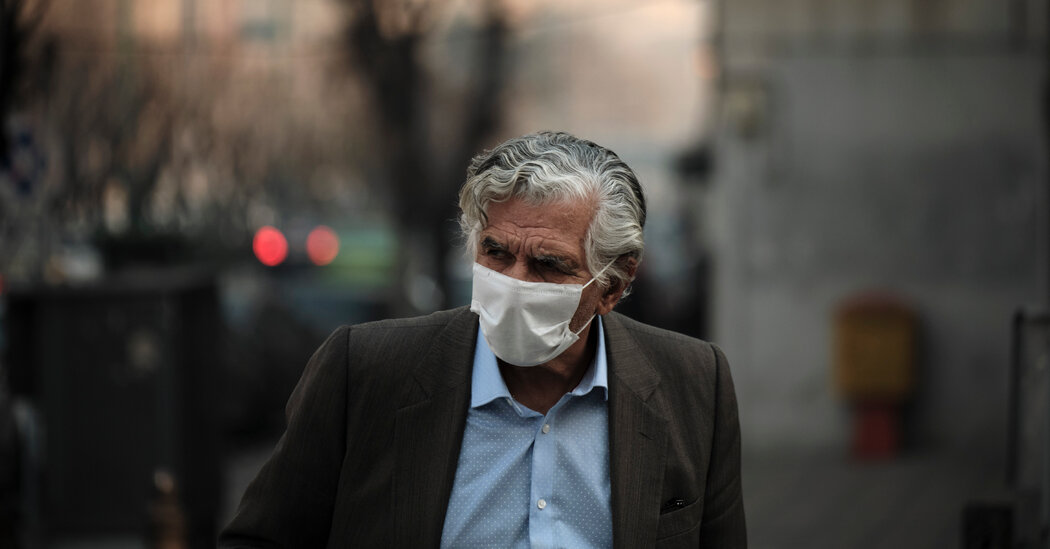
Even short-term exposure to polluted air may impair mental ability in the elderly. Aspirin and other NSAIDs showed some protective effects.Long-term exposure to air pollution has many health consequences, including accelerating brain aging and increasing the risk for dementia. Now new research suggests that short-term exposure to polluted air, even at levels generally considered “acceptable,” may impair mental ability in the elderly.Scientists studied 954 men, average age 69, living in the greater Boston area. The men were tested at the start of the study and several times over the next 28 days using the Mini-Mental State Examination, or MMSE, a widely used test of cognitive ability. The test includes simple questions like “What year is this?” and “What season is it?,” and requires tasks like counting backward by sevens from 100. Correctly answering fewer than 25 of its 30 questions suggests mild dementia.Over the month, the researchers measured air levels of what’s known as PM 2.5, particles of soot and other fine particulate matter with a diameter of up to 2.5 microns, small enough to enter the lungs and move into bloodstream. There is no safe level of PM 2.5, but the Environmental Protection Agency considers air acceptable when it is under 12 micrograms per cubic meter. During the testing period, PM 2.5 levels in Boston averaged 10.77.Higher PM 2.5 was consistently associated with lower test scores. In weeks with the highest levels of air pollution, the men were 63 percent more likely to score below 25 on the MMSE than in weeks with the lowest levels. The study, in Nature Aging, adjusted for age, B.M.I., coronary heart disease, diabetes, alcohol consumption, smoking, high blood pressure and other factors.Dr. Andrea A. Baccarelli, the senior author and a professor of environmental science at the Columbia Mailman School of Public Health, said that these short-term effects may be reversible. “When air pollution goes down,” he said, “the brain reboots and goes back to normal. However, if repeated, these episodes produce long-term damage to the brain.”“Some of these particles come from natural sources — sea salt, for example, soil and pollen,” Dr. Baccarelli added. “We’ll never be completely free of them. But the ones generated by humans are much worse. The good news is that we’re at a point where we have the technology to reduce air pollution even further.”In a finding the researchers described as “intriguing,” they discovered that men taking NSAIDs — aspirin and other nonsteroidal anti-inflammatory drugs — were partially protected from the negative cognitive effects of pollution. They speculate that NSAIDs may reduce the inflammatory response to pollutants in the brain and nervous system.“This is an impressive study,” said Robert M. Bilder, a professor of psychiatry and psychology at the University of California, Los Angeles, who was not involved in the work. But, he said, the study is observational and not a randomized trial, so does not prove cause and effect. Moreover, it was done only in older white men, many of whom were overweight or had a history of smoking. “Given the established risks of PM and other environmental hazards on cognition, and particularly given their disproportionate impacts on racial and ethnic minority communities,” he said, “we urgently need research that goes beyond the study of white men.”Dr. Bilder pointed out that “the study reveals a potentially important interaction between the use of NSAIDs and exposures to environmental risk. We need controlled clinical trials and further basic research to specify the mechanisms through which the NSAIDs may work.”Dr. Baccarelli agreed. “I would love to do a randomized trial to see if there is a real benefit,” he said. For now, “anything that promotes a healthy lifestyle helps protect against air pollution. A healthy diet helps. Physical exercise helps. But I wouldn’t tell anyone to take aspirin for protection against air pollution.”Nathalie LeesJoin us for Well’s Fresh Start Challenge! Starting Monday May 17 we’ll text you daily tips for mindful living. To sign up, just text “Hi” (or any word) to 917-809-4995 for a link to join. (Message and data rates may apply.)

Read more →

A Jane Brody Birthday Milestone: 80!

The secret to a happy and vibrant old age? Strive to do what you love for as long as you can do it.When a 50ish woman at my Y learned that I was about to turn 80, she exclaimed, “80 is the new 60, and you set a great example for the rest of us!”At least, I’m in good company:Dr. Anthony Fauci, national infectious disease guru, is five months my senior, sharp as a tack even under withering political fire;Nancy Pelosi, 81-year-old Speaker of the House, also stands up well against fierce opposition;Anthony Hopkins, 83, Oscar winner for “The Silence of the Lambs” and a frequent nominee, won again this year for “The Father;”Morgan Freeman, also 83, acts with a voice of distinction bested only by his formidable talent. He has four upcoming movies and a TV series.Bernie Sanders, former presidential hopeful who will be 80 in September, remains a force to be reckoned with in the U.S. Senate;Paul Simon, a month younger than Mr. Sanders, has won 12 Grammys as a singer and songwriter in a now six-decade career. He recently sold his songwriting catalog to Sony for around $250 million.)The list goes on. As my late husband, who didn’t make it to that milestone, would have said, “80 — not a record, but not a bad average.”Indeed, many have done far better. Everyday I read or hear about folks in their 90s who are still remarkably active and productive. Check out this recent feature in The Times on the indefatigable architect Frank Gehry. At 92, his latest project is a spectacular development in downtown Los Angeles. When asked if he’d consider retiring, he replied, “What would I do? I enjoy this stuff.”That to me is the secret of a happy, vibrant old age: Strive to do what you love for as long as you can do it. If the vicissitudes of life or infirmities of age preclude a preferred activity, modify it or substitute another. I can no longer safely skate, ski or play tennis, but I can still bike, hike and swim. I consider daily physical activity to be as important as eating and sleeping. I accept no excuses.And, as you can see, I still write, although it often takes me longer than it used to. In my job as a health columnist, I’m paid to be continually educated and inspired by the research and interviews I do for my weekly column. They keep my brain and spirit alive. And when a word or its spelling eludes me, there’s Google and my editors to fill in the gaps.The cohort of Americans who have lived for eight or more decades is rising steadily and projected to grow faster than the cohort of youngsters under 18 for at least the next 40 years. In fact, as more of us in the late decades of life continue to thrive, morbidity and mortality were rising among middle-aged men and women even before the pandemic. The average newborn today is not expected to make it to 80, thanks largely to poor diet and exercise and rising obesity.Assuming most people would opt for a long and fulfilling life, Nature permitting, what does this take? What accounts for the growing number of octogenarians and beyond who are accomplished and still accomplishing?Many clues have emerged during my decades of reporting on health. I’ve already alluded to the importance of regular physical activity, which supports a healthy brain and body. Assuming you don’t smoke, which was my husband’s undoing, Nature will usually take pretty good care of you for about half a century. Thereafter, it’s up to you.Without regular exercise, you can expect to experience a loss of muscle strength and endurance, coordination and balance, flexibility and mobility, bone strength and cardiovascular and respiratory function. In other words, a sedentary lifestyle is a recipe for chronic disease and decline.Abandon all excuses, as Todd Balf did after he became partially paralyzed following spinal surgery for cancer. Though he had long shunned being immersed in water, with a physical therapist as coach, he finally took the plunge and discovered that swimming back and forth in a pool buoyed both his body and soul.Of course, like any machine, to maintain peak levels of activity the human body requires quality fuel. Growing up, most of us who are now 80 and beyond were largely spared the plethora of ultra-processed foods that now line the shelves of every grocery. My father, the family food shopper, was a big fan of oatmeal and shredded wheat, fresh fruits and vegetables.Eating out was an occasional treat (and for me, still is). Most meals were prepared and eaten family style at home. Fast foods? Maybe a hot dog when we biked miles to Coney Island or celebrated my birthday at a Brooklyn Dodgers game. I was in my early 20s when McDonalds ballyhooed that it had just sold 600,000 burgers! (The company stopped counting in 1994, after it hit 99 billion burgers served.)But exercise and nutrition are not enough. Studies suggest that motivation, attitude and perspective are equally important to a long, healthy and fulfilling life. I was still in high school when my mother died of cancer at age 49, and her premature loss became a lesson for me to live each day as if it’s my last with a keen eye on the future in case it’s not.I entered college with plans to become a biochemist and discover lifesaving clues to cancer. But I found working in a laboratory boring and isolating, and in my junior year realized my true love was learning what others discovered and communicating that information to the public. So I married biochemistry with journalism, pursued a fulfilling career in science writing focused on personal and public health and, like a horse with blinders, never looked back.My advice to students: Try to combine your passion with your talent and you’ll have the best shot at a rich and rewarding career. I also recommend choosing a supportive life partner who’s willing to share the mundane tasks of daily life and step up for extra duty when needed.Having been raised to save, all my life I’ve shopped sales and bargains and parlayed the monetary rewards into scholarships for deserving students and fabulous nature, hiking and cycling trips for me, family and friends.Have I any regrets? I regret taking French instead of Spanish in high school and I keep trying to learn the latter, a far more practical language, on my own. I regret that I never learned to speed-read; whether for work or leisure, I read slowly, as if everything in print is a complex scientific text. Although I’d visited all seven continents before I turned 50, I never got to see the orangutans in their native Borneo or the gorillas in Rwanda. But I’m content now to see them up close on public television.If and when I finally retire, I’d like to work as a volunteer with young children. They lighten my step, warm my heart and enrich my soul. Their joie de vivre and innate curiosity foster hope that the world of the future will be a better one.

Read more →

UK PM urges 'caution' as lockdown eases

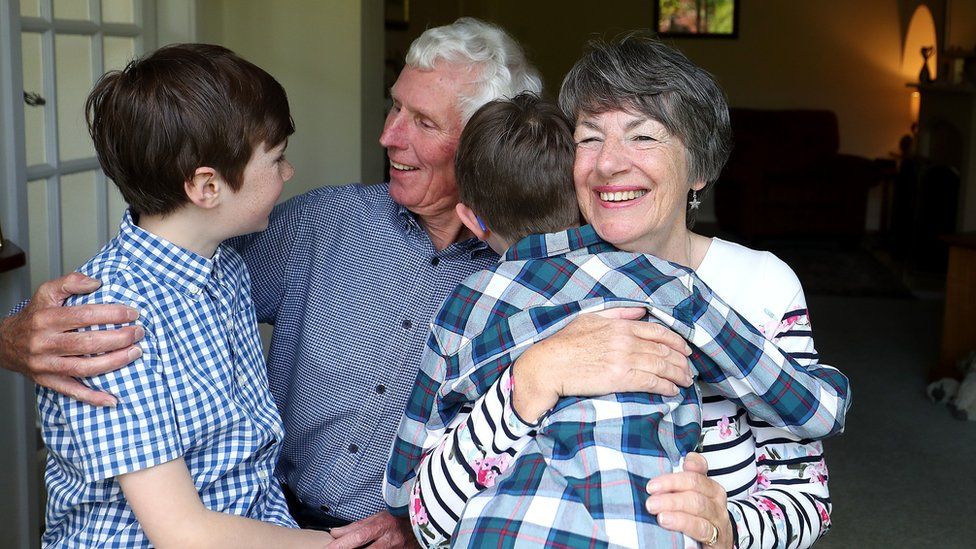
SharecloseShare pageCopy linkAbout sharingimage copyrightPA MediaPeople must continue to play their part in stopping coronavirus, Boris Johnson has said, as lockdown rules ease in England, Wales and most of Scotland.Millions can now socialise indoors in limited numbers, hug loved ones and visit pubs and restaurants indoors.The ban on foreign travel has also been lifted and replaced with new rules.Mr Johnson said: “We have reached another milestone in our road map out of lockdown, but we must take this next step with a heavy dose of caution.”The rule changes come as the variant first identified in India continues to spread in the UK, with mass testing rolled out to hotspots such as Bolton in Greater Manchester and parts of London, Sefton and Worcestershire.Sir Jeremy Farrar, a member of the government’s independent scientific advisory group Sage, said the lifting of the rules was the “most difficult policy decision of the last 15 months or so. It is very, very finely balanced.”He told BBC Radio 4’s Today programme the variant, which is thought to be more transmissible, “is becoming dominant in parts of the UK, and yet vaccination across the country has been extraordinary successful”.”I think we will see an increase of cases and infections over the coming weeks as some of the restrictions are lifted, but the key question is whether we have decoupled increased transmission in the number of people who do get infected from the number of people who get ill and need to go to hospital.”Live updates: Indoor pints and trips abroad as lockdown easesWhat are the latest changes to lockdown?The new rules for foreign travelThousands set for overseas holidays as rules easeWhile lockdowns are easing across England, Scotland and Wales, the changes are different in each nation. Two areas of Scotland – Glasgow and Moray – will not have their rules eased after a spike in cases.In a statement issued on Sunday evening on the lifting of the rules in England, Mr Johnson added: “Everyone must play their part by getting tested twice a week, coming forward for your vaccine when called, and remembering hands, face, space and fresh air.”I urge everyone to be cautious and take responsibility when enjoying new freedoms today in order to keep the virus at bay.”Anyone in England and Scotland can order free lateral flow tests – which give results in 30 minutes – even if they do not have symptoms. In Wales and Northern Ireland, they are available for certain people, such as those who cannot work from home.How have the rules changed?England:People can now meet indoors in groups of up to six or two households, or in groups of up to 30 outdoors. Overnight stays are allowedPubs, bars and restaurants can serve customers indoorsMuseums, cinemas, children’s play areas, theatres, concert halls and sports stadiums can all reopen, as can hotelsSocial distancing guidance is changing and contact with other households like hugs is a matter of personal choiceScotland (except Glasgow and Moray): People can meet indoors in groups of six from up to three households. Outdoors, up to eight people from eight households can mixPubs and restaurants can serve alcohol indoors until 22:30Entertainment venues such as cinemas, theatres and bingo halls can reopen and up to 100 people are allowed at indoor eventsWales: Pubs and restaurants can reopen indoors and customers can meet in groups of up to six from six householdsAll holiday accommodation can reopenCinemas, bowling alleys, museums, galleries and theatres can reopenNo change to indoor socialising – this is still restricted to extended households where two households can mix with each other and have physical contactAnd in all three nations, foreign holidays are allowed.Northern Ireland will review lockdown rules on 20 May, with the hope that some could be lifted on 24 May.Read more about the changes here.This is a big moment for the national mood and the UK economy – particularly those sectors that have been hardest hit by the restrictions. Nearly a million hospitality and leisure workers will go back to work today, according to industry estimates. Although many have been open for outside service, 60% of hospitality venues have no outside space and have been unable to open until now. However, this is not the champagne moment many had hoped for. The real prize for hospitality businesses is the planned removal of all restrictions on 21 June.Recent government warnings about the threat posed to these plans by the Indian variant are casting an unwelcome cloud of uncertainty. Even with today’s easing of restrictions, many businesses will be unable to operate at anywhere near pre-pandemic capacity. They will face the prospect of deferred rent bills, the repayment of Covid loans and an increasingly acute staff shortage – with hospitality workers who have left the industry not yet feeling confident enough to return. Scientists believe the Indian variant does spread more easily, but early data suggests vaccines still work. However, the exact impact on vaccine efficacy – if any – is still to be firmed up.At the weekend, the British Medical Association – which represents doctors – said it was a “real worry” that the easing was still going ahead while the Indian variant was spreading and many younger people were not vaccinated.How much faster does the Indian variant spread? Five ways to stay Covid safe as lockdown liftsMr Johnson said the government was keeping the variant “under close observation” and “taking swift action where infection rates are rising”.Ministers and senior advisers are concerned due to continued uncertainty about the Indian variant, including how much faster it spreads than the UK variant.   The impact on hospital numbers in communities most affected by the variant will be studied closely this week and next. Officials were preparing anyway to monitor the consequences of today’s easing of restrictions, the biggest step so far – with people mixing more and case numbers likely to rise.Preliminary laboratory data from Oxford University suggest, according to ministers, that vaccines will be effective against the Indian variant – but they stress that there’s a race to keep the vaccination programme ahead of the virus.Within the next few days, a first dose will be offered to all those aged 35 and over in England.The latest government figures show a further 1,926 Covid cases have been recorded in the UK, while a further four people have died.The number of people in the UK who have received a first dose of the vaccine has now topped 36.5 million, while the number of second doses given is at 20.1 million.Also from Monday, people travelling abroad will be able to use the NHS app – which is different to the NHS Covid-19 app – to prove they have had the vaccine. Transport Secretary Grant Shapps previously said people will be able to use the app at border controls, although the government says people should still check countries’ entry requirements as tests or quarantine might still be needed.Speaking to the BBC on Sunday, Health Secretary Matt Hancock defended the easing of lockdown rules on Monday, and said the government’s strategy was to “replace the restrictions with vaccination” as the first line of defence against the virus.LOOK-UP TOOL: How many cases in your area?YOUR QUESTIONS: We answer your queriesVACCINE: When will I get the jab?NEW VARIANTS: How worried should we be?Will you be socialising indoors and hugging loved ones you don’t live with? Tell us your your plans by emailing: haveyoursay@bbc.co.uk.Please include a contact number if you are willing to speak to a BBC journalist. You can also get in touch in the following ways:WhatsApp: +44 7756 165803Tweet: @BBC_HaveYourSayUpload your pictures/video hereOr fill out the form belowPlease read our terms & conditions and privacy policy

If you are reading this page and can’t see the form you will need to visit the mobile version of the BBC website to submit your question or comment or you can email us at HaveYourSay@bbc.co.uk. Please include your name, age and location with any submission. MOTHERLAND: Comedy navigating the trials and traumas of parentingRACISM IN THE MUSIC INDUSTRY: Little Mix’s Leigh-Anne confronts her own experiences

Read more →