Implantable piezoelectric polymer improves controlled release of drugs

A membrane made from threads of a polymer commonly used in vascular sutures can be loaded with therapeutic drugs and implanted in the body, where mechanical forces activate the polymer’s electric potential and slowly release the drugs.
The novel system, developed by a group led by bioengineers at UC Riverside and published in ACS Applied Bio Materials, overcomes the biggest limitations of conventional drug administration and some controlled release methods, and could improve treatment of cancer and other chronic diseases.
The drawbacks of conventional drug administration include repeated administration, nonspecific biodistribution in the body’s systems, the long-term unsustainability of drug molecules, and high cytotoxicity, posing a challenge for the efficient treatment of chronic diseases that require varying drug dosages over time for optimal therapeutic efficacy. Most controlled release methods encapsulate drug particles in biodegradable, bubble-like containers that dissolve over time to release the drug, making it difficult to deliver drugs on a schedule. Others involve a battery-powered device that is not biocompatible.
Jin Nam, an associate professor of bioengineering in UC Riverside’s Marlan and Rosemary Bourns College of Engineering, runs a lab that works with biocompatible polymers to build frameworks known as scaffolds that help stem cells repair tissues and organs. One of these polymers, poly(vinylidene fluoride-trifluro-ethylene), or P(VDF-TrFE), can produce an electrical charge under mechanical stress. Nam realized this property, known as piezoelectricity, made the polymer a potentially viable candidate for a drug release system.
His team used a technique called electrospinning to produce P(VDF-TrFE) nanofibers layered in a thin mat. Structuring the material in nanoscale by electrospinning optimized the sensitivity of the resulting nanofibers so the drug delivery system would respond to physiologically safe magnitudes of force while remaining insensitive to daily activities. The large surface area of the nanofibers allowed them to adsorb a relatively large quantity of drug molecules.
After embedding the film in a hydrogel that mimics living tissue, a series of tests using therapeutic shockwaves generated enough electric charge to release an electrostatically attached model drug molecule into the surrounding gel. The researchers could tune the drug release quantity by varying the applied pressure and duration.
“This piezoelectric nanofiber-based drug delivery system enables localized delivery of drug molecules on demand, which would be useful for diseases or conditions that require long-term, repeated drug administration, such as cancer treatments,” Nam said. “The large surface area-to-volume ratio of nanofibrous structure enables a greater drug loading, leading to a single injection or implantation that lasts longer than conventional drug delivery.”
Compared to traditional drug delivery systems based on degradation or diffusion release that typically show an initial burst release followed by different rates of release, the linear profile of drug release from the piezoelectric-based system allows for the precise administration of drug molecules regardless of implantation duration. Repeated on-demand drug release tests showed a similar amount of drug release per activation, confirming the robust control of release rate.
The sensitivity of the drug release kinetics can be tuned by controlling the nanofiber size to a range that is activated by therapeutic shockwaves, often used for musculoskeletal pain treatment with a handheld device. Smaller, more sensitive nanofiber sizes can be utilized for implantation in deep tissues, such as near a bone under muscles, while less sensitive larger nanofibers could find use in subcutaneous applications to avoid false activation by accidental impact.
Story Source:
Materials provided by University of California – Riverside. Original written by Holly Ober. Note: Content may be edited for style and length.

Read more →

Drug laws: The mother campaigning for decriminalisation

Pat Hudson’s son Kevin died in 2017 after injecting heroin. Now she’s campaigning for a reform in drug policy that would see the decriminalisation of possession of all drugs for personal use. Pat hopes this would see an end to the stigma young people face when dealing with addiction.”I’m not sure there’s a huge appetite amongst the public to do much more on drugs,” says Conservative MP Charles Walker.Labour’s Alison McGovern told the BBC: “There is an appetite for working out how to have better support for people who are affected”. However the Labour Party is not calling for the Misuse of Drugs Act to be reformed.

Read more →

The Perilous Hunt for Coconut Crabs on a Remote Polynesian Island

We meet Adams Maihota outside his house in the dead of night. A crab hunter, he wears white plastic sandals, board shorts, a tank top and a cummerbund to hold lengths of twine. He picks a sprig of wild mint and tucks it behind his ear for good luck.The photographer Eric Guth and I follow Mr. Maihota’s blazing headlamp into the forest in search of coconut crabs, known locally as kaveu. They are the largest land invertebrate in the world, and, boiled or stir-fried with coconut milk, they are delicious. Since the cessation of phosphate mining here in 1966, they have become one of Makatea’s largest exports.Coconut crabs (Birgus latro) are the largest land invertebrate in the world and seem perfectly adapted to an island full of holes. (They can climb just about anything.)It’s ankle-breaking terrain. We negotiate the roots of pandanus trees and never-ending feo, a Polynesian term for the old reef rocks that stick up everywhere. Vegetation slaps our faces and legs, and our skin becomes slick with sweat.The traps, which Mr. Maihota laid earlier that week, consist of notched coconuts tied to trees with fibers from their own husks. When we reach one, we turn off our lights to approach quietly. Then, Mr. Maihota pounces.A moment later, he stands up with a sky-blue crab pedaling its ten legs in broad circles. Even with its fleshy abdomen curled under the rest of its body, the animal is much longer than the hunter’s hand.A crab’s pincers can easily break fingers, so before placing them in his pack, Mr. Maihota grabs some twine from his cummerbund and wraps the animal to immobilize it.Each one is like a little escape artist. “He knows how to undo it all,” says Mr. Maihota, “and after that, he will pinch you in the back.”Makatea, part of the Tuamotu Archipelago in French Polynesia, sits in the South Pacific about 150 miles northeast of Tahiti. It’s a small uplifted coral atoll, barely four and a half miles across at its widest point, with steep limestone cliffs that rise as high as 250 feet straight out of the sea.About two-thirds of Makatea is still primary forest, an ecosystem that is increasingly rare in the Tuamotu Archipelago.From 1908 until 1966, Makatea was home to the largest industrial project in French Polynesia: Eleven million tons of phosphate-rich sand were dug out and exported for agriculture, pharmaceuticals and munitions. When the mining ceased, the population fell from around 3,000 to less than 100. Today, there are about 80 full-time residents. Most of them live in the central part of the island, close to the ruins of the old mining town, which is now rotting into the jungle.Makatea’s old mining town has fallen into disrepair.One-third of Makatea consists of a maze of more than a million deep, circular holes, known as the extraction zone — a legacy of the mining operations. Crossing into that area, especially at night, when coconut crabs are active, can be deadly. Many of the holes are over 100 feet deep, and the rock ledges between them are narrow. Still, some hunters do it anyway, intent on reaching the rich crab habitat on the other side.The extraction zone, viewed from above. During the mining era, laborers dug phosphate rich sand out of these naturally occurring limestone cylinders. Now they stand empty and pose a great risk to anyone trying to cross through the area.One evening before sunset, a hunter named Teiki Ah-scha meets us in a notoriously dangerous area called Le Bureau, so named for the mining buildings that used to be there. Wearing flip-flops, Mr. Ah-scha trots around the holes and balances on their edges. When he goes hunting across the extraction zone, he comes home in the dark with a sack full of crabs on his back.Teiki Ah-scha is comfortable enough in the dangerous environment to walk around in flip-flops.A set of cavernous holes.Teiki Ah-scha skirts the edge of the once-active phosphate extraction zone.Mr. Maihota, too, used to hunt this way — and he tells me that he misses it. But ever since his wife fell into a shallow hole a few months before our visit in 2019, she has forbidden him to cross the extraction zone. Instead, he sets traps around the village.Coconut crabs are adventurous omnivores. They eat fruits, nuts, vegetation and carrion, as well as the occasional bird or rat.Coconut crabs inhabit a broad range, from the Seychelles in the Indian Ocean to the Pitcairn Islands in the southern Pacific Ocean. They were part of local diets long before the mining era. The largest specimens, “les monstres,” can be the length of your arm and live for a century.There hasn’t been a population study on Makatea, so the crab’s conservation status is unclear — though at night, rattling across the rocks, they seem to be everywhere.The pastel hues of a coconut crab belie its terrific power; these pincers are stronger than the biting force of most land predators.Crabs are sold at the local grocery store, but they can also be used as currency. Five average-size crabs earn about $50 in store credit.When we catch crabs that aren’t legal — either females or those less than six centimeters across the carapace — Mr. Maihota lets them go.If the islanders are not careful, he says, the crabs might not be around for future generations. In many places across the Indo-Pacific, the animals have been hunted to the point of extirpation, or local extinction.Reretini Viritua wanders through the forest near her home to set coconut crab traps.Crab traps are made from fallen coconuts.Makatea is at a crossroads. Half a century after the first mining era, there is a pending proposal for more phosphate extraction. Though the island’s mayor and other supporters cite the economic benefits of work and revenue, opponents say that new industrial activity would destroy the island, including its fledgling tourism industry.“We cannot make her suffer again,” one woman tells me, invoking the island as a living being.Makatea’s only port, called Temao, was built during the mining era. Remnants of the crane and loading docks still stand.Still, it’s hard to make a living here. “There is no work,” Mr. Maihota says, as we stand under the stars and drip sweat onto the forest floor. He doesn’t want to talk about the mine. The previous month, he shipped out 70 coconut crabs for $10 each to his buyers in Tahiti.In popular hunting spots, hunters say the crabs are smaller or fewer, but hunters rely on the income and nobody has the full picture of how the population is doing overall.Coconut crabs must be carefully bound and gently packed in moist leaves to ensure their survival on their voyage to Tahiti.We visit Mr. Maihota’s garden the next morning where the crabs are sequestered in individual boxes to keep them from attacking each other. He’ll feed them coconut and water to purge their systems, since, in the wild, they eat all manner of food, including carrion.Captive crabs are kept separate to protect them from each other. Hunters feed them coconut and water to purge their systems before sending them to their buyers.By daylight, their shells are rainbows of purple, white, orange, along with many shades of blue. For now at least — without mining, and while harvests are still sustainable — they seem perfectly adapted to Makatea, holes and all.The extraction zone at sunset.The color of some crabs matches that of the sky, though they turn red when they are cooked.Eric Guth is a documentary photographer based in the Pacific Northwest. You can follow his work on Instagram.Jennifer Kingsley is a Canadian writer and journalist. You can follow her work on Twitter and Instagram.Follow New York Times Travel on Instagram, Twitter and Facebook. And sign up for our weekly Travel Dispatch newsletter to receive expert tips on traveling smarter and inspiration for your next vacation.

Read more →

Japan ramps up mass vaccinations in Tokyo and Osaka amid Covid surge

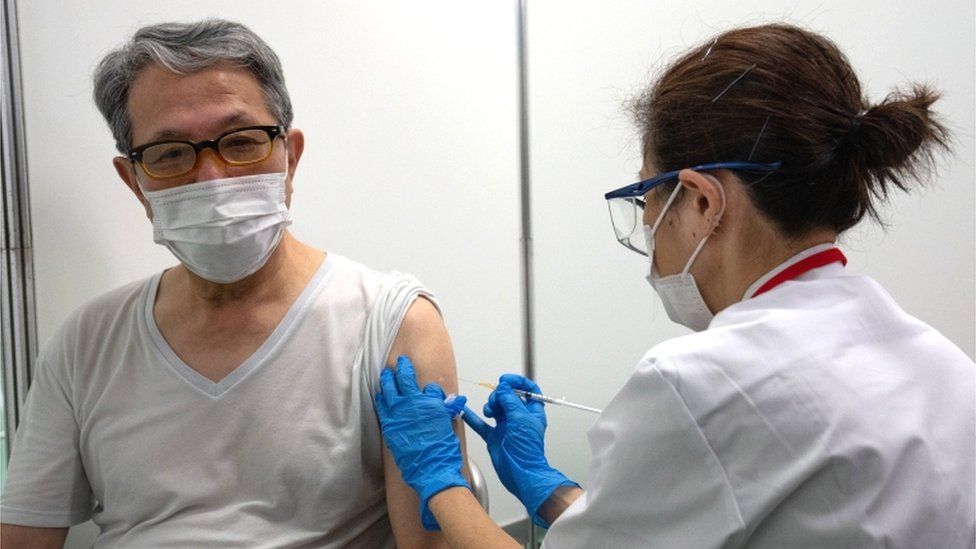
SharecloseShare pageCopy linkAbout sharingimage copyrightEPAJapan has kicked off a mass vaccination programme in Tokyo and Osaka, as the Covid crisis worsens. The military has set up centres offering thousands of shots each day, prioritising the elderly. The country’s vaccination drive started late and was hampered by supply shortages and organisational hurdles.As a result, Japan is lagging significantly behind other developed nations. Only about 1.9% of the population is fully vaccinated.With the Tokyo Olympics scheduled to start in July, there’s mounting pressure to call off the Games. Japan’s efficient healthcare system has been increasingly overwhelmed by the latest surge, with some hospitals running out of beds and ventilators.Large parts of Japan are currently under a state of emergency to give regional authorities more power to enforce measures against the pandemic. The country has recorded more than 700,000 infections and 12,000 Covid-19 deaths from the virus.Why doesn’t Japan cancel the Tokyo Olympic Games?The mass vaccination drive is run by Japan’s defence forces and is scheduled to stretch over the next three months. Officials are planning to vaccinate up to 5,000 people in Tokyo and 2,500 in Osaka every day with the recently approved Moderna jab, while in June and July this capacity is set to double. Mass vaccination facilities are also planned for other major cities like Kobe and Nagoya.Authorities hope that by the end of July, people aged 65 and above will have completed their vaccinations. image copyrightReutersThe country started vaccinating its people only in February, later than most other developed nations. Earlier vaccination drives, which were conducted by municipal authorities across the country, had prioritised healthcare and other frontline workers. But progress was slowed by supply shortages and logistical hurdles, such as getting enough local doctors to help out.So far only around 4.7% of the country’s elderly of 65 or older have received at least one dose of either Pfizer, Moderna or AstraZeneca. Hope after weeks of anxietyYuko Kato, Digital editor, BBC News JapanHospitals in many areas of the country are overwhelmed, in part due to the sheer number of cases, but also due to a shortage of beds and medical staff. Many of the hospitals here are private enterprises, and they won’t be able to sustain themselves financially if they were to constantly secure wards and beds for severe cases. And the larger hospitals which are better equipped also need to deal with other severe and emergency cases, which further impacts their ability to cope.Meanwhile there’s been considerable anxiety about the extremely slow rollout of vaccines, as well as confusion over how to secure slots for the elderly. The difficulty (or in some places, ease) of making the reservations vary greatly depending on where you live, and the initial errors found in the online booking system for the new mass vaccination centres, run by the central government, did not alleviate that confusion. However, now that the mass vaccination centres are up and running, there’s hope that the very visceral fear for our loved ones’ well-being will start to abate sooner than later.What’s the situation in Osaka and Tokyo?While Japan had long managed to avoid large scale outbreaks seen in other countries, recent weeks have seen a steady increase in cases. Tokyo is still Japan’s biggest Covid hotspot, and the capital currently has a weekly average of 650 cases per day.But the situation has also been getting worse rapidly in the country’s second city Osaka, with reports of hospitals running out of beds and ventilators. In late April the city saw a spike of more than 1,000 new cases a day. It now averages around half that number each day.image copyrightReutersExhausted doctors have told Reuters they saw a “explosive growth in the number of patients”.”Simply put, this is a collapse of the medical system,” Yuji Tohda, director of Kindai University Hospital in Osaka, told the news agency.What about the Tokyo Olympics?Despite the growing crisis, the Tokyo Olympics are still scheduled to go ahead after having been postponed from last year. John Coates, vice president of the International Olympic Committee (IOC) last Friday said the Games would “absolutely” go ahead, even under Covid restrictions. But polls indicate that a vast majority of Japanese prefer the Olympics to be cancelled or postponed a second time. image copyrightGetty ImagesOver the weekend, one of Japan’s most prominent business tycoons criticised the decision to continue with the Games.In a tweet that went viral, SoftBank CEO Masayoshi Son said that “more than 80% of people want the Olympics to be postponed or cancelled. Who and on what authority is it being forced through?”Medical workers have also repeatedly issued warnings. A nurse from the central city of Nagoya, who declined to be named, told the BBC’s Rupert Wingfield-Hayes that she has watched the Covid unit in her hospital fill to capacity in recent weeks.”We already don’t have enough hospital beds and staff for Covid patients. People are already dying at home because they can’t get into the hospital.”They want 500 nurses to volunteer at the Olympics. That means more Covid patients won’t get the care they need.”Akira Takasu, head of emergency medicine at the Osaka Medical and Pharmaceutical University Hospital, told Reuters: “The Olympics should be stopped, because we already have failed to stop the flow of new variants from England, and next might be an inflow of Indian variants. “This may be a trigger for another disaster in the summer.”

Read more →

India records 300,000 Covid deaths as pandemic rages

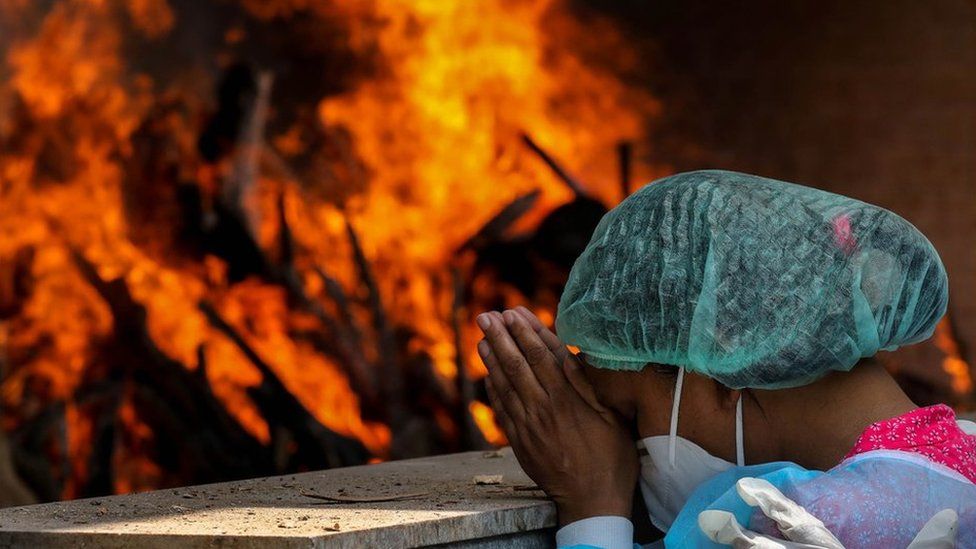
SharecloseShare pageCopy linkAbout sharingimage copyrightEPAThe number of deaths linked to Covid-19 in India has moved past the 300,000 mark as the country continues to grapple with the pandemic.Experts warn that the real number of fatalities might be much higher as many deaths are not officially recorded.India has recorded 26 million cases – second only to the US – and is now the epicentre of the global pandemic.The country is also only the third in the world to record more than 300,000 deaths – behind the US and Brazil.It took less than a month to record its last 100,000 deaths. A deadly second wave in recent weeks has overwhelmed the country’s healthcare system, with hospitals struggling to cope with the influx of patients and with critical drugs and oxygen running out.India orders social media to remove ‘India variant’Where is the Indian variant and how is it spreading?India reports nearly 9,000 ‘black fungus’ casesNearly half of India’s virus deaths occurred in the last three months. In the last 26 days alone, the country has recorded 102,533 Covid-19 deaths. Some experts say the number of daily deaths may rise further. Dr Murad Banaji, a mathematician at Middlesex University London, has been tracking the pandemic closely. “We expect a delay between cases peaking and deaths peaking. But also, as with cases, we know there are huge variations in death surveillance and recording between states, and between urban and rural areas,” he told the BBC. “Even once recorded fatalities start to fall, we’ll need to be wary of reading too much into this until we stop hearing reports of large numbers of rural deaths,” Dr Banaji said. Over the past days, concerns over a rising number of deadly fungus infections linked to Covid treatment have added to the overall crisis. image copyrightReutersIn some places, even crematoriums have run out of space and have been forced to expand to makeshift sites in public parks. A tribal area had oxygen while cities gaspedCovid increases China influence in India’s backyardWhy India’s vaccine makers can’t meet global demandMortality data in India is poor and deaths at home often go unregistered, especially in rural areas. There are reports of journalists counting bodies at morgues themselves, to try to get a more accurate number. Some models speculate that about a million people may have actually died.The country’s vaccination drive is also not nearly making enough progress to ease the current crisis.

Read more →

Covid: Sniffer dogs could bolster screening at airports

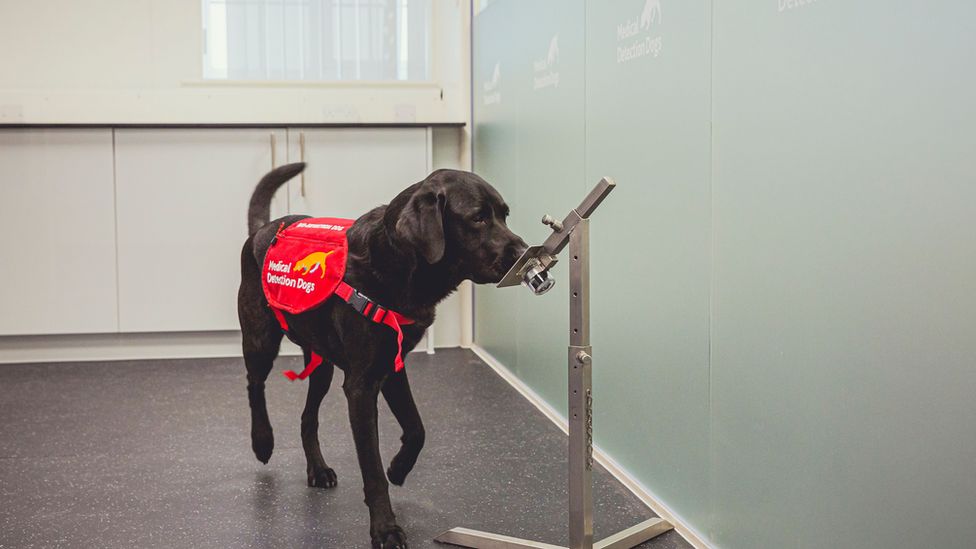
SharecloseShare pageCopy linkAbout sharingimage copyrightJohn AkehurstSniffer dogs could contribute to efforts to prevent the spread of Covid as society reopens, according to scientists.As part of a trial, dogs were trained to recognise a distinctive odour produced by people with the virus, but undetectable to the human nose.This could come in useful for screening at airports or mass events. But the dogs’ findings would have to be confirmed by lab testing, the researchers said.Although the dogs correctly picked up 88% of coronavirus cases, they also incorrectly flagged 14% of people who didn’t have Covid as having the virus.Dogs can have up to 100,000 times the smelling ability of humans and have long been used to sniff out drugs and explosives. Recent research has shown dogs – particularly breeds like spaniels and retrievers – can detect the unique scents of diseases including cancer, Parkinson’s and malaria.As part of the current canine screening trial, six dogs were trained to recognise the smell produced by people with Covid-19 using worn socks, face masks and t-shirts of various materials. They were rewarded with treats when they correctly guessed whether the sample was from an individual who had tested positive or negative. Some of the people in the negative group had common cold viruses, to make sure the dogs were able to distinguish Covid from other respiratory infections. The dogs were able to sniff out the disease even when it was caused by different variants, and when the person had no symptoms or only had very low levels of the virus in their system. Dr Claire Guest, Chief Scientific Officer at charity Medical Detection Dogs, which trained the animals, said the results were “further evidence that dogs are one of the most reliable biosensors for detecting the odour of human disease”.They picked up roughly 88% of positive cases – meaning, for every 100 cases, the dogs failed to recognise just 12 infected people. But out of 100 people who did not have Covid, the dogs wrongly suggested – via the sniff test – that 14 of them were infected. So if one person on a plane of 300 passengers has coronavirus, the dogs are likely to correctly identify that person, but may also wrongly indicate that another 42 Covid-negative people are infected.It means a proportion of infections will be missed, and more will be told they have the virus when they don’t. This is the case for all tests to different extents, but the canine method incorrectly tells a lot more people they have the virus than the type you swab up your nose. So the research team does not recommend dogs alone are used to sniff out positive cases.image copyrightMDDBut they believe the dogs could be an additional screening tool alongside more conventional tests. They say dog screening, followed by swab testing, will pick up 91% of infections. The real potential advantage, though, is speed: even the quickest tests take 15 minutes to show a result, while dogs can sniff out the disease in seconds. Two dogs could screen 300 people in half an hour, researchers say. This could make the sniff test “a suitable method for mass screening”, argues Prof James Logan at the London School of Hygiene & Tropical Medicine, which conducted the research alongside the University of Durham.In theory, people could be screened as they queue for a flight or to enter an event, and anyone flagged up by the dogs would need to take a PCR test – the more accurate type of swab tests which is processed in a lab.This could cut down on the numbers having to enter hotel quarantine. Dogs could also potentially be used in areas where there isn’t currently much screening, such as busy train stations, to help prevent a super-spreading event. The research is at an early stage so it still needs to be reviewed by other scientists before it can be published and, in the next phase of the study, tried out on infected people – rather than bits of sock.

Read more →

Pollution: ‘We can smell and taste the traffic at school'

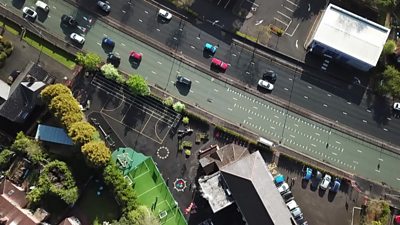
Around 6,500 schools across the UK are in area with high levels of air pollution, and among them is St Ambrose RC primary school in Manchester. It sits on one of Europe’s busiest roads where particle pollution levels exceed WHO limits.Coronavirus lockdowns made way for less traffic and cleaner air but as measures continue to ease, the school is campaigning against a return to pre-pandemic rush-hour traffic.Producer: Kate McGoughVideo Journalist: Lorna Acquah

Read more →

Covid: UK passes 60m jabs milestone after 762,000 in a day

SharecloseShare pageCopy linkAbout sharingimage copyrightGetty ImagesMore than 60 million coronavirus vaccine doses have been given in the UK, the health secretary has announced.There were 762,361 first or second jabs on Saturday, the second highest daily total of the rollout, and more than 22 million people have now had both doses.It comes as a study found the Pfizer and AstraZeneca vaccines are highly effective after two doses against the variant identified in India.The UK Health Security Agency’s head urged people to get their second dose.Dr Jenny Harries said the study was the “first real-world evidence of vaccine effectiveness” against the variant and the “straightforward message” was for people to make sure they took up the offer of the second jab.But speaking on the BBC’s Andrew Marr Show, she urged the public to remain cautious to avoid another lockdown, warning of the threat from the Indian variant which has become the “dominant strain” in some parts of the country.The latest government data shows 556,951 UK adults received a second jab on Saturday, meaning that 43% of the adult population – 22,643,417 people – have now been fully vaccinated.Of them 205,410 were first doses, bringing the number of people to have had one dose to 37,943,681 people, or 72% of UK adults.Only on 20 March, when 844,285 doses were administered, have more jabs been given on a single day. But Saturday’s second dose figure surpassed the previous highest daily total of 547,636 set on 24 April.Another 2,235 new cases and five deaths within 28 days of a positive test have also been announced.Where is the Indian variant and how is it spreading?My vaccine side effects and what they meanWho can book their Covid vaccine now?Public Health England, which ran the study into the two vaccines said they are likely to be even more effective at preventing hospital admission and deaths.Some 13,000 deaths and 39,100 hospitalisations have been prevented in the UK due to the vaccination programme up to 9 May, according to PHE analysis.Responding to the latest vaccination figures, the health secretary tweeted: “This is a fantastic milestone in our fight against this virus. “Thank you to everyone involved in our national effort. When you get the call, get the jab.”Earlier Matt Hancock also said the PHE study’s findings showed that getting both doses of the vaccine was “absolutely vital”.He added the research made him “increasingly confident” that the government was on track for the final stage of easing restrictions in England on 21 June.However, Home Secretary Priti Patel said there would not be a “green light all the way”, telling the Andrew Marr Show that people have to remain “conscientious…. following all the rules.”That is part of our normal life now and that will continue, and that, of course, will help us to that unlocking on 21 June.”LOOK-UP TOOL: How many cases in your area?LOCKDOWN RULES: What are they and when will they end?GLOBAL SPREAD: How many worldwide cases are there?THE R NUMBER: What it means and why it mattersAppointments for second doses for people in England have been brought forward from 12 to 8 weeks for those in the top nine priority groups.It follows advice from the Joint Committee on Vaccination and Immunisation, which recommended reducing the interval to counter the threat of new variants.The variant first discovered in India – also known as B.1.617.2 – is responsible for the majority of new cases in parts of England.The PHE study found two jabs of either the Pfizer or AstraZeneca vaccine give a similar level of protection against symptomatic disease from the Indian variant as they do for the Kent one.However, both vaccines were only 33% effective against the Indian variant three weeks after the first dose. This compared with 50% effectiveness against the Kent variant.The Moderna vaccine has also been used in the UK since April but the study said the numbers who had received it were too small for them to include it in their research.UNIQUE STAYCATIONS: Forgotten spaces are turned into one of a kind rural retreatsWHEN DID HISTORICAL EVENTS HAPPEN?: Take our mind-boggling time quiz to find out!

Read more →

Discover a Water Sport

This should be the summer you become a swimmer, a paddler or a sailor — it’s easier than you think.Diana Nyad was an elite, competitive swimmer in her youth, growing up in New York City, but it wasn’t until much later in life that she discovered the joys of open-water swimming. “I was doing these marathon swims in my 20s, but I never thought about the ocean,” Ms. Nyad said. “When I got back into swimming in my 60s, I fell head over heels in love with the ocean.”In 2013, at age 64, Ms. Nyad became the first person to swim the 110 miles from Cuba to Florida without a cage to protect her from sharks. “It would be a shame to get to the end of your life and not have the sheer pleasure of floating in an open body of water,” Ms. Nyad said. “Not that pools aren’t great, but it’s not the same as being in a lake, laying back and looking at the clouds and being part of planet Earth.”Make this summer the one you finally take the plunge. If swimming isn’t your thing, consider paddling a kayak or learning to sail, where you’ll still enjoy the stress-relieving benefits of being out on the water. Water sports are easier to learn — or rediscover — than you think.Learn to open-water swim.To start swimming in open water, pick a calm pond, lake or bay with water temperatures around 70 degrees or warmer. “People who aren’t used to swimming don’t want to be in water any colder than that,” Ms. Nyad said.Do not swim alone; bring a friend or find a group to join. Facebook and Meetup host local open-water swimming groups, while the Open Water Swimming Association lists swim coaches around the country.A few pieces of gear will make your swim more comfortable: A swimsuit that doesn’t budge, goggles that fit snugly on your face and a brightly colored swim cap (so that others can see you) are essentials. A wet suit, if the water is colder than 60 degrees, and swimmer’s earplugs to combat ear infections can help as well. Short swimmer’s fins can improve efficiency, and a center-mounted snorkel lets you breathe without turning your head. An open-water swim buoy (essentially a balloon tied around your waist) alerts watercraft of your presence.Once you’re out there, pay attention to your breathing and lift your head every few breaths to spot your location. If you start to panic, slow down and breathe. “Relax. You’re forcing your body to do something it’s not used to,” said Leo Briceno, a swim coach in Tampa, Fla., who leads regional open-water swim meet-ups several times per week. “Counting numbers or thinking of a song in your head can help you find the rhythm.”Pro tip for new swimmers: “Put a tiny dab of baby shampoo inside your goggles before your swim, swish it around and rinse it out,” said Tryn Kaleel, a swim coach with the California Bay Area’s Odyssey Open Water Swimming club. “The gentle, tear-free soap will keep your goggles from fogging.”Joyce Dopkeen for The New York TimesGo paddle a kayak.As with swimming, start kayaking in a calm estuary, bay, pond or lake rather than a choppy ocean or raging river. Sign up for a guided kayak tour or lesson if you’re brand-new, or rent a kayak from a local shop or outfitter who can give a few basic tips before you head out.You can rent or buy a kayak (or a standup paddleboard, if that’s more your style) through Gearo, a gear site that partners with hundreds of outdoor shops across the country. Find a spot to paddle via the Go Paddling app, which shows a map of launch sites used by other members. If you’d rather hire a guide, Airbnb Experiences can pair you with a local host who paddles or search Paddling.com for advice and suggestions for places to paddle.Be mindful of where you launch. “Both freshwater and ocean environments can present challenges and safety concerns — water and air temperatures, weather, wind, boat traffic,” said Kelly Maloney, program director with Maine Kayak, a sea kayaking outfitter in New Harbor, Maine. The U.S. Coast Guard has a Boating Safety mobile app that offers safety resources, makes it easy to file a float plan with your intended itinerary and has an emergency assistance button. You can find online and in-person instructional courses and local paddling clubs for both kayaking and canoeing through the American Canoe Association’s website.Life jackets are mandatory. You’ll also want quick-drying clothing, sun protection and a wind breaker. It’s best not to go barefoot — opt for grippy water shoes or a pair of old sneakers, so you can tromp around rocks on shore.If you decide to purchase a kayak, most shops allow you to try out boats before you buy or host demo days when you can test different kayaks on the water. Look for a stable, entry-level kayak that’s easy to maneuver. Eventually, you may opt to upgrade for one that’s sleeker and faster but less stable.Sales of kayaks — along with other outdoor equipment like bikes and camping gear — spiked during the pandemic, so you may need to wait a few months for your boat.“People are rediscovering how great it is to get outside, even in their own neighborhoods,” said Anton Willis, founder and chief design officer at Oru Kayak, a folding kayak company that experienced a more-than-100-percent increase in sales between 2019 and 2020. “We’re building kayaks as fast as we can. A lot of other companies are in that same boat, no pun intended.”Pro tip for new paddlers: “People think they’re going to capsize in the water, but usually if you’re going to tip over it happens when you’re getting in or out of the boat,” Mr. Willis said. “Start out easy, somewhere shallow and wave-free, like a floating dock or a gentle, sandy beach.”Join the sailing community.Sailing has a reputation for being difficult and expensive, but that’s not necessarily the case. “Sailing can be very affordable and accessible. It’s not just for billionaires at the America’s Cup,” said Bob Ross, president of the Seattle Sailing Club, which teaches sailing lessons and rents boats to its members. “Yacht clubs have sailing schools for kids and adults that are very low cost.”With sailing, it’s all about joining a community of other sailors. Make it serious and become part of a racing crew or keep it casual and go anchor for lunch in a protected harbor. Most sailors love to share their knowledge and welcome newcomers. You don’t necessarily need experience to crew on a bigger boat. Check bulletin boards or show up at the dock at local sailing clubs — or try the Go Sailing app — to see if anyone needs a crew member.“You can sign up to be what’s called ‘rail meat’ — that’s somebody who sits on the rail and weighs the boat down as it’s heeling,” said Michael Campbell, a founder of the Universal Sailing Club in Baltimore. “That’s the fastest paced learning environment you’ll find.”And you don’t need access to the ocean to sail. “There are lakes all over the country and every lake has a small yacht or sailing club that tends to be very approachable,” said John Kettlewell, executive director of Sail Martha’s Vineyard, a sailing nonprofit in Vineyard Haven, Mass. “The term ‘yacht club’ sounds snooty, but they’re usually not.”Find your local sailing club through the American Sailing Association, or search for accredited schools and courses from U.S. Sailing. Summer Sailstice, a global sailing celebration that coincides with the longest day of the year, takes place on June 19 this year, with sailing events open to the public around the world.If you already know how to sail, GetMyBoat — which is like Airbnb for boat rentals — lists peer-to-peer sailboat rentals as well as outfitters where you can charter a sailboat that you operate yourself or one that comes with a captain.“You’re being propelled by the wind across the water, you’re steering the boat based on the wind direction,” Mr. Kettlewell said. “It’s a totally new sensation.”If you’re heading out on your own, start small with a dinghy, like a Laser, Hobie Cat or RS Aero, and learn to sail it well. Those same skills will translate to bigger boats. Safety equipment is, again, critical: personal flotation devices, sun protection and foul-weather gear are all must-haves. You’ll also want non-marking, rubber-bottom shoes.Pro tip for new sailors: “Sailors have this historic language that we still use,” Mr. Kettlewell said. “The most important nautical terms to learn are ‘port’ and ‘starboard.’ If you’re facing the bow, or the front, of the boat, the starboard is your right-hand side and the port is your left.”

Read more →

Think Before You Make a Big Change

If you’re feeling the itch to overhaul your hair or finally get that tattoo or nose piercing, the timing makes perfect sense. But pump the brakes before breaking out the scissors or bleach.After spending a year inside her apartment with her two children, Danielle Campoamor, 34, was ready for a new look. The freelance writer and editor in Brooklyn wanted to cut her waist-length dark brown hair to her shoulders and bleach her locks white.At her salon, called [salon]718 in the Prospect Heights neighborhood, her stylist asked Ms. Campoamor if anything traumatic recently happened in her life, like a divorce.“No, just the pandemic,” Ms. Campoamor recalled saying. The stylist didn’t miss a beat. “She said, ‘Oh, I get that.’ Then she was like, ‘All right, let’s do it.’”Ms. Campoamor was thrilled with the result, calling her slick, snow-colored bob “one of the best, albeit expensive, decisions I’ve ever made.”If you’re feeling the itch to overhaul your hair or finally get that tattoo or nose piercing, the timing makes perfect sense. “I think what you see now is people coming out of the pandemic saying: ‘I feel changed, but I want to look like I have changed. I want an outward symbol of that,’” said Renee Engeln, a psychology professor at Northwestern University and author of the book “Beauty Sick.”However, as excited as you are to see a new reflection looking back at you in the mirror, you might want to pump the brakes before you break out the bleach.When it comes to anticipation, studies show that people are susceptible to having an optimism bias: They overestimate good things happening to them and underestimate negative occurrences. We may imagine that a wildly different hairstyle will look stunning but may be surprised when it doesn’t look the way we envisioned or turns out to be more expensive and time consuming to maintain than expected.Here’s everything you need to know if you’re considering a radical change to your look.Assess the financial and practical implications.If you plan a significant change, Brent Ericsson, a stylist at the Philadelphia salon American Mortals, emphasizes the importance of first consulting your stylist.“Always do a consultation because they’ll be able to tell you how long it’s going to take, what the maintenance is, how much it’s going to cost you and if it’s going to look good,” he said.If you’re booking your appointment online, Mr. Ericsson recommends alerting the salon to your plans. If there’s space to add a note, he suggests writing that you want a dramatic change. Including this information, he said, “is really going to help to make sure that your first time with a drastic change is going to have a better outcome.”Colored hair may require specialized shampoos, tinted conditioners or hair masks to maintain the color and nourish the hair. Shorter cuts might require more frequent trips to the salon for touch-ups. Budget accordingly.Sophie C’est la Vie, a tattoo artist in Brooklyn and co-owner of the tattoo studio This Time Tmrw, recommends thinking through how your new body art will influence how you are perceived at work. If the tattoo or piercing is highly visible, be prepared for stares and questions, even when you may not feel like dealing with the attention.There are also financial considerations to large-scale tattoo projects. Some studios require a deposit and may charge you by the hour, the day or the session, Ms. C’est la Vie said. The time it takes to complete a tattoo varies depending on the size and detail of the piece. “A very tiny, minimal outline tattoo could take less than five minutes, where a sleeve could take more than a year, depending on how often a client books for,” she said. You also need to factor in costs like tipping.Work with a professional.“Getting tattooed is such a personal, and I would say, intimate experience,” Ms. C’est la Vie said, so clients should feel welcome, safe and respected.Consult online portfolios when looking for a reputable salon, piercing studio or tattoo parlor. Approach friends who are happy with their salon experience or have body art you admire and seek recommendations.Ms. C’est la Vie recommends familiarizing yourself with tattoo design styles. Knowing the proper terminology will help you identify artists who can best produce the particular style you want. For instance, she said, if you want a geometric black-and-gray tattoo, an artist who is an expert at full-color photo realism may not be “able to produce something for you that is more in line with your vision,” she said.Be clear about your goals.When consulting with your hairdresser, bring a few pictures of your desired cut or color.Mr. Ericsson encourages his clients to find pictures of a model, actress or online personality whose face shape is similar to theirs. And most important, he said, look for people who have a similar hair density and curl pattern to yours. This will give you the best chance of a good result.“My stylist was so grateful that I didn’t just bring one picture,” Ms. Campoamor said. “I had a few that varied a little slightly, so we could work on what was best for me, my complexion, the shape of my face, all those kinds of factors.”If you’re not sure what kind of artwork you’d like for your tattoo, Ms. C’est la Vie recommends getting tattoo art books from a library or bookstore. Many tattoo artists showcase their work on their social-media profiles, too. This can help you pinpoint the design style you like.Be patient.Many transformative looks cannot be achieved in one session. If you’re lightening your hair, it might take several salon visits. A large tattoo or sleeve may take a few sessions. Be kind to yourself as you wait it out.To get her hair grandma-white, Ms. Campoamor said it took three trips to the salon over two months. “I was not going to walk out of the salon with the exact look that I wanted because my hair was so dark,” she said. “Having that expectation defined at the very beginning really helped me manage my own journey through the process of how my hair was going to look after each appointment.”Share the process.Keep friends and loved ones in the loop during your makeover. Send pictures and videos so they can join in the fun virtually.Ms. Campoamor credited her “hype squad” with making the experience enjoyable. “It makes it a lot of fun too to have people going through it with you and cheering you on and getting super stoked about your new look,” she said.She sent pictures to her group-text thread at every stage: the cut, the bleaching, the finished look. “It was fun to bring my friends with me virtually in a way and to have them there,” she said. “That was by far the best part.”Consider that you might not need a bold change.If he’s working with a client who asks for a transformative style like a bob or a pixie cut, Mr. Ericsson will often first snip the hair so it lays on the curvature of the back. Then they’ll assess.The goal is to avoid having a client shocked by a new look. He prefers to leave at least two inches of wiggle room so he can always go shorter.Don’t freak out if you hate your new look.“We can fix it,” Mr. Ericsson said. “Especially if it’s just a shape thing. You just have to be willing to let go of a little bit more length” to get the desired cut.Ms. C’est la Vie recommends telling your tattoo artist if you don’t like the finished work. “Give them an opportunity to address and fix the situation for you,” she said. “Sometimes people feel self-conscious or uncomfortable to do this, but it’s the best policy, the most fair, as well as respectful to allow the original artist the chance to rectify the situation.”If you feel you weren’t treated well during the session or the artist was unwilling to adjust the design, she suggests seeking out another artist to rework it.Think of other ways to mix up your style.Keep in mind that these experiences, while fun, are not designed to have real staying power. “We are sold a bill of goods by the beauty industry that making these kinds of superficial changes to our appearance will change our lives,” Dr. Engeln said. “It’s not going to change your life. It might be fun for a while. It might be interesting, but the way human brains work is we get used to new things and they’re no longer new.”“If you’re looking to make big changes in your life, the changes have to come from the way you’re thinking, the way you’re behaving, the way your relationships are working for you,” she said. They’re not going to come from a haircut, body art or piercing.

Read more →