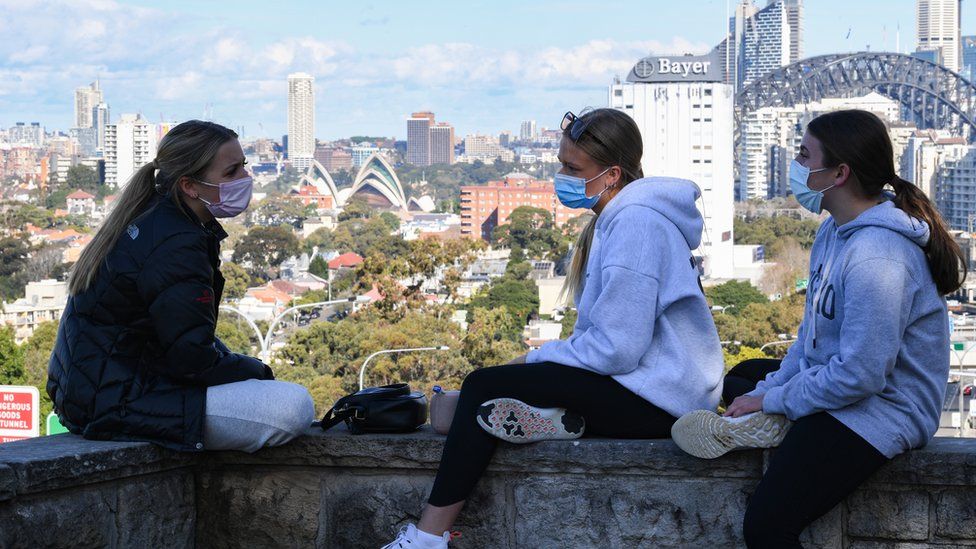
Covid: Sydney lockdown extended as Delta outbreak spreads

SharecloseShare pageCopy linkAbout sharingSydney residents will be in lockdown for another week as Australia’s largest city fights to contain a Covid outbreak.The New South Wales government said it had made the “difficult decision” as it battles the highly transmissible Delta strain.A stay-at-home order was issued on 26 June.Australia has recorded 910 deaths and fewer than 31,000 cases since the pandemic began. Clusters have emerged after some people who were later found to be infected left their homes for essentials.The outbreak of around 330 cases is the worst in the city this year.A stay-at-home order covering more than five million residents in the Greater Sydney, Wollongong and Central Coast areas was due to be lifted on Friday. It has now been extended to 16 July. Schools will also be closed next week.The New South Wales government said it recognised the “pain and stress” that lockdown was causing families and businesses.Australia to halve arrivals to fight Delta strainHalf of Australians in lockdown amid vaccine chaosHow Delta burst Australia’s Covid bubbleYet officials said the daily case rate – with 27 new cases recorded on Wednesday – and low levels of vaccination meant the restrictions needed to be extended.Less than 10% of Australians are fully vaccinated. A lack of supplies, specifically of the Pfizer vaccine, means many Australians will not be able to get a jab until the final months of the year.image copyrightGetty Images”What we want to do is give us our best chance of making sure this is the only lockdown we have until the vast majority of our citizens are vaccinated,” said Premier Gladys Berejiklian on Wednesday.”We don’t want to be in a situation where we are constantly having to move between lockdown and no lockdown.”Australia fights Delta strainSydney has been the hardest hit by Australia’s recent outbreak of the Delta variant, though cases have spread across the country. Leaks of the virus from hotel quarantine last week prompted snap lockdowns of state capital cities – including Brisbane, Darwin and Perth – affecting half the population of the country.Authorities in those cities have been able to contain the virus and ended lockdowns last week.Australia has used lockdowns and swift contact tracing to combat outbreaks of the virus when it has breached the nation’s strict border defences.

Read more →

Biden Makes New Push for Vaccinations, but Experts Say More Is Needed

Some public health experts worry that the administration is not being aggressive enough in waging what the president calls a “wartime effort” to vaccinate the country.WASHINGTON — Faced with a steep decline in vaccination rates, President Biden said on Tuesday that his administration would send people door to door, set up clinics at workplaces and urge employers to offer paid time off as part of a renewed push to reach tens of millions of unvaccinated Americans.But top health experts say that it is simply not enough, and that the president needs to take the potentially unpopular step of encouraging states, employers and colleges and universities to require vaccinations to slow the spread of the coronavirus.Instead, in a speech on Tuesday, Mr. Biden doubled down on coaxing people to get vaccinated, a voluntary approach that appears to have hit its limit for a large number of Americans who say they have no intention of taking the shot.“Please get vaccinated now. It works. It’s free,” Mr. Biden said in brief remarks at the White House. “It’s never been easier, and it’s never been more important. Do it now for yourself and the people you care about, for your neighborhood, for your country. It sounds corny, but it’s a patriotic thing to do.”Case numbers have gone up in parts of the country where vaccination rates remain low, fueled by the highly contagious Delta variant. That has some public health officials worried that the administration is not being aggressive enough in waging what the president calls a “wartime effort” to ensure that the population of the United States is protected.“I’m trying to restrain myself, but I’ve kind of had it,” said Kathleen Sebelius, who was the health secretary for five years under President Barack Obama. Schools and businesses should be encouraged to require the vaccine, she said.“You know, we’re going to tiptoe around mandates,” she said. “It’s like, come on. I’m kind of over that. I want to make sure that people I deal with don’t have it so I don’t transmit it to my granddaughter.”But Mr. Biden’s options to be more aggressive are limited.As president, he can mandate that members of the military get the vaccine — a step that his administration has declined to take, in part because the drugs are still considered experimental under the emergency authorizations that the Food and Drug Administration granted last year.The Biden administration considered and rejected calls to require a federal vaccine passport, a move that some experts said would help contain the spread of the virus by allowing people to prove that they have been inoculated. And the administration last month issued guidance to federal agencies saying they should not require employees to be vaccinated.For the most part, the power lies in the hands of states, employers or private institutions.Dr. Ezekiel J. Emanuel, a professor of bioethics and health policy at the University of Pennsylvania, said the United States was unlikely to make significant strides in its vaccination campaign without mandates.“I like to say a mandate is legal, ethical and efficacious,” he said. “Ultimately, workplaces are probably going to have to.”In his speech, Mr. Biden said his administration was not giving up on persuading people that vaccination was in their best interests, and in the interest of the country. But he made no mention of the need for states, private companies, schools and other institutions to begin requiring people who were reluctant to get vaccinated.Jen Psaki, the White House press secretary, acknowledged in comments to reporters on Tuesday that some companies, schools and other institutions were beginning to require vaccines. But she said the administration had no intention of encouraging them to do so.“We’re going to leave it up to them to make these decisions,” Ms. Psaki said.But others say the administration could be more aggressive.Lawrence O. Gostin, a professor of global health law at Georgetown University, said that even though the federal government’s authority to enact mandates was limited, the Biden administration still had considerable power to recommend them. It can provide more funding for proof-of-vaccination systems and create incentives for colleges, universities and organizations to require that a vaccine be offered, he said.“Vaccine mandates have been very successful in the United States and globally, even in politically difficult situations, because they make becoming vaccinated the default,” Mr. Gostin said. “We have to make being unvaccinated the hard choice, not the easy one.”The debate comes as Mr. Biden and the United States face a precarious moment days after narrowly missing his goal of having 70 percent of adults at least partly vaccinated by July 4. By the end of the week, nearly 160 million Americans — not quite half the population — will be fully vaccinated. But vaccination rates have plunged from where they were in the spring, and some parts of the South and the Midwest continue to struggle to inoculate their populations.Laura Alfredo received her first dose of the Pfizer vaccine in Newark last month. Vaccination rates have plunged from their peak in the spring.Bryan Anselm for The New York TimesAlabama has vaccinated only about 50 percent of its adult population; Mississippi has delivered shots to only 46 percent of its adults. At their current rates, it would take months for both states to reach Mr. Biden’s July 4 goal. Louisiana and the Virgin Islands have each vaccinated fewer than half of their populations.Numbers were down across the United States: As of Tuesday, providers were administering about 0.87 million doses per day on average, a 74 percent decrease from the peak of 3.38 million doses reported on April 13.That reality prompted Mr. Biden to announce what he called a renewed push to increase the number of vaccinated Americans. All of the steps he outlined in his speech are avenues his government has already pursued: door-to-door outreach to get Americans vaccinated; a push to provide vaccines to primary care doctors; bolstering efforts to get vaccines to pediatricians and other providers who serve younger people so that adolescents ages 12 to 18 can get their shots; expanded mobile clinic efforts and workplace changes.“Please, please, get vaccinated,” Mr. Biden said on Tuesday. “It makes a big difference.”The question of whether pleading is enough is at the heart of what the government and private businesses do next in the effort to slow the spread of the virus.States have broad authority to require vaccinations, including among health care workers, though they generally have not mandated vaccines for adults or for Covid shots.All 50 states require certain vaccines for children who attend school, but those mandates apply only to vaccines that have been fully approved by the Food and Drug Administration, a status the coronavirus shots have not yet reached. Any state mandates for Covid vaccines would almost certainly allow students to opt out for medical, religious and sometimes philosophical reasons, as they do for other childhood shots.Many state mandates to vaccinate schoolchildren were first imposed in the 1960s, at the urging of the Centers for Disease Control and Prevention after measles outbreaks.The idea of requiring vaccinations as a condition of employment or status as a student can be a politically volatile idea, which could backfire on Mr. Biden if he embraces it too aggressively, Dr. Emanuel said.The simple act of mask-wearing, he said, had become highly politicized and did not involve a new vaccine.“You just have to be realistic about what’s possible,” Dr. Emanuel said. “If the federal government does it, there’s going to be a ton of backlash. It’s going to be a political event. If private industry does it, it’s like, ‘OK, that’s private industry, that’s what we’re founded on.’”The Health Innovation Alliance, a coalition that supports the use of data and technology to improve outcomes, asked the White House this spring to set standards for digital “vaccine passports” — applications that can verify if a person is vaccinated — but that push gained little traction.“The government is not now nor will we be supporting a system that requires Americans to carry a credential,” Ms. Psaki said at the time. “There will be no federal vaccinations database and no federal mandate requiring everyone to obtain a single vaccination credential.”And when the White House hosted 1,000 military personnel and essential workers for a Fourth of July bash on the South Lawn on Sunday, proof of vaccination was not required, to the dismay of public health experts.“There is so much toxic politics around Covid that it’s constraining sensible action,” Dr. Tom Frieden, a former C.D.C. director, said in an interview last week. “Obviously it makes sense to require proof of vaccination in various settings, but that has become a political lightning rod.”Studies have shown that many Americans are anxious about taking a new vaccine under so-called emergency use authorization, seeing the review system as rushed. They are waiting for the Food and Drug Administration to fully approve a vaccine before taking it. A recent Kaiser Family Foundation survey found that three in 10 unvaccinated adults said they would be more likely to accept a vaccine if one were to be approved.But approvals are considered unlikely until at least September, according to people familiar with the F.D.A. review process. Regulators are already working to conduct a review that typically takes at least 10 months in half the time or less.Dr. Steven Joffe, a bioethicist at the University of Pennsylvania, said a full approval would have significant influence on how the public perceived the safety of vaccines and would most likely increase inoculation rates. In addition to making vaccinations more convenient, he said, Mr. Biden should use the bully pulpit to support more employer vaccine requirements.“The federal government encouraging that, and norm-setting, would be a very good thing,” Dr. Joffe said. “The risk is when they start to push things too hard, it gets into politically charged territory, whatever the legality of it.”Sheryl Gay Stolberg

Read more →

Adult ADHD is linked to numerous physical conditions, study finds

Adults with ADHD are at higher risk of a wide range of physical conditions, including nervous system, respiratory, musculoskeletal, and metabolic diseases, according to a large register-based study from Karolinska Institutet in Sweden published in The Lancet Psychiatry.
“Identifying co-occurring physical diseases may have important implications for treating adults with ADHD and for benefiting the long-term health and quality of life of patients,” says lead author Ebba Du Rietz, postdoctoral researcher at the Department of Medical Epidemiology and Biostatistics, Karolinska Institutet.
ADHD is a common neuropsychiatric disorder characterised by inattention, impulsiveness and hyperactivity, and commonly treated with stimulant therapy (methylphenidates or amphetamines).
Previous studies suggest increased risk for a number of physical health conditions in adults with ADHD, but only a limited number of these associations have been thoroughly researched. Moreover, detailed treatment guidelines for adults with ADHD and co-occurring physical disease are largely lacking. Now, researchers at Karolinska Institutet have examined possible associations between ADHD and a wide range of physical diseases in adulthood, and whether genetic or environmental factors are involved.
Over four million individuals (full-sibling and maternal half-sibling pairs) born between 1932-1995 were identified through Swedish registers and followed between 1973-2013. Clinical diagnoses were obtained from the Swedish National Patient Register. The researchers examined the risk of 35 different physical conditions in individuals with ADHD compared to those without, and in siblings of individuals with ADHD compared to siblings of those without.
Individuals with ADHD had a statistically significant increased risk of all studied physical conditions except arthritis. The strongest associations were found for nervous system, respiratory, musculoskeletal, and metabolic diseases. The diagnoses most strongly associated with ADHD were alcohol-related liver disease, sleep disorders, chronic obstructive pulmonary disease (COPD), epilepsy, fatty liver disease and obesity. ADHD was also linked to a slightly increased risk of cardiovascular disease, Parkinson’s disease and dementia.
“These results are important because stimulant therapy requires careful monitoring in ADHD patients with co-occurring cardiac disease, hypertension and liver failure,” says senior author Henrik Larsson, professor at Örebro University and affiliated researcher at Karolinska Institutet.
The increased risk was largely explained by underlying genetic factors that contributed both to ADHD and the physical disease, with the exception of nervous system disorders and age-related diseases. Full siblings of individuals with ADHD had significantly increased risk for most physical conditions.
The researchers now aim to study the underlying mechanisms and risk factors as well as the impact of ADHD on management and prognosis of physical diseases in adults.
The study was funded by the Swedish Research Council, the Swedish Brain Foundation, the Swedish Research Council for Health, Working Life and Welfare, Region Stockholm, StratNeuro (Karolinska Institutet), the European Union’s Horizon 2020 research and innovation programme, and The National Institute of Mental Health. Ebba Du Rietz has served as a speaker for Shire Sweden AB outside the submitted work. Henrik Larsson has served as a speaker for Evolan Pharma and Shire/Takeda and has received research grants from Shire/Takeda. Co-author Marica Leone is an employee of Janssen Pharmaceutical Companies of Johnson & Johnson. See the scientific article for a complete list of potential conflicts of interest.
Story Source:
Materials provided by Karolinska Institutet. Note: Content may be edited for style and length.

Read more →

mRNA vaccines slash risk of COVID-19 infection by 91 percent in fully vaccinated people, study finds

People who receive mRNA COVID-19 vaccines are up to 91 percent less likely to develop the disease than those who are unvaccinated, according to a new nationwide study of eight sites, including Salt Lake City. For those few vaccinated people who do still get an infection, or “breakthrough” cases, the study suggests that vaccines reduce the severity of COVID-19 symptoms and shorten its duration.
Researchers say these results are among the first to show that mRNA vaccination benefits even those individuals who experience breakthrough infections.
“One of the unique things about this study is that it measured the secondary benefits of the vaccine,” says Sarang Yoon, D.O., a study co-author, assistant professor at the University of Utah Rocky Mountain Center for Occupational and Environmental Health (RMCOEH), and principal investigator of the RECOVER (Research on the Epidemiology of SARS-CoV-2 in Essential Response Personnel) study in Utah.
The study, published online in the New England Journal of Medicine, builds on preliminary data released by the Centers for Disease Control and Prevention (CDC) in March.
The study was designed to measure the risks and rates of infection among those on the front lines of the pandemic.
“We gave these vaccines to some of the highest risk groups in this country — doctors, nurses, and first responders,” Yoon says. “These are the people who are getting exposure to the virus day in and day out, and the vaccine protected them against getting the disease. Those who unfortunately got COVID-19 despite being vaccinated were still better off than those who didn’t.”
The study found that mRNA COVID-19 vaccines were: 91% effective in reducing risk for infection once participants were “fully” vaccinated, two weeks after the second dose. 81% effective in reducing risk for infection after “partial” vaccination, two weeks after the first dose but before the second dose was given.

Read more →

Scientists closing in on map of the mammalian immune system

Using artificial intelligence, UT Southwestern scientists have identified thousands of genetic mutations likely to affect the immune system in mice. The work is part of one Nobel laureate’s quest to find virtually all such variations in mammals.
“This study identifies 101 novel gene candidates with greater than 95% chance of being required for immunity,” says Bruce Beutler, M.D., director of the Center for the Genetics of Host Defense (CGHD) and corresponding author of the study published this week in the Proceedings of the National Academy of Sciences. “Many of these candidates we have already verified by re-creating the mutations or knocking out the genes.” Lead author Darui Xu, a computational biologist at CGHD, wrote the software.
“We’ve developed software called Candidate Explorer (CE) that uses a machine-learning algorithm to identify chemically induced mutations likely to cause traits related to immunity. The software determines the probability that any mutation we’ve induced will be verified as causative after further testing,” Beutler says. His discovery of an important family of receptors that allow mammals to quickly sense infection and trigger an inflammatory response led to the 2011 Nobel Prize in Physiology or Medicine.
“The purpose of CE is to help researchers predict whether a mutation associated with a phenotype (trait or function) is a truly causative mutation. CE has already helped us to identify hundreds of genes with novel functions in immunity. This will improve our understanding of the immune system so that we can find new ways to keep it robust, and also know the reason it sometimes falters,” says Beutler, Regental Professor, and professor of immunology and internal medicine at UT Southwestern.
“CE provides a score that tells us the likelihood that a particular mutation-phenotype association will be verified for cause and effect if we re-create the mutation or knock out the gene,” he says.
CE examines 67 features of the primary genetic mapping data to arrive at an estimate of the likelihood of causation. For some mutations, causation is very clear; for others, less so. Over time, the program “learns” from experiments in which researchers re-create the mutation in a fresh pedigree and verify or exclude the hypothesis of causation. All mutations are made available to the scientific community through a public repository, and the data supporting causation are viewable within the Candidate Explorer program on the CGHD website, Mutagenetix (https://mutagenetix.utsouthwestern.edu/).

Read more →

Personalized medicine for cats with heart disease

Veterinarians at the University of California, Davis, have found that a cat’s DNA alters how it responds to a life-saving medication used to treat hypertrophic cardiomyopathy, or HCM, a heart disease that affects 1 in 7 cats. The study was published in the Nature Portfolio journal, Scientific Reports.
HCM causes a cat’s heart muscle to thicken. As the condition worsens, cats can form blood clots in their hearts that may later dislodge and cause extreme pain, distress and even sudden death. Clopidogrel, or Plavix®, is one of the most commonly prescribed medications used to prevent blood clots in cats with HCM.
“We were consistently seeing cats that despite being on clopidogrel, were still forming blood clots,” said corresponding author Josh Stern, professor of veterinary cardiology and geneticist with the UC Davis School of Veterinary Medicine. This led Stern and the research team to begin research in this area and identify mutations in the drug pathway that looked important. Data showed that nearly 20% of cats had resistance to the clopidogrel therapy, which is widely used by practitioners all over the world.
“This study was about figuring out why some cats weren’t responding as expected to clopidogrel therapy and leading us towards a more effective prescription,” Stern said.
SIMPLE GENETIC TEST
Researchers began a clinical trial on cats with HCM. They first tested the cats’ ability to form blood clots. The cats’ owners administered clopidogrel for 14 days, and the cats were tested again. Researchers were then able to test whether genetic mutations that they had identified within the drug pathway were responsible for reducing the drug’s effectiveness.
“The end result is the ability to use a simple genetic test to make an educated decision about which drug therapy may be best for preventing blood clots in cats with HCM,” Stern said.
While testing like this is not yet commercially available, researchers hope that eventually veterinarians will be able to rapidly test cats with HCM for these mutations as they are making prescribing decisions.
“We are very excited to be approaching this era where personalized or precision medicine in animals can catch up to precision medicine in humans,” said co-author Ronald Li, an assistant professor of veterinary emergency and critical care and coagulation researcher, whose lab conducted much of the functional testing of the anticoagulant therapies. “Just as we can’t expect every human to respond to medication in the same way, we can’t expect all cats to respond the same way either.”
Researchers are hoping that in the future, personalized medicine for cats would allow veterinarians to test kittens for a whole host of genetic variants that would help inform medical decisions and treatments as they grow and require veterinary care.
Story Source:
Materials provided by University of California – Davis. Original written by Amy Quinton. Note: Content may be edited for style and length.

Read more →

Do We Really Need to Take 10,000 Steps a Day for Our Health?

The advice that we take 10,000 steps a day is more a marketing accident than based on science. Taking far fewer may have notable benefits.Fitness tracking devices often recommend we take 10,000 steps a day. But the goal of taking 10,000 steps, which many of us believe is rooted in science, in fact rests on coincidence and sticky history rather than research. According to Dr. I-Min Lee, a professor of epidemiology at the Harvard T.H. Chan School of Public Health and an expert on step counts and health, the 10,000-steps target became popular in Japan in the 1960s. A clock maker, hoping to capitalize on interest in fitness after the 1964 Tokyo Olympic Games, mass-produced a pedometer with a name that, when written in Japanese characters, resembled a walking man. It also translated as “10,000-steps meter,” creating a walking aim that, through the decades, somehow became embedded in our global consciousness — and fitness trackers.But today’s best science suggests we do not need to take 10,000 steps a day, which is about five miles, for the sake of our health or longevity. A 2019 study by Dr. Lee and her colleagues found that women in their 70s who managed as few as 4,400 steps a day reduced their risk of premature death by about 40 percent, compared to women completing 2,700 or fewer steps a day. The risks for early death continued to drop among the women walking more than 5,000 steps a day, but benefits plateaued at about 7,500 daily steps. In other words, older women who completed fewer than half of the mythic 10,000 daily steps tended to live substantially longer than those who covered even less ground.Another, more expansive study last year of almost 5,000 middle-aged men and women of various ethnicities likewise found that 10,000 steps a day are not a requirement for longevity. In that study, people who walked for about 8,000 steps a day were half as likely to die prematurely from heart disease or any other cause as those who accumulated 4,000 steps a day. The statistical benefits of additional steps were slight, meaning it did not hurt people to amass more daily steps, up to and beyond the 10,000-steps mark. But the extra steps did not provide much additional protection against dying young, either. Realistically, few of us reach that 10,000-step goal, anyway. According to recent estimates, most adults in America, Canada and other Western nations average fewer than 5,000 steps a day. And if we do reach the 10,000-step target, our feat tends to be ephemeral. A famous study in Ghent, Belgium, provided local citizens in 2005 with pedometers and encouraged them to walk for at least 10,000 steps a day for a year. Of the 440 men and women who completed the study, about 8 percent reached the 10,000 step daily goal by the end. But in a follow-up study four years later, almost no one was still striding that much. Most had slipped back to their baseline, taking about the same number of steps now as at the study’s start. The good news is that upping our current step counts by even a few thousand additional strides most days could be a reasonable, sufficient — and achievable — goal, Dr. Lee said. The formal physical activity guidelines issued by the United States and other governments use time, not steps, as a recommendation, and suggest we exercise for at least 150 minutes a week, or a half-hour most days, in addition to any moving around we do as part of our normal, daily lives. Translated into step counts, Dr. Lee said, that total would work out to a little more than 16,000 steps a week of exercise for most people, or about 2,000 to 3,000 steps most days. (Two thousand steps equal approximately a mile.) If then, like many people, we currently take about 5,000 steps a day during the course of everyday activities like shopping and housework, adding the extra 2,000 to 3,000 steps would take us to a total of between 7,000 and 8,000 steps most days, which, Dr. Lee said, seems to be the step-count sweet spot.

Read more →

Fighting COVID with COVID

What if the COVID-19 virus could be used against itself? Researchers at Penn State have designed a proof-of-concept therapeutic that may be able to do just that. The team designed a synthetic defective SARS-CoV-2 virus that is innocuous but interferes with the real virus’s growth, potentially causing the extinction of both the disease-causing virus and the synthetic virus.
“In our experiments, we show that the wild-type [disease-causing] SARS-CoV-2 virus actually enables the replication and spread of our synthetic virus, thereby effectively promoting its own decline,” said Marco Archetti, associate professor of biology, Penn State. “A version of this synthetic construct could be used as a self-promoting antiviral therapy for COVID-19.”
Archetti explained that when a virus attacks a cell, it attaches to the cell’s surface and injects its genetic material into the cell. The cell is then tricked into replicating the virus’s genetic material and packaging it into virions, which burst from the cell and go off to infect other cells.
‘Defective interfering (DI)’ viruses, which are common in nature, contain large deletions in their genomes that often affect their ability to replicate their genetic material and package it into virions. However, DI genomes can perform these functions if the cell they’ve infected also harbors genetic material from a wild-type virus. In this case, a DI genome can hijack a wild-type genome’s replication and packaging machinery.
“These defective genomes are like parasites of the wild-type virus,” said Archetti, explaining that when a DI genome utilizes of a wild-type genome’s machinery, it also can impair the wild-type genome growth.
In addition, he said, “given the shorter length of their genomes as a result of the deletions, DI genomes can replicate faster than wild-type genomes in coinfected cells and quickly outcompete the wild-type.”
Indeed, in their new study, which published July 1 in the journal PeerJ, Archetti and his colleagues found that their synthetic DI genome can replicate three times faster than the wild-type genome, resulting in a reduction of the wild-type viral load by half in 24 hours.

Read more →

Lab analysis finds near-meat and meat not nutritionally equivalent

Plant-based meat substitutes taste and chew remarkably similar to real beef, and the 13 items listed on their nutrition labels — vitamins, fats and protein — make them seem essentially equivalent.
But a Duke University research team’s deeper examination of the nutritional content of plant-based meat alternatives, using a sophisticated tool of the science known as ‘metabolomics,’ shows they’re as different as plants and animals.
Meat-substitute manufacturers have gone to great lengths to make the plant-based product as meaty as possible, including adding leghemoglobin, an iron-carrying molecule from soy, and red beet, berries and carrot extracts to simulate bloodiness. The texture of near-meat is thickened by adding indigestible fibers like methyl cellulose. And to bring the plant-based meat alternatives up to the protein levels of meat, they use isolated plant proteins from soy, peas, and other plant sources. Some meat-substitutes also add vitamin B12 and zinc to further replicate meat’s nutrition.
However, many other components of nutrition do not appear on the labels, and that’s where the products differ widely from meat, according to the study, which appears this week in Scientific Reports.
The metabolites that the scientists measured are building blocks of the body’s biochemistry, crucial to the conversion of energy, signaling between cells, building structures and tearing them down, and a host of other functions. There are expected to be more than 100,000 of these molecules in biology and about half of the metabolites circulating in human blood are estimated to be derived from our diets.
“To consumers reading nutritional labels, they may appear nutritionally interchangeable,” said Stephan van Vliet, a postdoctoral researcher at the Duke Molecular Physiology Institute who led the research. “But if you peek behind the curtain using metabolomics and look at expanded nutritional profiles, we found that there are large differences between meat and a plant-based meat alternative.”
The Duke Molecular Physiology Institute’s metabolomics core lab compared 18 samples of a popular plant-based meat alternative to 18 grass-fed ground beef samples from a ranch in Idaho. The analysis of 36 carefully cooked patties found that 171 out of the 190 metabolites they measured varied between beef and the plant-based meat substitute.
The beef contained 22 metabolites that the plant substitute did not. The plant-based substitute contained 31 metabolites that meat did not. The greatest distinctions occurred in amino acids, dipeptides, vitamins, phenols, and types of saturated and unsaturated fatty acids found in these products.
Several metabolites known to be important to human health were found either exclusively or in greater quantities in beef, including creatine, spermine, anserine, cysteamine, glucosamine, squalene, and the omega-3 fatty acid DHA. “These nutrients have potentially important physiological, anti-inflammatory, and or immunomodulatory roles,” the authors said in the paper.
“These nutrients are important for our brain and other organs including our muscles” van Vliet said. “But some people on vegan diets (no animal products), can live healthy lives — that’s very clear.” Besides, the plant-based meat alternative contained several beneficial metabolites not found in beef such as phytosterols and phenols.
“It is important for consumers to understand that these products should not be viewed as nutritionally interchangeable, but that’s not to say that one is better than the other,” said van Vliet, a self-described omnivore who enjoys a plant-heavy diet but also eats meat. “Plant and animal foods can be complementary, because they provide different nutrients.”
He said more research is needed to determine whether there are short-term or long-term effects of the presence or absence of particular metabolites in meat and plant-based meat alternatives.
Story Source:
Materials provided by Duke University. Original written by Karl Leif Bates. Note: Content may be edited for style and length.

Read more →

New nanotech will enable a 'healthy' electric current production inside the human body, researchers report

A new nanotechnology development by an international research team led by Tel Aviv University researchers will make it possible to generate electric currents and voltage within the human body through the activation of various organs (mechanical force). The researchers explain that the development involves a new and very strong biological material, similar to collagen, which is non-toxic and causes no harm to the body’s tissues. The researchers believe that this new nanotechnology has many potential applications in medicine, including harvesting clean energy to operate devices implanted in the body (such as pacemakers) through the body’s natural movements, eliminating the need for batteries.
The study was led by Prof. Ehud Gazit of the Shmunis School of Biomedicine and Cancer Research at the Wise Faculty of Life Sciences, the Department of Materials Science and Engineering at the Fleischman Faculty of Engineering and the Center for Nanoscience and Nanotechnology, along with his lab team, Dr. Santu Bera and Dr. Wei Ji.
Also taking part in the study were researchers from the Weizmann Institute and a number of research institutes in Ireland, China and Australia. As a result of their findings, the researchers received two ERC-POC grants aimed at using the scientific research from the ERC grant that Gazit had previously won for applied technology. The research was published in the journal Nature Communications.
Prof. Gazit, who is also Founding Director of the BLAVATNIK CENTER for Drug Discovery, explains: “Collagen is the most prevalent protein in the human body, constituting about 30% of all of the proteins in our body. It is a biological material with a helical structure and a variety of important physical properties, such as mechanical strength and flexibility, which are useful in many applications. However, because the collagen molecule itself is large and complex, researchers have long been looking for a minimalistic, short and simple molecule that is based on collagen and exhibits similar properties. About a year and a half ago, in the journal Nature Materials, our group published a study in which we used nanotechnological means to engineer a new biological material that meets these requirements. It is a tripeptide — a very short molecule called Hyp-Phe-Phe consisting of only three amino acids — capable of a simple process of self-assembly of forming a collagen-like helical structure that is flexible and boasts a strength similar to that of the metal titanium. In the present study, we sought to examine whether the new material we developed bears another feature that characterizes collagen — piezoelectricity. Piezoelectricity is the ability of a material to generate electric currents and voltage as a result of the application of mechanical force, or vice versa, to create a mechanical force as the result of exposure to an electric field.”
In the study, the researchers created nanometric structures of the engineered material, and with the help of advanced nanotechnology tools, applied mechanical pressure on them. The experiment revealed that the material does indeed produce electric currents and voltage as a result of the pressure. Moreover, tiny structures of only hundreds of nanometers demonstrated one of the highest levels of piezoelectric ability ever discovered, comparable or superior to that of the piezoelectric materials commonly found in today’s market (most of which contain lead and are therefore not suitable for medical applications).
According to the researchers, the discovery of piezoelectricity of this magnitude in a nanometric material is of great significance, as it demonstrates the ability of the engineered material to serve as a kind of tiny motor for very small devices. Next, the researchers plan to apply crystallography and computational quantum mechanical methods (density functional theory) in order to gain an in-depth understanding of the material’s piezoelectric behavior and thereby enable the accurate engineering of crystals for the building of biomedical devices.
Prof. Gazit adds: “Most of the piezoelectric materials that we know of today are toxic lead-based materials, or polymers, meaning they are not environmentally and human body-friendly. Our new material, however, is completely biological, and therefore suitable for uses within the body. For example, a device made from this material may replace a battery that supplies energy to implants like pacemakers, though it should be replaced from time to time. Body movements — like heartbeats, jaw movements, bowel movements, or any other movement that occurs in the body on a regular basis — will charge the device with electricity, which will continuously activate the implant.”
Now, as part of their continuing research, the researchers are seeking to understand the molecular mechanisms of the engineered material with the goal of realizing its immense potential and turning this scientific discovery into applied technology. At this stage, the focus is on the development of medical devices, but Prof. Gazit emphasizes that “environmentally friendly piezoelectric materials, such as the one we have developed, have tremendous potential in a wide range of areas because they produce green energy using mechanical force that is being used anyway. For example, a car driving down the street can turn on the streetlights. These materials may also replace lead-containing piezoelectric materials that are currently in widespread use, but that raise concerns about the leakage of toxic metal into the environment.”
Story Source:
Materials provided by Tel-Aviv University. Note: Content may be edited for style and length.

Read more →