The new surgical tool inspired by a wasp

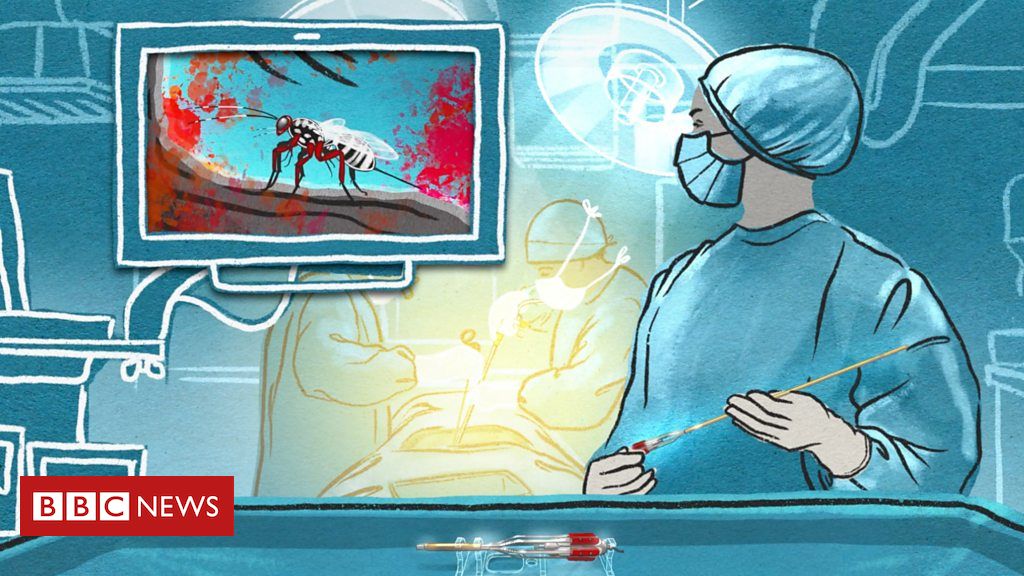
Scientists in the Netherlands have mimicked the way parasitoid wasps lay eggs to design a new tool for keyhole surgery. Currently tools used in these procedures are prone to clogging because they use suction. The new device avoids this by using friction. The team, at Delft University of Technology, have a working prototype and hope the tool will be ready within a few years. Voice: Patrick AryeeDigital producers: Christopher Brooks and Jennifer GreenAnimator: Jules BartlWith thanks to Aimée Sakes, TUDelft and Andrew Forbes, University of IowaFor more on this story, listen to ’30 Animals That Made Us Smarter’.

Read more →

Could Covid vaccine be taken as a pill?

SharecloseShare pageCopy linkAbout sharingimage copyrightGetty ImagesRight now, protection against Covid-19 comes via an injection. But in future, those vaccines could come from inhalers or even pills.In a white, airy laboratory in Medicon Village, one of southern Sweden’s largest science parks, chemist Ingemo Andersson holds up a thin, plastic inhaler, half the size of a matchbox. Her team is hoping this tiny product could play a big role in the global fight against coronavirus allowing people to take powdered versions of future vaccines at home.”It’s easy and it’s really cheap to produce,” says Johan Waborg, CEO of the firm, which usually makes inhalers for patients with asthma. “You just remove a little plastic slip and then the vaccine inhaler is activated and you just put it in your mouth, take a deep breath and inhale.” The company, Iconovo, is collaborating with an immunology research start-up in Stockholm, ISR, which has developed a dry-powder vaccine against Covid-19.It uses manufactured Covid-19 virus proteins (unlike Pfizer, Moderna and Astra Zeneca which use RNA or DNA that code for these proteins), and can withstand temperatures of up to 40C.That’s a major contrast to the conditions needed to store the current commonly available coronavirus vaccines approved by the World Health Organization (WHO), which are all in liquid form. They have to be kept in tough glass vials in temperatures as low as -70C, before being transferred to fridges, or they they lose effectiveness – known as the “cold chain”.”The game-changer is that you could distribute the [powder] vaccine extremely easily without the cold chain, and it can be administered without the need for healthcare providers,” says ISR’s founder, Ola Winquist, a professor of immunology at the Karolinska Institute, one of Sweden’s leading medical universities.Freeze-dried foodsThe company is currently testing its vaccines on the Beta (South African) and Alpha (UK) variants of Covid-19.It believes it could prove especially useful in speeding up vaccine rollouts in Africa where there are currently no home-grown vaccine manufacturers, and warmer climates and limited electricity supplies have led to major challenges when it comes to storing and delivering Covid-19 vaccines before they expire. There is still some way to go before trials indicate the full potential of ISR’s air-dried vaccine, including whether it can offer the same level of protection as the current list of vaccines approved by the WHO. So far, it has only been tested on mice, although ISR and Iconovo have raised enough funding to begin studies on humans within the next two months.But there is already optimism within the medical community that if powdered vaccines like this one prove successful, they could revolutionise the global response to the coronavirus pandemic, as well as making it easier to store and distribute vaccines for other illnesses.”It would really open up opportunities for hard-to-reach areas and maybe save us having people carrying cool boxes on bicycles and camels,” says Stefan Swartling Peterson, Unicef’s global health chief from 2016 to 2020, now professor of global transformation for health at Karolinska.He compares the potential impact to that of freeze-dried foods, which have proved “great for going into all sorts of funny places which are out of electricity’s reach”, whether for use by medical personnel or simply adventurous campers.While companies around the world are investigating powdered vaccines, Swartling Peterson points to another start-up with “promising technology”, just a 10-minute walk from Iconovo.Ziccum is testing a technology designed to air-dry existing or future liquid vaccines in a way that doesn’t limit their effectiveness. This could make it easier to set up so-called “fill and finish” facilities in developing countries, allowing them to complete the final stages of vaccine production on home soil. The vaccine powder would be mixed with a sterile water solution just prior to immunisation, and then injected using vials and needles.However, the technology “opens up for various other types of administration” from nasal sprays to pills, says its CEO Göran Conradsson. “It requires a lot of research and development for that. But in principle, yes.”‘Greener’ alternativeJanssen, which makes the single-dose Covid vaccine approved for use in the UK by the medicines regulator last month, is already working on a pilot project designed to analyse the Ziccum’s air-drying capabilities. The pharmaceutical giant would not say if this was connected to coronavirus or other infectious diseases, but a spokesperson said the research was part of a deep focus on “exploring novel technology that has the potential to ease distribution, administration and compliance” of future vaccines.Powder technologies could also help those who are afraid of needles, and offer a “greener” alternative to liquid vaccines, by cutting down on the electricity needed to power the fridges and freezers usually used to store vaccine vials. And it could help global vaccine coverage.”No-one’s safe until everyone is safe,” says Mr Conradsson. “You never know what’s going to happen if you [still] have the coronavirus going around somewhere in part of the world.””We have to be able to get vaccines to populations in all settings to tackle epidemics and pandemics globally,” agrees Ingrid Kromann, a spokesperson for the Coalition for Epidemic Preparedness Innovation (Cepi), a global non-profit organisation working to accelerate the development of vaccines.She is cautious, saying powder-based vaccines are still at an early stage of development and there is “still much work to do”, for example to streamline and scale up the manufacturing process. “But if it is successful, it could contribute to better access to vaccines, less wastage, and lower costs of vaccination programmes.”

Read more →

Fauci Sounds Alarm Over Low Covid Vaccination Rates

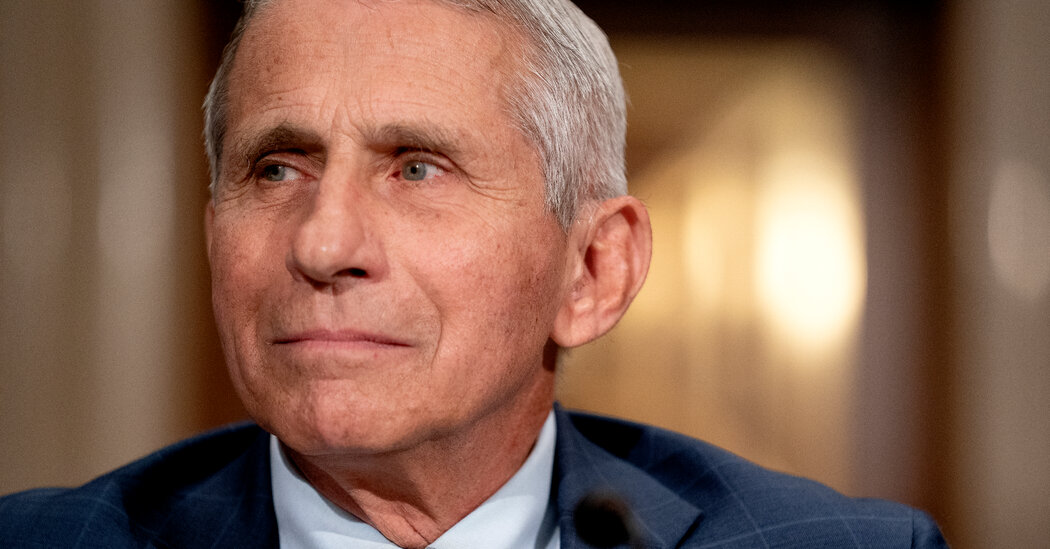
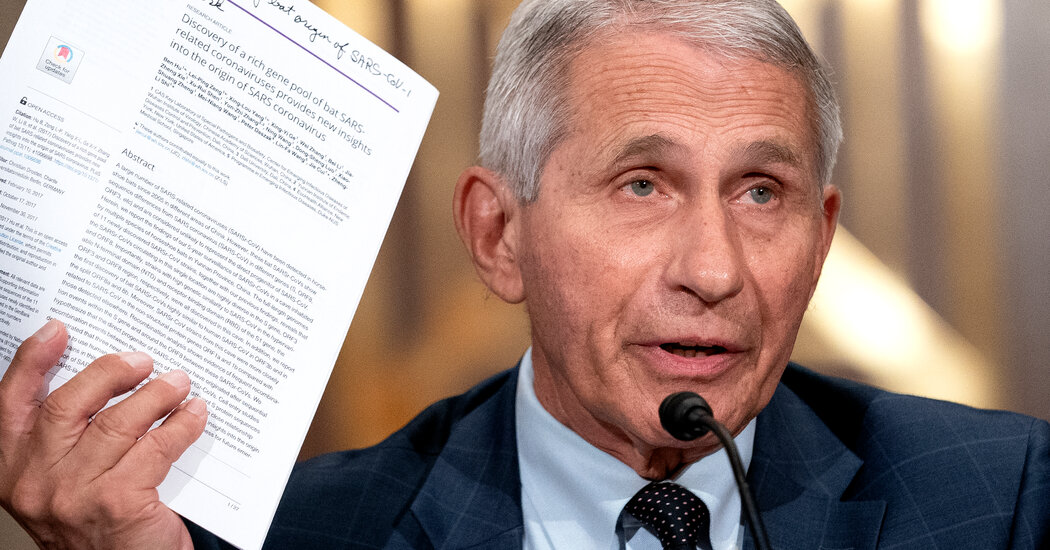
Dr. Anthony S. Fauci warned on Sunday that the coronavirus pandemic is now “going in the wrong direction” in the United States because too many Americans are still choosing not to get vaccinated.Asked on CNN’s “State of the Union” program about projections in recent statistical models that Covid-19 cases and deaths could surge in the coming months if vaccination rates don’t increase, Dr. Fauci said “it’s not going to be good.”With about half of Americans not yet vaccinated and the fast-spreading Delta variant circulating, Dr. Fauci and a range of current and former health officials expressed exasperation at the situation on Sunday and vigorously pressed the case that vaccination is the best and most effective way to stem the tide of Covid cases.“It is really a pandemic among the unvaccinated,” Dr. Fauci said, adding “It’s like you have two kinds of America. You have the very vulnerable unvaccinated part and you have the really relatively protected vaccinated part. If you are vaccinated, you are in a very different category than someone who is not vaccinated.”The situation is so dire that in recent days, even some Republican governors in low-vaccination states have been pointedly exhorting people to get a Covid vaccine.On Sunday on CNN, Gov. Asa Hutchinson of Arkansas said that, with the new school year on the horizon, “this is a pivotal moment in our race against the Covid virus,” adding that “what’s holding us back is a low vaccination rate.”Governor Hutchinson, a Republican, said he has been holding town halls recently, which he credited for a 40 percent increase in vaccination. Still he added that “certainly the resistance has hardened” among some people. “It’s simply false information,” he said. “It is myths.”On CBS’s “Face the Nation,” Dr. Jerome Adams, who was surgeon general in the Trump administration, also encouraged vaccination, casting the decision in patriotic terms. “Get vaccinated because it’s going to help every single American enjoy the freedoms that we want to return to,” he said.Dr. Adams said some people still have legitimate questions about getting vaccinated, including workers who worry post-vaccine side effects might cause them to miss a day of work or a paycheck. He predicted immunization rates would increase once the vaccines — currently available under emergency use authorization from the Food and Drug Administration — become fully licensed. That will likely prompt the military and some businesses to mandate vaccination for service members and employees, he said.In the meantime, Dr. Adams said the message should be “it is your choice, but choices come with consequences to you and other people,” including children not yet old enough for vaccination and people who are medically vulnerable..css-1xzcza9{list-style-type:disc;padding-inline-start:1em;}.css-3btd0c{font-family:nyt-franklin,helvetica,arial,sans-serif;font-size:1rem;line-height:1.375rem;color:#333;margin-bottom:0.78125rem;}@media (min-width:740px){.css-3btd0c{font-size:1.0625rem;line-height:1.5rem;margin-bottom:0.9375rem;}}.css-3btd0c strong{font-weight:600;}.css-3btd0c em{font-style:italic;}.css-w739ur{margin:0 auto 5px;font-family:nyt-franklin,helvetica,arial,sans-serif;font-weight:700;font-size:1.125rem;line-height:1.3125rem;color:#121212;}#NYT_BELOW_MAIN_CONTENT_REGION .css-w739ur{font-family:nyt-cheltenham,georgia,’times new roman’,times,serif;font-weight:700;font-size:1.375rem;line-height:1.625rem;}@media (min-width:740px){#NYT_BELOW_MAIN_CONTENT_REGION .css-w739ur{font-size:1.6875rem;line-height:1.875rem;}}@media (min-width:740px){.css-w739ur{font-size:1.25rem;line-height:1.4375rem;}}.css-9s9ecg{margin-bottom:15px;}.css-uf1ume{display:-webkit-box;display:-webkit-flex;display:-ms-flexbox;display:flex;-webkit-box-pack:justify;-webkit-justify-content:space-between;-ms-flex-pack:justify;justify-content:space-between;}.css-wxi1cx{display:-webkit-box;display:-webkit-flex;display:-ms-flexbox;display:flex;-webkit-flex-direction:column;-ms-flex-direction:column;flex-direction:column;-webkit-align-self:flex-end;-ms-flex-item-align:end;align-self:flex-end;}.css-12vbvwq{background-color:white;border:1px solid #e2e2e2;width:calc(100% – 40px);max-width:600px;margin:1.5rem auto 1.9rem;padding:15px;box-sizing:border-box;}@media (min-width:740px){.css-12vbvwq{padding:20px;width:100%;}}.css-12vbvwq:focus{outline:1px solid #e2e2e2;}#NYT_BELOW_MAIN_CONTENT_REGION .css-12vbvwq{border:none;padding:10px 0 0;border-top:2px solid #121212;}.css-12vbvwq[data-truncated] .css-rdoyk0{-webkit-transform:rotate(0deg);-ms-transform:rotate(0deg);transform:rotate(0deg);}.css-12vbvwq[data-truncated] .css-eb027h{max-height:300px;overflow:hidden;-webkit-transition:none;transition:none;}.css-12vbvwq[data-truncated] .css-5gimkt:after{content:’See more’;}.css-12vbvwq[data-truncated] .css-6mllg9{opacity:1;}.css-qjk116{margin:0 auto;overflow:hidden;}.css-qjk116 strong{font-weight:700;}.css-qjk116 em{font-style:italic;}.css-qjk116 a{color:#326891;-webkit-text-decoration:underline;text-decoration:underline;text-underline-offset:1px;-webkit-text-decoration-thickness:1px;text-decoration-thickness:1px;-webkit-text-decoration-color:#326891;text-decoration-color:#326891;}.css-qjk116 a:visited{color:#326891;-webkit-text-decoration-color:#326891;text-decoration-color:#326891;}.css-qjk116 a:hover{-webkit-text-decoration:none;text-decoration:none;}Several current and former officials discussed whether recommendations or mandates for wearing masks should be reinstated.Dr. Fauci said the Biden administration is considering reissuing stronger mask-wearing guidelines. In May, the Centers for Disease Control and Prevention relaxed its guidance, saying that people who are fully vaccinated do not need to wear a mask in most indoor settings.Dr. Adams said “that guidance, quite frankly, has confused citizens, it’s frustrated businesses and public health officials who I continue to hear from, and it’s been, by any qualification, a failure.”He said the C.D.C. should state clearly that even people who are vaccinated should wear masks if they are in public, around people whose vaccination status is unclear or in a community where Covid cases are increasing. “The CDC needs to give those businesses, those health officials a little bit of cover by clarifying the guidance that they have out there,” Dr. Adams said.

Read more →

The Delta Variant Is the Symptom of a Bigger Threat: Vaccine Refusal

There are almost as many reasons for vaccine hesitancy and refusal as there are unvaccinated Americans. But this problem, not the variant, lies at the root of rising infection rates.After an all too brief respite, the United States is again at a crossroads in the pandemic. The number of infections has ticked up — slowly at first, then swiftly — to 51,000 cases per day, on average, more than four times the rate a month ago. The country may again see overflowing hospitals, exhausted health care workers and thousands of needless deaths.The more contagious Delta variant may be getting the blame, but fueling its rise is an older, more familiar foe: vaccine hesitancy and refusal, long pervasive in the United States. Were a wider swath of the population vaccinated, there would be no resurgence — of the Delta variant, or Alpha variant, or any other version of the coronavirus.While mild breakthrough infections may be more common than once thought, the vaccines effectively prevent severe illness and death. Yet nearly half of the population remains unvaccinated and unprotected. About 30 percent of adults have not received even a single dose, and the percentage is much higher in some parts of the country.America is one of the few countries with enough vaccines at its disposal to protect every resident — and yet it has highest rates of vaccine hesitance or refusal of any nation except Russia.Public health experts have fruitlessly warned for months that the virus — any version of it — would resurge if the country did not vaccinate enough of the population quickly enough. Bill Hanage, an epidemiologist at the Harvard T.H. Chan School of Public Health, predicted in January that Florida might have a rough summer. Now one in five new infections nationwide is in Florida.True, the speed and ferocity with which the Delta variant is tearing through Asia, Europe, Africa and now North America has taken many experts by surprise. It now accounts for about 83 percent of the infections in the United States.But Delta is by no means the wickedest variant out there. Gamma and Lambda are waiting in the wings, and who knows what frightful versions are already flourishing undetected in the far corners of the world, perhaps even here in America.Every infected person, anywhere in the world, offers the coronavirus another opportunity to morph into a new variant. The more infections there are globally, the more likely new variants will arise.The United States will be vulnerable to every one of them until it can immunize millions of people who now refuse to get the vaccine, are still persuadable but hesitant, or have not yet gained access. The unvaccinated will set the country on fire over and over again.And they will not be the only ones who are singed. Vaccinated people will be protected from severe illness and death, but there may be other consequences. Already in some communities, they are being asked to wear masks indoors. If the numbers continue to soar, the restrictions that divided the country before may return. Workplaces may need to close again, and schools, too.And some number of vaccinated people will become infected. Breakthrough infections were expected to be vanishingly rare with the original virus, but recent data suggest they may be less so with the Delta variant. It is roughly twice as contagious as the original coronavirus, and some early evidence hints that people infected with the variant carry the virus in much higher amounts.“The larger the force of infection that comes from the pandemic in unvaccinated populations, the more breakthrough infections there will be,” Dr. Hanage said.Most breakthrough infections produce few to no symptoms, but some may prompt illness in vaccinated people serious enough to lay them up in bed, miss work — and put their children or older relatives at risk. Some cases may lead to long Covid, scientists now fear — a poorly defined syndrome in which symptoms seem to persist months.This grim redux has a glaringly obvious solution: shots in arms. But short of a federal mandate — or a patchwork of mandates by municipalities, hospitals, colleges and businesses — it is hard to see how enough Americans will be immunized to form a buttress against the virus.After a brisk vaccination campaign in the spring, the pace has slowed to about 537,000 doses per day, according to data gathered by The New York Times. Some responsibility for the lag lies with the frank refusal of conservative leaders — often Republicans — to champion the vaccines.But misinformation, an epidemic all its own on social media, emanates from all parts the cultural spectrum, and there is no single reason so many Americans remain unvaccinated. It is a Hydra-headed problem.Of the 39 percent of adults who are unvaccinated, about half say they are completely unwilling. But even within that group, some say they would comply if required to do so..css-1xzcza9{list-style-type:disc;padding-inline-start:1em;}.css-3btd0c{font-family:nyt-franklin,helvetica,arial,sans-serif;font-size:1rem;line-height:1.375rem;color:#333;margin-bottom:0.78125rem;}@media (min-width:740px){.css-3btd0c{font-size:1.0625rem;line-height:1.5rem;margin-bottom:0.9375rem;}}.css-3btd0c strong{font-weight:600;}.css-3btd0c em{font-style:italic;}.css-w739ur{margin:0 auto 5px;font-family:nyt-franklin,helvetica,arial,sans-serif;font-weight:700;font-size:1.125rem;line-height:1.3125rem;color:#121212;}#NYT_BELOW_MAIN_CONTENT_REGION .css-w739ur{font-family:nyt-cheltenham,georgia,’times new roman’,times,serif;font-weight:700;font-size:1.375rem;line-height:1.625rem;}@media (min-width:740px){#NYT_BELOW_MAIN_CONTENT_REGION .css-w739ur{font-size:1.6875rem;line-height:1.875rem;}}@media (min-width:740px){.css-w739ur{font-size:1.25rem;line-height:1.4375rem;}}.css-9s9ecg{margin-bottom:15px;}.css-uf1ume{display:-webkit-box;display:-webkit-flex;display:-ms-flexbox;display:flex;-webkit-box-pack:justify;-webkit-justify-content:space-between;-ms-flex-pack:justify;justify-content:space-between;}.css-wxi1cx{display:-webkit-box;display:-webkit-flex;display:-ms-flexbox;display:flex;-webkit-flex-direction:column;-ms-flex-direction:column;flex-direction:column;-webkit-align-self:flex-end;-ms-flex-item-align:end;align-self:flex-end;}.css-12vbvwq{background-color:white;border:1px solid #e2e2e2;width:calc(100% – 40px);max-width:600px;margin:1.5rem auto 1.9rem;padding:15px;box-sizing:border-box;}@media (min-width:740px){.css-12vbvwq{padding:20px;width:100%;}}.css-12vbvwq:focus{outline:1px solid #e2e2e2;}#NYT_BELOW_MAIN_CONTENT_REGION .css-12vbvwq{border:none;padding:10px 0 0;border-top:2px solid #121212;}.css-12vbvwq[data-truncated] .css-rdoyk0{-webkit-transform:rotate(0deg);-ms-transform:rotate(0deg);transform:rotate(0deg);}.css-12vbvwq[data-truncated] .css-eb027h{max-height:300px;overflow:hidden;-webkit-transition:none;transition:none;}.css-12vbvwq[data-truncated] .css-5gimkt:after{content:’See more’;}.css-12vbvwq[data-truncated] .css-6mllg9{opacity:1;}.css-qjk116{margin:0 auto;overflow:hidden;}.css-qjk116 strong{font-weight:700;}.css-qjk116 em{font-style:italic;}.css-qjk116 a{color:#326891;-webkit-text-decoration:underline;text-decoration:underline;text-underline-offset:1px;-webkit-text-decoration-thickness:1px;text-decoration-thickness:1px;-webkit-text-decoration-color:#326891;text-decoration-color:#326891;}.css-qjk116 a:visited{color:#326891;-webkit-text-decoration-color:#326891;text-decoration-color:#326891;}.css-qjk116 a:hover{-webkit-text-decoration:none;text-decoration:none;}Some are hesitant and may come around with the right persuasion from people they trust, while still others plan to be inoculated but say they have just not had the chance.Politics is a driver for only some of these people, noted Dr. Richard Besser, a former director of the Centers for Disease Control and Prevention. In New Jersey, where he lives, the rates vary drastically because of socioeconomic factors. In mostly white Princeton, 75 percent of adults are immunized, versus 45 percent in Trenton, just 14 miles away, which is heavily Black and Latino.“Both are strong Democratic areas, so it’s really important to break things down and to address the issues that are impeding vaccination progress in each segment of the unvaccinated population,” Dr. Besser said.Still, there is no doubt that the political divide is playing a role in rising infection rates. From the start, vaccinations in counties that voted for Donald J. Trump lagged those in counties that voted for Joseph R. Biden, and the gap has only widened — from two percentage points in April to nearly 12 points now, according to one recent poll by the Kaiser Family Foundation.Nationwide, 86 percent of Democrats have had at least one shot, compared with 52 percent of Republicans, according to another poll. Even the national goal of having 70 percent of adults vaccinated by July 4 somehow became “Biden’s goal,” said Dr. Nahid Bhadelia, director of the Center for Emerging Infectious Diseases Policy and Research at Boston University.“All of a sudden, even getting out of pandemic became a left versus right issue.”Fewer than half of House Republicans are vaccinated as of May, compared with 100 percent of congressional Democrats. For months, some Republican lawmakers including Senators Ron Johnson of Wisconsin and Rand Paul of Kentucky, and conservative news commentators like Tucker Carlson, have voiced their skepticism of vaccines, loudly and insistently.Lately, as infections rise in conservative precincts, a few Republican leaders have begun championing vaccination. Senator Mitch McConnell of Kentucky, the minority leader, who survived polio as a child, has worn masks and has urged that everyone be immunized. Senator Mitt Romney, Republican of Utah, said in an interview on Wednesday that “the politicization of vaccination is an outrage and frankly moronic.”All of these leaders, and many more, will need to repeat vaccine affirmations often enough to persuade millions of people to overcome their hesitation. The Delta variant is thriving amid American discord. The vaccines are the remedy not just for this variant, but all those yet to come.

Read more →

Comprehensive clinical sequencing opens door to the promise of precision medicine

St. Jude Children’s Research Hospital investigators have demonstrated that comprehensive genomic sequencing of all pediatric cancer patients is feasible and essential to capitalize on the lifesaving potential of precision medicine. Results from the St. Jude Genomes for Kids study appear online today in the journal Cancer Discovery.
Whole genome and whole exome sequencing of germline DNA was offered to all 309 patients who enrolled in the study. Whole genome, whole exome and RNA sequencing of tumor DNA was carried out for the 253 patients for whom adequate tumor samples were available.
Overall, 86% of patients had at least one clinically significant variation in tumor or germline DNA. Those included variants related to diagnosis, prognosis, therapy or cancer predisposition. Researchers estimated that 1 in 5 patients had clinically relevant mutations that would have gone undetected using standard sequencing methods.
“Some of the most clinically relevant findings were only possible because the study combined whole genome sequencing with whole exome and RNA sequencing,” said Jinghui Zhang, Ph.D., St. Jude Department of Computational Biology chair and co-corresponding author of the study.
Every tumor is unique. Every patient is unique.
Comprehensive clinical sequencing that includes whole genome, whole exome and RNA sequencing is not widely available. But as the technology becomes less expensive and accessible to more patients, researchers said comprehensive sequencing will become an important addition to pediatric cancer care.

Read more →

Fauci Wants to Make Vaccines for the Next Pandemic Before It Hits

If funded, a government program costing several billion dollars could develop “prototype” vaccines to protect against 20 families of viruses.In one sense, the world got lucky with the new coronavirus. By sheer chance, scientists just happened to have spent years studying coronaviruses, developing exactly the tools needed to make Covid vaccines as soon as the virus’s genetic sequence was published.But what will happen if the next pandemic comes from a virus that causes Lassa fever, or from the Sudan strain of Ebola, or from a Nipah virus?Dr. Anthony S. Fauci, director of the National Institute of Allergy and Infectious Diseases, is promoting an ambitious and expensive plan to prepare for such nightmare scenarios. It would cost “a few billion dollars” a year, take five years for the first crop of results and engage a huge cadre of scientists, he said.The idea is to make “prototype” vaccines to protect against viruses from about 20 families that might spark a new pandemic. Using research tools that proved successful for Covid-19, researchers would uncover the molecular structure of each virus, learn where antibodies must strike it, and how to prod the body into making exactly those antibodies.“If we get the funding, which I believe we will, it likely will start in 2022,” Dr. Fauci said, adding that he has been promoting the idea “in discussions with the White House and others.”Dr. Francis Collins, director of the National Institutes of Health, also thought it likely that the necessary funds would be allocated, calling the project “compelling.”“As we begin to contemplate a successful end to the Covid-19 pandemic, we must not shift back into complacency,” Dr. Collins said.Much of the financial support would come from Dr. Fauci’s institute, but a project of this scope would require additional funds that would have to be allocated by Congress. This year’s budget for the infectious diseases institute is a little over 6 billion dollars. Dr. Fauci did not specify how much additional money would be needed.If surveillance networks detected a new virus spilling over from animals into people, the logic goes, scientists could stop it by immunizing people in the outbreak by quickly manufacturing the prototype vaccine. And if the virus spread before the world realized what was happening, the prototype vaccines could be deployed more widely.“The name of the game would be to try and restrict spillovers to outbreaks,” said Dr. Dennis Burton, a vaccine researcher and chairman of the department of immunology and microbiology at Scripps Research Institute.Vaccine research at the Center for Virology and Vaccine Research at Beth Israel Medical Deaconess Center in Boston last year.Tony Luong for The New York TimesThe prototype vaccines project is the brainchild of Dr. Barney Graham, deputy director of the Vaccine Research Center at the National Institute of Allergy and Infectious Diseases. He presented the idea in February of 2017 at a private meeting of institute directors.Year after year, viruses had threatened to turn into pandemics, Dr. Graham said: the H1N1 swine flu in 2009, Chikungunya in 2012, MERS in 2013, Ebola in 2014, Zika in 2016. Each time scientists scrambled to try to make a vaccine. Their only success was a partial one, with an Ebola vaccine that helped control the epidemic but would not work against other Ebola strains. The other epidemics waned before the vaccines could be made or tested.“We were tired,” Dr. Graham said.But researchers had new tools developed over the past decade that could make a big difference. They allowed scientists to view molecular structures of viruses, isolate antibodies that block the viruses and find out where they bind. The result was an ability to do “structure-based design” for new vaccines that target the pathogen more precisely.When he heard Dr. Graham’s pitch in 2017, Dr. Fauci was inspired. “It struck me and others in the executive committee as something that is really doable,” Dr. Fauci said.Dr. Graham published a review paper outlining the proposal in Nature Immunology in 2018. But without the urgency of a threatening pandemic, his idea remained just that.Now, though, many think the time has come.The allergy and infectious diseases institute has created a spreadsheet for each of the 20 virus families showing what is known about each pathogen’s anatomy and vulnerabilities, said Dr. John Mascola, director of the Vaccine Research Center at the institute..css-1xzcza9{list-style-type:disc;padding-inline-start:1em;}.css-3btd0c{font-family:nyt-franklin,helvetica,arial,sans-serif;font-size:1rem;line-height:1.375rem;color:#333;margin-bottom:0.78125rem;}@media (min-width:740px){.css-3btd0c{font-size:1.0625rem;line-height:1.5rem;margin-bottom:0.9375rem;}}.css-3btd0c strong{font-weight:600;}.css-3btd0c em{font-style:italic;}.css-w739ur{margin:0 auto 5px;font-family:nyt-franklin,helvetica,arial,sans-serif;font-weight:700;font-size:1.125rem;line-height:1.3125rem;color:#121212;}#NYT_BELOW_MAIN_CONTENT_REGION .css-w739ur{font-family:nyt-cheltenham,georgia,’times new roman’,times,serif;font-weight:700;font-size:1.375rem;line-height:1.625rem;}@media (min-width:740px){#NYT_BELOW_MAIN_CONTENT_REGION .css-w739ur{font-size:1.6875rem;line-height:1.875rem;}}@media (min-width:740px){.css-w739ur{font-size:1.25rem;line-height:1.4375rem;}}.css-9s9ecg{margin-bottom:15px;}.css-uf1ume{display:-webkit-box;display:-webkit-flex;display:-ms-flexbox;display:flex;-webkit-box-pack:justify;-webkit-justify-content:space-between;-ms-flex-pack:justify;justify-content:space-between;}.css-wxi1cx{display:-webkit-box;display:-webkit-flex;display:-ms-flexbox;display:flex;-webkit-flex-direction:column;-ms-flex-direction:column;flex-direction:column;-webkit-align-self:flex-end;-ms-flex-item-align:end;align-self:flex-end;}.css-12vbvwq{background-color:white;border:1px solid #e2e2e2;width:calc(100% – 40px);max-width:600px;margin:1.5rem auto 1.9rem;padding:15px;box-sizing:border-box;}@media (min-width:740px){.css-12vbvwq{padding:20px;width:100%;}}.css-12vbvwq:focus{outline:1px solid #e2e2e2;}#NYT_BELOW_MAIN_CONTENT_REGION .css-12vbvwq{border:none;padding:10px 0 0;border-top:2px solid #121212;}.css-12vbvwq[data-truncated] .css-rdoyk0{-webkit-transform:rotate(0deg);-ms-transform:rotate(0deg);transform:rotate(0deg);}.css-12vbvwq[data-truncated] .css-eb027h{max-height:300px;overflow:hidden;-webkit-transition:none;transition:none;}.css-12vbvwq[data-truncated] .css-5gimkt:after{content:’See more’;}.css-12vbvwq[data-truncated] .css-6mllg9{opacity:1;}.css-qjk116{margin:0 auto;overflow:hidden;}.css-qjk116 strong{font-weight:700;}.css-qjk116 em{font-style:italic;}.css-qjk116 a{color:#326891;-webkit-text-decoration:underline;text-decoration:underline;text-underline-offset:1px;-webkit-text-decoration-thickness:1px;text-decoration-thickness:1px;-webkit-text-decoration-color:#326891;text-decoration-color:#326891;}.css-qjk116 a:visited{color:#326891;-webkit-text-decoration-color:#326891;text-decoration-color:#326891;}.css-qjk116 a:hover{-webkit-text-decoration:none;text-decoration:none;}“For each virus family we are in a different state of knowledge and vaccine development,” Dr. Mascola said. Vaccines for Lassa fever and Nipah virus, for example, are in early stages. Vaccines for Chikungunya and Zika are further along.The work to fill in the gaps in vaccine development would be done with research grants to academic scientists. “There is a lot of enthusiasm” among academic researchers, said Dr. Barton Haynes, director of the Duke Human Vaccine Institute. Although the proposal is not well known among the general public, Dr. Fauci said he has discussed it in talks to scientific audiences.The program would also establish collaborative agreements with pharmaceutical companies to produce prototype vaccines quickly, Dr. Fauci said.That is what happened with the shots for Covid-19. The SARS and MERS epidemics led scientists to work on a coronavirus vaccine. That led to the discovery that coronaviruses use a spike protein to infect cells, but the spike changes shape readily and needs to be held in one position to be useful as a vaccine. That could be done, researchers discovered, with tiny molecular changes in the spike protein.Days after the new coronavirus’s sequence was published, scientists had designed vaccines to fight it.That, Dr. Fauci said, is what pandemic preparedness can do. He’d like to have prototype vaccines for 10 out of the 20 virus families in the first five years of work.“It would require pretty large sums of money,” Dr. Fauci acknowledged. “But after what we’ve been through, it’s not out of the question.”

Read more →

Covid: Delta variant spreads globally as cases soar

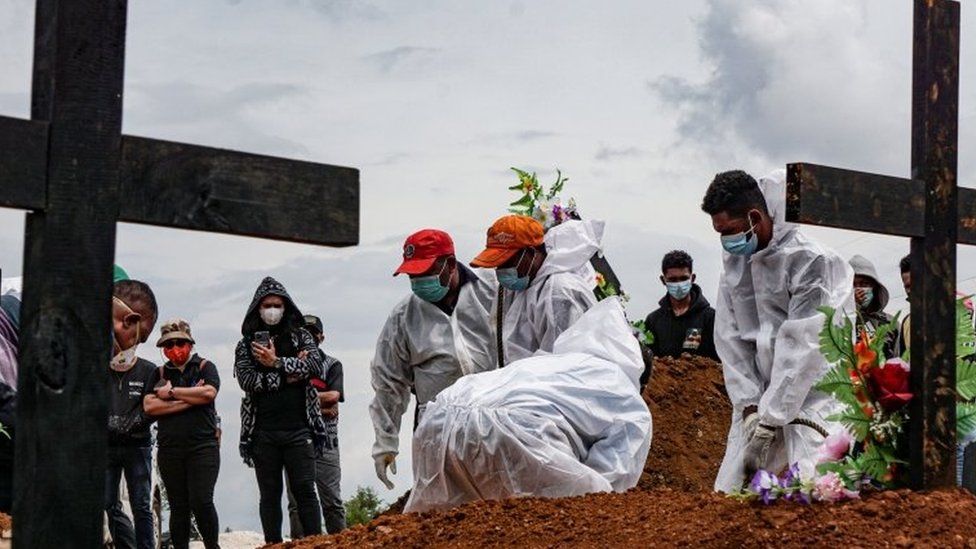
SharecloseShare pageCopy linkAbout sharingimage copyrightReuters/Indonesia OutThe Delta variant of Covid-19 has now been detected in 124 territories worldwide, the World Health Organization (WHO) says.It is expected to become the dominant variant globally in the coming months, with the WHO predicting that there could be more than 200 million confirmed cases within a matter of weeks.Infections are rising, particularly in Europe and the western Pacific region. Some Western countries have started to ease restrictions as death rates have dropped. But those without access to vaccines or with a slower vaccine rollout are facing a deadlier threat.Here, BBC journalists around the world give a sense of the toll the Delta variant is taking and what impact its spread could have.Indonesia – Demand for funerals soarsBy Valdya Baraputri, BBC News IndonesiaWith more than 1,300 deaths in a day, Indonesia has become Asia’s new Covid epicentre. Hundreds of people have died in self-isolation – possibly because they could not get immediate treatment or were turned away by overwhelmed hospitals.Wirawan, a firefighter in the capital city of Jakarta, sees the worsening crisis first-hand. He and his team are tasked with picking up bodies from homes before finally delivering them for burial. Before the latest spike in cases, he arranged two or three funerals a day. Now, he gets calls for up to 24 funerals a day.That’s more than he can handle, so the bodies need to wait.Dying alone in Indonesia’s grim battle with Covid-19The country is recording more than 50,000 new daily cases, and the government is keeping emergency restrictions until at least the end of this week. It is likely to extend the measures on Monday.As the new highly transmissible Delta variant, which was first detected in India, continues to ravage the country, Indonesia is racing to vaccine its people. From 208 million people eligible for vaccines, only around 16 million have received both doses.What is the Delta variant?By Michelle Roberts, BBC Health editorThe first cases were identified in India, but it has been reported in lots of countries around the world It is a variant of concern, meaning it has undergone some genetic changes that are potentially worrying in terms of transmissibility and vaccine escapeIn some countries, including the UK, Delta has become the dominant type of Covid circulatingExperts say vaccines still work well to protect against severe disease caused by this variantTunisia – Pizza offers for vaccine registrationBy Rana Jawad, BBC North Africa correspondentTunisia is now witnessing the most devastating impact of Covid since the global pandemic took hold. It’s not known whether most of the new infections are the Delta variant specifically, but case numbers grew after its known arrival here. Hospitals across the country are completely overwhelmed, with some medics filmed crying over a shortage of oxygen concentrators as they are forced to decide who lives and who dies. image copyrightGetty ImagesInfection rates are soaring, and the vaccination campaign has been very slow with less than 8% of the population fully jabbed. Rights organisations have accused the government of mismanaging the crisis, and on Tuesday the health minister was sacked. In recent days, Tunisia’s national telecoms agency has offered 1GB of free internet for those who follow a mobile text prompt to register for a vaccine. At least one known pizza place in Tunis offered a 10% discount if customers showed proof of vaccine registration.The situation could turn a corner next month after Tunisia received donations of vaccines, oxygen tanks and other medical supplies from European and Arabic countries, with several countries pledging to deliver more aid.Mexico – People tire of the crisisBy Marcos González Díaz, BBC Mundo correspondentMexico is facing its third wave of the pandemic. The number of infections has risen to more than 15,000 a day, reaching the peak we saw at the beginning of the year.Authorities are concerned about the advance of the Delta variant, which in the capital Mexico City already accounts for around 60% of cases.The government admitted that the spread of this variant in Mexico and the US is the reason they have extended the closure of the land border between the two countries to non-essential travel.Most of those affected in Mexico are young and unvaccinated people. Only one in four over 18 year-olds in the country are fully vaccinated.The Mexican villages refusing to vaccinateBut with 65% of beds available, hospitals do not show for now the collapse seen in the worst moments of the pandemic.In the streets, the feeling is almost of apparent normality among a population exhausted by this crisis. Many of them must leave home daily to work selling food or in other informal jobs, in order to earn the money they need to survive.This is why the government does not plan to increase restrictive measures or shut down economic activities once again, despite the risk of Delta.image copyrightGetty ImagesRwanda – Delta brings fresh restrictionsBy Samba Cyuzuzo, senior digital journalist for BBC Great LakesUntil recently, Rwanda had been praised for its swift and strong measures to contain the virus.But since mid-June, the virus has hit harder. Cases and deaths have spiked to record highs week after week. By early July, all Covid treatment centres were said to be full.”We have never been here before in this pandemic,” the health minister told the state broadcaster on 6 July. Two days later he confirmed the arrival of the faster spreading and deadlier Delta variant, and by 25 July the variant made up nearly 57% of samples sequenced.On 17 July, the country announced a 10 day lockdown in the capital Kigali and eight districts to try to halt virus. Cases and casualties, however, remain relatively high.More than 400,000 people are fully vaccinated – around 3% of Rwanda’s population.

Read more →

The Most Influential Spreader of Coronavirus Misinformation Online

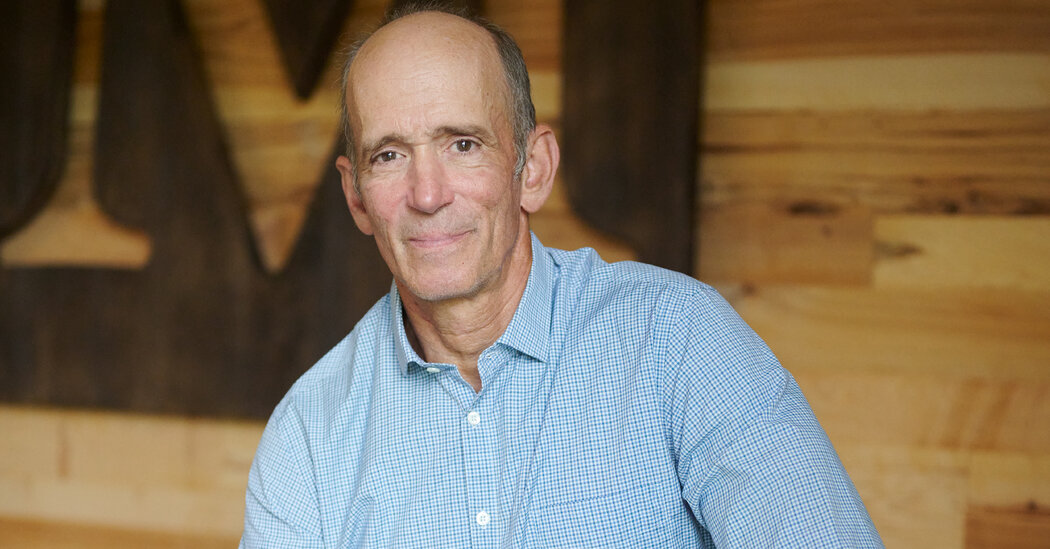
Researchers and regulators say Joseph Mercola, an osteopathic physician, creates and profits from misleading claims about Covid-19. “I have every right to inform the public,” he says.SAN FRANCISCO — The article that appeared online on Feb. 9 began with a seemingly innocuous question about the legal definition of vaccines. Then over its next 3,400 words, it declared coronavirus vaccines were “a medical fraud” and said the injections did not prevent infections, provide immunity or stop transmission of the disease.Instead, the article claimed, the shots “alter your genetic coding, turning you into a viral protein factory that has no off-switch.”Its assertions were easily disprovable. No matter. Over the next few hours, the article was translated from English into Spanish and Polish. It appeared on dozens of blogs and was picked up by anti-vaccination activists, who repeated the false claims online. The article also made its way to Facebook, where it reached 400,000 people, according to data from CrowdTangle, a Facebook-owned tool.The entire effort traced back to one person: Joseph Mercola.Dr. Mercola, 67, an osteopathic physician in Cape Coral, Fla., has long been a subject of criticism and government regulatory actions for his promotion of unproven or unapproved treatments. But most recently, he has become the chief spreader of coronavirus misinformation online, according to researchers.An internet-savvy entrepreneur who employs dozens, Dr. Mercola has published over 600 articles on Facebook that cast doubt on Covid-19 vaccines since the pandemic began, reaching a far larger audience than other vaccine skeptics, an analysis by The New York Times found. His claims have been widely echoed on Twitter, Instagram and YouTube.The activity has earned Dr. Mercola, a natural health proponent with an Everyman demeanor, the dubious distinction of the top spot in the “Disinformation Dozen,” a list of 12 people responsible for sharing 65 percent of all anti-vaccine messaging on social media, said the nonprofit Center for Countering Digital Hate. Others on the list include Robert F. Kennedy Jr., a longtime anti-vaccine activist, and Erin Elizabeth, the founder of the website Health Nut News, who is also Dr. Mercola’s girlfriend.“Mercola is the pioneer of the anti-vaccine movement,” said Kolina Koltai, a researcher at the University of Washington who studies online conspiracy theories. “He’s a master of capitalizing on periods of uncertainty, like the pandemic, to grow his movement.”Some high-profile media figures have promoted skepticism of the vaccines, notably Tucker Carlson and Laura Ingraham of Fox News, though other Fox personalities have urged viewers to get the shots. Now, Dr. Mercola and others in the “Disinformation Dozen” are in the spotlight as vaccinations in the United States slow, just as the highly infectious Delta variant has fueled a resurgence in coronavirus cases. More than 97 percent of people hospitalized for Covid-19 are unvaccinated, according to the Centers for Disease Control and Prevention.President Biden has blamed online falsehoods for causing people to refrain from getting the injections. But even as Mr. Biden has urged social media companies to “do something about the misinformation,” Dr. Mercola shows the difficulty of that task.Over the last decade, Dr. Mercola has built a vast operation to push natural health cures, disseminate anti-vaccination content and profit from all of it, said researchers who have studied his network. In 2017, he filed an affidavit claiming his net worth was “in excess of $100 million.”And rather than directly stating online that vaccines don’t work, Dr. Mercola’s posts often ask pointed questions about their safety and discuss studies that other doctors have refuted. Facebook and Twitter have allowed some of his posts to remain up with caution labels, and the companies have struggled to create rules to pull down posts that have nuance.“He has been given new life by social media, which he exploits skillfully and ruthlessly to bring people into his thrall,” said Imran Ahmed, director of the Center for Countering Digital Hate, which studies misinformation and hate speech. Its “Disinformation Dozen” report has been cited in congressional hearings and by the White House.In an email, Dr. Mercola said it was “quite peculiar to me that I am named as the #1 superspreader of misinformation.” Some of his Facebook posts were only liked by hundreds of people, he said, so he didn’t understand “how the relatively small number of shares could possibly cause such calamity to Biden’s multibillion dollar vaccination campaign.”The efforts against him are political, Dr. Mercola added, and he accused the White House of “illegal censorship by colluding with social media companies.”He did not address whether his coronavirus claims were factual. “I am the lead author of a peer reviewed publication regarding vitamin D and the risk of Covid-19 and I have every right to inform the public by sharing my medical research,” he said. He did not identify the publication, and The Times was unable to verify his claim.A native of Chicago, Dr. Mercola started a small private practice in 1985 in Schaumburg, Ill. In the 1990s, he began shifting to natural health medicine and opened his main website, Mercola.com, to share his treatments, cures and advice. The site urges people to “take control of your health.”In 2003, he published a book, “The No-Grain Diet,” which became a New York Times best seller. He has since published books almost yearly. In 2015, he moved to Florida.As his popularity grew, Dr. Mercola began a cycle. It starts with making unproven and sometimes far-fetched health claims, such as that spring mattresses amplify harmful radiation, and then selling products online — from vitamin supplements to organic yogurt — that he promotes as alternative treatments.To buttress the operation, he set up companies like Mercola.com Health Resources and Mercola Consulting Services. These entities have offices in Florida and the Philippines with teams of employees. Using this infrastructure, Dr. Mercola has seized on news moments to rapidly publish blog posts, newsletters and videos in nearly a dozen languages to a network of websites and social media.The Mercola headquarters in Cape Coral, Fla.MercolaHis audience is substantial. Dr. Mercola’s official English-language Facebook page has over 1.7 million followers, while his Spanish-language page has 1 million followers. The Times also found 17 other Facebook pages that appeared to be run by him or were closely connected to his businesses. On Twitter, he has nearly 300,000 followers, plus nearly 400,000 on YouTube.Dr. Mercola has a keen understanding of what makes something go viral online, said two former employees, who declined to be identified because they had signed nondisclosure agreements. He routinely does A/B testing, they said, in which many versions of the same content are published to see what spreads fastest online..css-1xzcza9{list-style-type:disc;padding-inline-start:1em;}.css-3btd0c{font-family:nyt-franklin,helvetica,arial,sans-serif;font-size:1rem;line-height:1.375rem;color:#333;margin-bottom:0.78125rem;}@media (min-width:740px){.css-3btd0c{font-size:1.0625rem;line-height:1.5rem;margin-bottom:0.9375rem;}}.css-3btd0c strong{font-weight:600;}.css-3btd0c em{font-style:italic;}.css-w739ur{margin:0 auto 5px;font-family:nyt-franklin,helvetica,arial,sans-serif;font-weight:700;font-size:1.125rem;line-height:1.3125rem;color:#121212;}#NYT_BELOW_MAIN_CONTENT_REGION .css-w739ur{font-family:nyt-cheltenham,georgia,’times new roman’,times,serif;font-weight:700;font-size:1.375rem;line-height:1.625rem;}@media (min-width:740px){#NYT_BELOW_MAIN_CONTENT_REGION .css-w739ur{font-size:1.6875rem;line-height:1.875rem;}}@media (min-width:740px){.css-w739ur{font-size:1.25rem;line-height:1.4375rem;}}.css-9s9ecg{margin-bottom:15px;}.css-uf1ume{display:-webkit-box;display:-webkit-flex;display:-ms-flexbox;display:flex;-webkit-box-pack:justify;-webkit-justify-content:space-between;-ms-flex-pack:justify;justify-content:space-between;}.css-wxi1cx{display:-webkit-box;display:-webkit-flex;display:-ms-flexbox;display:flex;-webkit-flex-direction:column;-ms-flex-direction:column;flex-direction:column;-webkit-align-self:flex-end;-ms-flex-item-align:end;align-self:flex-end;}.css-12vbvwq{background-color:white;border:1px solid #e2e2e2;width:calc(100% – 40px);max-width:600px;margin:1.5rem auto 1.9rem;padding:15px;box-sizing:border-box;}@media (min-width:740px){.css-12vbvwq{padding:20px;width:100%;}}.css-12vbvwq:focus{outline:1px solid #e2e2e2;}#NYT_BELOW_MAIN_CONTENT_REGION .css-12vbvwq{border:none;padding:10px 0 0;border-top:2px solid #121212;}.css-12vbvwq[data-truncated] .css-rdoyk0{-webkit-transform:rotate(0deg);-ms-transform:rotate(0deg);transform:rotate(0deg);}.css-12vbvwq[data-truncated] .css-eb027h{max-height:300px;overflow:hidden;-webkit-transition:none;transition:none;}.css-12vbvwq[data-truncated] .css-5gimkt:after{content:’See more’;}.css-12vbvwq[data-truncated] .css-6mllg9{opacity:1;}.css-qjk116{margin:0 auto;overflow:hidden;}.css-qjk116 strong{font-weight:700;}.css-qjk116 em{font-style:italic;}.css-qjk116 a{color:#326891;-webkit-text-decoration:underline;text-decoration:underline;text-underline-offset:1px;-webkit-text-decoration-thickness:1px;text-decoration-thickness:1px;-webkit-text-decoration-color:#326891;text-decoration-color:#326891;}.css-qjk116 a:visited{color:#326891;-webkit-text-decoration-color:#326891;text-decoration-color:#326891;}.css-qjk116 a:hover{-webkit-text-decoration:none;text-decoration:none;}In his email, Dr. Mercola said, “Translation and a variety of media positions are standard for most content oriented websites.”Facebook said it has labeled many of Dr. Mercola’s posts as false, banned advertising on his main page and removed some of his pages after they violated its policies. Twitter said it has also taken down some of Dr. Mercola’s posts and labeled others. YouTube said Dr. Mercola was not part of a program from which he can make money from ads on his videos.In 2012, Dr. Mercola began writing about the virtues of tanning beds. He argued that they reduced the chances of getting cancer, while also selling tanning beds with names like Vitality and D-lite for $1,200 to $4,000 each. Many of the articles were based on discredited studies.The Federal Trade Commission brought false-advertising claims against Dr. Mercola in 2017 based on the health claims about tanning beds. He settled and sent $2.95 million in refunds to customers who bought the tanning beds.The Food and Drug Administration has also issued warning letters to Dr. Mercola for selling unapproved health products in 2005, 2006 and 2011 and has fined him millions of dollars.Many of Dr. Mercola’s claims have been amplified by other vaccine skeptics, including Ms. Elizabeth. She worked for Mercola.com from 2009 to 2011, according to her LinkedIn page.But while Ms. Elizabeth and others are overtly anti-vaccine, Dr. Mercola has appeared more approachable because he takes less radical positions than his peers, Ms. Koltai said. “He takes away from the idea that an anti-vaccination activist is a fringe person,” she said.In an email, Ms. Elizabeth said she was “shocked to have been targeted as one of the 12” in the “Disinformation Dozen” and called it a “witch hunt.” When the coronavirus hit last year, Dr. Mercola jumped on the news, with posts questioning the origins of the disease. In December, he used a study that examined mask-wearing by doctors to argue that masks did not stop the spread of the virus. He also began promoting vitamin supplements as a way to ward off the coronavirus. In a warning letter on Feb. 18, the F.D.A. said Dr. Mercola had “misleadingly represented” what were “unapproved and misbranded products” on Mercola.com as established Covid-19 treatments.In May, Dr. Mercola took down many of his own Facebook posts to evade the social network’s crackdown on anti-vaccine content. Facebook also recently removed his Feb. 9 article.But Dr. Mercola has continued to raise vaccine questions. In a Facebook post on Friday, he used another study to mull how useful the Pfizer vaccine was against Covid-19 variants. One headline in the post said the vaccine was only 39 percent effective, but it did not cite another statistic from the study that said the vaccine was 91 percent effective against serious illness.“Is this possible? We were told 95 percent effectiveness,” he wrote.Within a few hours, the post had been shared more than 220 times.Davey Alba

Read more →

They Waited, They Worried, They Stalled. This Week, They Got the Shot.

CHICAGO — They acknowledged that they could have showed up months ago. Many were satisfied that they were finally doing the right thing. A few grumbled that they had little choice.On a single day this past week, more than half a million people across the United States trickled into high school gymnasiums, pharmacies and buses converted into mobile clinics. Then they pushed up their sleeves and got their coronavirus vaccines.These are the Americans who are being vaccinated at this moment in the pandemic: the reluctant, the anxious, the procrastinating.In dozens of interviews on Thursday in eight states, at vaccination clinics, drugstores and pop-up mobile sites, Americans who had finally arrived for their shots offered a snapshot of a nation at a crossroads — confronting a new surge of the virus but only slowly embracing the vaccines that could stop it.Duncan Beauchamp, 17, was vaccinated at Lyman Orchards in Middlefield, Conn. His father had been concerned by how quickly the vaccines were rolled out.Christopher Capozziello for The New York TimesEver Diaz, 42, was vaccinated at the Polk County Health Department in Des Moines. He said it had been hard to get a vaccine because of his job in construction.Kathryn Gamble for The New York TimesThe people being vaccinated now are not members of the eager crowds who rushed to early appointments. But they are not in the group firmly opposed to vaccinations, either.Instead, they occupy a middle ground: For months, they have been unwilling to receive a coronavirus vaccine, until something or someone — a persistent family member, a work requirement, a growing sense that the shot was safe — convinced them otherwise.How many people ultimately join this group, and how quickly, could determine the course of the coronavirus in the United States.Some of the newly vaccinated said they made the decision abruptly, even casually, after months of inaction. One woman in Portland, Ore., was waiting for an incentive before she got her shot, and when she heard that a pop-up clinic at a farmers’ market was distributing $150 gift cards, she decided it was time. A 60-year-old man in Los Angeles spontaneously stopped in for a vaccine because he noticed that for once, there was no line at a clinic. A construction worker said his job schedule had made it difficult to get the shot.Ronald Gilbert, 60, was vaccinated at a light rail station in Hawthorne, Calif. He said he didn’t really believe in the vaccines, but that with an uptick in cases it was “better to be safe than sorry.”Rozette Rago for The New York TimesCliberman Centeno, 36, was vaccinated in Los Angeles. He said he was tired of wearing a mask.Rozette Rago for The New York TimesMany people said they had arrived for a vaccine after intense pressure from family or friends.“‘You’re going to die. Get the Covid vaccine,’” Grace Carper, 15, recently told her mother, Nikki White, of Urbandale, Iowa, as they debated when they would get their shots. Ms. White, 38, woke up on Thursday and said she would do it. “If you want to go get your vaccine, get up,” Ms. White told her daughter, who was eager for the shot, and the pair went together to a Hy-Vee supermarket.Others were moved by practical considerations: plans to attend a college that is requiring students to be vaccinated, a desire to spend time socializing with high school classmates, or a job where unvaccinated employees were told to wear masks. Their answers suggest that the mandates or greater restrictions on the unvaccinated that are increasingly a matter of debate by employers and government officials could make a significant difference.Audrey Sliker, 18, of Southington, Conn., said she got a shot because New York’s governor announced that it was required of all students attending State University of New York schools. She plans to be a freshman at SUNY Cobleskill this fall.“I just don’t like needles, in general,” she said, leaving a white tent that housed a mobile vaccination site in Middlefield, Conn. “So it’s more like, ‘Do I need to get it?’”Lisa Thomas, 45, was vaccinated at the People’s Market in Portland, Ore. She first wanted to see how the vaccines affected Americans. “I do know people who have gotten it and they haven’t gotten sick, so that’s why,” Ms. Thomas said.Tojo Andrianarivo for The New York TimesPatricia White, 46, took her son Tariq, 17, right, to be vaccinated at Michele Clark Academic Preparatory Magnet High School in Chicago. Her grandson Diaunta is too young to be vaccinated.Taylor Glascock for The New York TimesMany people interviewed described their choices in personal, somewhat complicated terms.Willie Pullen, 71, snacked on a bag of popcorn as he left a vaccination site in Chicago, one of the few people who showed up there that day. He was not opposed to the vaccines, exactly. Nearly everyone in his life was already vaccinated, he said, and though he is at greater risk because of his age, he said he believed he was healthy and strong enough to be able to think on it for a while.What pushed him toward a high school on the West Side of Chicago, where free vaccines were being administered, was the illness of the aging mother of a friend. Mr. Pullen wanted to visit her. He felt it would be irresponsible to do so unvaccinated.“I was holding out,” Mr. Pullen said. “I had reservations about the safety of the vaccine and the government doing it. I just wanted to wait and see.”‘I’m still not sure if it’s safe’The campaign to broadly vaccinate Americans against the coronavirus began in a roaring, highly energetic push early this year, when millions were inoculated each day and coveted vaccine appointments were celebrated with joyful selfies on social media. The effort peaked on April 13, when an average of 3.38 million doses were being administered in the United States. The Biden administration set a goal to have 70 percent of American adults at least partly vaccinated by July 4.But since mid-April, vaccinations have steadily decreased, and in recent weeks, plateaued. Weeks after the July 4 benchmark has passed, the effort has now dwindled, distributing about 537,000 doses each day on average — about an 84 percent decrease from the peak.About 68.7 percent of American adults have received at least one shot. Conservative commentators and politicians have questioned the safety of the three vaccines that the Food and Drug Administration has approved for emergency use, and in some parts of the country, opposition to inoculation is tied to politics. An analysis by The New York Times of vaccine records and voter records in every county in the United States found that both willingness to receive a coronavirus vaccine and actual vaccination rates were lower, on average, in counties where a majority of residents voted to re-elect Donald J. Trump.Barnet Gaston, 14, was vaccinated at Michele Clark Academic Preparatory Magnet High School in Chicago. He wanted to get vaccinated so he could spend more time hanging out with his friends, most of whom were vaccinated.Taylor Glascock for The New York TimesAnastiacia Rincon, 15, was vaccinated at the Polk County Health Department in Des Moines. She says that she got vaccinated “to protect myself and others, and I have asthma.”Kathryn Gamble for The New York TimesDespite the lagging vaccination effort, there are signs that alarming headlines about a new surge in coronavirus cases and the highly infectious Delta variant could be pushing more Americans to consider vaccination. On Friday, Jen Psaki, the White House press secretary, said there had been “encouraging data” showing that the five states with the highest case rates — Arkansas, Florida, Louisiana, Missouri and Nevada — were also seeing higher vaccination numbers.In Florida, a clinic in Sarasota County was quiet, a brightly lit waiting area full of mostly empty chairs. Several people wandered in, often no more than one or two in an hour. Lately, they are vaccinating fewer than 30 people there a day.Elysia Emanuele, 42, a paralegal, came for a shot. One factor in her decision had been the rising case numbers in the state, which she had been watching with worry.“If everything had gone smoothly, if we had shut down immediately and did what we needed to do and it was seemingly wiped out,” she said, “I think I would have been less likely to get the vaccine.”In the shade of a freeway underpass in South Los Angeles, volunteers and would-be vaccine patients tried to talk over the roar of passing cars.Charlene Bradley, 71, was vaccinated at the People’s Market in Portland, Ore. “I was kind of against it, but I promised my son I would do it,” she said. “It just took a while.”Tojo Andrianarivo for The New York TimesCindy Adams, 52, was vaccinated at the Polk County Health Department in Des Moines. It was her workplace’s requirement to wear a mask as an unvaccinated person that changed her mind.Kathryn Gamble for The New York TimesRonald Gilbert, 60, said he did not really believe in the vaccines and has never been a fan of needles, but with an uptick in cases he reasoned that it was “better to be safe than sorry.”.css-1xzcza9{list-style-type:disc;padding-inline-start:1em;}.css-3btd0c{font-family:nyt-franklin,helvetica,arial,sans-serif;font-size:1rem;line-height:1.375rem;color:#333;margin-bottom:0.78125rem;}@media (min-width:740px){.css-3btd0c{font-size:1.0625rem;line-height:1.5rem;margin-bottom:0.9375rem;}}.css-3btd0c strong{font-weight:600;}.css-3btd0c em{font-style:italic;}.css-w739ur{margin:0 auto 5px;font-family:nyt-franklin,helvetica,arial,sans-serif;font-weight:700;font-size:1.125rem;line-height:1.3125rem;color:#121212;}#NYT_BELOW_MAIN_CONTENT_REGION .css-w739ur{font-family:nyt-cheltenham,georgia,’times new roman’,times,serif;font-weight:700;font-size:1.375rem;line-height:1.625rem;}@media (min-width:740px){#NYT_BELOW_MAIN_CONTENT_REGION .css-w739ur{font-size:1.6875rem;line-height:1.875rem;}}@media (min-width:740px){.css-w739ur{font-size:1.25rem;line-height:1.4375rem;}}.css-9s9ecg{margin-bottom:15px;}.css-uf1ume{display:-webkit-box;display:-webkit-flex;display:-ms-flexbox;display:flex;-webkit-box-pack:justify;-webkit-justify-content:space-between;-ms-flex-pack:justify;justify-content:space-between;}.css-wxi1cx{display:-webkit-box;display:-webkit-flex;display:-ms-flexbox;display:flex;-webkit-flex-direction:column;-ms-flex-direction:column;flex-direction:column;-webkit-align-self:flex-end;-ms-flex-item-align:end;align-self:flex-end;}.css-12vbvwq{background-color:white;border:1px solid #e2e2e2;width:calc(100% – 40px);max-width:600px;margin:1.5rem auto 1.9rem;padding:15px;box-sizing:border-box;}@media (min-width:740px){.css-12vbvwq{padding:20px;width:100%;}}.css-12vbvwq:focus{outline:1px solid #e2e2e2;}#NYT_BELOW_MAIN_CONTENT_REGION .css-12vbvwq{border:none;padding:10px 0 0;border-top:2px solid #121212;}.css-12vbvwq[data-truncated] .css-rdoyk0{-webkit-transform:rotate(0deg);-ms-transform:rotate(0deg);transform:rotate(0deg);}.css-12vbvwq[data-truncated] .css-eb027h{max-height:300px;overflow:hidden;-webkit-transition:none;transition:none;}.css-12vbvwq[data-truncated] .css-5gimkt:after{content:’See more’;}.css-12vbvwq[data-truncated] .css-6mllg9{opacity:1;}.css-qjk116{margin:0 auto;overflow:hidden;}.css-qjk116 strong{font-weight:700;}.css-qjk116 em{font-style:italic;}.css-qjk116 a{color:#326891;-webkit-text-decoration:underline;text-decoration:underline;text-underline-offset:1px;-webkit-text-decoration-thickness:1px;text-decoration-thickness:1px;-webkit-text-decoration-color:#326891;text-decoration-color:#326891;}.css-qjk116 a:visited{color:#326891;-webkit-text-decoration-color:#326891;text-decoration-color:#326891;}.css-qjk116 a:hover{-webkit-text-decoration:none;text-decoration:none;}“I feel better having this now, seriously I do,” he said. “I’m going to be walking like a rooster, chest up, like ‘You got the vaccine? I got the vaccine.’”News of the Delta variant also changed the mind of Josue Lopez, 33, who had not planned on getting a vaccine after his whole family tested positive for the coronavirus in December.“I thought I was immune, but with this variant, if it’s more dangerous, maybe it’s not enough,” he said. “Even now, I’m still not sure if it’s safe.”‘We have to fight for every one of them’At a vaccination site at Malcolm X College in Chicago, Sabina Richter, one of the workers there, said it used to be easy to find people to get shots. More recently, they had to offer incentives: passes to an amusement park in the north suburbs and Lollapalooza.“Some people come in and they’re still hesitant,” she said. “We have to fight for every one of them.”Otchere Darko, 44, was vaccinated at Westchester Community College in Ossining, N.Y. He waited until he felt the vaccines had proven to be safe.Christopher Capozziello for The New York TimesFrederique Moretto, 59, was vaccinated at a Florida Department of Health site in Sarasota, Fla. She got vaccinated to visit her daughter, who is going to a school in Washington in the fall.Octavio Jones for The New York TimesCherie Lockhart, an employee at a care facility in Milwaukee for older and disabled people, said she was worried about the vaccines because she did not trust a medical system that she felt had always treated Black people differently.She was not anti-vaccine, she said, just stalling until something could help her be sure. Her mother ultimately convinced her.“My mom has never steered me wrong,” Ms. Lockhart, 35, said. “She said, ‘I feel this is right in my heart of hearts.’ So I prayed about it. And, ultimately, I went with my guiding light.”Many of the people who newly sought shots said they had wanted to see how the vaccines affected Americans who rushed to get them early.“I do know people who have gotten it and they haven’t gotten sick, so that’s why,” said Lisa Thomas, 45, a home health care worker from Portland, Ore. “I haven’t heard of any cases of anyone hurting from it, and there’s a lot to benefit from it.”Leslie Vences-Avena, 14, was vaccinated at a Florida Department of Health site in Sarasota, Fla. The F.D.A. approved vaccinations for children age 12 and older in May.Octavio Jones for The New York TimesCherie Lockhart, 35, was vaccinated in Shorewood, Wis. Her mother convinced her to get the vaccine.Marla Bergh for The New York TimesFor Cindy Adams, who works for a Des Moines insurance company, it was her job’s requirement to wear a mask as an unvaccinated person that pushed her into the Polk County Health Department drive-up clinic for her first dose of the Pfizer-BioNTech vaccine.Ms. Adams, 52, said she had been concerned about possible long-term effects of the vaccines. But now her husband, children and most of her extended family have been vaccinated, as have most of her co-workers.“I just honestly got sick of wearing the mask,” Ms. Adams said. “We had an event yesterday, and I had to wear it for five hours because I was around a lot of people. And I was sick of it.“Everyone else is healthy and hasn’t had any side effects, gravely, yet, so I decided I might as well join the crowd.”Julie Bosman

Read more →

For Older Adults, Home Care Has Become Harder to Find

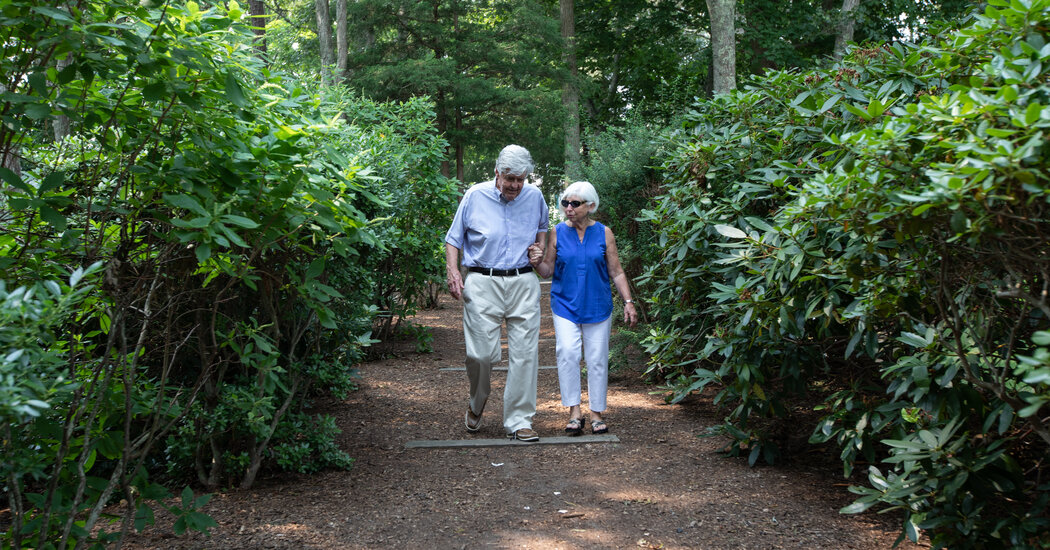
Staffing shortages have long plagued the home care industry. But the pandemic has intensified the problem.Almost daily, Terry Driscoll drives 40 minutes from her home in Yarmouth Port, Mass., to see her husband, Ken, in his memory care facility.That’s not where she wants him to be. The Driscolls, both 72, have been a couple since college. When he was diagnosed with Alzheimer’s disease almost a decade ago, “my plan, always, was to keep him at home,” said Ms. Driscoll, a nurse. “I thought, ‘I can handle this.’”For years she managed, cutting back to part-time work, then retiring earlier than planned and relying on adult day programs and support groups through a local nonprofit. As her husband’s needs increased and she could not leave him for even short periods, she hired two part-time independent home care aides. “They were both wonderful,” she said.But when the pandemic hit, she began to fear having outsiders in their home, and she let the aides go. Her daughter moved in for several months to help. In June, after Mr. Driscoll was briefly hospitalized, the family transferred him to an assisted living community with memory care while he regained his stability and the family caught its breath.“My goal is to bring him home,” Ms. Driscoll said. Her dilemma: She cannot shoulder his exhausting care alone, and she cannot find home care aides to hire.Word-of-mouth has produced no candidates. Local agencies charging $30 to $34 an hour tell her they have no workers available. “They all say the same thing: ‘We’ll put you on the waiting list, call us after Labor Day,’” Ms. Driscoll said. So her husband, at daunting expense, remains institutionalized.For years, staffing shortages have plagued the home care industry — a hodgepodge of for-profit companies and chains, nonprofit programs and publicly funded care through Medicaid, all operating under a confusing welter of state and federal regulations, plus an uncharted “gray market” of clients who avoid agencies and hire privately. But Covid-19 has intensified the problem.“I’ve never heard such frustration over finding workers, and I’ve been doing this for 20 years,” said Vicki Hoak, executive director of the Home Care Association of America, whose 4,000 member agencies collectively employ about 500,000 people.The Bureau of Labor Statistics estimated job losses of 342,000 in the direct care work force last year — including nursing home and other residential care and home care staff. (Typically, employment in these categories rises each year.) The losses came either through layoffs or from people resigning because of health problems or fears related to Covid, lack of child care and other impediments.By the end of 2020, employment in home care had rebounded and was only 3 percent below prepandemic levels, according to an analysis by PHI, a direct-care advocacy and research group..css-1xzcza9{list-style-type:disc;padding-inline-start:1em;}.css-3btd0c{font-family:nyt-franklin,helvetica,arial,sans-serif;font-size:1rem;line-height:1.375rem;color:#333;margin-bottom:0.78125rem;}@media (min-width:740px){.css-3btd0c{font-size:1.0625rem;line-height:1.5rem;margin-bottom:0.9375rem;}}.css-3btd0c strong{font-weight:600;}.css-3btd0c em{font-style:italic;}.css-w739ur{margin:0 auto 5px;font-family:nyt-franklin,helvetica,arial,sans-serif;font-weight:700;font-size:1.125rem;line-height:1.3125rem;color:#121212;}#NYT_BELOW_MAIN_CONTENT_REGION .css-w739ur{font-family:nyt-cheltenham,georgia,’times new roman’,times,serif;font-weight:700;font-size:1.375rem;line-height:1.625rem;}@media (min-width:740px){#NYT_BELOW_MAIN_CONTENT_REGION .css-w739ur{font-size:1.6875rem;line-height:1.875rem;}}@media (min-width:740px){.css-w739ur{font-size:1.25rem;line-height:1.4375rem;}}.css-9s9ecg{margin-bottom:15px;}.css-uf1ume{display:-webkit-box;display:-webkit-flex;display:-ms-flexbox;display:flex;-webkit-box-pack:justify;-webkit-justify-content:space-between;-ms-flex-pack:justify;justify-content:space-between;}.css-wxi1cx{display:-webkit-box;display:-webkit-flex;display:-ms-flexbox;display:flex;-webkit-flex-direction:column;-ms-flex-direction:column;flex-direction:column;-webkit-align-self:flex-end;-ms-flex-item-align:end;align-self:flex-end;}.css-12vbvwq{background-color:white;border:1px solid #e2e2e2;width:calc(100% – 40px);max-width:600px;margin:1.5rem auto 1.9rem;padding:15px;box-sizing:border-box;}@media (min-width:740px){.css-12vbvwq{padding:20px;width:100%;}}.css-12vbvwq:focus{outline:1px solid #e2e2e2;}#NYT_BELOW_MAIN_CONTENT_REGION .css-12vbvwq{border:none;padding:10px 0 0;border-top:2px solid #121212;}.css-12vbvwq[data-truncated] .css-rdoyk0{-webkit-transform:rotate(0deg);-ms-transform:rotate(0deg);transform:rotate(0deg);}.css-12vbvwq[data-truncated] .css-eb027h{max-height:300px;overflow:hidden;-webkit-transition:none;transition:none;}.css-12vbvwq[data-truncated] .css-5gimkt:after{content:’See more’;}.css-12vbvwq[data-truncated] .css-6mllg9{opacity:1;}.css-qjk116{margin:0 auto;overflow:hidden;}.css-qjk116 strong{font-weight:700;}.css-qjk116 em{font-style:italic;}.css-qjk116 a{color:#326891;-webkit-text-decoration:underline;text-decoration:underline;text-underline-offset:1px;-webkit-text-decoration-thickness:1px;text-decoration-thickness:1px;-webkit-text-decoration-color:#326891;text-decoration-color:#326891;}.css-qjk116 a:visited{color:#326891;-webkit-text-decoration-color:#326891;text-decoration-color:#326891;}.css-qjk116 a:hover{-webkit-text-decoration:none;text-decoration:none;}The bigger problem, industry sources say, is growing demand. Whereas nursing home occupancy has declined for years and fell further during the pandemic, and assisted living is at about 75 percent of capacity, the number of people seeking home care keeps increasing.More than 800,000 older and disabled people who qualify for Medicaid are on state waiting lists for home care. Agencies serving private-pay clients are turning away business.Congregate living looks less attractive after Covid, as residents died and family members were locked out for months. Moreover, a return to workplaces means that some adult children can no longer provide elder care. Even before the pandemic, the Bureau of Labor Statistics projected the addition of one million home care jobs by 2029.“The surge is here and we can’t meet the need,” Ms. Hoak said. “It’s disheartening.”Ms. Driscoll worries that trying to provide for Ken around the clock, unassisted, might endanger her own health. “You can be the strongest person in the world, but after a while you say, ‘I need a break,’” she said.Phyllis B. Dooney for The New York TimesIn response, many agencies are offering signing bonuses to employees and those who refer new hires, usually paid out over several months. A $500 incentive is common, Ms. Hoak said, but one franchise of the national chain Home Instead dangled $1,200.Seniors Helping Seniors, with more than 100 franchisees in 30 states, has begun paying new employees $100 to $500 bonuses after three months, earmarking a portion of that amount as a donation to local Alzheimer’s Association organizations.Its franchise operators employ about 7,000 home care aides, most over age 55. “We’re looking to add another 1,000 to 1,500 caregivers through this program,” said Namrata Yocom-Jan, its president.In eastern Tennessee, where Ray Bales operates two Seniors Helping Seniors franchises, 11 people applied within a week after he advertised $200 bonuses on Facebook, he said. He hopes to attract 30 to 40 new workers. (None objected to funding the company’s philanthropy with $50 from their prospective bonuses, he said.)But bonuses may not retain newcomers working in a field with notoriously high turnover — more than 80 percent in 2018, the Home Care Association found. Since then, turnover has fallen; still, two-thirds of agency employees have left each year.Some aides are taking advantage of higher pay in retail, fast food and other industries. Others have moved to independent work, avoiding intermediaries who pocket at least half of what clients pay.Wendy Gullickson, a licensed practical nurse in Wellfleet, Mass., spent only a few months as a $13-an-hour agency worker before discovering that she could make $25 as a private aide — still less than local agencies charge. (Home care cost an average of $23 to $24 an hour nationally last year, but $29 to $30 in Massachusetts.)To advocates, therefore, the key to enticing new aides into home care is not a mystery. “What they need is a competitive wage, because they can make as much or more in other sectors with full-time hours,” said Robert Espinoza, vice president of policy at PHI.In 2018, the nation’s estimated 2.8 million home care aides, most of them women of color and about one-third immigrants, earned a median $12 an hour and $17,200 annually. Very few received benefits; more than half relied on food stamps, Medicaid or other public assistance.“I don’t think a bonus is going to cut it anymore,” said April Verrett, president of SEIU Local 2015, which represents 400,000 home care workers in California’s Medicaid program. “Workers are choosing not to take jobs unless they’re guaranteed a family-sustaining wage.”The union’s new contracts with counties will raise wages to about $16 to $18 an hour within three years, with improved health benefits.Given the worsening shortage, industry groups are grappling with how to respond. “How do we elevate this profession?” Ms. Hoak asked. “We recognize the critical condition we’re in today.” Yet private-pay home care is already unaffordable for many middle-class families.President Biden’s proposed $400 billion Better Care Better Jobs Act would expand Medicaid eligibility for home care and improve wages, benefits and training for workers. It faces stiff opposition in Congress, however.Leading Age, which represents nonprofit senior care providers, has suggested a system of temporary visas and guest worker programs to bring elder care workers from overseas. And the Home Care Association supports a bipartisan bill providing a $5,000 federal tax credit (up from $3,000 in previous versions) to offset costs for family caregivers.But those efforts, even if they succeed, can’t help Terry Driscoll bring her husband home this summer, so they can have dinner on their deck and drive to the beach together.She worries that continuing to pay $10,000 a month for memory care will undermine her financial security. But she also fears that trying to provide round-the-clock care by herself could endanger her own health. “You can be the strongest person in the world, but after a while you say, ‘I need a break,’” she said.She keeps asking friends for leads and calling local home care agencies. They say they might be able to supply an aide by October.

Read more →