Making progress in developing probiotic beverages without animal protein

Most products enriched with probiotics and protein are made with dairy products. However, consumer demand for plant protein is growing. The nutritional value of these proteins must therefore be improved to be comparable to that of animal proteins.
A team led by Professor Monique Lacroix at the Institut national de la recherche scientifique (INRS) has demonstrated that fermenting drinks fortified with pea and rice proteins yields the same quality of protein as casein, an animal protein found in milk. The findings were published in the Journal of Food Science.
Increasing protein intake
Using plant proteins poses some challenges. For one thing, plant proteins are deficient in certain essential amino acids necessary for the body’s proper functioning. Since the body itself doesn’t produce these amino acids, they must come from food. The combination of pea and rice proteins helped counterbalance essential amino acid deficiencies through complementarity.
That said, plant proteins are also harder to digest. “They often are non soluble in water and under globular. That means our digestive enzymes have more difficulty breaking them down. Animal proteins, on the other hand, usually take the form of elongated fibres that are easily processed by digestive enzymes,” said Professor Lacroix.
But when pea and rice proteins are added before the fermentation stage during production of a fermented beverage, they can be predigested by lactic acid bacteria (LAB). This allows the production of peptides (protein fragments) resulting from the breakdown of proteins during fermentation, thereby facilitating their absorption during digestion.
The study, carried out in collaboration with Bio-K+, used a specific formulation containing the bacteria Lactobacillus acidophilus CL1285, L. casei LBC80R and L. rhamnosus CLR2. These LAB, whose probiotic functions have been scientifically proven and licensed by Health Canada, were used in this study to produce the fermented drink enriched with pea and rice proteins.
Story Source:
Materials provided by Institut national de la recherche scientifique – INRS. Original written by Audrey-Maude Vézina. Note: Content may be edited for style and length.

Read more →

Exercise may boost kids’ vocabulary growth

Swimming a few laps likely won’t turn your child into the next Katie Ledecky or Michael Phelps, but it just might help them become the next J.K. Rowling or Stephen King.
A recent study by University of Delaware researchers suggests exercise can boost kids’ vocabulary growth. The article, published in the Journal of Speech Language and Hearing Research, details one of the first studies on the effect of exercise on vocabulary learning in children.
Children ages 6 to 12 were taught new words before doing one of three things — swimming, taking part in CrossFit exercises or completing a coloring sheet. The children who swam were 13% more accurate in follow up tests of the vocabulary words.
It makes sense to the lead researcher, Maddy Pruitt, herself a former college swimmer who now regularly takes CrossFit classes. “Motor movement helps in encoding new words,” she said, explaining that exercise is known to increase levels of brain-derived neurotrophic factor, a protein Pruitt describes as the “Miracle-Gro of the brain.”
Why then, did swimming make a difference while CrossFit did not? Pruitt attributes it to the amount of energy each exercise demands of the brain. Swimming is an activity the kids could complete without much thought or instruction. It was more automatic, while the CrossFit exercises were new to them. The children needed to learn the moves, which required mental energy.
Pruitt conducted the research as part of her Master’s Capstone Project and graduated in 2020. She now works as a speech language pathologist at an elementary school in South Carolina, where she puts her findings into practice.
“My sessions are very rarely at a table,” she said. “I’ll take my kids out to the playground or we’ll take a walk around the school.”
Pruitt’s adviser and coauthor Giovanna Morini is building on the findings in her lab. Morini, an assistant professor in the Department of Communication Sciences and Disorders, said most research into exercise examines it from the angle of a healthy lifestyle, not much enters the domain of language acquisition. She said she sees this as a rich line of inquiry and has another student running a similar experiment now with toddlers.
“We were so excited about this study because it applies to clinicians, caregivers and educators who can put it into practice,” Morini said. “It’s simple stuff, nothing out of the ordinary. But it could really help boost the outcomes.”
Story Source:
Materials provided by University of Delaware. Original written by Andrea Boyle Tippett. Note: Content may be edited for style and length.

Read more →

A reversible male contraceptive, targeted to the testes with magnets

Women have several choices for long-lasting, reversible contraceptives, but most options for men are either single-use, such as condoms, or difficult to reverse, like vasectomies. Now, in a step toward a safe, long-lasting and reversible male contraceptive, researchers have developed magnetic, biodegradable nanomaterials that reduced the likelihood of mice fathering pups for at least 30 days.

Read more →

He Was Coughing Up Blood. But His Lungs Looked O.K.

The obvious place to look isn’t always the right place.“I’ve been coughing up blood,” the 59-year-old man confessed to his wife as they drove toward New York City from their home in Connecticut. It started the night before, he admitted when she asked. After 40 years of marriage, his wife, a nurse, was used to this kind of nonchalance from her husband, though it always carried a kind of punch. Take this exit, she instructed. They were near an urgent-care center in Brewster, N.Y. He needed to get this checked out.It was quiet when the couple walked in to urgent care, so her husband was seen right away. He had a runny nose and a cough for the past couple of days, and a few times he’d seen streaks of blood in what he coughed up, he told the nurse. His chest hurt a little when he took a deep breath, but otherwise he felt just fine. His vital signs, however, told a different story. He didn’t have a fever, but his oxygen level was at 91 percent. Even with the worst cold, his oxygen should have been 98 to 100 percent. Did he feel short of breath? Not particularly, he said. Maybe when he was walking from the car, but sitting here now? Not at all. He needed a CT scan of his chest, the couple was told, and so he was transferred to the emergency department at Northern Westchester Hospital in Mount Kisco, N.Y.The CT didn’t reveal any clots in the arteries of the lungs, so he didn’t have the feared pulmonary embolus, which could have caused his low oxygen and hemoptysis (coughing up blood) without other symptoms. Even so, the images were far from normal. There were patches of a light haze in areas that should be dark in both lungs. Maybe pneumonia? People usually feel sicker than this man when they have pneumonia, but how else could they explain the low oxygen level? He was started on antibiotics and admitted for observation.Crisis in the HarborDr. Tara Shapiro was the doctor assigned to his care that night. She was not at all sure the problem was in the man’s lungs. The CT scan also revealed a heart that was thicker and more muscular-looking than it should be. This kind of hypertrophy, as it’s called, is frequently seen in patients who have high blood pressure, when the heart has to work hard to squeeze its payload into the bloodstream. But this man didn’t have high blood pressure.The patient had a full cardiac work-up a few months earlier that he said was normal. But Shapiro was still worried that it was his heart and not his lungs that was failing him. His oxygen level improved greatly in just the few hours he’d been in the hospital. It was far too early for the antibiotics to have done this. More likely it was from the powerful diuretic he’d already been given in case the haziness in his lungs was fluid rather than an infection. A muscular heart doesn’t pump as well as a normal heart and sometimes can’t keep up. When that happens, fluid can get backed up — right into the lungs.Shapiro reached out to a cardiologist colleague, Dr. Ronald Wallach. He was one of the most knowledgeable doctors she knew. Wallach saw the patient the following day, just before he was discharged. The patient’s wife was reassured by the doctor’s white hair and air of quiet authority. Her husband, something of a hardhead, would certainly listen to this guy.After hearing the man’s story, Wallach asked if he had been short of breath before. Well, maybe it had been going on for a while, the man acknowledged. How long? The man’s wife gave him a sharp look. Certainly for the past several months, at least since the summer, he said. That’s when he’d had some serious trouble breathing.He was out one weekend on his motorboat with his wife and adult daughter. The women were on inner tubes in the cove just behind New Rochelle Harbor, enjoying the sun and calm waters. Then suddenly: “Throw me the rope,” he heard his wife shout. He looked up to see the two women moving rapidly away from his boat, caught in the oceanbound tide. He wrapped one end of a rope around his body and threw the other end out to his wife. It took a couple of tries, but she got it. He struggled to pull wife and daughter back to the side of the boat. As they clambered over the side, it was his wife who noticed his breathing. His face was red and shiny with sweat, and he was panting for breath. Are you OK? she asked. He nodded his head and held up a finger as if to say give me a minute. It took more than a minute — a lot more. It scared her. He was a tough guy, but it might have scared him too, because, though he refused to go to the emergency room then, he did see his primary-care doctor later that week.That doctor immediately sent him to a pulmonologist and then a cardiologist. The lung doctor gave him a diagnosis of asthma. It’s unusual at this age, the doctor said, but it happens. He gave the patient an inhaler to use when he felt short of breath. It didn’t help. The cardiologist ordered a stress test. The patient lasted only a few minutes before he was too out of breath to continue. His EKG was normal throughout the test, so his cardiologist chalked it up to his asthma. He was an elevator mechanic and that meant that most days he had to climb stairs — sometimes lots of stairs — to fix broken machinery. The man noticed the stairs had become a little harder on him over the past year or so, but, he asked Wallach with shrug and a smile, what can you do?Illustration by Ina JangZigzag FibersIt was the EKG done in the emergency department that provided Wallach with the last clue he needed to make his diagnosis. An EKG measures the electricity generated by the heart in order to make the muscles contract effectively. A thick, muscular heart will make an EKG tracing that is bigger, more exaggerated than normal. The more muscle present, the bigger the signal. But this man’s heart generated a signal that was smaller than normal. Less electricity could suggest less muscle. Was this man’s heart enlarged by something other than muscle?There are diseases that can invade cardiac muscles to make them look bigger but be weaker. A disease like that could account for all the man’s symptoms — the thick-looking walls, the overflow into the lungs, the strange EKG, the shortness of breath, even the hemoptysis. “I think you might have something serious,” Wallach told the patient. A cardiac M.R.I. could give them the answer. The patient got that test a few days later. He wasn’t out of the scanner for more than 20 minutes when his phone rang. It was Wallach. The images told the story: The man had a disease known as amyloidosis.Amyloidosis is the final result of many disease processes that ultimately cause zigzag-shaped fibers to accumulate in different parts of the body. Cardiac amyloidosis can be a result of a cancer known as multiple myeloma. In this cancer, a type of white cell called a plasma cell creates abnormal fibers that can break down and form the characteristic saw-toothed fibers of amyloidosis. These jagged fibers can also be a result of aging. In this version of the disease, carrier proteins known as transthyretins break down and take on the abnormal but characteristic irregular folds of amyloidosis. In both diseases, these serrated fibers travel through the body, invading and accumulating in muscle — often the heart muscle.Tests on blood and urine quickly showed that his disease wasn’t due to myeloma. That was a relief; the prognosis for patients with cardiac amyloidosis from multiple myeloma is poor. They often die within a year of getting the diagnosis. A biopsy of the heart muscle proved that it was the form of amyloidosis associated with aging. This type of amyloidosis is also progressive but much more slowly. The patient was referred to a cardiothoracic surgeon at Columbia University. Sooner or later, he was going to need a heart transplant.Three years passed before Wallach heard again from the patient. He wrote to let Wallach know he’d received his heart transplant and was doing well. He was writing to say thank you: “You saved my life.”I asked Wallach how he could make this diagnosis when other doctors had not. He called it the Aunt Tilly Sign. “If I described Aunt Tilly to you and sent you out into a crowd to find her, you’d probably fail. But if you’d ever seen Aunt Tilly” — he snapped his fingers — “no problem. You’d find her in a second. It’s all about recognition.”Lisa Sanders, M.D., is a contributing writer for the magazine. Her latest book is “Diagnosis: Solving the Most Baffling Medical Mysteries.” If you have a solved case to share with Dr. Sanders, write her at Lisa .Sandersmd@gmail.com.

Read more →

Covid Variant Adds to Worker Anxieties

Some see an undue rush by employers to get workplaces back to normal, whether by dropping precautions or imposing new rules.When Kelly Harris, a personal grocery shopper in Steubenville, Ohio, was vaccinated in March against Covid-19, it was a huge relief. “I felt the weight of the world off my shoulders,” she said.Her sense of relief has turned to dread. After most supermarkets eased masking requirements in May, mask wearing plummeted in her area. She worried about bringing the virus home to her school-age children.Then, as the Delta variant proliferated in recent weeks, her anxiety levels spiked again. “I try to stay away from everybody and use self-checkout,” she said. “It has me pretty stressed out.”Judging from the policies of the stores Ms. Harris frequents, many employers appear to regard the recent increase in Covid infections as a mere blip on the long-awaited road to normal.Some companies have intensified their efforts to return to a pandemic before-times, easing safety protocols while expecting employees to return to previous routines.But for many workers, the perception is quite different: a sense of rising vulnerability and frustration even for the vaccinated, who find themselves inundated with stories of breakthrough infections and long Covid.The gulf between employers’ actions and workers’ concerns appears to foreshadow a period of rising tensions between the two, and unions appear to be positioning themselves for it. Some unions are calling on companies to do more to keep members safe, while others are questioning new vaccination requirements. The two positions may seem at odds, but they send a common message: Not so fast.“I think we’re rushing to return to normal,” said Marc Perrone, the president of the United Food and Commercial Workers, which has over one million members in industries like groceries and meatpacking.Many workers complain about a mismatch between plans their employers appear to have made before the rise of the variant and the reality of the past few weeks.For much of the pandemic, Amazon has offered free on-site Covid testing for employees. It incorporated a variety of design features into warehouses to promote social distancing. But a worker at an Amazon warehouse in Oregon, who did not want to be named for fear of retribution, said there had been a gradual reduction in safety features, like the removal of physical barriers to enforce social distancing.Kelly Nantel, an Amazon spokeswoman, said that the company had removed barriers in some parts of warehouses where workers don’t spend much time in proximity, but that it had kept up distancing measures in other areas, like break rooms.“We’re continuously evaluating the temporary measures we implemented in response to Covid-19 and making adjustments in alignment with public health authority guidance,” Ms. Nantel said. She added that the company would “begin ramping down our U.S. testing operations by July 30, 2021.”At REI, the outdoor equipment and apparel retailer, four workers in different parts of the country, who asked not to be named for fear of workplace repercussions, complained that the company had recently enacted a potentially more punitive attendance policy it had planned to put in place just before the pandemic. Under the policy, part-time workers who use more than their allotted sick days are subject to discipline up to termination if the absences are unexcused. The workers also said they were concerned that many stores — after restricting capacity until this spring — had become more and more crowded.Halley Knigge, a spokeswoman for REI, said that under its new policies the company allowed part-time workers to accrue sick leave for the first time and that the disciplinary policy was not substantively new but merely reworded. The stores, she added, continue to restrict occupancy to no more than 50 percent capacity, as they have since June 2020.Workers elsewhere in the retail industry also complained about the growing crowds and difficulty of distancing inside stores like supermarkets. Karyn Johnson-Dorsey, a personal shopper from Riverside, Calif., who finds work on Instacart but also has her own roster of clients, said it had been increasingly difficult to maintain a safe distance from unmasked customers since the state eased masking and capacity restrictions in mid-June.“You have whole families who are picking out a pound of ground beef,” she said. “Children who are not vaccinated because of age are touching everything, not masked, either.”Amazon’s warehouse on Staten Island. Workers at Amazon have become concerned in recent weeks that the company is overly eager to wind down safety measures.Chang W. Lee/The New York TimesMs. Johnson-Dorsey, who had Covid last year and was vaccinated in March, said that what she was encountering in stores had become a major source of worry as the Delta variant spread. “I think it’s just showing that maybe we jumped too quickly to try and beat this imaginary deadline,” she said.On Tuesday, after the Centers for Disease Control and Prevention provided new guidance on masking, some employers said they would adjust their policies as warranted.“We’d always defer to state and local ordinances on capacity and masking mandates,” said a spokeswoman for Albertsons, which also owns Safeway and Jewel-Osco. “We don’t have a national mandate on capacity at this time.”Ms. Harris and Ms. Johnson-Dorsey, the personal shoppers, do not belong to a union, but Bob O’Toole, the president of the food workers local in Chicago, which represents more than 15,000 workers in the grocery, meatpacking and food-processing industries, said many of his members shared their sentiments.“The employees don’t feel as though the employers are doing anything to enhance safety after so many precautions were relaxed,” he wrote in a text message..css-1xzcza9{list-style-type:disc;padding-inline-start:1em;}.css-3btd0c{font-family:nyt-franklin,helvetica,arial,sans-serif;font-size:1rem;line-height:1.375rem;color:#333;margin-bottom:0.78125rem;}@media (min-width:740px){.css-3btd0c{font-size:1.0625rem;line-height:1.5rem;margin-bottom:0.9375rem;}}.css-3btd0c strong{font-weight:600;}.css-3btd0c em{font-style:italic;}.css-w739ur{margin:0 auto 5px;font-family:nyt-franklin,helvetica,arial,sans-serif;font-weight:700;font-size:1.125rem;line-height:1.3125rem;color:#121212;}#NYT_BELOW_MAIN_CONTENT_REGION .css-w739ur{font-family:nyt-cheltenham,georgia,’times new roman’,times,serif;font-weight:700;font-size:1.375rem;line-height:1.625rem;}@media (min-width:740px){#NYT_BELOW_MAIN_CONTENT_REGION .css-w739ur{font-size:1.6875rem;line-height:1.875rem;}}@media (min-width:740px){.css-w739ur{font-size:1.25rem;line-height:1.4375rem;}}.css-9s9ecg{margin-bottom:15px;}.css-uf1ume{display:-webkit-box;display:-webkit-flex;display:-ms-flexbox;display:flex;-webkit-box-pack:justify;-webkit-justify-content:space-between;-ms-flex-pack:justify;justify-content:space-between;}.css-wxi1cx{display:-webkit-box;display:-webkit-flex;display:-ms-flexbox;display:flex;-webkit-flex-direction:column;-ms-flex-direction:column;flex-direction:column;-webkit-align-self:flex-end;-ms-flex-item-align:end;align-self:flex-end;}.css-12vbvwq{background-color:white;border:1px solid #e2e2e2;width:calc(100% – 40px);max-width:600px;margin:1.5rem auto 1.9rem;padding:15px;box-sizing:border-box;}@media (min-width:740px){.css-12vbvwq{padding:20px;width:100%;}}.css-12vbvwq:focus{outline:1px solid #e2e2e2;}#NYT_BELOW_MAIN_CONTENT_REGION .css-12vbvwq{border:none;padding:10px 0 0;border-top:2px solid #121212;}.css-12vbvwq[data-truncated] .css-rdoyk0{-webkit-transform:rotate(0deg);-ms-transform:rotate(0deg);transform:rotate(0deg);}.css-12vbvwq[data-truncated] .css-eb027h{max-height:300px;overflow:hidden;-webkit-transition:none;transition:none;}.css-12vbvwq[data-truncated] .css-5gimkt:after{content:’See more’;}.css-12vbvwq[data-truncated] .css-6mllg9{opacity:1;}.css-qjk116{margin:0 auto;overflow:hidden;}.css-qjk116 strong{font-weight:700;}.css-qjk116 em{font-style:italic;}.css-qjk116 a{color:#326891;-webkit-text-decoration:underline;text-decoration:underline;text-underline-offset:1px;-webkit-text-decoration-thickness:1px;text-decoration-thickness:1px;-webkit-text-decoration-color:#326891;text-decoration-color:#326891;}.css-qjk116 a:visited{color:#326891;-webkit-text-decoration-color:#326891;text-decoration-color:#326891;}.css-qjk116 a:hover{-webkit-text-decoration:none;text-decoration:none;}Mr. Perrone, the international president for the food workers union, said in a statement on Tuesday that the new C.D.C. guidance wasn’t sufficient and urged a national mask mandate.Public-sector workers, too, have expressed safety concerns as officials move to get government services back to prepandemic norms. In Chicago, Mayor Lori Lightfoot recently brought back office-based city employees who had been working remotely during the pandemic.But one of the unions representing them, the Illinois council of the American Federation of State, County and Municipal Employees, has argued that more needs to be done to space workers apart and improve ventilation.“The workplaces where those people work could be sources of transmission because we live in a cubicle world where people are often very close together,” said Roberta Lynch, the union’s executive director in the state. “We want to ensure that people who have high-risk work locations are able to work safely.”A spokeswoman for the mayor did not respond to a request for comment.The Office and Professional Employees International Union, which represents nurses who are increasingly subject to vaccine requirements around the country, is unlikely to take a position on the mandates per se but will seek to have a voice in setting policy to guarantee that employees are treated fairly, said Sandy Pope, its bargaining director. For example, the union wants to ensure that no workers are disciplined or fired for refusing the vaccine if they have legitimate reasons for doing so.“We will demand to be consulted on these things,” Ms. Pope said. “I know a couple of members who have legitimate health issues that have prevented them from being vaccinated.”The union, which also represents clerical workers at insurance companies, credit unions and universities, has employee-management committees pushing to arrange adequate ventilation systems for workers, with mixed results, she said. She added that the union was preparing for a potential standoff in September, when many employers have said they will end hybrid work arrangements and require full-time attendance.“I think that’s going to be the big fight,” Ms. Pope said. “A number of employers had September as the target date.”The Culinary Workers Union, which represents casino workers in Las Vegas, has been calling for the return of a mask requirement for all customers indoors since Nevada relaxed the rule in May.John Locher/Associated PressBy contrast, the United Automobile Workers union said it was working with major automakers through a Covid task force to help make safety decisions. General Motors and Ford Motor both recently reinstituted masking for all employees at separate sites in Missouri, and Ford reinstituted masking at offices in Florida, after the companies assessed virus-related data in those regions. And a number of employers, including Amazon and the meat processor JBS, have had vaccination facilities for workers on site.Some unions may have been spared a fight by the C.D.C.’s move on Tuesday. In Las Vegas, the Culinary Workers Union, which represents casino workers, has been calling for the return of a mask requirement for all customers indoors since Nevada relaxed the requirement in May. The casinos had not heeded the call, but after the C.D.C. announcement, the state said it would reimpose an indoor mask mandate.In other cases, a reckoning still looms. The federal government’s mask mandate on airplanes is set to expire after Sept. 13, and unions representing airplane personnel are uneasy about the possibility that it will lapse, though Tuesday’s C.D.C. announcement suggests it may be more likely to be extended. The unions have applauded the airlines for moving to stop the spread of the coronavirus on airplanes by installing more sophisticated air filtration systems, but maintain that they are not sufficient.“Filtration is helpful for circulated air in the cabin,” said Sara Nelson, president of the Association of Flight Attendants. “But it doesn’t stop the general spread from one person to another sitting six inches apart.”

Read more →

Anger as Covid-ravaged Malaysia lifts pandemic measures

SharecloseShare pageCopy linkAbout sharingimage copyrightGetty ImagesThe Malaysian government has been asked why it revoked emergency Covid regulations as cases continue to spike.Malaysia has reported more than a million cases and 8,000 deaths so far, but experts warn the real numbers are much higher as testing rates are low. Hospitals are crowded and overwhelmed – recent images showed patients sitting on chairs and sharing oxygen cylinders. The country is also currently under a state of emergency, which will end on 1 August and will not be extended. Opposition leaders said they were not informed about the annulment, which happened last week, and demanded to know what the impact on the wider public would be. “Why were we not informed? Whose decision was it?” said Democratic Action Party deputy chairman Gobind Singh Deo during a parliamentary session on Tuesday. These emergency ordinances included allowing people to be fined for breaching movement restrictions. Like many other countries in the region, the South East Asian nation has been hit hard by the highly infectious Delta strain of the virus. This is its worst wave of the pandemic. Malaysia is now recording more than 14,000 cases a day, with a record 207 deaths recorded on Tuesday. Hospitals have been turning away patients, with even those who do get admission not guaranteed beds. On Monday, hundreds of junior doctors walked out of hospitals and medical facilities across the country, saying they deserved permanent jobs and better conditions. Undertakers and funeral workers have also told local reporters that they are overwhelmed with requests to bury Covid-19 victims, many of whom have died at home. Some experts had said that even the current emergency measures were “half-baked” and would not help improve the situation.However, it has taken a huge economic toll on people – especially daily wage earners and lower income families. Some of them have been flying white flags outside their homes as a plea for help. Emotional stories of families with depleted savings surviving on one meal a day have made the news in recent weeks. You may also be interested in…

Read more →

Covid: Sydney extends lockdown as other Australian cities reopen

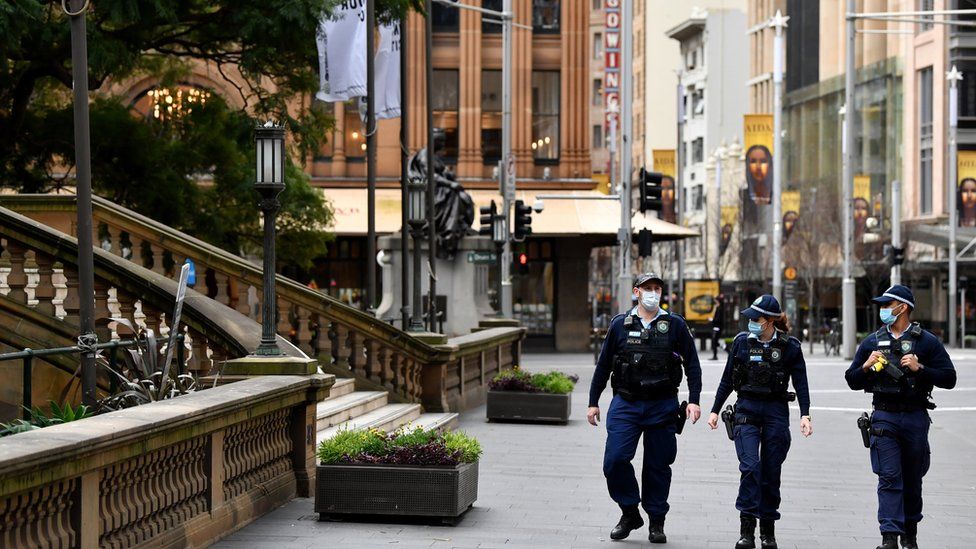
SharecloseShare pageCopy linkAbout sharingimage copyrightEPASydney’s lockdown has been extended by another month as Covid cases continue to rise.Australia’s largest city has been under stay-at-home orders since late June due to an outbreak of the Delta variant.More than 2,500 people have been infected in Sydney’s worst outbreak this year.New South Wales – of which Sydney is the capital – reported 177 new cases on Wednesday, the most in a day since March 2020.Premier Gladys Berejiklian said it was not possible for the city to exit lockdown on Friday as had been planned.She announced further curbs on movement – including a 10km (6.5 miles) limit on essential shopping.Victoria and South Australia both came out of lockdowns on Wednesday, after containing smaller outbreaks.Sydney’s five million residents had enjoyed a fairly normal lifestyle this year until the outbreak happened.For most of the pandemic, Australia has kept infections relatively low by closing its borders and ordering hotel quarantine for arrivals.State governments have plunged cities into rapid lockdowns to curb outbreaks, using aggressive contact tracing.There have been over a dozen snap lockdowns in the past year. But experts warn that restrictions in Sydney could last until September or even later.Authorities say they cannot re-open until the transmission rate is back to near zero. At least one in three cases from the past week had been infectious in the community. Reasons included undertaking critical work and grocery shopping.The highly policed lockdown has fuelled discontent among some in the community.Several thousand people staged “freedom” protests in Sydney, Melbourne and other cities on the weekend.Anger as half of Australians back in lockdownSydney lockdown protesters condemned as selfishIt has also highlighted the nation’s bungled vaccine programme, which began in February. Just 16% of Australia’s adult population is vaccinated.Critics have blamed the low rate on the federal government’s failure to secure more supplies of the Pfizer vaccine.They also attribute it to confidence in the AstraZeneca vaccine being undermined by mixed messaging about its rare blood clot risk.The national regulator has recently updated its guidance to urge Sydney residents to get the AstraZeneca jab, of which Australia has a large supply.Prime Minister Scott Morrison apologised for his government’s handling of the rollout last week, following months of criticism.

Read more →

Blood clots in people with severe COVID-19 may be related to abnormal antibody response

Inflammation and blood clotting seen in very severe cases of Covid-19 may be caused by the antibodies sent to fight the disease activating unnecessary platelet activity in the lungs.
A new paper published in the journal Blood reveals how antibodies produced by our bodies to protect against Covid-19 are triggering increased function of platelets, which may be causing fatal blood clots in patients with severe disease. Platelets are small cells found in blood which form clots to stop or prevent bleeding, but where platelets don’t function properly this can lead to serious health concerns such as strokes and heart attacks.
The study took antibodies produced to fight the coronavirus’s spike protein, from people with severe Covid-19 infections, and cloned them in a lab to study. The team found that the small sugars found on the surface of these antibodies were different to antibodies from healthy individuals, and when those cloned antibodies were introduced in a lab to blood cells taken from healthy donors, there was an observed increase in platelet activity.
The study team also found that it was possible to reduce or stop platelets from responding in this way in the laboratory by treating blood with active ingredients from different medication which is known to either inhibit platelet function or immune responses. The findings suggest that it may be possible for drugs that are currently used to treat immune system problems to reduce or stop the cells from producing an exaggerated platelet response.
A trial led by Imperial College London and Imperial College Healthcare NHS Trust — called MATIS — is already testing these drugs in clinical trials with patients at hospital sites across the UK to see whether they will reduce serious clotting for hospitalised Covid-19 patients.
The lab-based study of human cells provides key evidence to support the scientific basis for the MATIS trial and, while there are yet to be any results reported from this clinical trial, the two teams will continue to work closely together as the clinical trial develops.
Professor Jon Gibbins, Director of the Institute for Cardiovascular and Metabolic Research at the University of Reading said:
“Until now, we have only had assumptions about why platelets involved in clotting were being activated during Covid-19 infection.
“One way to think of what is happens is that the immune response that is designed to protect you from the infection in some cases, particularly in severely ill patients, actually causes more damage. In this case, the antibodies that are produced to stop Covid-19 from spreading trigger infected cells to induce platelet activity which causes clotting even though there is no wound that needs healing.
“We are particularly excited because our studies of platelets in the laboratory establishes important mechanisms that explain how and why dangerous blood clots may occur in severely ill Covid-19 patients, and importantly, also provides clues as to how this may be prevented.”
Co-author Nichola Cooper, reader at Imperial College London and consultant haematologist at Imperial College Healthcare NHS Trust, who also designed and leads the MATIS trial said: “Early on in the Covid-19 pandemic it was clear that the infection was causing an overwhelming immune response, including blood clotting, and that many of the more severe cases and deaths were related to this.
“Having been involved in early research around blood clotting related to inflammation, it occurred to me that the drugs we already use for other disorders could be easily accessible treatments for Covid-19. We are yet to see results from the MATIS trial so we do not yet know how these drugs will work in patients, but our hope is that we can both inhibit the inflammatory response and prevent severe disease and blood clots. It is exciting to see our collaboration with Reading backing our theory already and providing a solid scientific basis for clinical trials.”
Story Source:
Materials provided by University of Reading. Note: Content may be edited for style and length.

Read more →

How relaxing COVID-19 restrictions could pave the way for vaccine resistance

Relaxing Covid-19 restrictions could pave the way for new vaccine-resistant virus mutations, according to researchers at the University of East Anglia and the Earlham Institute.
A new article published today warns against relaxing Covid-19 restrictions prematurely.
It describes how we are in an ‘arms race’ with the virus and how rising cases could provide opportunities for it to evolve into even more transmissible variants.
The researchers fear that any new variants could be more virulent, more vaccine resistant, and more dangerous for children and vulnerable groups such as transplant patients.
Lead author and editor in chief of Virulence, Prof Kevin Tyler from UEA’s Norwich Medical School, said: “Over the past 17 months, economies, education and mental well-being have suffered tremendously due to the restrictions imposed in an attempt to stem the spread of the pandemic.
“Although vaccines have weakened the link between infection and mortality, they should not be used as an argument to justify a broad change in policy for countries experiencing an exponential increase in infection numbers.

Read more →