Texas passes law banning abortion after six weeks

SharecloseShare pageCopy linkAbout sharingimage sourceGetty ImagesA law banning abortion from as early as six weeks into pregnancy has come into effect in the US state of Texas.It bans abortions after the detection of what anti-abortion campaigners call a foetal heartbeat, something medical authorities say is misleading.The law, one of the most restrictive in the country, took effect after the Supreme Court did not respond to an emergency appeal by abortion providers.Doctors and women’s rights groups have heavily criticised the law.It gives any individual the right to sue doctors who perform an abortion past the six-week point.The so-called “Heartbeat Act” was signed into law by Texas Governor Greg Abbott in May. But rights groups, including Planned Parenthood and the American Civil Liberties Union (ACLU), then requested that the Supreme Court block the legislation. What’s going on with US abortion rights?What is Roe v Wade ruling on abortion?In the early hours of Wednesday, the ACLU confirmed that the court had “not responded to our request”, adding: “Access to almost all abortion has just been cut off for millions of people.” The group, which says that up to 90% of abortions in Texas take place after six weeks of pregnancy, described the development as “blatantly unconstitutional”. The US women’s health group Planned Parenthood also condemned the ban, tweeting: “No matter what, we aren’t backing down and we are still fighting. Everyone deserves access to abortion.”The Supreme Court still has the power to overturn the ban at a later stage.What does the law say?Since the 1973 Supreme Court decision in Roe v Wade, US women have had the right to an abortion until a foetus is viable – that is, able to survive outside the womb. This is usually between 22 and 24 weeks into a pregnancy.The so-called Texas Heartbeat Act prohibits abortions after six weeks of a pregnancy – at a point when many women do not know they are pregnant. The American College of Obstetricians and Gynaecologists has said the term “heartbeat” is misleading, and that what is being detected at this stage is “a portion of the foetal tissue that will become the heart as the embryo develops”.The Texas law enforces its ban with an uncommon approach: it empowers any private citizen to sue anyone who “aids and abets” an illegal abortion.The legislation makes an exception in the case of medical emergency, which requires written proof from a doctor, but not for pregnancies resulting from rape or incest. Texan women who wish to have an abortion after six weeks will need to travel across state lines, or – as estimated by the pro-choice Guttmacher Institute – an average of 248 miles (399km).How is this different from other restrictions?Most abortion restrictions that have been proposed before have relied on criminal penalties or some form of regulatory punishment.The Texas law instead authorises “a private civil right of action”, which allows people to sue to enforce the law even if they themselves have not been harmed.An ordinary American, from Texas or elsewhere, may now be able to seek up to $10,000 (£7,200) in damages in a civil court against abortion providers and doctors – and possibly anyone at all involved in the process. That means people like clinic staff, family members, or clergy who encourage or support the procedure could, in theory, be sued.Kim Schwartz of the Texas Right to Life organisation, which supports the measure, told the BBC most anti-abortion laws are “held up in the court system for years” and this “thwarts the will of the people”. She argued that courts would require “a credible claim that an illegal abortion occurred” and would still undergo fact-finding processes.But the ACLU and other critics have suggested the Texas law will champion “a bounty hunting scheme” of costly “vigilante lawsuits” designed to harass women seeking an abortion. The ACLU noted tip lines have already been set up by anti-abortion groups.How do Americans feel?Abortion has long been one of the country’s most contentious social issues. However, polls from the Pew Research Center indicate nearly six in 10 Americans believe abortion should be legal in all or most cases.This number has remained relatively stable over the past two decades, but masks a partisan divide: only 35% of Republicans support that position.In conservative Texas, an April poll found nearly half of the state’s voters support a six-week ban on abortions.What’s the background? The Texas law is one of many recent efforts to limit abortions in states controlled by Republicans.Three others – Idaho, Oklahoma and South Carolina – have passed six-week ban bills this year, all of which have been stalled by legal challenges and are yet to go into effect.According to the Guttmacher Institute, 2021 has already seen more restrictions enacted in any year since the Roe v Wade decision nearly 50 years ago.Supporters of these measures have been emboldened by the makeup of the Supreme Court, which currently has a 6-3 conservative lean.Pro-choice Americans have expressed fear that, if given the chance, a majority of the high court’s jurists will opt to overturn national abortion rights. This would not make abortion illegal across the country, but rather, would return that decision to each of the states. Some Democrat-led states, like New York, have enacted measures to safeguard abortion access in the event of this scenario.

Read more →

Japan finds black particles in Moderna vaccine

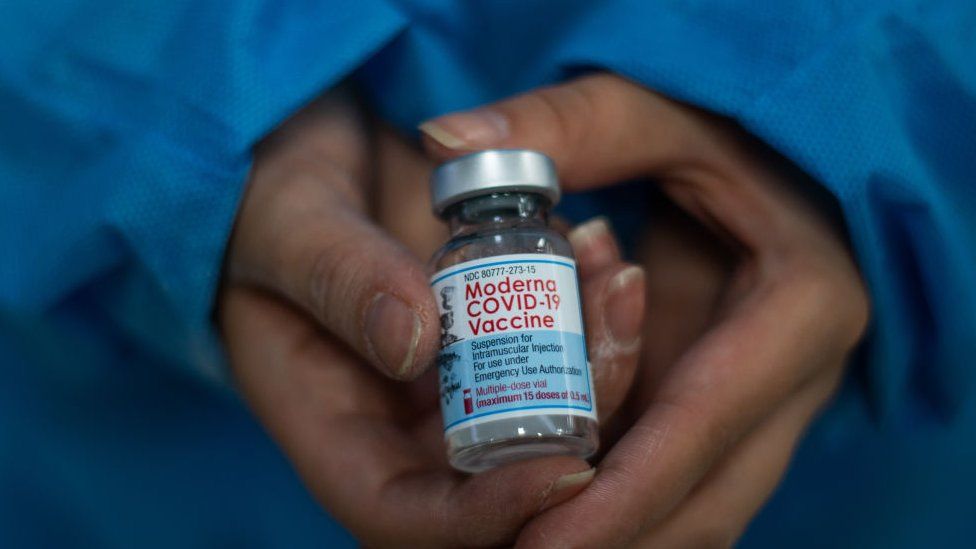
SharecloseShare pageCopy linkAbout sharingimage sourceGetty ImagesJapan has put a batch of Moderna’s Covid-19 vaccine on hold after a foreign substance was found in a vial.A pharmacist saw several black particles in one vial of the vaccine in Kanagawa Prefecture, according to authorities.Some 3,790 people had already received shots from the batch. The rest of the batch has now been put on hold.It comes less than a week after Japan suspended the use of about 1.63 million Moderna doses due to contamination.The pharmacist found the black particles while checking for foreign substances before the vaccine’s use.The jab’s domestic distributor has collected the vial suspected to be contaminated. Local media reports say there is no evidence so far of any health hazards caused by the potentially contaminated vaccine.Takeda Pharmaceutical, which sells and distributes the vaccine in Japan, had just last week put three batches of the vaccine on hold after “foreign materials” were found in some doses of a batch of roughly 560,000 vials.Spanish pharmaceutical firm Rovi, which bottles the vaccine, said in a statement that a manufacturing line in Spain could be the cause of the issue. It added that it was conducting an investigation. On Tuesday, Japan’s health minister said foreign matter found in jabs in the southern prefecture of Okinawa were due to needles being incorrectly inserted into vials.Japan is battling a spike in Covid cases while it hosts the Paralympic Games. Its vaccination roll-out has been relatively slow, with just over 40% of Japanese people fully vaccinated and around 50% having received one dose.

Read more →

Two Top F.D.A. Vaccine Regulators to Depart This Fall

The announcement that Dr. Marion Gruber and Dr. Philip Krause will leave this fall comes as the agency conducts sensitive reviews of coronavirus vaccines for children and booster shots.WASHINGTON — Two of the Food and Drug Administration’s top vaccine regulators will leave the agency this fall, a development that could disrupt its work on deciding whether to recommend coronavirus vaccines for children under 12 and booster shots for the general population.Dr. Marion Gruber, the director of the F.D.A.’s vaccines office, will retire at the end of October, and her deputy, Dr. Philip Krause, will leave in November, according to an email that Dr. Peter Marks, the agency’s top vaccine regulator, sent to staff members on Tuesday morning. One reason is that Dr. Gruber and Dr. Krause were upset about the Biden administration’s recent announcement that adults should get a coronavirus booster vaccination eight months after they received their second shot, according to people familiar with their thinking.Neither believed there was enough data to justify offering booster shots yet, the people said, and both viewed the announcement, amplified by President Biden, as pressure on the F.D.A. to quickly authorize them.Dr. Marks said he would serve as the acting director of the vaccines office while the agency searched for its next leader. Stephanie Caccomo, a spokeswoman for the agency, said it was “confident in the expertise and ability of our staff to continue our critical public health work.”Some public health experts have said the administration’s booster shot announcement, which did include a caveat that the F.D.A. would first have to authorize such shots, undermined the agency’s responsibility to make that assessment on its own schedule, led by career scientists. Since Mr. Biden took office in January, the White House has made a point of saying it would not influence the F.D.A.’s work.Some outside experts have also challenged the booster plan as premature, saying the available data shows that the Pfizer-BioNTech and Moderna vaccines are holding up well against severe disease and hospitalization, including against the Delta variant. Extra shots would be warranted only if the vaccines failed to meet that standard, some have said.White House officials have stressed that the plan for Americans to start receiving boosters next month was uniformly endorsed by the most senior federal health officials, including Dr. Janet Woodcock, the acting F.D.A. commissioner. They have described the need to develop a booster plan as urgent in light of growing evidence that the vaccines lose potency over time — a trend that they fear suggests the vaccines’ protection against severe disease and hospitalization will also soon weaken..css-1xzcza9{list-style-type:disc;padding-inline-start:1em;}.css-3btd0c{font-family:nyt-franklin,helvetica,arial,sans-serif;font-size:1rem;line-height:1.375rem;color:#333;margin-bottom:0.78125rem;}@media (min-width:740px){.css-3btd0c{font-size:1.0625rem;line-height:1.5rem;margin-bottom:0.9375rem;}}.css-3btd0c strong{font-weight:600;}.css-3btd0c em{font-style:italic;}.css-w739ur{margin:0 auto 5px;font-family:nyt-franklin,helvetica,arial,sans-serif;font-weight:700;font-size:1.125rem;line-height:1.3125rem;color:#121212;}#NYT_BELOW_MAIN_CONTENT_REGION .css-w739ur{font-family:nyt-cheltenham,georgia,’times new roman’,times,serif;font-weight:700;font-size:1.375rem;line-height:1.625rem;}@media (min-width:740px){#NYT_BELOW_MAIN_CONTENT_REGION .css-w739ur{font-size:1.6875rem;line-height:1.875rem;}}@media (min-width:740px){.css-w739ur{font-size:1.25rem;line-height:1.4375rem;}}.css-9s9ecg{margin-bottom:15px;}.css-uf1ume{display:-webkit-box;display:-webkit-flex;display:-ms-flexbox;display:flex;-webkit-box-pack:justify;-webkit-justify-content:space-between;-ms-flex-pack:justify;justify-content:space-between;}.css-wxi1cx{display:-webkit-box;display:-webkit-flex;display:-ms-flexbox;display:flex;-webkit-flex-direction:column;-ms-flex-direction:column;flex-direction:column;-webkit-align-self:flex-end;-ms-flex-item-align:end;align-self:flex-end;}.css-12vbvwq{background-color:white;border:1px solid #e2e2e2;width:calc(100% – 40px);max-width:600px;margin:1.5rem auto 1.9rem;padding:15px;box-sizing:border-box;}@media (min-width:740px){.css-12vbvwq{padding:20px;width:100%;}}.css-12vbvwq:focus{outline:1px solid #e2e2e2;}#NYT_BELOW_MAIN_CONTENT_REGION .css-12vbvwq{border:none;padding:10px 0 0;border-top:2px solid #121212;}.css-12vbvwq[data-truncated] .css-rdoyk0{-webkit-transform:rotate(0deg);-ms-transform:rotate(0deg);transform:rotate(0deg);}.css-12vbvwq[data-truncated] .css-eb027h{max-height:300px;overflow:hidden;-webkit-transition:none;transition:none;}.css-12vbvwq[data-truncated] .css-5gimkt:after{content:’See more’;}.css-12vbvwq[data-truncated] .css-6mllg9{opacity:1;}.css-qjk116{margin:0 auto;overflow:hidden;}.css-qjk116 strong{font-weight:700;}.css-qjk116 em{font-style:italic;}.css-qjk116 a{color:#326891;-webkit-text-decoration:underline;text-decoration:underline;text-underline-offset:1px;-webkit-text-decoration-thickness:1px;text-decoration-thickness:1px;-webkit-text-decoration-color:#326891;text-decoration-color:#326891;}.css-qjk116 a:visited{color:#326891;-webkit-text-decoration-color:#326891;text-decoration-color:#326891;}.css-qjk116 a:hover{-webkit-text-decoration:none;text-decoration:none;}Officials have singled out data from Israel as a particularly worrisome sign, especially for older adults and other vulnerable groups. Data from abroad “actually has led us to be even more concerned about increased risk of vaccine effectiveness waning against hospitalization, severe disease and death,” Dr. Rochelle P. Walensky, the director of the Centers for Disease Control and Prevention, said at a White House briefing on the pandemic Tuesday.Asked about reports that Dr. Gruber and Dr. Krause were unhappy with what they viewed as pressure on the agency, Jeffrey D. Zients, the White House’s Covid-19 response coordinator, reiterated that the booster strategy had always been contingent on F.D.A. review.“As our medical experts laid out, having reviewed all the available data, it is in their clinical judgment that it is time to prepare Americans for a booster shot,” he said at the briefing. “We announced our approach in order to stay ahead of the virus, give states and pharmacies time to plan, and to be transparent with the American people.”But some critics have said that explanation falls short, because F.D.A. regulators are in the position of trying to determine whether booster shots are safe and effective after the White House — and their own agency head, Dr. Woodcock — already endorsed administering them.Dr. Marion Gruber and Dr. Philip Krause viewed the announcement on booster shots, amplified by President Biden, as pressure on the F.D.A. to quickly authorize them, people familiar with their thinking said.Doug Mills/The New York Times“This process has been the reverse of what we would normally expect in vaccine policy,” with the administration announcing plans based on a certain outcome before regulators can complete their review, said Jason L. Schwartz, an associate professor of health policy at the Yale School of Public Health. “That has made it even more complicated and confusing for the public.”The announcement of the departures comes at a critical time for the F.D.A. The agency is in the midst of a marathon push to decide several important questions about the three coronavirus vaccines it authorized on an emergency basis over the past year. It is facing public pressure from some quarters to speed up, and from others to slow down. Mr. Biden still has not nominated someone to permanently lead the agency, a post that requires Senate confirmation.Only about three weeks remain before the Biden administration wants to begin offering boosters to recipients of the Pfizer-BioNTech and Moderna vaccines, starting with nursing home residents, health care workers and others who were inoculated early in the vaccination campaign..css-1xzcza9{list-style-type:disc;padding-inline-start:1em;}.css-3btd0c{font-family:nyt-franklin,helvetica,arial,sans-serif;font-size:1rem;line-height:1.375rem;color:#333;margin-bottom:0.78125rem;}@media (min-width:740px){.css-3btd0c{font-size:1.0625rem;line-height:1.5rem;margin-bottom:0.9375rem;}}.css-3btd0c strong{font-weight:600;}.css-3btd0c em{font-style:italic;}.css-w739ur{margin:0 auto 5px;font-family:nyt-franklin,helvetica,arial,sans-serif;font-weight:700;font-size:1.125rem;line-height:1.3125rem;color:#121212;}#NYT_BELOW_MAIN_CONTENT_REGION .css-w739ur{font-family:nyt-cheltenham,georgia,’times new roman’,times,serif;font-weight:700;font-size:1.375rem;line-height:1.625rem;}@media (min-width:740px){#NYT_BELOW_MAIN_CONTENT_REGION .css-w739ur{font-size:1.6875rem;line-height:1.875rem;}}@media (min-width:740px){.css-w739ur{font-size:1.25rem;line-height:1.4375rem;}}.css-9s9ecg{margin-bottom:15px;}.css-16ed7iq{width:100%;display:-webkit-box;display:-webkit-flex;display:-ms-flexbox;display:flex;-webkit-align-items:center;-webkit-box-align:center;-ms-flex-align:center;align-items:center;-webkit-box-pack:center;-webkit-justify-content:center;-ms-flex-pack:center;justify-content:center;padding:10px 0;background-color:white;}.css-pmm6ed{display:-webkit-box;display:-webkit-flex;display:-ms-flexbox;display:flex;-webkit-align-items:center;-webkit-box-align:center;-ms-flex-align:center;align-items:center;}.css-pmm6ed > :not(:first-child){margin-left:5px;}.css-5gimkt{font-family:nyt-franklin,helvetica,arial,sans-serif;font-size:0.8125rem;font-weight:700;-webkit-letter-spacing:0.03em;-moz-letter-spacing:0.03em;-ms-letter-spacing:0.03em;letter-spacing:0.03em;text-transform:uppercase;color:#333;}.css-5gimkt:after{content:’Collapse’;}.css-rdoyk0{-webkit-transition:all 0.5s ease;transition:all 0.5s ease;-webkit-transform:rotate(180deg);-ms-transform:rotate(180deg);transform:rotate(180deg);}.css-eb027h{max-height:5000px;-webkit-transition:max-height 0.5s ease;transition:max-height 0.5s ease;}.css-6mllg9{-webkit-transition:all 0.5s ease;transition:all 0.5s ease;position:relative;opacity:0;}.css-6mllg9:before{content:”;background-image:linear-gradient(180deg,transparent,#ffffff);background-image:-webkit-linear-gradient(270deg,rgba(255,255,255,0),#ffffff);height:80px;width:100%;position:absolute;bottom:0px;pointer-events:none;}.css-uf1ume{display:-webkit-box;display:-webkit-flex;display:-ms-flexbox;display:flex;-webkit-box-pack:justify;-webkit-justify-content:space-between;-ms-flex-pack:justify;justify-content:space-between;}.css-wxi1cx{display:-webkit-box;display:-webkit-flex;display:-ms-flexbox;display:flex;-webkit-flex-direction:column;-ms-flex-direction:column;flex-direction:column;-webkit-align-self:flex-end;-ms-flex-item-align:end;align-self:flex-end;}.css-12vbvwq{background-color:white;border:1px solid #e2e2e2;width:calc(100% – 40px);max-width:600px;margin:1.5rem auto 1.9rem;padding:15px;box-sizing:border-box;}@media (min-width:740px){.css-12vbvwq{padding:20px;width:100%;}}.css-12vbvwq:focus{outline:1px solid #e2e2e2;}#NYT_BELOW_MAIN_CONTENT_REGION .css-12vbvwq{border:none;padding:10px 0 0;border-top:2px solid #121212;}.css-12vbvwq[data-truncated] .css-rdoyk0{-webkit-transform:rotate(0deg);-ms-transform:rotate(0deg);transform:rotate(0deg);}.css-12vbvwq[data-truncated] .css-eb027h{max-height:300px;overflow:hidden;-webkit-transition:none;transition:none;}.css-12vbvwq[data-truncated] .css-5gimkt:after{content:’See more’;}.css-12vbvwq[data-truncated] .css-6mllg9{opacity:1;}.css-qjk116{margin:0 auto;overflow:hidden;}.css-qjk116 strong{font-weight:700;}.css-qjk116 em{font-style:italic;}.css-qjk116 a{color:#326891;-webkit-text-decoration:underline;text-decoration:underline;text-underline-offset:1px;-webkit-text-decoration-thickness:1px;text-decoration-thickness:1px;-webkit-text-decoration-color:#326891;text-decoration-color:#326891;}.css-qjk116 a:visited{color:#326891;-webkit-text-decoration-color:#326891;text-decoration-color:#326891;}.css-qjk116 a:hover{-webkit-text-decoration:none;text-decoration:none;}The F.D.A. is currently trying to schedule a meeting of its panel of independent experts, the Vaccines and Related Biological Products Advisory Committee, to discuss booster shots, according to people familiar with the agency’s planning. That meeting would be public, and could potentially reveal concerns among regulators and the F.D.A.’s outside experts about the administration’s strategy.The F.D.A. is also expected soon to tackle the question of whether to authorize coronavirus vaccines on an emergency basis for children under 12.Last week, the agency fully approved the Pfizer-BioNTech vaccine for people 16 and older, a major decision that spurred a series of vaccine mandates at corporations, universities, hospitals and elsewhere.That decision and a host of others fell to teams led by Dr. Gruber and Dr. Krause, working under Dr. Marks.The F.D.A. reviews data from vaccine manufacturers on safety and efficacy, and sometimes makes decisions with input from the outside advisory committee of vaccine experts. The agency’s decisions are followed by recommendations from the Centers for Disease Control and Prevention, after it hears from its own outside panel of experts.Both Dr. Gruber and Dr. Krause have been at the agency for 30 years and have long experience reviewing vaccines, including for Ebola. The office they lead evaluates annual flu vaccines, including which strains each year’s version targets, and it had a central role in the F.D.A.’s authorization of three coronavirus vaccines, which also include a single-dose shot from Johnson & Johnson.Their office also guides manufacturers on what kinds of studies they need to conduct to evaluate new vaccines, then reviews the data on them. The F.D.A. came under enormous pressure last fall by Trump administration officials to water down or scuttle standards it had set for vaccine emergency use authorizations, but prevailed in publishing the guidelines. Dr. Stephen M. Hahn, the F.D.A. commissioner under President Donald J. Trump, said on Tuesday that Dr. Gruber and Dr. Krause “stuck together and marshaled amazing resources and got the authorizations done in record time.”“They set the gold standard” for vaccine reviews, said Dr. Luciana Borio, the former acting chief scientist at the agency under President Barack Obama. During the pandemic, she added, “they put their heads down and organized their team to do this work under tremendous pressure, but do it in a rigorous, expedited and flexible form.”

Read more →

180 Cases of Covid-19 Linked to a Youth Camp and Conference

At least 180 coronavirus infections in three states have been traced to an Illinois youth camp and an affiliated men’s conference that did not require attendees to be vaccinated or tested for the virus, according to an investigation published on Tuesday by the Centers for Disease Control and Prevention.There have been no deaths linked to the outbreak, but five of those infected required hospitalization, according to the C.D.C., which noted that all of those hospitalized were unvaccinated. Roughly 1,000 people in four states were ultimately exposed to the virus by people who attended the two events, which took place in mid-June.The report, which expands on an earlier investigation by the Illinois Department of Public Health, highlights the perils of ignoring established safety guidelines for summer camps, business meetings and religious gatherings during a pandemic that continues to pummel the United States.And with the Delta variant causing significant spikes in infections across many states, some public health officials have expressed concerns about large Labor Day gatherings that do not include masks, or gate-keeping measures for admission, like testing or proof of vaccination.In the report, more than 120 of those infected were camp and conference attendees, and most of the others were members of their immediate households, researchers said. Twenty-nine of the 180 people infected were fully vaccinated against Covid-19, which is also known among epidemiologists as SARS-CoV-2.“This investigation underscores the impact of secondary SARS-CoV-2 transmission during large events such as camps and conferences when Covid-19 prevention strategies, including vaccination, masking, physical distancing, and screening testing, are not implemented,” the C.D.C.’s report said.Although coronavirus infections have affected youth camps across the country, those that have embraced testing and masks for attendees — and contact tracing and isolation for the infected — have fared much better than those that have taken a more laissez-faire approach, according to a number of studies.Sarah Patrick, the acting epidemiologist for the state of Illinois, said the outbreak illustrated the role that children can play in transmission of the virus — and the importance of ensuring they are included in efforts to curb its spread.“We’ve learned that kids, who some had thought might not be able to easily spread disease between each other, can actually be the fire starter that increases transmission beyond their immediate contacts and into the community,” she said.The Crossing, a nondenominational Christian group that organized the five-day youth camp and a two-day men’s conference, did not ask participants to be vaccinated or tested, nor did it not require mask wearing during the gatherings.The “What to Bring” page of camp’s website includes water shoes, sleeping bags and the Bible, but makes no mention of masks. Campers were between 14 and 18 years old, making them eligible for the vaccines.The phone number listed on the website for Crossing Camp was disconnected on Tuesday. Email and voice mail messages left by a reporter seeking comment at the church’s main office in Quincy, Ill., were not immediately returned.

Read more →

Two Top F.D.A. Vaccine Regulators Are Set to Depart During a Crucial Period

The announcement that Dr. Marion Gruber and Dr. Philip Krause will leave this fall comes as the agency conducts sensitive reviews of coronavirus vaccines for children and booster shots.WASHINGTON — Two of the Food and Drug Administration’s top vaccine regulators will leave the agency this fall, a development that could disrupt its work on deciding whether to recommend coronavirus vaccines for children under 12 and booster shots for the general population.Dr. Marion Gruber, the director of the F.D.A.’s vaccines office, will retire at the end of October, and her deputy, Dr. Philip Krause, will leave in November, according to an email that Dr. Peter Marks, the agency’s top vaccine regulator, sent to staff members on Tuesday morning. One reason is that Dr. Gruber and Dr. Krause were upset about the Biden administration’s recent announcement that adults should get a coronavirus booster vaccination eight months after they received their second shot, according to people familiar with their thinking.Neither believed there was enough data to justify offering booster shots yet, the people said, and both viewed the announcement, amplified by President Biden, as pressure on the F.D.A. to quickly authorize them.Dr. Marks said he would serve as the acting director of the vaccines office while the agency searched for its next leader. Stephanie Caccomo, a spokeswoman for the agency, said it was “confident in the expertise and ability of our staff to continue our critical public health work.”Some public health experts have said the administration’s booster shot announcement, which did include a caveat that the F.D.A. would first have to authorize such shots, undermined the agency’s responsibility to make that assessment on its own schedule, led by career scientists. Since Mr. Biden took office in January, the White House has made a point of saying it would not influence the F.D.A.’s work.Some outside experts have also challenged the booster plan as premature, saying the available data shows that the Pfizer-BioNTech and Moderna vaccines are holding up well against severe disease and hospitalization, including against the Delta variant. Extra shots would be warranted only if the vaccines failed to meet that standard, some have said.White House officials have stressed that the plan for Americans to start receiving boosters next month was uniformly endorsed by the most senior federal health officials, including Dr. Janet Woodcock, the acting F.D.A. commissioner. They have described the need to develop a booster plan as urgent in light of growing evidence that the vaccines lose potency over time — a trend that they fear suggests the vaccines’ protection against severe disease and hospitalization will also soon weaken..css-1xzcza9{list-style-type:disc;padding-inline-start:1em;}.css-3btd0c{font-family:nyt-franklin,helvetica,arial,sans-serif;font-size:1rem;line-height:1.375rem;color:#333;margin-bottom:0.78125rem;}@media (min-width:740px){.css-3btd0c{font-size:1.0625rem;line-height:1.5rem;margin-bottom:0.9375rem;}}.css-3btd0c strong{font-weight:600;}.css-3btd0c em{font-style:italic;}.css-w739ur{margin:0 auto 5px;font-family:nyt-franklin,helvetica,arial,sans-serif;font-weight:700;font-size:1.125rem;line-height:1.3125rem;color:#121212;}#NYT_BELOW_MAIN_CONTENT_REGION .css-w739ur{font-family:nyt-cheltenham,georgia,’times new roman’,times,serif;font-weight:700;font-size:1.375rem;line-height:1.625rem;}@media (min-width:740px){#NYT_BELOW_MAIN_CONTENT_REGION .css-w739ur{font-size:1.6875rem;line-height:1.875rem;}}@media (min-width:740px){.css-w739ur{font-size:1.25rem;line-height:1.4375rem;}}.css-9s9ecg{margin-bottom:15px;}.css-uf1ume{display:-webkit-box;display:-webkit-flex;display:-ms-flexbox;display:flex;-webkit-box-pack:justify;-webkit-justify-content:space-between;-ms-flex-pack:justify;justify-content:space-between;}.css-wxi1cx{display:-webkit-box;display:-webkit-flex;display:-ms-flexbox;display:flex;-webkit-flex-direction:column;-ms-flex-direction:column;flex-direction:column;-webkit-align-self:flex-end;-ms-flex-item-align:end;align-self:flex-end;}.css-12vbvwq{background-color:white;border:1px solid #e2e2e2;width:calc(100% – 40px);max-width:600px;margin:1.5rem auto 1.9rem;padding:15px;box-sizing:border-box;}@media (min-width:740px){.css-12vbvwq{padding:20px;width:100%;}}.css-12vbvwq:focus{outline:1px solid #e2e2e2;}#NYT_BELOW_MAIN_CONTENT_REGION .css-12vbvwq{border:none;padding:10px 0 0;border-top:2px solid #121212;}.css-12vbvwq[data-truncated] .css-rdoyk0{-webkit-transform:rotate(0deg);-ms-transform:rotate(0deg);transform:rotate(0deg);}.css-12vbvwq[data-truncated] .css-eb027h{max-height:300px;overflow:hidden;-webkit-transition:none;transition:none;}.css-12vbvwq[data-truncated] .css-5gimkt:after{content:’See more’;}.css-12vbvwq[data-truncated] .css-6mllg9{opacity:1;}.css-qjk116{margin:0 auto;overflow:hidden;}.css-qjk116 strong{font-weight:700;}.css-qjk116 em{font-style:italic;}.css-qjk116 a{color:#326891;-webkit-text-decoration:underline;text-decoration:underline;text-underline-offset:1px;-webkit-text-decoration-thickness:1px;text-decoration-thickness:1px;-webkit-text-decoration-color:#326891;text-decoration-color:#326891;}.css-qjk116 a:visited{color:#326891;-webkit-text-decoration-color:#326891;text-decoration-color:#326891;}.css-qjk116 a:hover{-webkit-text-decoration:none;text-decoration:none;}Officials have singled out data from Israel as a particularly worrisome sign, especially for older adults and other vulnerable groups. Data from abroad “actually has led us to be even more concerned about increased risk of vaccine effectiveness waning against hospitalization, severe disease and death,” Dr. Rochelle P. Walensky, the director of the Centers for Disease Control and Prevention, said at a White House briefing on the pandemic Tuesday.Asked about reports that Dr. Gruber and Dr. Krause were unhappy with what they viewed as pressure on the agency, Jeffrey D. Zients, the White House’s Covid-19 response coordinator, reiterated that the booster strategy had always been contingent on F.D.A. review.“As our medical experts laid out, having reviewed all the available data, it is in their clinical judgment that it is time to prepare Americans for a booster shot,” he said at the briefing. “We announced our approach in order to stay ahead of the virus, give states and pharmacies time to plan, and to be transparent with the American people.”But some critics have said that explanation falls short, because F.D.A. regulators are in the position of trying to determine whether booster shots are safe and effective after the White House — and their own agency head, Dr. Woodcock — already endorsed administering them.Dr. Marion Gruber and Dr. Philip Krause viewed the announcement on booster shots, amplified by President Biden, as pressure on the F.D.A. to quickly authorize them, people familiar with their thinking said.Doug Mills/The New York Times“This process has been the reverse of what we would normally expect in vaccine policy,” with the administration announcing plans based on a certain outcome before regulators can complete their review, said Jason L. Schwartz, an associate professor of health policy at the Yale School of Public Health. “That has made it even more complicated and confusing for the public.”The announcement of the departures comes at a critical time for the F.D.A. The agency is in the midst of a marathon push to decide several important questions about the three coronavirus vaccines it authorized on an emergency basis this year. It is facing public pressure from some quarters to speed up, and from others to slow down. Mr. Biden still has not nominated someone to permanently lead the agency, a post that requires Senate confirmation.Only about three weeks remain before the Biden administration wants to begin offering boosters to recipients of the Pfizer-BioNTech and Moderna vaccines, starting with nursing home residents, health care workers and others who were inoculated early in the vaccination campaign..css-1xzcza9{list-style-type:disc;padding-inline-start:1em;}.css-3btd0c{font-family:nyt-franklin,helvetica,arial,sans-serif;font-size:1rem;line-height:1.375rem;color:#333;margin-bottom:0.78125rem;}@media (min-width:740px){.css-3btd0c{font-size:1.0625rem;line-height:1.5rem;margin-bottom:0.9375rem;}}.css-3btd0c strong{font-weight:600;}.css-3btd0c em{font-style:italic;}.css-w739ur{margin:0 auto 5px;font-family:nyt-franklin,helvetica,arial,sans-serif;font-weight:700;font-size:1.125rem;line-height:1.3125rem;color:#121212;}#NYT_BELOW_MAIN_CONTENT_REGION .css-w739ur{font-family:nyt-cheltenham,georgia,’times new roman’,times,serif;font-weight:700;font-size:1.375rem;line-height:1.625rem;}@media (min-width:740px){#NYT_BELOW_MAIN_CONTENT_REGION .css-w739ur{font-size:1.6875rem;line-height:1.875rem;}}@media (min-width:740px){.css-w739ur{font-size:1.25rem;line-height:1.4375rem;}}.css-9s9ecg{margin-bottom:15px;}.css-16ed7iq{width:100%;display:-webkit-box;display:-webkit-flex;display:-ms-flexbox;display:flex;-webkit-align-items:center;-webkit-box-align:center;-ms-flex-align:center;align-items:center;-webkit-box-pack:center;-webkit-justify-content:center;-ms-flex-pack:center;justify-content:center;padding:10px 0;background-color:white;}.css-pmm6ed{display:-webkit-box;display:-webkit-flex;display:-ms-flexbox;display:flex;-webkit-align-items:center;-webkit-box-align:center;-ms-flex-align:center;align-items:center;}.css-pmm6ed > :not(:first-child){margin-left:5px;}.css-5gimkt{font-family:nyt-franklin,helvetica,arial,sans-serif;font-size:0.8125rem;font-weight:700;-webkit-letter-spacing:0.03em;-moz-letter-spacing:0.03em;-ms-letter-spacing:0.03em;letter-spacing:0.03em;text-transform:uppercase;color:#333;}.css-5gimkt:after{content:’Collapse’;}.css-rdoyk0{-webkit-transition:all 0.5s ease;transition:all 0.5s ease;-webkit-transform:rotate(180deg);-ms-transform:rotate(180deg);transform:rotate(180deg);}.css-eb027h{max-height:5000px;-webkit-transition:max-height 0.5s ease;transition:max-height 0.5s ease;}.css-6mllg9{-webkit-transition:all 0.5s ease;transition:all 0.5s ease;position:relative;opacity:0;}.css-6mllg9:before{content:”;background-image:linear-gradient(180deg,transparent,#ffffff);background-image:-webkit-linear-gradient(270deg,rgba(255,255,255,0),#ffffff);height:80px;width:100%;position:absolute;bottom:0px;pointer-events:none;}.css-uf1ume{display:-webkit-box;display:-webkit-flex;display:-ms-flexbox;display:flex;-webkit-box-pack:justify;-webkit-justify-content:space-between;-ms-flex-pack:justify;justify-content:space-between;}.css-wxi1cx{display:-webkit-box;display:-webkit-flex;display:-ms-flexbox;display:flex;-webkit-flex-direction:column;-ms-flex-direction:column;flex-direction:column;-webkit-align-self:flex-end;-ms-flex-item-align:end;align-self:flex-end;}.css-12vbvwq{background-color:white;border:1px solid #e2e2e2;width:calc(100% – 40px);max-width:600px;margin:1.5rem auto 1.9rem;padding:15px;box-sizing:border-box;}@media (min-width:740px){.css-12vbvwq{padding:20px;width:100%;}}.css-12vbvwq:focus{outline:1px solid #e2e2e2;}#NYT_BELOW_MAIN_CONTENT_REGION .css-12vbvwq{border:none;padding:10px 0 0;border-top:2px solid #121212;}.css-12vbvwq[data-truncated] .css-rdoyk0{-webkit-transform:rotate(0deg);-ms-transform:rotate(0deg);transform:rotate(0deg);}.css-12vbvwq[data-truncated] .css-eb027h{max-height:300px;overflow:hidden;-webkit-transition:none;transition:none;}.css-12vbvwq[data-truncated] .css-5gimkt:after{content:’See more’;}.css-12vbvwq[data-truncated] .css-6mllg9{opacity:1;}.css-qjk116{margin:0 auto;overflow:hidden;}.css-qjk116 strong{font-weight:700;}.css-qjk116 em{font-style:italic;}.css-qjk116 a{color:#326891;-webkit-text-decoration:underline;text-decoration:underline;text-underline-offset:1px;-webkit-text-decoration-thickness:1px;text-decoration-thickness:1px;-webkit-text-decoration-color:#326891;text-decoration-color:#326891;}.css-qjk116 a:visited{color:#326891;-webkit-text-decoration-color:#326891;text-decoration-color:#326891;}.css-qjk116 a:hover{-webkit-text-decoration:none;text-decoration:none;}The F.D.A. is currently trying to schedule a meeting of its panel of independent experts, the Vaccines and Related Biological Products Advisory Committee, to discuss booster shots, according to people familiar with the agency’s planning. That meeting would be public, and could potentially reveal concerns among regulators and the F.D.A.’s outside experts about the administration’s strategy.The F.D.A. is also expected soon to tackle the question of whether to authorize coronavirus vaccines on an emergency basis for children under 12.Last week, the agency fully approved the Pfizer-BioNTech vaccine for people 16 and older, a major decision that spurred a series of vaccine mandates at corporations, universities, hospitals and elsewhere.That decision and a host of others fell to teams led by Dr. Gruber and Dr. Krause, working under Dr. Marks.The F.D.A. reviews data from vaccine manufacturers on safety and efficacy, and sometimes makes decisions with input from the outside advisory committee of vaccine experts. The agency’s decisions are followed by recommendations from the Centers for Disease Control and Prevention, after it hears from its own outside panel of experts.Both Dr. Gruber and Dr. Krause have been at the agency for 30 years and have long experience reviewing vaccines, including for Ebola. The office they lead evaluates annual flu vaccines, including which strains each year’s version targets, and it had a central role in the F.D.A.’s authorization of three coronavirus vaccines, which also include a single-dose shot from Johnson & Johnson.Their office also guides manufacturers on what kinds of studies they need to conduct to evaluate new vaccines, then reviews the data on them. The F.D.A. came under enormous pressure last fall by Trump administration officials to water down or scuttle standards it had set for vaccine emergency use authorizations, but prevailed in publishing the guidelines. Dr. Stephen M. Hahn, the F.D.A. commissioner under President Donald J. Trump, said on Tuesday that Dr. Gruber and Dr. Krause “stuck together and marshaled amazing resources and got the authorizations done in record time.”“They set the gold standard” for vaccine reviews, said Dr. Luciana Borio, the former acting chief scientist at the agency under President Barack Obama. During the pandemic, she added, “they put their heads down and organized their team to do this work under tremendous pressure, but do it in a rigorous, expedited and flexible form.”

Read more →

Evidence mounts that MMR and Tdap vaccines strengthen protection against severe COVID-19

Vaccines are designed to induce a strong and long-lasting immune response through the creation of memory T cells and B cells. The Measles-Mumps-Rubella (MMR) vaccine, given during early childhood, and Tetanus-Diphtheria-Pertussis (Tdap) vaccine, given every 10 years, are known to elicit a protective response against the diseases from which the vaccines get their names. But these vaccines may have an unexpected bonus: It’s possible that they also elicit cross-reactive memory T cells capable of responding to protein targets called antigens that are present in other microbes that cause diseases — including the viral antigens in SARS-CoV-2. The concept is that pre-existing memory T cells generated by prior MMR or Tdap vaccination and activated by SARS-CoV-2 infection give the immune system a head start in responding to SARS-CoV-2, thereby lowering the risk of severe COVID-19.
To investigate whether the MMR and Tdap vaccines provide additional protection against COVID-19, researchers at Brigham and Women’s Hospital conducted laboratory-based analyses using sensitive, new techniques to detect and characterize T cell responses to antigens. They applied these techniques to measure the response of T cells isolated from the blood of COVID-19 convalescent patients and patients vaccinated against COVID-19 to antigens from SARS-CoV-2 and the MMR and Tdap vaccines. Teaming up with collaborators at Cleveland Clinic, they also leveraged a large, well-annotated cohort of COVID-19 patients and found that prior MMR or Tdap vaccination was associated with decreased disease severity. Their results are published in Med.
“Our Cleveland Clinic colleagues observed an association where individuals with COVID-19 who had either MMR or Tdap vaccines had a much lower frequency of going to the intensive care unit or dying,” said co-author Andrew Lichtman, MD, PhD, an immunologist and senior investigator in the Brigham’s Department of Pathology and professor of Pathology at Harvard Medical School. “Although previous smaller studies suggested a similar link, our in-depth epidemiological analyses, together with our basic research results, suggest that these commonly given vaccines may protect against severe disease.”
“During the COVID-19 pandemic, we know that there was a marked decline in routine vaccinations for children and adolescents,” said corresponding author Tanya Mayadas, PhD, a senior scientist in the Brigham’s Department of Pathology and professor of Pathology at Harvard Medical School. “Our findings emphasize the importance of routine vaccination for children and adults. We know vaccines protect against devastating diseases, and we’re now seeing growing evidence that some of them provide a degree of protection against severe COVID-19 disease.”
The team’s investigation was jumpstarted by an unexpected observation. Mayadas, her postdoctoral fellow Vijaya Mysore, PhD, and colleagues noted in laboratory experiments using COVID-19 convalescent blood that whenever they observed a heightened T cell response to SARS-CoV-2 proteins, they also saw a heightened response to proteins from MMR and Tdap, which they had been using as controls. This was observed with both COVID-19 convalescent and uninfected individuals vaccinated against SARS-CoV-2. This connection was made by the team’s use of highly efficient antigen-presenting cells (described in a recently published Nature Communications paper) derived from blood, loaded with SARS-CoV-2, MMR or Tdap antigens, and co-cultured with T cells from the same individual. Using single-cell RNA sequencing and analysis of T cell antigen receptors, the team observed that the antigen receptors on many of the T cells from individuals who had recovered from COVID-19 that responded to proteins from SARS-CoV-2 (Spike-S1 and Nucleocapsid) were identical to the antigen receptors on T cells that responded to MMR and Tdap proteins. This discovery indicated the presence of T cell clones that can respond to both SARS-CoV-2 antigens and the MMR and Tdap vaccine antigens.
In a second analysis, Mayadas and colleagues teamed up with investigators at Cleveland Clinic to examine the epidemiological evidence. The Cleveland Clinic team performed a retrospective cohort study using data from more than 75,000 patients seen at the Cleveland Clinic Health System in Ohio or Florida who had tested positive for COVID-19 between March 8, 2020, and March 31, 2021. The team used a statistical method known as overlap propensity score weighting to compare two disease severity outcomes (COVID-related hospitalization and COVID-related admission to the intensive care unit or death) for patients who had been vaccinated against MMR or Tdap and those who had not. They found that patients who had previously been vaccinated for MMR had a 38 percent decrease in hospitalization and a 32 percent decrease in ICU admission/death. Similarly, patients previously vaccinated for Tdap had 23 percent and 20 percent decreased rates, respectively, of these outcomes.
“Beyond learning about the potential benefits of the MMR and Tdap vaccines in the context of COVID-19, this study provides a blueprint for accelerating research,” said co-author Lara Jehi, MD, MHCDS, Chief Research Information Officer of the Cleveland Clinic Health System. “Biomedical hypotheses generated in the laboratory can be explored through robust clinical and epidemiological research in well-curated, real-world data such as the Cleveland Clinic COVID Registry. Knowledge learned through this collaboration is much more than the sum of our individual parts.”
The authors note that while their laboratory-based findings are strengthened by the epidemiological observations, further work is needed to assess the association between the MMR and Tdap vaccinations and severity of COVID-19 disease to determine if the relationship is a causal one. Prospective studies of vaccination and patient outcomes may help distinguish correlation from causation.
“With regards to COVID-19 vaccines, our findings predict that although MMR and Tdap are not a substitute for COVID-19 vaccines they may afford greater and more durable protection, possibly against emerging spike variants than the COVID-19 vaccine alone,” said Mayadas. “And in areas where the COVID-19 vaccines are not available, they could protect infected individuals from developing severe disease.”
Conflict of Interest: Co-author David R. Walt has a financial interest in Quanterix Corporation, a company that develops an ultra-sensitive digital immunoassay platform. He is an inventor of the Simoa technology, founder of the company and serves on its Board of Directors. The anti-SARS-CoV-2 Simoa assays in this publication have been licensed by Brigham and Women’s Hospital to Quanterix Corporation. Co-author Tal Gilboa receives royalty payments from Brigham and Women’s Hospital for the antibodies assay technology. Tanya Mayadas has a financial interest in neuAPC Therapeutics, a company that will develop anti-FcγRIIIB antibody for the generation of neutrophil-derived antigen presenting cells (nAPC) and serves as one of its scientific advisors. Co-authors Vijayashree Mysore, Xavier Cullere and Mayadas have a provisional patent on the generation of immunogenic nAPCs and methods of use thereof.
Funding: The work was supported by the National Institutes of Health R01HL065095, R01AI152522 and R01NS097719, a generous donation from Barbara and Amos Hostetter and the Chleck Foundation.

Read more →

Ferroelectrics everywhere?

A new family of materials that could result in improved digital information storage and uses less energy may be possible thanks to a team of Penn State researchers who demonstrated ferroelectricity in magnesium-substituted zinc oxide.
Ferroelectric materials are spontaneous electricly polarized bcause negative and positive charges in the material tend toward opposite sides and with the application of an external electric field reorient. They can be affected by physical force, which is why they are useful for push-button ignitors such as those found in gas grills. They can also be used for data storage and memory, because they remain in one polarized state without additional power and so are low-energy digital storage solutions.
“We’ve identified a new family of materials from which we can make tiny capacitors and we can set their polarization orientation so that their surface charge is either plus or minus,” said Jon-Paul Maria, Penn State professor of materials science and engineering, and co-author of the paper published in the Journal of Applied Physics. “That setting is nonvolatile, meaning we can set the capacitor to plus, and it stays plus, we can set it to minus, it stays minus. And then we can come back and identify how we set that capacitor, at say an hour ago.”
This ability could enable a form of digital storage that does not use as much electricity as other forms.
“This type of storage requires no additional energy,” Maria said. “And that’s important because many of the computer memories that we use today require additional electricity to sustain the information, and we use a substantial amount of the American energy budget on information.”
The new materials are made with magnesium-substituted zinc oxide thin films. The film was grown via sputter deposition, a process where argon ions are accelerated towards the target materials, impacting it with a high enough energy to break atoms free from the target that contains magnesium and zinc. The freed magnesium and zinc atoms travel in a vapor phase until they react with oxygen and collect on a platinum-coated aluminum oxide substrate and form the thin films.

Read more →

Researchers discover way to switch on and speed up tendon healing

Researchers at CÚRAM, the SFI Research Centre for Medical Devices based at NUI Galway, have shown how the simple act of walking can power an implantable stimulator device to speed up treatment of musculoskeletal diseases.
The results of have been published in the journal Advanced Materials.
The research establishes the engineering foundations for a new range of stimulator devices that enable control of musculoskeletal tissue regeneration to treat tendon damage and disease and sports injuries, without the use of drugs or external stimulation.
Lead researcher on the study, CÚRAM Investigator Dr Manus Biggs, said: “One of the most exciting parts of our study is that these implantable devices may be tailored to individual patients or disorders and may show promise in accelerating the repair of sport-related tendon injuries, particularly in athletes.”
The study investigated whether electrical therapy, coupled with exercise, would show promise in treating tendon disease or ruptures. It showed that tendon cell function and repair can be controlled through electrical stimulation from an implantable device which is powered by body movement.
Dr Marc Fernandez, who carried out the principal research of the study at CÚRAM, said: “Successful treatment of tendon damage and disease represents a critical medical challenge.

Read more →

In a common genetic disorder, blood test reveals when benign tumors turn cancerous

People with an inherited condition known as neurofibromatosis type 1, or NF1, often develop non-cancerous, or benign, tumors that grow along nerves. These tumors can sometimes turn into aggressive cancers, but there hasn’t been a good way to determine whether this transformation to cancer has happened.
Researchers from the National Cancer Institute’s (NCI) Center for Cancer Research, part of the National Institutes of Health, and Washington University School of Medicine in St. Louis have developed a blood test that, they believe, could one day offer a highly sensitive and inexpensive approach to detect cancer early in people with NF1. The blood test could also help doctors monitor how well patients are responding to treatment for their cancer.
The findings are published in the August 31 issue of PLOS Medicine.
NF1 is the most common cancer predisposition syndrome, affecting 1 in 3,000 people worldwide. The condition, caused by a mutation in a gene called NF1, isalmost always diagnosed in childhood. Roughly half of people with NF1 will develop large but benign tumors on nerves, called plexiform neurofibromas.
In up to 15% of people with plexiform neurofibromas, these benign tumors turn into an aggressive form of cancer known as malignant peripheral nerve sheath tumor, or MPNST. Patients with MPNST have a poor prognosis because the cancer can quickly spread and often becomes resistant to both chemotherapy and radiation. Among people diagnosed with MPNST, 80% die within five years.
“Imagine going through life with a cancer predisposition syndrome like NF1. It’s kind of like a ticking bomb,” said study co-author Jack F. Shern, M.D., a Lasker Clinical Research Scholar in NCI’s Pediatric Oncology Branch. “The doctors are going to be watching for cancerous tumors, and you’re going to be watching for them, but you really want to discover that transformation to cancer as early as possible.”
Doctors currently use either imaging scans (MRI or PET scan) or biopsies to determine if plexiform neurofibromas have transformed into MPNST. However, biopsy findings aren’t always accurate and the procedure can be extremely painful for patients because the tumors grow along nerves. Imaging tests, meanwhile, are expensive and can also be inaccurate.

Read more →

Model of SARS-CoV-2 dynamics reveals opportunity to prevent COVID-19 transmission

Scientists have simulated the transition of the SARS-CoV-2 spike protein structure from when it recognises the host cell to when it gains entry, according to a study published today in eLife.
The research shows that a structure enabled by sugar molecules on the spike protein could be essential for cell entry and that disrupting this structure could be a strategy to halt virus transmission.
An essential aspect of SARS-CoV-2’s lifecycle is its ability to attach to host cells and transfer its genetic material. It achieves this through its spike protein, which is made up of three separate components — a transmembrane bundle that anchors the spike to the virus, and two S subunits (S1 and S2) on the exterior of the virus. To infect a human cell, the S1 subunit binds to a molecule on the surface of human cells called ACE2, and the S2 subunit detaches and fuses the viral and human cell membranes. Although this process is known, the exact order in which it occurs is as yet undiscovered. Yet, understanding the microsecond-scale and atomic-level movements of these protein structures could reveal potential targets for COVID-19 treatment.
“Most of the current SARS-CoV-2 treatments and vaccines have focused on the ACE2 recognition step of virus invasion, but an alternative strategy is to target the structural change that allows the virus to fuse with the human host cell,” explains study co-author José N. Onuchic, Harry C & Olga K Wiess Professor of Physics at Rice University, Houston, US, and Co-Director of the Center for Theoretical Biological Physics. “But probing these intermediate, transient structures experimentally is extremely difficult, and so we used a computer simulation sufficiently simplified to investigate this large system but that maintains sufficient physical details to capture the dynamics of the S2 subunit as it transitions between pre-fusion and post-fusion shapes.”
The team was particularly interested in the role of sugar molecules on the spike protein which are called glycans. To see whether the number, type and position of glycans play a role in the membrane fusion stage of viral cell entry by mediating these intermediate spike formations, they performed thousands of simulations using an all-atom structure-based model. Such models allow you to predict the trajectory of atoms over time taking into account steric forces — that is, how neighbouring atoms affect the movement of others.
The simulations revealed that glycans form a ‘cage’ that traps the ‘head’ of the S2 subunit causing it to pause in an intermediate form between when it detaches from the S1 subunit and when the viral and cell membranes are fused. When the glycans were not there, the S2 subunit spent much less time in this conformation.
The simulations also suggest that holding the S2 head in a particular position helps the S2 subunit recruit human host cells and fuse with their membranes, by allowing the extension of short proteins called fusion peptides from the virus. Indeed, glycosylation of S2 significantly increased the likelihood that a fusion peptide would extend to the host cell membrane, whereas when glycans were absent, there was only a marginal possibility that this would occur.
“Our simulations indicate that glycans can induce a pause during the spike protein transition. This provides a critical opportunity for the fusion peptides to capture the host cell,” concludes co-author Paul C. Whitford, Associate Professor at the Center for Theoretical Biological Physics and Department of Physics, Northeastern University, Boston, US. “In the absence of glycans, the viral particle would likely fail to enter the host. Our study reveals how sugars can control infectivity, and it provides a foundation for experimentally investigating factors that influence the dynamics of this pervasive and deadly pathogen.”
Story Source:
Materials provided by eLife. Note: Content may be edited for style and length.

Read more →