Should We Be Vaccinated or Tested to Fly Within the U.S.?
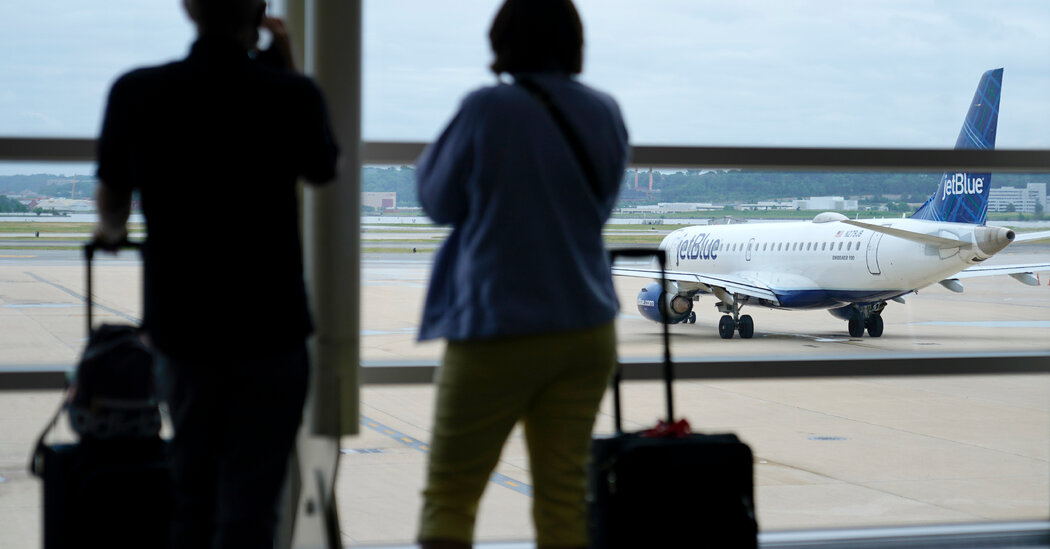
Numerous airline executives say no, but a growing number of politicians and medical experts say it is worth following Canada’s lead before holiday travel commences.By the holiday season, flying will have changed dramatically for Americans returning to the United States from abroad. They will be asked to show proof that they are vaccinated, to commit to two coronavirus tests if they are not and to participate in a new contact tracing system.For Americans traveling within the United States, however, none of this applies. As airlines prepare for what’s expected to be the biggest travel rush of the past two years, domestic travel — aside from a mask mandate and some restrictions on alcohol — will be largely the same as it was before the pandemic: packed cabins and no testing or proof of vaccination required.Whether this is a symptom of denial or a sign of progress depends on who you ask. Senator Dianne Feinstein, Democrat of California, recently telegraphed her position when she proposed a bill that would require passengers on domestic flights to be fully vaccinated, to have recently tested negative or to have a certificate of recovery from the virus.“We know that air travel during the 2020 holiday season contributed to last winter’s devastating COVID-19 surge,” Ms. Feinstein said in a statement. “We simply cannot allow that to happen again.”Dr. Anthony S. Fauci, President Biden’s top medical adviser, has said that he personally supports the idea of requiring proof of vaccination for domestic air travel, a policy that Canada will begin implementing on Oct. 30. The White House has said that it is focused on other strategies for encouraging broad vaccination.Requiring proof of vaccination to fly is ludicrous say numerous airline executives and representatives of airline trade organizations, who tend to reference a study that found, by some measures, that flight cabin air is “safer than the air in a surgical operating room.” Most Americans, they add, are vaccinated and the existing federal mask mandate should radically reduce any lingering risk of transmission. Plus virtually all crew members, they say, will soon be inoculated in compliance with President Biden’s vaccine requirements for government contractors and many airlines’ own requirements for employees.“We don’t see any reason to mandate vaccination in the domestic market,” said Willie Walsh, the director general of the International Air Transport Association, an airline trade group, at the World Air Transport Summit, a gathering last week of hundreds of airline executives in Boston. If you mandate vaccination and testing for flights, then you need to mandate it for all forms of transport, Mr. Walsh said, because in terms of the likelihood of transmitting coronavirus, “a plane is less risky than a train or a bus or a car.”Such a requirement would also create even longer airport lines and other organizational nightmares, said Robin Hayes, chief executive of JetBlue Airways.But if small restaurants in New York City can figure out how to check proof of vaccination without undermining the dining experience, then certainly the airline industry can work something out, said Dr. Georges Benjamin, executive director of the American Public Health Association, a health professionals association that supports Ms. Feinstein’s bill. Yes, the risk of transmission on planes is low, but only if everyone is properly wearing masks during the entire flight, which is far from guaranteed, he said. Neither do we understand, as several researchers have noted, how the Delta variant — or other variants — have changed the likelihood of spreading the virus on planes.Parsing the “it’s-too-complicated” argumentIn order to attend the first in-person World Air Transport Summit in two years, held at the Boston Park Plaza Hotel, journalists and airline industry executives had to show proof of vaccination , the negative results of a recent coronavirus test or a certificate of recovery. Attendees were supposed to wear a mask indoors except when eating, drinking or speaking on a panel.Though every room seemed to have at least four people flouting the conference’s mask mandate, no one queried seemed to object to the vaccine or testing requirement. When asked why domestic airlines should not also have these rules, Mr. Hayes of JetBlue Airways explained that it’s different because, while the conference had a few hundred attendees, roughly three million people are once again flying domestically every day. Though he supports encouraging vaccination, requiring proof from all those people involves too much “operational complexity,” he said.Unlike Canada, Israel and the European Union, the United States has not created a uniform digital proof of vaccination or coronavirus status system. That means that airlines and airports would potentially have to come up with a whole new way of reviewing and verifying results. Domestic travelers eager to check in online and whiz through security “would have to come earlier,” Mr. Hayes said. “There would be longer lines.”Doug Parker, the chief executive of American Airlines, made a similar comment in an interview on the Sway podcast in August,The White House chief of staff, Ron Klain, also expressed concerns that a vaccine mandate would create longer airport lines on the Pod Save America show last month, as the Washington Post previously reported. Mr. Klain also suggested that though such a policy is “something we continue to look at,” it might be unnecessary given that the administration is pushing vaccination through employer and military vaccination mandates.Airlines for America, an industry trade group that represents eight airlines shares the administration’s concerns about the implementation of a domestic travel requirement Katherine Estep, a spokeswoman for the group, said last week.Leonard J. Marcus, the co-director of the National Preparedness Leadership Initiative at Harvard University and the director of an initiative focused on public health on flights, said that airlines are not exaggerating when they say it’s complicated. But he thinks they are wrong to dismiss a domestic testing and vaccination requirement for flying because a good system does not yet exist. “I do believe we should get to the point where we have those mechanics,” he said.Dr. Patrice Harris, the former president of the American Medical Association and the chief executive of eMed, which sells at-home coronavirus tests to travelers and Delta Air Lines, said the “it’s-too-complicated” argument is a poor excuse. “The key is making the right thing to do, the easy thing to do,” she said.Hawaii is the one state that requests proof of vaccination or a negative test from domestic visitors. In order to avoid quarantine, travelers can upload an image of their C.D.C.-issued vaccination card or a negative coronavirus test to the state’s Safe Travels system. The system has gone through several iterations: Early on, checking test results created terrible lines at airports and caused havoc for travelers with connecting flights said Peter Ingram, the chief executive of Hawaiian Airlines.However, Mr. Ingram was more positive than other executives interviewed about expanding such a system across the country. “I wouldn’t say that it can’t possibly work,” he said. One of his primary concerns is how to deal with acceptable exceptions to a vaccine mandate.“Who is going to be the adjudicator?” he asked.Is an airplane really as low risk as an operating room?“It’s safe on board, safer than an operating room,” said Deborah Flint, the chief executive of Greater Toronto Airports Authority, during one of the air summit’s panels. This line comes from a widely recognized study, conducted by the Defense Department and published last October, which found that air circulation systems in two types of large Boeing aircraft were even better at filtering out airborne particles than the filtration systems recommended for most hospital operating rooms.Other research has also reinforced that air in a typical cabin is refreshed every two to three minutes, inhibiting the transmission of the coronavirus. But the risk of transmission increases when passengers fail to properly wear masks, Dr. Lin H. Chen, the former president of the International Society of Travel Medicine noted..(A case study published last week reinforced this point: One person not wearing a mask on a two-hour domestic flight in March 2020 in Japan, seems to have infected at least 14 other people despite a modern air filtration system.)Even with a federal mask mandate, some people while on board do and will refuse to wear masks properly. Others cannot wear them for medical reasons, because they are too young or because they are eating or drinking. But even assuming everyone age 2 and above — airlines’ standard age for mask requirements — is properly wearing one, experts still don’t know how new variants are changing the equation, said Dr. David Freedman, a professor of infectious diseases at the University of Alabama at Birmingham. “Delta is much more transmissible,” he said.This is the primary reason behind Canada’s decision to require proof of vaccination for anyone traveling by plane or train starting Oct. 30. “New variants have created new risks for all activities, including travel,” said Sara Johnston, a spokeswoman for Transport Canada, the government agency responsible for operating Canada’s airports and other transportation facilities. Also airports and ramps onto planes don’t typically have the same type of air circulation, Dr. Freedman said.And though vaccinated people are far less likely to get sick, they can still become infected and transmit the virus to another person.Ultimately, the risk in the sky is not the point, some scientists and economists said; it’s the role air travel plays in spreading coronavirus from one part of the country or world to another. The first case of what would later be known as the novel coronavirus was reported to the World Health Organization in China on Dec. 31, 2019. According to a paper in the Journal of Sustainable Tourism, in mid-March, less than three months later, global air transport had carried the virus to 146 countries and reached all continents.Follow New York Times Travel on Instagram, Twitter and Facebook. And sign up for our weekly Travel Dispatch newsletter to receive expert tips on traveling smarter and inspiration for your next vacation. Dreaming up a future getaway or just armchair traveling? Check out our 52 Places list.

Read more →


How One Woman Fell In Love Again After 80

“It’s Never Too Late” is a series that tells the stories of people who decide to pursue their dreams on their own terms.In 2015, nine months after her husband died, Phyllis Raphael, now 86, ran into Stan Leff, now 89, while exiting Citarella, a grocery store on Manhattan’s Upper West Side.“Stan remembered me from a party on Fire Island in 1974. He said I was on a deck serving hors d’oeuvres. But I didn’t remember him,” said Ms. Raphael, a Brooklyn-born writer. “We’d known each other peripherally and seen each other at parties but never spoke to each other until that day.”By then each had been married twice. Both were widowed. Mr. Leff’s second wife had died a decade earlier, Ms. Raphael’s second husband of 24 years had died of amyloidosis, a rare disease.“We started talking. A few nights later he called and asked me out,” she said. “He had gotten my number from a mutual friend of ours who thought our getting together was a good idea and encouraged him to call.”That call turned into a get-together. Then came a date. A second and third followed. So did a relationship. Then a love affair.Six years later the couple are still deeply committed to each other. Ms. Raphael said they spend some weeknights and weekends together; Mr. Leff sleeps over at her apartment in a stately prewar building on the Upper West Side. A retired bookseller, he lives four blocks away. At the moment, they have no plans to marry. (The following interview with Ms. Raphael has been edited and condensed.)What was life like after your husband passed away?I was going to a support group at New York Hospital that was filled with grief, which suited me at the time. I would go to dinner parties, there were always five single women and two men. I didn’t think I’d ever go on Match.com. I was going to throw myself on the mercy of my three kids and my friends. Stan changed everything.How did the relationship start?We saw Amy Schumer’s movie “Trainwreck” for our first get-together. I found him very attractive. I liked sitting next to him in the movie. We went to the Lime Leaf for dinner, which is no longer in business. I offered to pay my share; he offered to pay the bill. That established something. We started seeing each other shortly after that. We went to plays, movies, dinners, and took walks in Riverside Park. I couldn’t understand what we were doing. That November we were watching a movie at my home and I thought the time has come. I put my head on his shoulder. That opened the door. He said to me: ‘Winter is coming. It’s getting cold. I’m not going to want to go home at night.’ I understood what that meant. We became lovers that night.Did you ever think you’d be in another relationship?I never dreamed there would be someone else. I knew I would be lonely, but I wasn’t looking for a relationship. When I began seeing Stan, I didn’t think it would evolve to more than widowed neighborhood friends. Once it was happening, I was so surprised. I thought that part of my life was over, but it wasn’t. At my age you think, ‘OK, if this is what life is going to hand me I’m going to take it.’ So I started seeing him seriously.A few years ago I submitted a piece to Tiny Love Stories about our relationship. I originally wrote it as an exercise, which is what I do when I’m trying to write and can’t get started. I wanted to write something, and Stan was important in my life. He still is.”This relationship works for both of us” Ms. Raphael said. “I’m crazy about him.”Nate Palmer for The New York TimesHow is this relationship different than what you had with your second husband?This is a different kind of love. I loved my husband. We had a very good marriage. I grew to understand him better as time passed, but I don’t believe we were soul mates. Sometimes Stan comes closer. There’s sex, affection and longing for one another. We care deeply about each other. My kids love him and that means a lot. He’s devoted to his children. I couldn’t love someone who wasn’t. This relationship works for both of us. I’m crazy about him. Not the way I used to be with my husband, but differently. When he walks in the door I’m really happy to see him. It’s not euphoric. You can catch your breath, but we would suffer without each other.What makes this relationship work?We are two people who have a really good time together. We grew up in the same era. We laugh at the same jokes. We both love show tunes. We remember the same things. He’s my companion, but so much more. Stan’s at the top of my emergency list. I trust him. He makes me feel safe. He’s kind, reliable. We are good physically. I’ve not figured out what love actually is, but this comes pretty close.What are your future plans?Stan fits this time in my life. He calls me his girlfriend. I call him my boyfriend. We are more than friends; we are more than lovers. I don’t want to get married. I don’t want to mess with what we have. What we have is really good. “We are two people who have a really good time together. We grew up in the same era. We laugh at the same jokes. We both love show tunes. We remember the same things,” Ms. Raphael said.Nate Palmer for The New York TimesWhat suggestions can you offer people who feel stuck?Do something new that you normally wouldn’t do, or something you hadn’t planned on doing, or something you’re passionate about. Take an acting class or a cooking class, or go to a museum. These things let you connect to other people you might not have met ordinarily. It can make your life more lively. Pick up the phone. Send an email. Think of something you want to do and then ask someone if they want to do it with you. Don’t be afraid to let things happen.Any words of wisdom to share?Not to expect. I didn’t expect this to happen, or to be with someone for six years. I thought he must have other women in his life, but he didn’t. When I was married I had expectations. I have none of that here. You never know what’s around the corner. That thinking has made me happier. Life is a gift; it expires. When you get to my age you begin looking back on your life. I feel there are opportunities I’ve missed, but I’ve explored a lot. We all have an expiration date. It’s better to use the gift while you’ve got it.We’re looking for people who decide that it’s never too late to switch gears, change their life and pursue dreams. Should we talk to you or someone you know? Share your story here.

Read more →

What the Future May Hold for the Coronavirus and Us

On Jan. 9, 2020, about a week after the world first learned of a mysterious cluster of pneumonia cases in central China, authorities announced that scientists had found the culprit: a novel coronavirus.It was a sobering announcement, and an unnervingly familiar one. Nearly two decades earlier, a different coronavirus had hurdled over the species barrier and sped around the world, causing a lethal new disease called severe acute respiratory syndrome, or SARS. The virus, which became known as SARS-CoV, killed 774 people before health officials contained it.But even as scientists worried that history might be repeating itself, there was one glimmer of hope. Although all viruses evolve, coronaviruses are known to be relatively stable, changing more slowly than the common flu.“There was, I think, a sense that would work in our favor, and that the nightmare scenario of it being like influenza — constantly changing and needing updated vaccines all the time — would probably not be the case,” said Dr. Adam Lauring, a virologist and infectious disease physician at the University of Michigan. What many scientists had not counted on was unchecked global spread. Over the following weeks, the new virus, SARS-CoV-2, skipped from Wuhan, China, to a cruise ship in Japan, a small town in northern Italy and a biotechnology conference in Boston. Country by country, global coronavirus trackers turned red.To date, more than 237 million people have been infected with the virus, and 4.8 million have died — 700,000 in the United States alone.With every infection come new opportunities for the virus to mutate. Now, nearly two years into the pandemic, we are working our way through an alphabet of new viral variants: fast-spreading Alpha, immune-evading Beta, and on through Gamma, Delta, Lambda and, most recently, Mu.“We just have uncontrolled infections in much of the world, and that’s going to lead to more chances for the virus to evolve,” Dr. Lauring said.Even for a virus, evolution is a long game, and our relationship with SARS-CoV-2 is still in its infancy. We are extremely unlikely to eradicate the virus, scientists say, and what the next few years — and decades — hold is difficult to predict.But the legacy of past epidemics, as well as some basic biological principles, provides clues to where we could be headed.The genetic lotteryViruses are replication machines, hijacking our cells to make copies of their own genomes. Sometimes they make small mistakes, akin to typos, as they replicate.Most of the time, these errors have no benefit for the virus; many are harmful and quickly disappear. But occasionally, a virus hits the genetic lottery: a mutation that confers an advantage. This fitter version of the virus can then outcompete its peers, giving rise to a new variant.The coronavirus could shift in countless ways, but there are three concerning possibilities: It could become more transmissible, it could become better at evading our immune system or it could become more virulent, causing more serious disease.SARS-CoV-2 has already become more transmissible. “The virus is just better at transmitting from one person to another than it was in January of 2020,” said Jesse Bloom, an expert in viral evolution at the Fred Hutchinson Cancer Research Center in Seattle. “And this is due to a variety of mutations that the virus has acquired, some of which we understand and some of which we don’t.”One of the first of these mutations had already emerged by late January 2020. The mutation, D614G, likely stabilized the spike protein that the virus uses to latch onto human cells, making the virus more infectious. It quickly became widespread, displacing the original version of the virus.As the virus spread, more mutations sprang up, giving rise to even more transmissible variants. First came Alpha, which was about 50 percent more infectious than the original virus, and soon Delta, which was, in turn, roughly 50 percent more infectious than Alpha.“Now we’re basically in a Delta pandemic,” said Robert Garry, a virologist at Tulane University. “So another surge, another spread of a slightly better variant.”Although some experts were surprised to see the hyperinfectious variant, which has more than a dozen notable mutations, emerge so quickly, the appearance of more transmissible variants is textbook viral evolution.“It’s hard to imagine that the virus is going to pop into a new species perfectly formed for that species,” said Andrew Read, an evolutionary microbiologist at Penn State University. “It’s bound to do some adaptation.”But scientists don’t expect this process to continue forever.There are likely to be some basic biological limits on just how infectious a particular virus can become, based on its intrinsic properties. Viruses that are well adapted to humans, such as measles and the seasonal influenza, are not constantly becoming more infectious, Dr. Bloom noted.It is not entirely clear what the constraints on transmissibility are, he added, but at the very least, the new coronavirus cannot replicate infinitely fast or travel infinitely far.“Transmission requires one person to somehow exhale or cough or breathe out the virus, and it to land in someone else’s airway and infect them,” Dr. Bloom said. “There are just limits to that process. It’s never going to be the case that I’m sitting here in my office, and I’m giving it to someone on the other side of Seattle, right?”He added: “Whether the Delta variant is already at that plateau, or whether there’s going to be further increases before it gets to that plateau, I can’t say. But I do think that plateau exists.”Bianca BagnarelliDodging immunityIn addition to becoming more transmissible, some variants have also acquired the ability to dodge some of our antibodies. Antibodies, which can prevent the virus from entering our cells, are engineered to latch onto specific molecules on the surface of the virus, snapping into place like puzzle pieces. But genetic mutations in the virus can change the shape of those binding sites.“If you change that shape, you can make it impossible for an antibody to do its job,” said Marion Pepper, an immunologist at the University of Washington School of Medicine.Delta appears to evade some antibodies, but there are other variants, particularly Beta, that are even better at dodging these defenses. For now, Delta is so infectious that it has managed to outcompete, and thus limit the spread of, these stealthier variants.But as more people acquire antibodies against the virus, mutations that allow the virus to slip past these antibodies will become even more advantageous. “The landscape of selection has changed,” said Jessica Metcalf, an evolutionary biologist at Princeton University. “From the point of view of the virus, it’s no longer, ‘I just bop around, and there’s a free host.’”The good news is that there are many different kinds of antibodies, and a variant with a few new mutations is unlikely to escape them all, experts said.“The immune system has also evolved to have plenty of tricks up its sleeve to counteract the evolution of the virus,” Dr. Pepper said. “Knowing that there is this complex level of diversity in the immune system allows me to sleep better at night.”Certain T cells, for instance, destroy virus-infected cells, helping to reduce the severity of disease. Together, our assortment of T cells can recognize at least 30 to 40 different pieces of SARS-CoV-2, researchers have found.“It’s a lot harder to evade T cell responses than antibody responses,” said Dr. Celine Gounder an infectious disease specialist at the New York University Grossman School of Medicine.And then there are B cells, which generate our army of antibodies. Even after we clear the infection, the body keeps churning out B cells for a while, deliberately introducing small genetic mutations. The result is an enormously diverse collection of B cells producing an array of antibodies, some of which might be a good match for the next variant that comes along.“They’re actually a library of guesses that the immune system makes about what variants might look like in the future,” said Shane Crotty, a virologist at the La Jolla Institute for Immunology.So far, studies suggest that our antibody, T cell and B cell responses are all working as expected when it comes to SARS-CoV-2. “This virus is mostly playing by immunological rules we understand,” Dr. Crotty said.‘No interest in killing us’Whether the virus will become more virulent — that is, whether it will cause more serious disease — is the hardest to predict, scientists said. Unlike transmissibility or immune evasion, virulence has no inherent evolutionary advantage.“The virus has no interest in killing us,” Dr. Metcalf said. “Virulence only matters for the virus if it works for transmission.”Because people who are hospitalized may be less likely to spread the virus than those who are walking around with the sniffles, some have theorized that new viruses become milder over time.One commonly cited example is the myxoma virus, which Australian scientists released in 1950 in an attempt to reduce the population of invasive European rabbits.Initially, the myxoma virus proved to be “fantastically virulent,” one scientist wrote, killing more than 99 percent of the rabbits it infected. After just a few years, however, several somewhat milder strains of the virus emerged and became dominant..css-1kpebx{margin:0 auto;font-family:nyt-franklin,helvetica,arial,sans-serif;font-weight:700;font-size:1.125rem;line-height:1.3125rem;color:#121212;}#NYT_BELOW_MAIN_CONTENT_REGION .css-1kpebx{font-family:nyt-cheltenham,georgia,’times new roman’,times,serif;font-weight:700;font-size:1.375rem;line-height:1.625rem;}@media (min-width:740px){#NYT_BELOW_MAIN_CONTENT_REGION .css-1kpebx{font-size:1.6875rem;line-height:1.875rem;}}@media (min-width:740px){.css-1kpebx{font-size:1.25rem;line-height:1.4375rem;}}.css-1gtxqqv{margin-bottom:0;}.css-k59gj9{display:-webkit-box;display:-webkit-flex;display:-ms-flexbox;display:flex;-webkit-flex-direction:column;-ms-flex-direction:column;flex-direction:column;width:100%;}.css-1e2usoh{font-family:inherit;display:-webkit-box;display:-webkit-flex;display:-ms-flexbox;display:flex;-webkit-box-pack:justify;-webkit-justify-content:space-between;-ms-flex-pack:justify;justify-content:space-between;border-top:1px solid #ccc;padding:10px 0px 10px 0px;background-color:#fff;}.css-1jz6h6z{font-family:inherit;font-weight:bold;font-size:1rem;line-height:1.5rem;text-align:left;}.css-1t412wb{box-sizing:border-box;margin:8px 15px 0px 15px;cursor:pointer;}.css-hhzar2{-webkit-transition:-webkit-transform ease 0.5s;-webkit-transition:transform ease 0.5s;transition:transform ease 0.5s;}.css-t54hv4{-webkit-transform:rotate(180deg);-ms-transform:rotate(180deg);transform:rotate(180deg);}.css-1r2j9qz{-webkit-transform:rotate(0deg);-ms-transform:rotate(0deg);transform:rotate(0deg);}.css-e1ipqs{font-size:1rem;line-height:1.5rem;padding:0px 30px 0px 0px;}.css-e1ipqs a{color:#326891;-webkit-text-decoration:underline;text-decoration:underline;}.css-e1ipqs a:hover{-webkit-text-decoration:none;text-decoration:none;}.css-1o76pdf{visibility:show;height:100%;padding-bottom:20px;}.css-1sw9s96{visibility:hidden;height:0px;}.css-1in8jot{background-color:white;border:1px solid #e2e2e2;width:calc(100% – 40px);max-width:600px;margin:1.5rem auto 1.9rem;padding:15px;box-sizing:border-box;font-family:’nyt-franklin’,arial,helvetica,sans-serif;text-align:left;}@media (min-width:740px){.css-1in8jot{padding:20px;width:100%;}}.css-1in8jot:focus{outline:1px solid #e2e2e2;}#NYT_BELOW_MAIN_CONTENT_REGION .css-1in8jot{border:none;padding:10px 0 0;border-top:2px solid #121212;}What to Know About Covid-19 Booster ShotsThe F.D.A. authorized booster shots for a select group of people who received their second doses of the Pfizer-BioNTech vaccine at least six months ago. That group includes: Pfizer recipients who are 65 or older or who live in long-term care facilities; adults who are at high risk of severe Covid-19 because of an underlying medical condition; health care workers and others whose jobs put them at risk. People with weakened immune systems are eligible for a third dose of either Pfizer or Moderna four weeks after the second shot.Regulators have not authorized booster shots for recipients of the Moderna and Johnson & Johnson vaccines yet, but an F.D.A. panel is scheduled to meet to weigh booster shots for adult recipients of the Moderna and Johnson & Johnson vaccines.The C.D.C. has said the conditions that qualify a person for a booster shot include: hypertension and heart disease; diabetes or obesity; cancer or blood disorders; weakened immune system; chronic lung, kidney or liver disease; dementia and certain disabilities. Pregnant women and current and former smokers are also eligible.The F.D.A. authorized boosters for workers whose jobs put them at high risk of exposure to potentially infectious people. The C.D.C. says that group includes: emergency medical workers; education workers; food and agriculture workers; manufacturing workers; corrections workers; U.S. Postal Service workers; public transit workers; grocery store workers.It is not recommended. For now, Pfizer vaccine recipients are advised to get a Pfizer booster shot, and Moderna and Johnson & Johnson recipients should wait until booster doses from those manufacturers are approved.Yes. The C.D.C. says the Covid vaccine may be administered without regard to the timing of other vaccines, and many pharmacy sites are allowing people to schedule a flu shot at the same time as a booster dose.But myxoma is not a simple story of a virus gradually becoming less virulent.“Early variants that were too nice were also discovered in the mid-1950s,” said Dr. Read, who has studied the virus. “They caused little disease but transmitted poorly, so never came to dominate.”The rabbits also evolved new immune defenses that allowed them to fight off infection more easily, and then the virus fired back, acquiring new tricks for depressing the rabbits’ immune systems.“Seventy years — it’s still going gangbusters,” Dr. Read said.It is too early to say whether SARS-CoV-2 will change in virulence over the long-term. There could certainly be trade-offs between virulence and transmission; variants that make people too sick too quickly may not spread very far.Then again, this virus spreads before people become severely ill. As long as that remains true, the virus could become more virulent without sacrificing transmissibility.Moreover, the same thing that makes the virus more infectious — faster replication or tighter binding to our cells — could also make it more virulent. Indeed, some evidence suggests that Delta is more likely to result in hospitalization than other variants.“I could actually keep this game of imagining going on for a long time,” Dr. Read said. “On my good days, I’m optimistic that the disease severity will go down through time. Because clearly, people being isolated does affect transmission. On my bad days, I worry about it going the other direction.”Uneasy equilibriumAlthough many possible paths remain open to us, what is certain is that SARS-CoV-2 will not stop evolving — and that the arms race between the virus and us is just beginning.We lost the first few rounds, by allowing the virus to spread unchecked, but we still have powerful weapons to bring to the fight. The most notable are highly effective vaccines, developed at record speed. “I think there is hope in the fact that the SARS-CoV-2 vaccines at this point are more effective than flu vaccines have probably ever been,” Dr. Bloom said.Even the first generation vaccines provide substantial protection against disease, and there is plenty of room to improve them by tinkering with the dosing and timing, tailoring them to new variants or developing new approaches, such as nasal sprays that may be better at halting transmission.“I have great faith that we can sort any detrimental evolutionary trajectories out by improving our current or next generation vaccines,” Dr. Read said.The occasional breakthrough infection or booster could help top up our flagging immunity and teach our bodies to recognize new mutations, ultimately making us less vulnerable to the next variant that comes along.“Maybe you have a re-infection, but it’s relatively mild, which also boosts your immunity,” Dr. Gounder said.Meanwhile, as the number of completely vulnerable hosts dwindles, and transmission slows, the virus will have fewer opportunities to mutate. One recent paper, which has not yet been reviewed by experts, suggests that rising vaccination rates may already be suppressing new mutations.And the evolution rate could also slow down as the virus becomes better adapted to humans.“There’s low-hanging fruit,” Dr. Lauring said. “So there are certain ways it can evolve and make big improvements, but after a while there aren’t areas to improve — it’s figured out all the easy ways to improve.”Eventually, as viral evolution slows down and our immune systems catch up, we will reach an uneasy equilibrium with the virus, scientists predict. We will never extinguish it, but it will smolder rather than rage.What that equilibrium point looks like exactly — how much transmission there is and how much disease it causes — is uncertain. Some scientists predict that the virus will ultimately be much like the flu, which can still cause serious illness and death, especially during seasonal surges.Others are more optimistic. “My guess is that one day this is going to be another cause of the common cold,” said Jennie Lavine, who explored that possibility as an infectious disease researcher at Emory University.There are four other coronaviruses that have become endemic in human populations. We are exposed to them early and often, and all four mostly cause run-of-the-mill colds.Covid-19 might just be what it looks like when a novel coronavirus spreads through a population without any pre-existing immunity. “This may not be such a different beast than everything else that we’re accustomed to,” Dr. Lavine said. “It’s just a bad moment.”Of course, plenty of uncertainties remain, scientists said, including how long it will take to reach equilibrium. With infections beginning to decline again in the United States, hopes are again rising that the worst of the pandemic is behind us.But much of the world remains unvaccinated, and this virus has already proved capable of surprising us. “We should be somewhat cautious and humble about trying to predict what it is capable of doing in the future,” Dr. Crotty said.While we can’t guard against every eventuality, we can tip the odds in our favor by expanding viral surveillance, speeding up global vaccine distribution and tamping down transmission until more people can be vaccinated, scientists said.The actions we take now will help determine what the coming years look like, said Dr. Jonathan Quick, a global health expert at Duke University and the author of “The End of Epidemics.”The future, he said, “depends much, much more on what humans do than on what the virus does.”

Read more →

Covid Will Be an Era, Not a Crisis That Fades

The skeletons move across a barren landscape toward the few helpless and terrified people still living. The scene, imagined in a mid-16th-century painting, “The Triumph of Death” by Pieter Bruegel the Elder, illuminated the psychic impact of the bubonic plague.It was a terror that lingered even as the disease receded, historians say.Covid-19’s waves of destruction have inflicted their own kind of despair on humanity in the 21st century, leaving many to wonder when the pandemic will end.“We tend to think of pandemics and epidemics as episodic,” said Allan Brandt, a historian of science and medicine at Harvard University. “But we are living in the Covid-19 era, not the Covid-19 crisis. There will be a lot of changes that are substantial and persistent. We won’t look back and say, ‘That was a terrible time, but it’s over.’ We will be dealing with many of the ramifications of Covid-19 for decades, for decades.”Especially in the months before the Delta variant became dominant, the pandemic seemed like it should be nearly over.“When the vaccines first came out, and we started getting shots in our own arms, so many of us felt physically and emotionally transformed,” said Dr. Jeremy Greene, a historian of medicine at Johns Hopkins University School of Medicine. “We had a willful desire to translate that as, ‘The pandemic has ended for me.’”He added, “It was a willful delusion.”And that is a lesson from history that is often forgotten, Frank Snowden, a historian of medicine at Yale University, said: how difficult it is to declare that a pandemic has ended.It may not be over even when physical disease, measured in illness and mortality, has greatly subsided. It may continue as the economy recovers and life returns to a semblance of normality. The lingering psychological shock of having lived in prolonged fear of severe illness, isolation and painful death takes long to fade.Red Cross workers in Chicago constructing face masks during the influenza pandemic in 1918.Chicago History Museum, via Getty ImagesSome diseases, like the 1918 flu, receded. Others, like the bubonic plague, remained, smoldering. H.I.V. is still with us, but with drugs to prevent and treat it. In each case, the trauma for those affected persisted long after the imminent threat of infection and death had ebbed.If nothing else, the Covid-19 virus has humbled experts who once confidently predicted its course, disregarding the lessons of history.“What we are living through now is a new cycle of collective dismay,” Dr. Greene said — a dismay that has grown out of frustration with the inability to control the virus, fury of the vaccinated at those who refuse to get the shots and a disillusionment that astoundingly effective vaccines haven’t yet returned life to normal.No matter when or how pandemics dwindle, they change people’s sense of time.“A pandemic like Covid-19 is a breach of the progressive narrative,” that medicine is advancing and diseases are being conquered, Dr. Greene said.As the pandemic drags on, days merge into each other as time seems to blur and slow down with no forward momentum.An 1898 cartoon in Punch magazine favored the Vaccination Act, which required smallpox inoculation in Britain.Historical Images Archive/AlamyEdward Jenner, the English physician who discovered the first vaccine for smallpox. From “The Gallery of Portraits” by Charles Knight, 1837.World History Archive/AlamyIn past pandemics, as today, strong anti-science movements hindered public health and the waning of disease.As soon as Edward Jenner introduced the first smallpox vaccine in 1798, posters appeared in England showing humans who had been vaccinated “sprouting horns and hooves,” Dr. Snowden said.“In 19th-century Britain, the largest single movement was the anti-vaccine movement,” he added. And with vaccine resisters holding out, diseases that should have been tamed persisted.But the difference between vaccine skeptics and pandemic misinformation then and now, historians said, is the rise of social media, which amplifies debates and falsehoods in a truly new way.Demonstrations against inaction on AIDS during the New York City Pride Parade in 1994.Allan Tannenbaum/Getty ImagesWith H.I.V., Dr. Brandt said, “there were conspiracy theories and a lot of misinformation, but it never had a broadcast system like Covid-19.”Other pandemics, like this one, were hobbled by what Dr. Snowden calls “overweening hubris,” prideful certainties from experts that add to the frustrations of understanding how and when it will dwindle away.With Covid, prominent experts declared at first that masks did not help prevent infection, only to reverse themselves later. Epidemiologists confidently published models of how the pandemic would progress and what it would take to reach herd immunity, only to be proved wrong. Investigators said the virus was transmitted on surfaces, then later said that, no, it was spread through tiny droplets in the air. They said the virus was unlikely to transform in a substantial way, then warned of the Delta variant’s greater transmissibility.“We paid a heavy price for that,” Dr. Snowden said. Many people lost trust in officials amid ever-changing directives and strategies that weakened the effort to control the virus.Jonathan Moreno, a historian of science and medicine at the University of Pennsylvania, said the end of Covid would be analogous to a cancer that has gone into remission — still there, but not as deadly.“You are never cured,” he said. “It is always in the background.”

Read more →

If You’ve Had Covid, Do You Need the Vaccine?

So-called natural immunity varies from patient to patient, scientists say. Immunization is still the best choice after recovering from the disease. When Jonathan Isaac, a prominent basketball player for the Orlando Magic, explained why he chose not to be vaccinated against the coronavirus, he tapped into a dispute that has been simmering for months: Do people who have had Covid-19, as Mr. Isaac said he has, really need the vaccine?That question has thrust tortuous immunological concepts into a national debate on vaccine mandates, with politicians, athletes, law professors and psychiatrists weighing in on the relative strength of so-called natural immunity versus the protection afforded by vaccines.But the answer, like nearly everything about the virus, is complicated.While many people who have recovered from Covid-19 may emerge relatively unscathed from a second encounter with the virus, the strength and durability of their immunity depends on their age, health status and severity of initial infection.“That’s the thing with natural infection — you can be on the very low end of that or very high end, depending on what kind of disease you developed,” said Akiko Iwasaki, an immunologist at Yale University.Those with powerful natural immunity may be protected from reinfection for up to a year. But even they should not skip the vaccine, experts said. For starters, boosting their immunity with a vaccine is likely to give them long-lasting protection against all the variants.“If you’ve gotten the infection and then you’ve been vaccinated, you’ve got superpowers,” said Jennifer Gommerman, an immunologist at the University of Toronto.Without that boost, antibodies from an infection will wane, leaving Covid-recovered people vulnerable to reinfection and mild illness with variants — and perhaps liable to spread the virus to others.This is the same argument for giving boosters to people who are fully vaccinated, said Michel Nussenzweig, an immunologist at Rockefeller University in New York. “After a certain period of time, you’re either going to get boosted or you’re going to get infected,” he said.How immunity from infection and from vaccination compare is difficult to parse. Dozens of studies have delved into the debate, and have drawn contradictory conclusions.Some consistent patterns have emerged: Two doses of an mRNA vaccine produce more antibodies, and more reliably, than an infection with the coronavirus does. But the antibodies from prior infection are more diverse, capable of fending off a wider range of variants, than those produced by vaccines.Studies touting the durability and strength of natural immunity are hobbled by one crucial flaw. They are, by definition, assessing the responses only of people who survived Covid-19. The road to natural immunity is perilous and uncertain, Dr. Nussenzweig said. A 78-year-old man received a booster shot in the Bronx last month.Dave Sanders for The New York TimesOnly 85 percent to 90 percent of people who test positive for the virus and recover have detectable antibodies to begin with. The strength and durability of the response is variable.For example, while the immunity gained from vaccines and infection is comparable among younger people, two doses of the mRNA vaccines protected adults older than 65 better than a prior infection did.Research published by Dr. Iwasaki’s team in May showed a stepwise increase in the level of antibodies with rising severity of infection. About 43 percent of recovered people had no detectable neutralizing antibodies — the kind needed to prevent reinfection — according to one study. The antibodies drop to undetectable levels after about two months in about 30 percent of people who recover.Other researchers may find different results depending on the severity of illness in the participants, said Fikadu Tafesse, an immunologist at Oregon Health & Science University.“If your cohort is just only hospitalized individuals, I think the chance of having a detectable antibody is higher,” Dr. Tafesse said.In terms of the quality of the antibodies, it makes sense that invasion by a live virus would produce a broader immune response than would injecting the single protein encoded in the vaccines, he and others said.The virus would stimulate defenses in the nose and throat — exactly where they are needed to prevent a second infection — while the vaccines produce antibodies mainly in the blood.“That will give you an edge in terms of resisting a subsequent infection,” Dr. Gommerman said.Fragments of the virus may also persist in the body for weeks after infection, which gives the immune system more time to learn to fight it, while the proteins carried by the vaccine quickly exit the body.Several studies have now shown that reinfections, at least with the earlier versions of the virus, are rare.At the Cleveland Clinic, none of 1,359 health care workers who remained unvaccinated after having Covid-19 tested positive for the virus over many months, noted Dr. Nabin Shrestha, an infectious disease physician at the clinic. But the findings must be interpreted with caution, he acknowledged. The clinic tested only people who were visibly ill, and may have missed reinfections that did not produce symptoms. The participants were 39 years old on average, so the results may not apply to older adults, who would be more likely to become infected again.Most studies have also tracked people for only about a year, Dr. Shrestha noted. “The important question is, how long does it protect, because we’re not under any illusions that this will be a lifelong protection,” he said.It’s also unclear how well immunity after infection protects against the newer variants. Most studies ended before the Delta variant became dominant, and more recent research is patchy..css-1kpebx{margin:0 auto;font-family:nyt-franklin,helvetica,arial,sans-serif;font-weight:700;font-size:1.125rem;line-height:1.3125rem;color:#121212;}#NYT_BELOW_MAIN_CONTENT_REGION .css-1kpebx{font-family:nyt-cheltenham,georgia,’times new roman’,times,serif;font-weight:700;font-size:1.375rem;line-height:1.625rem;}@media (min-width:740px){#NYT_BELOW_MAIN_CONTENT_REGION .css-1kpebx{font-size:1.6875rem;line-height:1.875rem;}}@media (min-width:740px){.css-1kpebx{font-size:1.25rem;line-height:1.4375rem;}}.css-1gtxqqv{margin-bottom:0;}.css-k59gj9{display:-webkit-box;display:-webkit-flex;display:-ms-flexbox;display:flex;-webkit-flex-direction:column;-ms-flex-direction:column;flex-direction:column;width:100%;}.css-1e2usoh{font-family:inherit;display:-webkit-box;display:-webkit-flex;display:-ms-flexbox;display:flex;-webkit-box-pack:justify;-webkit-justify-content:space-between;-ms-flex-pack:justify;justify-content:space-between;border-top:1px solid #ccc;padding:10px 0px 10px 0px;background-color:#fff;}.css-1jz6h6z{font-family:inherit;font-weight:bold;font-size:1rem;line-height:1.5rem;text-align:left;}.css-1t412wb{box-sizing:border-box;margin:8px 15px 0px 15px;cursor:pointer;}.css-hhzar2{-webkit-transition:-webkit-transform ease 0.5s;-webkit-transition:transform ease 0.5s;transition:transform ease 0.5s;}.css-t54hv4{-webkit-transform:rotate(180deg);-ms-transform:rotate(180deg);transform:rotate(180deg);}.css-1r2j9qz{-webkit-transform:rotate(0deg);-ms-transform:rotate(0deg);transform:rotate(0deg);}.css-e1ipqs{font-size:1rem;line-height:1.5rem;padding:0px 30px 0px 0px;}.css-e1ipqs a{color:#326891;-webkit-text-decoration:underline;text-decoration:underline;}.css-e1ipqs a:hover{-webkit-text-decoration:none;text-decoration:none;}.css-1o76pdf{visibility:show;height:100%;padding-bottom:20px;}.css-1sw9s96{visibility:hidden;height:0px;}.css-1in8jot{background-color:white;border:1px solid #e2e2e2;width:calc(100% – 40px);max-width:600px;margin:1.5rem auto 1.9rem;padding:15px;box-sizing:border-box;font-family:’nyt-franklin’,arial,helvetica,sans-serif;text-align:left;}@media (min-width:740px){.css-1in8jot{padding:20px;width:100%;}}.css-1in8jot:focus{outline:1px solid #e2e2e2;}#NYT_BELOW_MAIN_CONTENT_REGION .css-1in8jot{border:none;padding:10px 0 0;border-top:2px solid #121212;}What to Know About Covid-19 Booster ShotsThe F.D.A. authorized booster shots for a select group of people who received their second doses of the Pfizer-BioNTech vaccine at least six months ago. That group includes: Pfizer recipients who are 65 or older or who live in long-term care facilities; adults who are at high risk of severe Covid-19 because of an underlying medical condition; health care workers and others whose jobs put them at risk. People with weakened immune systems are eligible for a third dose of either Pfizer or Moderna four weeks after the second shot.Regulators have not authorized booster shots for recipients of the Moderna and Johnson & Johnson vaccines yet, but an F.D.A. panel is scheduled to meet to weigh booster shots for adult recipients of the Moderna and Johnson & Johnson vaccines.The C.D.C. has said the conditions that qualify a person for a booster shot include: hypertension and heart disease; diabetes or obesity; cancer or blood disorders; weakened immune system; chronic lung, kidney or liver disease; dementia and certain disabilities. Pregnant women and current and former smokers are also eligible.The F.D.A. authorized boosters for workers whose jobs put them at high risk of exposure to potentially infectious people. The C.D.C. says that group includes: emergency medical workers; education workers; food and agriculture workers; manufacturing workers; corrections workers; U.S. Postal Service workers; public transit workers; grocery store workers.It is not recommended. For now, Pfizer vaccine recipients are advised to get a Pfizer booster shot, and Moderna and Johnson & Johnson recipients should wait until booster doses from those manufacturers are approved.Yes. The C.D.C. says the Covid vaccine may be administered without regard to the timing of other vaccines, and many pharmacy sites are allowing people to schedule a flu shot at the same time as a booster dose.The most widely cited study in favor of natural immunity’s potency against the Delta variant comes from Israel. A patient waited for a third dose of coronavirus vaccine at health clinic in Jerusalem in August.Ammar Awad/ReutersBreakthrough infections after vaccination were 13-fold more likely than reinfections in unvaccinated people, and symptomatic breakthrough infections 27-fold more likely than symptomatic reinfections, the study found.But experts cautioned against inferring from the results that natural immunity is superior to the protection from vaccines. The vaccinated group included many more people with conditions that would weaken their immune response, and they would be expected to have more breakthrough infections, noted Bill Hanage, an epidemiologist at the Harvard T.H. Chan School of Public Health.The study also did not account for people whose immune defenses may have been strengthened by a second exposure to the virus.For those lucky enough to have recovered from Covid-19, vaccination is still the ideal choice, experts said. It provides a massive boost in antibody levels and a near-impenetrable immune shield — perhaps even against future variants.“They are like rock stars on all the variants,” said Dr. Duane Wesemann, an immunologist at Harvard Medical School.Colorful graphs from Dr. Wesemann’s recent paper have been helpful for convincing Covid-recovered patients of the stark advantage even a single dose would offer them, he said.Regardless of the evolving understanding of natural immunity, on one point there is near-universal agreement among scientists. For people who were never infected, vaccines are much safer, and far less a gamble, than Covid-19.Many people who argue against vaccines cite the low mortality rates from Covid-19 among young people. But even seemingly mild cases of Covid-19 can result in long-term damage to the heart, kidneys and brain, or leave people feeling exhausted and unwell for weeks to months, Dr. Iwasaki said.“No one should try to acquire immunity through natural infection,” she said. “It’s just too dangerous.”

Read more →

Una dieta con menos sal ayuda así a la salud y la presión arterial

Reducir el sodio en la dieta, aunque sea ligeramente, puede tener un gran impacto en la reducción de la presión arterial.A veces, los cambios aparentemente pequeños en beneficio de nuestra salud pueden suponer una diferencia muy grande. Tal es el caso del efecto sobre la presión arterial del sodio, un nutriente esencial y la problemática mitad del cloruro de sodio, el popular condimento que conocemos comúnmente como sal.La cantidad de sal que se puede consumir sin peligro ha sido objeto de controversia durante un siglo, y es poco probable que el debate se resuelva pronto. Numerosos estudios de diversa calidad que relacionan la ingesta de sodio con la salud han hecho oscilar el péndulo de un lado a otro, obstaculizando las normativas para limitar el sodio en la mayoría de los alimentos preparados comercialmente. Algunas personas son especialmente sensibles a la capacidad del sodio para elevar la presión arterial, pero teniendo en cuenta lo común que es ya la hipertensión arterial y lo difícil que es evitar el consumo de demasiada sal, muchos expertos sostienen que el enfoque más seguro es una reducción general de los niveles de sodio en los alimentos preparados y procesados.Más de 100 millones de estadounidenses padecen hipertensión arterial, un trastorno que aumenta el riesgo de sufrir infartos de miocardio y accidentes cerebrovasculares y que, para muchas personas, empeora con el consumo de demasiado sodio. Solo un aumento de cuatro milímetros en la presión arterial —por ejemplo, de 130 a 134 milímetros de mercurio— puede poner en peligro la salud de algunas personas, y la presión arterial de quienes son especialmente sensibles a la sal puede aumentar diez o más milímetros de mercurio con una dieta típica rica en sal. En 2010, un equipo de la Universidad de Stanford calculó que reducir unos 350 miligramos de sodio al día (menos de una sexta parte de una cucharadita) reduciría la presión arterial sistólica en solo 1,25 milímetros de mercurio y, sin embargo, evitaría alrededor de un millón de accidentes cerebrovasculares y ataques cardíacos.Un nuevo estudio realizado en 600 aldeas de la China rural, con 20.995 personas que se sabe que corren un alto riesgo de sufrir un accidente cerebrovascular, demostró que la sustitución de la sal de mesa normal por una sal reducida en sodio redujo significativamente la tasa de eventos cardiovasculares y fallecimientos asociados durante un seguimiento medio de menos de cinco años.La protección se produjo en los hogares que usaron sal de mesa modificada en la que el cloruro de potasio sustituyó al 30 por ciento del cloruro de sodio, aunque no hubo cambios en el uso de otras fuentes ricas en sodio como la salsa de soja y el glutamato. Quince años antes, un estudio similar entre veteranos de edad avanzada de Taiwán que usaban una sal enriquecida con potasio redujo la mortalidad cardiovascular en un 41 por ciento en menos de tres años.En la actualidad, la cantidad de sodio en la dieta típica de los estadounidenses supera en más de un tercio el límite de 2300 miligramos diarios recomendado por la Asociación Estadounidense del Corazón para personas sanas, y es más del doble de la cantidad —1500 miligramos— de lo que la asociación considera ideal y esencial para las personas con presión arterial elevada. La necesidad fisiológica real de sodio es de apenas 220 miligramos al día, por lo que estas cantidades recomendadas proporcionan un enorme margen de seguridad.La especie humana evolucionó con una dieta muy baja en sodio, de 200 a 600 miligramos al día. De hecho, nuestro cuerpo está diseñado para conservar el sodio y eliminar el potasio, lo que explica por qué una dieta alta en sodio puede ser un problema. El cuerpo retiene el exceso de sodio, lo que aumenta las posibilidades de sufrir efectos nocivos.Antes de la invención de la refrigeración, la sal era apreciada por su capacidad para conservar los alimentos, y era tan valorada que se usaba como moneda. Ahora, sin embargo, la sal se ha convertido en el cuco de los médicos que tratan las enfermedades cardíacas, la hipertensión y las enfermedades renales, entre otros trastornos mortales. Aunque hace tiempo que abogan por reducir la sal en la dieta de los estadounidenses, los engranajes de la acción reguladora giran a paso de tortuga, y modificar la costumbre de las papilas gustativas de la gente es igualmente difícil.Cómo la industria de alimentos está haciendo frente a la salYa en 1979, un grupo consultivo encargado por la Administración de Alimentos y Medicamentos (FDA, por su sigla en inglés) recomendó que se reconsiderara el estatus de la sal como “generalmente reconocida como segura”. Pero la agencia solo pidió a la industria alimenticia que redujera voluntariamente la sal usada en los alimentos comerciales. Ahora, por lo menos, la cantidad de sodio en los alimentos envasados se ha añadido a las etiquetas nutricionales, lo que da a los consumidores una ventaja si se toman el tiempo de comparar las marcas antes de dirigirse a pagar.El problema actual de la sal se analiza a fondo en un excelente libro publicado el año pasado, Salt Wars, The Battle Over the Biggest Killer in the American Diet, de Michael F. Jacobson, antiguo director ejecutivo del Center for Science in the Public Interest, un grupo de defensa del consumidor con sede en Washington, D.C.Sin esperar a un golpe normativo, me dijo Jacobson, “algunas empresas han hecho un verdadero esfuerzo por reducir la cantidad de sodio en sus productos. Hay muchos trucos que las empresas pueden usar”.Por ejemplo, en su sopa de tomate en lata, Campbell’s sustituyó una cuarta parte de la sal normal por cloruro potásico, con lo que bajó el sodio de 760 a 480 miligramos por taza, sin que ello afectara la aceptación del consumidor. Nabisco redujo el sodio de Wheat Thins, mi galleta favorita, de 370 a 180 miligramos por onza, y General Mills redujo el sodio de Wheaties, el cereal con el que crecieron mis hijos, de 370 a 185 miligramos por onza. Los amantes de los tentempiés crujientes pueden probar Kale & Spinach Tortilla Chips de Abound, la marca de la tienda CVS, de que solo contiene 75 miligramos de sodio por onza (unos 11 chips).Consejos para reducir el consumo de sodioLas empresas han descubierto que reducir gradualmente el contenido de sodio de sus productos y no hacer ninguna fanfarria al respecto, como por ejemplo no afirmar que son “bajos en sodio”, ha fomentado la aceptación de los consumidores. La mayoría de la gente ni siquiera nota el cambio. Pero puede que no tengas que esperar a que las empresas hagan el trabajo. Por ejemplo, puedes reducir la sal de muchos alimentos enlatados, como los frijoles, enjuagándolos en una cernidera. O prueba mi truco de diluir la sal de las sopas enlatadas llenando primero el cuenco o la olla con espinacas frescas y otras verduras de cocción rápida o precocinadas antes de añadir la sopa y calentarla en el microondas o la cacerola.Si esperas mejorar tu salud al reducir el sodio, un truco es evitar el síndrome de abstinencia. Tanto yo como muchas otras personas hemos comprobado que es relativamente fácil reducir la preferencia por la alta ingesta de sal usando y consumiendo gradualmente menos cantidad. A medida que las papilas gustativas se adaptan, los alimentos con alto contenido en sal que antes disfrutabas probablemente tendrán un sabor desagradable y, por tanto, serán fáciles de resistir.En la cocina, en lugar de añadir sal al preparar una receta, prueba a salar el producto terminado, lo que probablemente complacerá a tu paladar con bastante menos sal. Condimentar los alimentos con jugos de cítricos, escamas de pimienta picante u otras hierbas y especias picantes puede compensar en gran medida la reducción de sal. También podrías comer menos pan; como categoría, el pan y otros productos de panadería contribuyen más a la ingesta de sodio de los estadounidenses que cualquier otro alimento.Pero es probable que una contribución aún mayor proceda de los alimentos preparados en restaurantes, que Jacobson califica de campo minado cargado de sal. Me he dado cuenta de que, al día siguiente de cenar en un restaurante, peso un kilo más, no porque haya comido un kilo más de comida, sino porque el exceso de sal de lo que consumí retiene mucha agua en mi cuerpo.En lugar de las regulaciones gubernamentales para limitar el sodio, los consumidores podrían considerar escribir a los productores de sus productos comerciales favoritos y pedirles que consideren la posibilidad de reducir la cantidad de sal que emplean.Jane Brody escribe la columna de salud Personal Health, un cargo que ha ocupado desde 1976. Ha escrito más de una decena de libros incluyendo los éxitos de ventas Jane Brody’s Nutrition Book y Jane Brody’s Good Food Book.

Read more →

Boosters Are Complicating Efforts to Persuade the Unvaccinated to Get Shots

The number of eligible people still weighing whether to get a Covid vaccine has sharply dwindled, leaving an unvaccinated population that is mostly hard-core refusers.Vaccinated people have been burning up the phone lines at the community health center in rural Franklin, La., clamoring for the newly authorized Covid booster shot.But only a trickle of people have been coming in for their initial doses, even though the rate of full vaccination in the area is still scarcely 39 percent.The dichotomy illustrates one of the most frustrating problems facing public health officials at this stage of the pandemic: Almost all the eligible adults who remain unvaccinated in the United States are hard-core refusers, and the arrival of boosters is making efforts to coax them as well as those who are still hesitating even more difficult. In the September vaccine monitor survey from the Kaiser Family Foundation, 71 percent of unvaccinated respondents said the need for boosters indicated that the vaccines were not working.“This vaccine has tested me like nothing before and I’ve been doing this for 40 years,” said Dr. Gary Wiltz, director of the Franklin health center. “I can’t tell you how many people we’ve tried to cajole into taking it.”In some ways the Covid vaccine landscape reflects great progress: Millions of holdouts have decided to get vaccinated over the past couple months, many prodded at the last minute by mandates or anxiety over the highly transmissible Delta variant. (Three unvaccinated people who showed up for shots in Franklin the other morning came because each knew someone who had recently died from Covid.) The decline of new cases recently in many states is another marker of the success of the vaccine campaigns, public health officials say.But millions of adults are not covered by mandates. Experts in vaccine behavior fear that the country is bumping up against the ceiling of persuadable people, one that is significantly lower than the threshold needed for broad immunity from Delta and, possibly, future variants.“One day we just hit a wall,” said Dr. Steven Furr, who practices family medicine in rural Jackson, Ala., where he has even made house calls to give patients their Covid shots. “We had vaccinated everybody who wanted to be vaccinated and there was nobody left.”Dr. Steven Furr practices family medicine in Jackson, Ala. He said he expected some vaccine hesitancy in his area, but not this much. “One day we just hit a wall,” he said.Charity Rachelle for The New York TimesAbout 56 percent of the U.S. population is fully vaccinated, a level that exceeds some early estimates about what it could take to achieve so-called herd immunity against the coronavirus. That percentage will surely rise once the shots are authorized for children under 12. But Delta is so contagious that experts have revised their optimum coverage estimates to 90 percent or higher.According to the Kaiser Family Foundation’s vaccine surveys, those who say they will never get the vaccine — the “definitely nots” — have held steady for months between 15 and 12 percent of respondents. The rising vaccination rates of late reflect the steady shrinking of a different group — those who say they had been waiting to decide and could be convinced. They now total just 7 percent, down from 39 percent in December.(An additional 4 percent of respondents say they would get vaccinated only if their workplace or school mandates it.)But even as boosters are providing added protection for vulnerable populations, they are raising further doubts among people like Christopher Poe, 47, who works in a manufacturing plant in Lima, Ohio. He hasn’t gotten the shot, despite haranguing and wheedling from worried relatives. He said the need for a booster had deepened his skepticism.“It seems like such a short time and people are already having to get boosters,” Mr. Poe said. “And the fact that they didn’t realize that earlier in the rollout shows me that there could be other questions that could be out there, like the long-term effects.”And when shots are approved for children ages 5 through 11, as is soon expected, health officials fear that the need for boosters will make parents of those younger children, whom surveys show are very skittish about the vaccines, that much harder to persuade.Faced with these accruing obstacles, doctors and others admit to bouts of “outreach fatigue,” exasperation and despair.“I just don’t know what else I can do,” Dr. Wiltz said. “Some people you just can’t convince and you have to accept that’s the way it’s going to be.”Some outreach campaigns are turning their focus to getting boosters to the homebound and nursing home patients, hoping that older vaccinated people, among the most in danger from the virus, are readily amenable to an additional shot.“We’ve got to revisit the places that we prioritized first, which were our senior centers in neighborhoods with folks that maybe had access challenges and who weren’t going to get that initial vaccination easily,” said Dr. Jennifer Avegno, director of the New Orleans health department.In Franklin, La., Dr. Wiltz, who serves a predominantly Black community, said that initial tireless discussions about the vaccine by doctors and ministers with older, reluctant patients were paying off in their enthusiasm for the boosters. “They don’t have to be convinced,” he said. “They’re already there.”But while doctors try to encourage eligible vaccinated people to come in for boosters, they struggle to defend the need for the third shot to those who have yet to get their first. “Between boosters and the unvaccinated, it’s now really two different types of campaigns,” Dr. Avegno said.Of late, many who are wary of the vaccine say they have become more confused by what they see as mixed messages from federal health agencies and the White House. To get them straightforward information, Yamhill County, Ore., will soon be offering discreet phone appointments. People who want to learn more about the shots will be able to sign up online and get a call from a local physician..css-1kpebx{margin:0 auto;font-family:nyt-franklin,helvetica,arial,sans-serif;font-weight:700;font-size:1.125rem;line-height:1.3125rem;color:#121212;}#NYT_BELOW_MAIN_CONTENT_REGION .css-1kpebx{font-family:nyt-cheltenham,georgia,’times new roman’,times,serif;font-weight:700;font-size:1.375rem;line-height:1.625rem;}@media (min-width:740px){#NYT_BELOW_MAIN_CONTENT_REGION .css-1kpebx{font-size:1.6875rem;line-height:1.875rem;}}@media (min-width:740px){.css-1kpebx{font-size:1.25rem;line-height:1.4375rem;}}.css-1gtxqqv{margin-bottom:0;}.css-k59gj9{display:-webkit-box;display:-webkit-flex;display:-ms-flexbox;display:flex;-webkit-flex-direction:column;-ms-flex-direction:column;flex-direction:column;width:100%;}.css-1e2usoh{font-family:inherit;display:-webkit-box;display:-webkit-flex;display:-ms-flexbox;display:flex;-webkit-box-pack:justify;-webkit-justify-content:space-between;-ms-flex-pack:justify;justify-content:space-between;border-top:1px solid #ccc;padding:10px 0px 10px 0px;background-color:#fff;}.css-1jz6h6z{font-family:inherit;font-weight:bold;font-size:1rem;line-height:1.5rem;text-align:left;}.css-1t412wb{box-sizing:border-box;margin:8px 15px 0px 15px;cursor:pointer;}.css-hhzar2{-webkit-transition:-webkit-transform ease 0.5s;-webkit-transition:transform ease 0.5s;transition:transform ease 0.5s;}.css-t54hv4{-webkit-transform:rotate(180deg);-ms-transform:rotate(180deg);transform:rotate(180deg);}.css-1r2j9qz{-webkit-transform:rotate(0deg);-ms-transform:rotate(0deg);transform:rotate(0deg);}.css-e1ipqs{font-size:1rem;line-height:1.5rem;padding:0px 30px 0px 0px;}.css-e1ipqs a{color:#326891;-webkit-text-decoration:underline;text-decoration:underline;}.css-e1ipqs a:hover{-webkit-text-decoration:none;text-decoration:none;}.css-1o76pdf{visibility:show;height:100%;padding-bottom:20px;}.css-1sw9s96{visibility:hidden;height:0px;}.css-1in8jot{background-color:white;border:1px solid #e2e2e2;width:calc(100% – 40px);max-width:600px;margin:1.5rem auto 1.9rem;padding:15px;box-sizing:border-box;font-family:’nyt-franklin’,arial,helvetica,sans-serif;text-align:left;}@media (min-width:740px){.css-1in8jot{padding:20px;width:100%;}}.css-1in8jot:focus{outline:1px solid #e2e2e2;}#NYT_BELOW_MAIN_CONTENT_REGION .css-1in8jot{border:none;padding:10px 0 0;border-top:2px solid #121212;}What to Know About Covid-19 Booster ShotsThe F.D.A. authorized booster shots for a select group of people who received their second doses of the Pfizer-BioNTech vaccine at least six months ago. That group includes: Pfizer recipients who are 65 or older or who live in long-term care facilities; adults who are at high risk of severe Covid-19 because of an underlying medical condition; health care workers and others whose jobs put them at risk. People with weakened immune systems are eligible for a third dose of either Pfizer or Moderna four weeks after the second shot.Regulators have not authorized booster shots for recipients of the Moderna and Johnson & Johnson vaccines yet, but an F.D.A. panel is scheduled to meet to weigh booster shots for adult recipients of the Moderna and Johnson & Johnson vaccines.The C.D.C. has said the conditions that qualify a person for a booster shot include: hypertension and heart disease; diabetes or obesity; cancer or blood disorders; weakened immune system; chronic lung, kidney or liver disease; dementia and certain disabilities. Pregnant women and current and former smokers are also eligible.The F.D.A. authorized boosters for workers whose jobs put them at high risk of exposure to potentially infectious people. The C.D.C. says that group includes: emergency medical workers; education workers; food and agriculture workers; manufacturing workers; corrections workers; U.S. Postal Service workers; public transit workers; grocery store workers.It is not recommended. For now, Pfizer vaccine recipients are advised to get a Pfizer booster shot, and Moderna and Johnson & Johnson recipients should wait until booster doses from those manufacturers are approved.Yes. The C.D.C. says the Covid vaccine may be administered without regard to the timing of other vaccines, and many pharmacy sites are allowing people to schedule a flu shot at the same time as a booster dose.“People have lots of questions and they want a confidential way to have that conversation,” said Lindsey Manfrin, director of the county’s health and human services office. “Unfortunately, there’s stigma here around getting vaccinated and there’s stigma around not getting vaccinated.”Health officials like Ms. Manfrin are reaching down deep to come up with creative solutions, and redoubling efforts to engage primary care providers and faith and business leaders to help them win over the holdouts, one by one.Lindsey Manfrin, the director of health and human services in Yamhill County, Ore. “Unfortunately, there’s stigma here around getting vaccinated and there’s stigma around not getting vaccinated.” she said.Alisha Jucevic for The New York TimesDan Mehan, president of the Missouri Chamber of Commerce and Industry, a pro-business group in a state where vaccination rates lag nationally, is providing companies a “vaccination encouragement” tip sheet and awarding them bronze, silver or gold-level certificates, based on percentage of vaccinated employees. Employers can then flaunt their status to encourage customer traffic. “We think vaccination is essential for the recovery from the pandemic,” Mr. Mehan said.Grief-stricken relatives of children and unvaccinated adults who succumbed to the Delta variant have even been taking it upon themselves to sponsor vaccine drives. This summer, some held vaccine events at funerals.But with mass vaccine sites largely shuttered, the burden of persuasion has fallen increasingly to primary care providers. Dr. David Priest, an infectious disease specialist with Novant Health, which has many clinics in North Carolina, has had repeated discussions with hesitant patients around the Covid vaccines.“You have to overcommunicate to an incredible degree,” Dr. Priest said, “because we still get questions on things that I think, ‘This was well-known 18 months ago.’ But that’s where people are, so you just have to keep answering that question and answering it and answering it.”It is critical, he added, that doctors have vaccines on hand. “So when the patient finally says, ‘I think I’ll do it,’ we can seal the deal. Because if you don’t have the shots in your clinic right then, people get in their car, get busy with other errands, forget or change their mind.”Alison Buttenheim, a behavioral health expert at the University of Pennsylvania, noted that although primary care doctors, as trusted sources for patients, had been playing a crucial role in this phase of vaccine uptake, “it definitely raises the question of what happens to people who don’t have a usual source of care.”But at this point, many doctors and nurses say they are exhausted by putting in so much persuasive effort, for so many months, with relatively little return, even as they are treating very ill patients who had refused to get vaccinated.“It is an uphill battle,” said Dr. Uzma Syed, an infectious disease specialist in Jericho, N.Y., on Long Island, who for months has been giving vaccine education talks to national and international groups. “I can’t say that these conversations don’t come with tremendous burnout. But you keep going in hopes that you reach even one person to change their mind, because that’s a life saved.”Nell Outlaw, a 95-year-old who finally received her first dose in Dr. Furr’s clinic.Charity Rachelle for The New York Times

Read more →

How Cutting Out a Little Salt Can Have Benefits for Health and Blood Pressure

For many, reducing sodium in the diet even modestly can have an outsize impact on lowering blood pressure.Sometimes, seemingly small changes in a health measurement can make a very large difference to people’s well-being. Such is the case with the effect on blood pressure of the essential nutrient sodium, the problematic half of the popular flavoring agent sodium chloride, commonly known as salt.The amount of salt that is safe for people to consume has been embroiled in controversy for a century, and the debate is unlikely to be resolved anytime soon. Scores of studies of varying quality linking sodium intake and health have swung the pendulum back and forth, stymieing regulations to limit sodium in most commercially prepared foods. Some people are especially sensitive to sodium’s ability to raise blood pressure, but given how common high blood pressure already is, and how difficult it is to avoid consuming too much salt, many experts maintain that the safest approach is an overall reduction in sodium levels in prepared and processed foods.More than 100 million Americans have high blood pressure, a disorder that increases their risk of heart attacks and strokes, and which, for many people, is made worse by consuming too much sodium. Just a four-millimeter rise in blood pressure — say, from 130 to 134 millimeters of mercury — can jeopardize the health of some people, and the blood pressure of those who are especially salt-sensitive can rise by 10 or more millimeters of mercury on a typical high-salt diet. In 2010, a Stanford University team estimated that cutting about 350 milligrams of sodium a day (less than a sixth of a teaspoon) would lower systolic blood pressure by only 1.25 millimeters of mercury yet avert about a million strokes and heart attacks. A new study conducted in 600 villages in rural China of 20,995 people known to face a high risk of stroke, demonstrated that substituting reduced-sodium salt for regular table salt significantly decreased the rate of cardiovascular events and associated deaths during an average follow-up of less than five years.The protection occurred in households that used modified table salt in which potassium chloride replaced 30 percent of sodium chloride, even though there was no change in their use of other rich sources of sodium like soy sauce and MSG. Fifteen years earlier, a similar study among elderly veterans in Taiwan who used a potassium-enriched salt reduced cardiovascular mortality by 41 percent in less than three years. Currently, the amount of sodium in the typical American diet is more than one-third higher than the daily limit of 2,300 milligrams recommended by the American Heart Association for otherwise healthy people, and it is more than double the amount — 1,500 milligrams — the association considers ideal for people with elevated blood pressure. The actual physiological requirement for sodium is a mere 220 milligrams a day, so these recommended amounts provide a huge safety margin.The human species evolved on a very low-sodium diet of 200 to 600 milligrams a day. In fact, our bodies are designed to conserve sodium and get rid of potassium, which explains why a high-sodium diet can be a problem. The body holds on to excess sodium, increasing the chances of ill effects.Before refrigeration, salt was prized for its ability to preserve foods, and was so highly valued it was used for currency. Now, however, salt has become the bête noir of physicians who treat heart disease, hypertension and kidney disease, among other deadly disorders. Though doctors have long argued that Americans should consume less salt, the wheels of regulatory action turn at a glacial pace, and modifying people’s taste buds is equally challenging.How the food industry is tackling saltAs far back as 1979, an advisory group commissioned by the Food and Drug Administration recommended that salt’s status as “generally recognized as safe” should be reconsidered. But the agency only asked the food industry to voluntarily reduce the amount of salt used in commercial foods. Now, at least, the amount of sodium in packaged foods has been added to nutrition labels, giving consumers a leg up if they take the time to compare brands before heading to the checkout counter.The ongoing problem with salt is thoroughly discussed in an excellent book published last year, “Salt Wars, The Battle Over the Biggest Killer in the American Diet,” by Michael F. Jacobson, the former executive director of the Center for Science in the Public Interest, a consumer advocacy group based in Washington, D.C.Without waiting for a regulatory hammer, Dr. Jacobson told me, “some companies have made a real effort to lower the amount of sodium in their products. There are lots of tricks companies can use.”For example, in its canned tomato soup, Campbell’s replaced a quarter of regular salt with potassium chloride, lowering sodium from 760 to 480 milligrams per cup, with no adverse effect on consumer acceptance. Nabisco cut the sodium in Wheat Thins, my favorite snack cracker, from 370 to 180 milligrams an ounce, and General Mills reduced the sodium in Wheaties, the cereal my sons grew up on, from 370 to 185 milligrams an ounce. For those fond of crunchy chips, check out the Kale & Spinach Tortilla Chips from the CVS store brand Abound, which have only 75 milligrams of sodium an ounce (about 11 chips).Tips for cutting down on sodiumCompanies have found that gradually lowering the sodium content of their products and making no fanfare about it, like not claiming they’re “low sodium,” actually fosters consumer acceptance. Most people don’t even notice the change. But you may not have to wait for companies to do the work. For example, you can reduce the salt in many canned foods, like beans, by rinsing them in a colander. Or try my trick of diluting the salt in canned soups by first filling the bowl or pot with fresh spinach and other quick-cooking or precooked veggies before adding the soup and heating it in the microwave or saucepan.If you hope to enhance your health by cutting down on sodium, one trick is to avoid going cold turkey. I and many others have found that it’s relatively easy to reduce one’s preference for high salt by gradually using and consuming less of it. As your taste buds adjust, high-salt foods you once enjoyed will probably taste unpleasantly salty and thus easy to resist.In cooking, rather than adding salt when preparing a recipe, try salting the finished product, which is likely to please your palate with considerably less salt. Seasoning foods with citrus juices, hot-pepper flakes or other pungent herbs and spices can go a long way to make up for reduced salt. You might also eat less bread; as a category, bread and other bakery products contribute more to Americans’ sodium intake than any other foodstuffs.But an even greater contribution most likely comes from restaurant-prepared foods, which Dr. Jacobson calls a salt-laden minefield. I’ve noticed that the day after I dine in a restaurant, I weigh about two pounds more, not because I ate two extra pounds of food but because the excess salt in what I did eat retains that much water in my body.In lieu of government regulations to limit sodium, consumers might consider writing to producers of their favorite commercial products and asking that they consider lowering the amount of salt used.

Read more →

Unraveling the mystery of touch

Some parts of the body — our hands and lips, for example — are more sensitive than others, making them essential tools in our ability to discern the most intricate details of the world around us.
This ability is key to our survival, enabling us to safely navigate our surroundings and quickly understand and respond to new situations. It is perhaps unsurprising that the brain devotes considerable space to these sensitive skin surfaces that are specialized for fine, discriminative touch and continually gather detailed information via the sensory neurons that innervate them.
But how does the connection between sensory neurons and the brain result in such exquisitely sensitive skin?
A new study led by researchers at Harvard Medical School has unveiled a mechanism that may underlie the greater sensitivity of certain skin regions.
The research, conducted in mice and published Oct. 11 in Cell, shows that the overrepresentation of sensitive skin surfaces in the brain develops in early adolescence and can be pinpointed to the brain stem. Moreover, the sensory neurons that populate the more sensitive parts of the skin and relay information to the brain stem form more connections and stronger ones than neurons in less sensitive parts of the body.
“This study provides a mechanistic understanding of why more brain real estate is devoted to surfaces of the skin with high touch acuity,” said senior author David Ginty, the Edward R. and Anne G. Lefler Professor of Neurobiology at Harvard Medical School. “Basically, it’s a mechanism that helps explain why one has greater sensory acuity in the parts of the body that require it.”
While the study was done in mice, the overrepresentation of sensitive skin regions in the brain is seen across mammals — suggesting that the mechanism may be generalizable to other species. From an evolutionary perspective, mammals have dramatically varied body forms, which translates into sensitivity in different skin surfaces. For example, humans have highly sensitive hands and lips, while pigs explore the world using highly sensitive snouts. Thus, Ginty thinks this mechanism could provide the developmental flexibility for different species to develop sensitivity in different areas.

Read more →

Powered exoskeleton helps amputees walk with less effort

Stan Schaar, who lost his left leg in an accident while helping a neighbor, never thought he would again feel the sensation of effortlessly walking with two healthy legs.
Then he slipped on a new experimental exoskeleton developed by mechanical engineers at the University of Utah’s Bionic Engineering Lab.
“It just felt like a big wind was behind me, pushing me down the road,” the 74-year-old Salt Lake County, Utah, man says about using the new device.
Schaar was one of a half-dozen lower-limb amputees who tested the new exoskeleton designed by a team of University of Utah researchers led by mechanical engineering assistant professor Tommaso Lenzi.
The exoskeleton, which wraps around the wearer’s waist and leg, uses battery-powered electric motors and embedded microprocessors enabling an amputee to walk with much less effort.
The group’s research was documented in a new paper published in the journal Nature Medicine. In addition to Lenzi, the paper’s co-authors include U mechanical engineering graduate students Marshall K. Ishmael and Dante A. Archangeli.

Read more →