A good night’s sleep may mitigate infant obesity risks

Scientists have long suggested that getting enough sleep at night is vital to staying healthy. Few studies, however, highlight the necessity of sufficient sleep during the first months of life. New research from investigators at Brigham and Women’s Hospital, Massachusetts General Hospital and collaborators suggests that newborns who sleep longer and wake up less throughout the night are less likely to be overweight in infancy. Their results are published in Sleep.
“While an association between insufficient sleep and weight gain is well-established in adults and older children, this link has not been previously recognized in infants,” said study co-author Susan Redline, MD, MPH, senior physician in the Division of Sleep and Circadian Disorders at the Brigham. “In this study, we found that not only shorter nighttime sleep, but more sleep awakenings, were associated with a higher likelihood of infants becoming overweight in the first six months of life.”
To conduct this research, Redline and colleagues observed 298 newborns born at Massachusetts General Hospital between 2016 and 2018. They then monitored their sleep patterns using ankle actigraphy watches — devices that measure patterns of activity and rest over multiple days. Researchers extracted three nights’ worth of data at the one- and six-month marks while parents kept sleep diaries, recording their children’s sleep and wake episodes.
To collect growth measurements, scientists measured infant height and weight and determined their body mass index. Infants were classified as overweight if they fell into or above the 95th percentile on the World Health Organization’s growth charts.
Notably, researchers found that just one additional hour of sleep correlated with a 26 percent decrease in infants’ risk of being overweight. In addition, infants that woke up less throughout the night faced a lower risk of excess weight gain. While it’s unclear exactly why this correlation exists, scientists speculate that getting more sleep promotes routine feeding practices and self-regulation, factors that mitigate overeating.
Investigators note that African American individuals and families of lower socioeconomic statuses were underrepresented in their dataset. Additionally, confounding variables, such as breastfeeding duration, could have impacted infant growth. In the future, the researchers aim to extend this study to evaluate how sleep patterns impact growth within the first two years of life and identify key factors that mediate the correlation between sleep and weight gain. They also aim to evaluate interventions for promoting healthy sleep habits.
“This study underscores the importance of healthy sleep at all ages,” said Redline. “Parents should consult their pediatricians on the best practices to promote healthy sleep, like keeping consistent sleep schedules, providing a dark and quiet space for sleeping, and avoiding having bottles in bed.”
Story Source:
Materials provided by Brigham and Women’s Hospital. Note: Content may be edited for style and length.

Read more →

Common antidepressant should no longer be used to treat people with dementia

A drug used to treat agitation in people with dementia is no more effective than a placebo, and might even increase mortality, according to a new study.
The research, led by the University of Plymouth and published in The Lancet, has shown that antidepressant mirtazapine offered no improvement in agitation for people with dementia — and was possibly more likely to be associated with mortality than no intervention at all.
Agitation is a common symptom of dementia, characterised by inappropriate verbal, vocal or motor activity, and often involves physical and verbal aggression. Non-drug patient-centred care is the first intervention that should be offered but, when this doesn’t work, clinicians may move to a drug-based alternative. Antipsychotics have proven to increase death rates in those with dementia, along with other poor outcomes, and so mirtazapine has been routinely prescribed. This study was designed to add to the evidence base around its effectiveness.
Funded by the National Institute for Health Research (NIHR), the study recruited 204 people with probable or possible Alzheimer’s disease from 20 sites around the UK, allocating half to mirtazapine and half to placebo. The trial was double-blind; meaning that neither the researcher nor the study participants knew what they were taking.
The results showed that there was no less agitation after 12 weeks in the mirtazapine group than in the control group. There were also more deaths in the mirtazapine group (seven) by week 16 than in the control group (only one), with analysis suggesting this was of marginal statistical significance.
Lead researcher Professor Sube Banerjee, Executive Dean of the Faculty of Health and Professor in Dementia at the University of Plymouth, explained why the results were so surprising, but important.
“Dementia affects 46 million people worldwide — a figure set to double over the next 20 years. Poor life quality is driven by problems like agitation and we need to find ways to help those affected,” he said.
“This study shows that a common way of managing symptoms is not helpful — and could even be detrimental. It’s really important that these results are taken into account and mirtazapine is no longer used to treat agitation in people with dementia.
“This study has added important information to the evidence base, and we look forward to investigating further treatments that may help to improve people’s quality of life.”
Story Source:
Materials provided by University of Plymouth. Note: Content may be edited for style and length.

Read more →

Fighting viruses with interchangeable defense genes

Bacterial viruses, so-called phages, destroy bacteria. Bacteria are constantly exposed to viral attacks. A research team led by Martin Polz, a microbiologist at the University of Vienna, has now studied how bacteria defend themselves against viral predators. The study shows that bacteria have exchangeable genetic elements that are specifically designed for defense against viruses, allowing a bacterial population to switch its innate immunity surprisingly quickly. The question of how and how quickly bacteria develop resistance to viruses is of central importance for the development of phage-based therapies against bacterial infections. The study now appears in the journal Science.
The predatory interaction between bacteria and phages
Bacteriophages are viruses that use bacteria as host cells. In the process of reproducing themselves, they destroy the bacterial cell: Infected bacteria produce viruses until they burst. As microbial predators, phages significantly shape the diverse communities of microorganisms that play an important role in all environments, for all living organisms and also for human health. In addition, because of increasing antibiotic resistance, phages are considered a promising alternative to antibiotics in the treatment of bacterial infections. “People actually used phages early on to fight bacteria. However, they were then replaced by antibiotics because the interaction between viruses and bacteria was still poorly understood,” says Martin Polz from the Center for Microbiology and Environmental Systems Science (CMESS) at the University of Vienna. About a year ago, the microbiologist moved from the Massachusetts Institute of Technology (MIT) in Cambridge (USA) to the University of Vienna. A research project that he initiated with his team at the MIT got to the bottom of this interaction.
International research team discovers rapid exchange of mobile defense genes
The team of researchers from the University of Vienna, the MIT and the Sorbonne Université in Paris (France) has studied in detail how bacteria defend themselves against viruses. “Each bacterial cell has a set of defense genes that enable it to eliminate certain viruses,” explains the head of the research project. “Our study shows that these defense genes are exchanged very quickly between bacterial cells. This is possible because they are integrated into so-called mobile genetic elements that themselves control whether and when they transfer from one cell to another.”
Defense against viruses shapes bacterial evolution
Each bacterium not only possesses a core genome that it shares with all other bacteria of its species, but also contains mobile genetic elements. This mobile, exchangeable genome can differ between individual bacteria, but its overall function has remained poorly understood. The study shows that it primarily serves one purpose: phage defense. Accordingly, the fight against viruses shapes the exchange of genomes and thus bacterial evolution. “The findings put a spotlight on the importance of phage defense in the microbial world,” Rotem Sorek, a professor at Israel’s Weizmann Institute of Science, comments on the findings. Sorek — he himself was not involved in the study — conducts leading research on the interaction of phages and bacteria. With the precise analysis of these defense islands, the scientists have solved a puzzle that has been occupying researchers for the past decade, he says.
Analysis of the evolution of innate defense mechanisms of marine Vibrio bacteria
The study analyzes defense mechanisms innate to the genome. “Our results highlight that this innate immunity is mainly responsible for the defense against viruses. Based on laboratory experiments, it had previously been assumed that bacteria defend themselves against viruses primarily by modifying receptors located on their surface,” Fatima Aysha Hussain, lead author of the study, explains. For three months, the researchers collected water samples on the New England coast every day to explore the interaction between Vibrio bacteria and those viruses that interact with them in their actual habitat. Using genomic and genetic analyses, they observed extremely rapid evolutionary change: Over the 93 days of study, individual bacteria developed specific resistances via the exchange of mobile gene elements. “These changes happen over a few generations, i.e. cell divisions,” explains principal investigator Martin Polz. “This translates to bacteria being able to develop resistance to certain viruses within a few weeks to months in the wild.”
Important implications for designing phage-based therapies
Phages and bacteria interact very specifically. Hence, viral attacks are successful on individual bacteria only, and not on an entire bacterial species. The study demonstrates why this is the case: “The defense genes are very diverse and are exchanged very quickly, so that there are always a large number of resistant individuals in the population,” explains Martin Polz. The findings of the study not only provide fundamental knowledge on how microbial communities are functioning. They also point to challenges in combating bacteria with phages: “The rapid acquisition of resistance must be taken into account in developing phage therapies, precisely because mobile gene elements similar to those we studied are also responsible for the rapid development of antibiotic resistance.”
Story Source:
Materials provided by University of Vienna. Note: Content may be edited for style and length.

Read more →

Cell-free DNA identifies early signs of relapse in pediatric medulloblastoma

Scientists at St. Jude Children’s Research Hospital have shown that cell-free DNA from cerebrospinal fluid (CSF) can be used to detect measurable residual disease (MRD) in children treated for the brain tumor medulloblastoma. The researchers developed a test to detect MRD, and thus the risk of relapse, earlier than a recurrent tumor would be identified using a traditional imaging scan. The findings were published today in Cancer Cell.
Medulloblastoma is among the most common malignant pediatric brain tumors. Imaging at the end of therapy is helpful to assess for the absence of bulky disease but, to date, there is no definitive test to declare a patient free of disease. As such, clinicians do not know who is cured or who will relapse but they do know that up to one-third of patients may relapse.
MRD refers to tumor cells that are present during or after cancer treatment has concluded. Detecting these tumor cells, or markers of them, such as cell-free DNA, is vital for recognizing early risk of relapse and potentially heading this off before it has become established.
“We scan patients frequently for the first couple of years when they come off therapy, but unfortunately, by the time we see a recurrence on a scan there is already a lot of disease,” said co-senior author Giles Robinson, M.D., St. Jude Department of Oncology. “Relapsed medulloblastoma harbors an incredibly poor prognosis and for many it is too late to cure. As a result, we sought a better way to determine whether a child is truly clear of disease at the time they come off therapy.
“With this test, we now know that if there is medulloblastoma cell-free DNA in the CSF at the end of therapy, then that patient is very likely to relapse,” Robinson said. “That gives us something we can act on, an opportunity to truly eradicate the disease before it has had a chance to relapse or re-emerge.”
The right test to answer the right question
As part of standard treatment for medulloblastoma, children undergo serial spinal taps to check for disease. This is specific to the treatment of pediatric brain tumors, which are more likely to spread through CSF. Cell-free DNA is not bound by the membrane of a cell and is instead found floating in plasma or CSF. Researchers used CSF samples from patients treated for medulloblastoma on the SJMB03 study to look for cell-free DNA that would indicate the presence of MRD. The trial samples were collected as part of necessary care.
“There’s a lot of interest in the concept of liquid biopsy for cancer, but the technology hadn’t been optimized for pediatric brain tumors,” said corresponding and co-senior author Paul Northcott, Ph.D., St. Jude Department of Developmental Neurobiology. “Through careful scientific trial and error and optimization at the lab bench, we found a protocol that can reliably identify the genomic variations characteristic of medulloblastoma.”
Northcott and his team relied on a methodology called low-coverage whole-genome sequencing that summarizes genome-wide copy number variation (changes in the genetic code). Most medulloblastoma genomes harbor these changes that can be readily detected with this approach.
The results showed that this method of detecting MRD can alert clinicians to the risk of relapse earlier. However, before it can be incorporated into prospective clinical trials, a certified clinical laboratory will need to adopt the test (rather than a research laboratory).
The study’s co-first authors are Anthony Liu, Kyle Smith and Rahul Kumar of St. Jude. The other co-senior author is Amar Gajjar, St. Jude Department of Pediatric Medicine chair. Additional authors are Kendra Maass and Kristian Pajtler of the German Cancer Research Center; Murali Chintagumpala and Jack Su, Texas Children’s Cancer Center; Eric Bouffet, The Hospital for Sick Children; Michael Fisher, Children’s Hospital of Philadelphia; Sridharan Gururangan, UF Health Shands Hospital; Richard Cohn, Sydney Children’s Hospital; Tim Hassall, Queensland Children’s Hospital; Jordan Hansford, The Royal Children’s Hospital; Julie Harreld, Dartmouth Geisel School of Medicine; Richard Gilbertson, Cancer Research UK Cambridge Institute; and Leena Paul, Laure Bihannic, Tong Lin, Paul Klimo Jr., Frederick Boop, Clinton Stewart, Thomas Merchant, Ruth Tatevossian, Geoffrey Neale, Matthew Lear, Jeffery Klco, Brent Orr, David Ellison and Arzu Onar Thomas, all of St. Jude.
The study was funded by the National Cancer Institute (R21CA256386, P30CA021765), the Carson Leslie Foundation Young Investigator Award, the Li Shu Pui Medical Foundation (Training Grant), the Lin Kin Pang-KHU Foundation Scholarship, the Pew-Stewart Scholar for Cancer Research Award, the Sontag Foundation (Distinguished Scientists Award), St. Baldrick’s Foundation (Robert J. Arceci Innovation Award) and ALSAC, the fundraising and awareness organization of St. Jude.

Read more →

Lower airways are distinct in cystic fibrosis even at younger ages

In the largest study of its kind, researchers found that the lower airways in children with cystic fibrosis (CF) have a higher burden of infection, more inflammation and lower diversity of microorganisms, compared to children with other illnesses who also have lung issues. They noted a clear divergence in these bacterial communities in toddlers, which is typically before progressive lung disease takes hold in patients with CF. Their findings, published in the journal PLOS ONE, could help providers target specific pathogens earlier, treat them and potentially prevent more severe lung disease.
“We compared lower airway samples from bronchoscopy in children with CF and disease controls across the age spectrum, and used genetic sequencing to identify microorganisms, finding that a few common cystic fibrosis pathogens begin to dominate at very early ages,” said lead author Jack O’Connor from Ann & Robert H. Lurie Children’s Hospital of Chicago. “Such a clear split from disease controls in this young age group has not been shown before. Our findings deepen our understanding of the disease trajectory in cystic fibrosis and could help improve outcomes through earlier intervention.”
Chronic airway infection and inflammation resulting in progressive, obstructive lung disease is the leading cause of illness and death in people with cystic fibrosis.
The multicenter study analyzed lower airway samples from 191 patients (63 with cystic fibrosis) aged 0-21 years. The disease controls included patients with diverse conditions, such as cancer, immune deficiency and pneumonia. By using the more sensitive genetic sequencing instead of culture to detect a broader range of microorganisms in the lower airways, researchers were able to identify distinct pathogens that are more dominant at different ages in patients with cystic fibrosis.
“Establishing key age-related differences in lower airway bacterial communities and inflammation in patients with CF, especially during early childhood, may give us a window of opportunity for earlier and more precise treatment,” said senior author Theresa Laguna, MD, MSCS, Division Head of Pulmonary and Sleep Medicine at Lurie Children’s and Associate Professor of Pediatrics at Northwestern University Feinberg School of Medicine. “If we can prevent worse infections, we could improve the quality of life and potentially expand the life expectancy of patients with CF.”
Story Source:
Materials provided by Ann & Robert H. Lurie Children’s Hospital of Chicago. Note: Content may be edited for style and length.

Read more →

Modeling cellular migration

The process of normal cell division in the human body is quite simple: start dividing in response to a signal such as a wound and stop when enough cells have been produced and the skin is healed. But cancerous cells ignore the stop signs. They grow and spread rapidly, proliferating even in cramped locations. Similar to navigating through a large crowd of people, moving through dense tissue is no easy task. Any normal cell would die during the process, but many cancerous cells have a cage-like protein which helps them protect their nucleus and DNA. That protein, called vimentin, is often expressed in intermediate filaments (one of the three structural elements of the cell) during cell movement. And now, A&S researchers are finding out more about this protein, which could eventually help with cancer treatment or wound healing.
In the past, the role of vimentin remained largely unclear, but researchers in Syracuse University’s College of Arts and Sciences have developed one of the first models that captures the dynamics of confined cell motility and shows how vimentin helps protect the cell’s nucleus during migration. The team, which includes lead author Sarthak Gupta, a graduate student in physics, Alison Patteson, assistant professor of physics, and Jennifer Schwarz, professor of physics, recently had their results published in the New Journal of Physics. Their model sheds light on the function of a protein that is a major player in cancer growth, and their results could one day help researchers determine better ways to stop the spread of cancer.
Cell migration is a fundamental process that contributes to building and maintaining tissue. During wound healing and cancer metastasis, two instances when cells are known to be on the move, they depend on the skeleton of the cell, known as the cytoskeleton, for protection and to generate force. The cytoskeleton is made up of a network of proteins, and one in particular — vimentin — is often present when cells decide that they want to travel.
“When a cell is stationary, it is known that the vimentin protein expression is very minimal,” says Gupta. “Conversely, when the cells become migratory, expression of this protein increases.”
In Patteson’s lab, researchers have been recreating what a cell goes through as it migrates to observe how vimentin plays into the process. By squeezing cells with and without vimentin through narrow microchannels on collagen gels, they mimic in 3D the way cells navigate through small pores in real tissue. In their observations they found that the presence of vimentin in the cytoskeleton was crucial for the survival of cells moving through 3D space, something that researchers were previously unable to detect using traditional two-dimensional experiments on glass or plastic.
Using Patteson’s experimental results, Gupta and Schwarz developed a model that captures the effects of the vimentin protein on the cell’s cytoskeleton and the nucleus. That model enables the team to regulate the forces that the cell generates and the stiffness of the nucleus, providing visual proof of Patteson’s lab experiments.
“Without vimentin, we found that the cells are very soft and the nucleus becomes deformed as it moves,” says Gupta. “In the simulation with vimentin, the cell is much more resistant to deformation and the inside of the nucleus and its DNA is protected.”
By understanding vimentin’s role in protecting cancerous cells as they spread through the body, Patteson says their research could help pinpoint drugs that could slow its growth.
“In theory treating cancer with drugs that target vimentin could be an option,” says Patteson. “By targeting vimentin, the cell will not be able to go from one place to another efficiently, stopping the spread of cancer in its tracks.”
The team says another possible application could be with wound healing, where drugs that stimulate vimentin expression could be administered to speed up the movement of cells to the wound area, essentially accelerating the tissue restoration process.
Read the team’s full paper in the New Journal of Physics.
Funding that contributed to their work includes: a National Science Foundation-Division of Materials Research grant and an Isaac Newton award from the Department of Defense belonging to Schwarz; a National Institutes of Health Maximizing Investigator’s Research award belonging to Patteson; a Syracuse University graduate fellowship awarded to Gupta; and a Syracuse University CUSE grant and Syracuse BioInspired grant awarded to Patteson and Schwarz.
Story Source:
Materials provided by Syracuse University. Original written by Dan Bernardi. Note: Content may be edited for style and length.

Read more →

N.I.H. Says Bat Research Group Failed to Submit Prompt Virus Findings

The federal agency told a G.O.P. House member that it had notified EcoHealth Alliance, a group criticized for its U.S.-funded work with Wuhan scientists, to file data within five days.The National Institutes of Health said on Wednesday that a nonprofit group under fire from some Congressional Republicans for its research collaborations in China had failed to promptly report findings from studies on how well bat coronaviruses grow in mice.In a letter to Representative James Comer, Republican of Kentucky, the N.I.H. said that the group, EcoHealth Alliance, had five days to submit all unpublished data from work conducted under a multiyear grant it was given in 2014 for the research. The organization’s grant was canceled in 2020 under President Trump’s administration during his feud with China over the origins of the coronavirus.In recent months, N.I.H. officials have rejected claims — sometimes in heated exchanges with Congressional Republicans — that coronaviruses studied with federal funding might have produced the pandemic. Dr. Francis Collins, the director of the N.I.H., released a statement Wednesday night reiterating that rebuttal.“Naturally occurring bat coronaviruses studied under the N.I.H. grant are genetically far distant from SARS-CoV-2 and could not possibly have caused the Covid-19 pandemic,” he said in the statement. “Any claims to the contrary are demonstrably false.”EcoHealth Alliance has come under scrutiny because of its collaboration on coronavirus research with researchers at the Wuhan Institute of Virology, which is situated in the city where the pandemic began. The group did not immediately respond to phone and email messages on Thursday.Some scientists have argued that it’s possible SARS-CoV-2 was the result of genetic engineering experiments or simply escaped from a lab in an accident. But direct evidence for those theories has yet to emerge. Others have deemed those scenarios unlikely, pointing instead to many lines of evidence suggesting that people acquired the coronavirus in a natural spillover from bats or an intermediate mammal host.The controversy has drawn scrutiny to the experiments that EcoHealth Alliance and the Wuhan Institute of Virology carried out with funding from the N.I.H.EcoHealth Alliance’s collaboration with the Wuhan Institute of Virology, funded by grant money from the N.I.H., was often the target of Congressional Republicans over the origins of the pandemic.Ng Han Guan/Associated PressLast month, The Intercept, an online publication, posted 900 pages of materials related to the N.I.H. grants to EcoHealth Alliance for the research. The materials provided details about experiments designed to provide new insights into the risk that bat coronaviruses have for sparking new pandemics.In some of their experiments, the researchers isolated genes from bat coronaviruses that encode a surface protein, called spike. Coronaviruses use the spike protein to bind to host cells, the first step to an infection. The spike protein latches onto a cell-surface protein called ACE2.According to the materials published, the researchers then engineered another bat virus, called WIV1, to carry spike proteins from other bat coronaviruses. They then conducted experiments to see if the engineered WIV1 viruses became better at attaching to ACE2 on cells.Such experiments reignited a debate that has been going on for years about what sort of research is simply too dangerous to carry out, regardless of the insights it may provide. Experiments that can endow viruses with new abilities — sometimes called “gain of function” — have caused particular concern.N.I.H. Letter on EcoHealth Alliance’s Late Study FilingsRead Document 2 pagesIn 2019, the National Institutes of Health rolled out the “P3CO framework” for research on “enhanced potential pandemic pathogens.” Dr. Lawrence Tabak, the principal deputy director of the N.I.H., wrote in the letter to Representative Comer that the agency determined that the research proposed by EcoHealth Alliance did not meet the criteria for additional review under that framework “because these bat coronaviruses had not been shown to infect humans.”But, “out of an abundance of caution,” Dr. Tabak wrote, the agency had added requirements for EcoHealth Alliance to notify it of certain results of the experiments.Representative James Comer, Republican of Kentucky, held hearings criticizing the use of federal funds for research related to bat coronaviruses in China.  Stefani Reynolds for The New York TimesDr. Tabak noted that in one line of research, the researchers produced mice genetically engineered to produce the human version of the ACE2 protein on their cells. Infecting these animals with coronaviruses could potentially provide a more realistic sense of the risk that the viruses have of infecting humans than just using dishes of cells.The N.I.H. required that EcoHealth Alliance notify the agency if the engineered viruses turned out to grow 10 times faster or more than WIV1 would without their new spike proteins.In some experiments, it turns out, that viruses did grow quickly.“EcoHealth failed to report this finding right away, as required by the terms of the grant,” Dr. Tabak wrote.The N.I.H. also sent Representative Comer a final progress report that EcoHealth Alliance submitted to the agency in August.In the report, the researchers describe finding that WIV1 coronaviruses engineered to carry spike proteins were more virulent. They killed infected mice at higher rates than did the WIV1 virus without spikes from the other coronaviruses. The filing had been submitted late, the N.I.H. said, nearly two years beyond the grant-specified deadline of 120 days from completion of the work. “Delayed reporting is a violation of the terms and condition of N.I.H. grant award,” Renate Myles, a spokeswoman for the agency, said.Jesse Bloom, a virologist at the Fred Hutchinson Cancer Center who has called for more research into the origins of the pandemic, said the revelations raised serious questions about the risks of investigating viruses originating from animals, known as zoonotic viruses.“In my view, some of this research on potential pandemic pathogens poses unacceptable risks,” he said. “In addition to asking if EcoHealth adhered to current regulations, we need to honestly ask what research should be done in the future to best minimize both zoonotic and lab-associated pandemic risks.”Some Congressional Republicans have pushed for more information for months, suggesting the research was the source of the pandemic. In a statement, Representative Comer claimed that “thanks to the hard work of the Oversight Committee Republicans, we now know that American taxpayer dollars funded gain-of-function research at the Wuhan lab.”Dr. Tabak’s letter did not include any mention of “gain-of-function” research.EcoHealth Alliance researchers collecting samples from bats in the field in Guandong Province in China in 2019.EcoHealth AllianceRepresentative Comer also accused Dr. Collins and Dr. Anthony Fauci, the head of the National Institutes for Allergies and Infectious Diseases, of potentially misleading the committee, vowing that the G.O.P. panel “will leave no stone unturned as we seek the truth for the American people about how their taxpayer dollars may have been associated with the start of this pandemic.”Ms. Myles dismissed the claim that EcoHealth’s experiments constituted gain-of-function research. She acknowledged that the findings in mice were “somewhat unexpected.” But Ms. Myles said the agency had reviewed the research described in EcoHealth’s progress report, and said it would not have triggered a review under the stricter protocols for P3CO studies.“The bat coronaviruses used in this research have not been shown to infect humans, and the experiments were not reasonably expected to increase transmissibility or virulence in humans,” she said.On a webpage posted Wednesday night, the National Institutes of Health provided additional details about the viruses that were studied in the experiments, demonstrating that they were not closely related to SARS-CoV-2.Bats harbor thousands of species coronaviruses, and since the start of the pandemic, researchers have searched for the closest relatives of SARS-CoV-2 that infect the animals. They have found several coronaviruses that are much more closely related to SARS-CoV-2 than WIV1.The analysis, Dr. Tabak wrote in his letter, “confirms that the bat coronaviruses studied under the EcoHealth Alliance grant could not have been the source of SARS-CoV-2 and the Covid-19 pandemic.”.

Read more →

N.I.H. Says Bat Research Group Failed to Report Findings on Time

SE USA)

HUMAN

DEPARTMENT OF HEALTH & HUMAN SERVICES

Public Health Service

INIWIX30

National Institutes of Health Bethesda, Maryland 20892

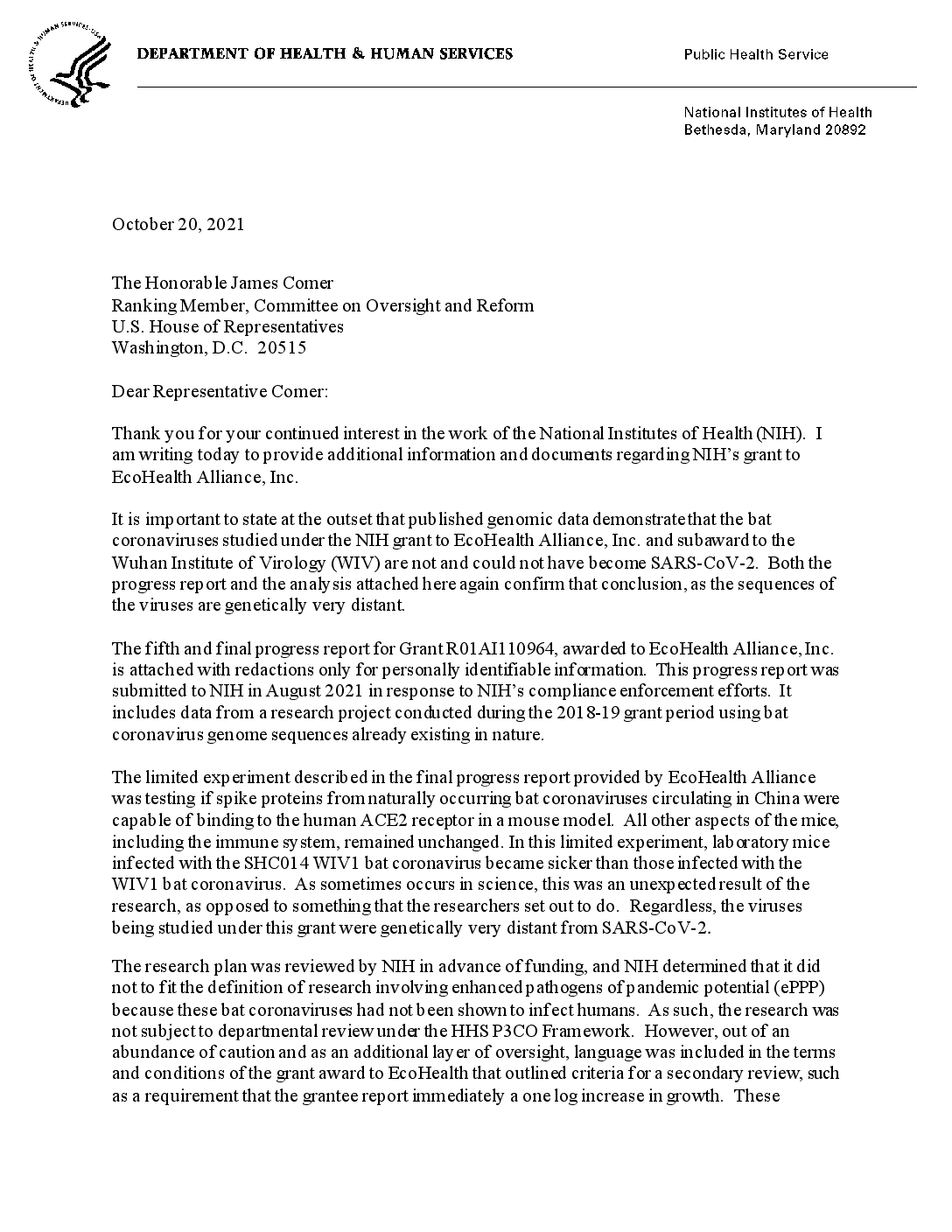
October 20, 2021

The Honorable James Comer Ranking Member, Committee on Oversight and Reform U.S. House of Representatives Washington, D.C. 20515

Dear Representative Comer:

Thank you for your continued interest in the work of the National Institutes of Health (NIH). I am writing today to provide additional information and documents regarding NIH’s grant to EcoHealth Alliance, Inc.

It is important to state at the outset that published genomic data demonstrate that the bat coronaviruses studied under the NIH grant to EcoHealth Alliance, Inc. and subaward to the Wuhan Institute of Virology (WIV) are not and could not have become SARS-CoV-2. Both the progress report and the analysis attached here again confirm that conclusion, as the sequences of the viruses are genetically very distant.

The fifth and final progress report for Grant RO1AI1 10964, awarded to EcoHealth Alliance, Inc. is attached with redactions only for personally identifiable information. This progress report was submitted to NIH in August 2021 in response to NIH’s compliance enforcement efforts. It includes data from a research project conducted during the 2018-19 grant period using bat coronavirus genome sequences already existing in nature.

The limited experiment described in the final progress report provided by EcoHealth Alliance was testing if spike proteins from naturally occurring bat coronaviruses circulating in China were capable of binding to the human ACE2 receptor in a mouse model. All other aspects of the mice, including the immune system, remained unchanged. In this limited experiment, laboratory mice infected with the SHC014 WIV1 bat coronavirus became sicker than those infected with the WIV1 bat coronavirus. As sometimes occurs in science, this was an unexpected result of the research, as opposed to something that the researchers set out to do. Regardless, the viruses being studied under this grant were genetically very distant from SARS-CoV-2.

The research plan was reviewed by NIH in advance of funding, and NIH determined that it did not to fit the definition of research involving enhanced pathogens of pandemic potential (ePPP) because these bat coronaviruses had not been shown to infect humans. As such, the research was not subject to departmental review under the HHS P3CO Framework. However, out of an abundance of caution and as an additional layer of oversight, language was included in the terms and conditions of the grant award to EcoHealth that outlined criteria for a secondary review, such as a requirement that the grantee report immediately a one log increase in growth. These

Read more →

US surgeon explains pig kidney-human transplant test

US surgeons say they have successfully transplanted the kidney of a genetically modified pig into a brain-dead human. The two-hour operation took place at the New York University Langone Health medical centre and, according to experts, is the most advanced experiment in the field so far.Lead investigator, Dr Robert Montgomery, explains the procedure.Read more: Pig kidney transplanted into brain-dead person

Read more →

Democrats' Campaign to Control Drug Prices Nears Collapse

Democrats have made giving government the power to negotiate drug prices a central campaign theme for decades. With the power to make it happen, they may fall short yet again.WASHINGTON — When a powerful Democratic Senate chairman assembled his Special Committee on Aging to confront what he called a “crisis of affordability” for prescription drugs, he proposed a novel solution: allow the government to negotiate better deals for critical medications.The year was 1989, and the idea from that chairman, former Senator David Pryor of Arkansas, touched off a drive for government drug-price negotiations that has been embraced by two generations of Democrats and one Republican president, Donald J. Trump — but now appears at risk of being left out of a sprawling domestic policy bill taking shape in Congress.Senior Democrats insist that they have not given up the push to grant Medicare broad powers to negotiate lower drug prices as part of a once-ambitious climate change and social safety net bill that is slowly shrinking in scope. They know that the loss of the provision, promoted by President Biden on the campaign trail and in the White House, could be a particularly embarrassing defeat for the package, since it has been central to Democratic congressional campaigns for nearly three decades.“Senate Democrats understand that after all the pledges, you’ve got to deliver,” said Senator Ron Wyden of Oregon, the chairman of the Finance Committee.“It’s not dead,” declared Representative Richard E. Neal of Massachusetts, the chairman of the Ways and Means Committee.But with at least three House Democrats opposing the toughest version of the measure, and at least one Senate Democrat, Kyrsten Sinema of Arizona, against it, government negotiating power appears almost certain to be curtailed, if not jettisoned. The loss would be akin to Republicans’ failure under Mr. Trump to repeal the Affordable Care Act, after solemn pledges for eight years to dismantle the health law “root and branch.”And after so many campaign-trail promises, Democrats could be left next year with a lot of explaining to do.“It would mean that the pharmaceutical industry, which has 1,500 paid lobbyists, the pharmaceutical industry, which made $50 billion in profits last year, the pharmaceutical industry, which pays its executives huge compensation packages, and which is spending hundreds of millions of dollars to defeat this legislation, will have won,” Senator Bernie Sanders, the Vermont independent and Budget Committee chairman, said on Wednesday. “And I intend to not allow that to happen.”It is not clear how Mr. Sanders can pull that off. The length of the fight speaks to the durability and popularity of the issue, but also the power of the pharmaceutical industry.Senator Pryor teed it up in the late 1980s, hoping to muscle through lower prices for Medicaid, with an eye on the bigger prize, Medicare. President Bill Clinton included government price negotiations in his universal health care plan in 1993, and throughout the 1990s, as Democrats pressed to add a prescription drug benefit for Medicare, government negotiations were central to holding the cost down.Then in 2003, a Republican Congress and president, George W. Bush, secured passage of that drug benefit — but with an explicit prohibition on the government negotiating the price of medicines older Americans would purchase.A protest last month mocking Representatives Kathleen Rice, Democrat of New York, and Kurt Schrader, Democrat of Oregon, who both once supported drug price negotiations but now oppose the measure.Saul Loeb/Agence France-Presse — Getty ImagesRepealing that so-called noninterference provision has been a centerpiece of Democratic campaigns ever since. Senator Chris Van Hollen of Maryland, a former head of House Democrats’ campaign arm, recalled that “Medicare shall negotiate drug prices” was one of the six planks in the “Six for ’06” platform that helped the Democrats win control of the House in 2006.It has passed the House numerous times, including in 2019 with yes votes from the three House members now opposing it — Representatives Kathleen Rice of New York, Scott Peters of California and Kurt Schrader of Oregon — only to die in the Senate. Even Mr. Trump adopted the effort in his 2016 campaign, only to see it go nowhere.That futility is why Mr. Schrader said he opposed it: “Why do the same thing again and again and expect to have a different result?” he asked.To proponents, defeat after defeat speaks solely to the power of the pharmaceutical industry and its attendant lobbyists.But opponents say it reflects the complexity of the issue. Advanced countries with fixed government purchase prices have seen access to medicines constrained, either by drug companies or by governments that choose their preferred medications.That could lead to a repeat of the political problems faced after passage of the Affordable Care Act, when President Barack Obama’s promise that “if you like your doctor, you can keep your doctor” proved to be untrue. Medicare recipients could find prescriptions they have long taken suddenly unavailable.“If anyone thinks this is the easy political route for me, that’s just laughable,” said Mr. Peters, who has endured scorn and pressure from his Democratic colleagues but whose San Diego district includes almost 1,000 biotechnology companies and 68,000 jobs directly tied to pharmaceutical work.Mr. Schrader and Mr. Peters said the House version of prescription drug price controls, tucked into the broader social policy legislation, would stifle innovation in one of the country’s most profitable global industries.The Pharmaceutical Research and Manufacturers of America, known as PhRMA, also maintains that government negotiations would severely limit the types of prescription drugs that would be available to Medicare beneficiaries, warning that companies would simply withdraw their products from the program. With the good will the industry has accrued with its coronavirus vaccines and treatments, drug companies have pressed their case with key lawmakers, and roped in the larger business community.American Action Network, a conservative group with business money, unveiled a new set of ads on Wednesday targeting vulnerable Democrats such as Representative Carolyn Bourdeaux of Georgia and decrying “another socialist health care plan to control what medicines you can get.”“We are taking on the greed and the corruption of the pharmaceutical industry — I know their power, believe me, I know their power,” Mr. Sanders said. “But this is a fight we’ve got to win.”Senator Ron Wyden, Democrat of Oregon, is trying reintroduce legislation in which drugmakers would offer rebates to consumers on products whose prices rise faster than inflation.Al Drago for The New York TimesMr. Wyden insisted that any legislative effort to tackle rising drug costs must include government negotiating power, but alternatives are emerging.Some simpler solutions would change the formula of the existing Medicare prescription drug benefit to limit out-of-pocket costs, especially in the event of a catastrophic health event.Mr. Wyden is also pressing to enact legislation he drafted with Senator Charles E. Grassley, Republican of Iowa, that would force drugmakers to offer rebates to the government on products whose prices rise faster than inflation. Mr. Grassley said he still supports the measure, as does Senator Bob Menendez, Democrat of New Jersey and a traditional ally of the pharmaceutical industry in his state.Mr. Schrader and Mr. Peters, who oppose giving the government blanket power to negotiate drug prices, said talks were progressing around a narrower measure they proposed. Their plan would limit Medicare to bargaining down only medicines used in outpatient services — which include some of the most costly drugs, such as those used in chemotherapy — and only once those drugs had outlived their patent exclusivity.Their bill would also force rebates for drug prices rising faster than inflation, and limit out-of-pocket medication expenses for older Americans. That is projected to save the government $300 billion over 10 years, about half what the more expansive measure would save.“Frankly, based on discussions we’ve had with the White House, senators and other members in our party, this could get done,” Mr. Schrader said. “That’d be huge.”Ultimately, if any significant price controls survive, it will be the logic of the policy overcoming the power over the lobby, said Representative Ron Kind, a Democrat whose Wisconsin district is being hit with pharmaceutical industry advertising. Mr. Kind, an influential centrist, said he has been speaking with like-minded Democrats, trying to buck them up against the onslaught.“Obviously, there’s some advertising,” he said. “But boy, public sentiment is overwhelming. They just don’t understand why the pharmaceutical industry is the only private industry the federal government’s refused to even discuss prices with.”Kitty Bennett

Read more →