After Tonga's Volcano Eruption, Worries Grow About Covid Exposure
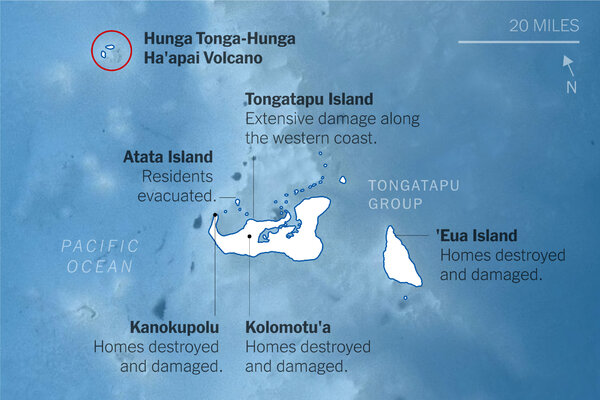
Aid workers risk bringing in a virus Tonga has so far kept out. But there are more immediate problems, as its government confirmed in its first statement since the disaster.SYDNEY, Australia — A cleanup and evacuation operation has begun in Tonga, where the island nation’s government, after days of silence, said Tuesday night that an epic volcanic eruption and the tsunami and ash clouds that followed were an “unprecedented disaster.”International efforts to deliver aid have been complicated not just by the ash and by damaged communication lines, but also by concerns that an island nation that has managed to ward off the coronavirus may be overcome should it allow in aid workers who might be carrying it.Mapping a First Look at Tonga’s Devastation After the Volcano EruptionOur map shows the death and damage that the Tongan government reported in the days after the eruption triggered a tsunami that battered the island nation.At a news conference on Tuesday, Jonathan Veitch, UNICEF’S resident coordinator for the Pacific Islands, said relief efforts would be conducted to get badly needed supplies into Tonga without direct contact.“We won’t be doing anything to threaten the safety of the population,” he said, speaking to reporters remotely from Fiji.But even moving in supplies will take some time.Both Australia and New Zealand have supply planes loaded and ready to go — but the debris produced by the blast Saturday has rendered the airport runways in Tonga unusable.“The ash has proven more difficult to clear than what was expected,” Mr. Veitch said. “We thought that it would be operational yesterday.”Equipment that uses water to clear the runways more quickly is making its way to Tonga by ship, but is still six to eight days away.Those ships also carry food and water, which is desperately needed in parts of the archipelago.“We have heard that shops are running out of food,” Mr. Veitch said.Slide 1 of 4 1/4Nukuʻalofa, Tonga’s capital, after the volcanic eruption and tsunami.Consulate of the Kingdom of TongaSlide 1 of 4 1/4Nukuʻalofa, Tonga’s capital, after the volcanic eruption and tsunami.Consulate of the Kingdom of TongaSlide 2 of 4 2/4Nukuʻalofa, Tonga’s capital, after the volcanic eruption and tsunami.Consulate of the Kingdom of TongaSlide 3 of 4 3/4Nukuʻalofa, Tonga’s capital, after the volcanic eruption and tsunami.Consulate of the Kingdom of TongaSlide 4 of 4 4/4Nukuʻalofa, Tonga’s capital, after the volcanic eruption and tsunami.Consulate of the Kingdom of TongaFor three days after the eruption of the volcano, Hunga Tonga-Hunga Ha’apai, about 40 miles off Tonga, little was heard from the nation of about 100,000. The eruption caused “a volcanic mushroom plume” and tsunami waves of up to 15 meters that hit the west coasts of several islands. The internet remained down, and communications, which were severed because of the eruption, were limited on the islands.The first official update came Tuesday night, when the government there said it had begun assessing the eruption’s toll and confirmed that three people had died, including a British national, a 65-year-old woman and a 49-year-old man.Search-and-rescue teams were sent beginning Sunday morning, the statement said, with nearly all the houses on some hard-hit islands, including Mango, Fonoifua and Nomuka, damaged or destroyed. The government also said that it had set up evacuation centers and was supplying relief items. Volcanic ash, it said, has “seriously affected” supplies of clean water.As nations geared up to help, the big question was how to do so safely.“The front-of-mind issue has to be: How do we 100 percent ensure that we don’t bring Covid to this country?” said Jonathan Pryke, the director of the Pacific Islands Program at the Lowy Institute, an independent think tank in Sydney. “Whatever good will might be built up by the response would be completely undone if they bring Covid into Tonga.”A satellite image of the main port facilities in Nuku’alofa, the Tongan capital, in December.Maxar TechnologiesA satellite image of the same port facilities on Monday, after the volcanic eruption.Maxar TechnologiesThe Tongans’ fears are an echo of past trauma. Throughout Polynesia, a region of around 1,000 islands spread across the Southern Pacific, disease delivered by outsiders is a theme that runs through hundreds of years of history.Regular contact with Europe’s colonizing forces came relatively late to places like Tonga — Capt. James Cook toured the archipelago in 1773, 15 years before the first group of British settled in Australia — but with devastating impact. Over the following century or so, epidemics of measles, dysentery and influenza, carried in by Europeans, devastated island communities all over the South Pacific.One historical study published in 2016 found that in Hawaii, Fiji, Tonga, Samoa and Rotuma (a Fiji dependency), the spread of measles alone in the early 19th century killed up to a quarter of the population across all ages.And in Tonga, another round of death arrived under even more dubious circumstances with the Spanish flu. In November 1918, according to Phyllis Herda, a historian at the University of Auckland in New Zealand, a steamship called the Talune is believed to have introduced the virus because its captain, John Mawson, hid the risk after leaving Auckland.A New Zealand Defense Force crew flying over Tonga on Monday. Australia and New Zealand have mobilized to deliver assistance.Cpl. Vanessa Parker/New Zealand Defense ForceWhen the ship landed in the Tongan capital, Nuku’alofa, with 71 sick passengers and crew members, he reportedly gave the order that everyone on board was “to get dressed and pretend they were not ill,” so the steamer could be unloaded. Almost 2,000 Tongans died in the outbreak that followed — about 8 percent of the population.Covid, not surprisingly, has been viewed through the lens of that experience. Tonga has reported just one case, in October, and it requires travelers arriving in the country to quarantine for 21 days. About 60 percent of the country’s population has received two doses of a Covid vaccine.Curtis Tu’ihalangingie, the deputy head of mission for the High Commission of Tonga in Australia, said that Tongan officials had been speaking to the Australian and New Zealand governments and donor partners about how to deliver aid in a Covid-safe way.A satellite image of the Hunga Tonga-Hunga Ha’apai volcano on Jan. 6, before the undersea volcanic eruption.Maxar TechnologiesA satellite image of the volcano on Monday, after the eruption.Maxar Technologies “We will be working with officials on the ground in Tonga to make sure that we meet any expectations and protocols that they have established,” New Zealand’s prime minister, Jacinda Ardern, said Sunday.Peeni Henare, the minister of defense, said there were other ways to avoid transmission. “We’ve done a number of operations in the Pacific over the past two years which have been contactless,” he said.Some two dozen U.N. aid workers were already stationed in Tonga when the volcano erupted, and Mr. Veitch said they were at work, including providing medical care.But aid groups in Australia and in the region have said they are deferring to governments on how to best provide assistance.“We won’t be sending anyone unless requested to do so, and at that point will follow guidance as required,” said Katie Greenwood, who leads the Pacific office of the International Federation of Red Cross and Red Crescent Societies.A satellite image showing a cleanup underway of volcanic ash on the runway of the Fua’amotu International Airport in Tonga, on Monday.Maxar TechnologiesShe said the Red Cross had about 70 volunteers in Tonga, with access to enough relief supplies for about 1,200 households, including tarpaulins, shelter-building kits and blankets.Whether that would be enough was still hard to tell. Mr. Tu’ihalangingie, the Tongan diplomat in Australia, said it would be weeks before phone or internet connections to the outside world were fully restored.“We still have limited access to Tonga,” he told ABC Radio in Australia. “We still don’t have a direct communication with our government.”Natasha Frost and Yan Zhuang contributed reporting.

Read more →

Calcium: Important not just for your bones but also for your heart

The heart is a tireless organ, beating an average of 100,000 times a day. However, conditions that stop the heart from pumping blood efficiently can cause serious problems and ultimately require a heart transplantation.
In a study published this month in the journal Science Translational Medicine, researchers from Osaka University have shown that a previously unknown mutation can lead to a condition called dilated cardiomyopathy, which is one of the main causes of heart failure.
Heart failure is an incurable condition where the heart is no longer able to meet the body’s demands in terms of blood supply. It is one of the most common causes of death and it affects almost 40 million people worldwide, representing a huge public health problem. One of the main factors leading to heart failure is a disease called dilated cardiomyopathy (or DCM). DCM is characterized by dilation of the heart’s chambers and a pumping disfunction. Previous research has shown that DCM is often inherited and has a genetic basis. However, for up to 80% of the familial DCM cases, we still don’t know the genetic mutation causing the disease.
The research team identified a gene called BAG5 as a novel causative gene for DCM. First, they studied patients from different families, highlighting a correlation between loss of function mutations in the BAG5 gene and DCM. The researchers found that this mutation has a complete penetrance, meaning that 100% of the individuals presenting it will develop the disease. They then found in a mouse model of dilated cardiomyopathy that mice without BAG5 exhibited the same symptoms of human DCM, such as dilatation of the heart’s chambers and irregular heart rhythm. This indicates that mutations that erase the function of BAG5 can cause cardiomyopathy.
“Here we showed that loss of BAG5 perturbs calcium handling in mouse cardiomyocytes,” says Dr. Hideyuki Hakui, lead author of the study. BAG5 is important for calcium handling in the heart muscle cells, and calcium is essential for a regular rhythm and overall health of the cardiac muscle, explaining why a loss of BAG5 leads to cardiomyopathy.
“After demonstrating that BAG5 mutations led to loss of functional BAG5 protein,” continues Dr. Yoshihiro Asano, senior author of the study, “we also showed that administration of an AAV9-BAG5 vector in a murine model could restore cardiac function. This finding suggests that gene therapy with adeno-associated viruses (AAV) should be further investigated as a possible treatment alternative to heart transplantation for patients who are BAG5 deficient.” AAV gene therapy is an innovative form of therapy aimed at fixing mutated genes in diseases that have a genetic cause like DCM. Therefore, these findings pave the way for a potential precision medicine treatment based on gene therapy.
Story Source:
Materials provided by Osaka University. Note: Content may be edited for style and length.

Read more →

Estrogen-regulated brain circuit helps females control obesity

Seeking to better understand the key role the female hormone estrogen plays in maintaining energy balance and weight control, a group led by researchers at Baylor College of Medicine looked into estrogen interactions with specific brain regions that provide these anti-obesity benefits.
The team reveals in the journal Science Advances an estrogen-activated neurocircuit that stimulates thermogenesis, or body heat production, and physical activity in animal models. The circuit begins in neurons located in a region of the hypothalamus called the ventrolateral subdivision of the ventromedial hypothalamic nucleus (vlVMH). These neurons interact with estrogen via estrogen receptor-alpha (ER-alpha) and respond to the hormone by connecting to and communicating with serotonin-producing neurons located in another brain region called dorsal raphe nucleus (DRN).
The circuit not only responds to estrogen, but also to changes in ambient temperature and in the nutritional status of the animal. Interestingly, the circuit seems to be functional in males but, at this point, its physiological relevance is not clear.
“My lab has long been interested in understanding sex differences in metabolic control,” said co-corresponding author Dr. Yong Xu, professor of pediatrics- nutrition and molecular and cellular biology at Baylor. “For instance, before menopause women are typically protected from metabolic problems that may lead to weight gain, when compared to age-matched men. However, after menopause, this benefit seems to disappear. Researchers around the world agree that estrogen is one important player in this benefit.”
In previous work, the researchers showed that one of the estrogen receptors, ER-alpha, is expressed in several brain regions, including the v1VMH of the hypothalamus. When v1VMH neurons expressing ER-alpha respond to estrogen, the animals increase thermogenesis and physical activity. Both responses are beneficial as they increase energy expenditure, which can prevent obesity.
“What we didn’t know at that time were the neurocircuits that mediate these responses,” Xu said. “Using modern neuroscience technology, we identified a neurocircuit that connects ER-alpha-expressing neurons in the vlVMH region with neurons in the DRN region. We confirmed that estrogen-mediated activation of this circuit actually stimulates thermogenesis and physical activity.”
The researchers also found that the circuit responds to changes in ambient temperature and in the nutritional status of the animal.
“For example, the circuit can be activated when it’s cold, stimulating thermogenesis and physical activity, which would help the animal stay warm,” Xu said. “The circuit can be inhibited when the animal is hungry, which would shut down thermogenesis and physical activity, saving energy to adapt to the lack of nutrients.”
Xu and his colleagues studied this circuit in females, but also in males.
“We found that the circuit is conserved in males — they have the same neurons that express ER-alpha and project into the same downstream brain regions. If the circuit is artificially activated in males, the same responses occur — thermogenesis and physical activity are stimulated. However, we still don’t know the role this circuit plays in males. Further studies will help answer this question.”
Other contributors to this research are Hui Ye, Bing Feng, Chunmei Wang, Kenji Saito, Yongjie Yang, Lucas Ibrahimi, Sarah Schaul, Nirali Patel, Leslie Saenz, Pei Luo, Penghua Lai, Valeria Torres, Maya Kota, Devin Dixit, Xing Cai, Na Qu, Ilirjana Hyseni, Kaifan Yu, Yuwei Jiang, Qingchun Tong, Zheng Sun, Benjamin R. Arenkiel, Yanlin He and Pingwen Xu. The authors are affiliated with Baylor College of Medicine, the University of Illinois at Chicago, Louisiana State University System or the University of Texas Health Science Center at Houston.
This work was supported by the following grants from National Institutes of Health: P01 DK113954, R01DK117281, R01 DK115761, R01739 DK125480; R01 DK120858, R00 DK107008, R01 DK123098, K01740 DK119471; K01 DK111771; P20 GM135002; R01 DK114279, R21 NS108091, R01 DK109934; Q01ES027544 and R03AG070687. Further support was provided by USDA/CRIS (51000-064-01S), DOD (Innovative Grant W81XWH-19-PRMRP-DA.; DOD W81XWH 9-1-0429), DRTC (The Pilot and Feasibility Award DK020595), and the American Diabetes Association (1-17-PDF-138).

Read more →

Review reports improved transparency in antidepressant drug trials

New research suggests manufacturers of newly developed antidepressant drugs have become more forthcoming about clinical trials that don’t pan out.
A new review and meta-analysis, published today in the journal PLOS Medicine, indicates that drug companies conducting clinical trials on new antidepressants have increased disclosure of clinical trials with negative outcomes, that is, trials that fail to show the drug is more effective than a placebo.
“Positive trials have always been reliably published, but negative trials, while common, have long been swept under the rug,” said lead author Erick Turner, M.D., associate professor of psychiatry in the Oregon Health & Science University School of Medicine.
This was shown compellingly in a landmark 2008 study published in The New England Journal of Medicine. The new study — an update of the 2008 study conducted by researchers from OHSU and around the world — shows a trend toward reporting negative trials more transparently.
The research shows things have changed since 2008, said co-author Andrea Cipriani, M.D., Ph.D., professor of psychiatry at the University of Oxford.
“Nowadays there is greater awareness of reporting bias in the scientific literature — not only in psychiatry but across all medicine — and there has been a cultural change: What was once standard practice is no longer considered acceptable,” Cipriani said. “Numerous policy changes have been implemented, which have played a major role in bringing about the increase in transparency.

Read more →

'Decoy' protein works against multiple SARS-CoV-2 variants, researchers report

A drug treatment that acts as a decoy against SARS-CoV-2 was highly effective at preventing death and lung damage in humanized animal models of severe COVID-19 disease, according to a Nature Chemical Biology study from researchers at the University of Illinois Chicago. The study suggests that the drug has the potential to treat COVID-19 patients, including those who are infected with aggressive SARS-CoV-2 variants.
The study’s senior lead author is Asrar Malik, professor in the department of pharmacology and regenerative medicine at the UIC College of Medicine. Jalees Rehman, professor in the department of pharmacology and regenerative medicine and the department of medicine, is a co-lead author of the study, “Engineered ACE2 decoy mitigates lung injury and death induced by SARS-CoV-2 variants.”
“While vaccines remain the best option for preventing infections, long-term complications and death from COVID-19, there is an urgent need for the development of effective treatments for vulnerable patients, especially as new variants continue to arise,” Rehman said.
“Vulnerable individuals who are at risk of developing severe COVID-19 include those who are unvaccinated or immunocompromised and therefore their immune system cannot protect them as well even after receiving vaccinations and boosters,” he said. “In addition, new variants of SARS-CoV-2, such as the most recent omicron variant, may partially evade the immune system and can cause breakthrough infections. For all the vulnerable patients, we need to create an array of treatments so that health care providers can choose the most appropriate drug or combination of drugs, depending on the individual patient’s disease stage and severity.”
The drug treatment, developed through a partnership between UIC and the University of Illinois Urbana-Champaign, consists of an artificially engineered ACE2 protein designed with unprecedently high binding capacity for the spike protein of SARS-CoV-2, which binds to natural ACE2 protein receptors located on human cells and causes COVID-19. The drug works by competing for the spike protein and soaking up viruses before they can bind and enter cells.
In animal studies of severe COVID-19, the researchers used mouse models designed to carry the human ACE2 protein. With multiple treatment regimens, infected mice were given the drug intravenously. The researchers found that mice receiving the treatment showed markedly reduced death and no significant evidence of severe acute respiratory syndrome, the hallmark of the disease and primary cause of death. The mice receiving the drug also regained appetite and weight, which are signs of recovery.

Read more →

UK rates of nearsightedness have increased significantly over time, study finds

Changing environmental factors as well as changing gene-environment interactions could be to blame for increasing rates of myopia, also known as nearsightedness or shortsightedness, over time, suggests a new study published this week in the open-access journal PLOS ONE by Jugnoo Rahi of University College London, and other members of the UK Biobank Eye and Vision Consortium.
Previous studies have pointed toward an emerging “epidemic” of myopia, characterized by increased prevalence of myopia accompanied by both a shift toward younger age at onset and greater severity. In the new study, researchers used data on 107,442 UK Biobank study participants aged 40 to 69 years old, born between 1939 and 1970. All participants underwent a detailed ophthalmic exam and provided sociodemographic data as well as information on their history of glasses and vision problems.
Overall, myopia frequency increased from 20.0% in the oldest cohort (born 1939-1944) to 29.2% in the youngest cohort (born 1965-1970). Temporal trends varied between types of myopia, with a greater increase in adult-onset myopia compared to childhood-onset myopia, and a greater increase in low myopia compared to high myopia. Moreover, the mean spherical equivalent — a measure of myopia severity — worsened between cohorts, but only for childhood-onset myopia, shifting from a median of -3.8 diopters (IQR -2.4 to -5.4) in the oldest cohort to -4.4 (IQR -3.0 to -6.2) in the youngest.
Among the trends, there were additional, notable differences in patterns of associations with sex, ethnicity, socioeconomic status and education. In particular, the association between higher educational attainment and myopia increased over time, from an adjusted odds ratio of 2.7 in the oldest cohort (95% CI 2.5-2.9) to an OR of 4.2 in the youngest cohort (95% CI 3.3-5.2) with the greatest increase seen for childhood-onset myopia (OR 3.3 (2.8-4.0) to 8.0 (4.2-13)).
The authors conclude that their evidence supports a complex of changing environmental factors and presumably changing gene-environment interactions, discernible only by distinguishing between childhood-onset and adult-onset myopia, which account for increasing myopia frequency.
The authors add: “Myopia is a priority of the World Health Organization’s global initiative to reduce the burden of sight impairment. We investigated environmental risk factors driving the ‘epidemic’ of increasing frequency and severity of myopia in the UK by analyzing cohort effects within the UK Biobank Study. Our findings suggest that that the frequency of childhood-onset myopia and of high (severe) myopia will continue to increase if increasing educational experience or intensity in childhood is not addressed.”
Story Source:
Materials provided by PLOS. Note: Content may be edited for style and length.

Read more →

New sensor grids record human brain signals in record-breaking resolution

A team of engineers, surgeons and medical researchers has published data from both humans and rats demonstrating that a new array of brain sensors can record electrical signals directly from the surface of the human brain in record-breaking detail. The new brain sensors feature densely packed grids of either 1,024 or 2,048 embedded electrocorticography (ECoG) sensors. The paper was published by the journal Science Translational Medicine on January 19, 2022.
These thin, pliable grids of ECoG sensors, if approved for clinical use, would offer surgeons brain-signal information directly from the surface of the brain’s cortex in 100 times higher resolution than what is available today. Access to this highly detailed perspective on which specific areas of the tissue at the brain’s surface, or cerebral cortex, are active, and when, could provide better guidance for planning surgeries to remove brain tumors and surgically treat drug-resistant epilepsy. Longer term, the team is working on wireless versions of these high resolution ECoG grids that could be used for up to 30 days of brain monitoring for people with intractable epilepsy. The technology also holds potential for permanent implantation to improve the quality of life of people who live with paralysis or other neurodegenerative diseases that can be treated with electrical stimulation such as in Parkinson’s disease, essential tremor, and the neurological movement disorder called dystonia.
The project is led by electrical engineering professor Shadi Dayeh at the University of California San Diego Jacobs School of Engineering. The team of engineers, surgeons and medical researchers hails from UC San Diego; Massachusetts General Hospital; and Oregon Health & Science University.
Next-generation electrocorticography
Recording brain activity from grids of sensors placed directly on the surface of the brain — electrocorticography (ECoG) — is already in common use as a tool by surgeons performing procedures to remove brain tumors and treat epilepsy in people who do not respond to drugs or other treatments. The new work in Science Translational Medicine provides a wide range of peer-reviewed data demonstrating that grids with 1,024 or 2,048 sensors can be used to reliably record and process electrical signals directly from the surface of the brain in both humans and rats. For comparison, the ECoG grids most commonly used in surgeries today typically have between 16 and 64 sensors, although research grade grids with 256 sensors can be custom made.
Being able to record brain signals at such high resolution could improve surgeons’ ability to remove as much of a brain tumor as possible while minimizing damage to healthy brain tissue. In the case of epilepsy, higher resolution brain-signal recording capacity could improve a surgeon’s ability to precisely identify the regions of the brain where the epileptic seizures are originating, so that these regions can be removed without touching nearby brain regions not involved in seizure initiation. In this way, these high resolution grids may enhance preservation of normal, functioning brain tissue.

Read more →

New electron microscopy technique could shortcut the development of vaccines and monoclonal antibody therapies

Scientists at Scripps Research have devised a method that may be able to shortcut one of the big steps in modern vaccine development.
The researchers, whose work appears in Science Advances on January 19, 2022, showed that they could use high-resolution, low-temperature electron microscopy (cryo-EM) to rapidly characterize antibodies — elicited by a vaccine or infection — that bind to a desired target on a virus at an atomic level.
“The COVID-19 pandemic has highlighted the need for robust and rapid vaccine and antiviral technologies,” says study senior author Andrew Ward, PhD, a professor in the Department of Integrative Structural and Computational Biology at Scripps Research. “We are optimistic that our new approach will help fill that need by greatly streamlining antibody discovery.”
“Traditionally, identifying antibodies that are useful against a virus involves the laborious sorting and testing of antibody-producing B cells to find the right ones — a process that takes months,” says Postdoctoral Research Associate and study co-first author Aleksandar Antanasijevic, PhD.
“With this new method we can go from blood sample collection from infected or immunized patients to identifying all the elicited antibodies of interest in about ten days,” adds Staff Scientist and study co-first author Charles Bowman.
The researchers’ feat was enabled in part by recent improvements in cryo-EM, a technology that uses a beam of electrons to illuminate and image targets far below the scale of ordinary light microscopy. In a study published in Nature Communications in August, for example, the researchers used high-resolution cryo-EM to rapidly and precisely map where antibodies in rhesus macaque monkeys bind to synthetic versions of the HIV envelope protein that are being developed for potential HIV vaccines.
In the new study, the team took this line of research a step further. They employed a “structure-to-sequence” computer algorithm that can relate antibody structure determined by cryo-EM, to the DNA sequence that would produce that structure. For this, they assembled a library of all the antibody-encoding DNA sequences from the monkeys — obtained by quickly bulk sequencing the genetic material from antibody-producing B-cells from the animals’ lymph nodes. Applying the algorithm to the cryo-EM data and the antibody sequence library, the scientists could reliably match an antibody of interest in their cryo-EM images to a unique antibody defined in the sequence database.
The researchers showed that they could confirm the accuracy of the result by making copies of that unique, “monoclonal” antibody using the sequence data, and verifying with cryo-EM that the antibody binds in an identical way to the originally imaged antibody.
The scientists are now refining their technique to optimize its speed and usability, and are applying it to several areas: to rapidly evaluate human antibody responses to experimental HIV vaccines; to develop antibody-blocking treatments for autoimmune diseases; and to discover antibodies that could therapeutically hit other protein targets on cells.
They expect that future improvements in cryo-EM technology and structure-to-sequence algorithms will allow the even more rapid identification of antibodies using high-resolution structural images alone, with no need for DNA sequencing of B cells.
“This structure-to-sequence approach has a lot of potential in immunology and beyond,” Antanasijevic says. “We envision being able to use it someday to study protein-to-protein interactions generally, for example, to discover a given protein’s binding partners.”
Story Source:
Materials provided by Scripps Research Institute. Note: Content may be edited for style and length.

Read more →

Team advances research on muscle health

An international team led by uOttawa Faculty of Medicine researchers have published findings that could contribute to future therapeutics for muscle degeneration due to old age, and diseases such as cancer and muscular dystrophy.
In a study appearing in the Journal of Cell Biology, which publishes peer-reviewed research on cellular structure and function, the authors said their work demonstrates the importance of the enzyme GCN5 in maintaining the expression of key structural proteins in skeletal muscle. Those are the muscles attached to bone that breathing, posture and locomotion all rely on.
“We found that if you delete GCN5 expression from muscle it will no longer be able to handle extreme physical stress,” says Dr. Keir Menzies, a molecular biologist at the Faculty of Medicine’s Biochemistry, Microbiology and Immunology department and cross-appointed as an associate professor at the Interdisciplinary School of Health Sciences.
Over the span of roughly five years, the uOttawa-led international collaboration painstakingly experimented with a muscle-specific mouse “knockout” of GCN5, a well-studied enzyme which regulates multiple cellular processes such as metabolism and inflammation. Through a series of manipulations, scientists produce lab mice in which specific genes are disrupted, or knocked out, to unveil animal models of human disease and better understand how genes work.
In this case, multiple experiments were done to examine the role the GCN5 enzyme plays in muscle fiber. What they found with this line of muscle-specific mouse knockouts was a notable decline in muscle health during physical stress, such as downhill treadmill running, a type of exercise known by athletes to cause micro-tears in muscle fibres to stimulate muscle growth. The lab animals’ muscle fibers became dramatically weaker as they scurried downhill, like those of old mice, while wild-type mice were not similarly impacted.
Dr. Menzies, the senior author of the study, says the findings are akin to what is observed in advanced aging, or myopathies and muscular dystrophy, a group of genetic diseases that result in progressive weakness and loss of muscle mass. It was supported by human data, including an observed negative correlation between muscle fiber diameter and Yin Yang 1, a highly multifunctional protein that is pivotal to a slew of cellular processes and found by the Menzies lab to be a target of GCN5.
Ultimately, the team’s research found that GCN5 boosts the expression of key structural muscle proteins, notably dystrophin, and a lack of it will reduce them.
This is significant because dystrophin is the body’s most important protein for maintaining the membrane of muscle cells, serving as a kind of anchor and cushioning shock absorber in cells of muscles. Without it, muscles are very susceptible to physical stress, and the withering of muscles can lead to crippling and deadly consequences.
“Our publication shows that if you knock out GCN5 the one major thing we see is a lack of dystrophin, without seeing any real disruption of any other mechanisms,” says Dr. Menzies. He noted that the paper also reaffirmed other research showing that GCN5 doesn’t alter the content of muscle mitochondria, the powerhouses in cells, and another major influencer of muscle health.
The research builds on data showing that dystrophin is “important for maintaining general muscle integrity and muscle health,” according to Dr. Menzies.
Dr. Menzies suggests the research could help to create a foundation for developing therapeutics down the line. “These findings may therefore be useful for the discovery of new therapeutics that regulate GCN5 activity, or its downstream targets, for maintaining healthy muscle during cancer, myopathies, muscular dystrophy or aging,” he says.
Story Source:
Materials provided by University of Ottawa. Original written by David McFadden. Note: Content may be edited for style and length.

Read more →

The role of ribosomes in age-related diseases

Aging leads to a decline in cellular fitness and loss of optimal protein function. Many age-related ailments, including Alzheimer’s and Parkinson’s diseases, are caused by protein aggregation, a result of errors in protein folding. Yet, the mechanisms underlying how ageing causes proteins to aggregate has largely remained a black box. In new research published Jan. 19 in Nature, researchers at Stanford University have traced this problem to age-dependent impairment of the machinery that produces new proteins.
To root out this issue, researchers in the lab of Judith Frydman, the Donald Kennedy Chair in the School of Humanities and Sciences at Stanford, focused on how age affects the functioning of ribosomes — the cellular machinery responsible for converting messenger RNA into proteins. They used two well-established models of human aging, yeast and roundworms. Through a combination of experiments and computational data analysis, they found that ribosome function degrades with age in both organisms. The increased load of defective proteins with age overwhelms the protective quality control failsafes that would otherwise prevent protein aggregation.
“We’ve known that protein aggregation with age is a problem linked to many diseases. At the moment, treatments try to address it by trial-and-error testing,” said Kevin Stein, lead author of the paper and a former postdoctoral scholar in the Frydman Lab. “Getting down to the basic-biology of these diseases, and understanding what mechanisms cause them, can help us make better decisions about what therapies could be effective before we test them.”
A vulnerable time
When folded correctly, proteins carry out their functions and remain soluble in the environment of the cell. Misfolded proteins, by contrast, cannot function properly and tend to stick to each other and other proteins, clogging up cellular processes and generating toxic aggregates. Protein aggregation has been specifically implicated in a wide variety of aging-linked diseases, including Alzheimer’s, Parkinson’s, frontotemporal dementia, Huntington’s disease and ALS (amyotrophic lateral sclerosis).
To guard against the continual production of misfolded proteins, cells have dedicated “quality control” machinery for fixing or degrading misfolded proteins. Previous research has shown that shortcomings in these processes can lead to aggregation. This research is the first to show the folding defect during ageing starts early in the journey of a protein, when it is made by the ribosome. Because ribosomes are constantly producing large amounts of proteins, these defects cause a subsequent snowball of disfunction.

Read more →