New York declares state of emergency over polio
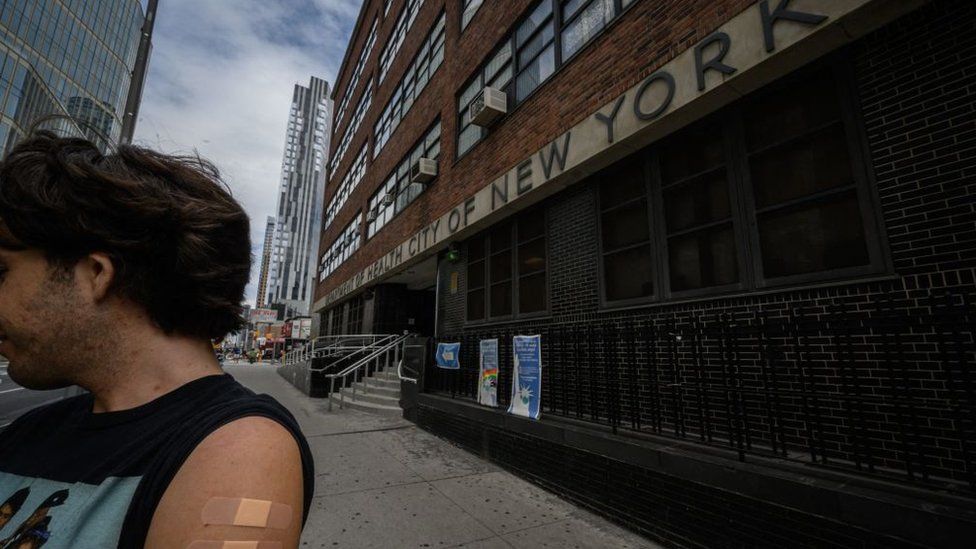
Published3 days agoSharecloseShare pageCopy linkAbout sharingImage source, Getty ImagesThe governor of New York has declared a state of emergency over polio as evidence emerges that the virus is spreading across the state.Health officials say wastewater samples in New York City and four adjacent counties have tested positive for a poliovirus that can cause paralysis.Although only one case has so far been confirmed, it was the first in the country in nearly a decade.Polio was largely eradicated from the US by vaccinations that began in 1955.By 1979, the US was declared polio-free.But according to New York officials, vaccination rates are too low in parts of the state. Friday’s emergency declaration is aimed at boosting flagging immunisation rates.There is no cure for polio, but it can be prevented by the vaccine. Mostly affecting children, the virus typically causes muscle weakness and paralysis, and in the most serious cases permanent disability and death.New York’s state health department said it aims to boost vaccination rates from the current state-wide average of about 79% to above 90%.”On polio, we simply cannot roll the dice,” Health Commissioner Dr Mary Bassett said in a statement. “If you or your child are unvaccinated or not up to date with vaccinations, the risk of paralytic disease is real.”She added that “for every one case of paralytic polio observed, there may be hundreds of other people infected”.An inactivated polio vaccine is used in both the US and the UK as part of the routine childhood programme. In the US, about 93% of toddlers have received at least three doses of the polio jab, according to vaccination data from the CDC.Officials began monitoring wastewater in the state for poliovirus after an unvaccinated man in Rockland County, just north of New York City, contracted the virus in July – the first recorded case since 2013 – and suffered paralysis.The case was later genetically linked to paralytic polio found in a wastewater sample collected from nearby Nassau County in August.Wastewater samples in Orange County, Sullivan County and the five boroughs of New York City have also tested positive for paralytic polio.The emergency order issued on Friday by Governor Kathy Hochul is the state’s third this year, in addition to similar orders issued in response to the coronavirus pandemic and monkeypox.It empowers emergency medical workers, midwives and pharmacists to join the network of providers who can roll out the polio vaccine.More on this storyWhat is polio and how can you protect yourself?10 AugustUS doctor warns of many undiagnosed polio cases9 AugustPolio virus found in New York wastewater2 August

Read more →

Stone age surgery: Earliest evidence of amputation found

A team of Indonesian and Australian researchers have uncovered the oldest case of surgical amputation to date in Borneo. The find presents a remarkable feat in human prehistory.
The discovery, published in Nature, describes the skeletal remains of a young adult found in a cave in Borneo, who had part of the left lower leg and left foot amputated, probably as a child, at least 31,000 years ago. The person survived the surgical procedure, living for at least another six to nine years.
The find presents a remarkable feat. It is notoriously difficult to prevent infections in surgical amputations, even to this day. Yet 30,000 years ago a community was able to successfully navigate veins, arteries, nerves, and tissue, and keep the wound clean so that it healed successfully. The individual went on the live into adulthood where an unknown cause eventually led to their death.
Bioarchaeologist and an expert in ancient skeletons, Dr Melandri Vlok, at University of Sydney said the find is “incredibly exciting and unexpected.”
“The discovery implies that at least some modern human foraging groups in tropical Asia had developed sophisticated medical knowledge and skills long before the Neolithic farming transition,” said Dr Vlok, who is co-lead author of the paper and a postdoctoral research associate in Sydney Southeast Asia Centre.
Studying bones
The skeleton of the young adult, possibly in their 20s when they died, was carefully buried within LiangTebo cave — located Borneo in East Kalimantan, in a limestone karst area that harbours some of the world’s earliest dated rock art.

Read more →

Vaccine expected to induce strong immune responses against 2022 monkeypox virus, research shows

New research has suggested that recommended vaccinia virus (VACV)-based vaccines will mount a robust immune response against the monkeypox virus observed in the current outbreak (MPXV-2022).
Since the new virus was first observed in early May 2022, over 52,000 cases have been confirmed in more than 90 countries and regions, including Hong Kong, as the city recorded the first imported case on Monday.
The study, co-led by University of Melbourne Prof. Matthew MCKAY, ARC Future Fellow at the University and Professorial Fellow (Honorary) at the Peter Doherty Institute for Infection and Immunity (Doherty Institute), and Prof. Ahmed Abdul QUADEER, Research Assistant Professor at the Hong Kong University of Science and Technology (HKUST), was published in the international journal Viruses.
Weeks after the new strain emerged, the team undertook genomic research to find out if the genetic mutations observed in MPXV-2022 may affect vaccine-induced immune responses against monkeypox.
“Specific VACV-based vaccines have demonstrated high efficacy against monkeypox viruses in the past and are considered an important outbreak control measure,” Prof. McKay, who is also an Adjunct Professor at HKUST said.
“However, given this is a novel monkeypox virus, we still lack scientific data on how well human immune responses triggered by VACV-based vaccines will recognise MPXV-2022 and provide protection against disease.”
Using genomic and immunological data, the team evaluated the genetic similarities and differences between VACV and MPXV-2022, specifically within the protein regions that are targeted by vaccine-induced neutralizing antibodies or T cells.

Read more →

Fix up Earth to exit COVID-19: Critical link between environment, pandemics

Ecosystem restoration can assist in COVID-19 recovery if it is closely integrated with socioeconomic, health and environmental policies, scientists say in a new article in The Lancet Planetary Health.
The repair of ecosystems as a core public health intervention can reduce the risk of infection and play an integral role in the long-term rehabilitation from COVID-19, which has so far claimed up to 15 million lives globally through direct and indirect infection (World Health Organization, 2020-21).
“Make no mistake. The loss of functional and resilient ecosystems around the world is linked to the global pandemic and the fundamentals of health and socioeconomic recovery,” says lead researcher Flinders University ecologist Dr Martin Breed. “The long-term health effects and economic recovery remain major concerns.”
Without effective and large-scale restoration efforts, up to 95% of land on Earth will be degraded by 2050.
The 2020s have been declared the UN Decade on Ecosystem Restoration to reflect the growing urgency and scale required to save ecosystems and landscapes.
First author, Flinders University academic and ecologist Dr Jake Robinson, says the new Lancet article demonstrates how ecosystem restoration has rarely been considered an integral part of the global response to COVID-19, even though the pandemic has exposed socioeconomic disparities and weaknesses in health systems worldwide.
“The next decade will be crucial for humanity’s recovery from the pandemic and for ecosystem repair,” says Dr Robinson, who us currently based in the UK.
“Urgent policy action is required at all levels — from local government to intergovernmental platforms — to transform the social, economic and financial models towards a simultaneous healthy recovery of both ecosystems and humanity.”
The researchers from Australia, the UK and US raise the following points: First and foremost, engaging with nature benefits both physical and mental health. It promotes physical activity, social engagement, psychological and emotional benefits, and boosts our biology including metabolic and immune systems via our gut microbiota and other physiological systems. Community-led action can embrace the repair of urban nature to work on positive biodiversity projects and involve people in sustainable development initiatives and conservation work. Ecosystem restoration programs provide vital employment opportunities, particularly in marginalised communities where environmental and health conditions are typically worse. Health professionals can promote nature-based activities to build health benefits, including recovery from long-COVID-19 symptoms. Exposure to healthy ecosystems can facilitate the transfer of immunoregulatory microbiota to people, which could improve resilience to diseases like COVID-19 and improve lung function by reducing exposure to air pollution in the long term. Restored habitats can provide a buffer to future crossover with zoonotic pathogens and reduce the likelihood of future disease spillover from animals to humans and potential pandemics.The article, ‘Ecosystem restoration is integral to humanity’s recovery from COVID-19’ (2022), by Jake M Robinson, James Aronson, Christopher B Daniels, Neva Goodwin, Craig Liddicoat, Laura Orlando, David Phillips, Jessica Stanhope, Philip Weinstein, Adam T Cross and Martin F Breed has been published in The Lancet — Planetary Health.
Acknowledgements: The project was funded by the Australia Research Council Linkage grants.
Story Source:
Materials provided by Flinders University. Original written by Yaz Dedovic. Note: Content may be edited for style and length.

Read more →

SARS-CoV-2 immunity research: Study suggests breakthrough infection may confer extra protection to vaccinees

Long-lasting immune cells that specifically recognise the SARS-CoV-2 virus were found in the noses of people who were infected following vaccination. These virus-specific T cells, which were not present in those who had only been vaccinated, are expected to confer an additional layer of protection against COVID-19, according to scientists from Duke-NUS Medical School in Singapore, whose findings were published in the Journal of Experimental Medicine.
Most antiviral immunity studies have been performed with peripheral blood, yet the primary site of SARS-CoV-2 infection is in the nasal cavity.
“The SARS-CoV-2 virus initially enters and replicates in the upper respiratory tract, with nasal cells maintaining high levels of virus replication for weeks,” explained Professor Antonio Bertoletti, senior author of the study from Duke-NUS’ Emerging Infectious Diseases Programme. “Immune cells, called T cells, that live in the nasal cavity and recognise virus-infected nose cells can play an important role in rapidly containing and eliminating infection. However, we don’t know much about the effect of injected vaccines or infection on the induction of these nose-resident, virus-specific cells.”
Prof Bertoletti and his team analysed the T cells in nasal swab samples taken from 16 people who received two doses of the Pfizer-BioNTech mRNA vaccine but had not yet been infected with SARS-CoV-2. They also analysed the T cells from nasal samples of another 34 people who had received two or three doses of the same vaccine and were later infected with SARS-CoV-2.
The team examined the T cells to determine the different types and to find out if they could specifically recognise different proteins of SARS-CoV-2.
Interestingly, virus-specific T cells were found almost exclusively in the noses of the group who had received the vaccine and then went on to become infected with the virus. They were not present in the nasal cavities of the group who had only received the vaccine, even though virus-specific T cells could be found in their blood.
“We also found that the T cells in the vaccinated and then infected group persisted for at least 20 weeks and were able to recognise various SARS-CoV-2 proteins, including the non-spike proteins that are more conserved between the different viral variants,” said Ms Joey Lim Ming Er, first author of the study and a PhD student at Duke-NUS. “This is important because it means that these T cells would likely be capable of recognising cells infected with the Omicron variant of SARS-CoV-2 despite its extensive spike protein mutations.”
Professor Patrick Casey, Senior Vice-Dean for Research at Duke-NUS, said, “As countries around the world, including Singapore, move toward living with the virus, the scientific community must continue to improve and innovate our defences against the next SARS-CoV-2 variant or other pathogens of public health concern. The findings by Professor Bertoletti and his team highlight an important new avenue of research that could have a major impact on this front.”
The researchers note that further research is needed to confirm these results due to the small sample size and other limitations of their study. Furthermore, it will be important to investigate how long these nasal-resident, virus-specific T cells last after 20 weeks to understand their long-term impact on SARS-CoV-2 protection.
Story Source:
Materials provided by Duke-NUS Medical School. Note: Content may be edited for style and length.

Read more →

Food insecurity has lasting impacts on the brains and behavior of mice

While food insecurity is a problem for a growing segment of the U.S. population — made even worse by the coronavirus pandemic — few studies have looked at the effect that feast or famine has on the developing brain in isolation from other factors that contribute to adversity.
A new study by neuroscientists at the University of California, Berkeley, simulated the effects of food insecurity in juvenile mice and found lasting changes later in life.
“We show that irregular access to food in the late juvenile and early adolescent period affects learning, decision-making and dopamine neurons in adulthood,” said Linda Wilbrecht, UC Berkeley professor of psychology and member of the Helen Wills Neuroscience Institute.
One key difference in behavior involved cognitive flexibility: the ability to generate new solutions when the world changes.
“Mice searching for rewards might be inflexible, sticking to only one strategy even when it no longer yields a reward, or they might be flexible and quickly try out new strategies. We found that the stability of the food supply mice had when they were young governed how flexible they were under different conditions when they were grown up,” she said.
Epidemiological studies have linked food insecurity in children and adolescents with weight gain in later life, as well as learning problems and lower scores in mathematics, reading and vocabulary. But these studies are confounded by other poverty-related issues, such as maternal depression and environmental stressors. The new study was designed to look at the developmental and behavioral impacts of food insecurity in a controlled setting not possible using human subjects.

Read more →

The roots of biodiversity: How proteins differ across species

To better understand what drives biological diversity on Earth, scientists have historically looked at genetic differences between species. But this only provides part of the picture. The traits of a particular species are not merely the result of its genes but also the proteins those genes code for. Understanding the differences between species’ proteomes — or all of the proteins that can be expressed — is, therefore, as important as understanding differences between genomes.
In a new study, Yale researchers have compared the proteomes of skin cells from 11 mammals, which, they say, will help scientists understand the molecular drivers of biodiversity and how these factors have evolved over time.
They found that while many proteins are similarly variable both across and within species, some are more variable between species, providing clues about which proteins might be more important in mammalian evolution. The work may also help researchers understand why some species are more resistant to cancer.
Their findings were published Sept. 9 in Science Advances.
“In order to understand biological diversity, along with knowing how the DNA is different across species, you may also want to know how species behave, develop, and look differently,” said Günter Wagner, the Alison Richard Professor Emeritus of Ecology and Evolutionary Biology.
And these attributes — how a species looks, behaves, and develops — are believed to be more closely related to protein levels than to DNA, explained Yansheng Liu, an assistant professor of pharmacology at Yale School of Medicine.

Read more →

Front-loading calories early in the day reduces hunger but does not affect weight loss

There’s the old saying in dieting that one must “breakfast like a king, lunch like a prince, and dine like a pauper,” based on the belief that consuming the bulk of daily calories in the morning optimizes weight loss by burning calories more efficiently and quickly. But according to a new study publishing September 9 in Cell Metabolism, whether a person eats their largest meal early or late in the day does not affect the way their body metabolizes calories. However, people who ate their largest meal in the morning did report feeling less hungry later in the day, which could foster easier weight loss in the real world.
“There are a lot of myths surrounding the timing of eating and how it might influence either body weight or health,” says senior author Professor Alexandra Johnstone, a researcher in the field of appetite control at the Rowett Institute, University of Aberdeen, Scotland. “This has been driven largely by the circadian rhythm field. But we in the nutrition field have wondered how this could be possible. Where would the energy go? We decided to take a closer look at how time of day interacts with metabolism.”
In this study, the investigators recruited healthy subjects who were overweight or obese to have their diets controlled and their metabolisms measured over a period of time; 16 men and 14 women completed the study. Each participant was randomly assigned to eat either a morning-loaded or an evening-loaded diet for four weeks. The diets were isocaloric, with a balance of 30% protein, 35% carbohydrate, and 35% fat. After a washout period of one week in which calories were balanced throughout the day, each participant crossed over to the opposite diet for four weeks. In that way, each participant acted as their own study control.
Throughout the study, the subjects’ total daily energy expenditures were measured using the doubly labelled water method, an isotope-based technique that looks at the difference between the turnover rates of the hydrogen and oxygen of body water as a function of carbon dioxide production. The primary endpoint of the study was energy balance measured by body weight. Overall, the researchers found that energy expenditures and total weight loss were the same for the morning-loaded and evening-loaded diets. The subjects lost an average of just over 3 kg (about 7 pounds) during each of the four-week periods.
The secondary end points were subjective appetite control, glycemic control, and body composition. “The participants reported that their appetites were better controlled on the days they ate a bigger breakfast and that they felt satiated throughout the rest of the day,” Johnstone says. “This could be quite useful in the real-world environment, versus in the research setting that we were working in.”
One limitation of the study is that it was conducted under free-living conditions rather than in the lab. Additionally, certain metabolic measurements were available only after breakfast and not after dinner.
Johnstone notes that this type of experiment could be applied to the study of intermittent fasting (also called time-restricted eating), to help determine the best time of day for people following this type of diet to consume their calories.
The group plans to expand its research into how the time of day affects metabolism by conducting studies similar to the one described here in subjects who do shift work. It’s possible these individuals could have different metabolic responses due to the disruption of their circadian rhythms. “One thing that’s important to note is that when it comes to timing and dieting, there is not likely going to be one diet that fits all,” Johnstone concludes. “Figuring this out is going to be the future of diet studies, but it’s something that’s very difficult to measure.”
Story Source:
Materials provided by Cell Press. Note: Content may be edited for style and length.

Read more →

Significant risk of sensory loss in long COVID, study finds

New research has revealed the extent of sensory loss among people suffering from long Covid, with around 30% reporting a decreased sense of smell, and a similar number finding their sense of taste continuing to be affected 12 weeks or more after the initial infection. The research has been published in the journal Frontiers in Medicine.
Researchers from Anglia Ruskin University (ARU) analysed data from 14 separate studies exploring the prevalence of persistent anosmia (full loss of smell), hyposmia (decreased sense of smell), ageusia (loss of sense of taste), and hypogeusia (reduced sense of taste), as well as vision and hearing-related long Covid symptoms.
Among the 4,702 people with long Covid included within the study, 31.2% reported suffering from reduced sense of taste and 29.9% reported decreased sense of smell at least 12 weeks after first being infected. In addition, 12.2% reported full loss of smell and 11.7% encountered full loss of taste.
Several people reported other symptoms affecting the eyes or ears, such as tinnitus, blurred vision or dry eyes.
Long Covid affects somewhere between 13% and 15% of people who test positive for Covid-19, and is defined as symptoms lasting for longer than 12 weeks post-infection. At the time of the last estimate by the Office of National Statistics, around two million people in the UK were believed to have long Covid.
Senior author Professor Shahina Pardhan, Director of the Vision and Eye Research Institute (VERI) at ARU, said: “Persistent changes in taste and smell have manifested as symptoms of long Covid. These are generally associated with decreases in quality of life, so it is vital that we understand these changes in patients’ smell and taste to help medical professionals advise or manage patients appropriately.
“Our results also show an elevated prevalence of persistent blurred vision and hearing-related symptoms after three months. Future research is required to understand why this is the case and so that healthcare providers can provide the right kind of care for people suffering from various sensory losses due to Covid-19.”
Lead author Dr Mike Trott, Visiting Fellow at ARU, said: ”Knowing the prevalence of changes in sensory symptoms post-Covid is essential to aiding our understanding of the pathophysiology of the disease, especially as our understanding of long Covid is in its infancy.”
Story Source:
Materials provided by Anglia Ruskin University. Note: Content may be edited for style and length.

Read more →

Tumors: Not just a backup — the dual specificity of UBA6

Ubiquitylation of target proteins is one of the most important post-translational modifications and plays essential roles in numerous cellular processes. Ubiquitylation is carried out by a sequential enzymatic cascade of E1 activating enzymes, E2 conjugating enzymes and E3 ligating enzymes. For many years UBA1 was thought to be the only E1 enzyme which activates ubiquitin, until in 2007 a second ubiquitin activating enzyme was discovered: UBA6.
A potential target for drug development
UBA6 is only present in vertebrates and sea urchins. Intriguingly, UBA6 is an unusual E1 enzyme as it activates both ubiquitin and the ubiquitin-like protein (Ubl) FAT10. Due to its restricted range of ubiquitylation events, compared to the action of the generic ubiquitin activating enzyme UBA1, and being the sole E1 catalyzing FAT10 attachment, UBA6 is considered to be a potential drug target. To further explore the targeted inhibition of UAB6, it is essential to understand its dual specificity and identify variants of the enzyme which are impaired in either ubiquitin or FAT10 activation.
The research group of Prof Hermann Schindelin at the Rudolf Virchow Center of the University of Würzburg reports the first structures of UBA6, in complex with either ATP or FAT10. Interestingly, their structural and modeling studies also revealed how UBA6 permits the dual recognition of ubiquitin and FAT10. Another key finding is the identification of UBA6 variants which selectively abolish the activation of either ubiquitin or FAT10. “These results provide the foundation to study the individual roles UBA6 is playing in the activation of either ubiquitin or FAT10 in downstream cellular pathways,” says Schindelin.
Tangled in various diseases
Since ubiquitylation and FAT10ylation are involved in multiple cellular processes, it is not surprising that malfunctions in one or more components of this system lead to a variety of diseases. UBA6-mediated proteasomal degradation was reported to be involved in brain-associated physiological and pathophysiological states in mice. Interestingly, UBA6 was found to be overexpressed in human brains from patients with Alzheimer’s disease. The tumor suppressor protein p53 is a FAT10 substrate and a double-negative regulation of FAT10 and p53 was observed to be critical in the control of tumorigenesis, which is in line with the overexpression of FAT10 in many cancer cell types.
While predictions regarding the orientation of ubiquitin in complex with UBA6 could be readily generated on the basis of the UBA6-ATP complex structure and available UBA1-Ub structures, it seemed impossible to predict how FAT10 and, in particular, its N-terminal domain (NTD) would interact with UBA6. Hence, the determination of the UBA6-FAT10 co-crystal structure was a crucial step. Based on the experimentally derived structures and the model UBA6-ubiquitin complex, a selectivity switch was identified which led to the subsequent discovery of UBA6 variants selectively abolishing the activation of either modifier.
Future studies of UBA6 with the selectively impaired mutants are needed to investigate possible links between UBA6-catalyzed ubiquitylation and FAT10ylation in the context of cancer. “If causal relationships can be established, the targeted inhibition of UBA6 by enzymatic and in silico-based screening approaches will be conducted,” explains Schindelin. “With the set of mutans which selectively impair ubiquitylation or FAT10ylation we will investigate the selective impairment of either process in cell-based experiments with a particular focus on cancer cells.”
Story Source:
Materials provided by University of Würzburg. Note: Content may be edited for style and length.

Read more →