When air and road travel dropped during COVID, so did air pollution levels

During the first year of the COVID-19 pandemic, global road travel and commercial flight activity decreased by 50 percent and 60 percent, respectively, compared to pre-pandemic levels. During the lockdowns that cities imposed in the initial months of COVID, flight activity in particular was reduced to a near standstill, decreasing by 96 percent — nearly triple the percentage of flight reductions that followed the 9/11 attacks.
This unexpected and widespread halt in travel provided a rare opportunity for researchers to explore the impact of these mobility changes on air pollution, specifically ultrafine particles. Now, a new study by Boston University School of Public Health (BUSPH) has found that ultrafine particle concentration dropped by nearly 50 percent due to reduced aviation and road activity during the first few months of the pandemic.
Published in the journal Environmental Science & Technology Letters, the study analyzed measurements of ultrafine particles, referred to as particle number concentration (PNC), that were collected before and during the first year of COVID at a rooftop site near Boston’s Logan International Airport. The findings revealed that during the state-of-emergency period from April-June 2020, average PNC was 48 percent lower than pre-pandemic levels, corresponding with flight activity that was 74 percent lower, highway traffic volume that was 51 percent lower, and local traffic volume that was 39 percent lower than pre-pandemic levels.
Total air quality measurements occurred from April 2020 through June 2021 and the researchers compared them with pre-pandemic measurements from 2017 and 2018.
By June 2021, traffic volume returned to pre-COVID levels, while flight activity remained 44 percent lower than normal. Similar to traffic volume, average PNC levels also returned to normal by summer 2021 — except when the site was downwind from Logan Airport.
The findings build upon previous studies on PNC, which have focused primarily on road traffic emissions, during much shorter time periods. The new study is the first to distinguish between aviation and automobile-related contributions to PNC over several months, providing a clearer understanding of the unique emissions produced by each transportation source.
Identifying and quantifying the emissions sources that contribute most to air pollution levels in a given area or region is crucial for air quality management, the researchers say.
“Urban air pollution is a serious public health threat, and residing in neighborhoods near sources of ultrafine particles, such as major roadways, trains and airports, has been shown to have elevated adverse health impacts,” says study lead author Sean Mueller, a PhD student in the Department of Environmental Health at BUSPH. “Our work shows that while airplanes can contribute to some of the highest community-level exposures to ultrafine particles, these exposures occur predominantly during specific meteorological conditions. Following the differences in road and flight activity patterns before and during the pandemic allowed us to understand that PNC in the community typically follows road traffic patterns — i.e. high during typical commuting rush hour, and lower after midnight — but that the highest air pollution levels occur when the site is downwind of Logan Airport.”
Ultrafine particles, which are 800 times smaller than a human hair, are particularly toxic pollutants that can cause inflammation in the lungs, brain, and other organs. They are also not regulated by the US Environmental Protection Agency. Approximately 40 million people in the US, including many in lower-income neighborhoods, live near major airports and bear the brunt of the health impacts that follow exposure to these pollutants.
In the absence of federal oversight, there are still policy changes that can help reduce exposures, including increasing the adoption of sustainable aviation fuel technology, such as low-sulfur fuel and electric engines, says study senior author Dr. Kevin Lane, assistant professor of environmental health at BUSPH.
“The EPA currently considers there to be insufficient health evidence at this time to promulgate an ultrafine particle air quality standard, so more research is needed to support regulation development,” Lane says. “While waiting for federal action and the development and integration of new technology to reduce exposure to air pollution, action can be taken at the local level by continuing to bring near-airport communities, researchers and airport administrators together to explore mechanisms to reduce community exposure, including integration of in-home air filtration such as HEPA filters.”

Read more →

Ethics not only allow but demand placebo in some HIV cure trials, paper finds

Is it ethical to test possible HIV cures by having subjects stop taking antiretroviral therapy and then giving them placebos rather than the experimental treatment?
The answer is often yes, according to a new paper published in the Journal of Virus Eradication by Rutgers ethicists and a Harvard doctor. They argue that if stopping antiretroviral treatment to give subjects an experimental medication is ethical in a particular trial, then so is stopping antiretroviral treatments to participants in the same trial who will get placebo.
“We wrote this paper because our coauthor Daniel Kuritzkes, who specializes in HIV treatment and cure research, told us that people at conferences and in the field were questioning the ethics of giving participants whose antiretroviral therapy was interrupted nothing but placebo,” said Monica Magalhaes, lead author and associate director of the Center for Population-Level Bioethics (CPLB) at the Rutgers Institute for Health.
“There was this perception that letting infected people go entirely untreated is inherently unethical, and that this is compounded by giving them placebo only. But when you analyze the practice carefully, giving some trial participants a placebo is often a scientific and ethical necessity,” Magalhaes said.
Antiretroviral cocktails usually keep levels of HIV in the blood under control indefinitely while they are taken, but drawbacks ranging from side effects to ongoing costs to the possibility of eventual failure make antiretrovirals inferior to cures — which remain a theoretical possibility.
There is widespread agreement among ethicists that, in HIV cure trials, it can be ethical to discontinue antiretrovirals temporarily — resuming once the levels of virus in the participant’s body start to bounce back up — when discontinuation is needed to test potential cures.
“It’s intuitive to see a participant agreeing to stop antiretrovirals to enter a trial of a potential cure as a fair trade,” Magalhaes said. “People take a small risk in exchange for the potential of a big reward: getting cured. It’s also intuitive to see participants who get the placebo as taking the same risk in exchange for nothing. In reality, the people getting the placebo often do better, risk-wise, than the ones getting the experimental medication.”
The explanation for this lies in the fact that experimental treatments often fail to help patients — many of them, particularly in early trials, produce no benefit — but they’re significantly more likely than placebos to produce toxic side effects.
If the experimental treatment actually works, the people who initially received placebo ought to get it shortly after the trial results are known, far earlier than members of the general public. In sum, participants who have their antiretrovirals interrupted and then get placebo are spared the risks of taking an unproven drug and later get the benefit of early access to a proven therapy, if the trial has positive results.
Magalhaes and her coauthors explore a broader range of ethical considerations and a wider range of possible outcomes in their paper, but the general conclusion remains the same: The group getting the trial medication faces the larger risk. If it’s ethical to subject them to that risk and the addition of placebo participants produces valuable extra information (as is usually agreed in the field), then it’s ethical to subject participants to the lesser risk of taking a placebo.
“Of course, that still leaves the necessity of answering the two underlying questions,” Magalhaes said. “Is the experimental treatment promising enough to justify testing it, and interrupting participants’ antiretroviral therapy to see if the treatment works? The answers to those questions are individual to each potential trial, and they are far more the domain of doctors than ethicists.”
Story Source:
Materials provided by Rutgers University. Original written by Andrew Smith. Note: Content may be edited for style and length.

Read more →

Biomarkers used to track benefits of anti-aging therapies can be misleading, suggests nematode study

We all grow old and die, but we still don’t know why. Diet, exercise and stress all effect our lifespan, but the underlying processes that drive ageing remain a mystery. Often, we measure age by counting our years since birth and yet our cells know nothing of chronological time — our organs and tissues may age more rapidly or slowly regardless of what we’d expect from counting the number of orbits we tale around the sun.
For this reason, many scientists search to develop methods to measure the “biological age” of our cells — which can be different from our chronological age. In theory, such biomarkers of ageing could provide a measure of health that could revolutionize how we practice medicine. Individuals could use a biomarker of ageing to track their biological age over time and measure the effect of diet, exercise, and drugs and predict their effects to extend lifespan or improve quality of life. Medicines could be designed and identified based on their effect on biological age. In other words, we could start to treat ageing itself.
However, no accurate and highly predictive test for biological age has been validated to date. In part, this is because we still don’t know what causes ageing and so can’t measure it. Definitive progress in the field will require validating biomarkers throughout a patient’s lifetime, an impractical feat given human life expectancy.
To understand the irreducible components of ageing, and how these can be measured and tested, researchers turn to laboratory animals. Unlike humans, the nematode C. elegans lives for an average of two weeks, making it easier to collect behavioural and lifespan data that would otherwise require centuries.
The nematode C. elegans begin adulthood vigorously exploring their environment. Over time, they slow and stop crawling, a behavioural stage known as vigorous movement cessation (VMC). VMC is a biomarker of ageing and a proxy for nematode health. Studies of genetically identical nematodes have shown it is a powerful predictor of a worm’s lifespan, but at the same time, interventions designed to alter ageing can disproportionately affect VMC in comparison to lifespan and vice versa. Researchers at the Centre for Genomic Regulation (CRG) in Barcelona seek to understand why this happens and what this means for the ageing process in humans.
A team lead by Dr. Nicholas Stroustrup, Group Leader at the CRG’s Systems Biology research programme, has developed the ‘Lifespan Machine’, a device that can follow the life and death of tens of thousands of nematodes at once. The worms live in a petri dish under the watchful eye of a scanner that monitors their entire lives. By imaging the nematodes once per hour for months, the device gathers data at unprecedented statistical resolution and scale.

Read more →

Disarming the body's defenders

When cancer arises in the body, it starts with tumor cells that rapidly grow and divide and eventually spread. But what enables these nascent tumor cells to dodge the body’s immune system, which is built to identify and fend off an attack from such defective cells? The answer to this question, which long mystified scientists, may be the key to unlocking more effective cancer treatments — therapies that disable tumors’ subversive maneuvers and allow the immune system to do its job.
Now, a team led by researchers at Harvard Medical School has identified a way that tumor cells can turn off the immune system, allowing the tumor to grow unchecked. The research, conducted primarily in mice and published Sept. 29 in Science, shows that tumor cells with a particular mutation release a chemical, a metabolite, that weakens nearby immune cells, rendering them less capable of killing cancer cells.
The findings reveal critical details of how tumors deactivate the immune system and highlight the role of tumor metabolites in this process. The results also point to the essential role that the area around the tumor — the tumor microenvironment — plays in cancer growth.
If elucidated through further research, the results could eventually help scientists develop better, more targeted therapies to treat cancers whose growth is fueled by this mechanism.
“Our study highlights an immune component in this type of cancer that wasn’t fully appreciated before,” said senior author Marcia Haigis, professor of cell biology in the Blavatnik Institute at HMS. “We now know that a metabolite produced by tumor cells can impact nearby immune cells to make the surrounding environment less hostile for the cancer.”
Fueling Cancer
For the past 15 years, the Haigis lab has been studying the mechanisms that fuel cancer, including tumor metabolites that help cancer cells survive and grow. The research led Haigis and colleagues to the immune system, which works to suppress tumor growth by dispatching immune cells into the tumor microenvironment to kill tumor cells. But how exactly do tumor and immune cells interact? Why do certain tumors survive the immune attack, while others do not?

Read more →

Schedule medical appointments for end of the week to increase attendance by over 10 per cent

A new academic study demonstrates for the first time that scheduling medical appointments later in the week increases patient attendance by over 10 per cent.
Missed appointments are a long-standing challenge for the NHS, increasing costs and reducing already strained services. Research has shown missing appointments can have a deadly impact on patient health. NHS analysis in 2019 found that more than 15 million GP appointments are wasted each year because patients fail to turn up or warn surgeries they will not be attending.
The new research, carried out by a team from the universities of Bath, York and London School of Economics and Political Science, published today 29 September in PLOS ONE, assessed the effect of moving hundreds of appointments in a community mental health clinic in Scotland to later in the week. Over the course of one year they found it increased attendance by 10 per cent.
The work builds on previous research, conducted by the same team and carried out a decade ago, which identified a ‘weekday effect’ for appointments in hospital and GP settings. Its analysis showed that patients were more likely to miss appointments on Monday, and most likely to attend them on Friday.
“We don’t fully understand what’s causing patients to favour end of the week appointments over those at the start of the week, but it could correlate with how people mentally associate with different days of the week, which typically becomes more positive as the week progresses,” said Dr David Ellis from the University of Bath’s School of Management. “The start of the week can sometimes feel frenetic, balancing work and life schedules.
“People often avoid medical appointments because they’re fearing bad news, or they’re dreading a particular treatment, or they feel they don’t get on well with the staff. It could well be that attendance improves as mood improves, and later in the week people find it easier to face medical appointments.”
Missingness in healthcare often focuses on what it means for a service, particularly in terms of financial expense, however missed appointments can have serious impacts for patients. Improving attendance can help mitigate these issues. Attendance could be increased further by sending reminder texts and phone calls, which are widely used measures.
However, the researchers emphasise that the weekday effect does not detract from significant and complex issues behind missed appointments, such as high levels of deprivation and those suffering from multiple long-term conditions. Nor, they say, would it resolve pressing policy challenges around access to appointments, particularly in General Practice, which require longer term funding and structural changes.
“We have taken a very specific look at appointment scheduling in this study, rather than considering the broader issue of patient demographics,” said co-author Dr Rob Jenkins, from the University of York’s Department of Psychology.
“These weekday effects are smaller compared to demographic effects but appointment allocation policy is theoretically more straightforward to address. It won’t be suitable for all clinics, and it won’t be possible for all staff rotas, but it’s potentially an inexpensive option to explore to address the long standing, thorny issue of missed appointments.”
Story Source:
Materials provided by University of Bath. Note: Content may be edited for style and length.

Read more →

Making lab-grown brain organoids 'brainier'

By using stem cells to grow miniature brain-like organs in the lab, scientists have opened a new avenue for studies of neurological development, disease and therapies that can’t be conducted in living people. But not all mini-brain organoids are created equal and getting them to precisely mimic the human brain tissues they’re modeling has been a persistent challenge.
“Right now, it’s like the Wild West because there is no standard method for generating mini-brain organoids,” said Bennett Novitch, a member of the Eli and Edythe Broad Center of Regenerative Medicine and Stem Cell Research at UCLA and the senior author of a new paper on the topic. “Every neuroscientist wants to make a brain organoid model of their favorite disease, and yet everyone’s organoids do not always look alike.”
In fact, because there is no common protocol for their production and a lack of quality-control guidelines, organoids can vary from lab to lab — and even from batch to batch — which means that a finding made in one organoid may not hold true in another.
“If my lab and another lab down the hall were to conduct drug screens using mini-brain organoid models of the same disorder, we could still get different results,” said Momoko Watanabe, the new paper’s first author and an assistant professor of anatomy and neurobiology at UC Irvine. “We won’t know whose findings are correct because the differences we’re seeing could be reflections of how our models differ rather than reflections of the disease.”
In their new study, published today in Stem Cell Reports, Novitch, Watanabe and their colleagues propose guidelines based on their research that can help scientists overcome two major obstacles standing in the way of these organoids’ full potential: differences in uniformity and structure.
Having organoids that accurately and consistently recreate the structure and cellular makeup of specific sections of the brain is especially important for studying disorders like schizophrenia and autism spectrum disorder in which the brains of affected people often appear identical to neurotypical brains in structure yet exhibit marked differences in function.

Read more →

New model captures the erratic speed of DNA copying proteins in bacteria

Cell division is fundamental for life, allowing organisms to grow, repair tissues, and reproduce. For a cell to divide, all the DNA inside the cell (the genome) must first be copied, in a process called DNA replication. But the precise dynamics of replisomes — the protein machinery that copies DNA — has been difficult for scientists to determine.
Now, researchers at the Okinawa Institute of Science and Technology (OIST) in Japan have developed a new model that can determine variations in the speed at which replisomes copy bacterial genomes. The model, combined with experiments, shows that certain sections of DNA are copied faster than others and reveals an intriguing link between replication speed and error rate. The research was published in eLife on July 25, 2022.
“The machines that copy DNA are amazing — they are very fast and very precise,” said Simone Pigolotti, an Associate Professor at OIST who heads the Biological Complexity Unit. “Understanding these machines can tell us what is important for cells — what mistakes are tolerable, what mistakes are not, how fast replication should be.”
The model relies on measuring how abundant different DNA locations are within a population of bacterial cells that are constantly dividing. In bacteria, to start DNA replication, two replisomes attach to the DNA at a set origin point and head in opposite directions along the loop of DNA, copying DNA until they meet on the other side. This means that the DNA closest to the origin point is copied first, while DNA closest to the termination point is copied last.
“If you let a population of bacteria freely grow, then at any given point in time, most cells will be in the process of cell division. Because DNA replication always starts from the same location, this means that if you then sequence all the DNA, there will be a higher abundance of DNA that is closest to the origin point, and a much lower amount of DNA that is closer to the end point,” explained Prof. Pigolotti.
In the study, researchers from the Nucleic Acid Chemistry and Engineering Unit at OIST cultured Escherichia coli (E. coli) bacteria at different temperatures. The Sequencing Section then sequenced the bacteria’s DNA.

Read more →

Uganda's Ebola outbreak: Why is it so serious?

Published8 hours agoSharecloseShare pageCopy linkAbout sharingImage source, AFPAn outbreak of Ebola in Uganda is proving more difficult to deal with than more recent epidemics, but the president has rejected calls for a lockdown.So far 31 cases have been confirmed, though it is feared that there could be many more.What is Ebola?It is a deadly virus with initial symptoms which can include a sudden fever, intense weakness, muscle pain and a sore throat.Subsequent stages can include vomiting, diarrhoea and – in some cases – both internal and external bleeding, known as haemorrhaging. The incubation period can last from two days to three weeks. Ebola can be associated with other illnesses such as malaria and typhoid.Why is this outbreak so serious?The fact that it was three weeks before the first case was detected on 20 September has caused concern.Ebola spreads between humans by direct contact with bodily fluids and contaminated environments. Funerals can be a particular risk if mourners have direct contact with the body.Most of the 31 cases identified are in Uganda’s central district of Mubende, of whom six people have died.However, the death toll may be higher as the health ministry says there were 18 deaths, linked to confirmed cases, where samples were not taken as they were buried before being tested. The World Health Organization (WHO) estimates the case fatality rate is between 41% and 100%.Is there a vaccine?Another concern is that this is the Sudan strain of Ebola, for which there is no approved vaccine, unlike the more common Zaire strain. This means there has been no vaccination of health workers, who account for six of the confirmed cases.Image source, Getty ImagesThe Zaire strain was responsible for the largest ever outbreak of Ebola, in West Africa from December 2013 to 2016. More than 11,000 people died.With more than 28,000 cases in Guinea, Liberia and Sierra Leone, scientists carried out intensive research into Ebola vaccines.Two years after that epidemic ended, the then unlicensed Ervebo vaccine, developed by Merck, was used during an outbreak of the Zaire strain in the west of the Democratic Republic of Congo. It was granted clearance by the WHO, which said it had limited infections and saved lives.A second vaccine by Johnson & Johnson has since been approved for use by the European Medicines Agency. But neither of these vaccines has been tested against the Sudan strain.Nonetheless Uganda’s President Yoweri Museveni said his government was exploring whether it was worth trying them.How is Uganda dealing with the outbreak?The focus is on contact tracing – finding those who have been in close proximity with patients, especially those who attended the community funerals.A 51-bed treatment facility is operational in Mubende district, the epicentre of the outbreak, and a second facility is due to be set up soon.President Museveni said two mobile laboratories would be sent to Mubende by Friday, so that people would not have to travel for tests and so risk spreading the virus.Medics have expressed concern about the lack of adequate personal protective equipment (PPE) such as gloves and masks. They have also called for the affected region to be put under quarantine. However, President Museveni ruled out restrictions, saying: “Ebola is not spread like corona[virus]” as it is not an airborne disease.He said markets, schools and places of worship would remain open, but urged people to observe personal hygiene and avoid close contact. How does Ebola spread? Ebola jumps to humans from infected animals, such as chimpanzees, fruit bats and forest antelope. Bushmeat – wild forest animals hunted for human consumption – is thought to be the natural reservoir of the virus.It then spreads between humans by direct contact with contaminated bodily fluids – blood, saliva, vomit, semen, vaginal discharge, urine, faeces and sweat.Men who have recovered from Ebola have also been found to harbour the virus in their semen for a period after recovery. What precautions can be taken? To prevent infection, health professionals advise avoiding contact with cases, including stopping shaking hands, washing hands with soap and water and cleaning surfaces with chlorinated water.It is also important to isolate cases and their contacts. Countries usually set up holding centres for suspected cases and treatment centres for laboratory-confirmed cases.Image source, EPAIn eastern DR Congo, which borders Uganda, survivors of Ebola played a key role in providing care for infected patients as it has been established that they cannot be re-infected. However, medical teams must wear full PPE when attending to cases to prevent infection. Bodies, in a body bag, must be buried by those wearing proper PPE. More recent innovations have included having body bags with clear covers around the face to enable families to view the body safely before burial. More on this storyWhy Ebola keeps coming back14 May 2018The virus detective who discovered Ebola18 July 2014Around the BBCAfrica Today podcasts

Read more →

Leonard Cole, Who Detailed Secret Army Germ Tests, Dies at 89

A dentist with a parallel career as a political scientist, he drew attention to a program that made millions of Americans unwitting guinea pigs.Leonard Cole, a dentist who became an expert on biological weapons and chronicled in troubling detail a secret U.S. Army program that turned millions of Americans into unwitting germ-warfare guinea pigs in the 1950s and ’60s, died on Sept. 18 in Ridgewood, N.J., He was 89.His death, at a hospital, was confirmed by his daughter, Wendy Cole.Dr. Cole’s dental practice was firmly established when he began a second career as a political scientist. He had written two other books — one on New Jersey’s emerging class of Black elected officials, the other on the intersection of politics and science — when he began to look into the clandestine military tests.The program, which ran from 1949 until President Richard M. Nixon halted it in 1969, involved releasing ostensibly harmless bacterial and chemical agents in the New York City subway, over the skies of San Francisco and in dozens of other places to test the country’s vulnerability to biological and chemical attacks.The experiments first came to light after Army reports about them were leaked to reporters in the 1970s. A 1977 Senate hearing brought the program to wider public attention.Dr. Cole augmented testimony from the hearing and declassified files with court documents, other government records and his own interviews to write “Clouds of Secrecy: The Army’s Germ Warfare Tests Over Populated Areas,” published in 1988.The book offers an in-depth examination of the Army program, which encompassed 239 open-air tests over 20 years. Using inert chemicals and bacteria that researchers believed were harmless, the tests were meant to measure how actual biological and chemical weapons might spread under real-world circumstances.When the experiments were disclosed in the 1970s, the Army insisted that no one had been sickened. But Dr. Cole was skeptical.He devoted a substantial portion of “Clouds of Secrecy” to a September 1950 test in which a military vessel cruising the San Francisco coast blanketed the city with an aerosol cocktail that contained the bacterium Serratia marcescens.Before long, about a dozen people with similar symptoms had checked in to a hospital in the city. The diagnosis was a rare pneumonia caused by bacteria believed by doctors there to be Serratia marcescens. One patient, Edward J. Nevin, a 75-year-old retired pipe fitter, died.The Army denied that Mr. Nevin’s death and the other hospitalizations were linked to its spraying, and a lawsuit brought by Mr. Nevin’s family was unsuccessful.But military officials acknowledged separately that contemporaneous monitoring of people who had been exposed to its tests was not part of the program, which Dr. Cole found alarming.Writing about open-air tests in Minneapolis in 1953 that used fluorescent particles of zinc cadmium sulfide to simulate bacterial agents, Dr. Cole wrote, “Who was breathing the material, and how much, seems to have been of no concern.”The Department of Health and Human Services classifies cadmium compounds as carcinogens, but a 1997 National Research Council report said that the tests in Minneapolis and other cities — including St. Louis, Winnipeg and Fort Wayne, Ind. — had not exposed residents to harmful levels of the chemical.Some critics said that Dr. Cole’s book “Clouds of Secrecy” exaggerated the risks of the Army’s tests. Others deemed it a vital public service.Some critics said that “Clouds of Secrecy” exaggerated the risks of the testing program, and that Dr. Cole had not adequately accounted for the military’s need to conduct such experiments in the Cold War era.Others deemed the book a vital public service.Hugh L’Etang, a British doctor and editor, said in the journal Politics and the Life Sciences that Dr. Cole, “through painstaking investigation,” had “written not only a real horror story, but even more important, shown how conscientious individuals were led to risk the health and even the lives of fellow Americans.” Reviewing the book in The New York Times, David Weir called it “a penetrating study” of the clandestine operation.Dr. Cole was born Leonard Aaron Cohen on Sept. 1, 1933, in Paterson, N.J. An only child, he changed his surname as a young man because of concerns about antisemitism. (He later held prominent positions in several Jewish community organizations.) His father, Morris Cohen, owned delis in New Jersey and New York City. His mother, Rebecca (Harelick) Cohen, was a homemaker.Leonard graduated from high school in Paterson and began his college studies at Indiana University before enrolling at the University of Pennsylvania’s dental school. In 1957 he earned his dental degree, married Ruth Gerber and joined the Air Force. He was stationed in Japan for two years.He and his wife then moved to Berkeley, Calif., where Dr. Cole worked at a dental office and earned a bachelor’s degree in political science at the University of California.In 1961, the couple moved to northern New Jersey, where Dr. Cole started a family dental practice in Hawthorne. He subsequently began graduate studies in political science at Columbia University, earning a doctorate in 1970.Dr. Cole first explored the issue of government-sponsored scientific research on unsuspecting human subjects in his second book, “Politics and the Restraint of Science” (1983).A later book about biological and chemical weapons, “The Eleventh Plague” (1996), solidified his credentials as an authority on the subject. When anthrax-laced letters began showing up in the U.S. mail in the wake of the Sept. 11 terrorist attacks, he became a sought-after commentator. He published “The Anthrax Letters: A Medical Detective Story” in 2003.Dr. Cole, a longtime adjunct professor of political science at Rutgers University-Newark, testified before Congress a number of times on topics related to biological weapons. He was the founding director of Rutgers New Jersey Medical School’s terrorism medicine program.In addition to his daughter, he is survived by his wife, a retired public-school teacher; two sons, William and Philip Cole; and six grandchildren. He lived in Ridgewood.Dr. Cole retired from dentistry in 2000 but continued to write books. His 10th, published last year, told the story of Dr. Frederick Reines, who won a Nobel Prize in Physics for codiscovering the neutrino, a subatomic particle. Dr. Reines was Dr. Cole’s cousin.As for how he balanced his various endeavors, Dr. Cole said in an interview with the online publication Authority Magazine last year that he gave his “undivided attention” to whatever he was doing at the moment.A friend once told him, he added, “that I surely was the best dentist among political scientists, and the best political scientist among dentists.”Kirsten Noyes contributed research.

Read more →

A Devious Cellular Trick Cancers Can Use to Escape Your Immune System

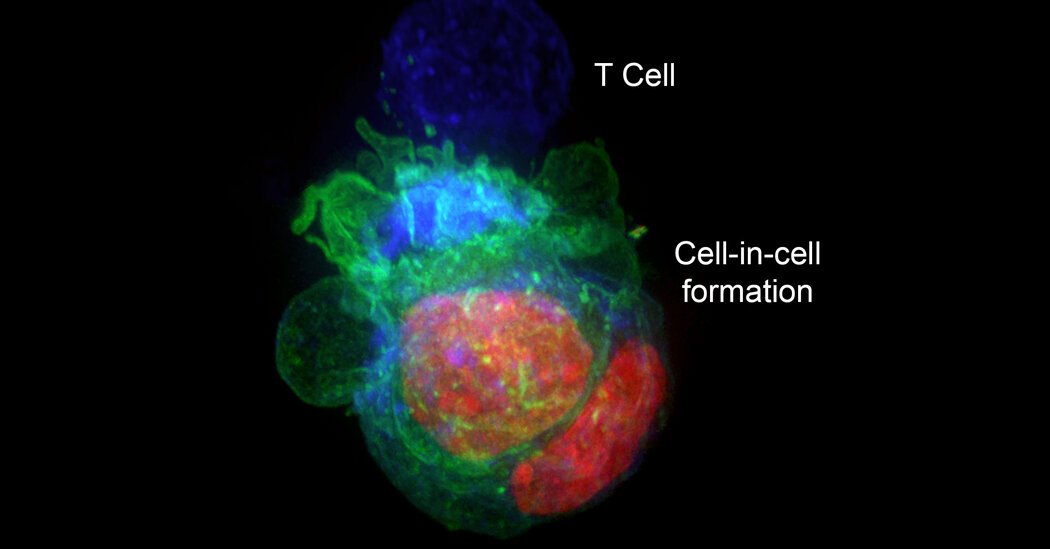
A researcher discovered that giant cells under a microscope were actually cancer cells hiding inside other cancer cells.In a surprise discovery, researchers found that cells from some types of cancers escaped destruction by the immune system by hiding inside other cancer cells.The finding, they suggested in an article published this month in the journal eLife, may explain why some cancers can be resistant to treatments that should have destroyed them.The research began when Yaron Carmi, an assistant professor at Tel Aviv University, and Amit Gutwillig, then a doctoral student studying in his lab, were studying which T cells of the immune system might be the most potent in killing cancers. They started with laboratory experiments that examined treatment-resistant melanoma and breast cancers in mice, studying why an attack by T cells that were engineered to destroy those tumors did not obliterate them.They were looking at checkpoint inhibitors, a particular type of cancer therapy. They involve removing proteins that ordinarily block T cells from attacking tumors and are used to treat a variety of cancers, including melanoma, colon cancer and lung cancer. But sometimes, after a tumor seems to have been vanquished by T cells, it bounces back.Dr. Carmi, who loves looking at cells under microscopes, started peering at the tumors while the T cells were attacking them. “I wanted to see the killing, the actual killing,” he said.Every time, though, he saw some giant cells that remained after the T cells had done their job. “I wasn’t sure what it was, so I thought I would take a closer look,” he said.The giant cells turned out to be cancer cells that were harboring other cancer cells, protecting them from destruction. Once the cancer cells escaped to their hiding places, T cells could not get to them, even if the immune system killed the cancer cells that were serving as cellular bunkers.“It was like seeing the devil,” Dr. Carmi said.Cancer cells, he added, can remain in hiding “for weeks or months.”When he removed the T cells from the petri dishes, the cancer cells came out of their shelters.A series of 3-D projections, top, and optical slices, bottom, across the height of tumor cells organized in cell-in-cell formation. The cells’ nuclei are color-coded in green and the cells’ membrane is red.Yaron Carmi and Amit Gutwilling, The Carmi Lab/Tel Aviv UniversityHe looked at human cells from breast cancers, colon cancers and melanomas and saw the same phenomenon. But blood cancers and glioblastomas, the deadly brain cancers, did not form the cell-in-cell structures.Perhaps, Dr. Carmi reasoned, it might be possible to prevent cancer cells from taking refuge. He decided to examine the genes involved in this defense mechanism. Blocking those genes, he discovered, also blocked the ability of T cells to attack the tumors.“I realized this is the limit of what the immune system can do,” Dr. Carmi said. “Our immune systems cannot win.”Others, while fascinated by the discovery, say many questions remain.“It’s definitely an interesting paper with some strong, compelling observations,” said Dr. Michel Sadelain, an immunologist at Memorial Sloan Kettering Cancer Center, where he heads the center’s gene transfer and gene expression laboratory. But, he asked, how relevant is the finding in disabling immunotherapies in the real world?Dr. Marcela Maus, the director of the cellular immunotherapy program at the Mass General Cancer Center, said the discovery showed what might be a new cancer cell defense mechanism.“We have seen that tumors can hide from the immune system, including a kind of ‘impersonating’ immune cells, but I don’t think we’ve ever seen that tumor cells hide inside each other.” But, she added, “I do think it needs to be replicated to gain full traction.”Dr. Jedd Wolchok, the director of the Sandra and Edward Meyer Cancer Center at Weill Cornell Medicine, had the same reaction.“I’ve heard about cancer cells feeding off themselves, feeding off their neighbors, putting out exosomes,” he said, referring to little pouches of signaling chemicals. “I guess this is the next step — hiding inside your neighbor.”One possible remedy, he said, might be to foil the cancer cells by treating a patient with immunotherapy for a short time, stopping, then treating again. That could be in keeping with new questions about how long patients should be treated with these expensive and toxic drugs. The current advice is to treat for two years. But, Dr. Wolchok said, “many of us are asking, Can you get away with less?”He cautioned, though, that the immunotherapy the Tel Aviv group had used was not a standard one in cancer patients.For now, Dr. Wolchok said, while the discovery is “a really innovative observation,” it remains to be seen whether it will lead to improvements in the treatment of cancer patients.

Read more →