Qatar scandal: Exclusive BBC interview on trauma of invasive medical examinations

A British grandmother says she is still in shock after being subjected to an invasive medical examination by Qatari officials on the tarmac of Doha’s Hamad International Airport in October 2020.The authorities were looking for the mother of a newborn baby which had been found in a plastic bag in a rubbish bin in the departures lounge.Speaking exclusively to the BBC, Mandy says that what happened to her and many other women that night felt like an assault and a violation for which they have received no apology.Now a group of five Australian women, including Anna (who did not want to use her real name), who were strip-searched and examined during the incident, are suing the authorities in Qatar and the national airline. They have filed legal action in the New South Wales Supreme Court in Sydney. The BBC understands the papers were served at Qatar Airways’ Australia head office in Melbourne on Thursday.Read more: Australian women sue over Qatar strip-searches

Read more →

Black Death 700 years ago affects your health now

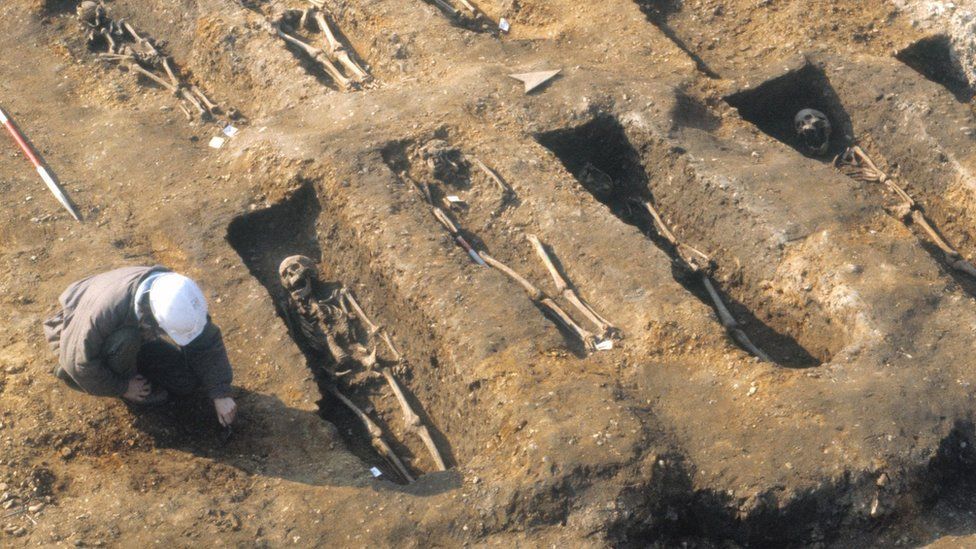
Published8 hours agoSharecloseShare pageCopy linkAbout sharingImage source, Museum of LondonBy James GallagherHealth and science correspondentThe devastation of the plague pandemic left such an incredible genetic mark on humanity that it’s still affecting our health nearly 700 years later.Up to half of people died when the Black Death swept through Europe in the mid-1300s.A pioneering study analysing the DNA of centuries-old skeletons found mutations that helped people survive the plague. But those same mutations are linked to auto-immune diseases afflicting people today. The Black Death is one of the most significant, deadliest and bleakest moments in human history. It is estimated that up to 200 million people died.Researchers suspected an event of such enormity must have shaped human evolution. They analysed DNA taken from the teeth of 206 ancient skeletons and were able to precisely date the human remains to before, during or after the Black Death. The analysis included bones from the East Smithfield plague pits which were used for mass burials in London with more samples coming from Denmark. Image source, McMaster UniversityThe standout finding, published in the journal Nature, surrounded mutations in a gene called ERAP2. If you had the right mutations you were 40% more likely to survive the plague. “That’s huge, it’s a huge effect, it’s a surprise to find something like that in the human genome,” Professor Luis Barreiro, from the University of Chicago, told me. The gene’s job is to make the proteins that chop up invading microbes and show the fragments to the immune system, priming it more effectively to recognise and neutralise the foe. The gene comes in different versions – those that work well and those that do nothing – and you get a copy from each parent. So the lucky ones, who were most likely to survive, inherited a high-functioning version from mum and dad. And the survivors had children and so passed those helpful mutations on so they suddenly became much more common. “It’s huge we see a 10% shift over two to three generations, it’s the strongest selection event in humans to date,” evolutionary geneticist Professor Hendrik Poinar, from McMaster University, told me.The results were confirmed in modern day experiments using the plague bacterium – Yersinia pestis. Samples of blood from people with the helpful mutations were more able to resist the infection than those without. “It’s like watching the Black Death unfold in a petri-dish – that’s eye-opening,” said Prof Poinar.Image source, University of ChicagoEven today those plague-resisting mutations are more common than they were before the Black Death. The problem is they have been linked to auto-immune diseases such as the inflammatory bowel disease Crohn’s – what helped keep your ancestors alive 700 years ago but could be damaging your health today. Other historic forces on our DNA have a legacy we feel. Around 1-4% of modern human DNA comes from our ancestors sleeping with Neanderthals and this inheritance affects our ability to respond to diseases including Covid. “So those scars from the past still impact our susceptibility to disease today, in a quite remarkable way,” said Prof Barreiro.Nobel Prize goes to Svante Paabo for Neanderthal workProf Barreiro said the 40% survival advantage was the “strongest selective fitness effect ever estimated in humans”. It seemingly dwarfs the benefit of HIV-resistance mutations or those that help digest milk – although he warns direct comparisons are tricky. The Covid pandemic will not leave a similar legacy though. Evolution works through your ability to reproduce and pass on your genes. Covid largely kills the elderly who have already passed the point of having children. It was plague’s ability to kill across the age spectrum and in such great numbers that meant it had such a lasting impact. Follow James on Twitter More on this storyPlague traced back to Bronze Age23 October 2015Black Death ‘spread by humans not rats’15 January 2018

Read more →

Virtual reality experiences to aid substance use disorder recovery

Indiana University researchers are combining psychological principles with innovative virtual reality technology to create a new immersive therapy for people with substance use disorders. They’ve recently received over $4.9 million from the National Institutes of Health and launched an IU-affiliated startup company to test and further develop the technology.
Led by Brandon Oberlin, an assistant professor of psychiatry at the IU School of Medicine, IU researchers have built a virtual environment using “future-self avatars” to help people recover from substance use disorders. These avatars are life-sized, fully animated and nearly photo realistic. People can converse with their avatars, who speak in their same voice using personal details in alternate futures.
“VR technology is clinically effective and increasingly common for treating a variety of mental health conditions, such as phobias, post-traumatic stress disorder and post-operative pain, but has yet to find wide use in substance use disorders intervention or recovery,” Oberlin said. “Capitalizing on VR’s ability to deliver an immersive experience showing otherwise-impossible scenarios, we created a way for people to interact with different versions of their future selves in the context of substance use and recovery.”
After four years of development and testing in collaboration with Indianapolis-based treatment centers, Oberlin and his colleagues’ pilot study was published Sept. 15 in Discover Mental Health. Their findings suggest that virtual reality simulation of imagined realities can aid substance use disorder recovery by lowering the risk of relapse rates and increasing participants’ future self-connectedness.
“This experience enables people in recovery to have a personalized virtual experience, in alternate futures resulting from the choices they made,” Oberlin said. “We believe this could be a revolutionary intervention for early substance use disorders recovery, with perhaps even further-reaching mental health applications.”
The technology is particularly well-suited for people in early recovery — a crucial time as there is a high risk for relapse — because the immersive experiences can help them choose long-term rewards over immediate gratification by deepening connections to their future selves, he said.

Read more →

In stressful jobs, depression risk rises with hours worked, study in new doctors finds

The more hours someone works each week in a stressful job, the more their risk of depression rises, a study in new doctors finds.
Working 90 or more hours a week was associated with changes in depression symptom scores three times larger than the change in depression symptoms among those working 40 to 45 hours a week.
What’s more, a higher percentage of those who worked a large number of hours had scores high enough to qualify for a diagnosis of moderate to severe depression — serious enough to warrant treatment — compared with those working fewer hours.
The research team, based at the University of Michigan, used advanced statistical methods to emulate a randomized clinical trial, accounting for many other factors in the doctors’ personal and professional lives.
They found a “dose response” effect between hours worked and depression symptoms, with an average symptom increase of 1.8 points on a standard scale for those working 40 to 45 hours, ranging up to 5.2 points for those working more than 90 hours. They conclude that, among all the stressors affecting physicians, working a large number of hours is a major contributor to depression.
Writing in the New England Journal of Medicine, the team from Michigan Medicine, U-M’s academic medical center, report their findings from studying 11 years’ worth of data on more than 17,000 first-year medical residents. The recently graduated doctors were in training at hundreds of hospitals across the United States.

Read more →

A 10,000-year-old infant burial provides insights into the use of baby carriers and family heirlooms in prehistory

If you’ve taken care of an infant, you know how important it is to find ways to multitask. And, when time is short and your to-do list is long, humans find ways to be resourceful — something caregivers have apparently been doing for a very, very long time.
The authors of a new article published in the Journal of Archaeological Method and Theory argue that they have found evidence of the use of baby carriers 10,000 years ago at the Arma Veirana site in Liguria, Italy. The research, led by Arizona State University’s Claudine Gravel-Miguel, PhD, also includes the University of Colorado Denver’s Jamie Hodgkins, PhD, an Associate Professor of Anthropology, and a co-principal investigator on the excavation of Arma Veirana.
Because material used to make the first baby carriers does not preserve well in the archaeological record and because prehistoric baby burials are very uncommon, evidence for prehistoric baby carriers is extremely rare. The site — which includes the oldest documented burial of a female infant in Europe, a 40- to 50-days-old baby, nicknamed Neve — has both. Researchers used innovative analytical methods to extract hard-to-obtain information about perforated shell beads found at the site.
The study used a high-definition 3D photogrammetry model of the burial combined with microscopic observations and microCT scan analyses of the beads to document in detail how the burial took place and how the beads were likely used by Neve and her community in life and in death.
The results of this research show that the beads were likely sewn onto a piece of leather or cloth that was used to wrap Neve for her burial. This decoration contained more than 70 small, pierced shell beads and four big, pierced shell pendants, the likes of which have yet to be found elsewhere. Most of the beads bear heavy signs of use that could not have been produced during Neve’s short life, demonstrating they were handed down to her as heirlooms.
“Given the effort that had been put into creating and reusing these ornaments over time, it is interesting that the community decided to part with these beads in the burial of such a young individual, said Gravel-Miguel. “Our research suggests that those beads and pendants likely adorned Neve’s carrier, which was buried with her.”
Relying on ethnographic observations of how baby carriers are adorned and used in some modern hunter-gatherer societies, this research suggests that Neve’s community may have decorated her carrier with beads in order to protect her against evil. However, it is possible that her death signaled that those beads had failed, and it would have been better to bury the carrier rather than reuse it.
“Infant burials are so rare, and this one had so many beads,” said Hodgkins. “Being able to look at the use wear and positioning of the ornaments around the infant to determine that these beads were handed down and the infant was wrapped in a way that matches the form of a baby carrier is truly a unique glimpse into the past, giving us a connection to this tragic event that happened so long ago.”
Story Source:
Materials provided by University of Colorado Denver. Note: Content may be edited for style and length.

Read more →

New data registry collects evidence in cardiogenic shock patients

Cardiogenic shock — a life threatening condition when a person’s heart can’t pump enough blood to meet the needs of the body — is most often caused by serious heart attack or advanced heart failure. Historically, data related to cardiogenic shock have been limited, inconsistent and challenging to interpret. As a result, varying treatment recommendations exist around best practices.
To address this need, the American Heart Association, the leading voluntary organization devoted to longer, healthier lives for all, created the Cardiogenic Shock Registry powered by Get With The Guidelines®. The new registry will help researchers, clinicians and regulators to better understand the clinical symptoms of shock types, treatment patterns and outcomes. The registry will provide a foundation for working toward improving the quality and consistency of care in patients in U.S. hospitals with cardiogenic shock symptoms.
“To understand how to improve care for cardiogenic shock patients, we first need a clearer view of the landscape of existing treatment practices for cardiogenic shock in U.S.-based acute care settings,” said Mitchell Krucoff, M.D., FAHA, volunteer expert for the American Heart Association and professor of medicine at Duke University, Durham, N.C.”No organization is better positioned to advance this critical public health question than the American Heart Association, with already established networks of sites entering data on heart failure, acute cardiac syndromes, cardiac arrest and COVID — all of which involve patients at risk of progressing to cardiogenic shock.”
The Cardiogenic Shock Registry builds on more than 20 years of quality improvement and registry experience rooted in the Association’s Get With The Guidelines® platform. Data from this no-cost registry will help inform the larger medical community on how best to treat cardiogenic shock.
The steering committee of the American Heart Association Cardiogenic Shock Registry provides guidance and expertise for establishing the registry and managing the data. The steering committee includes leading academic surgeons and cardiologists, representatives from founding funders, as well as representatives of the U.S. Food & Drug Administration and the U.S. Centers for Medicare & Medicaid Services.
The American Heart Association’s Cardiogenic Shock Registry is made possible through the generous financial support of founding supporters Abbott and Getinge.
“The new Cardiogenic Shock Registry will leverage the unparalleled reach of the American Heart Association in a unique collaboration between academic clinicians and researchers, federal agencies and funding supporters’ experts to provide high-quality evidence and promote best practices for the treatment of patients with cardiogenic shock,” said David Morrow, M.D., M.P.H., FAHA, volunteer expert for the American Heart Association and professor of medicine, Harvard Medical School, Boston.
Story Source:
Materials provided by American Heart Association. Note: Content may be edited for style and length.

Read more →

Climate change is making the Arba'een pilgrimage dangerously hot

Around 20 million Shia Muslims participate in Arba’een, one of the world’s largest religious gatherings. A new study projects climate change will make dangerous temperatures more common during Arba’een by the end of the 21st century, threatening participants with an increased risk of heat-related illness.
Pilgrims are exposed to the elements while traveling on foot to Karbala, Iraq, where they commemorate the martyrdom of Al-Hussain ibn Ali, the grandson of the Prophet Muhammad. On one popular route, pilgrims travel around 80 kilometers (~50 miles) from Najaf, Iraq, and typically reach Karbala within one to three days, butother routes can be as long as 500 kilometers (~311 miles).
Arba’een is scheduled according to the Islamic calendar, which is based on the lunar cycles, so it occurs 11 days earlier on our solar calendar each year, progressing through the seasons. Wintertime temperatures during Arba’een should remain tolerable, but when Arba’een occurs in the summer, heat stress is likely to reach dangerous levels by the end of the 21st century, according to the new study published in Geophysical Research Letters, AGU’s journal for high-impact, short-format reports with immediate implications spanning all Earth and space sciences.
The study’s authors, Yeon-Woo Choi and Elfatih Eltahir, used regional climate models to predict how future climate change could threaten the health of Arba’een pilgrims. Their models forecasted future wet-bulb temperature, the lowest temperature to which evaporating water can cool air based on the local air temperature and humidity. Wet-bulb temperatures exceeding 24 degrees Celsius (75 degrees Fahrenheit) become dangerous because sweat cannot sufficiently prevent the body from heating up.
In high greenhouse gas emission scenarios, the study predicts average summertime temperatures could cross this danger threshold between 2050-2060. The authors said increasing nighttime temperatures may also prove problematic as they prevent pilgrims from adequately recovering from exposure to the day’s heat.
As climate change increases the region’s temperatures, it could put additional strain on healthcare systems already challenged by heat waves. Daytime temperatures during this year’s pilgrimage, which began ahead of Arba’een’s start on 16 September, were a challenge. According to Aljazeera, some pilgrims fainted when temperatures reached 41 degrees Celsius (105.8 degrees Fahrenheit). The study suggests such extreme heat events will become more common if Iraqi summers continue to warm.
The study adds Arba’een to the list of religious mass gatherings that could be impacted by climate change. According to Ashraf Zakey, a climate scientist with the Egyptian Meteorological Authority who was not involved in the study, Muslims participating in the Hajj pilgrimage to Mecca also face heat strokes, heat stress, and heat cramps. Previous research from Eltahir’s lab suggests climate change could also put Hajj pilgrims at increased risk of heat-related illness.
Story Source:
Materials provided by American Geophysical Union. Note: Content may be edited for style and length.

Read more →

Third COVID-19 vaccine dose is highly effective in patients with cirrhosis

Cirrhosis of the liver is associated with decreased responsiveness to COVID-19 mRNA vaccines as evidenced by results after two doses. However, the results of a new study strongly support giving the recommended booster vaccinations to these patients. In this retrospective study of over 26,000 patients with cirrhosis, investigators found there was an 80% reduction in COVID-19 occurrence, 100% reduction in severe or critical COVID-19, and 100% reduction in COVID-19-related death. Their findings are reported in the Journal of Hepatology.
“Our group previously demonstrated that in patients with cirrhosis, the effectiveness associated with two doses of an mRNA vaccine was lower and slower compared to that seen in a healthy population,” explained lead investigator Binu V. John, MD, MPH, Division of Gastroenterology and Hepatology, Miami VA Medical System, and Division of Digestive Health and Liver Disease, Department of Medicine, University of Miami Miller School of Medicine, Miami, FL, USA. “Patients with cirrhosis are particularly vulnerable to the impact of COVID-19, presenting higher hospitalization and mortality rates compared to those without liver disease. These findings inspired us to focus on the next question: What is the additional benefit of booster doses in cirrhosis, and particularly against the delta and omicron variants.”
Investigators performed a retrospective cohort study of patients with cirrhosis who received two or three doses of doses of either the Pfizer BNT162b2 mRNA or Moderna mRNA-1273 vaccines at the Veterans Health Administration between December 18, 2020 and February 11, 2022, when the delta and omicron variants were active. Around 13,000 participants who received three doses of the vaccine were propensity-matched with 13,000 controls who had received two doses.
Patients who received three doses were evaluated for the development of COVID-19 and disease severity.
Results indicated that patients with cirrhosis should be encouraged to receive a third dose for effective protection because it appears to be highly effective against severe outcomes of COVID-19. The findings showed that the receipt of the third dose of either the BNT162b2 mRNA or the mRNA-1273 vaccines is associated with an 80% decrease in the development of COVID-19 and symptomatic COVID-19, and a 100% reduction in severe or critical COVID-19 and COVID-19 — related death, compared to participants with cirrhosis who received only 2 doses.
“This reduction associated with the third dose is significantly higher than that described in a healthy population and suggests that a third dose of the COVID-19 mRNA vaccine is able to overcome the vaccine hyporesponsiveness in cirrhosis,” noted Dr. John. “This study suggests that a third dose of an mRNA vaccine is able to offer significant protection against COVID-19, and particularly against severe disease. The vaccine was observed to be protective in both patients with compensated cirrhosis (where the liver function is relatively preserved and patients have no symptoms of liver disease), and decompensated cirrhosis (when liver disease is worse and associated with symptoms), but the magnitude of reduction was greater in patients with compensated cirrhosis. It adds to the growing body of evidence demonstrating the importance of COVID-19 vaccination in cirrhosis.”
The investigators noted that their findings were surprising. “We had anticipated that the third dose may offer greater protection compared to two doses. However, the magnitude of reduction was remarkable, and even greater than seen in the healthy population. Our results show that patients with cirrhosis should definitely receive the third vaccination dose, and potentially all boosters now recommended,” concluded Dr. John.
Cirrhosis of the liver is the impaired liver function caused by the formation of scar tissue known as fibrosis due to damage caused by liver disease. It is associated with decreased responsiveness to most vaccines, including against COVID-19.
Story Source:
Materials provided by Elsevier. Note: Content may be edited for style and length.

Read more →

Molecular structure of one of the most important receptors in the immune system unraveled

The surface of B cells is covered with antigen receptors with which they recognize invading pathogens such as bacteria and viruses. When a B cell receptor binds to an antigen, that is, to a foreign structure, the B cell is activated and triggers the production of antibodies. Antibodies are essential for our survival and protect us against severe diseases from infections with pathogens such as COVID-19. Vaccinations have a protective effect as they activate antigen receptors, thereby triggering an immune response. An international team of researchers from the Cluster of Excellence CIBSS of the University of Freiburg and Harvard Medical School, USA, has now published the exact molecular structure of an IgM-type B cell receptor. Their findings indicate that the receptor on the surface of the B cell interacts with further receptors, thus controlling its signal transduction. The study was published in the journal Nature.
Connection of Signaling Subunits with the Immunoglobulin
The B cell antigen receptor consists of an antibody bound to the cell membrane and two smaller proteins, Ig alpha and Ig beta. These smaller subunits pass on signals to the inside of the cell as soon as the B cell receptor identifies a pathogen. “Exactly how these signaling subunits are connected with the immunoglobulin was previously unknown,” says Prof. Dr. Michael Reth from the University of Freiburg’s Faculty of Biology, who has been conducting research on the receptor for over 30 years and originally discovered its signaling subunits. He is a member of the Cluster of Excellence CIBSS — Centre for Integrative Biological Signalling Studies and co-director of the Cluster of Excellence BIOSS. “For a long time, we did not have the technical possibilities to study the exact structure of membrane proteins. Now, cryo-electron microscopy has enabled us to create a high-resolution image of the B cell receptor,” says Reth.
With cryo-electron microscopy, the sample to be studied is cooled very rapidly to minus 183 °C. This reduces the natural movement of the molecules and prevents the formation of tiny ice crystals that otherwise would destroy the protein structure. In this way, it is possible to achieve resolutions that are many times higher than with other electron microscopic methods. In their current study, the researchers achieved a resolution of 3.3 ångströms, which corresponds to the width of just a few atoms. To do so, they combined hundreds of thousands of images of the entire receptor with those of a truncated version that lacked two flexible regions. They then used these data to calculate the complete three-dimensional structure of the B cell receptor on the computer.
Symmetrical membrane-bound antibody binds only on one side
The striking thing about the three-dimensional structure is that the symmetrical membrane-bound antibody only binds to Ig alpha and Ig beta on one side, thus forming an asymmetrical complex. This asymmetry resembles that of the T cell receptor, another important immune receptor whose structure was first elucidated in 2019. “It is astounding that both types of antigen receptor form asymmetrical complexes,” explains Reth. “This leads us to conclude that the structure now elucidated is part of a larger receptor complex and that it interacts with still other molecules on the B cell surface.”
Such larger structures, which are held together through less powerful forces, cannot yet be studied with techniques like cryo-electron microscopy. However, the newly published molecular structure provides further evidence in favor of such an interaction with other molecules: It shows that the outside of the B cell receptor contains conserved amino acids. Amino acids are described as conserved if they hardly change in the course of evolution and are therefore identical in the antigen receptors of different organisms. “The presence of conserved amino acids that are directed outward suggests that the IgM B cell receptor has further binding partners,” says Reth. “In other words, we only know part of the machine so far — and now we want to identify the other building blocks and determine how they influence the signaling effect of the receptor.”
These other building blocks could explain how the receptor is normally kept quiescent and is activated only when it binds to an antigen. “That will be one of the next important tasks in the study of adaptive immunity,” summarizes Reth. “A better understanding of B cell activation could also help us to further improve the development of vaccines or to understand the formation of lymphoma in which the B cell receptor is activated in an uncontrolled manner.”
Story Source:
Materials provided by University of Freiburg. Note: Content may be edited for style and length.

Read more →
Engineers record neurons to pinpoint synaptic links

It’s a mystery how human thoughts and dreams emerge from electrical pulses in the brain’s estimated 100 trillion synapses, and Rice University neuroengineer Chong Xie dreams of changing that by creating a system that can record all the electrical activity in a living brain.
In a recently published study in Nature Biomedical Engineering, Xie and colleagues described their latest achievement toward that goal, a 3D electrode array that allows them to map the locations and activity of up to 1 million potential synaptic links in a living brain based on recordings of the millisecond-scale evolution of electrical pulses in tens of thousands of neurons in a cubic millimeter of brain tissue.
“The thing that is novel about this work is the recording density,” said Xie, an associate professor of electrical and computer engineering at Rice and a core member of the Rice Neuroengineering Initiative. “Microcircuits in the brain are very mysterious. We don’t have many ways to map their activity, especially volumetrically. We want to deliver very dense recordings of the cortex because those are important, scientifically, for understanding how brain circuits work.”
Xie collaborated on the study with colleagues from Rice and the University of California, San Francisco, including Loren Frank of UCSF and co-corresponding author Lan Luan of Rice.
Neurons are small. Each cubic millimeter of brain tissue contains about 100,000. That density is roughly the same for humans and other mammals, including the rodents that are the subject of experiments in Xie’s lab. The processing power of the brain arises from synaptic connections between neurons. Synaptically linked neuron pairs are connected by narrow bridges of tissue called axons, which are just a few millionths of a meter in diameter.
Xie’s team has spent years developing a material called nanoelectronic thread (NET) that is thin, ultraflexible and biocompatible, a trifecta of properties for making minimally invasive electrode implants. In previous studies, Xie’s team has demonstrated techniques for emplanting tightly packed NET arrays of up to 128 electrodes. The researchers also showed their arrays could stay in place for up to 10 months, recording the pulsed spikes of electricity, or action potentials, in nearby neurons.

Read more →