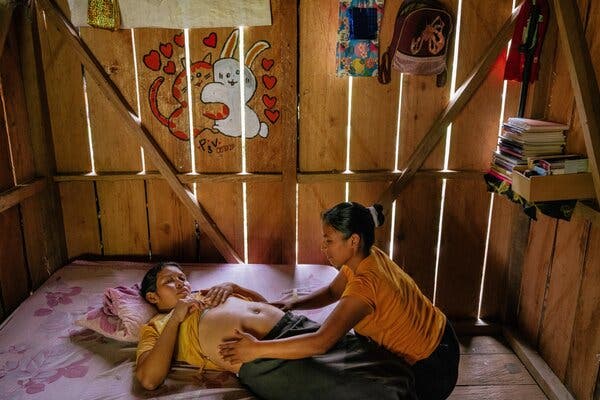
Listen to This ArticleAudio Recording by AudmThe roads surrounding the Jerusalén-San Luis Alto Picudito Indigenous reservation in Putumayo, Colombia, are treacherous on a good day. Made mostly of gravel and mud, they narrow to barely the width of a small truck in some places, and in others, especially after a storm, they yield almost completely to the many rivers with which they intersect. They also twist and turn and bump without stop. So, in the most difficult months of her pregnancy, when everything tasted like cardboard and it hurt even to sit or stand, Marleny Mesa avoided traveling altogether. This meant skipping checkups at the clinic in Villagarzón, which could take two hours or more to get to. But Marleny wasn’t overly worried. A nurse had assured her early in her pregnancy that her blood work was good and that everything looked fine. As a midwife herself, Marleny knew that making the trip would be riskier than missing a few doctor’s visits.But now, in the final days of her pregnancy, she could not shake the feeling that something was wrong. She could barely breathe, for one thing. For another, her anxiety and physical discomfort were approaching what felt like an unbearable peak. Her husband, Andrés Noscue, called for an ambulance. Hours passed, and none came. He’d tried to find a car to take her to the hospital. He’d also summoned Marleny’s sister Omaira, a prophet of their church, to come pray over her belly. That seemed to do the trick. Marleny’s breathing evened out, and a week or so later, she delivered a tiny, squirming boy with jet black hair and soft, curious eyes. The couple named him Eliad.Marleny thought he was perfect, but her mother, a retired midwife, insisted that the placenta contained a hint of trouble. It was far too big, she said, and Eliad was too small, probably because he did not have enough room in her womb to grow. His grandmother thought he might need an incubator. Marleny thought he was fine, but when the baby was a few days old, she and Andrés took him to Villagarzón for a checkup, just to be safe.This proved harder than they expected. The baby could not be seen at the hospital there until he had a civil identification or registration number, which he could not get without a birth certificate, which the hospital could not provide because the baby was born at home. Go to the registrar’s office, the nurses told Marleny and Andrés. But the registrar’s office only sent Andrés back to the hospital, where a different nurse told them to try the notary’s office instead. By then it was almost noon. The only bus of the day would be heading back to San Luis soon; if Andrés and his family missed it, they would have to cough up more money for room and board in town than they normally spent in a week. So they went home.The couple returned a few days later, but the registrar’s instructions were different and more complicated this time. They would need two witnesses from their reservation, he said, and several documents — including one with the baby’s blood type and another showing the medical care Marleny received during her pregnancy — in order to prove that he was born inside the nation’s borders and that he was, in fact, their child. The man seemed suspicious, Andrés said, and asked many questions that he did not ask the first time. “There was nothing we could do,” Andrés told me one sweltering July afternoon as we sat in the shade of his family’s covered wooden porch. “They didn’t believe the child was ours, so we went home again.” The couple planned to return to Villagarzón as soon as they were able to stay overnight, so they could sort everything out once and for all. But before they got the chance, Eliad developed a terrifying rash — with blisters on his head and face — and began gasping for breMarleny Mesa, a 34-year-old midwife, performing a checkup last July at a patient’s home in Putumayo, a department of Colombia. Midwives successfully petitioned to be allowed to issue birth certificates to the newborns they help birth.Juan Arredondo for The New York TimesThe family returned to Villagarzón for the third time. Marleny waited at the hospital while Andrés went to the notary. This time he was in luck: A clerk there put him in touch with Leydi Rodríguez, a community health worker who works with a program known as Colombia Rural Vital, one of several initiatives begun by the nonprofits Vital Strategies and Bloomberg Philanthropies as part of a broader effort to improve birth-and-death registries around the world. By the organizations’ estimate, some two billion people do not have birth certificates, and only half of the 60 million or so deaths that occur each year are recorded in any meaningful way. The consequences of this failure are manifold and frequently dire: Families like the Noscues struggle to access the rights and benefits of citizenship. Government officials struggle to allocate resources and formulate evidence-based health policies. And a roster of identity-based crimes — from election chicanery to child trafficking — are allowed to proliferate.The problem of inadequate registries is most pressing in the low-income nations of Africa and Southeast Asia. But it is not confined to those regions. In Colombia, birth and death registration is especially spotty in Indigenous and Afro-descendant communities, where the national government tends to have little presence and registrars and notaries tend to apply the rules arbitrarily. Colombia Rural Vital was created to simplify and democratize this process.Rodríguez, a petite woman in her mid-30s who exudes an earnest pluck, rushed to the notary’s office soon after the clerk called her. She asked Andrés a series of questions about Eliad, entered his answers into an app on her tablet and certified the baby’s birth and parentage, all in less than an hour. Andrés would need to complete a few more forms, she explained, but Eliad had a birth certificate now and could see the doctor right away. Andrés took the certificate to the hospital. The news there was far less comforting. Eliad had a serious bladder infection and several possible birth defects. The child was very sick, the doctor told them. The couple should have brought him in sooner.The world’s wealthiest nations are awash in so much personal data that data theft has become a lucrative business and its protection a common concern. From such a vantage point, it can be difficult to even fathom the opposite — a lack of any identifying information at all — let alone grapple with its implications. But the undercounting of human lives is pervasive, data scientists say. The resulting ills are numerous and consequential, and recent history is littered with missed opportunities to solve the problem.More than two decades ago, 147 nations rallied around the Millennium Development Goals, the United Nations’ bold new plan for halving extreme poverty, curbing childhood mortality and conquering infectious diseases like malaria and H.I.V. The health goals became the subject of countless international summits and steady news coverage, ultimately spurring billions of dollars in investment from the world’s wealthiest nations, including the United States. But a fierce debate quickly ensued. Critics said that health officials at the United Nations and elsewhere had almost no idea what the baseline conditions were in many of the countries they were trying to help. They could not say whether maternal mortality was increasing or decreasing, or how many people were being infected with malaria, or how fast tuberculosis was spreading. In a 2004 paper, the World Health Organization’s former director of evidence, Chris Murray, and other researchers described the agency’s estimates as “serial guessing.” Without that baseline data, progress toward any given goal — to halve hunger, for example — could not be measured.There were many barriers to obtaining those baselines, but the underlying problem was clear. Because many low- and-middle-income nations did not have functioning systems for civil registries and vital statistics, about one-third of all births and a vast majority of deaths were not being counted in the first place. Rather than develop those systems, health officials had come to rely on a mess of surveys, censuses and computer models that provided only crude estimates of specific illnesses. Effective birth and death registries would help paint a far more accurate picture, critics argued. But the surveys and censuses were faster and cheaper, and with a roster of disease-specific programs now competing for resources, whole-system reforms took a back seat.“It’s a bit of a Catch-22,” says Prabhat Jha, a professor of global health at the University of Toronto. “When you don’t have good data, you turn to clever mathematical models. They can be really quite wrong at the country level, but global funders and politicians think, ‘Oh, we’ve got data,’” which then undermines the case for investing in more robust fixes.Dr. Kevin Carvajal helping deliver a boy via C-section at the hospital in Mocoa last summer. He would later enter the boy’s vital measurements and his parents’ information into Colombia’s national registry so a birth certificate could be issued.Juan Arredondo for The New York TimesIn 2015, the United Nations set out to correct this problem, with yet another bold initiative — this one aimed at ensuring that all births and at least 80 percent of deaths would be routinely registered by 2030. But more than seven years in, that effort is falling far short of its goals. “It’s probably the single most critical failure of development in the past 30 years,” says Philip Setel, a medical and demographic anthropologist who directs the civil-registration initiative at Vital Strategies. “Not only because of how pervasive or underappreciated the problem is, but because of how broad its impacts are.” Bangladeshi widows can’t secure land rights or survivor benefits without the means to register their spouses’ deaths. Rwandan street children can’t attend school or access the legal economy because they lack valid birth certificates. And young girls across Southeast Asia can’t extract themselves from forced marriages without a way to prove their own ages or identities. “It’s disastrous,” says Stephen MacFeely, director of data and analytics at the World Health Organization. “Especially when you consider this is a really basic, fundamental metric. These are the two bookends of life, and we still don’t have a good handle on either.”The pandemic made these shortfalls difficult to ignore. From the earliest days of the first outbreaks, as scientists struggled to grasp how deadly the coronavirus actually was or to guess how long any given wave might last, elected officials and their constituents found themselves transfixed by maps and graphs and striking exponential growth curves. But if those emblems of the crisis created a feeling of understanding and control, the facts remained elusive. As with the Millennium Development Goals, at least part of the problem came down to a question of baselines. “You can’t contact-trace people that you don’t know exist in the first place,” MacFeely says. “You can’t allocate vaccines properly, or tell how severe a given variant is, if you don’t know how many people it’s killing.”Three years into the pandemic, Covid’s true death toll remains impossible to determine. In May 2022, the World Health Organization concluded that it was likely 2.5 times as high as previously reported: 15 million, as opposed to six million. By then, scientists were estimating that India’s death toll from Covid was probably six times as high as officials there initially said. A 2021 report in the journal eLife also noted large gaps between the figures government officials gave and what impartial analysis suggested — in Belarus, Egypt, Nicaragua, Russia, Tajikistan, Uzbekistan and elsewhere. Some of that undercounting was deliberate and political; the lower the death toll in a territory, the better any given leader’s pandemic response looks. But not all of it was. Death counts have remained low throughout sub-Saharan Africa for most of the pandemic. But death registries are especially weak in that part of the world, and scientists say it remains unclear whether those countries were truly spared or if hundreds of thousands of Covid deaths were simply never reported. “I think eventually we’ll find out,” says Chris Murray, now the director of the Institute for Health Metrics and Evaluation at the University of Washington School of Medicine. “But it is remarkable how much uncertainty there is on a subject that’s actually quite important.”It’s clear, meanwhile, that when it comes to fortifying our data systems, time is not on our side. As the pandemic wanes, a number of other pathogens — mpox, measles, influenza — are wreaking fresh havoc. With the planet warming, scientists say that we may soon find ourselves confronting several pandemics at once. “The only way to protect ourselves from these assaults will be to protect everyone else,” says Tom Inglesby, director of the Johns Hopkins Center for Health Security. “Especially those who are most vulnerable or least able to protect themselves.” The first step to doing that — to understanding who they are, how they live and what they are most likely to die of — will be to count them.Marleny comes from a long line of midwives and had already borne four children herself, but she could not remember ever taking an infant to a hospital. She was bewildered when the doctors in Villagarzón told her that Eliad needed to be transferred to a bigger facility in Puerto Asís, a city two hours in the opposite direction. And she became angry when the nurses in Puerto Asís took the baby from her arms and, without preamble, whisked him off to intensive care. How could it help to separate a newborn from his mother? Why could she not go to the I.C.U. with him? One nurse suggested that she return to her reservation because the baby would be there for a while. Another told her that she could come back during visiting hours to nurse him if she wanted.The following morning, she says, she found Eliad in the I.C.U., cold and wet, covered in vomit and turning purple. He was wailing. Marleny wanted to take him home immediately. If he was going to die, she thought, better it be there, where she could care for him herself. Eventually a doctor explained to Marleny why the baby had to stay: He needed an incubator and antibiotics and at least a few weeks to heal.Rosalia Lopez, a 66-year-old midwife, taking the blood pressure of a 16-year-old patient as part of a monthly prenatal visit near Riosucio, a rural town in the Chocó department.Juan Arredondo for The New York TimesThe couple spent those weeks in Puerto Asís, staying with relatives and using the bulk of their savings to cover personal expenses as well as the hospital fees for diapers and other supplies. Marleny, who was allowed to see her baby only during visiting hours, could not help thinking he might have been spared all this suffering if the doctors in Villagarzón had not turned him away in his first few weeks of life.The Noscue family’s experience did not surprise Edna Margarita Valle, the lead coordinator at Colombia’s national statistics department, DANE. Valle is based in Bogotá but spends the better part of her year visiting communities that can be reached only by river or airplane. She has met people in their 60s and 70s who have never had any legal identity. She has also encountered scores of families whose experiences mirror those of the Noscues. When I visited her office in July, she showed me one video in which a family in La Guajira — across the country from San Luis — described traveling four hours by motorcycle with their newborn in tow, only to be sent away by the registrar. “It’s the norm,” she said. “The registrars have been working in these places forever, and they treat it like their own store or their own private business. Families are often forced to pay for their birth certificates, a document that is really a basic human right.”National civil registries are relatively new in Colombia. For much of the country’s long history, births and deaths were logged primarily by the Catholic Church, and the best way to obtain a birth certificate was to have a baby baptized. But in the early 1990s, a new constitution strengthened the separation of church and state; a law guaranteeing health care to all citizens created new incentives for parents to register their children with the national government; and a new agency began collecting that data and producing statistics from it. But if those advances improved the government’s ability to count and analyze its population, they also created a yawning disparity between wealthy urban centers, like Bogotá and Medellín, and the impoverished rural regions that claim most of the nation’s physical space.A member of the archive team at the José María Hernández hospital in Mocoa, Colombia, sorting through decades-old medical files to filter out those of deceased patients.Juan Arredondo for The New York Times“Nationally, we have about 85 to 90 percent coverage now,” Víctor Hugo Álvarez Castaño, former director of epidemiology at Colombia’s Ministry of Health, told me. “But that last 15 percent makes up the poorest, most disenfranchised segment of the population. You’re talking about five or six million people. And because they aren’t registered, it’s as if they don’t exist.” As a result, health officials still struggle to identify and respond to health crises in those communities. In the Sierra Nevada de Santa Marta in northern Colombia, a recent whooping-cough outbreak was allowed to fester for weeks. In La Guajira, public-health agencies are still trying to map a childhood malnutrition crisis that the Inter-American Court of Human Rights found amounted to a human rights violation on the part of the Colombian government. And in Putumayo, where many births and deaths still happen far from hospitals and clinics, families like the Noscues are routinely thwarted by bureaucracies that they can neither grasp nor navigate.In principle at least, Colombia Rural Vital’s approach to this problem is simple. When a baby is born, or someone dies outside a hospital, the people connected to that event — family members, funeral directors, community leaders — send a text message to a toll-free number. The text is routed through a telephone and computer network that enables health workers like Leydi Rodríguez to see it. An investigation is begun, the vital event is verified and a birth or death certificate is issued.But if those steps are clear, so are the hurdles. Individuals and institutions must still be persuaded to report their births and deaths in this way. And because many villages don’t have reliable cellphone service, it’s tough to say what portion of sent texts reach the platform. The program is operational in just 25 of the nation’s 317 highly rural municipalities. Proponents are eager to see it expand, but in the wake of Covid, with the economy convulsed and resources thin, expansion has been difficult. Most rural hospitals don’t have the resources to hire and train sufficient staff members, and at those that do, officials don’t always see the point. Only seven of the 13 municipalities in Putumayo, where the Noscues live, have bothered to join the pilot project. “We are waiting for the strategy to become a law so that the municipalities are obliged to have at least one person who is fully trained and devoted to this work,” Franqui Moreno, a doctor in the epidemiology department of Putumayo, told me.Sonyer Alejandra Salas Guillén reviewing the birth certificate for her newborn son, Ithan Mathias Morales Salas, in Mocoa last August.Juan Arredondo for The New York TimesIn the meantime, he said, success hinges almost entirely on the tenacity of community health workers like Rodríguez, who are underpaid and tend to work on contracts that are subject to cancellation by municipal leaders. Despite those difficulties, Rodríguez, and others like her, often do triple duty: promoting the program to the communities they work in (a task they refer to as “socializing the program”), following up on the reports that make it to the platform and employing their own on-the-ground strategies to capture the births and deaths that are still slipping through the cracks. The work can be both tedious and risky. Armed groups control many of the territories Rodríguez frequents, and the motorbike she relies on to get her from one outlying village to the next is old and prone to breakdowns. Still, she loves her job. “We are uncounted, too,” she told me as we drove through Putumayo in mid-July. “We know what it is to be overlooked by our government, and it’s our job to stop that from happening to others.”Counting initiatives can be a tough sell. Uncovering problems like preventable illnesses or poor nutrition can increase the pressure on officials to address them. And overcoming individual apathy can be difficult in places where the benefits of citizenship (education, health care, social services) are paltry and the barriers to civil registration are high. In many low- and-middle-income countries, a substantial portion of births and deaths still occur away from institutional eyes. Families who want to register those events must not only gather documents (a tall order for people who cannot read or write) but also summon witnesses and often make arduous journeys to the nearest registrar.A key to resolving these difficulties, says Anushka Mangharam, a former technical adviser for Vital Strategies, is to take the registrar to the people. That’s an easy enough proposition when it comes to births: Parents who want health care or education for their children have obvious incentives to welcome such intrusions. But when it comes to death, the benefits can be harder to discern. And revisiting a painful loss often exacts a heavy emotional toll.To encourage people to register the deaths of loved ones, health workers use a technique called verbal autopsy, which is exactly what its name suggests: a standardized interview with the family of the deceased, in which a set series of questions is posed and the answers entered into an app on a tablet or cellphone. That information is then analyzed by algorithms and health officials to determine the most likely cause of death. Critics say that the algorithms are far from perfect and that it’s especially difficult to distinguish among conditions with similar symptoms, like lung cancer and respiratory infections. But proponents say that even with those shortcomings, verbal autopsies can still give health officials a much clearer picture of where and how people are dying.Dora Burbano, right, a nurse at Orito General Hospital who tracked and verified deaths for Colombia Rural Vital, and her assistant Marlen Patino, left, conducting a verbal autopsy with Aura Carmelina Nastacuas, whose mother died at her home in the Awá Indigenous community of Agua Blanca in Putumayo.Juan Arredondo for The New York TimesFor one thing, they enable health workers to count more deaths. For another, they help standardize a process that often gets short shrift. In many parts of the world, doctors aren’t adequately trained to assess the cause of death or to accurately fill out death certificates. In communities with significant shortages of trained health professionals, these forms are often completed by people with no medical experience at all. Verbal autopsies make it possible for those with even minimal training to collect the necessary information. Early trials of the approach have been eye-opening: In Sierra Leone, maternal mortality was found to be much lower than expected. In Bangladesh, drowning was found to be a leading cause of death among children, and construction-site accidents were a more common killer of adults than previously realized. In India, the Million Death Study — a seminal trial of verbal autopsies, designed by Jha and conducted in 1.3 million households beginning in 2001 — upended the nation’s understanding of sickness and death: Malaria was far more common among adults than anticipated, H.I.V. was rarer and snake bites were claiming tens of thousands more lives than officials had assumed.In Colombia, health officials have been promoting verbal autopsy as a means of shoring up death registration in rural regions like Putumayo. In my second week there, I traveled to Orito, another rural municipality just 100 miles or so from where the Noscues live, to observe these efforts up close.I was planning to spend the day with Dora Burbano, then a nurse at Orito General Hospital who tracked and verified deaths for Colombia Rural Vital (the Vital Strategies program). A new armed group, which seemed to be an offshoot of the Revolutionary Armed Forces of Colombia (FARC), had just blanketed the city with fliers claiming possession of the territory and issuing several new restrictions, including a 5 p.m. curfew. As we discussed whether to modify those plans, we received news that a funeral director the team worked with had been shot and killed that morning. The circumstances of his death were unclear. The only thing anyone could say for certain was that he had been stopped at a checkpoint on his way to one of the remote villages. But Burbano’s employers decided that it was too risky for health workers to travel. The verbal autopsies would have to be done at the hospital, or at some halfway point.Burbano — a 44-year-old single mother of two who grew up in Orito and followed in her mother’s footsteps by becoming a nurse at the local hospital — remained calm in the face of these developments. As a young girl, she watched as her own mother was summoned by armed men to tend to their wounded and, on at least one occasion, to prepare a corpse for burial. In the year or so since Colombia Rural Vital introduced its initiative in Orito, she had become a medical detective of sorts, traveling from village to village, cultivating sources and ferreting out unreported deaths. At the time of my visit, she was keeping tabs on several that had yet to be certified. They included a 14-year-old girl who either hanged herself or was killed by her father and then hanged to make it look like a suicide; a man who was crushed to death by a falling tree; and several grandparents whose existence may never have been registered in any way but whose deaths now needed to be counted.Dr. Maricel Tovar inspecting the body of an 82-year-old woman who died in her sleep in Suba last August and was found by her grandson. Tovar later conducted a verbal autopsy with family members.Juan Arredondo for The New York TimesOur first case that morning involved a man named Rodolfo whose wife and daughter had recently died. His wife’s death had been registered (it occurred in the hospital), but his daughter’s had not (because she died at home). Rodolfo was obstinate when Burbano first contacted him. He saw no reason to discuss such a painful event with strangers, he said. He would rather his family be left in peace. But Burbano met his resistance with so much empathy and calm persistence that when the plan changed and he was asked to travel to the hospital rather than receive her at his home, he went willingly.Now he was seated across from her in an empty conference room. He stared into the middle distance as she explained the verbal-autopsy process and then began with her questions.Did the baby have sudden convulsive seizures? No, he replied.Did she lose consciousness, have a stiff neck or get a faraway look? No.Did she have any rash on her body? No,Did her stomach seem bigger than normal, here, as if it was swollen? No.By now, Rodolfo’s eyes were tearing. He shifted in his seat and began tapping his left heel rapidly enough to make both knees shake. He seemed poised to stand up and leave. Burbano had learned from experience when to offer condolences — when to pat a shoulder or take a hand — and when to give a wider berth. She paused now, tilted her head slightly and regarded her client with solemnity and warmth. When his knees stopped shaking and he was able to meet her gaze, she resumed her questioning. Fifteen or so minutes later, they were finished.The intensive-care unit in Puerto Asís was like a netherworld between life and death. Eliad spent several weeks there before his bladder infection cleared. The doctors said he would need to see several specialists. But it would take weeks to schedule those appointments, so in the meantime his parents were free to take him home.The Noscue home — a spacious but only partially enclosed wooden structure — lacked the hospital’s amenities. Electricity was too erratic to power a refrigerator. The rains and the humidity brought a dampness that was often impossible to escape. But to Marleny’s mind, the things that home could provide more than compensated for those deficits: quiet so the baby could rest, the constant presence of loved ones and an abundance of plants that would enable her to treat at least some of her son’s ailments herself.Andrés wanted to make several improvements to the house, but those plans were delayed, owing partly to the low price of pineapples. He farmed them, and the market was saturated. Like most families on the reservation — and some 40 percent of families in the country — the Noscues hovered near the World Bank’s poverty line of $8.60 per day for a family of four. In Putumayo, the surest way to rise above that line was to switch from pineapples to coca. The Colombian and United States governments have spent decades trying to disrupt that calculus. Their interventions include aerial fumigation campaigns, the creation of a palm-oil industry and a steady persecution of farmers like the Noscues. But a majority of the world’s cocaine still comes from Colombia, and Putumayo remains one of the nation’s leading producers.The 2016 peace accord between FARC and the Colombian government was supposed to curb the appeal of coca growing, in part by bringing the trappings of government — not just roads and clinics, but plumbing and electricity, schools and shops, economic opportunities — to departments like Putumayo. But progress has been glacial, and armed groups still hold far greater sway over many communities than the national government. Colombia is one of the most unequal nations in Latin America, a fact that neither the cease-fire nor the economic gains of recent decades have done much to alter. And as a result of the pandemic, Indigenous groups — like the Nasa people to which Marleny and Andrés belong — have only fallen further behind.Midwives preparing to board a boat to access communities on the Atrato River, near Riosucio. Midwives in Colombia can register births in the national database, a crucial service for people in remote regions, where clinics are few and far between and civil registrars often nonexistent.Juan Arredondo for The New York TimesNowhere are the disparities more apparent than in health care. Technically, it has long been available to all, thanks to the universal health care law passed when Andrés and Marleny were children. But in practice, the barriers to access are often insurmountable: a lack of reliable transportation; clinics that are understaffed and often difficult to reach; doctors and nurses who can be hostile to the Black and Indigenous communities they serve; and a bureaucratic thicket of referrals and authorizations that exacerbates all those things. Eliad spent nearly a month in intensive care in Puerto Asís, but it was not until his follow-up appointments — at three different hospitals in three different cities — that the nature and extent of his condition became clear.Pasto was the most difficult of those cities to get to. The family had to travel from San Luis to Villagarzón, stay overnight and then take a six-hour bus ride to Pasto early the next morning. The distance between Villagarzón and Pasto is less than 100 miles, but a stretch of road linking the two cities is widely regarded as the worst in all of Colombia. Known as “the trampoline of death” and said to be teeming with ghosts, it snakes along hairpin-thin mountain ridges that give way to 100-foot drops on one side and steep mudslide-prone cliffs on the other. Marleny was already uncomfortable, having recently injured her hip in a fall, but Eliad was not a fussy baby; he slept peacefully in Andrés’s arms for most of the ride. The doctor in Pasto was kind. She saw Eliad right away and made careful study of the notes Marleny brought from the other hospitals. But she was also firm. The baby had several serious birth defects, including a heart murmur for which he would need surgery and pulmonary stenosis, which meant that a valve connecting his heart to his lungs was narrowing as he grew. He would have to grow a little more before any operations could be performed, and in the meantime Marleny and Andrés would have to be vigilant about doctors’ appointments and follow-up care. They would also have to keep their hopes in check: Some children like their son recovered with surgery and survived to adulthood, but many did not.Back home, Eliad gave no sign that he sensed these long odds. He suckled readily, smiled and cooed, charmed his mother. Marleny took scores of pictures and videos of him on her cellphone, hushing Andrés whenever he reminded her to conserve battery power for emergencies. Their son was feisty and spirited, she thought. And he seemed to be getting stronger. As they waited for him to grow into his first operation, she could not help but nurture a small blossom of hope.For decades, the burden of fixing birth and death registries — of counting the uncounted — has rested mostly on health officials. When MacFeely joined the World Health Organization in 2021, he was surprised to discover how intractable the problem seemed. “I wrote a blog post about it, and people were reaching out saying, ‘Oh, we made the same arguments 30 years ago,’” he told me recently. “I’m like, how the hell is this still a problem in this day and age?” But in the years since, he has come to see the challenge of accurate birth and death counts as much bigger than the health ministries charged with addressing them. It’s not just that health officials don’t control the registries or the purse strings. It’s that the registries implicate, and are implicated in, every aspect of the state: public health, local governance, basic human rights. MacFeely has come to think of the issue as a tragedy of the commons. Birth and death counts are like the environment or the ocean, he says: Because nobody quite owns them, no one takes responsibility for fixing them.Progress is nonetheless being made. In Rwanda, officials have amended laws to make registration easier and have vastly expanded the number of registration offices throughout the country. In Bangladesh, the national government has created a cabinet-level office devoted to building a modern civil registration and vital statistics program. And in Colombia, a new central computerized system will soon make it far easier to churn vital event data into the kind of statistics that can be used to guide health policy. Verbal-autopsy initiatives are taking root and mobile technology is being employed in all those countries and elsewhere. “It’s not a pipe dream anymore to say that we can count all births and deaths everywhere,” says Setel, the Vital Strategies anthropologist. “We have the technology to do that. It doesn’t even necessarily need to be superexpensive.”Luisa Jiménez on the phone with her husband before the burial of their 3-day-old son, Ángel Haziel Tenorio Jiménez, in Villagarzón last summer.Juan Arredondo for The New York TimesBut for the scores of individual pilot programs that are emerging now to morph into strong national institutions, leaders in every sphere of government will have to step up. “We have to stop thinking of this as a health problem and start looking at it as a whole-of-government issue,” MacFeely says. Health ministries will not be enough. Heads of state will have to get involved, and they will have to do more than just establish or strengthen registries. They will have to scale up social services in ways that pay more than lip service to the marginalized. Citizenship is only as valuable as the rights and protections it provides. And the problem of birth and death registration is inextricably bound to the problem of social-safety nets.In this regard, the Noscues’ story offers a parable of sorts: In principle at least, every Colombian citizen has access to the nation’s health care system. But without reliable roads or accessible clinics, Marleny was forced to carry and deliver her baby without the benefits of that resource. As a result, her enlarged placenta went undiagnosed, and her baby was caught in a vicious cycle: born at home because his parents could not access the health care system, and then unable to access the health care system because he was born at home.As they waited to see how he would fare, Eliad’s family did all they could to spoil him. Whenever he woke from a nap or began cooing, they would stop what they were doing and flock to him. Andrés encouraged Marleny to set aside her other responsibilities and spend every moment she could with the baby — partly to make sure he was OK, but also to savor him as much as possible.So when he began spitting up excessively one Friday, nearly two weeks after their visit to Pasto, his parents noticed immediately. He didn’t have a fever or other symptoms, but he could not seem to keep anything down. Marleny gathered plants and prepared an anti-nausea brew, which appeared to settle his stomach. But the couple agreed that if the sickness returned, they would take him to the hospital.The weekend passed, and Eliad once again seemed to push through his difficulties. By Saturday he was cooing and smiling again — well enough to join the family at church that evening. But on Sunday, when Marleny woke, he was short of breath. “We should leave,” she said, waking Andrés. It was still dark out. The bus would not come for hours. Andrés called for an ambulance, without much hope, and then went out to look for transportation while Marleny alternated between readying Eliad for the hospital and trying to soothe him as best she could. She yelled for her father to bring a blanket (“One does not know what to do in that desperation,” she told me later). But before she could wrap him up, the baby fell asleep. And then, after a few short breaths, his heart stopped beating.Marleny Mesa and her husband, Andrés Noscue, taking part in a verbal autopsy with members of the Colombia Rural Vital team a few weeks after their son Eliad Noscue Mesa died.Juan Arredondo for The New York TimesHis funeral was a blur. Marleny remembers only that the viewing and Mass took a full day and that their church honored him with a formal street procession en route to the graveyard. She remembers leaving home with the baby in her arms and returning several hours later, completely empty.Weeks later, when spring had yielded to summer and she and Andrés were settled deep into their grief, Rodríguez, the health worker, and several nurses visited the family to perform a verbal autopsy and provide a death certificate. They spent a full hour questioning Marleny and Andrés about Eliad’s illness and the circumstances of his death. The information they collected would be fed into a computer and sent to a national repository, where it would join a mountain of similar data. That data would be churned into statistics on who was dying in Colombia and how, and eventually those statistics would be used to shape policies and guide resources. But nothing in that long process would alter the basic facts: Eliad Noscue Mesa lived for 87 days and died in the same house where he was born. His life was infinitesimally short and packed with far more than its share of suffering. But he had still known joy. He had known his family’s love, and his time here had mattered to them.Marleny and Andrés took some comfort in knowing that, at the very least, his life had now been counted.Juan Arredondo is a photographer whose work focuses on social inequality and human-rights issues.
Read more →