Second Patient to Receive a Genetically Modified Pig Kidney Has Died
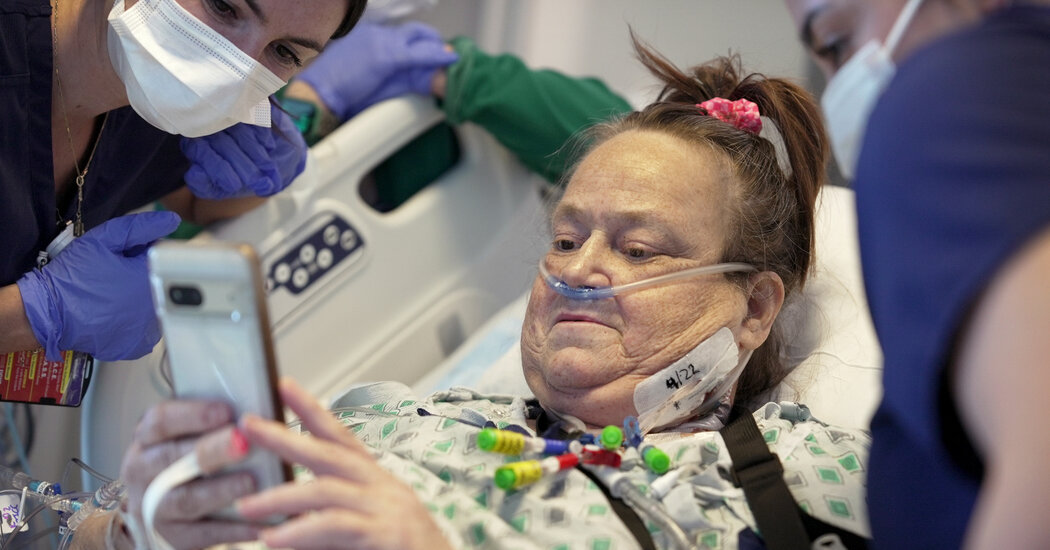
Lisa Pisano, 54, lived with the organ for 47 days. She was the first patient to receive both a heart pump and an organ transplant, doctors said.A 54-year-old New Jersey woman who was the second person to receive a kidney transplanted from a genetically modified pig, and who lived with the organ for 47 days, died on Sunday, surgeons at NYU Langone Health announced on Tuesday.The patient, Lisa Pisano, was critically ill, suffering from both kidney failure and heart failure. She received the pig kidney on April 12, just eight days after implantation of a mechanical heart pump.Surgeons were forced to remove the kidney on May 29 after it was damaged by inadequate blood flow related to the heart pump. After the explantation, Ms. Pisano resumed kidney dialysis but eventually was transitioned to hospice care.Ms. Pisano made medical history as the first person with a heart pump who is known to have also received an organ transplant. Patients with kidney failure are usually ineligible to receive a heart pump because of the high risk of dying.Dr. Robert Montgomery, the director of the NYU Langone Transplant Institute, said Ms. Pisano had contributed greatly to the budding field of xenotransplantation, the transplantation of organs from one species to another.“Lisa’s contributions to medicine, surgery and xenotransplantation cannot be overstated,” Dr. Montgomery said. “Her bravery gave hope to thousands of people living with end-stage kidney or heart failure who could soon benefit from an alternative supply of organs.”The first patient to receive a kidney from a genetically engineered pig was Richard Slayman, 62, who had the procedure in March at Mass General Brigham in Boston. Though he was well enough to be discharged two weeks after the surgery, he, like Ms. Pisano, suffered from complex medical problems and died within two months.Although the field of xenotransplantation has made great strides in recent years, the procedures are still experimental. Only patients who are so sick that they are not eligible to receive a human organ, and are at risk of dying without treatment, have been cleared to receive animal organs.The two transplants of kidneys from genetically modified pigs this year were approved under the Food and Drug Administration’s compassionate use, or expanded access, program for patients with life-threatening conditions.

Read more →


F.T.C. Says Middlemen Seem to Drive Up Drug Prices

In a report, the regulator sharply criticized pharmacy benefit managers, a reversal from its longstanding hands-off approach to policing the companies.The Federal Trade Commission on Tuesday sharply criticized pharmacy benefit managers, saying in a scathing 71-page report that “these powerful middlemen may be profiting by inflating drug costs and squeezing Main Street pharmacies.”The regulator’s study signals a significant ramping up of its scrutiny of benefit managers under the agency’s chair, Lina Khan. It represents a remarkable turnabout for an agency that has long taken a hands-off approach to policing these companies.The F.T.C. has so far stopped short of bringing a lawsuit or other enforcement action against a benefit manager. But the industry fears that the report could lead to a formal investigation into its practices or to a lawsuit accusing benefit managers of anticompetitive conduct. The agency’s findings could also fuel legislative efforts in Congress and in the states to impose limits on the industry.The three largest benefit managers — CVS Health’s Caremark, Cigna’s Express Scripts and UnitedHealth Group’s Optum Rx — collectively process roughly 80 percent of prescriptions in the United States. Hired by employers and government health insurance programs like Medicare, benefit managers are responsible for negotiating prices with drug makers, paying pharmacies and helping decide which drugs are available and at what cost to patients.Benefit managers are supposed to save everyone money. But in recent years, the industry has grown more consolidated and has taken more control over how patients get their medicines, in a shift that critics say contributes to driving up drug costs.We are having trouble retrieving the article content.Please enable JavaScript in your browser settings.Thank you for your patience while we verify access. If you are in Reader mode please exit and log into your Times account, or subscribe for all of The Times.Thank you for your patience while we verify access.Already a subscriber? Log in.Want all of The Times? Subscribe.

Read more →

Why Was the Young Woman Vomiting Everything She Ate or Drank?

She was involved in a minor car accident three months earlier. Could that somehow be the cause?“I feel just horrible, and no one knows what to do,” the 21-year-old woman sobbed to her father. In one hand, she held her phone, in the other, a red Solo cup. The pungent smell from the vomit-filled cup wafted through the room. Despite her best efforts, the strange lightness she felt when standing told her that she was dehydrated. And why wouldn’t she be? Everything she ate or drank came back minutes later in terrible heaves that tore at the aching muscles in her chest and abdomen. She filled the cup more than once during this call with her father. And maybe a dozen times earlier that day. And the day before. And the day before that.She paced around the room as she listened to her father. “You need to go to the emergency room,” he told her. She didn’t want to go. She already went seven times over the past three months since this vomiting became part of her daily routine. Most of the time they just gave her IV fluids and sent her home. They thought it was her anxiety. She was admitted twice. Both times they ran countless tests, then sent her home to vomit there — without any answers. Nevertheless, the woman took her father’s advice, and her roommate drove her to the Emory University Hospital emergency room in Atlanta. After getting some IV fluids and the anti-emetic Zofran, which hadn’t helped her in the past, she was discharged. She called her father as soon as she got back to her apartment, and he told her to come home to Cleveland. It was the week before Thanksgiving, and lots of flights were full, but she finally found one for that afternoon and packed her bag.Sideswiped and WhipsawedJust days after arriving in Atlanta that August to start her junior year at Emory University, she was in a car accident. Another car made an illegal turn and sideswiped hers, and she whipsawed against the door. She felt fine, though, and after they exchanged insurance information, she just went on with her day. But by the next day, she had started throwing up. Everything she ate or drank caused her to retch and vomit. She went to the E.R. Because the vomiting started right after her accident, the emergency-department doctor thought she had a concussion. He gave her some fluids and a medicine to stop the nausea. It should get better in a couple of days, he assured her. But it didn’t. She’d been vomiting every day since then. She felt fine until she ate or drank something — anything. Then, within minutes, she would have an overwhelming sense of nausea, and the wrenching spasms and vomiting would start. The flight to Cleveland was quick. Her father picked her up at the airport and drove directly to the Cleveland Clinic Children’s hospital. Her regular doctor, Ellen Rome, the head of the Center for Adolescent Medicine there, wasn’t in the office that holiday week but arranged for the young woman to see a pediatric gastroenterologist. She immediately admitted her to the hospital. The doctor who admitted her that night considered the possible causes of this kind of unremitting vomiting. The patient was taking medications for anxiety, so maybe the doctors in Atlanta were right — maybe this was psychogenic vomiting, caused by her longstanding psychiatric disorder. But there were other possibilities. Regular marijuana use could cause persistent vomiting. Hyperemesis gravidarum — excessive vomiting in pregnancy — was also possible. Those were easy to test for. Hyperthyroidism can cause this kind of vomiting as well. By the next morning results from the testing began to trickle in. She was not pregnant and had no evidence of marijuana in her system. Her thyroid was normal. So were the rest of the more routine studies.We are having trouble retrieving the article content.Please enable JavaScript in your browser settings.Thank you for your patience while we verify access. If you are in Reader mode please exit and log into your Times account, or subscribe for all of The Times.Thank you for your patience while we verify access.Already a subscriber? Log in.Want all of The Times? Subscribe.

Read more →

A Long-Distance Handcycling Trek in Santa Fe

The nervous energy was palpable as hundreds of bike riders, shrink-wrapped in colorful Lycra outfits, waited for the start of the 50-mile Half-Century ride from the Santa Fe Railyard, a center for art galleries, restaurants and a weekly farmers’ market in Santa Fe, N.M. Then, at last, we were winding through town as eight police officers on motorcycles leapfrogged ahead to guard the intersections.We rode past the Roundhouse, where the New Mexico Legislature meets. We passed Museum Hill, where four museums explore the Native American Southwest, the Spanish colonial past and more. Then, finally, after a dozen or so miles, Santa Fe was far behind us and we were on our own, riding through rolling ranch land.The Half-Century ride takes cyclists through rolling ranchland and a vast, high-desert landscape.Kate Russell for The New York TimesIt was the second day of a two-day biking event that each spring attracts more than 1,500 participants, who come for the companionship and the challenge to ride together through a high-desert landscape rich in history, art and Indigenous traditions. Of all those who had showed up for the Half-Century trek, I was the only one on a handcycle.Handcycles allow riders to sit or lie on their backs, turn cranks with their hands and propel themselves with arm power instead of leg power. My handcycle, a lightweight Swedish model, was equipped with an electric assist motor — essential for people like me who can’t move their legs.My arms were going to feel itTwelve years ago, while leading a climb in Joshua Tree National Park in Southern California, I made a costly mistake and plunged 40 feet onto the unforgiving rock. The fall burst my spine and severed my spinal cord, leaving me a paraplegic.We are having trouble retrieving the article content.Please enable JavaScript in your browser settings.Thank you for your patience while we verify access. If you are in Reader mode please exit and log into your Times account, or subscribe for all of The Times.Thank you for your patience while we verify access.Already a subscriber? Log in.Want all of The Times? Subscribe.

Read more →

What Red Flags Pushed You to Leave Your Therapist? Tell Us About It.

A New York Times mental health reporter wants to hear why therapy didn’t work out.People who have benefited from mental health therapy often praise its upsides, which can include developing better coping skills, stronger relationships and a calmer mind.But what happens when a therapist just isn’t helping, or is actually causing harm? A psychologist may send up red flags for a client by yawning during sessions, running late every week or giving bad advice.Patients can report unethical behavior to a counselor’s state licensing board, but there isn’t always a recourse for someone who feels as though a therapist has been poorly trained or is inexperienced or just bad at the job. At this time, there is no federal agency responsible for regulating psychotherapy.Have you ever signed up for therapy but quit after ineffective or even offensive treatment? We want to hear from you. If you do reach out, a reporter may be in contact for permission to share your story in an upcoming article.Tell us what happened

Read more →

Parkinson’s Expert Visited the White House Eight Times in Eight Months

An expert on Parkinson’s disease from Walter Reed National Military Medical Center visited the White House eight times in eight months from last summer through this spring, including at least once for a meeting with President Biden’s physician, according to official visitor logs.The expert, Dr. Kevin Cannard, is a neurologist who specializes in movement disorders and recently published a paper on Parkinson’s. The logs, released by the White House in response to a request from The New York Times, document visits from July 2023 through March of this year. More recent visits, if there have been any, would not be released until later under the White House’s voluntary disclosure policy.It was unclear whether Dr. Cannard was at the White House to consult specifically about the president or whether he was there as part of unrelatedfc meetings with the White House medical team. Dr. Cannard’s LinkedIn page describes him as “supporting the White House Medical Unit” for more than 12 years, which would include during the administrations of Presidents Donald J. Trump and Barack Obama.Dr. Cannard did not respond to repeated requests for comment. The White House did not comment specifically on the purpose of his visits. “A wide variety of specialists from the Walter Reed system visit the White House complex to treat the thousands of military personnel who work on the grounds,” Andrew Bates, a White House spokesman, said in a statement.Mr. Bates said that the president “has been seen by a neurologist once a year” as part of his overall annual physical checkup and “that examination has found no sign of Parkinson’s and he is not being treated for it.” He declined to provide dates of any meetings between Mr. Biden and any of his specialists but said “there have been no neurologist visits besides the one for his physical per year, three in total.”Dr. Cannard met on Jan. 17 with Dr. Kevin O’Connor, the White House physician, as well as Dr. John Atwood, a cardiologist at Walter Reed, and another person in the early evening in the White House residence clinic, the logs showed. That meeting came a month before Mr. Biden underwent his most recent annual physical checkup at Walter Reed on Feb. 28.We are having trouble retrieving the article content.Please enable JavaScript in your browser settings.Thank you for your patience while we verify access. If you are in Reader mode please exit and log into your Times account, or subscribe for all of The Times.Thank you for your patience while we verify access.Already a subscriber? Log in.Want all of The Times? Subscribe.

Read more →

Children With Autism Carry Unique Gut Flora, Study Finds

The research, which builds on previous work, eventually may lead to a more objective diagnostic tool, scientists said.The process for diagnosing a child with autism heavily relies on a parent’s description of their child’s behavior and a professional’s observations. It leaves plenty of room for human error.Parents’ concerns may skew how they answer questionnaires. Providers may hold biases, leading them to underdiagnose certain groups. Children may show widely varying symptoms, depending on factors like culture and gender.A study published Monday in Nature Microbiology bolsters a growing body of research that suggests an unlikely path to more objective autism diagnoses: the gut microbiome.After analyzing more than 1,600 stool samples from children ages 1 to 13, researchers found several distinct biological “markers” in the samples of autistic children. Unique traces of gut bacteria, fungi, viruses and more could one day be the basis of a diagnostic tool, said Qi Su, a researcher at the Chinese University of Hong Kong and the author of the study.A tool based on biomarkers could help professionals diagnose autism sooner, giving children access to treatments that are more effective at a younger age, he said.“Too much is left to questionnaires,” said Sarkis Mazmanian, a microbiome researcher at the California Institute of Technology. “If we can get to something we can measure — whatever it is — that’s a huge improvement.”We are having trouble retrieving the article content.Please enable JavaScript in your browser settings.Thank you for your patience while we verify access. If you are in Reader mode please exit and log into your Times account, or subscribe for all of The Times.Thank you for your patience while we verify access.Already a subscriber? Log in.Want all of The Times? Subscribe.

Read more →