Surge in ill health will have major impact on NHS

Published39 minutes agoShareclose panelShare pageCopy linkAbout sharingImage source, Getty ImagesBy Nick TriggleHealth correspondentThe number of people living with major illnesses in England will rise nine times faster than the healthy working age population, projections show.By 2040 nearly one in five will have health conditions such as dementia and cancer, up from one in six in 2019.The Health Foundation, which did the analysis, said the population shift would have a major impact on the NHS.The think tank said it would require a radical shift, with more care in the community, rather than hospitals.Happy 75th NHS – but can it survive to 100?The projections suggest there will be 9.1 million people with a major health condition by 2040, a 37% rise in the latest data from 2019.By comparison, the number of healthy working-age people will increase by just 4%.Most of the increase is being driven by the ageing population, but there will be growing numbers of young people living in ill health too, the report said.There will be particularly big increases in people living with anxiety and depression, chronic pain and diabetes. Obesity is one of the major factors that will drive rises in illnesses.This will more than offset the gains made by fewer people smoking, and lower cholesterol levels. The 10 conditions causing most ill healthChronic painDiabetesAnxiety or depressionCancer Chronic kidney diseaseAtrial fibrillationChronic obstructive pulmonary diseaseHeart failureConstipationDementiaLead researcher Anita Charlesworth said: “The challenge of an ageing population with rising levels of major illness is not unique to the NHS.”Countries across the globe face the same pressures. How well prepared we are to meet the challenge is what will set us apart.”Over the next two decades, the growth in major illness will place additional demand on all parts of the NHS.”But the impact will extend well beyond the health service too – and has significant implications for other public services, the labour market and the public finances.”She said while living with a major health condition would not necessarily exclude everyone from the workforce, many would be excluded.Dr Layla McCay, of the NHS Confederation, which represents health managers, said the projections were “worrying” given the increased pressure and demand on the NHS which the changes would lead to.She said there needed to be a greater focus on prevention to reduce the numbers living in ill health.And she added that investment in social care to support older people would also be needed: “We know that investment in health will support our ageing population to live well with illness, as well as support economic growth.”More on this storyViagra may be useful against Alzheimer’s dementiaPublished6 December 2021Pioneering dementia care village approvedPublished5 November 2021I’ve got dementia – dementia hasn’t got mePublished13 October 2021

Read more →

New drug delivery system shows promise in treatment of life-threatening pregnancy condition

Researchers in the Oregon State University College of Pharmacy have developed a drug delivery system that shows promise for greatly enhancing the efficacy of the medicine given to women with the life-threatening condition of ectopic pregnancy, which occurs when a fertilized egg implants somewhere other than the lining of the uterus.
Olena Taratula of the OSU College of Pharmacy, and Maureen Baldwin and Leslie Myatt of Oregon Health & Science University led a team that used a mouse model to show that the drug, methotrexate, ends pregnancy at a comparatively low dose when administered via nanoparticles known as polymersomes.
Findings were published in the journal Small.
Ectopic pregnancies are non-viable and the leading cause of maternal death in the first trimester. Methotrexate, commonly abbreviated to MTX, fails at greater than 10% rate because it doesn’t always accumulate properly at the implantation site — a problem the polymersomes address.
MTX ends ectopic pregnancy by causing embryonic cells to stop dividing, and even when it works, it comes with a collection of potential negatives for the patient: nausea, vomiting, diarrhea, elevated liver enzymes, kidney damage and lung disease. A lower dose, the scientists say, would be a step in the right direction for reducing side effects as well as increasing efficacy.
Two percent of all pregnancies in the United States, and between 1% and 2% worldwide, are ectopic, the authors note. In the U.S. alone that translates to approximately 100,000 ectopic pregnancies annually.
About 98% of ectopic implantations happen in the fallopian tubes, putting women at risk of hemorrhage and death.

Read more →

Modern slavery gangmasters exploit care worker shortage

Published9 hours agoShareclose panelShare pageCopy linkAbout sharingImage source, Getty ImagesBy File on 4BBC NewsThe number of modern slavery cases reported within the UK care industry has more than doubled in the past year. There were 109 potential victims, exploited for personal or financial gain, between January and March – twice as many as the same period in 2022.BBC File on 4 obtained the figures from the government-approved anti-slavery helpline, run by charity Unseen.Investigators trying to protect workers from being exploited say the care industry is now a “top priority”.The Gangmasters and Labour Abuse Authority (GLAA) – whose role is to protect workers from labour exploitation across the UK – told us it had more than 300 ongoing care sector investigations.Unseen says the rise in calls about the care sector in the past 12 months is because the government has made it easier for overseas social care staff to work in the UK post-Brexit – and fill thousands of job vacancies.As the supply chain gets bigger, there’s more chance for exploitation – says the charity.In the year to March, the government had issued 102,000 skilled worker, health and care visas to foreign workers – that’s up 171% on the previous year. In a statement, it told File on 4 that more than £17.8m had been spent policing modern slavery since 2016.It’s very rare to hear from a victim of modern slavery in person, but one woman who came to the UK on a work visa – and was forced to work gruelling hours as a carer – has told us her story.Still frightened of her former employers, we’re calling her Terri to protect her identity.Recruited by an agency in her home country in Africa, Terri was offered work in the UK as a domiciliary carer. The agency told her it would arrange her work visa and transport. She was interviewed in person, took an English test, and had to provide proof of her work experience. She was promised a job as a care assistant in the UK through a care company. She was told she would earn up to £29,000.For Terri, who was in an abusive marriage, the job was the perfect opportunity to escape with her three children.”Butterflies were going through me, it was one of the best days of my life,” she says. Terri brought her mother with her to the UK, so she could look after Terri’s children. Although Terri would be provided with somewhere to stay through the care company, depending on where she was asked to work, the children and their grandmother went into private rented accommodation.Terri told us she found her work hours gruelling – up to 20 hours a day – and that she often worked seven days a week. The car she had been promised to travel between clients did not materialise, so she had to walk to appointments.When Terri eventually received her wages from the company two months later, it worked out at less than £2 an hour, which is illegal. Care workers (aged 23 or over) must be paid at least the National Living Wage of £10.42 – for their time at appointments, plus travel time to and from the office.LISTEN: File on 4 on BBC Radio 4 at 20:00 on Tuesday 25 July and later on BBC SoundsTerri complained to the care company but it threatened to stop her work and cancel her visa. She says other carers she got to know also warned her that the firm’s owner had political links in her home country. “That makes him very dangerous where we come from – you don’t want to go against someone like that,” she told us.Her low pay meant she was unable to continue paying rent for her mum and children – and they were forced to leave their accommodation. Terri was on a night shift while her mother and children spent the night on the streets. They were spotted by a member of the public and Terri was reported to social services. When they asked to see her rota they were shocked. “This is too much, this is insane,” she says they told her. Social services helped Terri get placed in the National Referral Mechanism, the government system set up to identify and support victims of modern slavery. She and her family are now in accommodation provided by social services. Terri is now seeking asylum in the UK – and until a decision is made she isn’t allowed to work.The Home Office has told her she has “reasonable grounds” to prove she was a victim of modern slavery. The care company Terri worked for is currently being investigated by another government department over the UK’s skilled worker visa scheme, says Ian Waterfield, Head of Enforcement at the government-sponsored GLAA. He says the care industry has gone from “not being on their radar” to becoming a “top priority” in the past 18 months.Modern slavery has infiltrated several employment sectors – including construction and car washes. The total number of potential victims referred to the Home Office through the National Referral Mechanism in 2022 was almost 17,000 – the highest number ever recorded. The National Police Chief’s Council told us it had a dedicated team leading work to “understand and tackle” the problem – and that currently there were more than 3,500 active investigations across England and Wales. However, prosecuting cases is difficult. Last year, England and Wales police forces logged nearly 10,000 cases. But half of these were closed because offenders couldn’t be tracked down and less than 2% resulted in charges.”Victims of modern slavery are extremely vulnerable,” says Sara Thornton, the former Independent Anti-Slavery Commissioner.”They will be in terror of the people who’ve trafficked or enslaved them, who will tell them there’s no point going to the police or the local authority or a charity because they won’t support you.”Ms Thornton says the Illegal Migration Bill – which passed into law last week – will make it even harder to support vulnerable victims. The new law allows the government to legally detain and remove all people who unlawfully enter the UK. She believes traffickers will use this to persuade their victims not to go to the police, adding that she thinks it is “a grave, grave concern” that there is currently no anti-slavery commissioner in place. Terri is still haunted by her experience. “There are times when I still have nightmares about what went down at that job,” she says. She now wants to qualify as a nurse.Reporting by: Matt Pintus, Phil Marzouk, Datshiane Navanayagam and Melanie Stewart-SmithMore on this storyTrafficked for a kidney and now forced into hidingPublished27 JuneThe trafficked children hiding in plain sightPublished4 November 2022

Read more →

US heatwave leads to rising number of burns, medics say

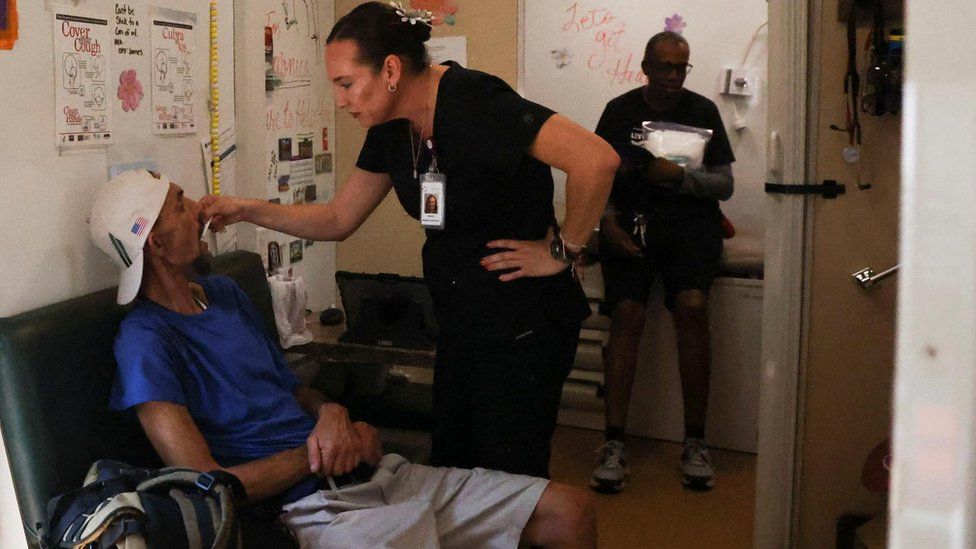
Published10 hours agoShareclose panelShare pageCopy linkAbout sharingThis video can not be playedTo play this video you need to enable JavaScript in your browser.By Sam Cabral & Max MatzaBBC NewsA prolonged heatwave in the US has led to an uptick in severely burned patients who were injured after touching hot surfaces or objects. Medics in Arizona said some patients were hurt after falling onto asphalt which had been heated by the sun. The city of Phoenix has now seen a record-breaking 24 consecutive days of temperatures above 110F (43C). Officials warn that ground temperatures can reach near-boiling, and warn people to seek shelter from the fiery heat. Dr Kevin Foster of the Arizona Burn Centre tells BBC News that all of the centre’s 45 hospital beds are currently occupied, and around one-third of those patients have suffered severe contact burns from scorching concrete and asphalt surfaces. “Summertime is the busy time, so that’s not surprising, but the numbers are a little bit higher than anticipated,” he says, adding that the rate of new patients has outpaced 2022 so far this summer.Many of the patients are elderly people, who may have fallen after becoming unsteady in the heat, or children who do not get off the ground quickly after falling. However, he says the “biggest problem” is drug users who are often dehydrated and can faint on sidewalks. “When people go down to a hot surface and stay there, it only takes 10 to 15 minutes to suffer heat exhaustion, burns and other problems,” says Dr Foster, adding that some of the burns are deep, third-degree injuries that will require skin grafts. The centre is also treating over 150 patients who have not been admitted to hospital, but need to be treated for burns sustained touching hot surfaces, such as metal car seat belts. The inside of a car or the dark asphalt surface of a road can be far hotter than the air temperature, research has shown. Touching metal or asphalt for only a few seconds can be enough to cause severe burns.Image source, ReutersCleo Warner helps co-ordinate the Heat Relief Network in Arizona’s Maricopa County. The network now works with with 235 cooling and hydration sites which people can visit to soak in a few hours of air conditioning and water. The locations serve hundreds of people on a weekly basis, she says. Many people using the centres are unsheltered, although they also include people who do not want to, or cannot afford, to run their air conditioner all day.All of the centres are run by volunteers, often out of businesses that have a few spare chairs in a cool room, or non-profit organisations such as houses of worship. The network began during another “particularly rough” heatwave in 2009, she tells BBC News. This is the first year that the network has included respite centres where people can lie down and sleep during the hottest hours of the day. There are now 18 respite centres, she says, adding that they came about in response to requests from the community. Heatwave to spread east across huge parts of USThe danger from surface burns is also being seen in nearby regions that have been hit by extreme heat.Christopher Malcolm, a 73-year-old US Air Force veteran in Las Vegas, told NBC News that he was badly burned after sitting on the ground at a bus stop on a day with temperatures reaching 110F.”I guess the pavement was hot enough so that it burned, although I was wearing blue jeans,” he said, adding that he did not realise the extent of his injuries at first. “I’ve dealt with heat before,” he said. “I lived in the Philippines for about seven years. Never had any problems with heat.”More on this storyHeatwave to spread east across huge parts of USPublished12 hours agoEarth in uncharted waters as climate records tumblePublished3 days agoHeatwave hits homeless people: ‘I cry all the time’ Video, 00:00:55Heatwave hits homeless people: ‘I cry all the time’Published6 days ago0:55

Read more →

Researchers discover specialized immune cells patrolling the human eye

The discovery, published in the Proceedings of the National Academy of Sciences journal, redefines current understanding of the immune cell landscape in the cornea of a healthy human eye.
It builds on previous research published by the team last year in Cell Reports that showed that T cells protect the eye against virus infection in mice.
The collaborative research team led by University of Melbourne’s Associate Professor Laura Downie and Dr Holly Chinnery from the Department of Optometry and Vision Sciences and Professor Scott Mueller, from the Department of Microbiology and Immunology at the Doherty Institute jointly developed a new imaging technique as part of their investigation.
Professor Mueller explained that our knowledge of the various immune cell types in the human cornea is important for establishing the eye’s protective mechanisms against pathogens and disease.
“By combining our newly developed imaging technique with other advanced analytical approaches, we were able to discover that a significant number of cells at the surface of the healthy cornea are actually T cells,” said Professor Mueller.
“Until now, these cells were mistakenly classified as dendritic cells based on static imaging. This completely changes the current dogma in the field that only dendritic cells are present in the healthy cornea.”
Associate Professor Downie said that being able to dynamically capture the cells’ normal behaviour, and in response to inflammation, provides unique understanding into the immune response in the eye.

Read more →

Infected blood scandal: Bereaved relatives in government compensation plea

Published12 hours agoShareclose panelShare pageCopy linkAbout sharingBy Vanessa Pearce & PA news agency BBC News, West MidlandsThe son of a man who died after he was given infected blood is among those handing in a letter to the government calling for wider compensation.Jason Evans from Coventry is among signatories to hand over a letter on Monday amid complaints the government is dragging its heels over the issue. Government’s ministers are set to appear before the Infected Blood Inquiry this week.”People are dying without seeing any acknowledgement,” said Mr Evans. The inquiry was established in 2017 to examine how thousands of patients in the UK were infected with HIV and hepatitis C through contaminated blood products in the 1970s and 1980s.About 2,400 people died in what has been labelled the worst treatment disaster in the history of the NHS.Commons Leader and former paymaster general Penny Mordaunt gave evidence on Monday.Concerns of delays in the Government’s approach to compensation were put to Ms Mordaunt, and she was asked if, hypothetically, the Government was deliberately dragging its feet, whether that would be morally objectionable.She replied: “yes”, it would be, but added: “That has not been my experience in my current role.”Elsewhere in her evidence, she said: “I do not think there is any delay to moving as quickly as we can on these matters, and it would have been pointless to have set up this inquiry and the (compensation framework) study not to then proceed with making redress.”Prime Minister Rishi Sunak will appear on Wednesday and the Chancellor and former health secretary Jeremy Hunt is due to appear on Friday.Surviving victims and families of the bereaved received interim compensation payments of about £100,000 from the government in October.But the chairman of the infected blood public inquiry, Sir Brian Langstaff, said the scheme should be widened so more people, including orphaned children and parents who lost children – could be compensated. Image source, PA MediaMr Evans was four years old when his father Jonathan, a carpenter, died in 1993 after he contracted both HIV and hepatitis C during treatment. “We need action to happen now because people are dying, not just people infected but the bereaved families as well,” he said. “We know that 380 children were infected with HIV, many of those died in childhood, and their parents are now in their 80s.”We know of people who have died only recently,” he said. “This delay denies victims and their families any sense of tangible progress,” the letter from relatives to the government said. “Many continue to die without full redress, this can not be right. “The interim payment for deaths not yet recognised is critical.”A government spokesman said it “accepts the moral case for compensation and work is ongoing across the UK Government and in consultation with the devolved administrations to consider as quickly as possible the recommendations put forward in the inquiry’s second interim report.”Follow BBC West Midlands on Facebook, Twitter and Instagram. Send your story ideas to: newsonline.westmidlands@bbc.co.ukMore on this storyInfected blood family anger over compensation waitPublished22 JuneParents and children ‘should get blood payout’Published5 AprilBlood scandal: 1 in 3 infected with HIV was a childPublished9 November 2022Blood scandal victims to get £100k this weekPublished22 October 2022Black and Asian infected blood victims ‘let down’Published30 September 2022Blood scandal pay-outs ignore some – victim’s sonPublished30 July 2022Related Internet LinksHomepage – Infected Blood InquiryThe BBC is not responsible for the content of external sites.

Read more →

Scientists find that supplementation with a special omega-3 lipid could treat acute kidney injury

Researchers from Singapore have identified a potential dietary supplement that may improve recovery following acute kidney injury (AKI). The finding, published in the Journal of Lipid Research, comes from a long-running research programme at Duke-NUS Medical School investigating how cells take up a specialised omega-3 lipid called LPC-DHA.
A major public health concern, AKI affects an estimated 13.3 million people globally each year and has a mortality rate of 20 to 50 per cent depending on the economic status of the country and stage of the disease. One of the main causes of AKI is ischemic reperfusion injury, which occurs when the kidney’s blood supply is restored after a period of restricted blood flow and poor oxygen delivery due to illness, injury or surgical intervention. In particular, it damages a crucial part of the kidney called the S3 proximal tubules that regulate the levels of absorption of water and soluble substances, including salts.
“AKI is a serious health problem with limited treatment options,” said Dr Randy Loke, first author of the study and an MD-PhD student with Duke-NUS’ Cardiovascular & Metabolic Disorders (CVMD) Programme. “We sought to understand how these tubules repair themselves and found that the activity of the protein Mfsd2a, which transports LPC-DHA into cells, is a key factor influencing the rate of recovery of kidney function after ischemic reperfusion injury.”
In their study, the researchers discovered that preclinical models with reduced levels of Mfsd2a showed delayed recovery, increased damage and inflammation after kidney injury. However, when these models were treated with LPC-DHA, their kidney function improved and the damage was reduced. LPC-DHA also restored the structure of the S3 proximal tubules, helping them function properly again.
“While more research is needed, the potential of LPC-DHA as a dietary supplement is exciting for future recipients who have suffered from AKI,” said Professor David Silver, the senior author of the study and Deputy Director of the CVMD Programme. “As our results suggest that LPC-DHA could become a safe and effective treatment that offers lifelong protection, its potential can help protect the kidneys and aid in recovery for these individuals.”
In the next phase, the research team plans to continue investigating the beneficial functions of LPC in the kidney and are aiming to initiate clinical testing of LPC supplements to determine their effectiveness in improving renal function and recovery following AKI in patients.
They also plan to continue their investigations of the protein Mfsd2a to learn more about its role in LPC transport and its involvement in diseases affecting other tissues and organs. Previous research by Prof Silver’s group, with collaborators from other institutions, have already highlighted the significance of the protein’s LPC-transporting activities in diseases of other organs, including the liver, lungs and brain.

Read more →

How an unlikely amphibian survived its 'Judgement Day'

An international team of researchers has uncovered “unprecedented” snake venom resistance in an unexpected species — the legless amphibian known as caecilians.
The University of Queensland’s Associate Professor Bryan Fry led the study, which he said provides a solid model for the fundamental evolutionary concept of predator-prey interactions.
“Our research provides a textbook example of how a single predatory pressure can trigger an evolutionary cascade where the same way of fighting back arises independently multiple times in a species’ different lineages,” Dr Fry said.
“In this case, the key predatory pressure was the rise of the elapid snakes, such as cobras and coral snakes, characterised by the evolution of a new way of delivering venom via their hollow, fixed, syringe-like fangs.
“Despite being quite slippery, caecilians are worm-like in their locomotion and speed and were incredibly easy prey to cobras and other snakes, which used their fangs to kill them and eat them later.
“It would have been absolute carnage to the point where elapids were basically grazing on caecilians, contributing to the rapid spread of elapid snakes across Africa, Asia, and the Americas.
“The caecilian’s ability to persevere and evolve despite these pressures is like a movie — like the survivors of Judgement Day fighting back by changing the chemical landscape.”
The team studied caecilian species from across all known families across the globe, including species in the Seychelles islands never reached by elapid snakes.

Read more →

Link found between childhood television watching and adulthood metabolic syndrome

A University of Otago study has added weight to the evidence that watching too much television as a child can lead to poor health in adulthood.
The research, led by Professor Bob Hancox, of the Department of Preventive and Social Medicine, and published this week in the journal Pediatrics, found that children who watched more television were more likely to develop metabolic syndrome as an adult.
Metabolic syndrome is a cluster of conditions including high blood pressure, high blood sugar, excess body fat, and abnormal cholesterol levels that lead to an increased risk of heart disease, diabetes and stroke.
Using data from 879 participants of the Dunedin study, researchers found those who watched more television between the ages of 5 and 15 were more likely to have these conditions at age 45.
Television viewing times were asked at ages 5, 7, 9, 11, 13 and 15. On average, they watched just over two hours per weekday.
“Those who watched the most had a higher risk of metabolic syndrome in adulthood,” Professor Hancox says.
“More childhood television viewing time was also associated with a higher risk of overweight and obesity and lower physical fitness.”
Boys watched slightly more television than girls and metabolic syndrome was more common in men, than women (34 percent and 20 per cent respectively). The link between childhood television viewing time and adult metabolic syndrome was seen in both sexes however, and may even be stronger in women.

Read more →

AI predicts the work rate of enzymes

Enzymes play a key role in cellular metabolic processes. To enable the quantitative assessment of these processes, researchers need to know the so-called “turnover number” (for short: kcat) of the enzymes. In the scientific journal Nature Communications, a team of bioinformaticians from Heinrich Heine University Düsseldorf (HHU) now describes a tool for predicting this parameter for various enzymes using AI methods.
Enzymes are important biocatalysts in all living cells. They are normally large proteins, which bind smaller molecules — so-called substrates — and then convert them into other molecules, the “products.” Without enzymes, the reaction that converts the substrates into the products could not take place, or could only do so at a very low rate. Most organisms possess thousands of different enzymes. Enzymes have many applications in a wide range of biotechnological processes and in everyday life — from the proving of bread dough to detergents.
The maximum speed at which a specific enzyme can convert its substrates into products is determined by the so-called turnover number kcat. It is an important parameter for quantitative research on enzyme activities and plays a key role in understanding cellular metabolism.
However, it is time-consuming and expensive to determine kcat turnover numbers in experiments, which is why they are not known for the vast majority of reactions. The Computational Cell Biology research group at HHU headed by Professor Dr Martin Lercher has now developed a new tool called TurNuP to predict the kcat turnover numbers of enzymes using AI methods.
To train a kcat prediction model, information about the enzymes and catalysed reactions was converted into numerical vectors using deep learning models. These numerical vectors served as the input for a machine learning model — a so-called gradient boosting model — which predicts the kcat turnover numbers.
Lead author Alexander Kroll: “TurNuP outperforms previous models and can even be used successfully for enzymes that have only a low similarity to those in the training dataset.” Previous models have not been able to make any meaningful predictions unless at least 40% of the enzyme sequence is identical to at least one enzyme in the training set. By contrast, TurNuP can already make meaningful predictions for enzymes with a maximum sequence identity of 0 — 40%.
Professor Lercher adds: “In our study, we show that the predictions made by TurNuP can be used to predict the concentrations of enzymes in living cells much more accurately than has been the case to date.”
In order to make the prediction model easily accessible to as many users as possible, the HHU team has developed a user-friendly web server, which other researchers can use to predict the kcat turnover numbers of enzymes.

Read more →