Revealing the secrets of cell competition

Cellular competition is a crucial quality control process that ensures that the development of an organism relies on healthy cells. Researchers revealed the secrets underlying cell competition and what features can pre-determine whether a cell will survive or not. Defects in energy production are critical in making cells vulnerable to elimination. The study was led by researchers from Helmholtz Zentrum München and Imperial College London.
As multicellular life relies on cell-cell interactions, it is not surprising that this is not always peaceful: cells with higher fitness eliminate cells with lower fitness through cell competition. Cell competition has emerged as a quality control mechanism and occurs when cells differ, genetically or otherwise, from each other. In mammals, the process of cell competition has been observed e.g., in cancer, during organ homeostasis, and during development as a process to select the fittest cells in the embryo and the adult. However, the features that distinguish “winner” from “loser” cells and whether there are key determinants for cell competition in various biological contexts remain elusive.
The recipe for elimination of “loser” cells
The research team found out that the cells losing the competition are characterized by defective mitochondria and, in mouse embryos, they are marked by sequence changes in their mitochondrial genome. Their work was published in the journal Nature Metabolism. “Our work suggests that differences in mitochondrial activity are key determinants of competitive cell fitness in a wide range of systems. In particular, we discovered that genetic defects in the mitochondria characterize ‘loser’ cells in mouse embryos,” says Antonio Scialdone, co-corresponding author of the article.
In more detail: The mouse embryo uses cellular competition to get rid of unfit epiblast cells before the basic body plan is laid down during gastrulation. Using single-cell RNAseq (a specific sequencing technique), the researchers compared cells in embryos treated with a cell death inhibitor versus those in untreated mouse embryos. By applying machine learning algorithms, they could identify the gene expression signature of “loser” cells and discovered that these cells have defective mitochondria and are marked by sequence changes in their mitochondrial genome. “It was nice to see how with our computational pipeline we were able to extract such important information from the single-cell RNAseq datasets,” says Gabriele Lubatti co-first author of the article.
The information on how “loser” cells look like in the mouse embryo allowed them to determine a “loser” cell identity. By analyzing the mitochondrial activity in other cell competition models, they could identify that mitochondrial dysfunction is a common characteristic in different “loser” cells and that small changes in the mitochondrial DNA are enough to drive cell competition.
Future work
This study suggests that mitochondrial activity may be a key determinant of cellular fitness in a variety of contexts where competition between cells occurs. Environmental changes can strongly influence metabolism and mitochondria play a central role in this process. Therefore, it is possible that cellular competition and associated defects in the mitochondrial genome in response to certain environmental factors leads to the emergence of a particular genotype (“winner” cells). This implies that cellular competition could be a direct link between environment and genotype, which will be interesting to explore further.
About the people
Gabriele Lubatti and Antonio Scialdone are part of the Institute for Epigenetics and Stem Cells, Institute of Functional Epigenetics, and Institute of Computational Biology at Helmholtz Zentrum München. At Imperial College London, Tristan Rodriguez, from the National Heart & Lung Institute, led the study from the UK side.

Read more →

More Genetic Clues to COVID-19 Susceptibility and Severity

Many factors influence our risk of illness from SARS-CoV-2, the coronavirus responsible for COVID-19. That includes being careful to limit our possible exposures to the virus, as well as whether we have acquired immunity from a vaccine or an earlier infection. But once a person is infected, a host of other biological factors, including age and pre-existing medical conditions, will influence one’s risk of becoming severely ill.

While earlier studies have tied COVID-19 severity to genetic variations in a person’s antiviral defenses and blood type, we still have a lot to learn about how a person’s genetic makeup influences COVID-19 susceptibility and severity. So, I was pleased to see the recent findings of an impressive global effort to map the genetic underpinnings of SARS-CoV-2 infection and COVID-19 severity, which involved analyzing the genomes of many thousands of people with COVID-19 around the globe.

This comprehensive search led to the identification of 13 regions of the human genome that appear to play a role in COVID-19 infection or severity. Though more research is needed to sort out these leads, they represent potentially high-quality clues to the pathways that this virus uses to cause illness, and help to explain why some people are more likely to become infected with SARS-CoV-2 or to develop severe disease.

The international effort, known as The COVID-19 Host Genetics Initiative, is led by Andrea Ganna, Institute for Molecular Medicine Finland, Helsinki, and colleagues in the United States and around the world. Teasing out those important genetic influences is no easy task. It requires vast amounts of data, so Ganna reached out to the scientific community via Twitter to announce a new COVID-19 gene-hunting effort and ask for help. Thousands of researchers around the world answered his call. The new study, published in the journal Nature, includes data collected through the initiative as of January 2021, and represents nearly 50,000 COVID-19 patients and another 2 million uninfected controls [1].

In search of common gene variants that may influence who becomes infected with SARS-CoV-2 and how sick they will become, Ganna’s international team turned to genome-wide association studies (GWAS). As part of this, the team analyzed patient genome data for millions of so-called single-nucleotide polymorphisms, or SNPs. While these single “letter” nucleotide substitutions found all across the genome are generally of no health significance, they can point the way to the locations of gene variants that turn up more often in association with particular traits or conditions—in this case, COVID-19 susceptibility or severity. To find them, the researchers compared SNPs in people with COVID-19 to those in about 2 million healthy blood donors from the same population groups. They also looked for variants that turned up significantly more often in people who became severely ill.

Their analyses uncovered a number of gene variants associated with SARS-CoV-2 infection or severe COVID-19 in 13 regions of the human genome, six of which were new. Four of the 13 affect a person’s risk for becoming infected with SARS-CoV-2. The other nine influence a person’s risk for developing severe illness following the infection.

Interestingly, some of these gene variants already were known to have associations with other types of lung or autoimmune diseases. The new findings also help to confirm previous studies suggesting that the gene that determines a person’s blood type may influence a person’s susceptibility to SARS-CoV-2 infection, along with other genes that play a role in immunity. For example, the findings show overlap with variants within a gene called TYK2, which was earlier shown to protect against autoimmune-related diseases. Some of the variants also point to the need for further work to study previously unexplored biological processes that may play potentially important roles in COVID-19.

Two of the new variants associated with disease severity were discovered only by including individuals with East Asian ancestry, highlighting the value of diversity in such analyses to gain a more comprehensive understanding of the biology. One of these newfound variants is close to a gene known as FOXP4, which is especially intriguing because this gene is known to play a role in the airways of the lung.

The researchers continue to look for more underlying clues into the biology of COVID-19. In fact, their latest unpublished analysis has increased the number of COVID-19 patients from about 50,000 to 125,000, making it possible to add another 10 gene variants to the list.

Reference:

[1] Mapping the human genetic architecture of COVID-19. COVID-19 Host Genetics Initiative. Nature. 2021 Jul 8.

Links:

COVID-19 Research (NIH)

The COVID-19 Host Genetics Initiative

Read more →

Learning to Love G.M.O.s

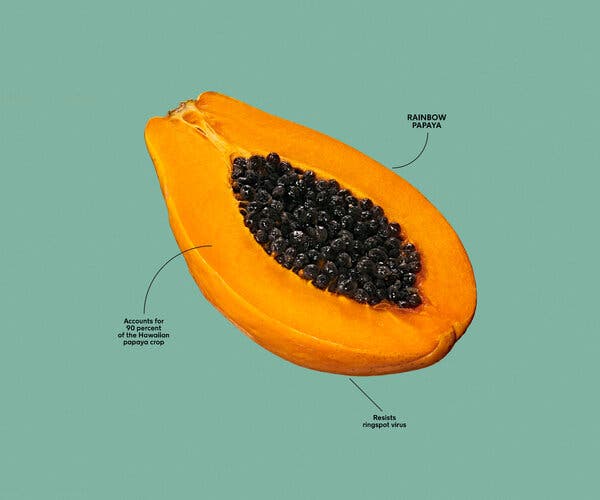
Listen to This ArticleAudio Recording by AudmTo hear more audio stories from publications like The New York Times, download Audm for iPhone or Android.On a cold December day in Norwich, England, Cathie Martin met me at a laboratory inside the John Innes Centre, where she works. A plant biologist, Martin has spent almost two decades studying tomatoes, and I had traveled to see her because of a particular one she created: a lustrous, dark purple variety that is unusually high in antioxidants, with twice the amount found in blueberries.At 66, Martin has silver-white hair, a strong chin and sharp eyes that give her a slightly elfin look. Her office, a tiny cubby just off the lab, is so packed with binders and piles of paper that Martin has to stand when typing on her computer keyboard, which sits surrounded by a heap of papers like a rock that has sunk to the bottom of a snowdrift. “It’s an absolute disaster,” Martin said, looking around fondly. “I’m told that the security guards bring people round on the tour.” On the desk, there’s a drinks coaster with a picture of an attractive 1950s housewife that reads, “You say tomato, I say [expletive] you.”Martin has long been interested in how plants produce beneficial nutrients. The purple tomato is the first she designed to have more anthocyanin, a naturally occurring anti-inflammatory compound. “All higher plants have a mechanism for making anthocyanins,” Martin explained when we met. “A tomato plant makes them as well, in the leaves. We just put in a switch that turns on anthocyanin production in the fruit.” Martin noted that while there are other tomato varieties that look purple, they have anthocyanins only in the skin, so the health benefits are slight. “People say, Oh, there are purple tomatoes already,” Martin said. “But they don’t have these kind of levels.”The difference is significant. When cancer-prone mice were given Martin’s purple tomatoes as part of their diet, they lived 30 percent longer than mice fed the same quantity of ordinary tomatoes; they were also less susceptible to inflammatory bowel disease. After the publication of Martin’s first paper showing the anticancer benefit of her tomatoes, in the academic journal Nature Biotechnology in 2008, newspapers and television stations began calling. “The coverage!” she recalled. “Days and days and days and days of it! There was a lot of excitement.” She considered making the tomato available in stores or offering it online as a juice. But because the plant contained a pair of genes from a snapdragon — that’s what spurs the tomatoes to produce more anthocyanin — it would be classified as a genetically modified organism: a G.M.O.That designation brings with it a host of obligations, not just in Britain but in the United States and many other countries. Martin had envisioned making the juice on a small scale, but just to go through the F.D.A. approval process would cost a million dollars. Adding U.S.D.A. approval could push that amount even higher. (Tomato juice is known as a “G.M. product” and is regulated by the F.D.A. Because a tomato has seeds that can germinate, it is regulated by both the F.D.A. and the U.S.D.A.) “I thought, This is ridiculous,” Martin told me.Martin eventually did put together the required documentation, but the process, and subsequent revisions, took almost six years. “Our ‘business model’ is that we have this tiny company which has no employees,” Martin said with a laugh. “Of course, the F.D.A. is used to the bigger organizations” — global agricultural conglomerates like DowDuPont or Syngenta — “so this is where you get a bit of a problem. When they say, ‘Oh, we want a bit more data on this,’ it’s easy for a corporation. For me — it’s me that has to do it! And I can’t just throw money at it.”Martin admitted that, as an academic, she hadn’t been as focused on getting the tomato to market as she might have been. (Her colleague Jonathan Jones, a plant biologist, eventually stepped in to assist.) But the process has also been slow because the purple tomato, if approved, would be one of only a very few G.M.O. fruits or vegetables sold directly to consumers. The others include Rainbow papayas, which were modified to resist ringspot virus; a variety of sweet corn; some russet potatoes; and Arctic Apples, which were developed in Canada and resist browning.It also might be the first genetically modified anything that people actually want. Since their introduction in the mid-1990s, G.M.O.s have remained wildly unpopular with consumers, who see them as dubious tools of Big Ag, with potentially sinister impacts on both people and the environment. Martin is perhaps onto something when she describes those most opposed to G.M.O.s as “the W.W.W.s”: the well, wealthy and worried, the same cohort of upper-middle-class shoppers who have turned organic food into a multibillion-dollar industry. “If you’re a W.W.W., the calculation is, G.M.O.s seem bad, so I’m just going to avoid them,” she said. “I mean, if you think there might be a risk, and there’s no benefit to you, why even consider it?”The purple tomato could perhaps change that calculation. Unlike commercial G.M.O. crops — things like soy and canola — Martin’s tomato wasn’t designed for profit and would be grown in small batches rather than on millions of acres: essentially the opposite of industrial agriculture. The additional genes it contains (from the snapdragon, itself a relative of the tomato plant) act only to boost production of anthocyanin, a nutrient that tomatoes already make. More important, the fruit’s anti-inflammatory and anticancer properties, which seem considerable, are things that many of us actively want.Nonetheless, the future of the purple tomato is far from certain. “There’s just so much baggage around anything genetically modified,” Martin said. “I’m not trying to make money. I’m worried about people’s health! But in people’s minds it’s all Dr. Frankenstein and trying to rule the world.”Bobby Doherty for The New York TimesIn the three decades since G.M.O. crops were introduced, only a tiny number have been developed and approved for sale, almost all of them products made by large agrochemical companies like Monsanto. Within those categories, though, G.M.O.s have taken over much of the market. Roughly 94 percent of soybeans grown in the United States are genetically modified, as is more than 90 percent of all corn, canola and sugar beets, together covering roughly 170 million acres of cropland.At the same time, resistance to G.M.O. foods has only become more entrenched. The market for products certified to be non-G.M.O. has increased more than 70-fold since 2010, from roughly $350 million that year to $26 billion by 2018. There are now more than 55,000 products carrying the “Non-G.M.O. Project Verified” label on their packaging. Nearly half of all U.S. shoppers say that they try not to buy G.M.O. foods, while a study by Jennifer Kuzma, a biochemist who is a director of the Genetic Engineering and Society Center at North Carolina State University, found that consumers will pay up to 20 percent more to avoid them.For many of us, the rejection of G.M.O.s is instinctive. “For people who are uncomfortable with this, the objection is that it isn’t something that would ever happen in nature,” says Alan Levinovitz, a professor of religion and science at James Madison University. “With genetic engineering, there’s a feeling that we’re mucking about with the essential building blocks of reality. We may feel OK about rearranging genes, the way nature does, but we’re not comfortable mixing them up between creatures.”Our distrust might also stem from the way G.M.O.s were introduced. When the agribusiness giant Monsanto released its first G.M.O. crop in 1996 — an herbicide-resistant soybean — the company was in need of cash. By adding a gene from a bacterium, it hoped to create crops that were resistant to glyphosate, the active ingredient in its trademark herbicide, RoundUp, enabling farmers to spray weeds liberally without also killing the soy plant itself — something that wasn’t possible with traditional herbicides. Commercially, the idea succeeded. By 2003, RoundUp Ready corn and soy seeds dominated the market, and Monsanto had become the largest producer of genetically engineered seeds, responsible for more than 90 percent of G.M.O. crops planted globally.But the company’s rollout also alarmed and antagonized farmers, who were required to sign restrictive contracts to use the patented seeds, and whom Monsanto aggressively prosecuted. At one point, the company had a 75-person team dedicated solely to investigating farmers suspected of saving seed — a traditional practice in which seeds from one year’s crop are saved for planting the following year — and prosecuting them on charges of intellectual-property infringement. Environmental groups were also concerned, because of the skyrocketing use of RoundUp and the abrupt decline in agricultural diversity.“It was kind of a perfect storm,” says Mark Lynas, an environmental writer and activist who protested against G.M.O.s for over a decade. “You had this company that had made Agent Orange and PCBs” — an environmental toxin that the E.P.A. banned in 1979 — “that was now using G.M.O.s to intensify the worst forms of monoculture farming. I just remember feeling like we had to stop this thing.”That resistance was compounded because early G.M.O.s — which focused largely on pest- and herbicide-resistance — offered little direct benefit to the consumer. And once public sentiment was set, it proved hard to shift, even when more beneficial products began to emerge. One of these, Golden Rice, was made in 1999 by a pair of university researchers hoping to combat vitamin A deficiency, a simple but devastating ailment that causes blindness in millions of people in Africa and Asia annually, and that can also be fatal. But the project foundered after protests by anti-G.M.O. activists in the United States and Europe, which in turn alarmed governments and populations in developing countries.“Probably the angriest I’ve ever felt was when anti-G.M.O. groups destroyed fields of Golden Rice growing in the Philippines,” says Lynas, who publicly disavowed his opposition to G.M.O.s in 2013. “To see a crop that had such obvious lifesaving potential ruined — it would be like anti-vaxxer groups invading a laboratory and destroying a million vials of Covid vaccine.”In recent years, many environmental groups have also quietly walked back their opposition as evidence has mounted that existing G.M.O.s are both safe to eat and not inherently bad for the environment. The introduction of Bt corn, which contains a gene from Bacillus thuringiensis, a naturally insect-resistant bacterium that organic farmers routinely spray on crops, dropped the crop’s insecticide use by 35 percent. A pest-resistant Bt eggplant has become similarly popular in Bangladesh, where farmers have also embraced flood-tolerant “scuba rice,” a variety engineered to survive being submerged for up to 14 days rather than just three. Each year, Bangladesh and India lose roughly four million tons of rice to flooding — enough to feed 30 million people — and waste a corresponding volume of pesticides and herbicides, which then enter the groundwater.In North America, though, such benefits can seem remote compared with what we think of as “eating naturally.” That’s especially true because, for many of us, G.M.O.s and the harms of industrial agriculture (monocultures, overuse of pesticides and herbicides) remain inextricably linked. “Because of the way that G.M.O.s were introduced to the public — as a corporate product, focused on profit — the whole technology got tarred,” Lynas says. “In people’s minds it’s ‘Genetic engineering equals monoculture equals the broken food system.’ But it doesn’t have to be that way.”Bobby Doherty for The New York TimesThe greenhouse where Martin grows her tomatoes is surprisingly modest: a small and somewhat grubby building filled with leggy plants in plastic pots. Martin often has multiple projects going at one time, and as she walked me down the row, she pointed out a (non-G.M.O.) tomato bred to be rich in vitamin D; another with high levels of resveratrol, the antioxidant compound in red wine; and one that a postdoc, Eugenio Butelli, is trying to modify to produce serotonin, a neurotransmitter used in antidepressant drugs. When I asked whether antidepressant tomatoes were next, Martin shrugged. “He’s playing,” she said. “A lot of what we do is play.”Even if the serotonin-producing tomatoes proved possible, she added, they wouldn’t be sold in grocery stores but would simply be added to the growing list of “biologics”: plants or bacteria that have been genetically engineered to produce the active ingredient in medications, including ones for diabetes, breast cancer and arthritis. Martin herself recently created a tomato that produces levodopa, the primary drug for treating Parkinson’s disease, in hopes of making the drug both more affordable and more tolerable. (The synthetic version of levodopa can cause nausea and other side effects, and it also costs about $2 a day — more than some patients, especially those in developing countries, can afford.)Farther down the row was the next-generation purple tomato: a dark blue-black variety called Indigo that Martin has created by crossing the high-anthocyanin purple tomato with a yellow one high in flavonols, an anti-inflammatory compound found in things like kale and green tea, making it even richer in antioxidants. The Indigo, which is also a G.M.O., is too new to have been evaluated for health benefits, but Martin is hopeful that it will have even more robust health effects than the purple tomato.One pot over, Martin stopped at a purple-​tomato plant hung with a single luscious cluster of fruit. “There’s a lovely one,” Martin said, picking it gently and brushing off a few white flecks. “Interestingly, the high-anthocyanin tomatoes also have an extended shelf life. We’re not sure why, but they seem to be more resistant to fungal infection, which is what causes tomatoes to rot.”Such unanticipated genetic changes can cut both ways, of course. In 1996, researchers determined that soybeans containing a gene from a Brazil nut could trigger a reaction in someone who is allergic. (The soybeans were experimental and never intended for the market.) Likewise, instead of lasting longer, Martin’s tomato could have turned mealy or become more bitter. Theoretically, it could even have become dangerous. Had Martin added genes that increased production of solanine — a toxic chemical produced by plants in the nightshade family, including tomatoes and potatoes — the resulting fruit could have been lethal.For anyone wondering, I sampled Martin’s purple and Indigo tomatoes, and eating them has so far not had any alarming effects, at least that I can detect. But of course, I can’t say for sure. What if genetically modified produce turns out to have delayed or unpredictable consequences for our health? Something we can’t easily observe or test for, or perhaps even detect until it’s too late?The fear of such unforeseen effects — what Kuzma calls “unknowingness” — is perhaps consumers’ biggest concern when it comes to G.M.O.s. Genetic interactions, after all, are famously complex. Adding a new gene — or simply changing how a gene is regulated (i.e., how active it is) — rarely affects just a single thing. Moreover, our understanding of these interactions, and their effects, is constantly evolving. Megan Westgate, executive director of the Non-G.M.O. Project, echoed this point. “Anyone who knows about genetics knows that there’s a lot we don’t understand,” Westgate says. “We’re always discovering new things or finding out that things we believed aren’t actually right.” Charles Benbrook, executive director of the Heartland Health Research Alliance, also notes that any potential health impacts from G.M.O.s would be stronger in whole foods — produce we consume raw, unprocessed and in large amounts — than in ingredients like corn syrup.‘For the majority of people, the anxiety around G.M.O.s is almost entirely untethered to an understanding of what’s happening at a scientific level.’Despite that, plant geneticists tend not to be overly concerned about the risks of G.M.O.s, as long as the modifications are made with some care. As a 2016 report by the National Academy of Sciences found, G.M.O.s were generally safe, though it allowed that minor impacts were theoretically possible. Fred Gould, a professor of agriculture who was chairman of the committee that prepared the 600-page report, noted that genetic changes that alter a metabolic pathway — the cellular process that transforms biochemical elements into a particular nutrient or compound, like the anthocyanins in Martin’s tomato — were especially important to study because they could cause cascading effects.Gould likened these pathways to the plumbing in a house. If a genetic edit shuts off one pipe — say one that generates a bitter compound — the building blocks for that compound will start flowing elsewhere, the way a blocked pipe will force water into neighboring channels. The results of this redirection, Gould told me, are poorly understood. “Do the extra precursor chemicals end up producing more of something else?” Gould asked. “Or do they just stay as precursors? For some pathways, plant biologists know the answer. But in other cases we don’t.”But he also noted that this problem wasn’t unique to G.M.O.s. Years ago, for instance, farmers crossbred cucumbers to reduce the amount of cucurbitacin (a bitter compound that repels spider mites) in the peel. But because those cucumbers were made with conventional breeding, growers weren’t required to sequence the genome of the new variety, or even to look at its nutritional and toxicity profile, as they would with something genetically engineered. “We’ve never really asked a conventional breeder: ‘Hey, when you turn off the production of cucurbitacin by crossbreeding, does something else get produced?’” Gould added. “Or do the levels of other important compounds go up or down?”Gould emphasized that many genetic modifications to food are trivial and extremely unlikely to have any measurable effect on people. And even the effects of precursor changes would mostly be slight. “I mean, we’ve been changing all these things already with conventional breeding, and so far we’re doing all right,” he added. “Making the same change with genetic engineering — there’s really no difference.”Bobby Doherty for The New York TimesIf we don’t find these sorts of distinctions very reassuring, it’s in part because our extravagant concern about G.M.O.s reflects something more fundamental: the fact that most of us don’t really understand how genes work. As several scientists I spoke with pointed out, a gene is just a narrow set of biological instructions, many of which appear across a wide range of species. The snapdragon gene in Martin’s tomato, for instance, is known as a transcription factor: essentially, a kind of volume knob that regulates how much of something a particular gene will produce. That something could be anthocyanin, or it could be a dangerous toxin, but the knob itself isn’t the problem, nor is the process by which it was added. “For the majority of people, the anxiety around G.M.O.s is almost entirely untethered to an understanding of what’s happening at a scientific level,” Levinovitz says. “But that actually makes the anxiety harder to address, rather than easier.”This is particularly true around food. Whether or not people actually understand where their fruits and vegetables come from, Levinovitz says, we think that we do — and are disturbed when that changes. The philosophical term for this is epistemic opacity. “When you imagine you know how something works, or where it comes from, that’s comforting,” he added. “So when you hear that an apple was genetically modified, it’s like, What does that mean? It’s alienating.”For many consumers, Levinovitz notes, the word “natural” has become a heuristic: a mental shortcut for deciding if something is good or safe. “We hear it all the time, and it is often true. Why do we have chronic pain? Because we weren’t meant to sit at a desk for hours. Why is the sea turtle not reproducing? Because of the artificial light we introduced on beaches. It’s not a very consistent view” — there are all kinds of unnatural things that nobody worries about, like Netflix and indoor plumbing — “but it’s become a kind of shorthand for this world we feel like we’ve lost.”In practice, of course, almost everything we grow and eat today has had its DNA altered extensively. For millenniums, farmers, discovering that one version of a plant — usually a random genetic mutant — was hardier, or sweeter, or had smaller seeds, would cross it with another that, say, produced more fruit, in hopes of getting both benefits. But the process was slow. Simply changing the color of a tomato from red to yellow while preserving its other traits could take years of crossbreeding. And tomatoes are one of the easiest cases. Introducing even a minor change to a cherry through crossbreeding, I was told, could take up to 150 years.To those who worry about G.M.O.s, that slowness is reassuring. “There’s a sense that, yes, these things have been altered,” Levinovitz noted. “But they’ve been altered over a very long time, in the same way that nature alters things.”Yet the way nature alters things is also profoundly haphazard. Sometimes a plant will acquire one trait at the expense of another. Sometimes it actually becomes worse. The same is true for agricultural crossbreeding. Not only is there no way to control which genes are kept and which are lost; the process also tends to introduce unwanted changes. The technical term for this is “linkage drag”: all the unintended, and unknown, genes that get pulled along during cross-pollination, like fish in a net. Commercial berry growers spent decades trying to create a domesticated version of the black raspberry through crossbreeding but never succeeded: the thornless berries either tasted worse or produced almost no fruit, or they developed other problems. It’s also why meeting the needs of modern agriculture — growing produce that can be shipped long distances and hold up in the store and at home for more than a few days — can result in tomatoes that taste like cardboard or strawberries that aren’t as sweet as they used to be. “With conventional breeding, you’re basically just shuffling the genetic deck,” the agricultural executive Tom Adams told me. “You’re never going to carry over only the gene you want.”In recent years genetic-engineering tools like CRISPR have offered a way around this imprecision, making it possible to identify which genes control which traits — things like color, hardiness, sweetness — and to change only those. “It’s far more precise,” says Andrew Allan, a plant biologist at the University of Auckland. “Instead of rolling the dice, you’re changing only the thing you want to change. And you can do it in one generation instead of 10 or 20.”Last year, the U.S.D.A. ruled that plants that had undergone simple cisgenic edits — changes to the plant’s own DNA, of the kind that could theoretically be created by years of traditional crossbreeding — would not be subject to the same regulation as other G.M.O.s. And some people are arguing that it’s time to reconsider how G.M.O.s are regulated as well, especially when it comes to small growers like Martin. From a regulatory perspective, Allan pointed out, all G.M.O.s are treated the same, regardless of the modification and regardless of the scale. “Whether you’re a corporation that wants to plant millions of acres of pest-resistant corn or someone who’s made a lovely little tomato that could save lives, it’s all the same process,” he said. Allan noted that his current project, the red flesh apple, contains a single gene taken from a crab apple which increases its antioxidants. “It’s an extremely low-risk change,” he said. “We’re literally just taking a gene from one kind of apple and putting it into another. But it is still, demonstrably, a G.M.O.”The policy is partly a holdover from the early days of genetic engineering, when less was known about the process and its effects. But it has persisted, in part because of powerful anti-G.M.O. campaigning. Eric Ward, co-chief executive of the agricultural technology company AgBiome, described the situation as “stuck in a closed loop.” He went on: “People think, Well, if you’ve got this really strict regulatory system, then it must be really dangerous. So it becomes self-reinforcing.”For Martin, this has created a strange catch-22. Grocery stores are afraid to carry something like a genetically modified tomato because they worry that consumers will reject it. Growers and businesses are afraid of investing in one for the same reason. Genetic engineering, Ward notes, has become far more accessible since the first G.M.O. crops were introduced in the 1990s. “But it’s turned into this thing that only half a dozen companies in the world can afford to do, because they’ve got to go through all this regulatory stuff.” He paused. “It’s ironic. The activists that first objected to G.M.O.s did it because they didn’t trust big agribusiness. But the result now is that only big companies can afford to do it.”Bobby Doherty for The New York TimesA few days before traveling to Norwich, I joined Martin at the Royal Society in London for the Future Food conference, a series of talks on genetic engineering in agriculture. There I met Haven Baker, a founder of a company called Pairwise, which was started to create fruits and vegetables that are genetically edited but not G.M.O.“I don’t think we can change people’s minds about G.M.O.s,” Baker said. “But gene editing is a clean slate. And maybe then G.M.O.s will be able to follow.”In his talk, Baker noted that there are hundreds of kinds of berries in the world. But among those we commonly call berries, we eat just four: strawberries, raspberries, blueberries and blackberries. There’s a reason the other varieties rarely reach us. Sometimes the fruit rots within days after picking (salmonberries), or the plant puts out fruit for only a few weeks in summer (cloudberries). Sometimes the plant doesn’t produce much fruit at all or is too thorny or sprawling for the fruit to be picked without a vast amount of labor. As Joel Reiner, a horticulturalist at Pairwise, would later put it, “Berries always have some tragic flaw.”Black raspberries, one fruit that Pairwise hopes to bring to market, used to be widely grown in North America, until a virus decimated them. (The red raspberries we eat now originally came from Turkey.) The revived version, which will be in field trials in 2024, has been engineered to be thornless and seedless, while retaining the fruit’s signature jammy flavor.More recently, the company began a similar project with vegetables. Baker says that we underestimate the mediocrity of most grocery-store produce, which tends to be tasteless and also offers little in the way of novelty. On top of that, most vegetables just aren’t very appealing, especially compared with processed foods. Vegetables take work to prepare, vary in quality and can be bitter or woody. They’re also perishable, often going bad before we get around to cooking them. “Especially if you’re on a budget, you hate the idea of wasting food,” Megan Thomas, one of Baker’s colleagues, noted. “You buy processed food, you can put it in the freezer or in the pantry for eight months and not worry about it.”These drawbacks have affected our diet. Only 10 percent of Americans eat the U.S. recommended daily allowance of fruit and vegetables, and teenagers eat even less. And that isn’t because the standard is particularly high: In an entire year, the average American consumes just a few heads of broccoli. “So how do we change that?” Baker asked. “People already know that they’re supposed to be eating vegetables. They just aren’t doing it. But if we can use gene editing to make broccoli slightly less bitter, maybe people — and especially kids — will eat more of it, and therefore be getting more fiber and more vitamins. Which might make a difference in their long-term health.”Not long after the conference, I flew to North Carolina to meet with Baker and his co-founder, Tom Adams. Before starting Pairwise, Baker and Adams each worked at large companies that invested in G.M.O. crops: Adams at Monsanto and Baker at Simplot, where he oversaw the development of a potato that produces less acrylamide, a carcinogen, when fried. (Monsanto, which is now owned by Bayer, provided some of the initial funding for Pairwise and retains the option to commercialize any innovation in row crops, though not in consumer produce.)Pairwise’s office is in an airy former textile mill that also houses a yoga studio, a tattoo parlor and several artist studios. When I showed up in February 2020, the area was just recovering from a winter storm that brought snow and black ice. Inside the greenhouses, though, it was warm and humid. “It’s a great place to work in the winter,” said Reiner, who tends to Pairwise’s plants. “In the summer it can get rough.”In anticipation of my visit, Reiner had set up samples from the company’s “superfood greens project,” which he described as creating “something that’s essentially lettuce but healthier.” Baker noted that Americans trying to eat well often order salads, but around half of those are made with iceberg or romaine lettuce, which have few nutrients and very little fiber. “If those empty leaves could be swapped for a healthy green, it would be a big nutrition boost,” he said. The problem is that nobody really likes the taste of healthy greens. “Do you want to guess what percent of the leafy green market is kale?” Baker asked at one point. “From what we can gather, it’s about 6 and a half percent. And the thing is, kale is known to be extremely good for you. It’s very rich in fiber and micronutrients: vitamins and minerals. But people don’t like to eat it.”In theory, gene editing could change that. Pairwise’s initial lettuce alternative, mustard greens, are in the same family as kale, Reiner explained, and have better nutritional value. But they’re extremely pungent, a trait the company hopes to minimize. For the tasting, Reiner laid out two varieties of genetically altered mustard greens. The first was beautiful: a dark green leaf veined with red, like a miniature chard. The edited version tasted extremely mild — perfect for salad — but when Reiner talked with consumer researchers, they complained that the leaves were too red. (“It’s OK to have a little bit of red, like some leaf lettuces,” Reiner explained. “But people expect most of what they see in the bag to be green.”)The second variety was more recognizable: a big, frilly, light green leaf that resembled the mustard greens I often buy — and then fail to eat — from the farmers’ market. That version was also extremely, almost inedibly, strong. Just nibbling the edge of a leaf cleared my sinuses like eating wasabi. “The compound that you’re tasting is called allyl isothiocyanate,” Reiner said as I dabbed at my watering eyes. “It’s not made until you chew it. The plant contains both the enzyme and the compound that converts it — but it holds them separate. When you chew, they combine to make something that tastes like horseradish. That’s why you have that little delay when you first bite into it, before it hits you.”By comparison, the genetically edited version was delightful, if almost unrecognizable: mild to the point of sweetness, with a pleasant, springy texture. It also has the advantage of looking more like romaine lettuce, and with its larger size and greater frilliness, it does a better job, as Reiner puts it, of “filling up the plate.” It seemed like something that I would happily eat, and in the months after the tasting, as I slogged through my usual salads, I found myself looking forward to the day when I could buy Pairwise’s mustard greens. I liked the idea of getting all that extra nutrition — the vitamins, the fiber — without the punishing pungency. But I also found myself worrying. If I got used to eating greens that were genetically edited to be milder, would I lose my tolerance for funkier ones, like bitter rapini or peppery radishes? At what point would I not want to eat even the local greens from the farmers’ market?After Baker’s talk at the Future Food conference, a member of the audience voiced the same concern: He was terrified, he said, by the prospect of using genetic engineering to “change what is natural just to meet people’s taste.” Rather than bending the natural world to our palates, shouldn’t we be adapting ourselves to the world? I put this question to Heather Hudson, who oversees Pairwise’s vegetable projects. Hudson smiled grimly. Modifying people’s taste, she said, is extremely difficult. An individual might manage it, by training her palate to appreciate, say, the slight bitterness of radicchio, but as a public health strategy it’s essentially hopeless. “I actually started out in nutrition, hoping to change how people ate,” Hudson went on. “But changing people’s behavior is hard.” There’s also a big difference between what we virtuously say we want and what we actually buy, let alone consume.This disconnect is something that Baker has thought about as well. With berries, Baker noted: “People definitely like them better when they’re sweeter. They don’t want sour berries, they want sweet berries!” From a purchasing perspective, he added, berries are in competition with “cheap sugar”: candies and cookies. “So, then you ask, should we even be editing these berries to make them sweeter? Have we then made these healthy berries more like candy?” He shook his head. “But the flip side is I don’t see us making progress on fruits and vegetables if we don’t make them more palatable at some level.”For all of Pairwise’s innovations, there’s a significant limit to how much a plant can be altered without making it a G.M.O. Insect-resistant crops like Bt corn and eggplant, for instance, rely on a gene from a bacterium; neither plant has a gene capable of performing the same function. Even Martin’s purple tomato would have been harder to make without using the transcription factor from snapdragons — although it would theoretically be possible. In general, it’s easy to stop an existing gene from functioning, but much harder to use gene editing to add a new trait or function.If Pairwise’s fruits and vegetables succeed with consumers, they will almost certainly open the door to other produce made through various kinds of genetic engineering. But getting shoppers to trust that these products are safe requires building confidence in how they’re regulated. “For a G.M.O., you’d want to ask: Is there anything in this which is toxic? Are there any novel proteins, or anything else potentially allergenic?” Lynas says. “And you’d do a compositional analysis. It’s basic food-safety stuff, really.” Gould and his co-authors on the National Academy of Sciences report have floated a more meticulous alternative: Researchers would compare the chemical and nutritional profiles of a genetically modified fruit or vegetable against existing varieties we’re already eating. “We have technologies now that allow you to check thousands of traits, to see if anything has changed,” Gould told me. “Why not use them to look at whether, you know, the vitamin C content in the orange you’ve made has gone down or stayed the same?”‘We’ve been changing all these things already with conventional breeding, and so far we’re doing all right. Making the same change with genetic engineering — there’s really no difference.’Should these sorts of comparisons become standard, they could determine, at a molecular level, whether there’s a measurable difference between the tomatoes and apples we’re already eating and the genetically modified version. Paradoxically, these comparisons might also reveal just how much ordinary breeding has already done to create the very changes we fear that G.M.O.s introduce: lowering a vegetable’s nutritional value, say, or increasing an allergen or invisibly altering the biochemical makeup of a plant in ways that could affect our long-term health. Conversely, they may show that G.M.O.s are just as safe, if not safer, than foods that have been altered more conventionally.Providing such safeguards for G.M.O. fruits and vegetables should be reassuring. But just as someone who distrusts vaccines tends to persist in that belief even when presented with abundant evidence of safety and efficacy, those who distrust G.M.O.s are unlikely to change their views until there’s a pressing reason. One possibly persuasive factor is climate change. As Allan notes, the global population is only increasing: By 2050, it will have gone up by two billion, and all those people need to be fed. “So where’s that extra food going to come from?” Allan says. “It can’t come from using more land, because if we use more land, then we’ve got to deforest more, and the temperature goes up even more. So what we really need is more productivity. And that, in all likelihood, will require G.M.O.s.”Others believe that we’ll embrace G.M.O.s only when the alternative is to lose something we value. For years, the Florida citrus industry has been plagued by “citrus greening,” a bacterial disease that is currently being controlled — with limited success — by sprayed antibiotics and pesticides. “If it comes down to buying orange juice that’s G.M.O., or not buying any orange juice, what are you going to choose?” the grower Harry Klee told me. “It’s the same thing that happened with the papaya in Hawaii. At some point, the consumer is going to have to decide what really matters to them.”One of those things might be the very biodiversity that G.M.O.s have helped diminish. As agriculture has industrialized, genetic diversity has shrunk profoundly, with monocultures (or a limited number of hardy varieties) replacing what was once a cornucopia of wild varieties. One study found that before G.M.O.s were even introduced, we’d lost 93 percent of the genetic diversity in our fruits and vegetables. In the early 1900s, farmers in Iowa regularly grew pink-fleshed Chelsea watermelons, which were known for being intensely sweet but have now all but disappeared because they’re too delicate for shipping. Blenheim apricots, once widely cultivated in California, have a sublime, honeyed flavor and a delicate blush-mottled skin, but also bruise easily and ripen from the inside out, confusing consumers. As a result, fresh Blenheims are now almost impossible to find, even though, as the food writer Russ Parsons put it, they’re the apricot that “reminds you of what that fruit is supposed to taste like.”Genetic engineering and G.M.O.s could help undo these losses, restoring rare and delicate heirloom varieties that were once abundant but have now all but disappeared. One appealing vision is for small growers and academics to figure out what tiny modification would make Blenheims slightly more durable, while preserving everything else about the texture and flavor. While the apricot will most likely never be hardy or controllable enough for mass production, it might be made sturdy enough to allow small producers to plant an orchard that’s sustainable.It’s not just the most fragile fruits that we’re losing — or may soon lose. Cherries, for instance, are highly sensitive to rain and frost, a problem that makes them especially vulnerable to climate change. They’re also extremely seasonal, ripening all at once over the span of just a few weeks, rather than growing year-round. Faced with labor shortages and shrinking profits, some growers have begun talking about converting their cherry orchards to apples, which keep better and are less risky. To prevent that from happening, Hudson suggested that cherries could be made easier to pick, and perhaps grown year-round, like blueberries (which until recently were also highly seasonal). “Doing that means the farmer gets stability, and the workers get stability,” she added.But we’re unlikely to see these kinds of projects while G.M.O.s remain the exclusive product of global agrochemical companies. While a researcher at an agricultural college might be interested in bringing back the Blenheim — or creating a wonderful new antioxidant tomato — the financial payoff is nonexistent. “Imagine you’re a big company,” says Ward, the AgBiome chief executive. “You can put a dollar into an insect-control trait in soybean and bring in 10 to 15 billion dollars. Or you can put a dollar into a healthier tomato that at peak might be worth a few million dollars. It’s pretty simple financial calculation.”There are some signs that the future of small-scale, bespoke G.M.O. produce may already have begun. In late April, Cathie Martin told me that the U.S.D.A. had recently updated its regulations to allow more G.M.O. plants to be grown outside, without a three-year field trial or in tightly contained greenhouses. (The exceptions are plants or organisms with the potential to be a pest, pathogen or weed.) In the wake of this change, Martin and Jones are planning to make the purple tomato available first to home gardeners, who could grow it from seed as soon as next spring — well before the commercially grown tomato reaches grocery stores. (U.S.D.A. approval is expected by December.) They’re currently testing six different varieties, to find the most flavorful. “When we first developed the purple tomato, it was home gardeners who were most interested in it,” Martin noted. “And with home gardening, it’s an opt-in system. It’s up to you whether you want to grow it.”It was an intriguing idea. Months earlier, while browsing a website called The Garden Professors, I noticed that a home gardener named Janet Chennault had posted a query asking where she could buy G.M.O. seeds. Others had wondered the same thing. “I would love to try some G.M. vegetable seeds in my garden,” a woman named Lorrie Delehanty said.After some searching, I managed to track down Delehanty, who had recently retired and was living in Charlottesville, Va. Over the phone, she described herself as having “a little tiny backyard in the middle of the city” that she and her husband had worked hard to homestead, planting blackberries along the fence line and creating a bird sanctuary around the vegetable plot. She was interested in G.M. seeds, she said, because she did her own canning and freezing, “and I’m always looking to grow something different.”When I asked what kind of thing she was looking for, Delehanty grew animated. “Something with the sweet, smoky flavor of a scorpion pepper without the screaming heat,” she began. “Also potatoes that resist bacterial scab. I’m sick and tired of getting scabby potatoes. The purple tomato — I would try that in a heartbeat.” She paused. “Oh, and bigger blackberries!”Jennifer Kahn is a contributing writer for the magazine and the narrative-program lead at the Graduate School of Journalism at the University of California, Berkeley. Levon Biss is a British photographer known for his extremely magnified images of natural subjects like insects and seeds. Bobby Doherty is a photographer based in Brooklyn who focuses on studio still-life photography. His first book, “Seabird,” is a collection of moments observed from 2014 to 2018.

Read more →

How an Unproven Alzheimer’s Drug Got Approved

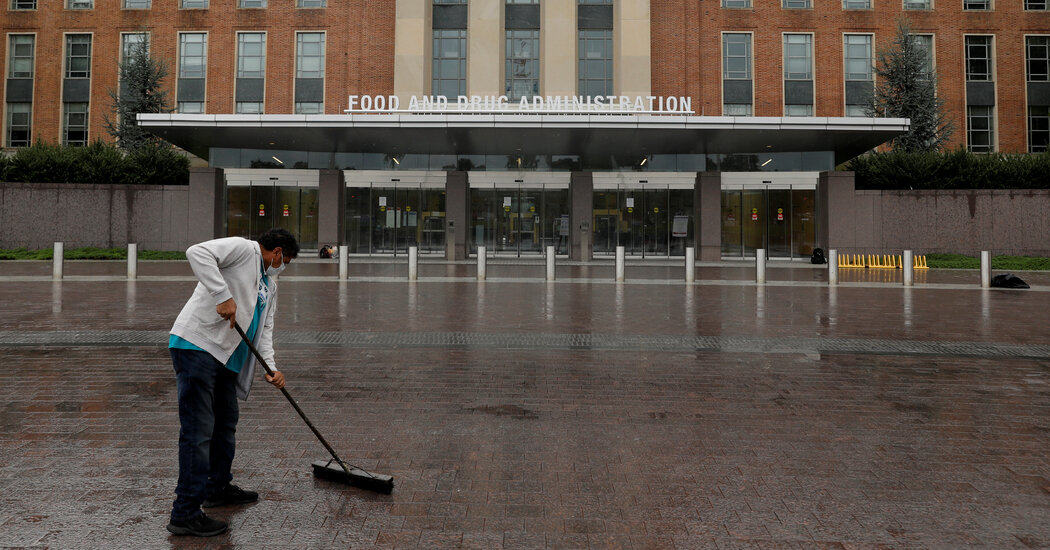
Though some of its own senior officials said there was little evidence of benefit for patients, the F.D.A. nonetheless greenlighted Biogen’s Aduhelm, or aducanumab.Two months before the Food and Drug Administration’s deadline to decide whether to approve Biogen’s controversial Alzheimer’s drug aducanumab, a council of senior agency officials resoundingly agreed that there wasn’t enough evidence it worked.The council, a group of 15 officials who review complex issues, concluded that another clinical trial was necessary before approving the drug. Otherwise, one council member noted, approval could “result in millions of patients taking aducanumab without any indication of actually receiving any benefit, or worse, cause harm,” according to minutes of the meeting, obtained by The New York Times.“It is critical that the decision be made from a place of certainty,” the minutes said.The session, whose details have not been reported before, represented at least the third time that proponents of approving aducanumab in the F.D.A. had received a clear message that the evidence did not convincingly show the drug could slow cognitive decline.On June 7, the F.D.A. greenlighted the drug anyway — a decision that has been met with scathing rebuke from many Alzheimer’s experts and other scientists and calls for investigations into how the agency approved a treatment that has little evidence it helps patients.How and why the F.D.A. went ahead and approved the drug — an intravenous infusion, marketed as Aduhelm, that the company has since priced at $56,000 a year — has become the subject of intense scrutiny. Two congressional committees are investigating the approval and the price. Much is still unknown, but an examination by The Times has found that the process leading to approval took several unusual turns, including a decision for the F.D.A. to work far more closely with Biogen than is typical in a regulatory review.Allegations about the collaboration prompted the F.D.A. to conduct an internal inquiry after a consumer advocacy group called for an inspector general’s investigation, according to documents reviewed by The Times. The agency has not disclosed the inquiry.Though the decision was considered one of the agency’s most consequential and controversial in years, its leader, Dr. Janet Woodcock, the acting commissioner, was not involved in the deliberations and left the final ruling to the head of the center responsible for drug applications, the agency confirmed.Dr. Janet Woodcock, the acting F.D.A. commissioner, recently called for an inspector general to investigate the agency’s approval process.Al Drago/BloombergIn written responses to questions from The Times, the F.D.A. defended its decision to approve the drug — the first for Alzheimer’s in 18 years.“The agency did not lower its standards,” the F.D.A. said, adding, “and at no time considered doing so.”The decision, the agency said, was “informed by science, medicine, policy, and judgment, in accordance with applicable legal and regulatory standards.”In written answers to questions, Biogen said, “Biogen stands 100 percent behind Aduhelm and the clinical data that supported its approval.”Facing mounting pressure, Dr. Woodcock recently called for an inspector general to investigate the agency’s approval process. Dr. Woodcock has publicly acknowledged “process problems,” but has not described what those problems were.“This incident has shaken F.D.A. integrity quite significantly,” said Wayne Pines, a former F.D.A. senior official who has written histories about the agency. “The F.D.A. is obligated to be sure that all stones are turned over, that every avenue is pursued to make sure that this was a decision that was made on the basis of scientific judgment and not on the basis of anything else.”While some Alzheimer’s experts did support the drug’s approval given the dearth of treatment choices for patients, many say it was a mistake to approve a medication with such unclear evidence of benefit and that trials showed can cause brain swelling or brain bleeding..css-1xzcza9{list-style-type:disc;padding-inline-start:1em;}.css-3btd0c{font-family:nyt-franklin,helvetica,arial,sans-serif;font-size:1rem;line-height:1.375rem;color:#333;margin-bottom:0.78125rem;}@media (min-width:740px){.css-3btd0c{font-size:1.0625rem;line-height:1.5rem;margin-bottom:0.9375rem;}}.css-3btd0c strong{font-weight:600;}.css-3btd0c em{font-style:italic;}.css-w739ur{margin:0 auto 5px;font-family:nyt-franklin,helvetica,arial,sans-serif;font-weight:700;font-size:1.125rem;line-height:1.3125rem;color:#121212;}#NYT_BELOW_MAIN_CONTENT_REGION .css-w739ur{font-family:nyt-cheltenham,georgia,’times new roman’,times,serif;font-weight:700;font-size:1.375rem;line-height:1.625rem;}@media (min-width:740px){#NYT_BELOW_MAIN_CONTENT_REGION .css-w739ur{font-size:1.6875rem;line-height:1.875rem;}}@media (min-width:740px){.css-w739ur{font-size:1.25rem;line-height:1.4375rem;}}.css-9s9ecg{margin-bottom:15px;}.css-uf1ume{display:-webkit-box;display:-webkit-flex;display:-ms-flexbox;display:flex;-webkit-box-pack:justify;-webkit-justify-content:space-between;-ms-flex-pack:justify;justify-content:space-between;}.css-wxi1cx{display:-webkit-box;display:-webkit-flex;display:-ms-flexbox;display:flex;-webkit-flex-direction:column;-ms-flex-direction:column;flex-direction:column;-webkit-align-self:flex-end;-ms-flex-item-align:end;align-self:flex-end;}.css-12vbvwq{background-color:white;border:1px solid #e2e2e2;width:calc(100% – 40px);max-width:600px;margin:1.5rem auto 1.9rem;padding:15px;box-sizing:border-box;}@media (min-width:740px){.css-12vbvwq{padding:20px;width:100%;}}.css-12vbvwq:focus{outline:1px solid #e2e2e2;}#NYT_BELOW_MAIN_CONTENT_REGION .css-12vbvwq{border:none;padding:10px 0 0;border-top:2px solid #121212;}.css-12vbvwq[data-truncated] .css-rdoyk0{-webkit-transform:rotate(0deg);-ms-transform:rotate(0deg);transform:rotate(0deg);}.css-12vbvwq[data-truncated] .css-eb027h{max-height:300px;overflow:hidden;-webkit-transition:none;transition:none;}.css-12vbvwq[data-truncated] .css-5gimkt:after{content:’See more’;}.css-12vbvwq[data-truncated] .css-6mllg9{opacity:1;}.css-qjk116{margin:0 auto;overflow:hidden;}.css-qjk116 strong{font-weight:700;}.css-qjk116 em{font-style:italic;}.css-qjk116 a{color:#326891;-webkit-text-decoration:underline;text-decoration:underline;text-underline-offset:1px;-webkit-text-decoration-thickness:1px;text-decoration-thickness:1px;-webkit-text-decoration-color:#326891;text-decoration-color:#326891;}.css-qjk116 a:visited{color:#326891;-webkit-text-decoration-color:#326891;text-decoration-color:#326891;}.css-qjk116 a:hover{-webkit-text-decoration:none;text-decoration:none;}Two nearly identical late-stage clinical trials of aducanumab were shut down in 2019 because an independent monitoring committee concluded that the drug did not appear to be helping patients. A later analysis by Biogen found that participants receiving the highest dose of aducanumab in one trial experienced a very slight slowing of cognitive decline, but participants in the other trial did not benefit at all.Analysts have predicted that the drug could bring Biogen billions of dollars. But since the approval, some major medical centers have decided not to offer it, and the American Neurological Association’s executive committee told the doctors who are its members that “based on the clinical evidence, Aduhelm should not have been approved at this time.”Even some scientists who were involved in earlier phases of the company’s aducanumab research said in interviews that they did not agree with the F.D.A.’s decision.“This approval shouldn’t have happened,” said Dr. Vissia Viglietta, a former Biogen senior medical director, who helped design the two late-stage clinical trials of the drug. “It defeats everything I believe in scientifically and it lowers the rigor of regulatory bodies.”Because of that, “I felt really deflated personally,” Dr. Viglietta said, adding, “This was not the reason why my team and I did the work we did designing the study.”In announcing its approval in June, the F.D.A. acknowledged there was not sufficient evidence that the drug would help patients. Instead, it said it was greenlighting Aduhelm under a program called “accelerated approval,” which allows the authorization of drugs without persuasive proof of benefit if they are for serious diseases with few treatment options and if the drug affects part of the disease’s biology (known as a biomarker) in a way that is “reasonably likely to predict clinical benefit.”The reason the agency gave — that the drug reduces a key protein that clumps into plaques in the brains of people with Alzheimer’s — is one that the agency official leading the aducanumab review had said in an earlier public meeting would not be used. Many Alzheimer’s experts say there is not nearly enough evidence that reducing the protein, amyloid, slows memory and thinking problems.Even some former employees at Biogen involved in earlier phases of the work on Aduhelm did not agree with the F.D.A.’s approval of the drug.CJ Gunther/EPA, via ShutterstockMany of the questions surrounding the approval of the drug have centered on the close working relationship the F.D.A. and Biogen seemed to have during the application process. That included meeting several times a week in the summer of 2019 to jointly assess the data and chart a path forward, as well as a joint Biogen-F.D.A. presentation to a committee of independent experts.After receiving letters in December and January from the consumer advocacy group Public Citizen calling for an inspector general’s investigation of the collaboration, the F.D.A. began an internal review focusing on the issue.The inquiry took place during the spring, as the decision deadline on the drug loomed, and was conducted by an office in the Center for Drug Evaluation and Research. The center includes the office that led the aducanumab assessment. Public Citizen said it was not informed that the inquiry was taking place. Biogen said the F.D.A. had not contacted the company in the inquiry.It is unclear what the internal review concluded. Michael Felberbaum, a spokesman for the F.D.A., said the agency would have no comment while the issue of close collaboration is the subject of external investigations.The approval was the culmination of a roller-coaster journey for aducanumab, which seemed to be dead when the trials were aborted in March 2019. Less than two months later, Biogen decided that because its subsequent analysis had found a slight benefit for patients on the high dose in one trial, it would revive its effort to get the drug approved.That May, Dr. Al Sandrock, Biogen’s chief medical officer, scheduled an informal meeting with Dr. Billy Dunn, director of the F.D.A. office that reviews Alzheimer’s drugs, at a neurology conference they both attended. At the meeting, first reported by the medical news organization STAT and confirmed by The Times, Dr. Sandrock showed the regulator some data underlying the new analysis. The discussion led to a formal meeting several weeks later on the F.D.A. campus. There, according to minutes of the meeting, Biogen and Dr. Dunn’s team decided that “it is imperative that extensive resources be brought to bear on achieving a maximum understanding of the existing data” on aducanumab.“Given the wholly unique situation that is the current state of the aducanumab development program,” the minutes say, “further analyses would best be conducted as part of a bilateral effort involving the agency and sponsor, i.e. through a ‘workstream’ or ‘working group’ collaboration.”Biogen said the idea for collaboration was proposed by the F.D.A. and was “carefully structured and documented, and in effect, allowed for an appropriate deep dive analysis by the F.D.A.”The F.D.A. said it “often works closely with industry,” especially “where there is a significant need for treatments for devastating diseases.”When Biogen officials presented what had happened to the company’s board of directors, “people were just blown away that this would be the situation and that aducanumab actually might have a forward path,” said a person familiar with the session.As the process unfolded, a former employee was surprised by the collaborative workstream, saying “what I was shocked by was just how close the interaction was between the teams.”While aducanumab was in trials, Dr. Dunn and Samantha Budd Haeberlein, who oversaw the drug’s clinical development for Biogen, worked together on several other projects, interactions that some scientists, former F.D.A. officials and former Biogen employees said they thought blurred the expected boundary between a regulator and an official of a company in that regulator’s purview.The projects included a framework for understanding the biology of Alzheimer’s disease published in 2018 as part of a work group convened by Maria Carrillo, chief science officer of the Alzheimer’s Association, a patient advocacy group that later pushed for aducanumab’s approval. That effort led to new F.D.A. guidance for reviewing Alzheimer’s drugs drafted by Dr. Dunn’s team.Dr. Dunn and Dr. Budd Haeberlein also made joint presentations or appeared together on conference panels several times during the aducanumab trials. William B. Schultz, who served as a deputy F.D.A. commissioner and general counsel for the Department of Health and Human Services, the F.D.A.’s parent agency, said such interactions were ill-advised.“It is not appropriate for F.D.A. officials to collaborate on publications and presentations with employees of companies with applications pending before those very officials,” he said. “It undermines the essential arm’s-length relationship between the regulator and the regulated industry and destroys the F.D.A.’s credibility as the government agency entrusted with the critical responsibility of deciding the safety and efficacy of drugs.”The F.D.A. said “it is part of the agency’s role to participate” in the group developing the Alzheimer’s framework, but declined to comment about the joint presentations or say whether Dr. Dunn’s participation in them was cleared beforehand.Asked about Dr. Budd Haeberlein’s working relationship with the F.D.A. official, Dr. Priya Singhal, Biogen’s head of global safety and regulatory sciences, said: “Relationships do not govern the regulatory process or its outcomes. There is no relationship that would override data gaps.”Last November, Biogen and Dr. Dunn’s team presented a joint review to an advisory committee of independent experts outside the agency who were tasked with voting on whether aducanumab was ready for approval. Usually, a company and F.D.A. reviewers give separate presentations.The joint presentation asserted that there was “substantial evidence of effectiveness to support approval” and, in language that a former F.D.A. official said was unusually effusive for a scientific presentation, described the single positive trial — which showed that the high dose slowed decline by 0.39 on an 18-point scale — as “exceptionally persuasive.”That was not the conclusion of every F.D.A. division. The agency’s biostatistical office had reached an opposite assessment, writing in a separate review presented to the committee that “there is no compelling, substantial evidence of treatment effect or disease slowing.”At the end of the daylong meeting, the advisory committee overwhelmingly agreed with the biostatistical assessment. To the question of whether there was enough evidence the drug would help patients, 10 members of the panel voted no and one was uncertain. There were no yes votes.“To have a virtually unanimous vote against approval and then to have the F.D.A. turn around and approve — that’s never happened,” said Mr. Pines, the former F.D.A. official, who now directs the health practice at APCO, a public relations firm.Henry Magendantz, a participant in the Aduhelm clinical trial, finished receiving an infusion of the drug at Butler Hospital in Rhode Island in May.Kayana Szymczak for The New York TimesFor months after the advisory committee meeting, Dr. Dunn and his team continued to work toward conventional approval of the drug.But when the case was presented to the agency’s Medical Policy and Program Review Council, meeting on March 31 and April 7, the vast majority of the 15 members said the evidence did not meet the threshold for “instilling public confidence in the usefulness of the drug,” according to the minutes. Another trial was necessary, the council agreed, but could be “a shorter and more efficient trial,” countering the contention from approval advocates that another trial would take years.Although the council, which advises on but doesn’t make approval decisions, recognized that some patients would accept the drug “despite the uncertainties,” the minutes say, “the council, however, stressed that this should not influence the regulatory decision.”The idea of accelerated approval came up briefly toward the end, raised by Dr. Rick Pazdur, head of F.D.A.’s oncology center, who was not a council member. It was not discussed in detail, but after the meeting, given the council’s rejection of standard approval, accelerated approval appeared to be the only way to make the drug available.On April 26, Dr. Patrizia Cavazzoni, Dr. Dunn’s boss and director of the Center for Drug Evaluation and Research, led a smaller meeting about accelerated approval, which had never been used for Alzheimer’s drugs.In fact, the F.D.A.’s most recent guidance for Alzheimer’s drugs, issued by Dr. Dunn in 2018, says “the standard for accelerated approval” had not yet been met for the disease, “despite a great deal of research.” The guidance says that is because “there is unfortunately at present no sufficiently reliable evidence” that attacking amyloid plaques or other biomarkers of Alzheimer’s “would be reasonably likely to predict clinical benefit.”And at the November advisory committee meeting, Dr. Dunn said that in considering whether to approve aducanumab, “we’re not using the amyloid as a surrogate for efficacy.” Under accelerated approval, while a drug is on the market, a company must conduct an additional trial, a costly undertaking. Biogen said its goal was standard approval, which it believed its data warranted. At the April 26 meeting, Dr. Cavazzoni invited two officials not involved with neurological drugs who had used accelerated approval frequently: Dr. Pazdur and Dr. Peter Marks, the top vaccine regulator. They and Dr. Cavazzoni voted to grant such approval to aducanumab, as did Dr. Issam Zineh, director of the Office of Pharmacology, and Dr. Jacqueline Corrigan-Curay, who led the internal review of the F.D.A-Biogen collaboration.The director of the office of translational sciences, Dr. ShaAvhrée Buckman-Garner — who supervises both the pharmacology and biostatistics offices — did not vote yes or no, saying she understood both arguments. The only clear no vote, F.D.A. documents say, was the director of the office of biostatistics, Dr. Sylva Collins, “stating her belief that there is insufficient evidence to support accelerated approval or any other type of approval.”Mr. Felberbaum, the F.D.A. spokesman, said the agency “concluded that the reduction in amyloid beta plaques was reasonably likely to predict clinical benefit, meeting the requirements for an accelerated approval.”The 2018 guidance “no longer reflects the current state of the science,” he said, citing data from aducanumab and earlier-stage trials of other anti-amyloid drugs, evidence that many Alzheimer’s experts say is not strong enough to link reduction in amyloid to the likelihood of slowing cognitive decline.In its written responses to The Times, the agency added that its decision took into account that patients expressed “their willingness to accept some uncertainty about clinical benefit to get earlier access to a potentially clinically valuable drug.”On April 28, Biogen was told that aducanumab was now being considered for accelerated approval instead of standard approval, according to documents obtained by The Times.The documents also show that Biogen submitted draft language for a label stating which patients should be eligible for the treatment, a common step in the final stages of a drug review for possible approval. Up until about a week before approval was announced, the label listed “contraindications” — medical conditions that should preclude patients from getting the drug. The final approval label, however, has only one word under contraindications: “None.”The F.D.A. said it does not comment on labeling negotiations. Biogen said that after “thoughtful consideration,” the conclusion was that it should be up to “the treating physician in the real-world” to decide which patients receive the drug.Another change was made to the proposed label. Before approval, it said the drug’s purpose was “to delay clinical decline in patients with Alzheimer’s disease.”But after a comment was put in the margin, the language was changed to “for the treatment of Alzheimer’s disease.” The note said the F.D.A.’s office of prescription drug promotion “is concerned with the promotional implication of the phrase ‘to delay clinical decline’ considering that this product is being approved under accelerated approval.”“In a promotional context,” the note cautioned, “the phrase suggests a guarantee of efficacy.”

Read more →

Covid: Which children can have the vaccine in the UK?

Hundreds of thousands of under-18s will now be offered the Covid vaccine in the UK.They’ll get the Pfizer-BioNTech vaccine, as that’s the only one which has been approved for 12 to 17-year-olds – so far.However, the news means that most children still aren’t eligible for the jab – in keeping with guidance from the Joint Committee on Vaccination and Immunisation (JCVI).BBC health reporter Laura Foster explains why, and why that might change in the future.

Read more →

White House Dispute Exposes Facebook Blind Spot on Misinformation

The company doesn’t know some specifics about how falsehoods about Covid-19 and vaccines for the virus spread on its social network.SAN FRANCISCO — At the start of the pandemic, a group of data scientists at Facebook held a meeting with executives to ask for resources to help measure the prevalence of misinformation about Covid-19 on the social network.The data scientists said figuring out how many Facebook users saw false or misleading information would be complex, perhaps taking a year a more, according to two people who participated in the meeting. But they added that by putting some new hires on the project and reassigning some existing employees to it, the company could better understand how incorrect facts about the virus spread on the platform.The executives never approved the resources, and the team was never told why, according to the people, who requested anonymity because they were not authorized to speak to reporters.Now, more than a year later, Facebook has been caught in a firestorm about the very type of information that the data scientists were hoping to track.The White House and other federal agencies have pressed the company to hand over data about how anti-vaccine narratives spread online, and have accused Facebook of withholding key information. President Biden on Friday accused the company of “killing people” by allowing false information to circulate widely. On Monday, he walked that back slightly, instead directing blame at people who originate falsehoods.“Anyone listening to it is getting hurt by it,” Mr. Biden said. He said he hoped that instead of “taking it personally,” Facebook would “do something about the misinformation.”The company has responded with statistics on how many posts containing misinformation it has removed, as well as how many Americans it has directed to factual information about the government’s pandemic response. In a blog post on Saturday, Facebook asked the Biden administration to stop “finger-pointing,” and casting blame on Facebook after missing its goal of vaccinating 70 percent of American adults by July 4.“Facebook is not the reason this goal was missed,” Guy Rosen, Facebook’s vice president of integrity, said in the post.But the pointed back-and-forth struck an uncomfortable chord for the company: It doesn’t actually know many specifics about how misinformation about the coronavirus and the vaccines to combat it have spread. That blind spot has reinforced concerns among misinformation researchers over Facebook’s selective release of data, and how aggressively — or not — the company has studied misinformation on its platform.“The suggestion we haven’t put resources toward combating Covid misinformation and supporting the vaccine rollout is just not supported by the facts,” said Dani Lever, a Facebook spokeswoman. “With no standard definition for vaccine misinformation, and with both false and even true content (often shared by mainstream media outlets) potentially discouraging vaccine acceptance, we focus on the outcomes — measuring whether people who use Facebook are accepting of Covid-19 vaccines.”Executives at Facebook, including its chief executive, Mark Zuckerberg, have said the company committed to removing Covid-19 misinformation since the start of the pandemic. The company said it had removed over 18 million pieces of Covid-19 misinformation since the start of the pandemic.Experts who study disinformation said the number of pieces that Facebook removed was not as informative as how many were uploaded to the site, or in which groups and pages people were seeing the spread of misinformation.“They need to open up the black box that is their content ranking and content amplification architecture. Take that black box and open it up for audit by independent researchers and government,” said Imran Ahmed, chief executive of the Center for Countering Digital Hate, a nonprofit that aims to combat disinformation. “We don’t know how many Americans have been infected with misinformation.”Mr. Ahmed’s group, using publicly available data from CrowdTangle, a Facebook-owned program, found that 12 people were responsible for 65 percent of the Covid-19 misinformation on Facebook. The White House, including Mr. Biden, has repeated that figure in the past week. Facebook says it disagrees with the characterization of the “disinformation dozen,” adding that some of their pages and accounts were removed, while others no longer post content that violate Facebook’s rules.Renée DiResta, a disinformation researcher at Stanford’s Internet Observatory, called on Facebook to release more granular data, which would allow experts to understand how false claims about the vaccine were affecting specific communities within the country. The information, which is known as “prevalence data,” essentially looks at how widespread a narrative is, such as what percentage of people in a community on the service see it.“The reason more granular prevalence data is needed is that false claims don’t spread among all audiences equally,” Ms. DiResta said. “In order to effectively counter specific false claims that communities are seeing, civil society organization and researchers need a better sense of what is happening within those groups.”Many employees within Facebook have made the same argument. Brian Boland, a former Facebook vice president in charge of partnerships strategy, told CNN on Sunday that he had argued while at the company that it should publicly share as much information as possible. When asked about the dispute with the White House over Covid misinformation, he said, “Facebook has that data.”“They look at it,” Mr. Boland. But he added: “Do they look at it the right way? Are they investing in the teams as fully as they should?”`Mr. Boland’s comments were widely repeated as evidence that Facebook has the requested data but is not sharing it. He did not respond to a request for comment from The New York Times, but one of the data scientists who pushed inside Facebook for deeper study of coronavirus misinformation said the problem was more about whether and how the company studied the data.Technically, the person said, the company has data on all content that moves through its platforms. But measuring and tracking Covid misinformation first requires defining and labeling what qualifies as misinformation, something the person said the company had not dedicated resources toward.Some at Facebook have suggested the government, or health officials, should be the ones who define misinformation. Only once that key baseline is set can data scientists begin to build out systems known as qualifiers, which measure the spread of certain information.Given the billions of individual pieces of content posted to Facebook daily, the undertaking of measuring, tracking and ultimately calculating the prevalence of misinformation would be a huge task, the person said.The meeting held at the start of the pandemic was not the only time Facebook had internal discussions about how to track misinformation.Members of Facebook’s communications team raised the question of prevalence as well, telling executives last summer and fall that it would be useful for disputing articles by journalists who used CrowdTangle to write articles about the spread of anti-vaccine misinformation, according to a Facebook employee involved in those discussions.After the 2016 presidential election, Mr. Zuckerberg sought a similar statistic on how much “fake news” Americans had seen leading up to it, a member of Facebook’s communications team said. One week after the vote, Mr. Zuckerberg published a blog post saying the false news had amounted to “less than 1 percent,” but the company did not clarify that estimate or give more details despite being pressed by reporters.Months later, Adam Mosseri, a Facebook executive who was then the head of NewsFeed, said part of the problem was that “fake news means different things to different people.”Davey Alba

Read more →

The American Academy of Pediatrics recommends universal masking in schools this fall.

The American Academy of Pediatrics issued new Covid-19 guidelines for schools on Monday, recommending that everyone over age 2 wear masks this fall, even if they have been vaccinated. Exceptions may be made for those with medical or developmental conditions that complicate mask wearing, the group said. The universal masking recommendation is a departure from the guidance issued by the Centers for Disease Control and Prevention earlier this month, which recommend masking in schools only for unvaccinated people over age 2. Those guidelines heavily implied that fully vaccinated children and adults would not need to wear masks in the classroom — although they also said that individual schools were free to implement universal mask mandates.In many other ways, however, the two sets of guidelines are similar. The A.A.P., like the C.D.C., emphasized the importance of returning to in-person learning.“We need to prioritize getting children back into schools alongside their friends and their teachers — and we all play a role in making sure it happens safely,” Dr. Sonja O’Leary, the chair of the A.A.P. Council on School Health, said in a statement. Like the C.D.C., the A.A.P. recommended a “layered” approach that combines a variety of measures to reduce the risk of coronavirus transmission. In addition to universal masking, those measures include vaccination, improved ventilation, virus testing, quarantines, and cleaning and disinfection, the group said. The A.A.P. laid out several reasons for its universal masking recommendation. Many students are too young to be eligible for the vaccines, which are authorized only for those ages 12 and older, the group noted. And universal masking could reduce overall transmission of the virus, helping to protect those who are unvaccinated. The group also cited concerns about more transmissible virus variants and the possibility that vaccination rates could be low in the surrounding community, which could raise the risk of an outbreak at a particular school. The A.A.P. recommended universal masking also because it may be difficult to verify whether individual students or staff members have been vaccinated.Some state and local officials have already announced that they will not require universal masking in the fall, and at least eight states have banned such mandates. The A.A.P. guidance stopped short of outright recommending vaccine mandates, but said that they may ultimately be needed. “It may become necessary for schools to collect Covid-19 vaccine information of staff and students and for schools to require Covid-19 vaccination for in-person learning,” the guidelines said. The A.A.P. also encouraged families to ensure that students catch up on any other childhood vaccines they may have missed during the pandemic.

Read more →

Dr. Paul Auerbach, Father of Wilderness Medicine, Dies at 70

He pioneered a new branch of emergency medicine — when emergency rooms are nowhere to be found — and helped compile the definitive textbook on health care in the wild.Dr. Paul Auerbach, an emergency care physician who pioneered the field of wilderness medicine in the 1980s and then taught ways to heal people injured by the unpredictable, died on June 23 at his home in Los Altos, Calif. He was 70.His wife, Sherry Auerbach, said the cause was brain cancer.Out in the wild, knowing how to treat a venomous snake bite or a gangrenous infection can mean the difference between life and death. In the 1970s, however, the specialized field of health care known as wilderness medicine was still in its infancy. Then Dr. Auerbach showed up.A medical student at Duke University at the time, he went to work in 1975 as an intern with the Indian Health Service on a Native American reservation in Montana, and the experience was revelatory.“We saw all kinds of cases that I would have never seen at Duke or frankly anywhere else except on the reservation,” Dr. Auerbach said in a recent interview given to Stanford University, where he taught for many years. “Snakebites. Drowning. Lightning strike.”“And I just thoroughly enjoyed it,” he continued. “Taking care of people with very limited resources.”Back at Duke he tried to learn more about outdoor medicine, but he struggled to find resource material.“I kept going back to literature to read, but there was no literature,” he said. “If I wanted to read about snake bites, I was all over the place. If I wanted to read about heat illness, I was all over the place. So I thought, ‘Huh, maybe I’ll do a book on wilderness medicine.’”Dr. Auerbach started researching material for the book in 1978, when he began his medical residency at U.C.L.A., finding the time to do so despite grueling 12-hour hospital shifts. He collected information about how to treat burn wounds, hypothermia, frostbite and lighting injuries. He interviewed hikers, skiers and divers. And he assigned chapters to doctors who were passionate about the outdoors.The resulting book, “Management of Wilderness and Environmental Emergencies,” which he edited with a fellow student, Edward Geehr, was published in 1983 and is widely considered the definitive textbook in the field. Updated by Dr. Auerbach over 30 years, it is in its seventh edition and now titled “Auerbach’s Wilderness Medicine,” with sections like “Protection From Blood-Feeding Arthropods” and “Aerospace Medicine: The Vertical Frontier.”“Paul literally conceived of this subspecialty of medicine,” said Dr. Andra Blomkalns, chair of emergency medicine at Stanford. “At the time, there wasn’t a recognition that things happen when you’re out doing things. He developed this notion of, ‘Things happen to people all the time.’ Which is now a big part of our identity in emergency medicine.”In the early 1980s, hearing from doctors and nurses with similar interests in outdoor medicine, Dr. Auerbach founded the Wilderness Medical Society with Dr. Geehr and Dr. Ken Kizer. The group is now the largest membership organization in its field and has hosted events like a trek to a Mount Everest base camp and a trip to a station in the Utah desert that simulates life on Mars.Dr. Auerbach joined Stanford as chief of its emergency medicine division in 1991. He left the university four years later to work in the private health care sector before returning to the university in 2005 and remaining there until his retirement last year.He became an elder statesman in his field. He spoke at conferences around the world, in one case describing how the erectile-dysfunction pill Viagra can be used to treat high altitude pulmonary edema because it reduces artery pressure.In his wilderness medicine classes at Stanford, Dr. Auerbach taught his students, foremost, to respect the outdoors“When house staff and residents and young doctors say, ‘How do I learn wilderness medicine?’ My very first answer to them always is, ‘Learn the wilderness first,” he said in the Stanford interview. “Because you can’t help anybody if you’re just scrambling to keep yourself alive.”Dr. Auerbach and a young patient in 2010 after he had traveled to Haiti as a medical volunteer in the wake of a devastating earthquake there.Chuck Liddy/The News & ObserverIn 2010, when an earthquake devastated Haiti, Dr. Auerbach traveled to the country with a team of emergency medical workers, and despite his years of experience, he found the trip harrowing. A few years later, when an earthquake hit Nepal, he went there to assist with emergency care and later helped establish a hospital there.Dr. Auerbach said it was imperative never to get too comfortable when dealing with the whims of nature. “You have to be afraid when you go into work,” he said. “You have to stay humble.”Paul Stuart Auerbach was born on Jan. 4, 1951, in Plainfield, N.J. His father, Victor, was a patents manager for Union Carbide. His mother, Leona (Fishkin) Auerbach, was a teacher. Paul was a wrestling star in high school and grew up spending summers on the Jersey Shore.He graduated from Duke in 1973 with a bachelor’s degree in religion and then enrolled in Duke’s medical school. He met Sherry Steindorf at U.C.L.A., and they were married in 1982. (In the 1980s he worked part-time as a swimsuit model for the swimwear company Laguna.) Dr. Auerbach studied at Stanford’s business school shortly before joining the university’s medical faculty in 1991.In addition to his wife, he is survived by two sons, Brian and Daniel; a daughter, Lauren Auerbach Dixon; his mother; a brother, Burt; and a sister, Jan Sherman.As he grew older, Dr. Auerbach became increasingly devoted to expanding the field of wilderness medicine. In revising his textbook, he added sections about handling environmental disasters, and, with Jay Lemery, he wrote “Enviromedics: The Impact of Climate Change on Human Health,” published in 2017.Last year, shortly before he received his cancer diagnosis, the coronavirus pandemic began to take hold, and Dr. Auerbach decided to act.“The minute it all first happened, he started working on disaster response,” his wife said. “Hospitals were running out of PPE. He was calling this person and that person to learn as much as he could. He wanted to find out how to design better masks and better ventilators. He never stopped.”

Read more →

Heart Failure Tied to Increased Cancer Risk, Study Finds

People with heart failure may live for many years and should continue to get regular cancer screenings, experts say.People with heart failure may be at increased risk for cancer.Cancer patients are usually monitored for heart failure because some cancer drugs can damage the heart. Now a new study suggests that heart failure patients, who may live for many years with the condition, might benefit by being monitored for cancer.Researchers used a German health database to track 100,124 patients with heart failure, comparing them with the same number of controls who did not have heart failure. All were cancer-free at the start, and the scientists tracked their incidence of cancer over the following 10 years. The study is in the journal ESC Heart Failure.The two groups were matched for age, sex, age, obesity and the incidence of diabetes, although the researchers lacked data on socioeconomic status, smoking, alcohol consumption and physical activity, which are all known to affect the risk for cancer.Still, the differences in cancer incidence between the two groups were significant. Overall, 25.7 percent of patients with heart failure were diagnosed with some form of cancer, compared with 16.2 percent of those without.The increased rate of cancer among heart patients has been found in other studies, but the large sample in this analysis allowed the researchers to note differences between types of cancer. Patients with heart failure had more than double the risk for cancers of the lip, oral cavity and pharynx. The risk was 91 percent higher for lung cancer and other respiratory cancers, 86 percent higher for female genital cancers, and 83 percent higher for skin cancers. People with heart failure had a 75 percent higher risk for colon cancer, stomach cancer and other cancers of the digestive system. Women with heart failure had a 67 percent higher risk for breast cancer, and men a 52 percent higher risk for cancer of the genital organs.“I think it is an interesting retrospective cohort study,” said Dr. Girish L. Kalra, a senior cardiology fellow at the David Geffen School of Medicine at U.C.L.A., who was not involved in the work. “The primary shortcoming of the study is that the database did not allow investigators to control for the single greatest risk for developing cancer and heart disease: smoking. Cigarette smoking may be the common thread in this study.”Still, while the strong connection with oropharyngeal and respiratory cancers suggests that smoking may be one explanation, the association remained robust for a broad range of cancers. The study also controlled for other factors linked to various cancers, including obesity, diabetes and advancing age, as well as frequency of medical consultations, which might lead to increased detection of cancers.In addition to smoking, there are other possible mechanisms that could explain the link. For example, a previous study found that a well-known protein biomarker of heart disease that appears even before symptoms occur is also correlated with an increase in the risk for cancer. It is also possible, the researchers write, that chronic inflammation may be involved in both heart failure and cancer. Alcohol use has also been tied to a variety of cancers.“There are more correlations between heart failure and cancer than just common risk factors,” said the senior author, Mark Luedde, a cardiologist at the University of Kiel in Germany. “Heart failure is not a disease of the heart. It is almost always a disease of the heart and other organs. The importance of comorbidities for the prognosis and quality of life of those affected cannot be overestimated.”Dr. Kalra agreed. “Ultimately, the heart is a bellwether for all health,” he said. “This study supports the notion that people with heart failure are a high-risk group and warrant our closest attention. As physicians, we should make sure that our cardiac patients are getting screened for cancer at the recommended time intervals. And we should continue to nag our smokers to quit.”

Read more →

New study examines commuter characteristics and traffic pollution exposure among commuters

New research examines commuter characteristics to better understand how factors such as departure time, frequency, and commute length are associated with exposure to air pollution. Using personal air pollution monitors, the research clustered commuters to determine whether these clusters were associated with traffic pollution exposures. The study reveals that commuters that travel during rush hour have higher overall exposure to traffic-related air pollution compared to sporadic commuters, though the difference was not statistically significant.
The link between on-road traffic and air pollution is well-known, as are the negative health impacts of pollution exposure. However, the many factors that may influence commuters’ exposure to pollutants — such as frequency, time, and duration of commute — and the overall impact of commuting remains a matter of on-going scientific discovery.
Dr. Jenna Krall, assistant professor at the George Mason University College of Health and Human Services, is using statistical methods to better understand exposure to air pollution. Krall studies how commuting patterns impact exposure to fine particulate matter (PM2.5) from various traffic-related sources such as tailpipe emissions, road salts, and brake wear.
New research from Krall and colleagues published in Environmental Research examines commuter characteristics to better understand how factors such as departure time, commute length, and number of trips are associated with exposure to PM2.5. Building on a study of 46 women’s exposure to PM2.5 using personal air pollution monitors, the new research clustered commuters to determine whether these clusters were associated with traffic pollution exposures. The new study reveals that commuters that travel to work during rush hour have higher overall exposure to traffic-related air pollution compared to sporadic commuters, though the difference was not statistically significant.
As COVID-19 infection rates decline in most areas of the country and employers weigh whether to continue work-from-home policies, studies such as this provide important insight into the role that daily commutes can play in personal air pollution exposure and the public’s health.
“This is one of the first studies to utilize in-vehicle monitoring, specifically on-board diagnostics data loggers, to understand real-world commuting behaviors for environmental health,” said Krall, “Linking these data with personal air pollution monitoring allowed us to better understand how commuter characteristics are associated with sources of air pollution exposures.”
“The current research cannot tell us whether modifying commutes, for example by avoiding highways or commuting outside of rush hour, will lower traffic pollution exposures for commuters. More research is needed to determine what changes would be effective to lower exposures,” says Krall.
Krall’s on-going research seeks to distinguish between similar sources of traffic pollution, such as pollution generated by brake wear or from tailpipe emissions, and to develop statistical methods to better estimate exposure to pollution sources.
Study participants included 46 women commuters in northern Virginia who were exposed to pollution generated by mobile vehicles, road salts, and other sources throughout a 48-hour period.
Story Source:
Materials provided by George Mason University. Note: Content may be edited for style and length.

Read more →