New biosensors shine a light on CRISPR gene editing

Detecting the activity of CRISPR gene editing tools in organisms with the naked eye and an ultraviolet flashlight is now possible using technology developed at the Department of Energy’s Oak Ridge National Laboratory.
Scientists demonstrated these real-time detection tools in plants and anticipate their use in animals, bacteria and fungi with diverse applications for biotechnology, biosecurity, bioenergy and agriculture. The team described the successful development of the UV system in Horticulture Research and their proof-of-principle demonstration in ACS Synthetic Biology.
CRISPR technologies have quickly become the primary tools of bioengineering, and new versions are continually in development. Identifying whether an organism has been modified by CRISPR technology was previously a complex and time-consuming process.
“Before this, the only way to tell if genome engineering occurred was to do a forensic analysis,” said Paul Abraham, a bioanalytical chemist and head of ORNL’s Secure Ecosystem Engineering and Design Science Focus Area. “To be successful, you would need to know what the genome looked like before it was rewritten. We wanted to design a platform where we could proactively observe CRISPR activity.”
The research team developed an efficient self-detect solution that takes advantage of the way CRISPR works to trigger the technology to reveal itself. Under normal conditions, CRISPR works by connecting with a short RNA sequence, known as the guide RNA, as it leads CRISPR to a matching DNA sequence. When the target DNA is found, CRISPR modifies the DNA by acting like tiny molecular scissors to cut through one or both strands of DNA, depending on the type of CRISPR technology in use.
Abraham likens their method to an alarm system with two components: a biosensor guide RNA that redirects CRISPR activity and a reporter protein that flags the activity. Researchers encode the two components into an organism’s DNA to enable the monitoring system.

Read more →

A step toward 'living biotherapeutics'

The human gut is home to thousands of species of bacteria, and some of those bacteria have the potential to treat a variety of gastrointestinal diseases. Some species may help to combat colon cancer, while others could help treat or prevent infections such as C. difficile.
One of the obstacles to developing these “living biotherapeutics” is that many of the species that could be beneficial are harmed by oxygen, making it difficult to manufacture, store, and deliver them. MIT chemical engineers have now shown that they can protect those bacteria with a coating that helps them to survive the manufacturing process.
In a study appearing today in the Journal of the American Chemical Society, the researchers showed they could use the coating on a strain of E. coli as well as another species that may aid in digestion of plant starches. The coating could be applied to many other species as well, they say.
“We believe this coating could be used to protect pretty much any microbe of interest,” says Ariel Furst, the Raymond and Helen St. Laurent Career Development Professor of Chemical Engineering and the senior author of the new study. “We think there are microbes out there that can help with a variety of diseases, and that we can protect them for manufacture and production.”
MIT postdoc Gang Fan is the lead author of the study. Pris Wasuwanich, an MIT undergraduate, and Mariela Rodriguez-Otero, a former MIT Materials Research Laboratory Summer Scholar, are also authors of the paper.
Protective coating
Most of the microbes that live in the human gut are anaerobic, and they have varying degrees of sensitivity to oxygen. Some can tolerate a little bit of oxygen, while for others, oxygen is deadly.

Read more →

Family dynamics can motivate and prevent talking about health

For many emerging adults, the period between 18 and 25 years of age marks a stage of life to explore what matters to them and assume new legal rights and responsibilities, including their own private health information and medical decision-making. But this transition to independence can create sticky family dynamics, especially when emerging adults remain on their parents’ health insurance plans.
A new study from Iowa State University finds open dialogue and reciprocal information sharing between parents and emerging adults reduces barriers for talking about health, which can lead to better overall health outcomes for an emerging adult.
“If you’re an emerging adult who’s worried about what a parent might think, particularly if it’s a health issue that’s stigmatized or your choices in handling the health issue do not align with your parent’s values, then chances are you’re going to avoid seeking treatment or look for an alternative route,” said Katherine Rafferty, an associate teaching professor of psychology and communication studies at Iowa State University, and co-author of the new publication published in Western Journal of Communication.
In the U.S., turning 18 means an individual can make medical decisions without parental consent. They also assume legal ownership over their private health information. But with the Affordable Care Act, adult children can stay on their parents’ health insurance plans until their 26th birthday. So, while parents are not privy to their adult child’s medical records, they still receive bills.
“When mom and dad are paying for their adult child’s health, any time they go to a doctor or seek medical care, it lends itself to needing to have a conversation,” said Rafferty.
To understand how conversations about private health information were unfolding between emerging adults and their parents, Rafferty, along with Associate Professor of English Tina Coffelt and a research team of undergraduate students, surveyed more than 300 college students; the majority were on their parents’ health insurance plans and came from a traditional, nuclear family with a mother and father.

Read more →

Two-year follow up shows delaying umbilical cord clamping saves babies’ lives

The new research, led by the University of Sydney, is a two-year follow up of the Australian Placental Transfusion Study, the award-winning and largest-ever clinical trial of delayed cord clamping of babies born before 30 weeks. It was conducted in 25 hospitals across seven countries.
The new study compared outcomes for over 1500 babies from the initial study, 767 with caregivers aiming for 60 second delay in clamping and 764 with caregivers aiming for cord clamping before 10 seconds after delivery.
Researchers found that delaying clamping reduces a child’s relative risk of death or major disability in early childhood by 17 percent. This included a 30 percent reduction in mortality before the age of two.
In addition, 15 percent fewer infants in the delayed-clamping group needed blood transfusions after birth.
The study is published in The Lancet Child and Adolescent Health today.
It is coordinated by the University of Sydney’s NHMRC Clinical Trials Centre in collaboration with the IMPACT Clinical Trials Network of the Perinatal Society of Australia and New Zealand and the Australian and New Zealand Neonatal Network.

Read more →

Our Favorite Healthy Habits of 2021

From labeling your feelings to exercise snacks, here’s a roundup of some of Well’s best advice for better living.What good things did you do for yourself in 2021?This year on Well, we suggested a number of small habits that can make life just a little better. It’s not too late to try them, and pick a few you’d like to continue. Here are nine of our favorites.Give the best hours of your day to yourself. What time of day do you feel your best? For some people, we may feel most energetic during the first few hours of the morning. For night owls, evening might be our best time of day. Now ask yourself, “Who gets those hours?” Do you spend your best hours checking emails, catching up on work or doing tasks for your family? Try giving that time to yourself instead. Use it to focus on your priorities, rather than someone else’s. You can use that hour or two for anything you want — it might be for a hobby, a project that you feel passionate about, time with your children or even to volunteer and help others. Setting aside your best hours to focus on personal goals and values is the ultimate form of self-care.Enjoy exercise snacks. Too often we think of exercise as a formal activity we have to do for an hour at the gym each day. But a number of studies show that short bursts of exercise several times a day lead to meaningful gains in fitness and overall health. Just as you might grab a handful of chips or nuts to break the monotony of your day, an exercise “snack” is a quick movement break. Get up and pace when you’re on the phone. Do jumping jacks, lunges, a wall sit or walk the stairs for 20 seconds. My go-to exercise snack is 10 wall push-ups.Take a gratitude photo. If a gratitude journal isn’t your thing, make a plan to take one photo a day of something special in your life. It can be a cute picture of your dog, a sunset or a delicious meal. Take a moment to study the photo, sit with your feelings of gratitude, and then share it with a friend or post it on social media. When we make an effort to notice our surroundings or show appreciation for the people, places or things that make us happy, it’s called “savoring.” Scientists know that savoring exercises can lead to meaningful gains in overall happiness and well-being.Print a “feelings” list. Every day when you brush your teeth or make your coffee, ask yourself: How are you, really? Think of a word that describes exactly what you’re feeling. Unsettled? Energetic? Delighted? Frazzled? (Avoid standard answers like “good,” “fine” or “OK.”) This simple labeling activity is surprisingly effective for calming stress and taking the sting out of negative thoughts. Studies show that when we label our feelings, it helps turn off the emotional alarm system in our brain and lowers our stress response. Click the link for a list of words, from the Hoffman Institute, to describe how you’re feeling and put it on your refrigerator or your bathroom. Ask your kids to pick a word from the list every day too. It can be a surprisingly fun family routine.Do a five-finger meditation. This is an easy way to calm yourself, no matter where you are. Use the index finger of one hand to trace the outline of the opposite hand. As you trace up a finger, breathe in. As you trace down, breathe out. Continue finger by finger until you’ve traced your entire hand. Now reverse directions and do it again, making sure to inhale as you trace up, and exhale as you trace down. (Click on the link for a simple animation showing how it’s done.) I’ve used this method on airplanes, before getting my Covid vaccine shots and during stressful meetings, and it works every time.Make it easy: In the scientific study of habit formation, the thing that makes it harder for you to achieve your goal is called friction, which typically comes in three forms — distance, time and effort. The friction-free habits you’ll keep are those that are convenient, happen close to home and don’t take much time or effort. For example, one of my goals this year was to cook more and stop ordering take out or buying expensive grocery-prepared foods. I hated going to the grocery store, and I found it difficult to cook for one person. Then I read a Wirecutter article on the best meal kit delivery services and realized I could make home cooking a lot easier on myself. I started using the Martha Stewart & Marley Spoon meal kits, and it was like having my own personal sous chef. By removing the friction, cooking is now fun, easy and delicious.Watch the jellyfish. One of the best mindfulness tips I came across this year was from Cord Jefferson, the television writer who thanked his therapist on national television when he won an Emmy Award. Mr. Jefferson told me he struggled with traditional meditation, but he enjoys watching the feed from a web camera showing the jellyfish at the Monterey Bay Aquarium. Bookmark the jelly-cam on your phone or laptop browser and get lost in the gentle pulses of the jellyfish for a short mindfulness break during your workday.Find a health buddy. Choose a friend who shares your health goals and make a plan. Meet each other once or twice a week for a walking date. Or it could be a daily text check-in to see how you’re doing on a diet, or a Zoom call to work together on a decluttering project. Studies show we’re more likely to reach our goals when we bring a friend along for the journey.More from the Well newsletterWhen grief doesn’t go awayProlonged grief disorder is a syndrome in which people feel stuck in an endless cycle of mourning that can last for years or even decades, severely impairing their daily life, relationships and job performance.The disorder was recently added to the Diagnostic and Statistical Manual of Mental Disorders. Symptoms of P.G.D. can include emotional numbness; intense loneliness; avoidance of reminders the person is not there; feeling that life is meaningless; difficulty with reintegration into life; extreme emotional pain, sorrow or anger; a sense of disbelief about the death; and a feeling that a part of oneself has died.In the immediate aftermath, or “acute” phase of a death, such feelings are considered normal. But when three or more of these symptoms persist nearly every day for a year after the loss in adults, or for six months in children and adolescents, grief counselors say it can be a worrisome sign of prolonged grief disorder.The disorder, which was previously known as complicated grief and persistent complex bereavement disorder, isn’t new. But before it was listed in the D.S.M. as a condition for further study. Preliminary studies suggest that it affects around 7 percent of those in mourning, though estimates vary. With the coronavirus claiming nearly 800,000 lives so far in the United States alone, grief counselors are concerned about the ongoing fallout. Each Covid death is projected to leave a ring of nine bereaved: That’s roughly seven million grieving parents, children, siblings, grandparents and spouses. And the losses cast a shadow over many more.Read more:As Covid Deaths Rise, Lingering Grief Gets a New NameThe Week in WellHere are some stories you don’t want to miss:Gretchen Reynolds explains why 9 cents can motivate you to exercise.Roni Rabin tallies the pandemic effect on blood pressure.Jane Brody explores the health toll of poor sleep.And of course, we’ve got the Weekly Health Quiz.Let’s keep the conversation going. Follow me on Facebook or Twitter for daily check-ins, or write to me at well_newsletter@nytimes.com.Stay well!

Read more →

Lip fillers: Beauticians breaking the law on underage ops

A BBC investigation has found that some beauticians are illegally offering lip fillers to under 18’s on social media.It is against the law for under 18’s to receive dermal fillers for cosmetic reasons in England. Liv, from Warrington, spoke to the BBC. She legally got lip fillers when she was 16 and supports the ban, but understands the pressure teenagers are put under to look a certain way.

Read more →

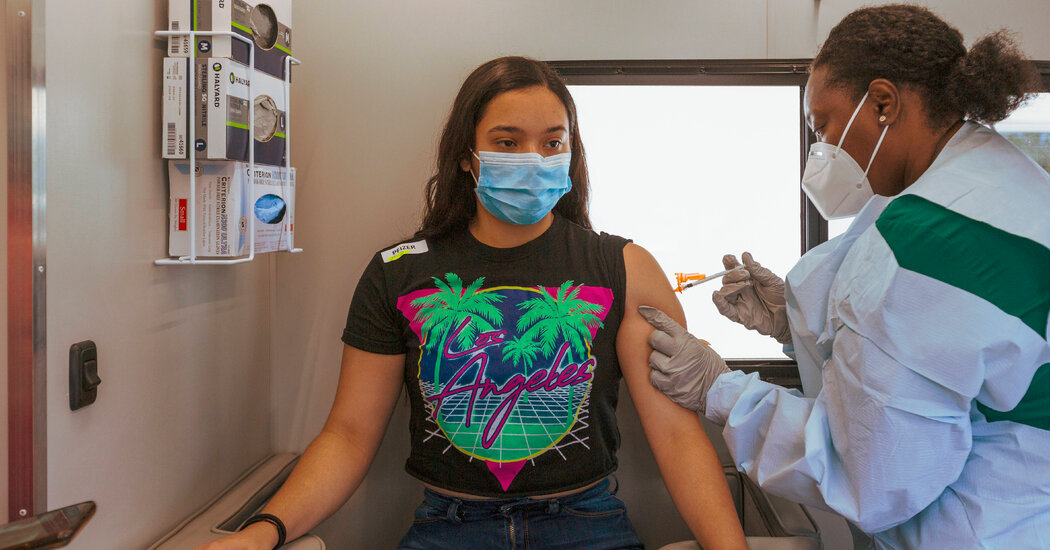
F.D.A. Authorizes Pfizer Boosters for 16- and 17-Year-Olds

The move clears the way for millions of teenagers to receive an additional shot, with a top regulator citing evidence that the effectiveness of two doses is waning in the age group.WASHINGTON — Federal regulators on Thursday authorized booster shots of the Pfizer-BioNTech coronavirus vaccine for another swath of the population, 16- and 17-year-olds, at least six months after they received their second shot of that vaccine. The move clears the way for several million teenagers to receive an additional shot.The decision by the Food and Drug Administration, which was expected, comes as initial laboratory tests have suggested that the new fast-spreading variant, Omicron, dulls the power of two doses of the Pfizer vaccine.Everyone 18 and older has been eligible since Nov. 19 to receive a booster six months after getting a second shot of the Pfizer or Moderna vaccine, or two months after a Johnson & Johnson shot. Nearly 50 million Americans — a quarter of those fully vaccinated — have gotten the additional shots.The F.D.A. broadened Pfizer’s authorization to cover the younger age group on an emergency basis. The Moderna and Johnson & Johnson vaccines remain authorized only for adults.“Since we first authorized the vaccine, new evidence indicates that vaccine effectiveness against Covid-19 is waning after the second dose of the vaccine for all adults and for those in the 16- and 17-year-old age group,” said Dr. Peter Marks, who oversees the F.D.A.’s vaccine division. A booster, he added, “will help provide continued protection against Covid-19 in this and older age groups.”Dr. Marks did not address whether vaccine effectiveness was also ebbing for 12- to 15-year-olds, who became eligible for the Pfizer vaccine in May.Regulators reviewed immune response data from adults that showed more robust antibody levels a month after booster doses were given. They said the analysis demonstrated the effectiveness of a booster shot for adolescents.Dr. Rochelle P. Walensky, the Centers for Disease Control and Prevention director, promptly signed off on the move, saying the agency was encouraging adolescents to receive a booster dose.“Although we don’t have all the answers on the Omicron variant, initial data suggests that Covid-19 boosters help broaden and strengthen the protection against Omicron and other variants,” she said in a statement.Before meeting his Covid-19 response team at the White House, President Biden called the development “even more great news from the F.D.A. and C.D.C.” He added, “I say it to all of you: If you got vaccinated six months ago, get your booster right away.”The F.D.A. and the C.D.C., which sets vaccine policy for the federal government, acted without input from their independent expert advisory panels. The committees have typically discussed whether to authorize or expand eligibility for shots in public meetings before the agencies act.Dr. Jesse L. Goodman, a former chief scientist at the F.D.A., said that given the spirited debate about boosters this fall among the agency’s regulators and outside advisers, more public discussion would have been helpful.“Transparency lets people make more informed decisions,” Dr. Goodman said. For instance, he said, recent data from Israel and elsewhere that suggests minimal serious side effects in younger, boosted people might help allay some parents’ concerns about a third dose for older male teenagers.Support for boosters has been growing among public health experts in the face of the Omicron variant; some who previously opposed them now support a broad campaign. The F.D.A.’s expert committee recommended rejecting Pfizer-BioNTech’s request in September to clear a booster shot for 16- and 17-year-olds, partly because of concerns over what the panel saw as insufficient data about a rare heart condition tied to the Pfizer-BioNTech and Moderna shots, especially in younger men.That condition, myocarditis, or inflammation of the heart muscle, can also be caused by the virus. Federal scientists have said that cases tend to be mild and resolve quickly.The Coronavirus Pandemic: Key Things to KnowCard 1 of 4The Omicron variant.

Read more →

Key step toward personalized medicine: Modeling biological systems

A new study by the Oregon State University College of Engineering shows that machine learning techniques can offer powerful new tools for advancing personalized medicine, care that optimizes outcomes for individual patients based on unique aspects of their biology and disease features.
The research with machine learning, a branch of artificial intelligence in which computer systems use algorithms and statistical models to look for trends in data, tackles long-unsolvable problems in biological systems at the cellular level, said Oregon State’s Brian D. Wood, who conducted the study with then OSU Ph.D. student Ehsan Taghizadeh and Helen M. Byrne of the University of Oxford.
“Those systems tend to have high complexity — first because of the vast number of individual cells and second, because of the highly nonlinear way in which cells can behave,” said Wood, a professor of environmental engineering. “Nonlinear systems present a challenge for upscaling methods, which is the primary means by which researchers can accurately model biological systems at the larger scales that are often the most relevant.”
A linear system in science or mathematics means any change to the system’s input results in a proportional change to the output; a linear equation, for example, might describe a slope that gains 2 feet vertically for every foot of horizontal distance.
Nonlinear systems don’t work that way, and many of the world’s systems, including biological ones, are nonlinear.
The new research, funded in part by the U.S. Department of Energy and published in the Journal of Computational Physics, is one of the first examples of using machine learning to address issues with modeling nonlinear systems and understanding complex processes that might occur in human tissues, Wood said.

Read more →

Common drugs affect our gut microbiome differently, with good and bad impacts on health

Inside the gut live billions of health-promoting bacteria, collectively called the gut microbiome. They act like a giant chemical factory that produce a wealth of different substances that pass through the intestinal wall, enter into the blood circulation and from there affect the body’s cells in different ways.
Now a European research team consisting of scientists from France, Germany and Denmark has shown the different ways that common medicines apparently affect gut bacteria. The work is published in the  journal Nature.
“It has already been substantiated in various clinical trials that different kinds of food can both positively and negatively regulate the gut’s ‘chemical factory’. We have now taken the next step and investigated the relationship of 20 different kinds of ordinary medicine with the abundance and function of intestinal bacteria and their connection to the severity of chronic diseases, such as heart disease, obesity and type 2 diabetes,” says Professor Oluf Pedersen from the Novo Nordisk Foundation Center for Basic Metabolic Research (CBMR) at the University of Copenhagen. He is the leader of the Danish team of researchers involved in the European research project.
Several surprising findings
Among the surprising discoveries was evidence that a combination of two commonly used drugs — diuretic tablets (so-called loop diuretics) and blood pressure medication (so-called beta-blockers) — are associated with increased levels of health-promoting bacteria belonging to the bacterial genus Roseburia.
This type of bacterium is able to break down dietary fiber in plant foods and convert them into butyric acid, whose health benefits include lowering inflammation and regulation of the epigenome. That is the dynamic part of our DNA.

Read more →