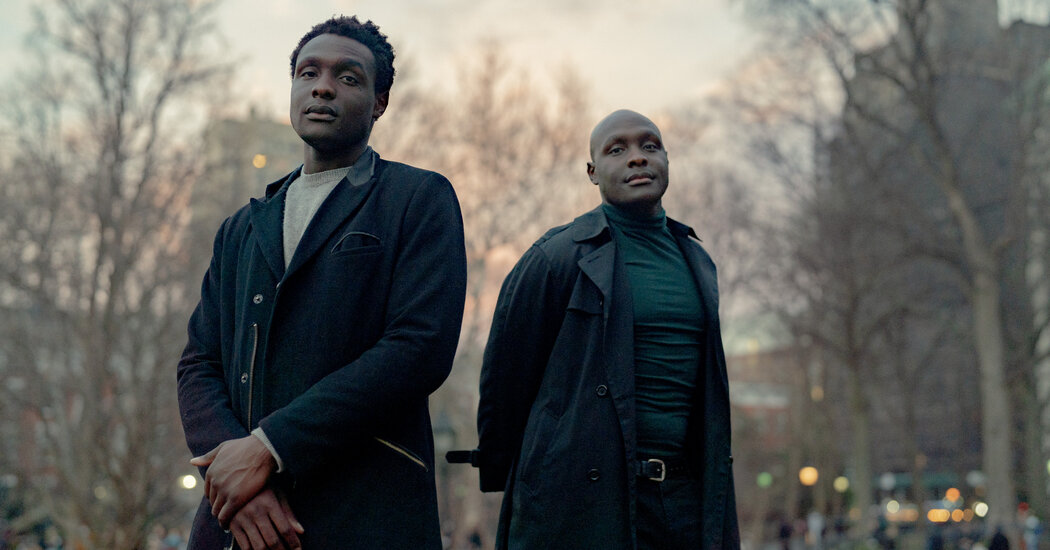
Doctors Gave Her Antipsychotics. She Decided to Live With Her Voices.
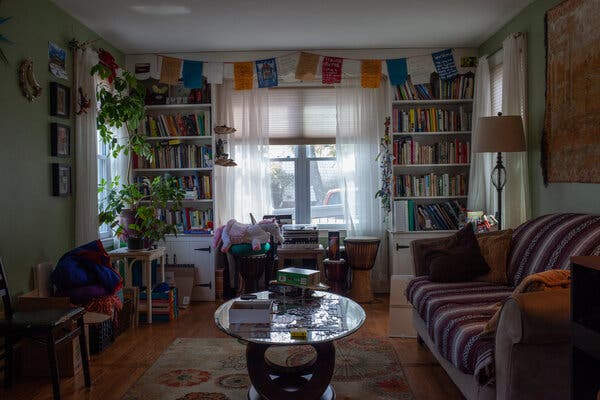
Caroline Mazel-Carlton began hearing voices when she was in day care. Mornings, by the time she was in middle school, a bowl of oatmeal awaited her for breakfast next to a white saucer of colorful pills. Her voices remained vibrant. They weren’t within her head; they spoke and screamed from outside her skull. They belonged to beings she could not see.The voice who had been with her longest warned of catastrophes coming for her family in Zionsville, a town north of Indianapolis, calamities tied in some unspecified way to TV images from the gulf war: fighter planes, flashes in the sky, explosions on the ground, luminous and all-consuming. A woman’s voice castigated her at school, telling her that her clothes smelled and that she had better keep her hand down, no matter that she knew the answers to the teacher’s questions. Another voice tracked her every move, its tone faintly mocking. “She’s getting out of bed now; oh, she’s walking down the hall now.”Her mix of psychotropic pills shifted, expanded: antipsychotics, mood stabilizers, an antidepressant, a benzodiazepine for anxiety, a stimulant for attention deficit. The pileup of drugs was typical; people hearing voices or having other hallucinations rarely wind up on just one medication. Multiple chemicals are prescribed, often more than one similar antipsychotic simultaneously, in an attempt to quell the psyche.At most, for Mazel-Carlton, the antipsychotics sometimes succeeded in reducing her voices to a wall of sound. This could feel more assaultive than hearing them separately. The antipsychotics caused obesity — 50 pounds of new weight — and the feeling that she was losing control of her forearms and her neck. Her hands quivered and seemed to want to flap-paddle the air. To the isolation caused by the difference of her mind, the drugs added isolation from severe side effects. Her agitation and self-disgust, her terror of being barely human, drove her to twist clusters of her hair around her fingers, to yank hard. Patches of bare scalp crept into view. Classmates taunted, asking why she shook and was going bald, calling her “fat-ass” and “crackhead.”In high school, she supplemented her prescriptions with street drugs — weed, Valium, heroin — in a quest to escape. Though her grades were dismal, she received a perfect score on the verbal section of her SATs. For years she had found partial release in literature: in “Hamlet,” in “Ethan Frome,” with the “delirious descent” of its attempted suicide, which she read aloud to herself over and over. She also read books aloud to her two little sisters. They adored the way she changed her voice during the dialogue and when the narration switched between characters. This talent drew from the voices she heard. It wasn’t that she gave those voices to the characters in the books but more that her mind was well tuned to the nuances of speech, because she heard speech so intimately and ceaselessly. And for her, reading aloud, whether to her sisters or herself, partly quieted the people who existed neither within the books nor within the reality that her family and other human beings inhabited.Her perfect score was enough to get her into Indiana University Bloomington, where she signed up for a neuroscience seminar, figuring, she said, “I’ll learn why I’m crazy.” Though answers weren’t forthcoming, she loved the course. But she was also bartering sex for drugs. It was blurrier than prostitution but no softer: men in states of addiction and states of rage; she absorbing their anger, their brutality; a man battering her in the shower; she waking up in a costume of florid bruises.After an abortion, a voice told her he would remove her fingers “one by one by one.” She was arrested more than once. She tussled with cops; she raved and slammed her head against the wall of a solitary-confinement cell. Her third arrest was for stealing electronics to trade for drugs. It may only have been the wherewithal of her parents, both lawyers, that spared her a criminal sentence. She was sent to a high-end locked ward in the outskirts of Houston and then to a psychiatric farm in the foothills of the Appalachian Mountains, where, after dutifully earning the privilege of not taking her pills under the vigilant eye of a nurse, she decided to quit all her medications. The choice was impulsive but not irrational. She felt calmer at the farm, shoveling out sheep stalls and ministering to the chapped hooves of a runt donkey. And she could no longer bear the drugs’ futility and harm. She did no tapering. She flushed the drugs down the toilet morning by morning and evening by evening, careful that if anyone checked her med case they would find the right number of pills remaining.She shed pounds. Her hair grew back. Her voices seemed to be in retreat though hardly in surrender. She graduated to a group home in Asheville, N.C., where a staff member took the residents on an outing to a flat-track roller-derby bout. Mazel-Carlton expected to be repelled by a crowd of men titillated by skaters in skimpy outfits, but she sat rapt among families watching women of all builds competing in a violent sport that resembled rugby without a ball. She bought skates the next day. She practiced on her own, talked her way into drilling with the local team and soon was in the foreground on billboards around the city: pint-size, with a helmet low above her dark eyes, one of the team’s key scorers. She felt she was starting to manage her turmoil and convert it to determination, and she credited roller derby, where mayhem had to be marshaled and deployed.Around that time, in the late 2000s, when Mazel-Carlton was in her mid-20s, a new position arose in mental health: peer-support specialist, someone with what’s known as lived experience who works alongside practitioners. The idea is that peers can better win the trust of people who are struggling. For Mazel-Carlton, a series of these low-paying roles took her, in 2012, to Holyoke, Mass., once home to more than 25 paper mills, now one of the poorest places in the state. There, she went to work for a fledgling peer-run organization that is now called the Wildflower Alliance, with a three-room headquarters above a desolate downtown street and a goal of transforming the way our society understands and treats extreme mental distress.She began leading Hearing Voices Network support groups — which are somewhat akin to Alcoholics Anonymous meetings — for people with auditory and visual hallucinations. The groups, with no clinicians in the room, gathered on secondhand chairs and sofas in humble spaces rented by the alliance. What psychiatry terms psychosis, the Hearing Voices Movement refers to as nonconsensus realities, and a bedrock faith of the movement is that filling a room with talk of phantasms will not infuse them with more vivid life or grant them more unshakable power. Instead, partly by lifting the pressure of secrecy and diminishing the feeling of deviance, the talk will loosen the hold of hallucinations and, crucially, the grip of isolation.Mazel-Carlton also worked as a sometime staff member at Afiya house, a temporary residence run by the alliance as an alternative to locked wards. The people who stay at Afiya are in dire need; many are not only in mental disarray but also homeless. Many are suicidal. There are no clinicians on staff, no security personnel, only people who know such desperation firsthand. In the living room, a homemade banner declares: “Holding multiple truths. Knowing that everyone has their own accurate view of the way things are.”Afiya house in Western Massachusetts.Danna Singer for The New York TimesA decade after her arrival in Holyoke, Mazel-Carlton and the Wildflower Alliance are now leaders in a growing effort to thoroughly reform how the field of mental health approaches severe psychiatric conditions. Their views remain marginal to the medical establishment. The conventional mode emphasizes risk management, especially when it comes to psychosis; mainstream providers maintain that antipsychotic drugs, despite their downsides, can reduce the long-term odds of mental disintegration, suicide and — however low the odds to begin with — violent eruptions.Yet the evidence that the medications improve outcomes is murky. And it is countered by other studies suggesting that maintenance on the drugs may actually worsen outcomes and even cause brain atrophy, though these findings have been debated. The area is devoid of conclusive science, a failure that is a prominent part of a wider problem in biomedical psychiatry: its lack of progress in treating serious conditions, or even precisely diagnosing and comprehending them. “Something has gone wrong in contemporary academic and clinical psychiatry,” a 2019 lead opinion piece in The New England Journal of Medicine stated. “We are facing the stark limitations of biologic treatments,” it argued. “There is no comprehensive biologic understanding of either the causes or the treatments of psychiatric disorders.”Last June, the World Health Organization published a 300-page directive on the human rights of mental-health clients — and despite the mammoth bureaucracy from which it emerged, it is a revolutionary manifesto on the subject of severe psychiatric disorders. It challenges biological psychiatry’s authority, its expertise and insight about the psyche. And it calls for an end to all involuntary or coercive treatment and to the dominance of the pharmaceutical approach that is foremost in mental health care across conditions, including psychosis, bipolar disorder, depression and a host of other diagnoses. Psychiatry’s problematic drugs, the W.H.O. maintains, must no longer be an unquestioned mainstay.To back its position, the W.H.O. highlights stark words from Thomas R. Insel, who from 2002 to 2015 was head of the National Institute of Mental Health, the largest funder of mental-health research in the world: “I spent 13 years at N.I.M.H. really pushing on the neuroscience and genetics of mental disorders, and when I look back on that, I realize that while I think I succeeded at getting lots of really cool papers published by cool scientists at fairly large costs — I think $20 billion — I don’t think we moved the needle in reducing suicide, reducing hospitalizations, improving recovery for the tens of millions of people who have mental illness.”Better outcomes, the W.H.O. predicts, “will depend on a re-evaluation of many of the assumptions, norms and practices that currently operate, including a different perspective on what ‘expertise’ means when it comes to mental health.” Michelle Funk, a former clinician and researcher who is leading the W.H.O’s work on mental-health policy, law and human rights and is the primary author of the report, spoke to me about the need for a radical change in prevailing clinical presumptions: “Practitioners cannot put their expertise above the expertise and experience of those they’re trying to support.” Present methods can do damage and undermine outcomes not only through psychotropic side effects, and not only through the power imbalances of locked wards and court-ordered outpatient care and even seemingly benign practitioner-patient relationships, but also through a singular focus on reducing symptoms, a professional mind-set that leaves people feeling that they are seen as checklists of diagnostic criteria, not as human beings. “The widespread belief by many in the health sector that people with a mental-health condition have a brain defect or disorder of the brain,” Funk added, “so easily leads to overwhelming disempowerment, loss of identity, loss of hope, self-stigma and isolation.”In demanding a “fundamental paradigm shift” in the field of mental health, the W.H.O. is calling for a close to half a century of psychiatric history. In the early 1960s, weeks before his assassination, President John F. Kennedy signed a mental-health bill into law and declared that “under present conditions of scientific achievement, it will be possible for a nation as rich in human and material resources as ours to make the remote reaches of the mind accessible.” American science, he pledged, would not just land a man on the moon but would triumph over mental illness.This confidence stemmed from psychiatry’s first pharmaceutical breakthrough a decade earlier, the discovery of chlorpromazine (marketed in the United States as Thorazine), the original antipsychotic. The drug brought on debilitating side effects — a shuffling gait, facial rigidity, persistent tics, stupor — but it becalmed difficult behavior and seemed to curtail aberrant beliefs. The Times hailed the drug’s “humanitarian and social significance,” and Time magazine compared Thorazine to the “germ-killing sulfas,” groundbreaking drugs developed in the 1930s and 1940s to fight off bacterial infections. But patients didn’t seem persuaded that the benefits outweighed the harm; they frequently abandoned their medication.Thorazine was followed by Haldol, a more potent antipsychotic whose side effects were no kinder. Yet each drug contributed to a sweeping release of residents from psychiatric asylums, and by the 1970s, crude concepts emerged about how these medications work. Overactive systems of dopamine, a neurotransmitter, were thought to be the culprit in psychosis, and antipsychotics inhibited these systems. The problem was that they impaired dopamine networks all over the brain, including in ways that led to movement disorders and torpor.By the 1980s, though, biological psychiatrists believed that they would solve this flaw by creating more finely tuned antipsychotics. Joseph Coyle, then a professor of psychiatry and neuroscience at the Johns Hopkins School of Medicine, was quoted in a 1984 Pulitzer Prize-winning Baltimore Sun series that heralded new brain research and deftly targeted antipsychotics and other psychotropics on the horizon: “We’ve gone from ignorance to almost a surfeit of knowledge in only 10 years.” A protégé of Coyle’s, Donald Goff, now a psychiatry professor at New York University’s Grossman School of Medicine and for decades one of the country’s pre-eminent researchers into psychosis, told me, about the end of the 1980s, “Those were heady years.” Every day, as he neared a Boston clinic he directed, he saw the marks of Haldol in some of the people he passed on the sidewalk: “As you approached, there were the patients from the clinic with their strange movements, their bent-over bodies, their tremors. Not only was the illness debilitating; the medications were leaving them physically so miserable.” Yet he sensed, he said, “the possibility of limitless progress.”What were christened the “second-generation antipsychotics” — among them Risperdal, Seroquel and Zyprexa — came on the market mostly in the 1990s. In addition to their assault on dopamine, they seemed to act, in lesser ways, on other neurotransmitters, and they appeared to have fewer side effects. “There was so much optimism,” Goff remembered. “We were sure we were improving people’s lives.” But quickly worries arose, and eventually Eli Lilly and Johnson & Johnson, makers of Zyprexa and Risperdal, would pay out several billions of dollars — a fraction of the drugs’ profits — in lawsuits over illegal marketing and the drugs’ effects on users’ metabolisms. Zyprexa caused a greatly heightened risk of diabetes and severe weight gain (Eli Lilly concealed internal data showing that 16 percent of patients gained over 66 pounds on Zyprexa). Some boys and young men who took Risperdal were affected by gynecomastia; they grew pendulous breasts. In 2005, the N.I.M.H. published a study with 1,460 subjects looking at whether the new antipsychotics were in fact better, in efficacy or safety, than one of the first-generation drugs. The answer was no. “It was a resounding disappointment,” Goff said, though he advocates long-term and probably lifelong medication as, on balance, the best way to guard against psychiatric devastation.“If you look at the treatments we have right now,” Coyle, Goff’s mentor, told me, “in terms of their fundamental mechanisms” — the drugs’ disruption of dopamine pathways — “they’re no different than they were almost 70 years ago with the discovery of chlorpromazine. That’s pretty scary.”The W.H.O.’s directive points to 22 examples from around the world, from Norway to Myanmar, of the kind of care it hopes will ultimately displace mainstream psychiatric thinking. The report features Afiya house, along with the other work of the alliance, as well as the type of Hearing Voices groups that Mazel-Carlton is leading — and seeding across the country. Priorities common to the 22 are combating alienation, moving “beyond the biomedical model” that puts “psychotropic drugs at the center” and replacing “the language of diagnoses” with an emphatic embrace of “human diversity.” In a sense, the W.H.O. and Mazel-Carlton are aligned with the neurodiversity movement that has begun to change society’s perceptions of autism. Mazel-Carlton takes care not to diminish the suffering of people like herself and speaks of expanding “the options for healing.” Yet she sees her wish as analogous to not just the mainstreaming of autism but the nascent acceptance of new forms of gender identity. “Our society needs to expand its view of what it means to be human,” she says. “To expand what is affirmed and honored.”Two years into her work with the alliance, in 2014, Mazel-Carlton was overtaken by despair. It wasn’t the first time. Before she left Asheville for Holyoke, her voices grew louder and more lacerating, and she planned out a suicide. This time her reeling began on the forensic psych ward of a decrepit state hospital where the alliance had a peer contract. One day a man with curly blond hair, who was around Mazel-Carlton’s age, was forced down and strapped to the bed in an isolation room. She went in alone without consulting anyone on staff. She had always refused staff offers to review patient charts. She didn’t want assessments; she wanted to know the people, to talk with them as they paced the low-ceilinged halls. She sat on the floor below the bound man. “He was remorseful, tearful,” she remembered. “He was, ‘I’m never going to get out of here now.’ I think he’d been injected; typically, they would give a shot,” she said, referring to the involuntary injection of antipsychotics. “He wasn’t trying to free himself from the restraints, but one of the staff pulled me out of the room, saying that I didn’t understand the danger. Most of them saw me as a crazy person with keys.”The incident wasn’t unusual, but her voices surged, filling her car on her drive home. Her oldest insisted, “They’re going to kill us.” She obeyed his order to barricade her bedroom door with a dresser. “We have to kill them,” he commanded.She had no idea what to do. If she went into the alliance’s office to work, colleagues would figure out what was happening to her mind. If she didn’t go in, they would know just the same. She decided to ask her boss at the alliance whether she could stay at Afiya, not as a staff member but as someone in terrible crisis.“Afiya was where I was no longer hiding,” Mazel-Carlton said, recalling her time there. The house, two towns up the road from Holyoke, is a compact four-bedroom home of gray clapboard, with a chain-link fence bordering one side of a little yard and some low-end rental units across the way. When she was on the psych ward in Houston in her early 20s, or at the Appalachian farm or the Asheville group home, Mazel-Carlton concealed her voices, and until then at the alliance she hadn’t confided their intensity. But somehow Afiya inspired sharing, though the house had no group sessions and no formal methods. An atmosphere without judgment pulled people into revealing conversations. In a basement den, by the hovering blues and golds of a large fish tank, she talked with a gender-nonbinary person about how they each longed to be completely open about themselves, and yearned to live as examples for other people, but also “about how much that can cost, about how there’s a lot of cruelty in the world.”In a bright living room, with a guitar and tambourines mounted between windows, a staff member asked Mazel-Carlton what would help her. As she related this moment to me, the memory of the simple, genuine question moved her to tears, because she felt fully entrusted with knowing what she needed, something that seldom happens with those engulfed in their own realities; their perception is presumed to be too warped. “Some of my voices have their own tastes,” she told me. “I don’t know if I personally like Lynyrd Skynyrd, but my oldest voice does” — the one who impelled her to barricade herself. She told the staff person that she needed him to play “Free Bird.” “He is a serious guitarist; he toured Europe.” He took the guitar from the wall. “Before he even got to the solo where the guitar goes wild, I felt this peace come over that voice.”She stayed seven nights, the official limit. It’s all that is feasible given the demand for Afiya’s bedrooms, with residents coming via mental-health agencies and word of mouth. Fleeting as a week is, it’s not all that different from a typical stay on a psych ward, to which Afiya sees itself as a better alternative. The W.H.O. estimates that Afiya is one of three dozen comparable places, known as peer-run respite houses, across the country.Ephraim, the director of Afiya house.Danna Singer for The New York TimesIn March, Mazel-Carlton, whom I first met in 2019, took me to Afiya and introduced me to its director, Ephraim, who asked that only his first name be used to protect his privacy. That afternoon, over his slender frame, he was wearing a black sweatshirt emblazoned with “Spiritbox,” the name of one of his favorite metal bands. Guests, he explained, are free to come and go at any hour. Then he shared: “I feel like I want to die every day. It’s one of the first things I think about when I wake up. That is normal for me. Many people act like it isn’t normal. Here, we have people express that they want to harm someone. These are all normal thoughts. But people train themselves to believe that they’re not. Giving space to express these things, to have these conversations, that’s the healing thing, that’s the magic here. When we don’t allow that space, things get bigger.”“For some people,” Ephraim said, “staying here is only a slight beginning. There’s power in feeling able to talk and feeling truly heard, in not feeling alone. But for other people, it’s transformative.”For several years now, from her cramped alliance office with a bit of roller derby memorabilia on a shelf above her computer, Mazel-Carlton has been a leader in running Hearing Voices Network groups and training others to do the same around the country, from Augusta, Maine, to Eureka, Calif. H.V.N. originated in the mid-’80s after a Dutch psychiatrist, Marius Romme, worked with a client, Patsy Hage, who was hallucinating and suicidal. Hage insisted that Romme pay attention to the content of her voices instead of dismissing what they said as meaningless. Romme went on to study hundreds of people like Hage, and in a 1989 paper in Schizophrenia Bulletin, he argued that practitioners should “accept the patient’s experience of the voices”; that “biological psychiatry” may not be “very helpful in coping with the voices because it, too, places the phenomenon beyond one’s grasp”; that practitioners should “stimulate the patient to meet other people with similar experiences”; and that patients benefited when they could “attribute some meaning to the voices.” Romme’s paper was mostly ignored, but Hearing Voices support groups cropped up, especially in Britain and across Europe. In the United States, it took much longer; some of the first were started by the alliance around 2008, four years before Mazel-Carlton began working there.For Mazel-Carlton, one of the groups’ most essential tenets is that there must be no disabusing anyone of a personal reality. Unlike on a psych ward or in many a psychiatrist’s office, unusual beliefs are not monitored, corrected, constrained. Mazel-Carlton’s motto is, “If I’m controlling, I’m not connecting” — and connection, for her, is everything. It defines hope.Ideally the groups meet in person, but with the pandemic, the movement has turned to Zoom, and one day in March, I joined a virtual group that Mazel-Carlton helps to conduct. The session drew seven people spanning from North Carolina to Washington State. This particular group focuses on the spiritual, a common theme for people with voices and visions. At the outset, Mazel-Carlton invited everyone to open up by reminding: “This is where I can go if I have direct experiences of the divine. It’s a place I can go, if I’m someone with a psychiatric label, to talk about spirituality without having my experience pathologized. We validate one another here.”A man described being rocked and comforted by “an upside-down angel” when he was growing up. Mazel-Carlton modeled an H.V.N. principle that prizes curiosity about other realities by asking the man for more about his experience. In reply to another participant, she said, “I’m so sorry that people are refusing to honor your soul’s identity.” Then a woman talked about visiting her grandmother in a nursing home during Covid and seeing her grandmother’s “glowing pink orb rising from her chest” and everything as “sparkling and glowing and timeless.”The woman said, “Everything was connected; there was this pulse, this flow” — and there was a fight with a nurse when the woman, feeling that she was God, took off her mask. A psychiatrist labeled her psychotic, “so I couldn’t keep telling him my experiences, because he was telling me I’m sick, and I’m not sick.” In this, according to the mainstream view, she was confirming her illness; denial of one’s diagnosis, termed anosognosia, is seen as a glaring symptom of psychotic disorder.“The first time I came to this group,” the woman went on, “and said something about what happened that day with my grandma, I looked at the screen and people were nodding their heads, and I thought, holy [expletive], people get what I’m talking about. And when people talked about feeling like they’re Jesus Christ, I was like, Oh, my God, I’m not the only one? In group, I don’t feel alone, and feeling alone is like something crushing my chest.” She began to cry minimally. “Group is a place to be vulnerable,” she said. “In my everyday life, I don’t feel safe. I have to put on my armor.”On a wall next to Mazel-Carlton’s desk, there’s a map of the United States dotted with colored pins. Blue pins mark places where she and alliance colleagues have led or arranged for an H.V.N. facilitator training. “I sometimes feel like a general mapping the revolution,” she said. Through her zeal, the network had grown from a handful of U.S. groups to 120, though after two years of the pandemic, the number is closer to 100. Zoom sessions can’t match the reassurance and resonance of in-person gatherings.On the map, red pins represent another campaign. They stand for cities and towns where Mazel-Carlton and the alliance have conducted trainings in their approach to suicide prevention. The workshops are for prospective founders of support groups — and within the groups, as at H.V.N. meetings, clinicians tend to be barred from the room — but they are also for practitioners and family members who want a new way to talk with those contemplating suicide.A slide within the training protocol Mazel-Carlton has designed teaches that the mission is “to stay present” and not “to prevent them from doing that.” “Stay away from fix-it mode, from savior mode,” Mazel-Carlton tells trainees. “With our capes on, we can’t listen.” A first principle is that people must be allowed to talk freely about all that is preying on them, including the wish to take their own lives, and in the groups, a foundational pact is that no one will be reported, not to any hotline, not to the police or any practitioner, no matter what he or she expresses an intent to do. To comprehend how thoroughly this defies dominant practice, take the policy of the country’s most-called — and heavily federally funded — suicide hotline. It advertises confidentiality but covertly scores risk and, each year, without permission, dispatches police cars and ambulances to the doors of thousands. From hotline to psych hospital, the focus is on risk management. It is on exerting control. By contrast, the core idea of the alliance’s program is that as long as you are talking about killing yourself, and feel you are being listened to and understood, you are much less prone to end your life. There’s little research that assesses these approaches or compares them. A 2020 study in the journal Suicide and Life-Threatening Behavior links a person’s perception of being coercively hospitalized with an increased risk of attempted suicide after hospitalization; there is little research that looks at the approach favored by the alliance.Under Mazel-Carlton, the groups have grown to almost 30 from three, from Boston to Denver, despite the obstacles of the pandemic. At least as important, countless U.S. practitioners have learned new ways to listen to the desperate. And a Brazilian mental-health organization, CENAT, has brought Mazel-Carlton to that country, where she has spoken on suicide to clinicians, along with clergy, law enforcement and the diagnosed in São Paulo, Vitória and Salvador. MercyCare, an Australian community-services nonprofit, has flown her in to speak in Sydney, Melbourne and Perth. Over the past two years, in the United States, she has given dozens of talks on suicide and the Hearing Voices movement to audiences of several hundred at conferences, to social-work graduate students, to staff at psych hospitals on grand rounds. In early May, she was in Indianapolis, teaching a roomful of clinicians not far from her childhood home.‘We must also combat the notion that people with mental illness are to be feared.’In addition to leading groups and organizing trainings, Mazel-Carlton packs her days, late into the evenings, with one-on-one sessions — with a grandmother desperate to hear that her grandson’s voices will not destroy his life, with a young man who is certain that his house is under surveillance and who winds up confiding in Mazel-Carlton the sources of his shame. One woman, a mother, told Mazel-Carlton that a voice was commanding that she cut off her hand; if she didn’t, the voice would harm her child. Mazel-Carlton listened and eventually wondered aloud to the woman what the voice might be straining to communicate beneath its horrifying terms. She drew her into thinking about the voice’s underlying meaning, that it could be expressing something about the pressures and conflicts of motherhood, especially during Covid, how caring for a child sometimes feels like a commandment to give up too much of oneself.“As human beings,” Mazel-Carlton said later, “we are drawn to meaning; it gives us a sense of power. But to get there, you can’t feel only that the voice is scary. And to do this work, you have to get past your own fears.”The work, for her, is “a spiritual practice.” But she can be overwhelmed by all that people bring to her, along with her own voices, which are sometimes loud enough that she asks me to repeat a question. The only medication she uses is to help her sleep: trazodone, which at her low dose is prescribed for insomnia. It often fails.Mazel-Carlton knows that the alliance’s methods are not always successful. A year ago, a close friend of hers killed herself, someone who had stayed at Afiya and participated in the alliance’s groups. “When she died, there were people in our community who talked about how they should have done more,” Mazel-Carlton said. “But here’s the reality. As long as our wider world is deeply marginalizing of neurodiversity, we are going to lose people.”The W.H.O. report features another innovative approach, temporary residences called Soteria Houses. In Israel, Pesach Lichtenberg has founded two of a handful of such houses now operating around the world. At the outset of his career, Lichtenberg was taken with the promise of psychopharmacology. In the mid-1980s, he moved from New York City to Israel for his psychiatric training, and one day, as he made rounds with a senior colleague, a patient spoke “about demons and the messiah and so forth,” he told me. “I was fascinated. I’ve always had the problem of being intrigued. But as we walked away from this person, the senior psychiatrist said: ‘That’s not him. That’s his dopamine talking.’ It struck me as such a wonderful insight.” Lichtenberg laughed at himself almost bitterly. “Today I’m ashamed that I could think this way.”For 25 years, Lichtenberg ran the psych ward at a Jerusalem hospital. He described his patients as sodden with medication. “Half the dose was to calm the patient, and the rest was to assuage the anxiety of the staff,” he said. Then, in 2016, utterly disillusioned, he opened his first Soteria House in Jerusalem. He was inspired by a book about the Soteria origin story by Loren Mosher, a former head of schizophrenia research at the N.I.M.H., who was appalled by psychiatry’s heavy reliance on antipsychotics. He established a pair of treatment houses in the Bay Area in the 1970s that minimized medication and prioritized two words, “being with,” as the main treatment philosophy.Mosher’s Soterias eventually closed for lack of funds; two decades later, Lichtenberg picked up where Mosher left off. Lichtenberg’s two Soteria facilities, with two others in the works, can house up to 10 people; the average stay is five weeks. Clinicians are present but sidelined, hierarchies of knowledge are banished, medication is a secondary option, mostly to be avoided unless residents arrive already on drug regimens, and “being with” is carried out above all by melavim, companions — paid interns whose ameliorative mission is simply to be engaged, empathetic and curious, to leave residents feeling less alien, less alone.While visiting Lichtenberg’s houses in 2019, I sat with three residents and two melavim, who talked in an internal courtyard. One resident said that Descartes was the source of his trouble, that while at a job one night, passing the hours playing video games, he had wandered onto a website that included Descartes’s dictum “I think, therefore I am.” “It is stuck in my head like glue,” the young man said, eyes in anguish below his bangs. Before that night, he had had issues with obsessional thoughts. Since, everything outside him was unreal. The melavim, the other residents, the courtyard’s walls and benches, none of it existed. He knew his mind was awry but couldn’t set it right. The melavim asked him about his experience, listening openly, no more, no less.As I spent time with Lichtenberg, I asked about one of the pressing fears with psychosis — eruptions of violence. What he recounted was akin to what I heard at Afiya, where I was told there was just one incident in 10 years, when a staff member suffered two black eyes and was threatened with a pair of scissors. Lichtenberg said that chairs have been broken and plates smashed but that threats against other residents, melavim or staff members are rare. With the exception of one broken nose, the situations have ended with hardly more than a scratch, though one melaveh was put in a headlock before being released without injury. “If someone becomes intimidating,” Lichtenberg said, “I’ll sometimes put my hands behind my back, look him in the eyes and tell him, ‘If you want to attack me, it’s going to be so easy for you.’”Occasionally the Israeli Soterias will insist on medication if a resident becomes too belligerent, but the drug is almost as often an anti-anxiety pill as an antipsychotic, and the dose may then be tapered down, sometimes to nothing. The houses refuse to take a small fraction of applicants because of a recent history of violence, but they have also knowingly accepted residents who, a few months or only weeks before their arrival, put a parent in the hospital, for example, or assaulted a government security officer.Avraham Friedlander, a former director of Lichtenberg’s first house, told me about a resident who, on the man’s first day, interrupted a group meeting in the living room. He splintered a darbuka, a Middle Eastern drum, and began to dance aggressively. In response, Friedlander joined him in the middle of the group, dancing wildly. “Everybody made a drumbeat with their feet, stomping, and we fought in a choreographed way, a dance-fight,” Friedlander said. “He grabbed me; he put me on the floor; but I wasn’t hurt; and later we talked. He was asking what was happening to his mind. He was crying. I slept near him that night, and when he woke with nightmares, I sang him songs and gave him tea.”Soteria’s methods may seem romantic and naïve, but Lichtenberg has won the support of Israel’s Health Ministry, and two of Israel’s four public insurance carriers as well as the Defense Ministry’s insurance system will pay for a stay in Soteria as an alternative to hospitalization. Since Lichtenberg got started in 2016, 17 houses with practices similar to Soteria’s have opened throughout Israel. This year, at the invitation of one of Jerusalem’s major psychiatric institutions, Kfar Shaul Psychiatric Hospital, Lichtenberg has taken over its locked ward and begun to turn it into a Soteria facility.In the United States, the mainstream mental-health establishment has been slower to embrace these alternative approaches, but that might be changing. I asked Ashwin Vasan, the new commissioner of New York City’s Department of Health and Mental Hygiene, whose most recent work has been in mental health, about how cities like New York and San Francisco should respond to a spike in violence and overall lawlessness attributed to the mentally ill and those who don’t have housing. His email reply focused on preventing crises not only by adherence to medication but also by “breaking extreme isolation.” As part of this effort, he added, “We must also combat the notion that people with mental illness are to be feared.”The data does much to support Vasan, suggesting that while those with hallucinations and delusions are probably disproportionately prone to violence, this pattern largely disappears when researchers control for factors like poverty, homelessness and substance abuse. Those may be the more relevant drivers. Data also indicates that people diagnosed with psychosis are less likely to be perpetrators of violence than they are to be its victims.Chacku Mathai, a Hearing Voices Network facilitator, in Rochester, N.Y.Danna Singer for The New York TimesChacku Mathai, whose Indian family immigrated to the United States when he was a child, works as a project director with a large New York State-funded program, OnTrackNY, which combines an emphasis on medication with the inclusion of client perspectives about their care. And he facilitates Hearing Voices groups. During one of our many conversations, Mathai told me a parable about a traveler in a foreign land coming across a bird he has never seen before, a peacock. Thinking that such a freakish creature will never survive, the traveler cuts off its feathers to correct nature’s error.Mathai, who hears voices and has visions and was hospitalized after a suicide attempt as a teenager, is something like the peacock, except that he rejects medication that would shear away his difference. By immersing himself in yogic practices, he gives his mind a measure of rest. Still, voices stalk him, suspicious of people and full of foreboding. Sometimes, he told me, he thinks about whether, if the perfect antipsychotic existed, he would take it. “My experience is so rich,” he said, “I wouldn’t trade it for anything.” He spoke of having a keen empathy for the singularity and solitude of others, a sensitivity that can bring a feeling of being universally joined.Beth, who asked that I use only her first name and who has led H.V.N. groups in Western Massachusetts, pointed out that though the Hearing Voices movement wrestles against conventional psychiatry, it isn’t anti-psychiatry. A former music teacher and cellist, Beth used to take medications that left her with terrible tremors and a torturous physical restlessness called akathisia, deepening the agony of a teaching career lost to her struggles. But after an odyssey of working with inflexible psychiatrists, she found one willing to chart a path of mutual understanding and compromise. She continues to have unsettling visions, but a religious practice along with a calibrated mix of drugs helps somewhat to make her life more manageable while inflicting only mild tremors, and she is playing her cello for the first time in 20 years.Beth, who has led Hearing Voices Network groups in Western Massachusetts.Danna Singer for The New York Times“It’s like an ecosystem of dreams,” Dmitriy Gutkovich said, describing his voices to me over Zoom from Foster City, Calif. Some threaten his family; others speak philosophically on entropy. He takes an almost negligible dose of an antipsychotic, an amount bordering on a placebo. More relevant, he explained, is that H.V.N. groups helped him to realize that coexistence with voices is possible. It is, he said, “about understanding them and their intentions, so that we can live in harmony; it’s about relationship management.” A decade ago, in his early 20s, he was “not in a period of perfect functioning,” he said wryly. “The professional assessment was doom and gloom.” He is now married and a new father. On the screen, he smiled beatifically about this. He is a marketing director at a magazine and oversees an eight-person team.Sometimes, at the end of a conversation with Mazel-Carlton, a mother will ask: “When can we talk again? When?” There is nothing like the panic of a parent whose son or daughter knows another reality. In her office, late one afternoon in March, with the overhead light off and the light from the lone window getting dim, she counseled a mother for the second time by Zoom. The woman’s grown son believed he was taking directions from God. In the recent past, he had been hospitalized, suicidal, homeless. “He thinks he’s kind of like a savior,” she told Mazel-Carlton. His ever-changing plans terrified her. “I need to know how to talk to him. I don’t want to say the wrong thing. I’m trying to just be there, to be empathetic.”She knew Mazel-Carlton’s lessons well, and quietly, Mazel-Carlton echoed and encouraged her.“But I don’t know how to get him to understand that I’m on his side. He’s very turned off to the mental-health system. He told me I put him in the hospital. I said it wasn’t me, it was the psychiatrist. I know he’s going to do what he’s going to do, I know I can’t prevent it, but he says he was comfortable being homeless, because no one could tell him anything — and now what if he becomes homeless again? He could be killed, God forbid.”“I’m not putting this on you,” Mazel-Carlton said, “but it sounds like he’s had some institutional trauma. So what I might avoid is bringing things up from a mental-health lens.”“I think about the M-word,” she said, talking about medication. “But I don’t say it.”“I think that’s wise.”“I can’t help it.”“I think it’s good that you don’t go there,” Mazel-Carlton said. “Pharmaceuticals are easily accessible — he knows that. He knows he can make that choice anytime. When a mom brings up medication, it can sound like, I don’t like the way you are. Like, the way you are makes me uncomfortable.”“I’m freaking out.”“As adults, the moments when we feel that our parents trust us — that’s the lottery-like feeling,” Mazel-Carlton said.“To let him be who he is,” the mother said. “Not to get in his face. I’m really working on it.”“I know you are.”Daniel Bergner is a contributing writer for the magazine. This article is adapted from his book “The Mind and the Moon: My Brother’s Story, the Science of Our Brains, and the Search for Our Psyches,” published this month by Ecco. Danna Singer is a photographer based in Philadelphia as well as a lecturer at Yale School of Art and Princeton. In 2020, she was named a Guggenheim fellow.
Read more →