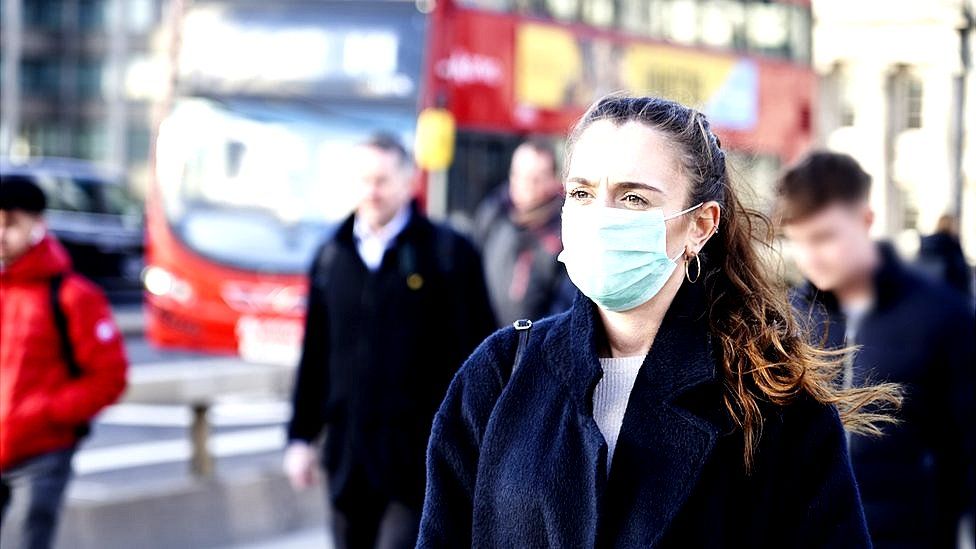
Covid infections on the way down again across the UK

Published1 hour agocommentsCommentsSharecloseShare pageCopy linkAbout sharingImage source, Getty ImagesCovid infections are on the way down in the UK, dropping by more than half a million in a week, according to Office for National Statistics (ONS) figures.An estimated 3.2 million people had the virus in the week up to 20 July, compared to 3.8 million the week before. Hospital cases are also decreasing. Admissions in England of people with Covid stood at 16.3 per 100,000 people in the seven days to July 24, down from 18.2 the previous week.There is still lots of Covid around to catch, even though the rates are declining, experts warn. Over the peakIn the latest ONS report, for the week ending 20 July, the estimated Covid rates were:One in 20 in England – down from one in 17 the week beforeOne in 19 in Wales – down from one in 17One in 16 in Northern Ireland – up from one in 20 (although experts say the trend is uncertain)One in 19 in Scotland – down from one in 15Many of the recent cases have been caused by fast-spreading sub-variants of Omicron, called BA.4 and BA.5. People are still able to become infected even if they have had Covid before.But vaccines are still doing a good job of helping protect people from getting very sick with the virus. Everyone aged 50 and over in the UK will be offered another Covid booster vaccine this autumn.The ONS data is collated by testing thousands of people from UK households – whether or not they have symptoms – to estimate how much virus is around.Dr Gayatri Amirthalingam, from the UK Health Security Agency, said: “We are now seeing decreases in Covid case rates and hospitalisations. Whilst this is encouraging, Covid has not gone away and we really want to see further declines in the coming weeks and months. “People aged 75 and over remain at particular risk of severe disease if they are not up to date with their vaccinations.”We urge anyone who is not up to date with their jabs to come forward to give themselves the best possible protection.”Sarah Crofts, from the ONS, said: “Our most recent data suggest that we may now be over the peak of the latest wave of infections across the UK, although rates still remain among the highest seen during the course of the pandemic.”We have seen welcome decreases among most parts of the UK and in all age groups. With summer holidays starting and more people travelling, we will continue to closely monitor the data.” More on this storyBA.4 and BA.5 Omicron: How worried should we be?1 JulyCovid origin studies say evidence points to market2 days agoRelated Internet LinksOffice for National StatisticsThe BBC is not responsible for the content of external sites.

Read more →

To Stop or Not to Stop the Fight

As combat sports grow in popularity, ringside physicians grapple with the precarious ethics of their role.CHATTANOOGA, Tenn. — Late one Saturday evening in June, two men in their 20s stood across from each other, shirtless and swaying, in a mixed martial arts cage in Exhibit Hall B of the Chattanooga Convention Center. The mat was sticky, a dark canvas of blood and foot sweat. Something in the combatants’ eyes made them look both terrifying and terrified, wolflike and rabbitlike at once.The bout was one of 12 that evening in the B2 Fighting Series 166, an amateur event, and Dr. Danielle Fabry, a primary care physician with a private practice in Nashville, had been hired to make sure no one got seriously hurt. Stationed by the cage door, she had the best seat in the house.Combat sports run on the excitement of an unstable equilibrium. In a perfectly matched fight, combatants trade blows until the final bell, bringing their bodies as close as possible to their limits. One mistake, though, and it ends violently. This combination of uncertainty and danger has helped transform mixed martial arts over two decades from a siloed obsession, illegal in a number of U.S. states, to a multibillion-dollar industry.But even here there are limits to the harm allowed. Referees, often former fighters or trainers themselves, can stop a fight if they think a fighter is too injured to defend him- or herself. So can ringside physicians, who determine whether fighters are fit to step into the ring and to stay there. In combat sports, physicians have had to reckon with the precarious ethics of their role.“I’m clearing someone to fight today, 20 years from now he walks into my office and has C.T.E., he has Parkinson’s,” said Dr. Nitin Sethi, a neurologist at Weill Cornell Medicine and board member of the Association of Ringside Physicians, or A.R.P., which formed in 1997. “Every doctor who works ringside should feel conflicted.”Dr. Fabry sits ringside, watching a fight and trying to make sure no one gets seriously injured. “You can never tell how it’ll go,” she said.Bee Trofort for The New York TimesIn 2019, Dr. Sethi stopped a fight at Madison Square Garden between two U.F.C. fighters, Nate Diaz and Jorge Masvidal. With the fourth round about to start, a deep cut above Mr. Diaz’s eye opened up; he seemed heavily concussed, and the skin on his forehead was drooping over his eye. When Dr. Sethi intervened, the crowd booed and both fighters protested; afterward, his office phones rang off the hook with abusive messages.“But how can you let a fighter who is getting injured on your watch go on?” said Dr. Sethi, who has worked ringside for a decade. He quickly noted the paradox of this statement; every moment he sits beside the ring is a moment he lets fighters get injured. “It’s impossible to make this sport safe,” he said.Dr. Fabry, who started her private practice in 2021, has been doing ringside work for a little over a year. When the opening bell rang in Chattanooga, she leaned forward in her seat and watched the two fighters move toward each other. It wasn’t Madison Square Garden, but the medical stakes — for her and for the combatants — were just as high.“You can never tell how it’ll go,” she said. In her previous event, a fighter had taken three minutes to revive after being knocked out cold by an uppercut.“That scares me,” Dr. Fabry said. “That’s where you start to say, ‘OK, this is serious.’” She added: “At the same time, they’re all adults. They know what they’re getting into.”The Check-InDr. Fabry performing pre-fight physicals in a makeshift locker room at the Chattanooga Convention Center.Bee Trofort for The New York TimesDr. Fabry drove down from Nashville on Friday, the day before the fight, with her boyfriend and a friend. By 4 p.m. on Saturday, she was in a makeshift locker room, working through pre-fight physicals for more than a dozen jittery men.“You see the adrenaline from the second they walk into the room,” Dr. Fabry said as she waited for one man’s blood pressure reading and studied the quivering pupils of another.“Push me away,” she instructed the second man — a test of his mobility and ability to follow basic directions. “Pull me toward you.” Then: “Can you feel when I rub down your arm?” He obeyed as the other man looked on. “Hopefully you’re not fighting each other,” she joked. They were not.Growing up in Cincinnati, Dr. Fabry had attended a couple of combat events, but her interest blossomed in medical school, when she picked up boxing to relieve stress. “I feel like I always look at it as a doctor,” she said. “I’m like, ‘Oh, that’s going to be a problem.’ But I love boxing, and I love M.M.A. It’s something that I want to be a part of.”In 2021, shortly after moving to Nashville, she heard that fight promoters were looking for physicians to sit ringside in Kentucky and Tennessee. She quickly had six job offers. A gig typically paid a couple hundred dollars, plus travel and lodging — a free weekend trip, a free fight. She decided to try it.Pre-fight physicals include eye checks, but they are not always comprehensive.Bee Trofort for The New York TimesProfessional combat sports are overseen by state agencies, and the standards for medical screenings vary. New York requires fighters to undergo a neurological exam, electrocardiogram, dilated eye exam and an M.R.I. before each fight. Most other states just ask for blood work, to check for blood-borne diseases, and a physical. The ringside physician interprets the results and decides who can or cannot fight.“The commission doesn’t give you anything,” Dr. Fabry said of Tennessee’s medical guidelines for amateur fights, which are overseen by the International Sport Karate Association, or I.S.K.A. “They just give you a short thing” — a vague, quarter-page checklist of body parts and organ systems. Eyes? Check. Abdomen? Check. Neurological? Check.To fill in her knowledge, Dr. Fabry said, she spent a few days looking over sports-physical checklists online: “I wanted to know, ‘What else should I be looking for?’” After a couple of fights, she had the hang of it. “It’s a lot like the physicals I do as a primary care physician, just a lot faster,” she said.In Chattanooga, a blood pressure monitor on one of the fighter’s arms beeped ready: 210 over 185. Dr. Fabry shook her head. The number was way too high; if correct, it could indicate an underlying heart condition. But the man was nervous and chattering, and, like most fighters, he had probably dehydrated himself to make his weight class; most have elevated blood pressure before a fight. Dr. Fabry was also thinking about the crowd, the promotion and the man’s opponent, who had come from Knoxville for the event.“You feel bad, because it’s your call, and you’re, like, ‘I just messed the whole card up for this guy,’” she said.To the fighter she said: “That’s too high. Tough weight cut?” He shrugged. “OK, stop talking and relax,” she said. She took his blood pressure again: 161 over 86. “Much better,” she said, and cleared him to fight.‘Why We Do What We Do’An amateur U.F.C. fighter has his eyes scanned by Dr. Fabry, who has boxed recreationally.Bee Trofort for The New York TimesAfter check-in, the fighters gathered awkwardly in the locker room as officials laid the ground rules: No kneeing a downed opponent. No elbows to the face. No eye pokes, crotch shots, glove-grabbing. “The number one thing for us is fighter safety,” said Brandon Higdon, a B2 promoter.Bobby Wombacher, the night’s referee, added: “It’s all about fighter safety.” Todd Murray, who was overseeing the event for the I.S.K.A., chimed in: “We don’t want any of y’all getting hurt.”As the meeting ended, Mr. Higdon hinted that he might give a $100 “locker-room bonus” to fighters who could pull off special finishes — something more dramatic than a judge’s decision. Amateur fighters are otherwise unpaid. In contrast, the U.F.C. pays its top fighters for each bout, plus as much as $50,000 for a particularly spectacular knockout or submission.The regulation of combat sports is inherently contradictory: A good fight is violent and unsafe — but not too violent or unsafe. (The U.F.C. has fired officials who have allowed fights to go on too long.) From a medical standpoint, each time a fighter is hit in the head, he or she risks a brain bleed that can kill within minutes. And repeated trauma can result years later in chronic traumatic encephalopathy, or C.T.E., which can cause aggressive behavior, depression and eventually dementia.Many physicians, as well as the American Medical Association and the World Medical Association, have called for the elimination of sanctioned combat sports. “We need to spread the word that brain-bashing is not a socially acceptable spectator sport,” Dr. Stephen Hauser, a neurologist at the University of California, San Francisco, wrote in 2012 in the medical journal Annals of Neurology.For those who opt to be involved, the A.R.P. has created a standardized set of instructions and recommendations to remove some of the ambiguity of ringside medicine. The group has certified more than 100 doctors across 34 states and 11 countries since its founding.But once the bell sounds, every ringside physician is alone, charting a calculus of risk, harm and entertainment. “You cannot become a fan,” Dr. Sethi said. “You stop it too late, and the damage is already done.”While ringside physicians are required at every sanctioned combat sport event in America, some doctors and medical groups think their presence promotes unsafe behavior.Bee Trofort for The New York TimesA week earlier, Dr. Sethi and several dozen physicians had attended a virtual seminar hosted by the A.R.P. — a new course on the basics of ringside medicine. This was “Round 8,” dedicated to ethics, and it was led by Dr. Ed Amores, an emergency medicine specialist at NewYork-Presbyterian Hospital and an association board member.Dr. Amores began by showing a video of a South African boxer who had died from a subdural hematoma a couple of days earlier. The video was from the end of boxer’s tenth round, and the fight had been called; the boxer was clearly injured, punching the air above him. “This is why we do what we do,” Dr. Amores said to the attendees.At the seminar, Dr. Amores, sporting a neat goatee onscreen, seemed to be struggling with his role as a ringside arbiter. He read from an article in the Western Journal of Medicine by Dr. Suzanne Leclerc of McGill University and Christopher Herrera, a bioethicist at Montclair State University. “The mere presence of a sport physician at a boxing match lends an air of legitimacy to behavior that is medically and ethically unacceptable,” the authors had written.But, Dr. Amores countered aloud, fighters would fight with or without physician involvement. “There are people who live dangerous lives,” he said. “Do I agree with what risk they’re putting themselves in? No. But at the end of the day I just try to do whatever I can to help them.”Dr. Louis Durkin, an emergency medicine specialist at Mercy Medical Center in Massachusetts and vice president of the A.R.P., jumped in: Ringside physicians were like pulmonologists who take care of smokers, even though they disapprove of smoking. “We’re E.R. docs,” Dr. Durkin said with a laugh. “We would have nothing to do all day if it wasn’t for bad behavior.”Dr. Amores nodded, noting that the American Academy of Neurology recommends the presence of a doctor at combat events. Then he added, “Sometimes I feel very enthusiastic about making this unsafe sport safer, and sometimes I really question myself and wonder whether I really should be doing this.”Dr. Sethi spoke up: “Ed, if you’re not feeling conflicted, I think there’s something majorly wrong.”Boxers in their twenties come to Dr. Sethi all the time asking to be cleared to fight despite M.R.I.s brimming with small “white” scars that form after traumatic brain injuries. “On our watch, we probably have a bunch of athletes that are going to develop C.T.E.,” he said. “When you and I hang up our gloves, would you be comfortable going to bed and saying, ‘I did the right thing?’”After the BellTyler Britt, left, and Antonio Holt, during their fight.Bee Trofort for The New York TimesOn that Saturday night in Chattanooga, Tyler Britt entered the cage wearing a cape of animal pelts and a demon mask; it was the penultimate fight of the night, and the crowd was buzzing. He glared at his opponent, Antonio Holt, and drew a finger across his throat.Mr. Wombacher, standing in the middle of the cage, checked in with the fighters one last time. Ready? Ready. Ready? Ready. Ringside, Dr. Fabry rubbed her legs in anticipation. “This is going to be good,” she said.In front of her were the forms she had filled out during check-in; she would use the flip side and the margins to note any injuries during the fight. “There needs to be an organization to this for everyone’s safety,” she said. She had heard of the A.R.P. only recently; she felt she could figure things out pretty well on her own, she said.At one point in the bout Mr. Britt twisted underneath Mr. Holt and grabbed his right arm, pulling it back like a chicken wing — a kimura lock. “Break his arm!” yelled fans in the crowd. “Break his arm!”Mr. Holt, stuck in the lock, did not tap to concede the fight, but he did not move. The bones in his forearm looked as though they might burst through the skin. “I’m gonna break your arm,” Mr. Britt said through clenched teeth, tightening the hold.Mr. Holt reached back, trying to relieve pressure by grabbing his right hand with his left. He swiped at the air once or twice. “I think he’s trying to tap,” Dr. Fabry said aloud to herself; she was poised to rise from her seat. A broken arm could mean the end of Mr. Holt’s fighting career and thousands of dollars in medical bills.“He’s tapping! He’s tapping!” came voices from the crowd. The referee let the fight continue.Later, when the excitement had died down and the hall was emptying — after Mr. Holt managed to escape the kimura and went on to win in a technical knockout — Mr. Wombacher and Dr. Fabry stood in the locker room. There was a brief conversation about the fights, and then the doctor headed off to a bar with her companions. Mr. Wombacher lingered. He acknowledged that he could have stopped the Britt-Holt fight during the arm lock.“It was really deep,” he said, squinting. “Look — the guy kept saying ‘I’ll break your arm’ while on the ground. Well, don’t just say it. Do it.”

Read more →

Dr. Oh Eun-young, ‘the God of Parenting,’ Will See You Now, on TV

In South Korea, Dr. Oh Eun-young, a celebrated psychiatrist, has helped destigmatize seeking therapy and blown up the traditionally private relationship with patients by putting it all on TV.SEOUL — Appointment day was finally here. The parents had waited for a month to see the renowned psychiatrist in South Korea about their child’s issues. They entered the room, the doctor arrived, and the door closed.Then the teleprompters turned on, the cameras started rolling, and the producer shouted, “Action!”So began the taping of “My Golden Kids,” one of the most popular reality shows in South Korea. Reigning over the episode was Dr. Oh Eun-young, a specialist in child and adolescent psychiatry who has been called the “god of parenting.”Her mantra: “There is no problem child, only problems in parenting.”In a country where celebrity is often personified by young megastars churned out by an exacting entertainment industry, Dr. Oh, 57, occupies a singular cultural place. She draws millions of viewers on television and the internet, dispensing advice on parenting and marriage.Through a portfolio of shows — and books, videos and lectures — she has redefined therapy for Koreans, blown up the traditionally private relationship between doctor and patient and introduced the nation to accessible vocabulary on mental health issues.“She is the mother that you wish that you would have had in your childhood,” said Dr. Yesie Yoon, a Korean-American psychiatrist in New York who grew up watching Dr. Oh’s shows. “People really put their personal feelings toward popular figures in the media. And I feel like she’s serving a kind of good mother role to a lot of Korean people.”Her success is all the more notable in a country where taboos about seeking mental health treatment have deep roots and getting therapy has traditionally been a furtive enterprise.South Koreans attest to Dr. Oh’s role in destigmatizing psychiatric treatment, and the fact that some are willing to share their struggles on her shows is a watershed cultural moment. Practitioners in Dr. Oh’s field say it is becoming easier to persuade South Koreans to get therapy or take medication.Dr. Oh recording an episode of “My Golden Kids.” The show launched in 2020, when the pandemic, with its extended lockdowns, was forcing people to confront their loved ones’ problems full on.Chang W. Lee/The New York TimesIn South Korea, about one in four adults has reported having a mental disorder in his or her lifetime, with only one in 55 receiving treatment in 2021, according to the National Mental Health Center. (One in five American adults received mental health treatment in 2020, according to the Centers for Disease Control and Prevention.) South Korea has among the world’s highest suicide rates; it was the fifth leading cause of death in 2020, the government says. Among people in their 20s, it accounted for 54 percent of deaths.When Dr. Oh started her career as a medical doctor in 1996, many South Koreans associated mental illness with weakness, she said in an interview at a counseling center in the wealthy Seoul district of Gangnam. Some even believed that people could become mentally ill from studying psychiatry. Over the years, those attitudes have transformed.Tips for Parents to Help Their Struggling TeensCard 1 of 6Are you concerned for your teen?

Read more →

Heart gene therapy to remove young sudden death risk

Published3 hours agoSharecloseShare pageCopy linkAbout sharingImage source, Getty ImagesScientists say they should soon be able to effectively cure inherited, life-threatening heart muscle conditions to save more young people from sudden cardiac death. The British Heart Foundation has pledged £30m to the gene researchers who believe they can correct faulty DNA responsible for the damage. Cardiomyopathies can kill without warning.Many members of the same family are often at risk due to their genetics. Cardiomyopathies often hit the headlines when they result in sudden cardiac death or heart emergencies in young, elite athletes. Sport can exacerbate an underlying condition.This video can not be playedTo play this video you need to enable JavaScript in your browser.Footballer Fabrice Muamba collapsed on the pitch aged 23 because of heart problems during a game for Bolton in 2012. Doctors managed to resuscitate him, but others – like 28-year-old Cameroon soccer star Marc-Vivien Foe – have died.The research team who have been given the grant say they are confident that their gene therapy could be ready for testing in human clinical trials within five years, now that the genes and specific genetic faults responsible for different cardiomyopathies, and how they work, have been uncovered. They have already been doing groundwork in animals and human cells.Delivered through an injection in the arm, the therapy could halt heart damage in those already living with genetic cardiomyopathies, they say.And it could prevent the disease developing in family members who carry a faulty gene but have not yet developed the condition – effectively curing the problem.Image source, BHFMax Jarmey, who is 27, was told a few years ago that he had inherited a type of genetic cardiomyopathy. The condition – arrhythmogenic right ventricular cardiomyopathy (ARVC) – killed his father when Max was 13. Max’s younger brother Tom has it too. Max says he tries to focus on what he can do rather than what his condition stops him doing, although he says has given up some types of sport as a precaution. He has been fitted with an implantable defibrillator device that can shock his heart back into a normal rhythm, protecting him from a cardiac arrest.It’s the same treatment England cricketer James Taylor needed for his ARVC.Image source, BHFMax said: “I’m pretty mentally robust, but the first six months following my diagnosis were incredibly difficult.”I think the only way to deal with my diagnosis is to accept it and the fact that I can’t control it.”He hopes to be involved in the CureHeart trial. “When I think about my future, the decision to have children and their future, CureHeart could make that decision easier. My children might never have to suffer like I have with this condition. That is completely life-changing. “This project gives me hope.”Cardiomyopathy is a disease in which heart muscle is typically weakened or distorted, and functionally impaired. This can cause symptoms such as chest pain, breathlessness or palpitations, and frequently leads to heart failure. While cardiomyopathy symptoms can often be controlled by medication, devices such as pacemakers, or surgery, there is currently no cure for heart failure. Prof Sir Nilesh Samani, medical director at the British Heart Foundation, said: “This is a defining moment for cardiovascular medicine. Not only could CureHeart be the creators of the first cure for inherited heart muscle diseases by tackling killer genes that run through family trees, it could also usher in a new era of precision cardiology. “Once successful, the same gene editing innovations could be used to treat a whole range of common heart conditions where genetic faults play a major role. This would have a transformational impact and offer hope to the thousands of families worldwide affected by these devastating diseases.”More on this story’Sudden death risk for runners like me’2 October 2021How tiny device led to Eriksen’s ‘miracle’ football return26 FebruaryGoogle helps new mum discover her heart condition19 MayCardiac screening event held in teenager’s memory14 MayWoman urges awareness after heart condition found7 JuneRelated Internet LinksCardiac Risk in the YoungBritish Heart FoundationCardiomyopathy UKThe BBC is not responsible for the content of external sites.

Read more →

On Monkeypox, Health Secretary Says States ‘Need to Work With Us’

The suggestion that states need to do more seemed to startle state and local officials, who said in interviews that they are generally satisfied with the federal government’s response.WASHINGTON — With monkeypox cases on the rise and vaccine doses in scarce supply, President Biden’s health secretary suggested on Thursday that states and localities bear some of the responsibility for what critics have called a flawed response.“We don’t control public health in the 50 states, in the territories and in the tribal jurisdictions,” said Xavier Becerra, the secretary of health and human services, in response to a reporter’s question about whether the virus could be eliminated. “We rely on our partnership to work with them. They need to work with us.”Still speaking of the states, he added, “They are ultimately the ones to determine how health care is administered in their jurisdictions.”Mr. Becerra’s comments came as San Francisco, which like New York has one of the highest case rates of monkeypox in the United States, declared its own public health emergency. Officials there said the move would allow the city to get reimbursed by California and the federal government as it works to address its outbreak.In Washington, though, Mr. Becerra said his agency is still weighing whether to declare a national public health emergency. His suggestion that states and localities need to do more seemed to startle state and local officials, who said in interviews that they are generally satisfied with the federal government’s actions, despite the vaccine shortage.“We feel the federal response has been strong and they have been working with us,” said Dr. Marcus Plescia, the chief medical officer for the Association of State and Territorial Health Officials. “There’s just going to be a little bit of a lag between when we find out about these things and when we can really scale up the interventions we’ve got.”The secretary may have been trying to deflect criticism from advocates for people with H.I.V. and AIDS, who face disproportionate risk of contracting monkeypox and have been vocal about their unhappiness with the response.The Centers for Disease Control and Prevention reported on Thursday that the United States has now confirmed more than 4,600 cases of monkeypox, which has already been declared a global health emergency by the World Health Organization. The U.S. case count is among the highest in the world, and the figure is almost certainly an underestimate. Men who have sex with men comprise 99 percent of the confirmed cases so far.On Wednesday, the Food and Drug Administration announced it had cleared nearly 800,000 additional doses of Jynneos, the monkeypox vaccine. On Friday, the administration will begin allowing states to order doses, using the same ordering system it set up to handle coronavirus vaccines. Mr. Becerra said his agency has also purchased an additional 5.5 million vaccine doses and will have secured more than 6.9 million doses, all told, by May 2023.James Krellenstein, a founder of PrEP4All, an AIDS advocacy group, said that was not fast enough. He faulted the F.D.A. for not moving more quickly to scale up supply and for delaying an inspection of the vaccine maker’s manufacturing plant in Denmark.But Dr. Robert Califf, the F.D.A. commissioner, told reporters Thursday that his agency had moved “much faster than had been planned,” considering that it had to not only inspect the plant but also make sure the vaccine was effective. “The only thing worse than not having a vaccine,” he said, “is having a vaccine which is widely distributed and is not effective.”At the moment, there is not enough vaccine to go around. On Wednesday, Gov. Phil Murphy of New Jersey, a Democrat, wrote a letter to Mr. Becerra and Dr. Rochelle Walensky, the C.D.C. director, complaining that New Jersey had not gotten its fair share. In the letter, obtained by The New York Times, Mr. Murphy noted New Jersey’s proximity to New York, which has more monkeypox cases than any other state.He said that his calculations showed that because of that proximity and the number of same-sex households in New Jersey, his state would carry 3 percent of the national disease burden, but had been allocated only 2.06 percent of the 131,000 doses that have been available thus far. “Therefore, we do not believe that New Jersey has received an equitable percentage of available vaccine,” Mr. Murphy’s letter said.Federal health officials say their allocation strategy depends on two factors: how many cases a state has and how many of its residents are at risk. The formula favors areas with at-risk populations — including men who have sex with men, who have H.I.V. or who are eligible for medication that can reduce a person’s chances of getting infected with H.I.V., said Dr. Jennifer McQuiston, who is helping to lead the monkeypox response for the C.D.C.Coming after more than two years of the coronavirus pandemic, the monkeypox outbreak, which began in May, has been yet another challenge for beleaguered public health officials around the country. Congress has so far not allocated any money for the response — although Senate Democrats did propose $21 billion in Covid spending on Thursday — and the public is tired of hearing about infectious disease. The Biden administration has estimated it will need another $7 billion to combat monkeypox.And because of the country’s federalist system, in which public health is left to the states, coordinating a national response has not been easy, said Theresa Spinner, a spokeswoman for the National Association of County and City Health Officials.“It doesn’t help us to have 57 plans when we have a national challenge,” she said, referring to the 50 states plus territories and major cities. Infectious diseases, she added, “don’t care about jurisdictional boundaries.”Some states have reported smooth cooperation so far with the Biden administration. “We are getting more vaccine from the federal government, and they’ve been really responsive,” said Dr. Clay Marsh, the executive dean for health sciences at West Virginia University, who helped lead the state’s Covid response.Patrick Allen, the director of the Oregon Health Authority, said the state was already strained by its Covid-19 response and bracing for monkeypox cases to continue rising.“Everybody is stretched really thin,” he said. “That’s really obvious. The systems that have been taxed really hard through the coronavirus are the same systems we have to rely on for monkeypox.”Oregon, which has dozens of confirmed and presumed cases, has not yet experienced intense demand for vaccines but is in great need of more doses from the federal government, Mr. Allen said.“We’re implementing a delayed second-dose strategy for vaccines, to make sure we can get as many first doses out in vulnerable communities and people with exposures,” he said. “We know the second doses will come, and we think that maximizes the benefit.”Zolan Kanno-Youngs

Read more →

England Overhauls Medical Care for Transgender Youth

The National Health Service is closing England’s sole youth gender clinic, which had been criticized for long wait times and inadequate services.The National Health Service in England announced on Thursday that it was shutting down the country’s only youth gender clinic in favor of a more distributed and comprehensive network of medical care for adolescents seeking hormones and other gender treatments.The closure followed an external review of the Tavistock clinic in London, which has served thousands of transgender patients since the 1990s. The review, which is ongoing, has raised several concerns, including about long wait times, insufficient mental health support and the surging number of young people seeking gender treatments.The overhaul of services for transgender young people in England is part of a notable shift in medical practice across some European countries with nationalized health care systems. Some doctors there are concerned about the increase in numbers as well as the dearth of data on long-term safety and outcomes of medical transitions.In the United States, doctors specializing in gender care for adolescents have mixed feelings about the reforms in Europe. Although many agree that more comprehensive health care for transgender youth is badly needed, as are more studies of the treatments, they worry that the changes will fuel the growing political movement in some states to ban such care entirely.“How do we draw the line so that we keep care individualized while maintaining safety standards for everyone? That’s what we’re trying to sort out,” said Dr. Marci Bowers, a plastic surgeon and the incoming president of the World Professional Association for Transgender Health, who is transgender. “It’s the people on the ground who need to make these decisions, not people in Washington or state legislatures.”The N.H.S. said current patients at the Tavistock clinic could continue to receive care there before transferring to two new hubs at children’s hospitals in London and Manchester. The new clinics will expand the country’s gender services while making sure children are adequately treated for autism, trauma and mental health issues. The specialists will also carry out clinical research on gender medications.There are “critically important unanswered questions” about the use of puberty blockers, wrote Dr. Hilary Cass, head of the external review of the country’s youth gender identity services, in a letter to the head of N.H.S. England last week.Puberty blockers, which are largely reversible, are intended to buy younger patients time to make weighty decisions about permanent medical changes. But Dr. Cass questioned whether most adolescents prescribed these drugs were given the support to reverse course, should they choose to.Tavistock received more than 5,000 patient referrals in 2021, up from just 250 in 2011. The types of patients seeking referrals have also shifted over the past decade. When the clinic opened, it primarily served children who were assigned male at birth. Last year, two-thirds of its patients were assigned female at birth.It is unclear why the number of patients has surged so drastically or why transgender boys are driving the increase.Transgender advocates in Britain welcomed the changes but emphasized that many questions still remained about how they would affect care for young people.“We are optimistic, cautiously optimistic, about the news,” said Susie Green, chief executive of Mermaids, an advocacy group for transgender and gender-diverse youth. “There is a two-and-a-half-year waiting list to be seen for your first appointment. We’ve seen the distress caused to young people because of that.”But Ms. Green, who has a transgender adult daughter, said the group was concerned about whether mental health services would be prioritized over medical care. Gender diversity, she said, should not be treated as a mental disorder.“We would not want any further barriers to be put in place in terms of access to medical intervention,” Ms. Green said.In 2020, a former patient at Tavistock, Keira Bell, joined a highly publicized lawsuit against the clinic. She claimed that she was put on puberty blockers at 16 “after a series of superficial conversations with social workers,” and had her breasts removed at age 20, decisions she later regretted.A high court initially ruled that children under 16 were unlikely to be mature enough to consent to such medical interventions. But that decision was reversed in September of last year, with judges ruling that “it was for clinicians rather than the court to decide” whether a young patient could provide informed consent.In 2020, employees at Tavistock raised concerns about medical care at the clinic, prompting the N.H.S. to commission Dr. Cass, a pediatrician in London who was not affiliated with the clinic, for an external review. Her interim report was released in February of this year.Sweden’s national health service determined this year that gender-related care for young people should only be provided in exceptional cases when children have clear distress over their gender, known as dysphoria. All adolescents who receive treatment will be required to be enrolled in clinical trials in order to collect more data on side effects and long-term outcomes. Finland took a similar stance last year.“Our position is we cannot see this as just a rights issue,” Dr. Thomas Linden, director of the country’s National Board of Health and Welfare, said in a February interview. “We have to see patient safety and precision in the judgment. We have to be really to some degree sure that we are giving the right treatments to the right person.”While these European countries have put some limits around transgender care, their approaches are far more permissive than those in some conservative U.S. states. A recent Alabama law made it a felony for doctors to prescribe puberty-blockers and hormones to minors. In Texas, parents who allow their children to receive gender treatments have been investigated for child abuse. Both states are tied up in court battles with civil rights groups.Some American doctors worried that the changing standards in Europe would bolster the notion that gender treatments are dangerous for young people.“My fear is that this is going to be interpreted as another notch against providing gender-affirming care for kids,” said Dr. Angela Goepferd, medical director of the Gender Health Program at Children’s Minnesota hospital. More services are needed, they said, not less. “That’s our challenge here.”

Read more →

Disparities in United States COVID-19 vaccine distribution

When reports showed COVID-19 vaccination rates were lower among racial/ethnic minority groups, most discussions focused on mistrust and misinformation among these populations or their reduced access to health care facilities. But new research from University of California San Diego and collaborating institutions has identified an additional barrier to equity: whether or not each health care facility actually received and administered vaccines.
In a study published July 28, 2022 in PLOS Medicine, researchers demonstrated that health care facilities serving underrepresented, rural and hardest-hit communities were less likely to administer COVID-19 vaccines in the early phase of the vaccine rollout.
Led by Inmaculada Hernandez, PharmD, PhD, associate professor of clinical pharmacy at Skaggs School of Pharmacy and Pharmaceutical Sciences at University of California San Diego, the study is the first to quantify disparities in the early distribution of COVID-19 vaccines to health care facilities across the country.
Previous studies of vaccine accessibility have not distinguished whether lower access in underserved neighborhoods was a product of the lower concentration of health care facilities in these areas or of inequities in the distribution of COVID-19 vaccines to each health care facility.
To answer this question, Hernandez and colleagues tested whether the likelihood of an eligible health care facility administering COVID-19 vaccines varied based on the racial/ethnic composition and urbanicity of the local county. The team focused on the initial phase of vaccine rollout, using data from May 2021 when states were officially required to make vaccines available to the public.
At that time, 61 percent of eligible health care facilities and 76 percent of eligible pharmacies across the U.S. provided COVID-19 vaccinations. When researchers began comparing these rates with the socioeconomic features of the county each facility was located in, several patterns emerged.

Read more →

How molecular motor proteins are involved in malaria transmission

Scientists at the University of Nottingham have made a major breakthrough in understanding how malaria parasites divide and transmit the disease, which could be a major step forwards in helping to prevent one of the biggest killer infections in the world.
Malaria is still the deadliest parasitic disease worldwide, with approximately 241 million cases and over half a million deaths annually. It is caused by a single-celled parasite called Plasmodium, which is transmitted between people by the female Anopheles mosquito when they bite to take blood.
In this new study, published in PLOS Biology, scientists have uncovered the crucial roles of a group of motor proteins named kinesins during the parasite life cycle.
The research, led by Rita Tewari, Professor of Parasite Cell Biology in the University’s School of Life Sciences, has shown the significance of kinesins in basic cellular processes needed for malaria parasite development, multiplication and invasion, most importantly within the mosquitoes that transmit the parasite.
Kinesins are molecular motor proteins that use energy from the hydrolysis of adenosine triphosphate (ATP — a universal store of energy in all cells), and function in various cellular processes. They are involved in transport, cell division, cell polarity and cell motility.
This latest study showed that of the nine kinesins present in the parasite genome, eight are required for the various functions of cell proliferation to cell movement in the mosquito host which was very surprising.
Researchers at the University of Nottingham have studied the location and function of all kinesins in live parasite cells at various stages of development, both in the mosquitoes which transmit the disease, and in the host where it causes disease. These proteins are important potential drug targets, hence the importance of this study in the search for new intervention targets.
Professor Tewari said: “This is an important genome-wide study and an essential resource for studying the various morphologically distinct parasite cells involved in parasite transmission. It shows how these important motors proteins are involved in forming molecular tracks for movement, multiplication, and transmission.”
Dr Zeeshan, who is the first author of the paper, said: “This is a comprehensive study on parasite molecular motors. It was very challenging to capture the dynamics of these proteins in live parasite cells within mosquitoes. Most importantly, we could study the formation of the male gamete (sperm), which involves a rapid multiplication process that completes within 10-12 min after the female mosquito has ingested blood from an infected host. Multiple kinesins are involved in efficient production of male gametes and deletion of kinesin genes halts parasite transmission, a discovery that can be explored further for drug discovery.
“In addition, we found one motor protein, kinesin-13, which is essential for parasite multiplication in all stages of the life cycle.”
The study was carried out in collaboration with several scientists; Tony Holder at the Francis Crick Institute, London; Prof Carolyn Moores at Birbeck College; Profs Sue Vaughan and David Ferguson at Oxford Brookes; Prof Mathieu Brochet and Ravish Raspa at the University of Geneva; and Prof Karine Le Roch and Steven Abel at the University of California. This study demonstrates the power of multidisciplinary science and how networking and collaboration lead greater global understanding in science. The work was funded by BBSRC, MRC, CRUK, Wellcome Trust, NIH and NIAID.
Story Source:
Materials provided by University of Nottingham. Note: Content may be edited for style and length.

Read more →

Decoding 'photoplethysmograms' to broaden the scope of health monitoring technologies

Advancing the potential applications of photoplethysmography, an optical technique used to measure heart rate, in cardiovascular and mental health monitoring requires the analysis of complex nonlinear data from photoplethysmograms (PPGs). Circumventing traditional analytical methods of resolving the complex and dynamic PPG signals, researchers from Tokyo University of Science have used nonlinear analysis to determine the accuracy of dynamical features estimated using short PPG signals.
With the rising burden of cardiovascular and mental disorders across the world, the need for early detection and timely health monitoring is becoming increasingly pertinent. Wearable devices serve as a practical, affordable, and non-invasive approach for systematic and prolonged health monitoring. “Photoplethysmography,” a simple optical technique based on photoelectric pulse wave signaling, has been in use for decades for monitoring parameters like heartbeat, oxygen rate, and changes in blood volume in clinical settings as well as on the go through wearable devices. These measurements rely on basic signal processing and analysis such as noise filtering and movement reduction.
Information extracted from the dynamics of photoplethysmograms (PPGs), the biological signal recordings made in photoplethysmography, can be used for physiological and mental health monitoring, but such advanced applications are impeded by high measurement noise and movement artifacts in PPGs, particularly those obtained using wearable devices.
So how can the complex nonlinear dynamics of PPGs be analyzed in order to broaden their clinical applications?
Diving deeper into analyzing the complex characteristics of PPGs, a team of researchers from Japan have evaluated the applicability of nonlinear analysis of short PPG signals in clinical measurements, and the accuracy with which they can estimate the dynamical properties of PPGs. A group of researchers led by Dr. Nina Sviridova, an assistant professor from Tokyo University of Science, and including Prof. Tohru Ikeguchi from Tokyo University of Science, Dr. Tiejun Zhao from Niigata Agro-Food University, and Prof. Akimasa Nakano from Chiba University, has published their findings in the special issue “Data Analytics for Mobile-Health” of the journal Sensors. The study was published in Volume 22, Issue 14 of the journal on July 9, 2022.
“Filtered signals can be used for traditional photoplethysmography applications; however, they are not suitable for advanced analysis. As an alternative, only high-quality short segments of PPG signals can be used, but, the applicability of nonlinear analysis to such short recordings has not been investigated in detail,” explains Dr. Sviridova.
Advanced nonlinear analysis methods used to estimate PPG dynamics are often limited by the applied data length. Previous studies suggest that recurrent quantification analysis (RQA), a nonlinear analytical approach, is not affected by signal length. In this study, the researchers used RQA to extract the dynamical properties of PPGs such as determinism, divergence, predictability, and complexity from short signals. PPG recordings were obtained from thirty healthy individuals by measuring the transmission of near-infrared light from skin surfaces. These recordings were further sub-sampled to generate sparse time series data. Further, the chaotic “Rössler model” (a model used to describe continuous chaos in dynamic nonlinear systems) was used to compute the relative error, while accounting for noise.
Results suggested that dynamical properties such as “determinism,” “predictability,” and “entropy” can be estimated with good accuracy (less than 1% error) using short time series signals. Comparisons with the noisy Rossler system suggested that in the absence of noise, lower length of time series is acceptable for measuring these properties with accuracy. However, for some properties like “divergence,” short PPGs were not sufficient for accurate estimation with an acceptable error (lower than 1%).
These observations can help estimate the error associated with dynamical properties in cases where only short length PPG signals are available, and aid future investigations using other photodetectors and studies in different experimental and real-world settings. An understanding of the complex features of PPGs can further improve the clinical applications of wearable health monitoring technologies.
Highlighting the broader applications of their study, Dr. Sviridova says, “The findings of this study will help improve the estimation of health parameters using wearable devices, ultimately accelerating the World Health Organization’s goal of early detection of cardiovascular and mental diseases.”

Read more →

Specialized brain regions recognize vocal cues that don't involve speech

Specific parts of the brain recognize complex cues in human vocal sounds that do not involve speech, such as crying, coughing or gasping — found researchers from the University of Pittsburgh.
In a paper published today in PLOS Biology, scientists showed that two areas of the auditory cortex are specialized to recognize human voice sounds that, unlike speech, do not carry linguistic meaning. Rather, they help us react to sound cues that allow people to instantly identify characteristics of the person who is speaking, such as gender, approximate age, mood and even height — all without seeing them.
“Voice perception is similar to how humans recognize different faces,” said senior author Taylor Abel, M.D., assistant professor of neurological surgery at Pitt. “Voices that don’t include speech — for example, a baby’s cries, coughing, moaning or exclamations — allow us to gain a lot of information about the person making those vocalizations in the absence of other information about the person.”
Humans live in a world full of sounds, where noises from the environment shape our daily interactions with our surroundings and other people. And even though speech is one of the unique aspects of human communication that does not have direct analogs in the animal world, people do not rely on speech alone to convey auditory information.
Non-speech aspects of voice serve a vital role in our communication toolbox, expanding human ability to express oneself accurately and dynamically. Part of that expression is subconscious, and part of it may be intentionally modulated by the speaker to convey a wide spectrum of emotion, such as happiness, fear or disgust.
Humans are born with the capacity for voice recognition — in fact, babies can recognize their mother’s voice while still in the womb — but that capacity is dynamic, and it continues to evolve throughout adolescence.

Read more →