
World Population Reaches 8 Billion, U.N. Says

CNN
—
The rate of premature birth in the United States is climbing, according to the infant and maternal health nonprofit March of Dimes.
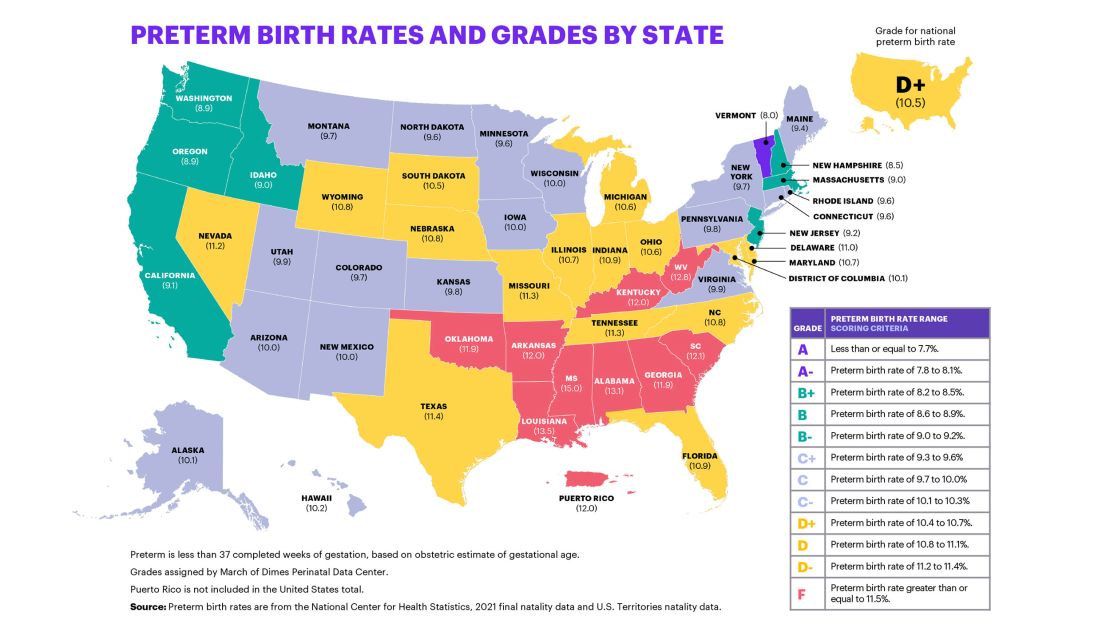
On Tuesday, the organization released its annual “report card” on maternal and infant health, which involves a newly updated calculation system. Taking an in-depth look at premature births, the new report found that the US preterm birth rate rose to 10.5% last year, representing an increase of 4% since 2020 and the worst national rate since March of Dimes started tracking this data in 2007, based on its new calculation system.
“This is actually a 15-year high in the preterm birth rate in this country,” said Dr. Zsakeba Henderson, senior vice president and interim chief medical and health officer at March of Dimes.
The US preterm birth rate peaked in 2006 at 12.8%, according to data from the National Center for Health Statistics.
Since then, some March of Dimes reports have found US preterm birth rates much higher than 10.5%, but those rates were based on calculations that have since been updated, according to March of Dimes.
“There are too many babies being born too soon: 1 in 10. If you were to have 10 babies in front of you and one of them is having to face the complications that comes with prematurity, that’s unacceptable, and we need to do better,” Henderson said, adding that those 1 in 10 are more likely to be Black, American Indian or Alaska Native.
March of Dimes data in the new report shows that infants born to Black and Native American mothers are 62% more likely to be born preterm than those born to White women.
States with the highest and lowest rates
The new March of Dimes report also highlighted state-by-state differences in the rate of babies born prematurely across the country.
The report grades a preterm birth rate less than or equal to 7.7% as an A and a preterm birth rate greater than or equal to 11.5% as an F.
The national preterm birth rate of 10.5% is graded as a D+.
No state has achieved an A rate, and only one has a state-level preterm birth rate that would be graded as an A-: Vermont, which has the lowest preterm birth rate in the US at 8%.
Meanwhile, nine states and one territory have preterm birth rates that received an F grade: Georgia and Oklahoma with 11.9%; Arkansas, Kentucky and Puerto Rico with 12%; South Carolina with 12.1%; West Virginia with 12.8%; Alabama with 13.1%; Louisiana with 13.5%; and Mississippi with the highest preterm birth rate of all states at 15%.
“The areas that have the worst grades are the same areas we’ve been seeing consistently for a long time, and it’s past time for us to do what we need to do to make health better and make our country a better place to give birth and be born,” Henderson said. “It’s unfortunate that we don’t have policies in place to protect the most vulnerable in our country, and without protecting our moms and babies, we can’t secure the health of everyone else.”
To address these state-by-state disparities in preterm births and help improve the national preterm birth rate as a whole, March of Dimes has been advocating for certain policies, Henderson said, including the Black Maternal Health “Momnibus” Act of 2021, a sweeping bipartisan package of bills to provide pre- and postnatal support for Black mothers – but most of the bills in the package are still making their way through Congress.
March of Dimes also has been urging more states to adopt legislation expanding access to doulas and midwives, among other maternal health care services, and reduce the prevalence of maternity care deserts across the country.
How Covid-19 plays a role
There are many potential factors contributing to the nation’s rising preterm birth rate, and Henderson said the Covid-19 pandemic remains one of the biggest.
“We cannot forget about the impact of the Covid-19 pandemic and recognize that there is likely a huge contribution of that, knowing that Covid-19 infection increases the risk of preterm birth,” she said. “But we also know that this pandemic brought many other issues to the forefront, knowing that issues around structural racism and barriers to adequate prenatal care, issues around access, were brought to the forefront during this pandemic as well.”
She added that many mothers in the United States are starting pregnancies later in life, and there has been an increase in mothers with chronic health conditions, who are at higher risk of having to give birth early due to pregnancy complications.
Henderson also said that preterm birth is one of the top causes of infant deaths and disproportionately affects babies born to women of color.
“The United States is one of the worst places to give birth and be born among industrialized countries, unfortunately. When we look at maternal deaths and infant deaths, we’re at the bottom of the pack among countries with similar profiles in terms of gross domestic product,” Henderson said. “It’s because of our disproportionate numbers of preterm births – particularly for populations that are disproportionately impacted, such as Black families and American Indian and Alaskan Native families – that our rates are so much higher than other countries.”
An ‘urgent public health issue’
Globally, about 10% of births are preterm worldwide – similar to the US preterm birth rate.
About 15 million babies are born preterm each year, amounting to more than 1 in 10 of all births around the world, according to the World Health Organization, which has called prematurity an “urgent public health issue” and “the leading cause of death of children under 5.”
Separate from the March of Dimes report, WHO released new guidelines Tuesday on how nations can improve survival and health outcomes for babies born too early, at 37 weeks of pregnancy or less, or too small, at 5½ pounds or less.
These WHO recommendations advise that skin-to-skin contact, also known as kangaroo mother care, be provided to a preterm infant immediately after birth, without any initial time spent in an incubator.
“Previously, we recommended that kangaroo mother care to only be for babies that were completely stable,” said pediatrician Dr. Karen Edmond, medical officer for newborn health at WHO, who was the lead on the new guidelines.
“But now we know that if we put babies in skin-to-skin contact, unless they are really critically ill, that this will vastly increase their chances of surviving,” she said. “So what’s new is that we now know that we should provide kangaroo mother care immediately after birth, rather than waiting until the baby’s stable.”
Edmond added that immediate kangaroo mother care can help infants better regulate their body temperature and help protect against infections, and she said that these guidelines are for on-the-ground health care providers as well as families.
The new WHO guidelines also recommend that emotional, financial and workplace support be provided for families of babies born too early or at low birth weights.
“Preterm babies can survive, thrive, and change the world – but each baby must be given that chance,” WHO Director-General Tedros Adhanom Ghebreyesus said in a news release.
“These guidelines show that improving outcomes for these tiny babies is not always about providing the most high-tech solutions,” he said, “but rather ensuring access to essential healthcare that is centred around the needs of families.”
Read more →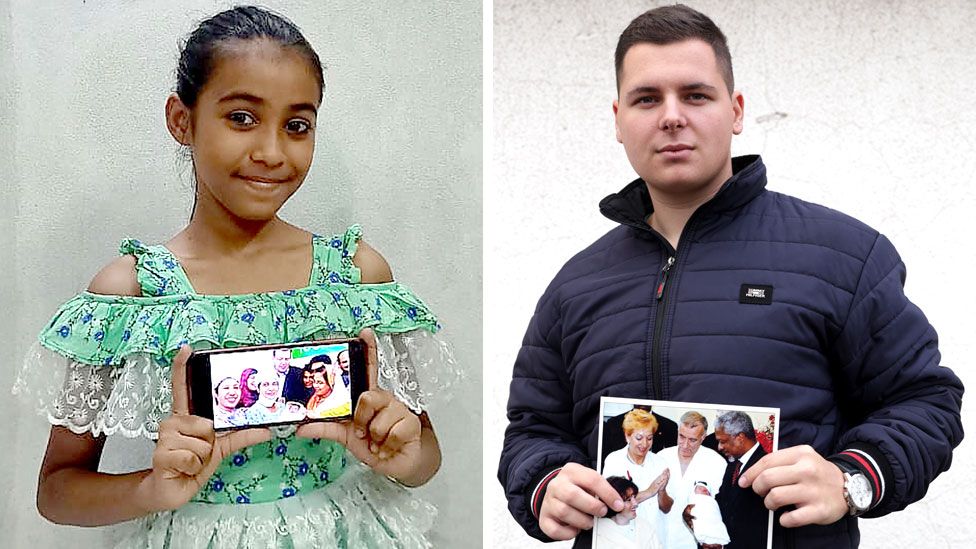
Published9 hours agoSharecloseShare pageCopy linkAbout sharingBy Stephanie HegartyPopulation correspondent, BBC World ServiceThe UN says the world’s population has hit eight billion, just 11 years after passing the seven-billion milestone.After a big surge in the middle of the 20th Century, population growth is already slowing down.It could take 15 years to reach nine billion and the UN doesn’t expect to reach 10 billion until 2080.It’s hard to calculate the number of people in the world accurately, and the UN admits its sums could be out by a year or two.But 15 November is its best estimate for the eight billion line to be crossed. In previous years, the UN has selected babies to represent the five, six and seven-billionth children – so what can their stories tell us about world population growth?A few minutes after he was born in July 1987, Matej Gaspar had a flashing camera in his tiny face and a gaggle of besuited politicians surrounding his exhausted mother.Stuck at the back of a motorcade outside, British UN official Alex Marshall felt partially responsible for the momentary chaos he had brought upon this tiny maternity unit in the suburbs of Zagreb.”We basically looked at the projections and dreamed up this idea that the world population would pass five billion in 1987,” he says. “And the statistical date was 11 July.” They decided to christen the world’s five-billionth baby.When he went to the UN’s demographers to clear the idea they were outraged. “They explained to us ignorant people that we didn’t know what we were doing. And we really shouldn’t be picking out one individual among so many.”But they did it anyway. “It was about putting a face to the numbers,” he says. “We found out where the secretary general was going to be that day and it went from there.” This video can not be playedTo play this video you need to enable JavaScript in your browser.Thirty-five years later the world’s five-billionth baby is trying to forget his ceremonious entry into the world. His Facebook page suggests he’s living in Zagreb, happily married and working as a chemical engineer. But he avoids interviews and declined to speak to the BBC.”Well, I don’t blame him,” Alex says, remembering the media circus of Matej’s first day.Since then, three billion more people have been added to our global community. But the next 35 years could see a rise of only two billion – and then the global population is likely to plateau.Just outside Dhaka in Bangladesh, Sadia Sultana Oishee is helping her mum, peeling potatoes for dinner. She’s 11 and would rather be outside playing football but her parents run a pretty tight ship. The family had to move here when their business, selling fabric and saris, was hit by the pandemic. Life is less expensive in the village, so they can still afford to pay school fees for their three daughters. Oishee is the youngest and the family’s lucky charm. Born in 2011, she was named one of the world’s seven-billionth babies. Her mum had no idea what was about to happen. She hadn’t even expected to give birth that day. After a doctor’s visit she was sent to the labour ward for an emergency Caesarean section. Oishee arrived at one minute past midnight, surrounded by TV crews and local officials craning over each other to see her. The family were stunned but delighted. While her father had hoped for a boy, he’s now happy with his three hard-working, intelligent daughters. His eldest is already in university and Oishee is determined to become a doctor. “We are not that well-off and Covid has made things harder,” he says. “But I’ll do everything to make her dream come true.”Since Oishee was born, another 17 million people have been added to Bangladesh’s growing population. This growth is a great medical success story, but the rate at which Bangladesh is expanding has slowed enormously. In 1980 the average woman would have more than six children, now it is less than two. And that’s thanks to the focus that the country has put on education. As women become more educated they choose to have smaller families. This is crucial for understanding where the world’s population is likely to go. The three main bodies that make projections on global population – the UN, the Institute of Health Metrics and Evaluation (IHME) at the University of Washington and the IIASA-Wittgenstein Centre in Vienna – vary on the gains they expect in education.The UN says the global population will peak in the 2080s at 10.4 billion but the IHME and Wittgenstein believe it will happen sooner – between 2060 and 2070, at less than 10 billion. But these are just projections. Since Oishee was born in 2011 a lot has changed in the world, and demographers are constantly surprised. “We were not expecting that the Aids mortality would fall so low, that treatment would be saving so many people,” says Samir KC, a demographer at the IIASA. He’s had to alter his model because an improvement in child mortality has a long-term impact, as surviving children go on to have children themselves.And then there are the staggering drops in fertility. Demographers were shocked when the number of children born per woman in South Korea dropped to an average of 0.81, Samir KC says. “So, how low will it go? This is the big question for us.”It is something more and more countries will have to grapple with.While half of the next billion people will come from only eight countries – most of them in Africa – in most countries the fertility rate will be lower than 2.1 children per woman, the number necessary to sustain a population.In Bosnia-Herzegovina, one of the most rapidly declining populations in the world, 23-year-old Adnan Mevic thinks about this a lot. “There is going to be nobody left to pay for pensions for retired people,” he says. “All the young people will be gone.”He has a masters in economics and is looking for a job. If he can’t find one he’ll move to the EU. Like many parts of Eastern Europe, his country has been hit with the double-whammy of low fertility and high emigration.Adnan lives outside Sarajevo with his mum, Fatima, who has surreal memories of his birth.”I realised something was unusual because doctors and nurses were gathering around but I couldn’t tell what was happening,” Fatima says. When Adnan arrived, the then UN Secretary General Kofi Annan was there to christen him the world’s six-billionth baby. “I was so tired, I don’t know how I felt,” Fatima recalls, laughing.Adnan and his mum flick through photo albums. In one a tiny boy sits in front of a giant cake, flanked by men in suits and military khakis. “While other kids were having birthday parties, I was just visited by politicians,” Adnan says.But there were perks. Being the six-billionth baby led to an invitation to meet his hero, Cristiano Ronaldo, at Real Madrid, when he was 11. He finds it stunning that in 23 years the world population has grown by two billion people. “That’s really a lot,” he says. “I don’t know how our beautiful planet will cope.”More on this storyHow the world got to 8 billion – and where next. Video, 00:01:44How the world got to 8 billion – and where next11 hours ago1:44Where is India’s billionth baby now?27 October
Read more →
A new study published in Diabetologia (the journal of the European Association for the Study of Diabetes [EASD]) finds that outdoor artificial light at night (LAN) is associated with impaired blood glucose control and an increased risk of diabetes, with more than 9 million cases of the disease in Chinese adults being attributed to LAN exposure. The study is by Dr Yu Xu and colleagues at the Shanghai Institute of Endocrine and Metabolic Diseases, Ruijin Hospital, Shanghai Jiaotong University School of Medicine, Shanghai, China.
Exposure to artificial LAN at night is a ubiquitous environmental risk factor in modern societies. The intensity of urban light pollution has increased to the point that it not only affects residents of big cities, but also those in distant areas such as suburbs and forest parks that may be hundreds of kilometres from the light source. The authors note: “Despite over 80% of the world’s population being exposed to light pollution at night, this problem has gained limited attention from scientists until recent years.”
Earth’s 24-hour day-night cycle has resulted in most organisms, including mammals, having an inbuilt circadian (roughly 24-hour) timing system which is adapted to the natural sequence of light and dark periods. Light pollution has been found to alter the circadian rhythm of insects, birds and other animals, resulting in premature death and loss of biodiversity.
Artificial LAN has also been implicated as a potential cause of metabolic dysregulation through altering the timing of food intake. Rats exposed to artificial LAN developed glucose intolerance, exhibiting elevated blood sugar and insulin. Another study found that mice exposed to nocturnal dim white light of minimal brightness for 4 weeks had increased body mass and reduced glucose tolerance compared to animals whose environment was completely dark at night, despite having roughly equivalent energy consumption and expenditure.
Associations have also been found between artificial LAN and health problems in humans. A study of night-shift workers found that those exposed to brighter LAN were more likely to have disrupted circadian rhythms, as well as a greater risk of coronary heart disease. Other research found that higher LAN exposure was associated with a 13% and 22% increase in the likelihood of being overweight and obese, respectively, while exposure to LAN in the bedroom was reported to be positively associated with the development of diabetes in elderly people.
The potential impact of outdoor artificial LAN was revealed by a study in South India which used satellite images to map light pollution and compared this with data on general health markers among adults across the region. With increasing LAN intensity, there were corresponding rises in average body mass index (BMI), systolic blood pressure and ‘bad’ (LDL) cholesterol levels in the exposed population.
A study published in Nature Medicine reports the ability of a smartwatch ECG to accurately detect heart failure in nonclinical environments. Researchers at Mayo Clinic applied artificial intelligence (AI) to Apple Watch ECG recordings to identify patients with a weak heart pump. Participants in the study recorded their smartwatch ECGs remotely whenever they wanted, from wherever they were. Periodically, they uploaded the ECGs to their electronic health records automatically and securely via a smartphone app developed by Mayo Clinic’s Center for Digital Health.
“Currently, we diagnose ventricular dysfunction — a weak heart pump — through an echocardiogram, CT scan or an MRI, but these are expensive, time consuming and at times inaccessible. The ability to diagnose a weak heart pump remotely, from an ECG that a person records using a consumer device, such as a smartwatch, allows a timely identification of this potentially life-threatening disease at massive scale,” says Paul Friedman, M.D., chair of the Department of Cardiovascular Medicine at Mayo Clinic in Rochester. Dr. Friedman is the senior author of the study.
People with a weak heart pump might not have symptoms, but this common form of heart disease affects about 2% of the population and 9% of people over 60. When the heart cannot pump enough oxygen-rich blood, symptoms may develop, including shortness of breath, a rapid heart rate and swelling in the legs. Early diagnosis is important because once identified, there are numerous treatments to improve quality of life and decrease the risks of heart failure and death.
Mayo researchers interpreted Apple Watch single-lead ECGs by modifying an earlier algorithm developed for 12-lead ECGs that is proven to detect a weak heart pump. The 12-lead algorithm for low ventricular ejection fraction is licensed to Anumana Inc., an AI-driven health technology company, co-created by nference and Mayo Clinic.
While the data are early, the modified AI algorithm using single-lead ECG data had an area under the curve of 0.88 to detect a weak heart pump. By comparison, this measure of accuracy is as good as or slightly better than a medical treadmill diagnostic test.
“These data are encouraging because they show that digital tools allow convenient, inexpensive, scalable screening for important conditions. Through technology, we can remotely gather useful information about a patient’s heart in an accessible way that can meet the needs of people where they are,” says Zachi Attia, Ph.D., the lead AI scientist in the Department of Cardiovascular Medicine at Mayo Clinic. Dr. Attia is first author of the study.
“Building the capability to ingest data from wearable consumer electronics and provide analytic capabilities to prevent disease or improve health remotely in the manner demonstrated by this study can revolutionize health care. Solutions like this not only enable prediction and prevention of problems, but also will eventually help diminish health disparities and the burden on health systems and clinicians,” says Bradley Leibovich, M.D., the medical director for the Mayo Clinic Center for Digital Health, and co-author on the study.
All 2,454 study participants were Mayo Clinic patients from across the U.S. and 11 countries. They downloaded an app created by the Mayo Clinic Center for Digital Health to securely upload their Apple Watch ECGs to their electronic health records. Participants logged more than 125,000 previous and new Apple Watch ECGs to their electronic health records between August 2021 and February 2022. Clinicians had access to view all the ECG data on an AI dashboard built into the electronic health record, including the day and time it was recorded.
Approximately 420 participants had an echocardiogram — a standard test using sound waves to produce images of the heart — within 30 days of logging an Apple Watch ECG in the app. Of those, 16 patients had low ejection fraction confirmed by the echocardiogram, which provided a comparison for accuracy.
This study was funded by Mayo Clinic with no technical or financial support from Apple. Drs. Attia and Friedman, along with others, are co-inventors of the low ejection fraction algorithm licensed to Anumana and may benefit from its commercialization.
Story Source:
Materials provided by Mayo Clinic. Original written by Terri Malloy. Note: Content may be edited for style and length.
An immune response that likely evolved to help fight infections appears to be the mechanism that drives human immunodeficiency virus (HIV) into a latent state, lurking in cells only to erupt anew, researchers at Duke Health report.
Publishing Nov. 14 in the journal Nature Microbiology, the research team provides new insights into the vexing process that makes HIV particularly stealthy, but could also play a role in other viral infections.
“HIV has proven to be incurable because of a small number of latently HIV-infected T-cells that are untouched by both antiviral drugs and the immune response,” said senior author Bryan R. Cullen, Ph.D., professor in the Department Molecular Genetics and Microbiology at Duke University School of Medicine.
“These cells, which are very long lived, can spontaneously emerge from latency and start producing HIV even years after infection, thus necessitating the life-long use of antiretrovirals,” Cullen said. “The origin of these latently infected cells has remained unknown despite considerable effort.”
The findings from Cullen and colleagues offer important insights, pointing to a protein complex called SMC5/6, which is involved in a host cell’s chromosome function and repair.
HIV enters the body, infects the immune system’s CD4+ T-cells, then makes a genome-length DNA molecule that it integrates into a host cell chromosome where it is then copied to generate viral RNAs and proteins.
For the first time, scientists at Northwestern Medicine have demonstrated a causal link between environmental phthalates (toxic chemicals found in everyday consumer products) and the increased growth of uterine fibroids, the most common tumors among women.
Manufacturers use environmental phthalates in numerous industrial and consumer products, and they’ve also been detected in medical supplies and food. Although they are known to be toxic, they are currently unbanned in the U.S.
“These toxic pollutants are everywhere, including food packaging, hair and makeup products, and more, and their usage is not banned,” said corresponding study author Dr. Serdar Bulun, chair of the department of obstetrics and gynecology at Northwestern University Feinberg School of Medicine and a Northwestern Medicine physician. “These are more than simply environmental pollutants. They can cause specific harm to human tissues.”
Up to 80% of all women may develop a fibroid tumor during their lifetime, Bulun said. One-quarter of these women become symptomatic with excessive and uncontrolled uterine bleeding, anemia, miscarriages, infertility and large abdominal tumors necessitating technically difficult surgeries.
The new study found women with a high exposure to certain phthalates such as DEHP (used as a plasticizer to increase the durability of products such as shower curtains, car upholstery, lunchboxes, shoes and more) and its metabolites have a high risk for having a symptomatic fibroid.
The study will be published Nov. 14 in the Proceedings of the National Academy of Sciences (PNAS).
Prior epidemiological studies have consistently indicated an association between phthalate exposure and uterine fibroid growth, but this study explains the mechanisms behind that link. The scientists discovered exposure to DEHP may activate a hormonal pathway that activates an environmentally responsive receptor (AHR) to bind to DNA and cause increased growth of fibroid tumors.
“Interestingly, AHR was cloned in the early ’90s as the receptor for dioxin, the key toxin in the agent orange,” Bulun said. “The use of agent orange during the Vietnam war caused significant reproductive abnormalities in the exposed populations; and dioxin and AHR were thought to be responsible for this.”
This new study, Bulun said, provides further evidence to support these theories.
More about DEHP:
DEHP has been the most widely used phthalate. Although there has been increased concern in the public and some regulatory restrictions in European Union countries, it is still widely used for the packaging of food and health products in the U.S. and across the world. DEHP can be gradually released from consumer products into indoor environments such as homes, schools, daycare centers, offices and cars. It settles on floors and other surfaces and can accumulate in dust and air. During pregnancy, DEHP can pass from mother to baby.
Story Source:
Materials provided by Northwestern University. Original written by Kristin Samuelson. Note: Content may be edited for style and length.
A Rutgers study of obese adults, all with nonalcoholic fatty liver disease (NAFLD) and morbid obesity (body mass index > 40), has shown that those who underwent bariatric surgery suffered far fewer extreme cardiovascular events subsequently.
Reporting their results in JAMA Network Open, the Rutgers team, along with collaborators from Ohio State University, reported that obese patients undergoing bariatric surgery were nearly 50 percent less likely to develop adverse cardiovascular events such as heart attacks, angina or strokes.
“The findings provide evidence in support of bariatric surgery as an effective therapeutic tool to lower elevated risk of cardiovascular disease for select individuals with obesity and NAFLD,” said Vinod K. Rustgi, Distinguished Professor of Medicine, clinical director of Hepatology and director of the Center for Liver Diseases and Liver Masses at Rutgers Robert Wood Johnson Medical School. “These finding are tremendously impactful for many reasons.”
Heart disease is the leading cause of death for men and women across the board for racial and ethnic groups in the United States. About 697,000 people in the country died from heart disease in 2020, according to the U.S. Centers for Disease Control and Prevention.
NAFLD, and a more advanced form known as NASH, are rapidly increasing causes of liver disease, and can impact people who drink little to no alcohol. The condition, which occurs because too much fat is being stored in liver cells, inciting an inflammatory state, is more common in people with obesity and type 2 diabetes.
In the study, researchers analyzed outcomes data, using the MarketScan Commercial Claims and Encounters medical insurance database, from 2007 to 2017. Of 230 million covered individuals, 86,964 adults between the ages of 18 and 64 who had obesity and NAFLD were identified. Of those, 68 percent of the study group were female, 35 percent underwent bariatric surgery and 65 percent received nonsurgical care.
Bariatric surgery patients experienced a 49 percent decrease in the risk of developing major cardiovascular events such as heart attacks, heart failure or ischemic strokes. They were also far less likely to experience angina, atherosclerotic events or arterial blood clots.
The association between bariatric surgery and risk reduction of developing cardiovascular disease has not been studied to this level of detail before, the researchers said.
There is growing evidence that bariatric surgery, because of the weight reduction it brings about in patients, offers definitive health benefits. A study conducted by Rustgi and colleagues, published in the journal Gastroenterology in March 2021, showed that bariatric surgery can also significantly reduce the risk of cancer — especially obesity-related cancers — in obese individuals with NAFLD. Importantly, these cancers included colorectal, pancreatic, endometrial, thyroid cancer, multiple myeloma and hepatocellular carcinoma.
“Although bariatric surgery is a more aggressive approach than lifestyle modifications, it may be associated with other benefits, such as improved quality of life and decreased long-term health care burden,” Rustgi said.
Other Rutgers physicians and statisticians in the study included You Li, and Carlos Minacapelli, both in the Division of Gastroenterology and Hepatology at Rutgers Robert Wood Johnson Medical School. Mohamed Elsaid, who worked with this team while obtaining his PhD at Rutgers, is now on faculty at Ohio State.
Story Source:
Materials provided by Rutgers University. Original written by Kitta MacPherson. Note: Content may be edited for style and length.