Inherited genetic factors may predict the pattern of X chromosome loss in older women

Researchers have identified inherited genetic variants that may predict the loss of one copy of a woman’s two X chromosomes as she ages, a phenomenon known as mosaic loss of chromosome X, or mLOX. These genetic variants may play a role in promoting abnormal blood cells (that have only a single copy of chromosome X) to multiply, which may lead to several health conditions, including cancer. The study, co-led by researchers at the National Cancer Institute, part of the National Institutes of Health, was published June 12, 2024, in Nature.

To better understand the causes and effects of mLOX, researchers analyzed circulating white blood cells of nearly 900,000 women across eight biobanks, of whom 12% had the condition. The researchers identified 56 common genetic variants — located near genes associated with autoimmune diseases and cancer susceptibility — that influenced whether mLOX developed. In addition, rare variants in a gene known as FBXO10 were associated with a doubling in the risk of mLOX.
In women with mLOX, the investigators also identified a set of inherited genetic variants on the X chromosome that were more frequently observed on the retained X chromosome than on the one that was lost. These variants could one day be used to predict which copy of the X chromosome is retained when mLOX occurs. This is important because the copy of the X chromosome with these variants may have a growth advantage that could elevate the woman’s risk for blood cancer.
The researchers also looked for associations of mLOX with more than 1,200 diseases and confirmed previous findings of an association with increased risk of leukemia and susceptibility to infections that cause pneumonia.
The scientists suggest that future research should focus on how mLOX interacts with other types of genetic variation and age-related changes to potentially alter disease risk.

Read more →

Study on fruit flies could benefit eggs of older women

A Dartmouth study conducted on fruit flies reports the first evidence in any organism that oocytes — the cells that become eggs — regularly rejuvenate the critical protein linkages that bind chromosomes together. The findings are a potentially important step toward helping women reduce their risk of pregnancy complications as they age, the researchers report in the journal Current Biology.
Women are born with the oocytes they will have for life, and the cohesive linkages that connect chromosomes are established in those cells prenatally. When they reach childbearing age, ovulation triggers the oocyte to divide, resulting in the formation of an egg that can be fertilized by a sperm. Cohesive linkages must be present in the dividing oocyte to form an egg that contains the correct number of chromosomes.
As a woman ages, so do her oocytes. The loss of cohesive linkages as oocytes age is one factor that increases the likelihood of miscarriages and conditions such as Down syndrome for older women, a phenomenon known as the maternal age effect. The risk of cell division producing an egg with the wrong number of chromosomes goes up significantly after the age of 30.
But the Dartmouth researchers discovered that in fruit fly oocytes, new cohesive linkages form on the chromosomes to replace the originals. They monitored specific proteins within the cohesin complex — the group of proteins that mediate the linkages between chromosomes — and found that this rejuvenation process occurs throughout the development of the fly oocyte.
“Our work is the first in the field to demonstrate that cohesive linkages in oocytes can form after the original linkages are generated,” says Sharon Bickel, professor of biological sciences at Dartmouth and the paper’s corresponding author.
“Whether organisms other than fruit flies utilize cohesion rejuvenation in oocytes is not known,” Bickel says. “But it is hard to understand why rejuvenation would be necessary to keep cohesion intact for six days in fruit fly oocytes, but not in human oocytes that undergo decades of aging.”
The researchers propose in their paper that if human oocytes do have the ability to rejuvenate cohesive linkages, this mechanism may become less efficient because of oxidative damage brought on by aging. A decline in rejuvenation could lead to an overall loss in chromosome linkages, Bickel says.

The Bickel Lab uses fruit flies as a model for investigating the molecular mechanisms underlying chromosome cohesion. They have found that the effects of aging on fruit fly oocytes are similar to that seen in humans. In 2008, the lab reported a method for “aging” fruit fly oocytes that provided evidence that aging causes a loss of cohesive linkages. A 2016 paper showed that increasing oxidative damage in fruit fly oocytes also results in the loss of cohesive linkages, while a 2019 paper from the lab reported that decreasing oxidative damage in aging oocytes improves cell division outcomes.
“If we can identify the proteins and the mechanisms that underlie cohesion rejuvenation in this system, that could inform the development of therapeutic strategies designed to enhance rejuvenation in the eggs of older women and slow the loss of cohesion,” Bickel says.
Muhammad Haseeb, a postdoctoral researcher in Bickel’s lab and the paper’s first author, says that evidence for turnover in cohesive linkages has proven elusive for researchers. To date, experiments performed in mice have reported no signs of rejuvenation.
The Dartmouth researchers took several different approaches, says Haseeb, who began the project as a graduate student in Dartmouth’s Molecular and Cellular Biology program. Some of the fly strains the team utilized were generated by co-author Katherine Weng when she was a graduate student in Bickel’s lab.
The tools available for fruit fly experiments allowed the researchers to manipulate proteins at an earlier stage in oocytes, but still after the original cohesive linkages had formed. They also used two different methods to monitor a protein that exists in all varieties of the cohesin complex found in fruit fly oocytes, Haseeb says. Researchers working in mice focused on a single protein present in only a subset of cohesin complexes in mouse oocytes, he says.
“It is possible that one or both of these differences account for our findings,” Haseeb says. The paper may help facilitate further experiments in mouse oocytes that could help forge a clearer path to discovering and understanding this process in humans, he says.
“Interestingly, two of the regulatory proteins that we know are required for rejuvenation in fly oocytes also are present on mouse oocyte chromosomes — after the original cohesive linkages are formed,” Haseeb says. “That is consistent with them playing a role in rejuvenation in mammals.”
Bickel and Haseeb take the study one step further in a paper published June 8 in the journal G3 with co-authors Alana Bernys ’20 and Erin Dikert ’21, who worked on the project as Dartmouth undergraduate students. In it, the researchers identify proteins required for rejuvenation so that the molecular pathway or pathways can be better understood.
An additional project ongoing in the Bickel Lab is testing whether nutritional supplements can reduce the risk of chromosome errors in fly oocytes that have undergone aging.

Read more →

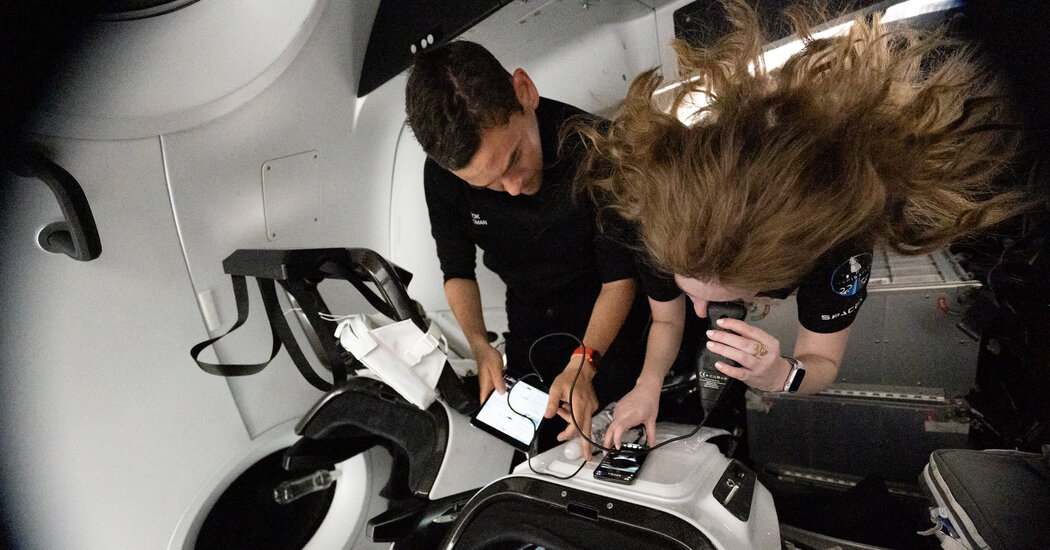
Four Astronauts Spent 3 Days in Space. Here’s What It Did to Their Bodies and Minds.

An extensive examination of medical data gathered from the private Inspiration4 mission in 2021 revealed temporary cognitive declines,Space changes you, even during short trips off the planet.Four people who spent three days off Earth in September 2021 experienced physical and mental changes that included modest declines in cognitive tests, stressed immune systems and genetic changes within their cells, scientists report in a package of papers published on Tuesday in the journal Nature and several other related journals.Almost all of what changed in the astronauts returned to normal after they splashed down on Earth. None of the alterations appeared to pose a showstopping caution for future space travelers. But the results also highlighted how little medical researchers know.Christopher Mason, a professor of genomics, physiology and biophysics at Weill Cornell Medicine in New York City and one of the leaders of the research, called the collection of papers and data “the most in-depth examination we’ve ever had of a crew” as he spoke during a news conference on Monday.The four astronauts traveled on a mission, known as the Inspiration4, which was the first trip to orbit where not one of the crew members was a professional astronaut. Jared Isaacman, a billionaire entrepreneur, led the mission. Instead of bringing friends along, he recruited three travelers who represented a wider swath of society: Hayley Arceneaux, a physician assistant who survived cancer during her childhood; Sian Proctor, a community college professor who teaches geoscience; and Christopher Sembroski, an engineer.The Inspiration4 crew members consented to participating in medical experiments — collecting samples of blood, urine, feces and saliva during their flight — and to allowing the data to be cataloged in an online archive known as the Space Omics and Medical Atlas, or SOMA, which is publicly available.Although the data is anonymous, that does not provide much privacy because there were only four crew members on Inspiration4. “You could probably figure out who is who, actually,” Dr. Proctor said in an interview.We are having trouble retrieving the article content.Please enable JavaScript in your browser settings.Thank you for your patience while we verify access. If you are in Reader mode please exit and log into your Times account, or subscribe for all of The Times.Thank you for your patience while we verify access.Already a subscriber? Log in.Want all of The Times? Subscribe.

Read more →

Painful truth about knee osteoarthritis: Why inactivity may be more complex than we think

Knee osteoarthritis (OA) is a common cause of pain and joint stiffness. And while physical activity is known to ease symptoms, only one in 10 people regularly exercise.
Understanding what contributes to patients’ inactivity is the focus of a world first study from the University of South Australia. Here, researchers have found that people with knee OA unconsciously believe that activity may be dangerous to their condition, despite medical advice telling them otherwise.
The study found that of those surveyed, 69% of people with knee pain had stronger implicit (unconscious) beliefs that exercise was dangerous than the average person without pain.
It’s an interesting finding that not only highlights the conflicted nature of pain and exercise, but also that what people say and what people think, deep down, may be entirely different things.
Lead researcher, and UniSA PhD candidate based at SAHMRI, Brian Pulling, says the research provides valuable insights for clinicians treating people with knee OA.
“Research shows that physical activity is good for people with knee OA, but most people with this condition do not move enough to support joint or general health,” Pulling says.
“To understand why people with OA might not be active, research studies typically use questionnaires to assess fear of moving. But unfortunately, questionnaires are limited — what we feel deep down (and how our system naturally reacts to something that is threatening) may be different to what we report. And we still know that many people are avoiding exercise, so we wanted to know why.”
To assess this, the researchers developed a tool that can detect and evaluate people’s implicit beliefs about exercise; that is, whether they unconsciously think activity is dangerous for their condition.

“We found that that even among those who said they were not fearful about exercise, they held unconscious beliefs that movement was dangerous,” Pulling says.
“Our research shows that people have complicated beliefs about exercise, and that they sometimes say one thing if asked directly yet hold a completely different implicit belief.
“People are not aware that what they say doesn’t match what they choose on the new task; they are not misrepresenting their beliefs.
“This research suggests that to fully understand how someone feels about an activity, we must go beyond just asking directly, because their implicit beliefs can sometimes be a better predictor of actual behaviour than what people report. That’s where our tool is useful.”
The online implicit association test presents a series of words and images to which a participant must quickly associate with being either safe or dangerous. The tool intentionally promotes instant responses to avoid deliberation and other influencing factors (such as responding how they think they should respond).
Associate Professor Tasha Stanton says that the new tool has the potential to identify a group of people who may have challenges increasing their activity levels and undertaking exercise.

“What people say and what people do are often two different things, Assoc Prof Stanton says.
“Having access to more accurate and insightful information will help health professionals better support their patients to engage with activity and exercise. It may also open opportunities for pain science education, exposure-based therapy, or cognitive functional therapy…things that would not usually be considered for someone who said that they were not scared to exercise.”
Researchers are now looking to see if implicit beliefs are directly associated with behaviour and are asking for people to complete the Implicit Association Test (takes seven minutes). At the end of the test participants are given their results in comparison to the rest of the population.
To take the test, please click here: https://unisasurveys.qualtrics.com/jfe/form/SV_0OZKUqzBNtiKGF0

Read more →

Preparing for a world where Alzheimer’s disease is treatable

Drugs with the potential to change the course of Alzheimer’s disease are expected to be approved by mid-year in the UK. Healthcare services may need to change to ensure that all patients have equitable access to these new modifying anti-amyloid therapies, according to research led by Queen Mary University of London and University College London (UCL).
Alzheimer’s disease is the most common cause of dementia. Of the 944,000 people living with dementia in the UK, 60-80% have Alzheimer’s. Currently, the only available drugs for Alzheimer’s treat symptoms. However, recent clinical trials show that new therapies — which use monoclonal antibodies to remove amyloid plaques that form on the brain — may slow down disease progression. Two of these ‘disease-modifying therapies’ (DMTs) have been granted ‘breakthrough therapy’ designation in the UK and are likely to become available to patients by mid-2024 (pending regulatory approval).
In the UK, dementia care is mostly centred around psychiatry-led memory clinics in the community. In their current state, it is extremely unlikely that DMTs will be administered in these settings. Delivery of these new treatments will require a major restructure to existing dementia services — from determining eligibility to delivery of the treatment itself, including follow-up. It will require additional staff and training across imaging, diagnostics and pathology, and other clinical services. It will also require access to laboratories that can carry out biomarker testing to confirm whether a patient is eligible for the treatment.
The potential roll-out of DMTs presents major challenges for services and has real potential to amplify existing inequities in service access. To anticipate and mitigate these challenges, researchers from Queen Mary’s Centre for Preventive Neurology, UCL’s Dementia Research Centre, and UCL Partners carried out essential research to estimate how many patients are likely to be eligible for DMTs.
The researchers compared clinical case notes from over 1,000 people attending either community memory clinics or specialist cognitive services in England. They found that 32% of those attending memory services and 14% of people attending specialist cognitive services would likely be referred for consideration for the new DMTs. Researchers found that amyloid biomarker tests were available for people attending specialist cognitive services in the form of specialist scans called PET scans and spinal fluid tests. However, fewer than 1% of people attending community memory clinics had undergone biomarker tests.
While a sizeable proportion of patients attending memory clinics may be referred for therapy for Alzheimer’s disease, only a minority are likely to be suitable, once they have undergone biomarker testing. The researchers highlight an immediate need for biomarker testing to ensure that the right patients can be identified for these treatments.
First author, Professor Ruth Dobson, Professor of Neurology at Queen Mary University of London, Consultant Neurologist and Dementia Theme Co-Lead for UCL Partners, said: “The development of disease modifying therapies for dementia has the potential to drive significant service changes. We have seen the impact of this in MS and stroke. It is crucial to understand and plan such changes proactively in order to ensure best care for all people living with dementia, regardless of initial treatment availability and eligibility.”
Study lead, Professor Rimona Weil, Consultant Neurologist at UCL and the National Hospital for Neurology and Neurosurgery, and Dementia Theme Co-Lead for UCL Partners said: “Working with clinicians running memory clinics was crucial to this work, meaning that we could get real-world estimates for how many people are likely to be referred for these new drugs for the first time.”

Study co-lead, Professor Catherine Mummery, Consultant Neurologist at UCL and the National Hospital for Neurology and Neurosurgery, said: “We demonstrate that diagnostic resources affect the accuracy of diagnosis and referral habits, and that a collaborative networked approach is critical to developing a functioning treatment service in preparation for these new therapies.”
David Thomas, Head of Policy and Public Affairs at Alzheimer’s Research UK, said: “New Alzheimer’s drugs are finally on the horizon, but for their full potential to be realised, health systems need to be able to offer people with symptoms of dementia an accurate and early diagnosis to find out whether these treatments could benefit them.
“As this research demonstrates, the NHS is a long way from being able to do this testing routinely. Whoever forms the next government must invest in the NHS urgently, to ensure we have the right diagnostics and workforce in place to help identify people who could benefit from new treatments should they be deemed safe and effective by the regulators. A key part of the solution is cheaper, more scalable diagnostics, such as blood tests, for use in clinical care.”
This study was produced by researchers from a network of universities who form the Academic Health Science Centre for UCLPartners and in collaboration with a network of clinicians in memory clinics in London and the South East.

Read more →

Biden Proposes Dropping Medical Debt From Credit Reports

The move would offer relief to millions of Americans who need a better credit score to get an apartment or a car, but it would not wipe out their financial obligations.The Biden administration on Tuesday proposed removing medical debt from the credit reports of more than 15 million Americans, making it easier for them to qualify for car, home and small-business loans.The proposed rule, which will go through a public comment period, would not take effect immediately. It would forbid health care providers to share medical debt with loan providers and prohibit those providers from factoring in medical information when it came to granting loans.Vice President Kamala Harris said the move would improve “the financial health and well-being of millions of Americans.”“One of the most significant consequences of carrying medical debt is the harm it does to a person’s credit score,” Ms. Harris said. “Medical debt makes it more difficult for millions of Americans to be approved for a car loan, a home loan or a small-business loan, all of which in turn makes it more difficult to just get by, much less get ahead. That is simply not fair.”Medical debt often looms large in the lives of Americans, with an estimated 20 million owing more than $250 to health care providers. Americans who are Black and Latino are more likely to report outstanding bills, as are those who are low income or uninsured. In surveys, Americans have described taking out loans and working extra hours to cover those debts.As the economy and inflation have soured voters during President Biden’s first term, his administration’s efforts to limit costs have become a focus of his re-election campaign. His aides believe measures such as cutting prices for prescription products like insulin or inhalers are already being felt by voters and will help improve the perception of Mr. Biden’s domestic agenda. The president has also relied on such economic achievements to convince voters of color — a base of his constituency — that he has delivered on his racial equity agenda, even as more sprawling proposals have been blocked by the courts.We are having trouble retrieving the article content.Please enable JavaScript in your browser settings.Thank you for your patience while we verify access. If you are in Reader mode please exit and log into your Times account, or subscribe for all of The Times.Thank you for your patience while we verify access.Already a subscriber? Log in.Want all of The Times? Subscribe.

Read more →

Do traumatic life experiences impact perception of distressing imagery?

The human visual system is a dominant part of the brain’s processes and navigation of the world. To better understand an aspect of this system, researchers from Drexel University’s College of Nursing and Health Professions examined how life experiences impact a person’s perception of imagery — specifically decorated masks.
The study, published in Frontiers in Psychology, examined viewer responses to images of distressing and neutrally decorated masks and whether personal life history, particularly past experiences of trauma and difficulty, affected how the person perceived the imagery.
The research team, led by Girija Kaimal, EdD, an associate professor, and Asli Arslanbek-Evci, a recent doctoral graduate, both from the College of Nursing and Health Professions, found that traumatic life events do impact the perception of trauma-related imagery, and that neutral imagery overall evoked less of an emotional response in viewers than the imagery depicting moral, psychological or physical injuries.
“This shows the important associations between personal experiences of trauma and how we respond to visual imagery,” said Kaimal.
“It’s important for health care providers and caregivers to be aware of the vulnerabilities and sensitivities to visual imagery for individuals with a history of experiencing or witnessing trauma. Further, researchers may incorporate these methods to better understand differences in brain function and structure associated with traumatic experiences,” said John Williamson, PhD, co-author of the paper and an associate professor from the University of Florida.
Kaimal added that in addition to the practical implications for improving therapeutic practices and supporting trauma recovery, the study highlights our collective sensitivities as a society to the impact of viewing distressing images.
The research team found that responses to mask image content (traumatic versus neutral) were associated with viewers’ personal history of adversity and trauma. Specifically, images representing injury/trauma provoked stronger reactions on positive/negative emotional responses (valence) and arousal scales than neutral images.

“We found imagery with intense emotional content including distress and pain were more likely to evoke heightened emotion and a sense of personal relevance for individuals who have experienced adversities and trauma in their life,” said Arslanbek-Evci. “This does not necessarily indicate negative consequences of viewing distressing content. Instead, it may suggest that people connect with imagery in different ways. For individuals who have experienced trauma, they might find both emotional activation and resonance (a sense of personal connection) with graphic images depicting distress.”
Study participants took an anonymous online survey responding to a series of mask images and completed the Life Events Checklist, which asks whether they had witnessed, experienced or heard about a series of traumatic events. The images of the masks included artwork created by military service members with traumatic brain injury (TBI) and post-traumatic stress disorder (PTSD), depicting physical, psychological and moral injuries. Those images were matched with neutral masks created by the research team. Nearly 700 participants rated 98 masks in terms of their arousal, emotional response and perceived personal relevance.
“Mask images were used since they mimic the human face and this has a distinct brain pathway in terms of recognition, responses to pain, empathy and similar interpersonal responses,” said Kaimal. “In the profession of art therapy, mask-making has been recognized as a safe and effective medium that enables individuals to establish psychological distance for the purpose of self-expression and has been used to depict transformation and growth.”
Kaimal and Arslanbek-Evci explained that this study shows how impactful imagery can be in all aspects of life, including in mass communications, public health and mental health care perspectives. Evocative images have the power to both promote a sense of personal connection, as well as activate emotions that are associated with past experiences. They hope further research can examine how these differ based on age, gender, type of trauma history as well as different types of imagery such as humans, nature, or environment, among others.

Read more →