Trial of Controversial Alzheimer’s Drug Halted After Disappointing Results

Cassava Sciences said that its drug did not significantly reduce cognitive decline in 1,900 people with mild to moderate Alzheimer’s disease.Cassava Sciences, a small biotechnology company based in Austin, Texas, announced it would stop the advanced clinical trial for an experimental Alzheimer’s drug, ending a long-contested bid for regulatory approval.The company announced on Monday that the drug, simufilam, did not significantly reduce cognitive decline in people with mild to moderate Alzheimer’s disease in the trial, which enrolled more than 1,900 patients.“The results are disappointing for patients and their families who are living with this disease and physicians who have been looking for novel treatment options,” the company’s chief executive, Richard J. Barry, said in a statement.These results were unsurprising to many dementia researchers, who had questioned why the trial had been allowed to proceed in the first place, since much of the drug’s underlying science had been called into question.Studies that once seemed to support the drug have been retracted from scientific journals. A consultant researcher who helped conduct some of the drug’s foundational studies was charged with fraud by a federal grand jury for allegedly falsifying data to obtain research grants.In September, the company settled with the Securities and Exchange Commission over allegations that Cassava had made misleading statements about the results of earlier clinical trial data. However, the company neither admitted nor denied wrongdoing.Even so, the company forged ahead with its Phase 3 clinical trial — typically the last evaluation before the Food and Drug Administration decides whether to approve a medication for public use — and maintained that there was still research and clinical results that suggested the drug could prove valuable.Hopes in the drug’s efficacy were dashed by Monday’s results, though the company said the trial still showed the drug was safe.Cassava’s future now appears to be in flux, as simufilam was the company’s only drug in clinical trials.Following the company’s investor call Monday morning, Cassava’s stock price dropped more than 80 percent, a blow to the company’s loyal investors, who once valued the company at more than $5 billion.

Read more →

An I.V.F. Mixup, a Shocking Discovery and an Unbearable Choice

In the days after Daphna Cardinale delivered her second child, she experienced a rare sense of calm and wonder. The feeling was a relief after so much worrying: She and her husband, Alexander, had tried for three years to conceive before turning to in vitro fertilization, and Daphna, once pregnant, had frequent and painful early contractions. But now, miraculously, here was their baby, their perfect baby, May, with black hair plastered on her head. (May is a nickname that her parents requested to protect her privacy.)Listen to this article, read by Julia WhelanBecause everything about May felt like an unexpected gift, Daphna was not surprised to find that she was an easy newborn: a good eater, a strong sleeper. The couple settled May into her lavender bedroom in their home in a suburb of Los Angeles. Daphna, on leave from her work as a therapist, was grateful for the bounty of two children, overjoyed that she could deliver to her older daughter, Olivia, then 5, the sister she had begged for since she could speak in full sentences.Alexander, a singer and songwriter, wanted to share his wife’s happiness, but instead he was preoccupied by a concern that he was reluctant to voice: May did not look to him like a member of their family. She certainly did not resemble him, a man of Italian descent with fair hair and light brown eyes, or Daphna, a redhead with Ashkenazi Jewish heritage. Alexander often turns to dark humor to mask a simmering anxiety, and in the days after the birth, he started to joke that their I.V.F. clinic had made a mistake. Later he would explain that the jokes were a kind of superstition, a way of warding off something threatening: If you say the horrible thing out loud, it won’t happen. But friends and family members were also commenting to him on the striking difference in appearance — Alexander’s mother, for example, told him, out of Daphna’s earshot, that she would have guessed that at least one of May’s parents was Asian.Alexander would convince himself that everything was fine, only to be walloped once again by the suspicion that May was not his genetic child. Daphna, who was accustomed to calming Alexander’s worries, quickly tired of his nervous jokes about the clinic. Looking back, she realized that her consciousness was working on two levels, that her mind was laboring not to see what was fairly obvious. She often sought reassurance from a baby photo of herself that her mother sent her, in which she closely resembled May. But occasionally, when Daphna looked in the mirror, she would see her own face and think it looked strange — as if there were something wrong with her.Daphna Cardinale with May at the hospital.From the Cardinale familyAlexander Cardinale at the hospital with Olivia and May.From the Cardinale familyWe are having trouble retrieving the article content.Please enable JavaScript in your browser settings.Thank you for your patience while we verify access. If you are in Reader mode please exit and log into your Times account, or subscribe for all of The Times.Thank you for your patience while we verify access.Already a subscriber? Log in.Want all of The Times? Subscribe.

Read more →

World Seeks an End to Plastic Pollution at Talks in South Korea

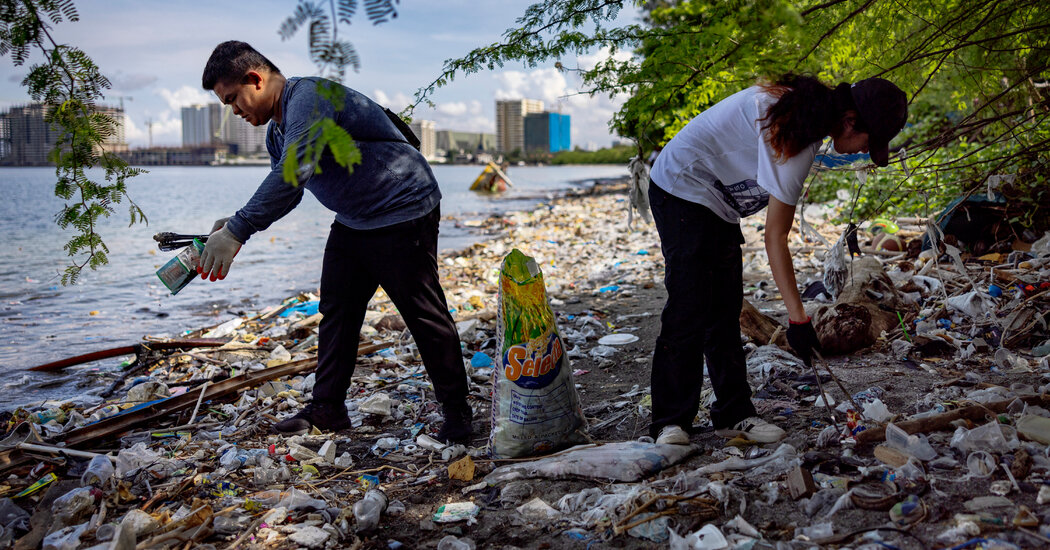
Many nations hope to reduce the half a billion tons of plastic made each year. But pushback from plastic and oil producers, and Donald Trump’s election, could scuttle an agreement.On the heels of contentious climate talks in Azerbaijan, negotiators from around the globe are descending on Busan, South Korea, this week with another formidable goal: to hammer out the world’s first treaty designed to tackle plastic pollution’s explosive growth.On the table is a proposal that aims to cut down on the millions of tons of plastic waste discarded each year. And a broad coalition of nations is seeking to go a step further and rein in plastic production, with a focus on restricting single-use plastic.That notion had gained traction leading up to the final round of talks in Busan, with even the United States, a major plastics producer, tentatively backing the United Nations-led effort.Then came the election of Donald J. Trump.Now, few expect the United States to sign on to an eventual treaty at all. And with deep-seated opposition from oil and gas nations like Saudi Arabia and Russia — which, like the United States, produce the fossil fuels used to make plastic — some delegates are wondering whether any agreement is possible by the scheduled end of the talks on Sunday.“The U.S. really engaged on this, but if they step back, it’s a big disappointment,” said Ndiaye Cheikh Sella, a delegate for Senegal and the chief of staff of the country’s environmental ministry.There is one consensus among most delegates: The world has a colossal plastic waste problem.The world produces nearly half a billion tons of plastic each year, more than double the amount from two decades ago, and much of that turns up on coastlines and river banks, as well as in whales, birds and other animals that ingest them. Researchers have estimated that one garbage truck’s worth of plastic enters the ocean every minute.We are having trouble retrieving the article content.Please enable JavaScript in your browser settings.Thank you for your patience while we verify access. If you are in Reader mode please exit and log into your Times account, or subscribe for all of The Times.Thank you for your patience while we verify access.Already a subscriber? Log in.Want all of The Times? Subscribe.

Read more →
Trump’s Choices for Health Agencies Suggest a Shake-Up Is Coming

The picks to oversee public health have all pushed back against Covid policies or supported ideas that are outside the medical mainstream.A longtime leader of the anti-vaccine movement. A highly credentialed surgeon. A seven-term Florida congressman. A Fox News contributor with her own line of vitamins.President-elect Donald J. Trump’s eclectic roster of figures to lead federal health agencies is almost complete — and with it, his vision for a sweeping overhaul is coming into focus.Mr. Trump’s choices have varying backgrounds and public health views. But they have all pushed back against Covid policies or supported ideas that are outside the medical mainstream, including an opposition to vaccines. Together, they are a clear repudiation of business as usual.“What they’re saying when they make these appointments is that we don’t trust the people who are there,” said Dr. Paul Offit, director of the Vaccine Education Center at Children’s Hospital of Philadelphia and an adviser to the Food and Drug Administration.Some doctors and scientists are bracing themselves for the gutting of public health agencies, a loss of scientific expertise and the injection of politics into realms once reserved for academics. The result, they fear, could be worse health outcomes, more preventable deaths and a reduced ability to respond to looming health threats, like the next pandemic. “I’m very, very worried about the way that this all plays out,” Dr. Offit said.But other experts who expressed concerns about anti-vaccine views at the helms of the nation’s health agencies said that some elements of the picks’ unorthodox approaches were welcomed. After a pandemic that closed schools across the country and killed more than one million Americans, many people have lost faith in science and medicine, surveys show. And even some prominent public health experts were critical of the agencies’ Covid missteps and muddled messaging on masks and testing.We are having trouble retrieving the article content.Please enable JavaScript in your browser settings.Thank you for your patience while we verify access. If you are in Reader mode please exit and log into your Times account, or subscribe for all of The Times.Thank you for your patience while we verify access.Already a subscriber? Log in.Want all of The Times? Subscribe.

Read more →

So Many Days Lost at the Doctor’s Office

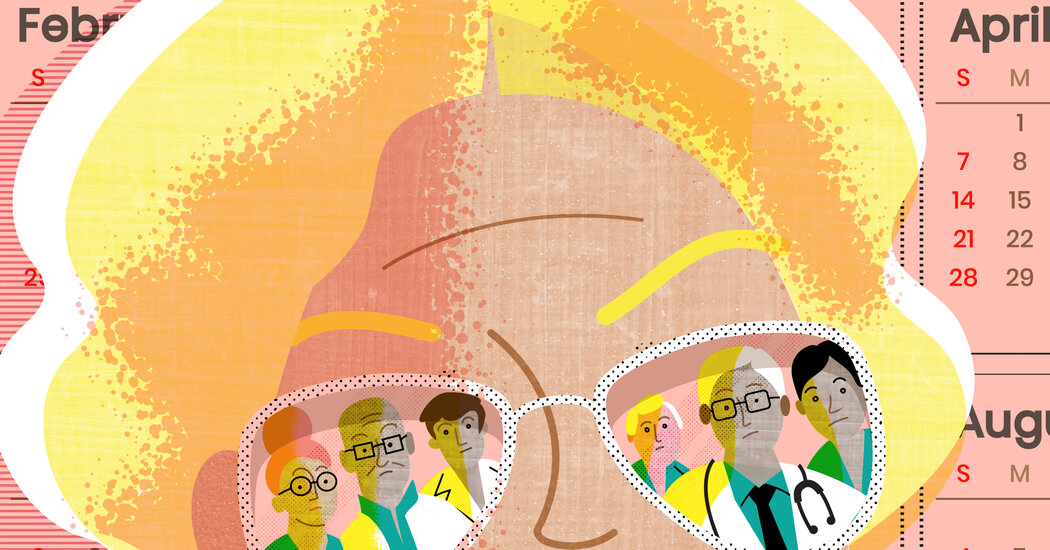
Medical care can be wearying and time-consuming, especially for seniors. Researchers are beginning to quantify the burdens.Deana Hendrickson sometimes feels daunted by the demands of the medical system. “Every body part has a doctor,” she lamented. “I hate it.”Ms. Hendrickson reeled off a long list of her health care providers: a primary care doctor; a cardiologist, because she has mild heart disease and a concerning family history; a lung surgeon and a pulmonologist who oversee an annual scan because of her family history of lung cancer.Plus an ophthalmologist, a gynecologist, a urologist, a podiatrist, a gastroenterologist — “and I just came back from the dentist.”She estimates that with scans, imaging and tests, she spends two dozen days a year engaged with some sort of provider. Most of them, she added, practice in Santa Monica, Calif., where she used to live, now an hour’s drive from her home.At 65, providing five-day-a-week care (with her husband) for three grandsons under 5, she’s reasonably healthy and active. But her regimen “makes me feel like a sick person,” Ms. Hendrickson said.“I’m like an older car that always needs more maintenance. There’s so many other things I’d rather be doing.”We are having trouble retrieving the article content.Please enable JavaScript in your browser settings.Thank you for your patience while we verify access. If you are in Reader mode please exit and log into your Times account, or subscribe for all of The Times.Thank you for your patience while we verify access.Already a subscriber? Log in.Want all of The Times? Subscribe.

Read more →