Read the Letter From Nobel Laureates Urging That Mr. Kennedy Not be Confirmed

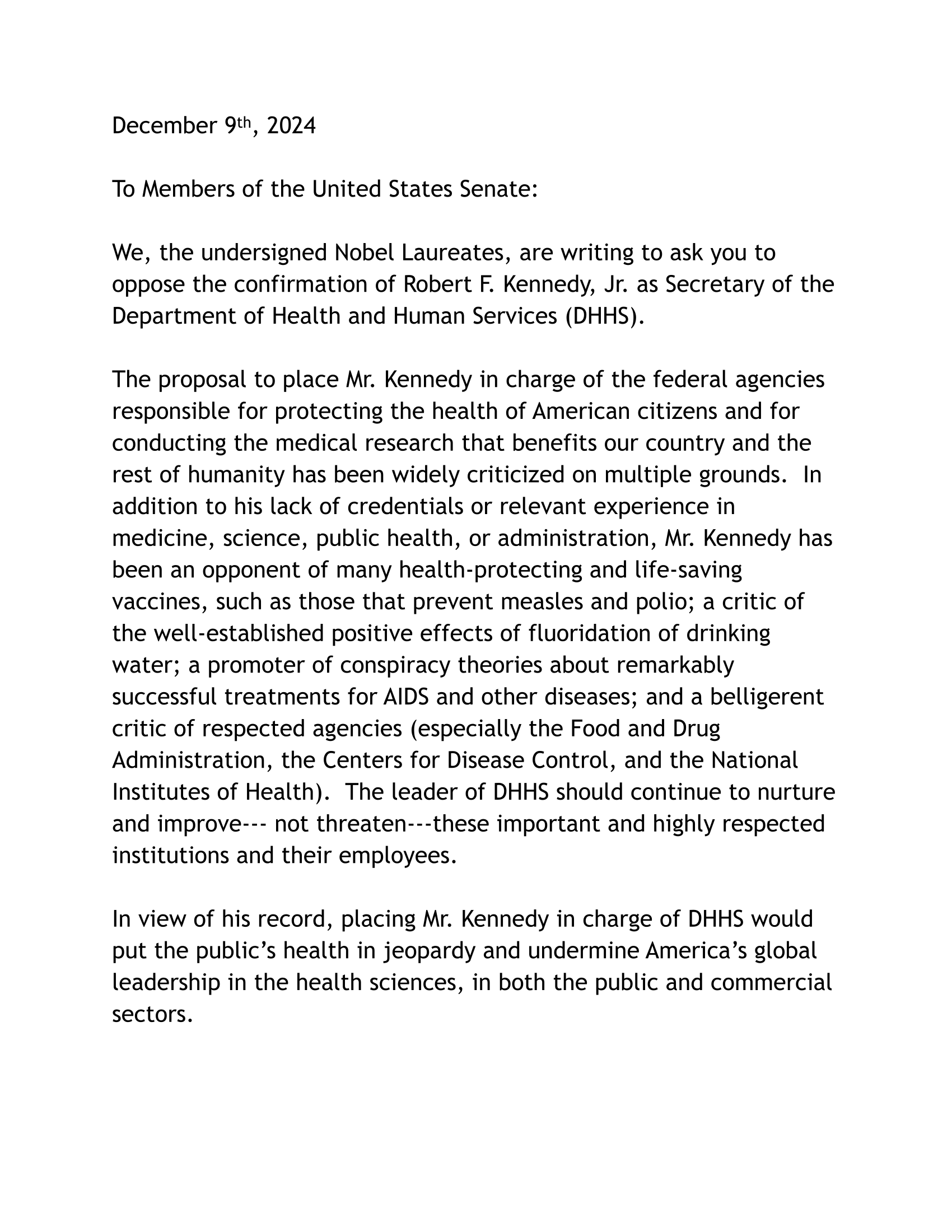
December 9th, 2024
To Members of the United States Senate:
We, the undersigned Nobel Laureates, are writing to ask you to
oppose the confirmation of Robert F. Kennedy, Jr. as Secretary of the
Department of Health and Human Services (DHHS).
The proposal to place Mr. Kennedy in charge of the federal agencies
responsible for protecting the health of American citizens and for
conducting the medical research that benefits our country and the
rest of humanity has been widely criticized on multiple grounds. In
addition to his lack of credentials or relevant experience in
medicine, science, public health, or administration, Mr. Kennedy has
been an opponent of many health-protecting and life-saving
vaccines, such as those that prevent measles and polio; a critic of
the well-established positive effects of fluoridation of drinking
water; a promoter of conspiracy theories about remarkably
successful treatments for AIDS and other diseases; and a belligerent
critic of respected agencies (especially the Food and Drug
Administration, the Centers for Disease Control, and the National
Institutes of Health). The leader of DHHS should continue to nurture
and improve— not threaten—these important and highly respected
institutions and their employees.
In view of his record, placing Mr. Kennedy in charge of DHHS would
put the public’s health in jeopardy and undermine America’s global
leadership in the health sciences, in both the public and commercial
sectors.

Read more →

Nobel Laureates Urge Senate to Turn Down Kennedy’s Nomination

Elevating Mr. Kennedy to secretary of H.H.S. “would put the public’s health in jeopardy,” more than 75 laureates wrote.More than 75 Nobel Prize winners have signed a letter urging senators not to confirm Robert F. Kennedy Jr., President-elect Donald J. Trump’s pick to lead the Department of Health and Human Services.The letter, obtained by The New York Times, marks the first time in recent memory that Nobel laureates have banded together against a Cabinet choice, according to Richard Roberts, winner of the 1993 Nobel in Physiology or Medicine, who helped draft the letter. The group tries to stay out of politics whenever possible, he said.But the confirmation of Mr. Kennedy, a staunch critic of mainstream medicine who has been hostile to the scientists and agencies he would oversee, is a threat that the Nobel laureates could not ignore, Dr. Roberts said.“These political attacks on science are very damaging,” he said. “You have to stand up and protect it.”The laureates questioned whether Mr. Kennedy, who they said has “a lack of credentials” in medicine, science or administration, was fit to lead the department responsible for protecting public health and funding biomedical research.“Placing Mr. Kennedy in charge of DHHS would put the public’s health in jeopardy and undermine America’s global leadership in the health sciences,” the letter warned.We are having trouble retrieving the article content.Please enable JavaScript in your browser settings.Thank you for your patience while we verify access. If you are in Reader mode please exit and log into your Times account, or subscribe for all of The Times.Thank you for your patience while we verify access.Already a subscriber? Log in.Want all of The Times? Subscribe.

Read more →

The Brave New World of A.I.-Powered Self-Harm Alerts

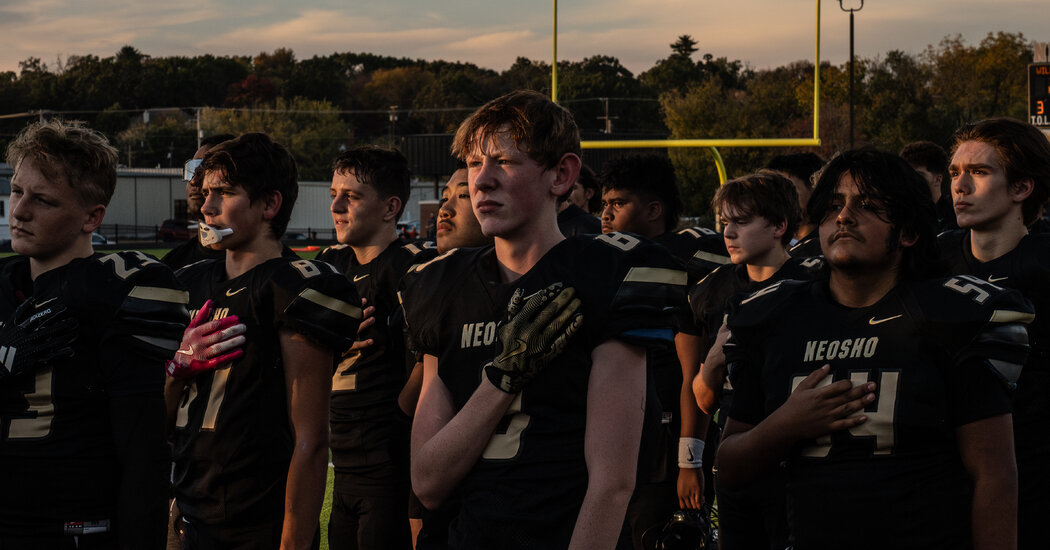
Dawn was still hours away when Angel Cholka was awakened by the beams of a police flashlight through the window. At the door was an officer, who asked if someone named Madi lived there. He said he needed to check on her. Ms. Cholka ran to her 16-year-old’s bedroom, confused and, suddenly, terrified.Ms. Cholka did not know that A.I.-powered software operated by the local school district in Neosho, Mo., had been tracking what Madi was typing on her school-issued Chromebook.While her family slept, Madi had texted a friend that she planned to overdose on her anxiety medication. That information shot to the school’s head counselor, who sent it to the police. When Ms. Cholka and the officer reached Madi, she had already taken about 15 pills. They pulled her out of bed and rushed her to the hospital.Thousands of miles away, at around midnight, a mother and father in Fairfield County, Conn., received a call on their landline and were unable to reach it in time to answer. Fifteen minutes later, the doorbell rang. Three officers were on the stoop asking to see their 17-year-old daughter, who had been flagged by monitoring software as at urgent risk for self-harm.The girl’s parents woke her and brought her downstairs so the police could quiz her on something she had typed on her school laptop. It took only a few minutes to conclude that it was a false alarm — the language was from a poem she wrote years earlier — but the visit left the girl profoundly shaken.“It was one of the worst experiences of her life,” said the girl’s mother, who requested anonymity to discuss an experience “traumatizing” to her daughter.We are having trouble retrieving the article content.Please enable JavaScript in your browser settings.Thank you for your patience while we verify access. If you are in Reader mode please exit and log into your Times account, or subscribe for all of The Times.Thank you for your patience while we verify access.Already a subscriber? Log in.Want all of The Times? Subscribe.

Read more →

In Congo, a Medical Mystery Offers Clues to the Mpox Epidemic

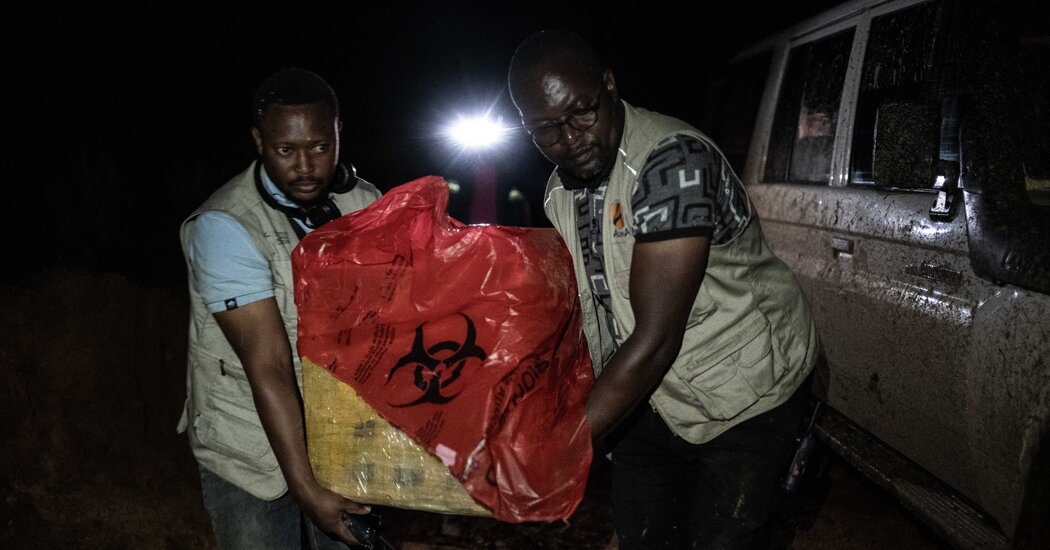
On Sept. 30, 2023, an anxious father brought his 5-year-old son to the hospital in Kamituga, a muddy, bustling town carved out of the thick forest in the eastern Democratic Republic of Congo. The boy had a high fever and oozing sores on his torso and face.Nurses diagnosed chickenpox. They admitted him to the pediatric ward, part of a sprawl of low-slung brick buildings that date to the colonial era, and tried to manage his fever.Days passed, and the child’s health did not improve. His fever climbed higher, the lesions spread, blistering even the soles of his small feet.Perplexed, the pediatric staff called Dr. Steeve Bilembo, who was managing urgent care. He and a trusted nurse colleague, Fidèle Kakemenge, examined the boy and named, and then quickly eliminated, possibilities: Not chickenpox, not measles, not rubella, not a bad case of dermatitis — he would be improving by now if he had any of those ailments.The spreading sores meant it wasn’t malaria or typhoid or cholera, the diseases afflicting other children in the crowded ward.“And then at one point, we said, ‘Could it be mpox?’” Dr. Bilembo recounted. “Although we have never seen it — only in books.”We are having trouble retrieving the article content.Please enable JavaScript in your browser settings.Thank you for your patience while we verify access. If you are in Reader mode please exit and log into your Times account, or subscribe for all of The Times.Thank you for your patience while we verify access.Already a subscriber? Log in.Want all of The Times? Subscribe.

Read more →
Payments Are Going Digital, but Many Seniors Still Rely on Cash

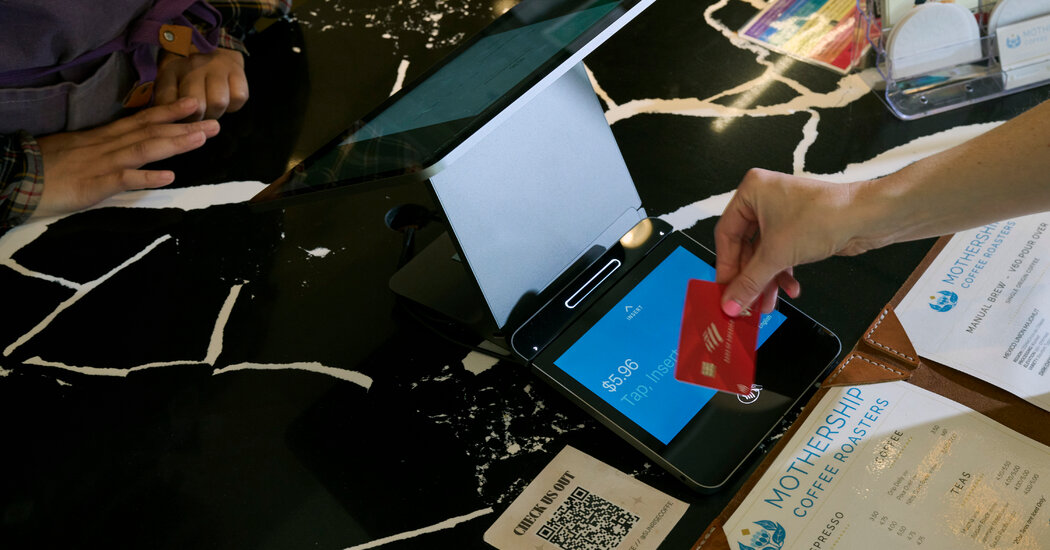
“We’re putting another burden on the elderly that we don’t have to,” one researcher said.Some things you can no longer do with cash: Buy a well-loaded hot dog at any of the five Devil Dawgs eateries in and around Chicago. Order a Vermont Pale Lager from Hill Farmstead Brewery’s taproom in Greensboro Bend, Vt.Attend the annual BeachLife Festival in Redondo Beach, Calif., or buy food, drinks or merchandise there. Purchase admission to the Home of Franklin D. Roosevelt National Historic Site in Hyde Park, N.Y., or to many other sites maintained by the National Park Service.The park service’s expanding no-cash policy exasperated several would-be visitors enough for them to sue in federal court earlier this year.Anne Ronan, 70, a retired attorney, walks around Lake Merritt in Oakland, Calif., a few times a week. After the three-mile-plus trek, she sometimes stops at one of two local cafes. Neither accepts payment in cash.Nor do a restaurant and a cocktail lounge nearby on Grand Avenue. “I don’t find it unusual anymore,” Ms. Ronan said.To buy coffee and a croissant, she routinely carries a credit card in her pocket. She doesn’t find that bothersome, but “as a public policy, it’s not a good thing.”We are having trouble retrieving the article content.Please enable JavaScript in your browser settings.Thank you for your patience while we verify access. If you are in Reader mode please exit and log into your Times account, or subscribe for all of The Times.Thank you for your patience while we verify access.Already a subscriber? Log in.Want all of The Times? Subscribe.

Read more →