Gender-affirming hormone therapy may increase risk of high blood pressure

Gender-affirming hormone therapy (GAHT) was associated with blood pressure changes in both transgender men and women, according to new research published today in Hypertension, an American Heart Association journal. Given the higher burden of heart attack, stroke and other cardiovascular conditions among transgender men and women, blood pressure screening and monitoring are important, especially after beginning hormone therapies.
Although doctors have prescribed gender-affirming hormone therapy to transgender men and women for more than 25 years, researchers and health care professionals know little about rates of hypertension and how the effects on blood pressure change over time. Previous research has shown that transgender men were almost five times as likely to report having a heart attack compared to cisgender women. Conversely, transgender women were more than two-and-a-half times more likely to have reported a heart attack than cisgender women, yet they did not have a significant increase in heart attack incidence when compared with cisgender men. However, a systematic review conducted in 2020 found most of the studies examining gender-affirming hormones and blood pressure had sample sizes that were too small to detect statistically significant differences in blood pressure.
“There are many important gaps in our knowledge about the effects of hormone therapy for transgender people. This study examined the time course and magnitude of the effects of gender-affirming hormones on blood pressure,” said senior study author Michael S. Irwig, M.D., an associate professor of medicine at Harvard Medical School and director of transgender medicine at Beth Israel Deaconess Medical Center in Boston.
To conduct the largest and longest observational study of its kind, the researchers followed 470 patients who began GAHT at a medical center in the Washington, D.C. area from 1/1/2007 to 6/1/2015. Participants were all at least 17 years old and non-cisgender. Of the 470 patients, 247 were transfeminine and 223 were transmasculine. About 27% of the participants were non-white, and 16% self-identified as Latinx. Researchers measured each patient’s blood pressure before beginning GAHT to establish a baseline and continued measurements at subsequent clinical visits for up to 57 months.
The study found: Within two to four months of beginning hormone therapy, transgender women saw an average decrease of 4.0 mm Hg in their systolic blood pressure, but transgender men saw an average increase of 2.6 mm Hg. The prevalence of stage 2 hypertension (at least 140/90 mm Hg) dropped from 19% to 10% in the transfeminine group within two to four months of beginning hormone therapy. The use of testosterone in transgender men could lead to an increased risk for heart attack or stroke if they also have untreated high blood pressure.In addition, the results indicated that some patients experienced different blood pressure effects compared to the majority of those with the same gender identity. Some transgender women and transgender men saw blood pressure rates trend in the opposite direction of their peers. The study authors highlight this is an area that requires further research, noting individuals taking the same medication may react in different ways.
The study has several limitations. Most patients were on the same formulation of intramuscular testosterone or oral estrogen, so the effects of other formulations need further study. Additionally, the study did not have a large enough sample to detect statistically significant changes in blood pressure measures among Black or Latinx patients.
Monitoring blood pressure and other preventive screening measures are particularly important in transgender and LBGTQ communities. A 2020 Scientific Statement from the American Heart Association indicates transgender adults had lower physical activity levels than their cisgender counterparts, and transgender women may be at increased risk for cardiovascular disease due to behavioral and clinical factors (such as the use of gender-affirming hormones like estrogen). The statement indicates that it is paramount to include LGBTQ health in clinical training and licensure requirements for health care professionals in order to better address cardiovascular health disparities in the LGBTQ community.
Study co-authors are Katherine Banks, M.D.; Mabel Kyinn, M.D.; Shalem Y. Leemaqz, Ph.D.; Eleanor Sarkodie, M.P.H.; Deborah Goldstein, M.D.
Story Source:
Materials provided by American Heart Association. Note: Content may be edited for style and length.

Read more →

India coronavirus: Delhi announces lockdown as Covid cases surge

SharecloseShare pageCopy linkAbout sharingimage copyrightGetty ImagesIndia’s capital Delhi has announced a week-long lockdown after a record spike in cases overwhelmed the city’s healthcare system.Government offices and essential services, such as hospitals, pharmacies and grocers, will be open during the lockdown which starts on Monday. The city had imposed a weekend curfew but reported its highest single-day spike so far on Sunday – 24, 462 cases. India has been reeling from a deadly second wave since the start of April.”I have always been against lockdowns, but this one will help us amplify the number of hospital beds in Delhi,” Chief Minister Arvind Kejriwal said in a press conference on Monday. He also appealed to the city’s migrant workers not to leave – last year’s national lockdown saw millions of them heading back to their villages after they found themselves unemployed and running out of money. “This was a difficult decision to take but we had no other option left,” Mr Kejriwal said. “I know when lockdowns are announced, daily-wage workers suffer and lose their jobs. But I appeal to them to not leave Delhi, it’s a short lockdown and we will take care of you.Lockdown rules:Religious places are allowed to open but cannot accept visitors.Only 50 people will be allowed at weddings and up to 20 people at funerals.Malls, cinemas, restaurants, public parks, gyms, spas will remain closed during the lockdown.All social, political and religious gatherings have been banned.Sporting events without spectators are allowed.Public transport like buses and the Metro will function with up to 50 per cent seating capacity.Students appearing for examinations with valid documents will be allowed to travel.Home delivery and takeaway of food by restaurants will be allowed.People travelling for Covid-19 vaccinations or testing will be allowed if they have valid documents. How India failed to prevent a deadly second wave’Think about ICU workers before you party”Covid lockdown will make us beg for food again’India has been reporting more than 200,000 cases daily since 15 April – this is well past its peak last year, when it was averaging around 93,000 cases a day. Deaths too have been rising. India confirmed 1,620 deaths from the virus on Sunday. On Monday UK Prime Minister Boris Johnson cancelled a planned trip to India in view of the situation. Mr Johnson and India’s Prime Minister Narendra Modi will speak later this month to “launch ambitious plans for the future partnership”, a statement said.image copyrightGetty ImagesMaharashtra, which has India’s financial hub Mumbai as its capital, remains the worst-hit state, accounting for a nearly a third of India’s more than 1.9 million active cases. But Delhi is the worst-hit city, confirming more cases daily than Mumbai in recent days. Hospitals are struggling to accommodate Covid positive patients in Delhi and other badly hit cities such as Mumbai, Lucknow and Ahmedabad. Several states have been reporting an acute shortage of beds in Covid wards and ICUs. Even test results are being delayed because of overwhelming demand, which, doctors say, is leading to people not getting diagnosed and treated in time. Experts say the Indian government ignored warnings of a second wave and did little to prevent it or even contain it – they point to cricket matches attended by unmasked crowds, massive election rallies that appeared to flout basic Covid safety rules and a huge Hindu festival where millions congregated on the banks of the Ganges river earlier this month to take a holy dip. Buoyed by a sharp dip in case numbers and the start of the vaccination drive, India began the year on what appeared to be a normal note. But things soon took a turn for the worse as people began leaving home more, wearing masks less and socialising in larger groups. The entry of variants and a lag in the vaccination drive only drove up infections further, experts say.Within weeks, India shot to the top of the world’s Covid chart, recording more cases daily than any other country.

Read more →

Young people to be reinfected with Covid for study

SharecloseShare pageCopy linkAbout sharingimage copyrightGetty ImagesHealthy young people who have had Covid-19 are being asked to volunteer for a trial that will deliberately expose them to the pandemic virus. The experts behind the study, beginning this month, want to see how the immune system copes second time round. The ultimate aim is to design better treatments and vaccines.Up to 64 people aged 18-30 will spend 17 days in a quarantine unit at a hospital suite and have numerous tests, including lung scans. They will be re-exposed to the virus, the original strain from Wuhan, China, in a “safe and controlled environment” while the medical team monitors their health.Develop symptomsThe first phase of this study, funded by the Wellcome Trust, will aim to establish the lowest dose of virus that can take hold and start replicating but produce few or no symptoms.This dose will then be used to infect participants in the second phase of the study, expected to start in the summer.Volunteers who develop symptoms will be given an antibody treatment to help them fight off the infection. They will be discharged only when they are no longer contagious. Anti-viral therapiesChief investigator Prof Helen McShane, from the University of Oxford, said: “Challenge studies tell us things that other studies cannot because, unlike natural infection, they are tightly controlled. “When we reinfect these participants, we will know exactly how their immune system has reacted to the first Covid infection, exactly when the second infection occurs, and exactly how much virus they got. “As well as enhancing our basic understanding, this may help us to design tests that can accurately predict whether people are protected.”Prof Lawrence Young, of Warwick University, said: “Human challenge studies have a long history of being able to generate important information about infections under strictly controlled conditions as well as allow the efficacy of vaccination to be accurately assessed.”They will significantly improve our understanding of the dynamics of virus infection and of the immune response as well as provide valuable information to help with the ongoing design of vaccines and the development of anti-viral therapies.”OXFORD JAB: What is the Oxford-AstraZeneca vaccine?SYMPTOMS: What are they and how to guard against them?TREATMENTS: What progress are we making to help people?VACCINE: When will I get the jab?COVID IMMUNITY: Can you catch it twice?

Read more →

What’s Behind the Growth in Alcohol Consumption?

A comparison across demographic groups over two decades offers some clues, and there has been a particular rise in misuse among women during the pandemic.American deaths from misuse of substances, including alcohol, have increased over the past two decades, but not uniformly across various demographic groups.Overall rates of alcohol abuse and related deaths have consistently and significantly increased for white non-Hispanic Americans, while Black Americans have experienced a much slower and less significant incline, and some other groups have had declines.More recently, alcohol use has been up during the pandemic, with one study showing a greater increase in misuse among women than among men.(For men, recommended limits are four drinks per day and 14 drinks per week, and for women, three drinks per day and seven drinks per week, according to the National Institute on Alcohol Abuse and Alcoholism.)“Alcohol kills many more people than many may realize,” said Yusuf Ransome, an assistant professor at Yale’s School of Public Health. “It is a major contributor to deaths linked to physical injuries, interpersonal violence, motor vehicle crashes, self-harm and other harmful outcomes.”One reason for this might be that alcohol is often viewed as socially acceptable. “Alcohol use has been normalized because it is consumed sometimes at family and communal gatherings, casual outings, and that’s the type of drinking that is typically seen or showed within the media,” he said. “We rarely see the long-term health impacts of excessive alcohol use, nor do we show the acute dangers of alcohol misuse and abuse.”Between 2000 and 2016, according to research published in JAMA, alcohol-related deaths continually increased for white men (2.3 percent per year on average) and white women (4.1 percent), with middle-aged white Americans accounting for the highest increase in deaths. Rapid increases during this period in mortality related to alcohol and drugs like opioids among white Americans — particularly those without a college degree — have been termed “deaths of despair.”The trend mirrors one experienced by Black Americans living in cities in the 1970s and 1980s. The underlying sources suggested by scholars are similar for the two groups, just shifted in time: social and economic stressors including poverty, stagnant or declining incomes, loss of blue-collar jobs, and disintegration of family units.For Black Americans, there was the added problem of structural and explicit racism that contributed (and continues to contribute) to reduced economic opportunity and worse mental and physical health outcomes.Rates of alcohol-related deaths among Black Americans declined somewhat in the early years of the 21st century, though they began to rise once more in 2007 (among women) and 2012 (among men). Nonetheless, the rate of alcohol-related death remains lower than among white Americans.One factor might be a high sense of community and high levels of religious service attendance within the Black community, which have consistently been associated with both lower and less severe alcohol use. Another possible reason for lower rates of alcohol use among Black Americans is the well-founded sense that the possible downsides are more severe for them compared with other racial and ethnic groups. African-Americans are more likely to be policed and to suffer negative outcomes during their interactions with law enforcement, as evidenced over the past year and historically.“African-Americans, particularly men and those of lower income, are at a higher risk of more social and legal consequences associated with drinking and other substance use,” said Tamika Zapolski, an associate professor of clinical psychology at Indiana University-Purdue University, Indianapolis. “They are more likely to experience negative health complications and be arrested and convicted.”For example, one study found that Black (and Hispanic) drinkers are 1.5 times more likely to report adverse social consequences from drinking compared with their white non-Hispanic counterparts. These results support earlier findings of significant racial disparities in alcohol-related consequences. Some studies attribute this to increased policing in lower-income Black neighborhoods.Native Americans have experienced the highest rates of alcohol-related deaths, which have been on the rise since 2000. According to a JAMA study, Native Americans’ alcohol misuse can be traced to “poverty, family history of alcohol use disorder, availability of alcohol at a younger age,” as well as stress from historical trauma. The death rate in 2016 was 113.2 per 100,000 for Native American men and 58.8 per 100,000 for Native American women.For other groups per 100,000, the death rate was 4.4 and 1.0 for Asian-American and Pacific Islander men and women; 13.8 and 4.6 for Black men and women; 21.9 and 4.7 for Hispanic American men and women; and 18.2 and 7.6 for white men and women.While there has been an overall increase in such deaths among Asian-Americans, the trends in alcohol consumption tend to diverge by national origin. Among Asian-American and Pacific Islander populations, U.S.-born individuals have higher rates of alcohol abuse than their first-generation immigrant counterparts, which may be because of cultural assimilation, among other factors.The enculturation process may have also had an impact on young Hispanic women, who are experiencing an increase in alcohol consumption and have the third-highest rates of female alcohol-related deaths, after Native American and white women.In the past two decades, women died of alcoholic liver disease on average two to three years earlier than men, even though they generally had longer life expectancies. During the pandemic, they have experienced a 41 percent increase in heavy drinking episodes, a survey study showed. (The C.D.C. definition of binge drinking for women is four or more drinks over two hours.)“Over the past two decades, underage females were exposed to and suffered the effects of alcohol marketing,” said David Jernigan, professor of health law, policy and management at the Boston University School of Public Health, who has researched the relationship between alcohol marketing and consumption of alcohol.“Specific products and product categories were created primarily for females: sweeter, fizzier, and marketed as more ‘feminine’ drinks,” he said.More than boys and young men, girls and young women are drawn to so-called alcopops — flavored, often fruity, alcoholic beverages — fueling their popularity, according to one study. Women absorb more alcohol than men when drinking equivalent amounts because it takes longer for them to metabolize it, so the risk of harm is higher.“We are seeing the consequences now, with increasing rates of cirrhosis and liver cancer deaths for women being the canary in the coal mine for a range of negative effects,” Professor Jernigan said.Nambi Ndugga is a policy analyst with KFF’s Racial Equity and Health Policy program. You can follow her on Twitter at @nambinjn.

Read more →

Emerging From the Pandemic With Acne, Facial Hair and Body Odor

Young people experiencing the body changes of puberty without being in school are facing a unique set of challenges. Here’s how parents can support them.A pediatrician friend saw a 10-year-old girl recently, for her yearly checkup. Like so many children (and so many adults) among us, she had gained a little extra weight over the past year, but she was fundamentally healthy. “The mom says to me, ‘You know, she’s very self-conscious, she’s developed over this last year, and none of her friends have, and it makes her so uncomfortable and it makes her sad,’” said the pediatrician, Dr. Terri McFadden, a professor of pediatrics at Emory University School of Medicine.The child had been attending virtual classes, and she was worried about going back into the classroom looking different; her mother had tried to explain to her that different people develop at different rates, Dr. McFadden said, but “she just felt she wasn’t normal, she wasn’t like her friends.”Most of the children in Dr. McFadden’s practice have been out of school for a full year, she said, and while many are eager to return to their friends, some are anxious about going back. Many have gained a significant amount of weight, which alone can make them worried about how they may be received by their peers. “School can be cruel,” Dr. McFadden said.While some schools have already gone back to in-person classes, circumstances vary across the country. Many children in the public school system in Atlanta, where Dr. McFadden practices, have been at home for more than a year. Some may be returning to school in bodies that have morphed over months at home, and while classmates may have noticed certain developments like a cracking voice, acne or facial hair on Zoom screens, other changes will be much more evident in person.“I definitely have seen a lot of people with a lot of weight gain and worry about going back,” said Dr. Holly Gooding, the head of adolescent medicine at Emory University School of Medicine. She always asks teenagers how school is going, she said, and nowadays, many of them say they’ll be going back in the fall. That presents an opportunity to ask more specifically about re-entry, she said, and open up the subject of body image.Dr. Chanelle Coble, an adolescent medicine specialist at N.Y.U. Grossman School of Medicine, said that young people are experiencing the body changes of puberty without the supports they would usually get from their peer group, and that is part of the general stress of the pandemic year. In her New York City practice, Dr. Coble said that she has seen higher than usual rates of severe anxiety and depression, as well as disordered eating, including among 11-, 12- and 13-year-olds.Some of these were children who gained weight early in the pandemic, and then, perhaps in reaction, started restricting their eating. In some, the weight loss has been so severe that they have stopped growing, or stopped menstruating.“Puberty is a general time of angst for people,” said Dr. Jennifer Miller, a pediatric endocrinologist at the Ann & Robert H. Lurie Children’s Hospital of Chicago, and an assistant professor of pediatrics at the Northwestern University Feinberg School of Medicine. It’s a stage when adolescents tend to be sensitive about changes in their bodies and how others perceive those changes, and the anxieties of returning to school — or more generally to life after lockdown — make that more pronounced.Dr. Jami Josefson, a pediatric endocrinologist at Lurie Children’s Hospital and an associate professor at Northwestern, said that going back to school after being out may be like seeing a relative you haven’t seen in a long time — there will always be comments about how the child has grown and changed.Some children will be taller, some will be more developed, some boys will have changing voices while others won’t. “This is all a normal part of going through adolescence, but it might seem a little more sudden,” Dr. Josefson said.Families should talk with children about how these changes are normal, about how everyone’s body changes, but not in unison. Dr. Coble suggested, “start with the basics, how are you eating, how are you sleeping?”If your children have been truly isolated, think about helping them ease back in — perhaps by encouraging them to spend socially distanced time outside with one good friend. Pandemic or no pandemic, children and families need reliable information about puberty. Dr. Adiaha Spinks-Franklin, a developmental behavioral pediatrician at Texas Children’s Hospital and an associate professor at Baylor College of Medicine, sends families to Amaze.org, which has videos aimed at kids, and to the Healthy Bodies Toolkit site developed by Vanderbilt University.Even in nonpandemic times, life is often harder for early developers, who remain emotionally and intellectually the same age as their peers, but who may look significantly older. Dr. Carol Ford, a professor of pediatrics and division chief of adolescent medicine at the Children’s Hospital of Philadelphia, said that the children who develop early always need more support, and that may be particularly true now, when the changes may be starker after an interval away. Parents need to be ready to have concrete and detailed conversations about issues like personal hygiene (yes, your sweat starts to smell different) and the developments still to come (menstruation, wet dreams).Some adolescent specialists have raised questions about whether the emotional intensity of lockdown and the pandemic year may actually have contributed to early puberty; Dr. Spinks-Franklin said, “I’ve had quite a few of my girls start their periods during the pandemic.” She has wondered whether stress has had something to do with that, or whether it is just regular development.One preliminary analysis out of Italy that was published in March suggested that referrals for early puberty in girls were significantly increased during the first six months of the pandemic, compared to the same six-month period of 2019. From March to September of 2020, 246 children, almost all girls, were referred to Bambino Gesù Children’s Hospital in Rome to be evaluated for suspected precocious puberty, compared to 118 during the same months of 2019. The authors raised questions about the possible links to stress, higher caloric intake and increased screen use, to be addressed with further research.If you think your child might be developing too early, schedule an appointment for an in-person checkup, and ask their pediatrician to discuss issues of puberty and body image. After the 10-year-old’s mother brought up the subject, Dr. McFadden talked with her patient, reinforcing the message that the body changes of puberty are normal and healthy. She talked with the mother about speaking with the child’s teachers, “so there will be a cadre of folks looking out for her as she re-emerges into in-person school.” And she and the mother discussed the risks that can attend early development in girls, who may be taken for older than they are, or preyed upon.Make sure that your child has clothes that fit her changing body and doesn’t seem to be popping out of too-short pants or too-tight shirts, which will draw attention to the changes. Talk about whether a child developing breasts wants to wear a camisole or bra. Talk through the logistics of getting your period at school, and make sure she knows where to go if she needs help or supplies.Though Dr. Miller sees patients for puberty-related questions and problems, her own sense of puberty during the pandemic also reflects her experience as a parent. “We have an 11-year-old daughter who is emotionally a roller coaster,” she said. Her daughter’s school recently had the “puberty talk,” in person, and her daughter reported, “The best part was being in one room with all the girls.”Her daughter then asked her pediatric endocrinologist mother why anyone needed to be a doctor focusing on puberty, Dr. Miller said, “Since all I do is talk about how it’s a completely normal thing for your body to go through.”

Read more →

Australia opens travel bubble with New Zealand

SharecloseShare pageCopy linkAbout sharingTearful reunions filled Auckland airport on Monday as residents from Australia were able to travel freely to New Zealand for the first time in more than a year.The long-awaited Australia-New Zealand travel bubble means visitors no longer need to quarantine on arrival.Thousands of passengers were booked to fly between the two nations on Monday. Both countries have contained Covid outbreaks and kept infection rates low, largely due to tight restrictions. Excited passengers crowded airports in Australia for flights to various parts of New Zealand on Monday, with some rising before dawn to get ready to board. “I didn’t realise how emotional I was going to be today,” passenger Dawn Tratt told the BBC at Sydney airport. While many buzzed with the anticipation of seeing loved ones, for others it was a more sombre occasion. “My older brother passed away last week on Thursday, we couldn’t get there last week, but it’s given us an opportunity to go back home today without quarantine so it’s good, very good to go and lay him to rest,” said John Palalagi in Sydney. Nirali Johal said she was going to see her partner for the first time in almost two years.”I couldn’t sleep last night, it has been very exciting,” she said. “We are just… happy that it has happened and we’re able to live a normal life again.”She said she was looking forward to “going to a café, chilling and do what people do on a normal day face-to-face.” She added: “Zoom relations aren’t great. I’m over it.”Australia and New Zealand shut their borders in March last year and brought in compulsory quarantine for returning nationals.Since October, New Zealand travellers have been allowed to enter most Australian states without quarantine, though this had not been reciprocated amid concerns about sporadic Covid outbreaks. To fly under the bubble’s rules, passengers must have spent 14 days before departure in either Australia or New Zealand. They must not be awaiting the results of a Covid test, nor have any Covid symptoms, amongst other criteria. ‘It’s weird being on a plane again’The international departure terminal at Sydney airport was very busy, very early in the day. The queue in front of the check-in desk was long and spiralling. Many parents tried to entertain exhausted toddlers who had to wake up exceptionally early to catch the first flight from Sydney to Auckland on Day 1 of the trans-Tasman bubble. Some passengers told me they camped outside from 02:00 local time (Sunday 17:00 GMT) before the airport had even opened. Others said they were so excited they couldn’t sleep. The first Jetstar flight was absolutely full. It’s a big day for airlines after a catastrophic year because of Covid, and a big sigh of relief for both the travel and tourism industries. But really, this moment is about friends and family reuniting with their loved ones. Dawn Tratt’s voice broke a little as she spoke to me ahead of take-off in Sydney. Her cousin is unwell and while this is a hard time for her family, she’s glad she’ll be able to be there for her. “We’re so privileged here in Australia and in New Zealand to be able to travel like that. It’s weird being on a plane again,” she smiled through her tears.Economic boostThe bubble is expected to deliver a lift to both economies, Australia’s Prime Minister Scott Morrison and New Zealand’s Prime Minister Jacinda Ardern said in a joint statement.”It is truly exciting to start quarantine-free travel with Australia. Be it returning family, friends or holiday-makers, New Zealand says welcome and enjoy yourself,” Ms Ardern said.The country relies on Australia for 40% of its international tourism, injecting about NZ$2.7bn (£1.4bn, $1.9bn) into the economy.In the other direction, New Zealanders accounted for 1.3 million arrivals to Australia in 2019, contributing A$2.6bn (£1.46bn; $2bn) to the Australian economy. Qantas, Jetstar and Air New Zealand will all fly routes between the two countries.Still, the leaders warned the trans-Tasman travel bubble will be under “constant review” given the risks of quarantine-free travel. The two countries have also previously raised the idea of separate travel bubbles with low-risk places like Singapore, Taiwan and several Pacific island nations. Both nations have won praise for their handling of the Covid pandemic. Strict border controls and snap lockdowns are among the measures that have kept infection rates low. Australia has recorded 910 deaths, and New Zealand 26 deaths. Despite its success in containing outbreaks, the Australian government is facing growing criticism over delays in its Covid vaccination rollout. The country has fallen far behind other nations and failed to meet its immunisation targets. The delays are likely to slow any further easing of border restrictions.

Read more →

How the Tiny Kingdom of Bhutan Out-Vaccinated Most of the World

The Himalayan nation has given more than 60 percent of its people a shot. Some villages were reached by helicopter, and health workers hiked through ice and snow.THIMPHU, Bhutan — The Lunana area of Bhutan is remote even by the standards of an isolated Himalayan kingdom: It covers an area about twice the size of New York City, borders far western China, includes glacial lakes and some of the world’s highest peaks, and is inaccessible by car.Still, most people living there have already received a coronavirus vaccine.Vials of the Oxford-AstraZeneca vaccine arrived last month by helicopter and were distributed by health workers, who walked from village to village through snow and ice. Vaccinations proceeded in the area’s 13 settlements even after yaks damaged some of the field tents that volunteers had set up for patients.“I got vaccinated first to prove to my fellow villagers that the vaccine does not cause death and is safe to take,” Pema, a village leader in Lunana who is in his 50s and goes by one name, said by telephone. “After that, everyone here took the jab.”Lunana’s campaign is part of a quiet vaccine success story in one of Asia’s poorest countries. As of Saturday, Bhutan, a Buddhist kingdom that has emphasized its citizens’ well-being over national prosperity, had administered a first vaccine dose to more than 478,000 people, over 60 percent of its population. The Health Ministry said this month that more than 93 percent of eligible adults had received their first shots.Helicopters were crucial for distributing the vaccine to parts of mountainous Bhutan.Bhutan Ministry of HealthThe vast majority of Bhutan’s first doses were administered at about 1,200 vaccination centers over a weeklong period in late March and early April. As of Saturday, the country’s vaccination rate of 63 doses per 100 people was the sixth highest in the world, according to a New York Times database.That rate was ahead of those of the United Kingdom and the United States, more than seven times that of neighboring India and nearly six times the global average. Bhutan is also ahead of several other geographically isolated countries with small populations, including Iceland and the Maldives.Dasho Dechen Wangmo, Bhutan’s health minister, attributed its success to “leadership and guidance” from the country’s king, public solidarity, a general absence of vaccine hesitancy, and a primary health care system that “enabled us to take the services even to the most remote parts of the country.”“Being a small country with a population of just over 750,000, a two-week vaccination campaign was doable,” Ms. Dechen Wangmo said in an email. “Minor logistic issues were faced during the vaccination but were all manageable.”All of the doses used so far were donated by the government of India, where the drug is known as Covishield and manufactured by the Serum Institute of India, the world’s largest vaccine producer. Bhutan’s government has said it plans to administer second doses about eight to 12 weeks after the first round, in line with guidelines for the AstraZeneca vaccine.A Buddhist ritual as vaccine doses arrived in Lhuntse, Bhutan, in an image posted to Facebook by the country’s health ministry.Bhutan Ministry of HealthWill Parks, the representative in Bhutan for UNICEF, the United Nations agency for children, said the first round was a “success story, not only in terms of the coverage but also in the way the vaccination drive was executed collectively from the planning to the implementation.”“It involved participation from the highest authority to local community,” he said.The campaign has relied in part on a corps of volunteers, known as the Guardians of the Peace, who operate under the authority of Bhutan’s king, Jigme Khesar Namgyel Wangchuck.In Lunana, eight volunteers pitched field tents and helped carry oxygen tanks from village to village, said Karma Tashi, a member of the government’s four-person vaccination team there. The tanks were a precaution in case any villagers had adverse reactions to the shots.To save time, Mr. Tashi said, the team administered vaccines by day and walked between villages by night — often for 10 to 14 hours at a time.The yak damage to the tents wasn’t the only hiccup. Some villagers did not initially show up to be vaccinated because they were busy harvesting barley, or because they worried about possible side effects. “But after we told them about the benefits, they agreed,” Mr. Tashi said.Vaccinating a resident of the district of Pema Gatshel.Bhutan Ministry of HealthAs of April 12, 464 of Lunana’s 800 or so residents had gotten a first dose, according to government data. The population figure includes minors who are not eligible for vaccines.Health care in Bhutan, a landlocked country that is slightly larger than Maryland and borders Tibet, is free. Between 1960 and 2014, life expectancy there more than doubled, to 69.5 years, according to the World Health Organization. Immunization levels in recent years have been above 95 percent.But Bhutan’s health system is “hardly self-sustainable,” and patients who need expensive or sophisticated treatments are often sent to India or Thailand at the government’s expense, said Dr. Yot Teerawattananon, a Thai health economist at the National University of Singapore.A government committee in Bhutan meets once a week to make decisions about which patients to send overseas for treatment, Dr. Yot said. He said the committee — which focuses on brain and heart surgery, kidney transplants and cancer treatment — was known informally as the “death panel.”.css-1xzcza9{list-style-type:disc;padding-inline-start:1em;}.css-rqynmc{font-family:nyt-franklin,helvetica,arial,sans-serif;font-size:0.9375rem;line-height:1.25rem;color:#333;margin-bottom:0.78125rem;}@media (min-width:740px){.css-rqynmc{font-size:1.0625rem;line-height:1.5rem;margin-bottom:0.9375rem;}}.css-rqynmc strong{font-weight:600;}.css-rqynmc em{font-style:italic;}.css-yoay6m{margin:0 auto 5px;font-family:nyt-franklin,helvetica,arial,sans-serif;font-weight:700;font-size:1.125rem;line-height:1.3125rem;color:#121212;}@media (min-width:740px){.css-yoay6m{font-size:1.25rem;line-height:1.4375rem;}}.css-1dg6kl4{margin-top:5px;margin-bottom:15px;}.css-16ed7iq{width:100%;display:-webkit-box;display:-webkit-flex;display:-ms-flexbox;display:flex;-webkit-align-items:center;-webkit-box-align:center;-ms-flex-align:center;align-items:center;-webkit-box-pack:center;-webkit-justify-content:center;-ms-flex-pack:center;justify-content:center;padding:10px 0;background-color:white;}.css-pmm6ed{display:-webkit-box;display:-webkit-flex;display:-ms-flexbox;display:flex;-webkit-align-items:center;-webkit-box-align:center;-ms-flex-align:center;align-items:center;}.css-pmm6ed > :not(:first-child){margin-left:5px;}.css-5gimkt{font-family:nyt-franklin,helvetica,arial,sans-serif;font-size:0.8125rem;font-weight:700;-webkit-letter-spacing:0.03em;-moz-letter-spacing:0.03em;-ms-letter-spacing:0.03em;letter-spacing:0.03em;text-transform:uppercase;color:#333;}.css-5gimkt:after{content:’Collapse’;}.css-rdoyk0{-webkit-transition:all 0.5s ease;transition:all 0.5s ease;-webkit-transform:rotate(180deg);-ms-transform:rotate(180deg);transform:rotate(180deg);}.css-eb027h{max-height:5000px;-webkit-transition:max-height 0.5s ease;transition:max-height 0.5s ease;}.css-6mllg9{-webkit-transition:all 0.5s ease;transition:all 0.5s ease;position:relative;opacity:0;}.css-6mllg9:before{content:”;background-image:linear-gradient(180deg,transparent,#ffffff);background-image:-webkit-linear-gradient(270deg,rgba(255,255,255,0),#ffffff);height:80px;width:100%;position:absolute;bottom:0px;pointer-events:none;}#masthead-bar-one{display:none;}#masthead-bar-one{display:none;}.css-1pd7fgo{background-color:white;border:1px solid #e2e2e2;width:calc(100% – 40px);max-width:600px;margin:1.5rem auto 1.9rem;padding:15px;box-sizing:border-box;}@media (min-width:740px){.css-1pd7fgo{padding:20px;width:100%;}}.css-1pd7fgo:focus{outline:1px solid #e2e2e2;}#NYT_BELOW_MAIN_CONTENT_REGION .css-1pd7fgo{border:none;padding:20px 0 0;border-top:1px solid #121212;}.css-1pd7fgo[data-truncated] .css-rdoyk0{-webkit-transform:rotate(0deg);-ms-transform:rotate(0deg);transform:rotate(0deg);}.css-1pd7fgo[data-truncated] .css-eb027h{max-height:300px;overflow:hidden;-webkit-transition:none;transition:none;}.css-1pd7fgo[data-truncated] .css-5gimkt:after{content:’See more’;}.css-1pd7fgo[data-truncated] .css-6mllg9{opacity:1;}.css-1rh1sk1{margin:0 auto;overflow:hidden;}.css-1rh1sk1 strong{font-weight:700;}.css-1rh1sk1 em{font-style:italic;}.css-1rh1sk1 a{color:#326891;-webkit-text-decoration:underline;text-decoration:underline;text-underline-offset:1px;-webkit-text-decoration-thickness:1px;text-decoration-thickness:1px;-webkit-text-decoration-color:#ccd9e3;text-decoration-color:#ccd9e3;}.css-1rh1sk1 a:visited{color:#333;-webkit-text-decoration-color:#ccc;text-decoration-color:#ccc;}.css-1rh1sk1 a:hover{-webkit-text-decoration:none;text-decoration:none;}“I don’t think they could cope with the surge of severe Covid cases if that happened, so it is important for them to prioritize Covid vaccination,” he said, referring to Bhutan’s health authorities.Bhutan has reported fewer than 1,000 coronavirus infections and only one death. Its borders, tight by global standards even before the pandemic, have been closed for a year with few exceptions, and anyone who enters the country must quarantine for 21 days.Masked pedestrians in Thimpu. Bhutan has reported only one Covid-19 death.Associated PressThat includes the prime minister, Lotay Tshering, who received his first vaccine dose last month while in quarantine after a visit to Bangladesh. He has been supporting the vaccination effort in recent weeks on his official Facebook page.“My days are dotted with virtual meetings on numerous areas that need attention, as I closely follow the vaccination campaign on the ground,” Dr. Tshering, a surgeon, wrote in early April. “So far, with your prayers and blessings, everything is going well.”The economy in Lunana depends on animal husbandry and harvests of a so-called caterpillar fungus that is prized as an aphrodisiac in China. People speak Dzongkha, the national language, and a local dialect.Last year, the drama “Lunana: A Yak in the Classroom” became the second film ever selected to represent Bhutan at the Academy Awards. It was filmed using solar batteries, and its cast included local villagers.Lunana’s headman, Kaka, who goes by one name, said the most important part of the vaccination campaign was not on the ground, but in the sky.“If there hadn’t been a chopper,” he said, “getting the vaccines would have been an issue, since there’s no access road.”Face masks for sale in Thimpu.Associated PressChencho Dema reported from Thimphu, Bhutan, and Mike Ives from Hong Kong.

Read more →

How To Clean Your Patio

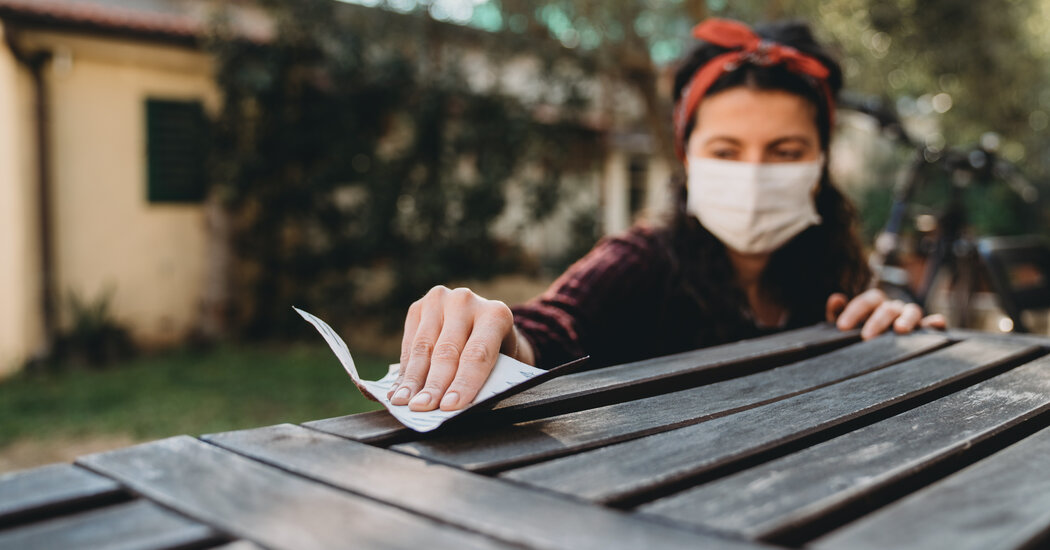
Sprucing up for spring includes giving your lawn furniture the cleaning it deserves.The weather is turning the corner, and that means one thing for certain: It’s patio season. Before you resurrect the outdoor space of your dreams, though, give your patio furniture the spring cleaning it deserves. Here’s how to get your furniture ready.Assess the damageBefore diving in, give your furniture a visual inspection. For wood furniture, you may find that the wood has bowed, cracked or discolored during the cooler seasons. Look for signs of rust on metal furniture, for any cane unraveling on your wicker, and tears or animal damage on fabrics. A visual inspection, said Josh Bateman, owner of Prince Gardening in Pittsburgh, can help to establish a cleaning “game plan.”Remove debrisIn addition to dirt, your furniture may have organic matter in hard-to-reach places. Cobwebs, insects and leaves are likely to accumulate on furniture that has been sitting around unused. Regardless of your furniture’s material, “the first step is to take a soft-bristled brush or cloth and wipe down any dust, dirt, or leaves,” Mr. Bateman said.Dawn Hollier, owner of Sparkleyard Outdoor Maids in Los Angeles, said, “A good bench brush and pretty much any rag you have lying around the house will get you far.” For furniture with more to eliminate, consider a garden hose with a targeted spray nozzle, which will quickly wash away anything too large or sticky for a sponge.Leave the power washer for more durable materials, though: “These can often damage all types of outdoor furniture,” Mr. Bateman said.Small crevices that are dusty and dingy — as well as hard-to-clean spaces between pieces of wicker — will benefit from canned air, which is typically used to clean computer keyboards and is available at most office supply stores. A leaf blower also works for more stubborn debris.Make necessary repairsAfter surveying your furniture, determine what kind of repairs it needs. For small cracks in wooden chairs or tables, use wood putty to fill in gaps, said Jenna Shaughnessy, founder of the home décor and D.I.Y. site JennaKateAtHome.com.“Loose joints can easily be fixed with wood glue,” she said. “If the furniture was previously painted, I like to give it a quick sanding and apply a fresh coat of exterior-grade paint to freshen it up.” Faded plastic furniture, she said, can be brought back to life with spray paint made especially for plastics, like the Krylon Fusion brand.To sand wood furniture, use a 120-grit pad to remove the graying layer, exposing the wood’s original color beneath. Apply stain (or paint) using an old cloth and allow it to dry for one hour, repeating if necessary. Once the stain is fully dry, which could take one to two hours, apply an outdoor sealant to protect against the elements.Loose caning can be a persistent problem with wicker. “If a customer has invested in higher quality woven furniture from a specialty retailer, they can sometimes order additional material that can then be woven into their existing area and secured,” said Brad Schweig, vice president for operations at Sunnyland Outdoor Living in Dallas. Mass-produced wicker and resin items, though, he said, don’t offer parts or materials, so he suggested gluing this type of caning back in place if it comes loose.In metal furniture, scout for rust. “If you spot any, rub it down to bare metal with steel wool and paint to match,” Mr. Bateman said. But don’t forget about swivels, wheels and hinges, Mr. Schweig said. “From time to time, lubrication of all moving parts is recommended to extend the life and minimize squeaks or noises,” he said. He recommends using WD-40 or a “similarly lubricating process” to keep these parts moving smoothly.Deep-clean cushions, frames and fabricsSome outdoor cushions have zippered, removable covers that can be laundered. Remove these protective covers and vacuum, or most can be tossed in the washing machine with a little color-safe bleach and then air-dried. Foam inserts can also be vacuumed and cleaned with a hose before being set out to air dry. For cushions without removable covers, or to clean cushions without removing the foam insert, Ms. Shaughnessy suggests a solution of warm water, one to two tablespoons of liquid dish soap and a quarter cup of Borax.“Thoroughly soak the cushions with a garden hose,” she said, before using a nylon-scrubbing brush to generously apply the solution over the cushions. Allow the solution to sit for 10 to 15 minutes, scrub to loosen stains and spray the cushions with a high-powered garden hose spray nozzle until the water runs clear. Leave the cushions out to air dry, about four to 12 hours, depending on the weather. (Place them on their sides for faster drying.) Fabrics, Ms. Hollier said, benefit from “an ounce of prevention,” too. “Brush off dust weekly to keep molds from developing and staining the fabric,” she said.For cleaning wood, metal and resin frames, Ms. Shaughnessy said to fill a large bucket of warm water with a quarter cup of dish soap. Using a cloth or soft-bristle brush, remove dirt. In stubborn spots where the dirt does not lift easily, allow the soapy water to sit for a few minutes before scrubbing. Rinse off any residual soap with clean water.You can also make a more aggressive cleaning solution, using one cup of bleach, one cup of water and one cup of laundry detergent. (Don’t use this on metal because it can cause discoloration.) For wicker or resin, use a brush with long, soft bristles, as well as an old toothbrush, which will help excavate anything left behind.“I really recommend cleaning wicker furniture at least twice per year to prevent too much mildew, because the tight weaves can make cleaning difficult,” Mr. Bateman said.To clean outdoor umbrellas, Mr. Bateman recommends a solution of a quarter cup of laundry detergent and one gallon of warm water. Remove the umbrella fabric from its frame and spread it out on a clean, flat surface, such as a tarp. Vacuum up loose dirt, soak the umbrella with a hose and then scrub the fabric with the cleaning solution, using a soft-bristled brush or cloth. Let the solution sit for about 20 minutes before rinsing and letting dry in the sun. “Umbrellas are also prone to mildew,” he said. “If this is the case, mix equal parts vinegar and warm water, followed by light scrubbing and a rinse.”Protect from the elementsThe final step in getting your furniture ready for the season is to protect it. Teak can be oiled yearly with tung oil to prevent the gray patina, but oil should be applied after the furniture is fully clean and dry. The patina, Mr. Schweig said, helps protect the wood. If you prefer to maintain the original teak color, he said, clean the teak and apply sealant, which must be stripped off before the next cleaning. Wicker furniture in the sun, Ms. Hollier said, “should be conditioned monthly with a UV protectant.”Dry cushions and covers can be sprayed with a fabric protectant, like Scotchgard’s Water & Sun Shield, or with a UV protectant like Nikwax’s Tent & Gear SolarProof. For metal furniture, add a rust protectant, like Rust-Oleum’s Rust Inhibitor. (That brand also makes a line of sprays that can be applied to rusty metal, making it possible to paint directly over the damage.)For ongoing care, Mr. Bateman recommended bringing outdoor furniture inside when the weather turns “to prevent further distress and fading.” He also said to be vigilant. Addressing rust and mold early on “is crucial to the longevity of patio furniture.”

Read more →

Americans Reflect on How the Pandemic Has Changed Them

In a National desk project, people across the country describe, in their own words, how the pandemic has transformed the way they live, work and think.Times Insider explains who we are and what we do and delivers behind-the-scenes insights into how our journalism comes together.The pandemic has reshaped our reality. To gain a better understanding of this transformation, Elizabeth Dias and Audra D. S. Burch, correspondents for the National desk, recently spoke with people across the country about their own experiences. They posted a callout to readers online, conducted interviews to hear from a range of voices and collected these accounts in the article “Who We Are Now.” Ms. Dias and Ms. Burch shared what they learned in their reporting and how they, themselves, have changed during this time. Read a lightly edited excerpt below.How did this story come about?ELIZABETH DIAS Over the past year, I have been reporting on the crisis of spirit that the pandemic has wrought. People everywhere have had to confront mortality and the deepest questions humans have about life, death and suffering. The editor of the National desk, Jia Lynn Yang, and I talk often about what it all means, and this story grew from one of those conversations into a collaboration with Audra and our photo editor Heather Casey. The theme of transformation is a deeply spiritual one, and we wanted to hear from people who are living differently now and could share those stories with us.How did you work with photography for this story?DIAS It was a collaboration from the very start. Art can give voice to moments in our lives when words fail. The images and words together offer a journey for readers to reflect on their own lives.What were you looking for in your callout to readers?AUDRA D. S. BURCH We tried to frame the questions in a way that would force people to ponder what this year has meant to them, in obvious and not-so-obvious ways. I think even the exercise of responding to the callout was its own journey. Some people were clearly grappling with who they had become in a year’s time and, in coming out of the “darkness,” what they wanted for themselves. I can’t tell you how many people thanked us for exploring what the pandemic has conjured. Probably midway through reading the entries, I remember thinking, in some ways, this really feels like a public service.What did you find most interesting about the responses?DIAS So many people found the process of reflection enormously hard, or even impossible. It revealed to me just how difficult it is to face feelings, much less to change as a result of them, and how little collective language there is to help us talk about these deep issues. Realizing that helped me to think about how this story might help readers through that process.BURCH I think I was most surprised by the bookends, the people willing to reveal their deepest thoughts and experiences on one end of the spectrum and the people who — even though they were participating — were clearly in a kind of private holding pattern and unwilling or unable to process the pandemic’s emotional or spiritual toll.Were there certain themes that you heard again and again?DIAS So many people were wrestling with home, wanting to return to the central core of who they are and where they are from. Over and over, people were re-evaluating their most important relationships, where they want to live, and how they want to be in the world.What changes do you think we will see as a result of this time?DIAS The most honest answer is, I don’t know. I hope we will be able to remember the shared humanity that this year has revealed, and help one another on that journey. But it is also true that the clarity that comes with intense suffering often clouds as time moves on — it is a reason we did this story, to name the transformation visible in this moment.BURCH I think the great challenge is how long we can hang on to the clarity that such an event brought and how long the truths we discovered this year will shape our lives.Was there anything you often thought about in the course of working on this story?BURCH I thought about death. A lot. One of the people I interviewed for the story was Joelle Wright-Terry. She is a Covid survivor. Her husband died of Covid last April. Her story stayed with me. I thought often of what it must feel like to have your family crushed by this virus and the enduring trauma of loss.DIAS I often thought about narratives of apocalypse and awakening in spiritual literature, and how woven they are with suffering. So often, beings had to die to be reborn, like the phoenix, the ancient bird that burst into flames and then rose from the ashes.How have you, personally, changed during this time?DIAS One of the most amazing things in doing all these interviews was hearing echoes of my feelings in the stories of so many other people, with so many different life experiences, from anger to loneliness to newfound strength. It helped me feel less alone, and to take heart.BURCH The process of working on this story offered its own kind of comfort. I also saw myself in so many of the narratives shared, from feeling afraid to feeling helpless to feeling unmoored as we trudged through the pandemic month after month.

Read more →

The Covid-19 Plasma Boom Is Over. What Did We Learn From It?

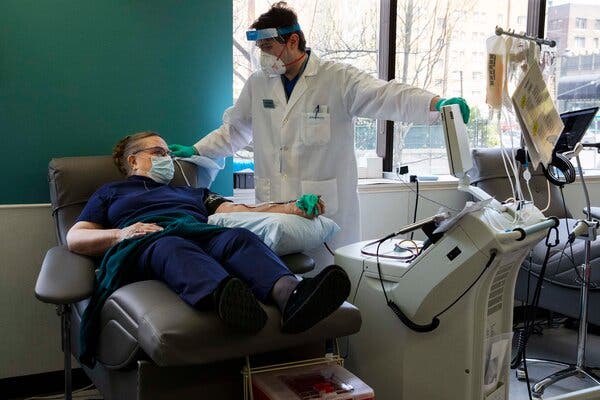
Scott Cohen was on a ventilator struggling for his life with Covid-19 last April when his brothers pleaded with Plainview Hospital on Long Island to infuse him with the blood plasma of a recovered patient.The experimental treatment was hard to get but was gaining attention at a time when doctors had little else. After an online petition drew 18,000 signatures, the hospital gave Mr. Cohen, a retired Nassau County medic, an infusion of the pale yellow stuff that some called “liquid gold.”In those terrifying early months of the pandemic, the idea that antibody-rich plasma could save lives took on a life of its own before there was evidence that it worked. The Trump administration, buoyed by proponents at elite medical institutions, seized on plasma as a good-news story at a time when there weren’t many others. It awarded more than $800 million to entities involved in its collection and administration, and put Dr. Anthony S. Fauci’s face on billboards promoting the treatment.A coalition of companies and nonprofit groups, including the Mayo Clinic, Red Cross and Microsoft, mobilized to urge donations from people who had recovered from Covid-19, enlisting celebrities like Samuel L. Jackson and Dwayne Johnson, the actor known as the Rock. Volunteers, some dressed in superhero capes, showed up to blood banks in droves.Mr. Cohen, who later recovered, was one of them. He went on to donate his own plasma 11 times.But by the end of the year, good evidence for convalescent plasma had not materialized, prompting many prestigious medical centers to quietly abandon it. By February, with cases and hospitalizations dropping, demand dipped below what blood banks had stockpiled. In March, the New York Blood Center called Mr. Cohen to cancel his 12th appointment. It didn’t need any more plasma.Brandon Connor, right, a phlebotomist, discussed the plasma donation process with Sheila Julich, a long-term-care nurse, at Bloodworks in Seattle in April 2020.Ruth Fremson/The New York TimesA year ago, when Americans were dying of Covid at an alarming rate, the federal government made a big bet on plasma. No one knew if the treatment would work, but it seemed biologically plausible and safe, and there wasn’t much else to try. All told, more than 722,000 units of plasma were distributed to hospitals thanks to the federal program, which ends this month.The government’s bet did not result in a blockbuster treatment for Covid-19, or even a decent one. But it did give the country a real-time education in the pitfalls of testing a medical treatment in the middle of an emergency. Medical science is messy and slow. And when a treatment fails, which is often, it can be difficult for its strongest proponents to let it go.Because the government gave plasma to so many patients outside of a controlled clinical trial, it took a long time to measure its effectiveness. Eventually, studies did emerge to suggest that under the right conditions, plasma might help. But enough evidence has now accumulated to show that the country’s broad, costly plasma campaign had little effect, especially in people whose disease was advanced enough to land them in the hospital.In interviews, three federal health officials — Dr. Stephen M. Hahn, the former commissioner of the Food and Drug Administration; Dr. Peter Marks, a top F.D.A. regulator; and Dr. H. Clifford Lane, a clinical director at the National Institutes of Health — acknowledged that the evidence for plasma was limited.“The data are just not that strong, and it makes it makes it hard, I think, to be enthusiastic about seeing it continue to be used,” Dr. Lane said. The N.I.H. recently halted an outpatient trial of plasma because of a lack of benefit.Plasma promotionsDoctors have used the antibodies of recovered patients as treatments for more than a century, for diseases including diphtheria, the 1918 flu and Ebola.So when patients began falling ill with the new coronavirus last year, doctors around the world turned to the old standby.In the United States, two hospitals — Mount Sinai in New York City and Houston Methodist in Texas — administered the first plasma units to Covid-19 patients within hours of each other on March 28.Dr. Nicole M. Bouvier, an infectious-disease doctor who helped set up Mount Sinai’s plasma program, said the hospital had tried the experimental treatment because blood transfusions carry a relatively low risk of harm. With a new virus spreading quickly, and no approved treatments, “nature is a much better manufacturer than we are,” she said.As Mount Sinai prepared to infuse patients with plasma, Diana Berrent, a photographer, was recovering from Covid-19 at her home in Port Washington, N.Y. Friends began sending her Mount Sinai’s call for donors.“I had no idea what plasma was — I haven’t taken a science class since high school,” Ms. Berrent recalled. But as she researched its history in previous disease outbreaks, she became fixated on how she could help.She formed a Facebook group of Covid-19 survivors that grew to more than 160,000 members and eventually became a health advocacy organization, Survivor Corps. She livestreamed her own donation sessions to the Facebook group, which in turn prompted more donations.“People were flying places to go donate plasma to each other,” she said. “It was really a beautiful thing to see.”Diana Berrent was recovering from Covid at home on Long Island when she began hearing about the benefits of plasma. She started a Facebook group and encouraged members to donate, forming her group, Survivor Corps.Desiree Rios for The New York TimesAround the same time, Chaim Lebovits, a shoe wholesaler from Monsey, N.Y., in hard-hit Rockland County, was spreading the word about plasma within his Orthodox Jewish community. Mr. Lebovits called several rabbis he knew, and before long, thousands of Orthodox Jewish people were getting tested for coronavirus antibodies and showing up to donate. Coordinating it all was exhausting.“April,” Mr. Lebovits recalled with a laugh, “was like 20 decades.”Two developments that month further accelerated plasma’s use. With the help of $66 million in federal funding, the F.D.A. tapped the Mayo Clinic to run an expanded access program for hospitals across the country. And the government agreed to cover the administrative costs of collecting plasma, signing deals with the American Red Cross and America’s Blood Centers.The news releases announcing those deals got none of the flashy media attention that the billion-dollar contracts for Covid-19 vaccines did when they arrived later in the summer. And the government did not disclose how much it would be investing.That investment turned out to be significant. According to contract records, the U.S. government has paid $647 million to the American Red Cross and America’s Blood Centers since last April.“The convalescent plasma program was intended to meet an urgent need for a potential therapy early in the pandemic,” a health department spokeswoman said in a statement. “When these contracts began, treatments weren’t available for hospitalized Covid-19 patients.”As spring turned to summer, the Trump administration seized on plasma — as it had with the unproven drug hydroxychloroquine — as a promising solution. In July, the administration announced an $8 million advertising campaign “imploring Americans to donate their plasma and help save lives.” The blitz included promotional radio spots and billboards featuring Dr. Fauci and Dr. Hahn, the F.D.A. commissioner.Dr. Anthony S. Fauci, left, speaking during a roundtable on plasma donation at the American Red Cross headquarters in Washington in July.Doug Mills/The New York TimesA coalition to organize the collection of plasma was beginning to take shape, connecting researchers, federal officials, activists like Ms. Berrent and Mr. Lebovits, and major corporations like Microsoft and Anthem on regular calls that have continued to this day. Nonprofit blood banks and for-profit plasma collection companies also joined the collaboration, named the Fight Is In Us.The group also included the Mitre Corporation, a little-known nonprofit organization that had received a $37 million government grant to promote plasma donation around the country.The participants sometimes had conflicting interests. While the blood banks were collecting plasma to be immediately infused in hospitalized patients, the for-profit companies needed plasma donations to develop their own blood-based treatment for Covid-19. Donations at those companies’ own centers had also dropped off after national lockdowns.“They don’t all exactly get along,” Peter Lee, the corporate vice president of research and incubations at Microsoft, said at a virtual scientific forum in March organized by Scripps Research.Microsoft was recruited to develop a locator tool, embedded on the group’s website, for potential donors. But the company took on a broader role “as a neutral intermediary,” Dr. Lee said.The company also provided access to its advertising agency, which created the look and feel for the Fight Is In Us campaign, which included video testimonials from celebrities.Lack of evidenceIn August, the F.D.A. authorized plasma for emergency use under pressure from President Donald J. Trump, who had chastised federal scientists for moving too slowly.At a news conference, Dr. Hahn, the agency’s commissioner, substantially exaggerated the data, although he later corrected his remarks following criticism from the scientific community.In a recent interview, he said that Mr. Trump’s involvement in the plasma authorization had made the topic polarizing.“Any discussion one could have about the science and medicine behind it didn’t happen, because it became a political issue as opposed to a medical and scientific one,” Dr. Hahn said.The authorization did away with the Mayo Clinic system and opened access to even more hospitals. As Covid-19 cases, hospitalizations and deaths skyrocketed in the fall and winter, use of plasma did, too, according to national usage data provided by the Blood Centers of America. By January of this year, when the United States was averaging more than 130,000 hospitalizations a day, hospitals were administering 25,000 units of plasma per week.Dr. Stephen Hahn, the former F.D.A. commissioner, during a briefing in April 2020.Anna Moneymaker for The New York TimesMany community hospitals serving lower-income patients, with few other options and plasma readily available, embraced the treatment. At the Integris Health system in Oklahoma, giving patients two units of plasma became standard practice between November and January.Dr. David Chansolme, the system’s medical director of infection prevention, acknowledged that studies of plasma had showed it was “more miss than hit,” but he said his hospitals last year lacked the resources of bigger institutions, including access to the antiviral drug remdesivir. Doctors with a flood of patients — many of them Hispanic and from rural communities — were desperate to treat them with anything they could that was safe, Dr. Chansolme said.By the fall, accumulating evidence was showing that plasma was not the miracle that some early boosters had believed it to be. In September, the Infectious Diseases Society of America recommended that plasma not be used in hospitalized patients outside of a clinical trial. (On Wednesday, the society restricted its advice further, saying plasma should not be used at all in hospitalized patients.) In January, a highly anticipated trial in Britain was halted early because there was not strong evidence of a benefit in hospitalized patients.In February, the F.D.A. narrowed the authorization for plasma so that it applied only to people who were early in the course of their disease or who couldn’t make their own antibodies.Dr. Marks, the F.D.A. regulator, said that in retrospect, scientists had been too slow to adapt to those recommendations. They had known from previous disease outbreaks that plasma treatment is likely to work best when given early, and when it contained high levels of antibodies, he said.“Somehow we didn’t really take that as seriously as perhaps we should have,” he said. “If there was a lesson in this, it’s that history actually can teach you something.”Dr. Nicole Bouvier helped set up Mount Sinai’s plasma program, which ended earlier this year. “That’s what science is — it’s a process of abandoning your old hypotheses in favor of a better hypothesis,” she said.Desiree Rios for The New York TimesToday, several medical centers have largely stopped giving plasma to patients. At Rush University Medical Center in Chicago, researchers found that many hospitalized patients were already producing their own antibodies, so plasma treatments would be superfluous. The Cleveland Clinic no longer routinely administers plasma because of a “lack of convincing evidence of efficacy,” according to Dr. Simon Mucha, a critical care physician.And earlier this year, Mount Sinai stopped giving plasma to patients outside of a clinical trial. Dr. Bouvier said that she had tracked the scientific literature and that there had been a “sort of piling on” of studies that showed no benefit.“That’s what science is — it’s a process of abandoning your old hypotheses in favor of a better hypothesis,” she said. Many initially promising drugs fail in clinical trials. “That’s just the way the cookie crumbles.”Plasma’s futureSome scientists are calling on the F.D.A. to rescind plasma’s emergency authorization. Dr. Luciana Borio, the acting chief scientist at the agency under President Barack Obama, said that disregarding the usual scientific standards in an emergency — what she called “pandemic exceptionalism” — had drained valuable time and attention from discovering other treatments.“Pandemic exceptionalism is something we learned from prior emergencies that leads to serious unintended consequences,” she said, referring to the ways countries leaned on inadequate studies during the Ebola outbreak. With plasma, she said, “the agency forgot lessons from past emergencies.”While scant evidence shows that plasma will help curb the pandemic, a dedicated clutch of researchers at prominent medical institutions continue to focus on the narrow circumstances in which it might work.Dr. Arturo Casadevall, an immunologist at Johns Hopkins University, said many of the trials had not succeeded because they tested plasma on very sick patients. “If they’re treated early, the results of the trials are all consistent,” he said.Convalescent plasma donations in La Plata, Argentina, last year.Agustin Marcarian/ReutersA clinical trial in Argentina found that giving plasma early to older people reduced the progression of Covid-19. And an analysis of the Mayo Clinic program found that patients who were given plasma with a high concentration of antibodies fared better than those who did not receive the treatment. Still, in March, the N.I.H. halted a trial of plasma in people who were not yet severely ill with Covid-19 because the agency said it was unlikely to help.With most of the medical community acknowledging plasma’s limited benefit, even the Fight Is In Us has begun to shift its focus. For months, a “clinical research” page about convalescent plasma was dominated by favorable studies and news releases, omitting major articles concluding that plasma showed little benefit.Now, the website has been redesigned to more broadly promote not only plasma, but also testing, vaccines and other treatments like monoclonal antibodies, which are synthesized in a lab and thought to be a more potent version of plasma. Its clinical research page also includes more negative studies about plasma.Nevertheless, the Fight Is In Us is still running Facebook ads, paid for by the federal government, telling Covid-19 survivors that “There’s a hero inside you” and “Keep up the fight.” The ads urge them to donate their plasma, even though most blood banks have stopped collecting it.Two of plasma’s early boosters, Mr. Lebovits and Ms. Berrent, have also turned their attention to monoclonal antibodies. As he had done with plasma last spring, Mr. Lebovits helped increase acceptance of monoclonals in the Orthodox Jewish community, setting up an informational hotline, running ads in Orthodox newspapers, and creating rapid testing sites that doubled as infusion centers. Coordinating with federal officials, Mr. Lebovits has since shared his strategies with leaders in the Hispanic community in El Paso and San Diego.And Ms. Berrent has been working with a division of the insurer UnitedHealth to match the right patients — people with underlying health conditions or who are over 65 — to that treatment.“I’m a believer in plasma for a lot of substantive reasons, but if word came back tomorrow that jelly beans worked better, we’d be promoting jelly beans,” she said. “We are here to save lives.”’

Read more →