Gove apologises after Covid report alleges ‘toxic’ culture
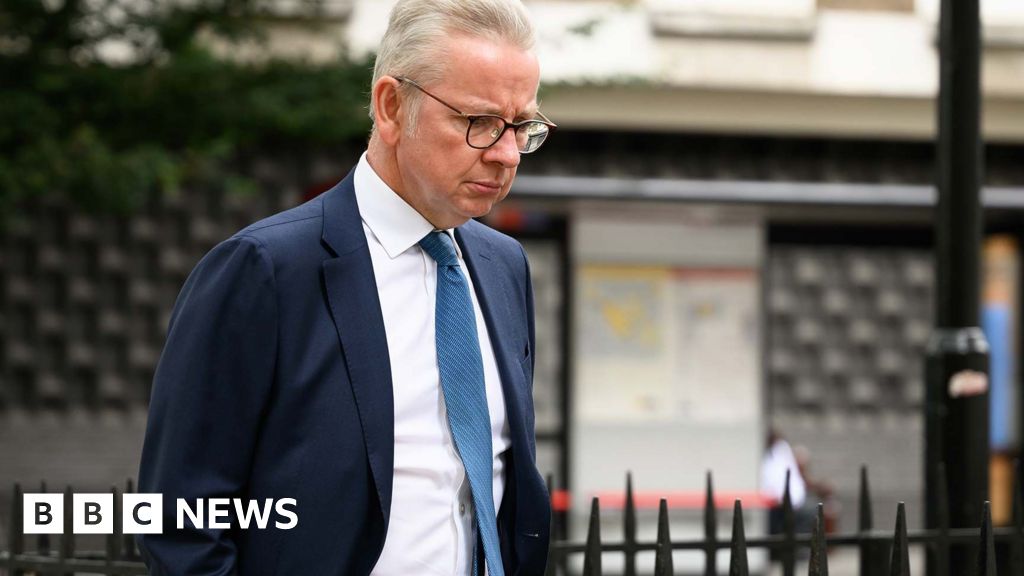
Former cabinet minister Lord Michael Gove has apologised on behalf of the then-government and Conservative Party for “mistakes made” during the coronavirus pandemic.In her long-awaited report published, Baroness Hallett says Boris Johnson, the prime minister at the time, oversaw a “toxic and chaotic” culture in No 10 during Covid.Lord Gove told the BBC’s Today programme some “attitudes” in Downing Street had been “far from ideal” but added that in a crisis “the business of government can’t be carried out in the manner of a Jane Austen novel”. He also said an earlier lockdown would have been “wiser” but questioned the report’s assertion that it would have meant fewer deaths.Responding to the report, Prime Minister Sir Keir Starmer said the government would learn lessons from the report and was already “taking measures to make sure that, not just the NHS but the government as a whole, is prepared for any number of eventualities”.The 800-page inquiry report is highly critical of government decision-making, and says implementing a Covid lockdown a week earlier could have saved 23,000 lives in the first wave in England – although it does not suggest that the overall death toll would have been reduced.It also says lockdowns could have been avoided if the government had introduced restrictions such as social distancing earlier and concludes lockdowns “only became inevitable because of the acts and omissions of the four governments” in England, Northern Ireland, Scotland and Wales. The report describes February 2020 as a “lost month” and says the government’s lack of urgency was “inexcusable”. It says there was a failure to learn lessons from the first Covid wave and that restrictions in autumn 2020 were introduced too slowly. At Christmas of the same year, the inquiry argues the governments failed to take action “until infection levels were critical”.Johnson, who was prime minister between 2019 and 2022 and set up the inquiry, is accused in the report of failing to make decisions quickly enough in autumn 2020 – and of repeatedly changing his mind.He has been contacted for a comment.Lord Gove rejected a suggestion that the conclusions of the Covid report would put an end to any future political ambitions Johnson may have. He said Johnson’s style of decision-making “may not be to everyone’s taste” but added he was “wrestling with an enormously difficult question about the curtailment of liberty and the maintenance of access to healthcare”.”More than that, without his drive we would not have had his vaccine roll-out that ensured we were the first country to put jabs in arms.”Dominic Cummings, a senior aide in Downing Street at the time, is singled out for criticism in the report which suggests he displayed “destabilising behaviour” and contributed to a “culture of fear” that “poisoned the atmosphere”. It also said the loudest voices in government prevailed – and many were ignored “to the detriment of good decision-making”.Cummings, who left No 10 at the end of 2020, accused the inquiry of enabling “a vast rewriting of history”.He said it was “important for the public to realise that on most of the big questions, the ‘experts’ including the senior scientists were completely wrong” in the early months of 2020. Lord Gove said Cummings had been responsible for ensuring data was “accurately and thoroughly interrogated”. He also said the report noted Cummings’ interventions had been “critical to putting in place the measures necessary to suppress the virus”. Asked about the culture in Downing Street, he said: “It’s the case that we were dealing with, as everyone in the world was, an unprecedented crisis… and of course, under pressure with imperfect information, mistakes are made, voices are raised.”Rishi Sunak, who was chancellor during the pandemic, told BBC 5 Live’s Matt Chorley that both the government and scientists had been “operating in a highly uncertain environment”. “I think we do need to view the decisions taken through that lens, but it’s important that lessons are learned so that we can be better prepared if there’s ever another pandemic.”Baroness Hallett also criticised Sir Chris Wormald – he is currently the cabinet secretary, the most senior civil servant in the government, but during the pandemic was the permanent secretary at the health department.She said he had failed to take action to “rectify the overenthusiastic impression” given by then-Health Secretary Matt Hancock about the ability of the department to deal with the pandemic.Asked on Radio 4’s Today programme, if Sir Chris should stay in his job, given the report’s criticism, Science Secretary Liz Kendall said “yes” adding that he was doing “excellent work across government including learning the lessons from this pandemic”.

Read more →
Trans people could be barred from services based on appearance

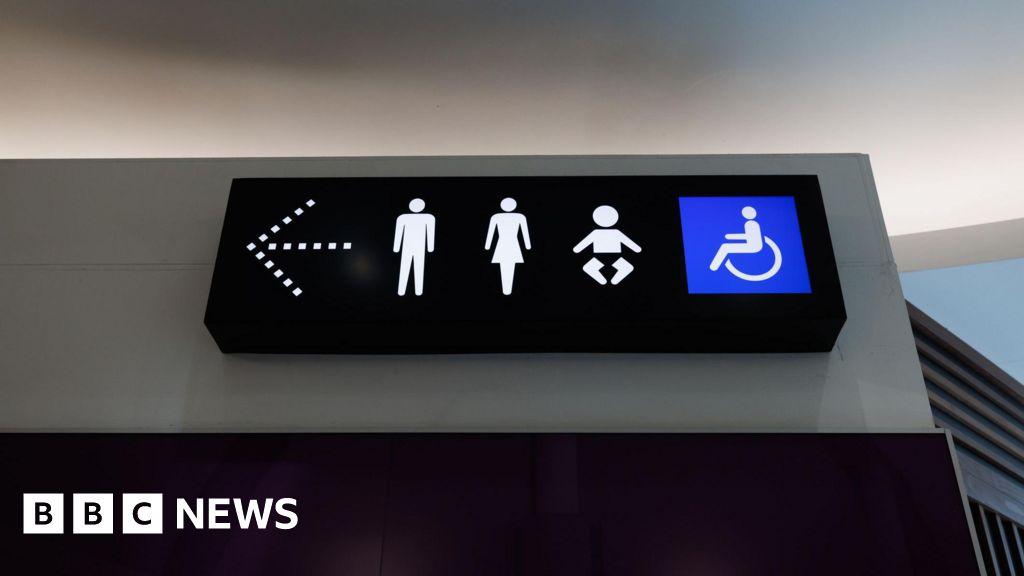
Trans people could be asked about whether they should be accessing single-sex services based on their physical appearance or behaviour, new guidance seen by the BBC has said.A code of practice, produced by the equalities watchdog and awaiting ministerial approval, says it may be legitimate for businesses or services to ask individuals to provide confirmation that they are of the eligible sex “by proportionate means”. It acknowledges that there is “no type of official record or document in the UK which provides reliable evidence of sex” because people can self-identify on documents such as passports.Equalities minister Bridget Phillipson said she’d take the time needed to “get this right”.Phillipson, who received the code nearly three months ago, added that it was important to make sure women had access to single-service provisions such as rape crisis centres while ensuring that trans people are treated with “dignity and respect”.The 300-page document was drawn up by the Equality and Human Rights Commission (EHRC) after the Supreme Court unanimously ruled that legally a woman should be defined by biological sex for the purposes of the Equality Act. The EHRC has to provide practical advice to businesses and services about how this should work. Following the Supreme Court ruling in April, the EHRC guidance says single-sex spaces should only be open to people of the same biological sex, otherwise they cease to be single-sex areas. That would mean, for instance, that a trans woman – a biological male who identifies as a woman – would not be able to use women’s toilets and changing rooms. The guidance says transgender people, who are also protected by equalities law, should be treated with dignity and respect.The updated code of practice is awaiting approval. It can only gain legal force once it has been signed off by ministers and laid in Parliament for 40 days. The guidance, first reported by The Times, says that if there are concerns then decisions about access to spaces may need to be based on how someone looks. It also says that if a transgender person is excluded from a space, the organisation should consider alternatives and that it would not be proportionate to leave the person without essential services, such as toilets. The guidance acknowledges that providing alternatives may not always be possible due to space constraints or cost.Last month, interim guidance was withdrawn and EHRC chair Baroness Falkner urged the government to speed up its approval of the new code, warning that some organisations were operating under old guidance, which had become unlawful in the light of the court’s decision.Conservative shadow women and equalities minister Mims Davies has previously suggested Phillipson had chosen not to sign off the guidance because she did not want to damage her chances in the Labour Party deputy leadership election, which ended last month.A source close to Phillipson described the claim as “utter nonsense”. Approving the guidance could be unpopular in some parts of the Labour Party.During the deputy leadership contest, Lucy Powell, who eventually beat Phillipson to the job, said “I think we have got some of the language not right on this, and particularly around some of the guidance that’s coming forward.”Last month, 32 Labour MPs wrote to the EHRC arguing that the interim guidance it issued in April, would “open the door to discrimination and harassment against trans people”. The interim guidance, which was withdrawn in October, is being challenged in the courts. During the hearing in the High Court, the lawyer, representing the government, suggested the interim guidance may have been too simplistic and that access to spaces such as toilets could be judged on a case-by-case basis.Speaking to Times Radio, education minister Josh MacAllister said the government was working “as fast as we can” but that there was no deadline for reaching a decision. “We want to get it right, and if we don’t get it right it does risk putting this back into the courts and providing even greater uncertainty for people.”Asked if the government was avoiding making a decision in the hope the issue would be forgotten about, he said that would be “really bad politics… because the problem isn’t going to go away”.”These are massive issues… when you drill down into examples of how this might be applied, it has big implications for individuals, it has big implications for businesses and public services,” he said.”The guidance, as it’s written, has implications for both how physical buildings are set up, but also how staff in those settings would need to determine and judge even whether somebody might look like a woman.”And so we want to avoid being in a position where toilets are being policed by people.”

Read more →

Davey urges US cancer scientists to come to UK

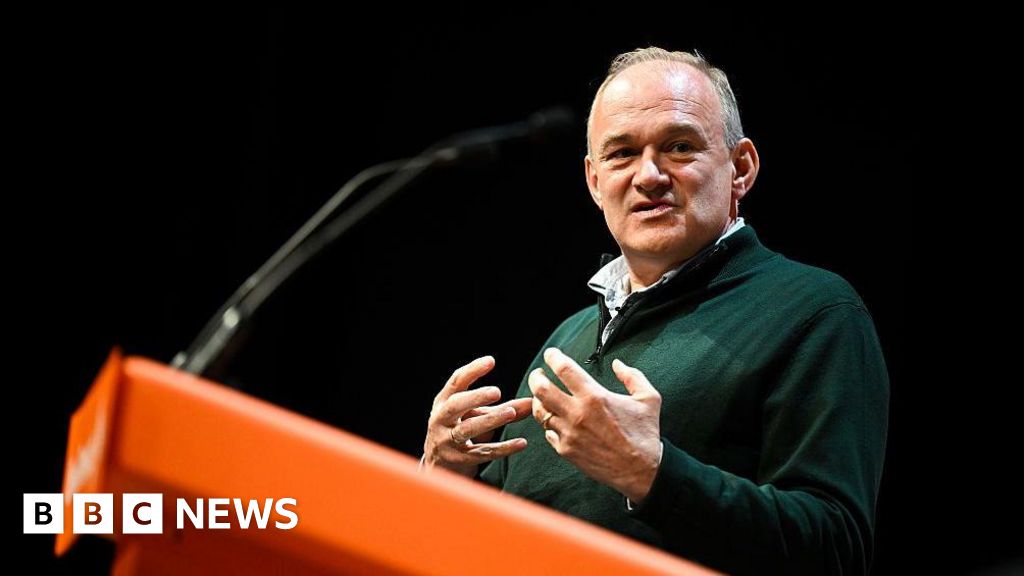
The UK government should offer discount visas to US cancer scientists who have had their research cancelled by the Trump administration, Sir Ed Davey will say.”The UK should step up and say: If Trump won’t back this research, we will,” the Liberal Democrat leader will say in a speech to his party’s conference in Bournemouth on Tuesday.He will propose the setting up of a fellowship scheme for US scientists seeking to escape the US government’s “anti-science agenda”.The Lib Dem leader has stepped up his attacks on the US president this week and accused Reform UK leader Nigel Farage of wanting to turn the UK into “Trump’s America”.His staunch criticism of Farage, President Trump and his allies is expected to be a big theme of Sir Ed’s keynote speech on the final day of his party’s conference.In February, the US government cut billions of dollars from overheads in grants for biomedical research as a part of broader cost-saving measures.The US government said it was “vital to ensure that as many funds as possible go towards direct scientific research costs rather than administrative overheads”. At the time, the boss of the American Society of Clinical Oncology said the move “would be devastating to the pace and progress of cancer research in America”.”Slashing federal research funding at a time when science is revolutionising cancer care risks leaving millions of patients without the promise and potential of life-saving breakthroughs,” said Clifford Hudis. According to a poll conducted by the Nature journal, 75% of its readers were considering leaving the US and heading to Europe or Canada as a result of the actions of Trump.The Liberal Democrats have not set out what level of discounts the UK government should offer to researchers wanting to come to the UK. Costs to purchase a visa can exceed £1,000.In his conference speech, Sir Ed will argue that the UK should be “stepping into the vacuum left by Trump’s anti-science agenda – leading the world in the fight against cancer”.The Liberal Democrat leader is also expected to criticise Reform UK party members for applauding a US decision to cut research for mRNA vaccines. Twenty-two projects had been examining how the vaccine technology could counter viruses such as bird flu. Sir Ed will say: “It is hard to express the cruelty and stupidity of cutting off research into medicine that has the power to save so many lives.”In addition to criticising Trump, Sir Ed has also been increasingly vocal in his attacks on the billionaire and former Trump ally Elon Musk.On Sunday, he called on the UK’s communications regulator Ofcom to “go after” Musk over “crimes” he claims are being committed on the tech mogul’s social media platform X.Sir Ed has also accused Musk of “inciting violence” when he addressed a rally in London via video link. In response, the X owner called the Liberal Democrat leader a “craven coward”.Asked by Sky News if he was worried about legal threats from Musk, Sir Ed said: “If he … sues me, let’s see how he fares, because I don’t think he’ll win.”The Lib Dems have become well known for their political stunts alongside a policy offer focused on social care and other priorities under Sir Ed’s leadership.It brought them success at last year’s general election, with the party winning 72 seats in the House of Commons – its highest ever share.But the Lib Dems have struck a more serious tone at this year’s conference, as the party considers it’s next move ahead of local elections next year.On the opening night of the conference, former Lib Dem leader Tim Farron draped himself in a flag and called on members to “reclaim patriotism” from the far right.Farron told a hall full of activists to “stop being so flaming squeamish and English” and reclaim the UK’s flags from groups who seek to “divide and destroy”.Unusually for the Lib Dems, they have gone out of their way to claim that they are the true patriots, in contrast to Farage, who they have dubbed a “plastic patriot”.In an interview with the BBC, Sir Ed said his party has a moral duty to keep Farage and his Reform UK party out of power.

Read more →

Ex-medical officer close to tears over Covid deaths

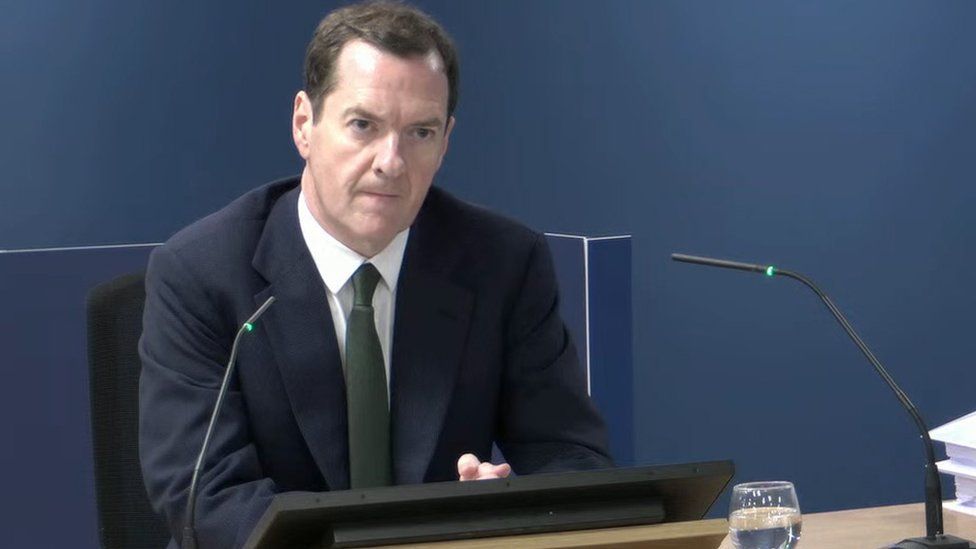
Published20 June 2023Shareclose panelShare pageCopy linkAbout sharingThis video can not be playedTo play this video you need to enable JavaScript in your browser.By Kate WhannelPolitical reporter, BBC NewsEngland’s former chief medical officer Dame Sally Davies was close to tears at the Covid Inquiry as she apologised to families bereaved by the pandemic.”It wasn’t just the deaths, it was the way they died… it was harrowing and it remains horrible,” she said. She also said the UK did not have enough resilience to cope with the pandemic, with fewer doctors, nurses or hospital beds than similar countries.The inquiry is currently examining the UK’s preparedness ahead of Covid.In her evidence, Dame Sally also expressed concern about the impact of the lockdowns on children and students. “We have damaged a generation, and it is awful… watching these people struggle,” she said.The former chief medical officer told the inquiry the UK did not have plans in place to cope with a Covid pandemic, but she added “it didn’t have resilience either”.Compared with similar countries, the UK was at the bottom of the table for numbers of doctors, nurses, beds, IT units and ventilators per 100,000, she said.During questions about preparation exercises for pandemics, Dame Sally broke off to say: “Maybe this is the moment to say how sorry I am to the relatives who lost their families.””I heard a lot about it from my daughter who was on the front line as a doctor in Scotland,” she added. Dame Sally Davies became chief medical officer in 2010 and left in 2019 to be replaced by Sir Chris Whitty. He is due to give evidence on Thursday along with Sir Patrick Vallance, who was the government’s chief scientific adviser during the pandemic. Ex-PM Cameron admits mistake over pandemic planningWhat is the UK Covid inquiry and how long will it take?Covid inquiry criticises government evidence The NHS crisis – decades in the makingAt the same hearing, George Osborne said his spending cuts meant the UK was better able to cope with the pandemic. The former chancellor argued that without austerity Britain would have been “more exposed” and rejected claims his approach left the health and social care “depleted” ahead of the Covid pandemic. Last week Sir Michael Marmot, a professor of epidemiology at University College London told the inquiry that the UK had entered the pandemic with “depleted” public services. Asked by inquiry lawyer Kate Blackwell KC if he agreed with the statement, Mr Osborne said: “Most certainly not, I completely reject that.”He accepted more money could have been spent on the NHS, but said as chancellor he had to balance demands for resources from other public services.”You can’t just say we like public spending to be higher without explaining where you get money from,” he told the inquiry.He said the public had elected the Conservatives to government in 2010 and 2015 knowing the party was planning to cut public spending. During the period, cuts were introduced in welfare spending, school building programs, local government, police, courts and prisons. There was also an overall squeeze on health spending. Mr Osborne – who was chancellor from 2010 to 2016 – said: “If we had not done that Britain would have been more exposed, not just to future things like the coronavirus pandemic, but indeed to the fiscal crisis which very rapidly followed in countries across Europe.”If we had not had a clear plan to put the public finances on a sustainable path then Britain might have experienced a fiscal crisis, we would not have had the fiscal space to deal with the coronavirus pandemic when it hit.” The British Medical Association said Mr Osborne’s “denial” of a connection between austerity and the impact of the pandemic on the most vulnerable was “staggering”. On Monday, the Trades Union Congress (TUC) produced a report,

Read more →